
A4988 5-Pack with Heat Sinks
5.0Editor score
Simple STEP/DIR control
Five microstepping resolutions
Adjustable current potentiometer
Included thermal management
Discover the best Stepper Motor Driver for 3D Printer options, comparing noise, current handling, compatibility, microstepping, protection, and ease of setup.
A stepper motor driver translates commands from a 3D printer controller into precisely controlled movement for each axis. A capable driver can improve motion smoothness, reduce mechanical noise, protect delicate electronics, and support finer positioning. The right choice depends on your board, motor ratings, power supply, and desired level of tuning.
This guide compares ten popular stepper motor driver modules using their published ratings, current capacity, voltage range, microstepping support, operating modes, protection features, and printer compatibility. The list includes established A4988, DRV8825, TMC2208, and TMC2209 options, with entries selected for straightforward builds, quiet operation, sensorless homing, and flexible configuration.
Each pick highlights a different practical advantage, from simple STEP/DIR control to UART tuning and advanced current management. Ratings reflect the supplied customer feedback and should be considered alongside motor compatibility and firmware support. Product availability, configurations, and prices can change, so verify the current listing and board requirements before purchasing.
5.0Editor score

4.7Editor score

4.6Editor score
The comparison below places the ten modules side by side, emphasizing control methods, current handling, microstepping, and printer compatibility. It is designed to help builders identify the appropriate driver for a basic replacement, a quiet retrofit, or a fully featured controller upgrade.

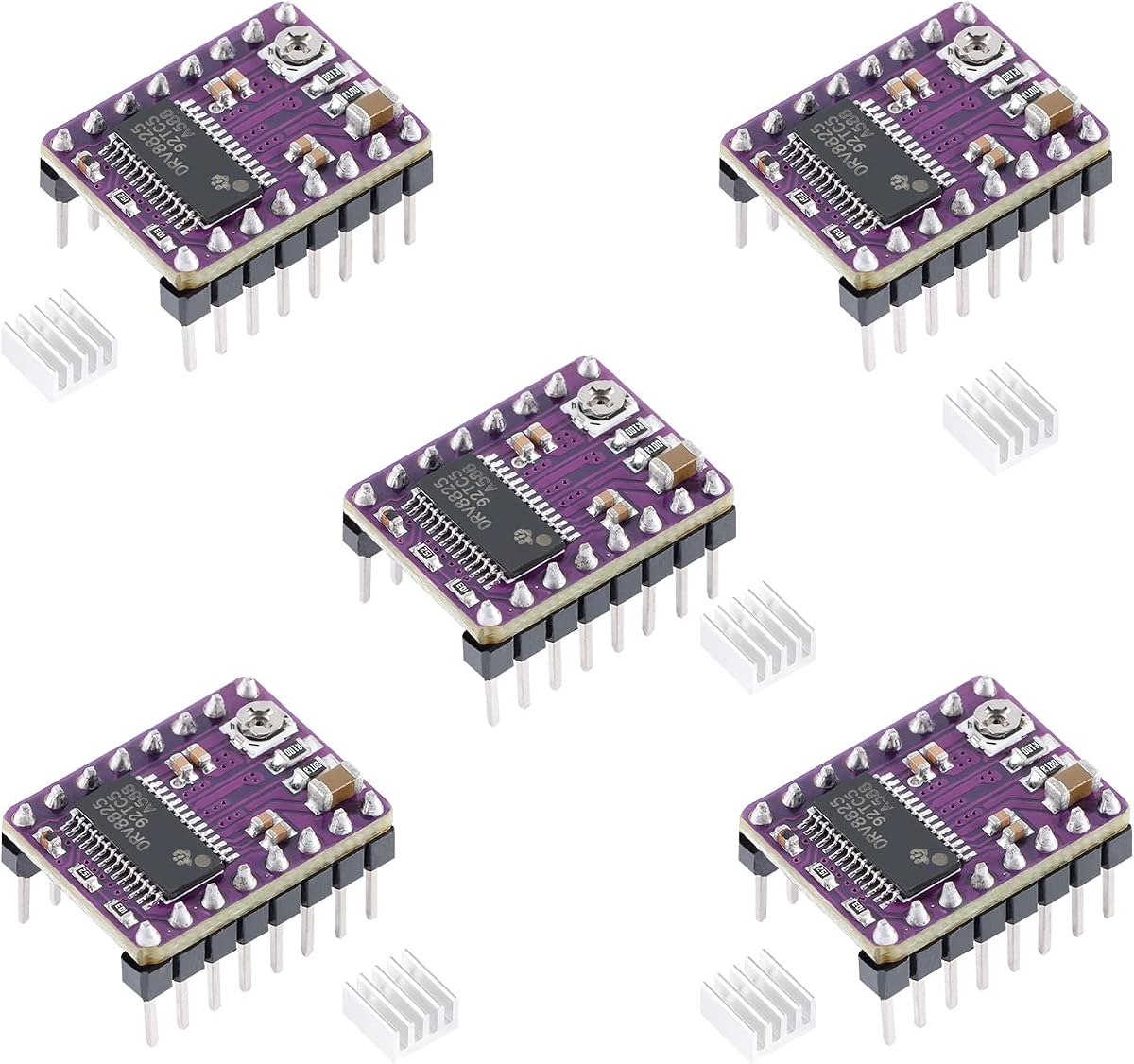


The HiLetgo A4988 5-Pack is a straightforward driver choice for common 3D-printer electronics, and its supplied rating of 4.4 reflects generally favorable customer feedback. It uses the familiar step-and-direction interface, so it suits builders who want to replace or populate a board without introducing more complicated configuration requirements.
We may earn a commission when you buy through this link, at no additional cost to you.
Its strongest features are accessible rather than exotic. The modules support full-step through sixteenth-step operation, allowing the builder to trade speed and smoothness through the printer's microstepping setting. An onboard potentiometer adjusts maximum current, while the driver supports motor power supplies up to 35 volts and a stated output capacity of plus or minus 1.2 amperes.
Thermal and electrical safeguards add practical value. The listed protection features include over-temperature shutdown, under-voltage lockout, and crossover-current protection. Intelligent chopping automatically chooses between fast and slow current decay, although the A4988 is still likely to produce more audible movement than the StealthChop2-based TMC alternatives in this list.
This set is most appropriate for a budget repair, an older RAMPS-style build, or any printer using a compatible A4988 footprint. The five-module format can cover several axes and spares. It is less appealing when silent operation, sensorless homing, or firmware-level current tuning are priorities, but for uncomplicated control it remains an easy recommendation.
The step-and-direction interface keeps configuration familiar to most printer builders. Current adjustment through the onboard potentiometer also makes these modules practical for a first driver upgrade or a replacement repair.
Over-temperature shutdown, under-voltage lockout, and crossover-current protection help reduce the consequences of common electrical faults. Proper heat-sink contact and conservative current settings remain essential.
We may earn a commission when you buy through this link, at no additional cost to you.
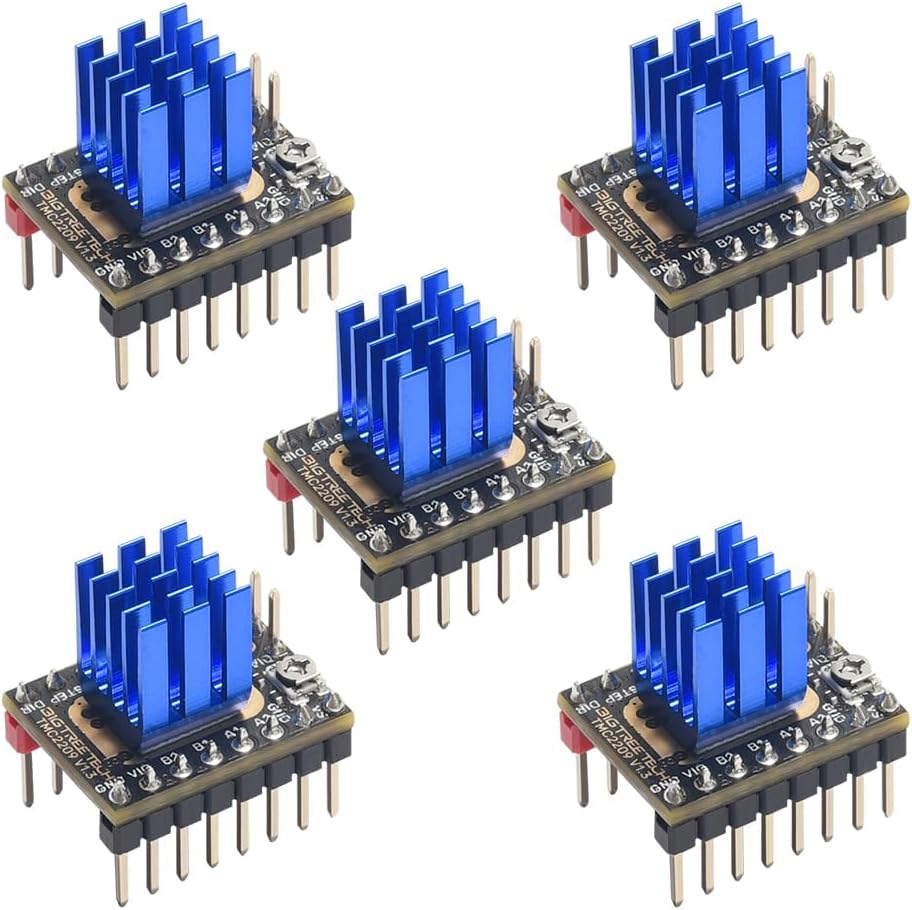
The BIGTREETECH TMC2209 V1.3 4-Pack combines one of the strongest customer ratings in the group with features suited to modern 3D printers. StealthChop2 is the headline advantage, reducing stepper noise while retaining a continuous current capability stated at up to 2.0 amperes and a peak of 2.8 amperes.
We may earn a commission when you buy through this link, at no additional cost to you.
These modules support both UART and STEP/DIR operation. STEP/DIR offers a familiar path into a quiet build, while UART unlocks more detailed current, current-limit, and microstepping control when the printer board and firmware support it. CoolStep dynamic current control is also listed as reducing energy use by as much as 75 percent under the conditions described by the manufacturer.
The trade-off is configuration complexity. UART use can require firmware modification, and Stallguard4 sensorless homing needs an appropriate threshold to distinguish a stopped motor from normal operation. Those features are valuable for experienced builders, but they are less convenient than the plug-in simplicity of an A4988 module.
For printers using compatible BIGTREETECH, MKS, or other listed controller families, this is an excellent all-around upgrade. The 4.7 rating supports its strong overall showing, while the combination of quiet operation, flexible modes, current management, and sensorless homing makes it the most versatile recommendation in this guide.
StealthChop2 provides a major acoustic improvement over conventional chopper drivers. UART mode allows users to refine current behavior where their controller and firmware expose the necessary settings.
Stallguard4 monitors motor-current changes to identify a locked rotor. This can support endstop-free homing, although reliable results depend on correct tuning and consistent motor load.
We may earn a commission when you buy through this link, at no additional cost to you.
The DRV8825 5-Pack is aimed at builders seeking more voltage and current headroom than a standard A4988 provides. Its supplied rating of 4.2 indicates solid but somewhat more mixed customer feedback, which makes careful motor and heat-sink matching particularly important.
We may earn a commission when you buy through this link, at no additional cost to you.
The stated maximum output capability reaches 45 volts and plus or minus 2.5 amperes, while microstepping extends through thirty-second-step operation. A four-layer PCB and lower internal chip resistance are presented as heat-management improvements, and the module is approximately the same size as an A4988, helping it fit common stepstick layouts.
Those higher ratings are not permission to set every motor to the maximum. Actual current must remain within both the motor's rating and the board's thermal capability. The included heat sinks help dissipate waste heat, while airflow and correct adjustment are still required in a tightly enclosed printer.
The DRV8825 is well suited to CNC, robotics, automation, and 3D-printer projects that need more current capability or finer microstepping than an A4988. It may also suit builders without a dedicated quiet driver. Its primary drawback is acoustic: TMC modules are generally the more appropriate choice when near-silent movement is the main goal.
The higher stated current ceiling provides more room for motors that require substantial holding torque. The value should still be treated as a device specification, not a target to apply automatically.
Thirty-two microstep modes can improve positioning smoothness at lower movement speeds. The benefit is most noticeable in slow moves, where full-step operation would otherwise produce more noticeable stepping.
We may earn a commission when you buy through this link, at no additional cost to you.
This BIGTREETECH TMC2209 V1.3 module combines a 4.7 customer rating with sophisticated control for builders who want quiet, finely resolved motor movement. It supports bipolar stepper motors from one to 256 microsteps and uses StealthChop2 for the low-noise operation associated with the TMC2209 family.
We may earn a commission when you buy through this link, at no additional cost to you.
The module accepts STEP/DIR and UART signals, with firmware modification needed when choosing UART. Its flexible microPlyer interpolation can maintain smoother sinusoidal control even where the available pulse frequency is limited. Stallguard4 adds a route to sensorless homing by watching for the current changes associated with a locked motor.
Compatibility is broad across several named 3D-printer motherboard families, and the manufacturer states that the module can replace TMC2100, A4988, DRV8825, and LV8729-style drivers in suitable setups. This makes it a logical upgrade for an existing board, but physical header arrangement, voltage, and firmware support must still be confirmed.
This single-module option is best for a targeted repair or an incremental upgrade of one axis. Builders replacing every driver can choose a multi-module bundle, while a user who needs only one extra position may prefer this listing. The 4.7 rating and advanced feature set make it one of the strongest individual picks here.
Combining StealthChop2 with up to 256 microsteps supports smooth, restrained movement. This is especially attractive for printers where acoustic noise during fine positioning is disruptive.
STEP/DIR provides a straightforward starting point, while UART permits deeper configuration on supported firmware. Builders should review the controller documentation before changing communication modes.
We may earn a commission when you buy through this link, at no additional cost to you.
The DORHEA TMC2208 5-Pack is a quiet-driver option for 3D-printer boards that need substantial microstepping but operate within the TMC2208's current capability. Its supplied rating is 4.5, placing it among the well-regarded choices in this comparison.
We may earn a commission when you buy through this link, at no additional cost to you.
TMC2208 supports two-phase bipolar motors with continuous current up to 1.4 amperes and peak current of 2 amperes. The stated voltage range reaches 36 volts, and flexible microPlyer interpolation provides up to 256 subdivisions. StealthChop2 is used to reduce audible motor noise, making this a meaningful upgrade over a basic A4988.
The listing is particularly useful for builders working with RAMPS 1.4, MKS, Prusa i3, and Ender-3 Pro-style electronics. Stackable headers support placement directly on compatible controller boards, and the adapter can test or flash a SilentStepStick through a USB-to-serial converter. That standalone testing function is useful but requires more setup than ordinary plug-in wiring.
Compared with the TMC2209, the TMC2208 offers a wider stated voltage ceiling but less continuous current. It is best when the printer's motors are rated below 1.4 amperes or the existing board favors the TMC2208 form factor. For quiet operation, fine interpolation, and a complete multi-module package, it is a convincing choice.
StealthChop2 reduces the characteristic noise of a conventional stepper driver. The result can make a familiar printer feel more refined without redesigning its motion system.
The included adapter can test a SilentStepStick or flash one using a USB-to-serial converter. Its preconfigured standalone operation and stackable headers support both bench testing and board installation.
We may earn a commission when you buy through this link, at no additional cost to you.
The 5-Pack A4988 Stepper Motor Driver Module with Heat Sink is a conventional, approachable choice for DIY printers, CNC upgrades, and automation projects. Its 4.5 rating suggests a favorable balance of usefulness and customer satisfaction.
We may earn a commission when you buy through this link, at no additional cost to you.
Its main strength is the uncomplicated control interface. The modules accept step and direction signals and provide full-step through sixteenth-step settings. A potentiometer adjusts maximum current, and the listed drive capacity reaches plus or minus 1.2 amperes with motor supplies up to 35 volts.
The module also includes intelligent chopping that selects fast or slow current decay automatically. Protection features include thermal shutdown, under-voltage lockout, and crossover-current protection, while the supplied aluminum heat sinks assist with temperature control. These safeguards make the package a functional general-purpose driver rather than a bare minimum design.
Compatibility is broad across RAMPS and numerous common printer platforms, and the included documentation is intended to assist with setup and troubleshooting. It is a strong choice for a repair kit or a first stepper-driver build, though users prioritizing silence should look toward a TMC2208 or TMC2209 instead.
The onboard potentiometer allows maximum current to be matched to the motor rather than relying on a fixed factory setting. Measured motor ratings and conservative thermal limits should guide the adjustment.
Compatibility with popular boards and established printer platforms makes this useful for repairs, complete builds, and spare modules. The physical layout should still be checked before installation.
We may earn a commission when you buy through this link, at no additional cost to you.
The A4988 High-Current 5-Pack stands out with a supplied 5.0 rating and a configuration that emphasizes the essentials of dependable stepper control. It is a sensible entry-level or replacement option for a printer that does not require the advanced configuration offered by TMC modules.
We may earn a commission when you buy through this link, at no additional cost to you.
The package includes five A4988 modules, pins, and five matching heat sinks. Each module provides a step-and-direction interface, a 35-volt maximum motor supply, and a stated drive capability of plus or minus 1.2 amperes. A maximum current of 2 amperes is mentioned when the included heat sink is used, although safe motor operation should always remain governed by the motor's own rating.
Five microstep resolutions are available, from full-step to sixteenth-step, and the onboard potentiometer provides direct current adjustment. Intelligent chopping chooses the decay mode automatically, while over-temperature shutdown, under-voltage lockout, and crossover-current protection add useful safeguards.
This product is a particularly attractive choice for a new build using common boards, a multi-axis repair, or a collection of inexpensive spare modules. It is less suitable for a user whose central goal is near-silent movement or sensorless homing. Even so, the perfect supplied rating, matched accessories, and uncomplicated setup make it a compelling budget recommendation.
Five boards and five heat sinks provide the parts needed for a multi-axis installation or a small collection of spares. Matching the modules simplifies inventory and replacement planning.
Thermal shutdown, under-voltage lockout, and crossover-current protection support safer operation. Automatic decay selection and adjustable current make routine setup manageable.
We may earn a commission when you buy through this link, at no additional cost to you.
The BIGTREETECH TMC2209 V1.3 6-Pack is the most complete premium bundle in this guide, providing six driver modules and heat sinks for a multi-axis upgrade or a full spare set. Its 4.6 rating reflects strong customer approval for quiet operation and broad compatibility.
We may earn a commission when you buy through this link, at no additional cost to you.
StealthChop2 uses a high-precision chopping algorithm to reduce motor noise while preserving useful torque during printing. Flexible microPlyer interpolation supports up to 256 subdivisions, allowing smooth operation even with limited pulse frequency. The listed electrical figures include continuous current up to 2.0 amperes, peaks of 2.8 amperes, and a 4.75-to-28-volt operating range.
The module uses a low-resistance output design intended to reduce power dissipation, while Spreadcycle provides precise cycle-by-cycle current control for dynamic movement. It can replace several common driver families in suitable installations, reducing the need to redesign an existing printer's electronics. The principal requirement is matching the controller, headers, voltage, and firmware.
This bundle is ideal for a printer builder who wants a consistent set of quiet drivers across multiple axes or for a TMC2209 user who wants immediate spares. Smaller printers may not need six modules, and UART use still involves configuration. For a ready-to-install, low-noise multi-axis solution, however, it is the strongest premium choice.
Six matched modules make it possible to upgrade every driven axis consistently. The included heat sinks support thermal management on the 2.0-ampere continuous-current-rated design.
Spreadcycle supports cycle-by-cycle current regulation, while the low-resistance output stage helps limit dissipation. Correct current settings remain necessary to extract the intended performance safely.
We may earn a commission when you buy through this link, at no additional cost to you.
The BIGTREETECH TMC2209 V1.3 UART/DIR/Step module offers a strong set of operating features and a supplied rating of 4.2. It is particularly relevant to builders who want both quiet operation and access to firmware-level motor configuration.
We may earn a commission when you buy through this link, at no additional cost to you.
StealthChop2 supplies the low-noise chopping behavior, while up to 256 microsteps support highly resolved positioning. The module can operate in UART or STEP/DIR mode, although the chosen mode must be reflected in firmware. Its continuous current is stated at 2 amperes, with peaks of 2.8 amperes across a 4.75-to-28-volt range.
CoolStep dynamically controls current and is listed as saving 75 percent energy in applicable conditions. This can reduce heat and cooling requirements. Stallguard4 can also support sensorless homing by detecting changes in motor current when an axis is obstructed or unable to move.
Compatibility extends across several listed BIGTREETECH, SKR, Manta, and MKS board families, and the driver can replace several common types where the installation permits. The lower customer rating does not eliminate its technical strengths, but it makes careful review of compatibility and configuration especially worthwhile. It is best for an informed builder seeking quiet, tunable motion.
UART mode exposes more detailed control over current and related behavior. Firmware must support the appropriate driver configuration, so users should verify this before purchasing for a specific board.
CoolStep adjusts current dynamically according to operating conditions. The claimed energy reduction can ease thermal management, although actual savings vary with the motion profile.
We may earn a commission when you buy through this link, at no additional cost to you.
The TMC2208 V1.2 2-Pack is a compact way to add quiet motion to selected axes. Its 4.5 rating indicates positive customer reception, and the package is aimed at builders working with Reprap, MKS, Prusa i3, and Ender-3 Pro-style controller boards.
We may earn a commission when you buy through this link, at no additional cost to you.
The TMC2208 drives two-phase bipolar stepper motors with continuous current up to 1.4 amperes and peak current of 2 amperes. It supports a 4.75-to-36-volt supply range and uses flexible microPlyer interpolation for up to 256 subdivisions. StealthChop2 handles the low-noise chopping behavior that distinguishes this module from conventional drivers.
Stackable headers allow direct installation on compatible boards, while the adapter can test or flash a SilentStepStick with a USB-to-serial converter. The tester is preconfigured for standalone operation with the VIO-VM jumper closed. This adds useful flexibility for bench work, though it is unnecessary for a simple direct replacement.
With only two modules, the set works well for upgrading one axis or pairing with another matching driver, rather than replacing an entire multi-axis board. The 1.4-ampere continuous rating also requires the builder to confirm motor requirements. Within those limits, it is a practical and quiet choice with a broad stated voltage range.
A two-module package works well when the main concern is one particularly noisy axis. It can also serve as a bench-tested spare pair for compatible printers.
The supplied adapter supports standalone testing and firmware flashing through a USB-to-serial converter. This makes it easier to validate a SilentStepStick before placing it into a printer.
We may earn a commission when you buy through this link, at no additional cost to you.
A good driver must fit the printer electrically, physically, and logically. Current ratings, voltage, interface method, microstepping, thermal demands, and firmware support should be considered together before choosing a module.
The driver must supply the current required by each motor without exceeding either the motor's rating or the driver's safe operating limit. A4988 modules offer a stated continuous capacity of plus or minus 1.2 amperes, DRV8825 modules list up to plus or minus 2.5 amperes, and the TMC2209 family states continuous current up to 2.0 amperes. These figures are not interchangeable targets, and peak-current claims should not be treated as continuous settings. The builder should identify the motor's rated phase current, confirm the controller's current-adjustment method, and begin with a conservative setting before testing heat and motion.
Choose a driver with enough continuous-current headroom for the motor while staying within the thermal limits of the board. Current capability alone does not guarantee quiet or reliable operation.
The motor supply voltage must remain within the driver's supported range and suit the motor's design. The A4988 choices support supplies up to 35 volts, the DRV8825 is listed up to 45 volts, the TMC2208 modules extend to 36 volts, and the TMC2209 modules use a 4.75-to-28-volt range. Higher voltage can improve acceleration and high-speed torque, but it can also increase heat and stress components if the motor is not rated for it. Confirm the printer's existing supply, board distribution, wiring, and motor voltage before replacing a driver.
Match both the voltage and current ratings of the replacement to the printer. A wider specification range offers flexibility, but it does not justify exceeding the motor's own limits.
Physical pin placement, driver footprint, and communication signals all matter. A4988 and DRV8825 modules generally use a simple STEP/DIR arrangement, while TMC2208 and TMC2209 boards may expose UART in addition to STEP/DIR. UART enables deeper configuration but often requires compatible firmware and board support. The product listings name numerous RAMPS, BIGTREETECH, MKS, Prusa, Ender, and related platforms, but those references do not guarantee that every board revision or firmware combination behaves identically.
Check the controller's documentation and the module's jumper settings before installation. Compatibility should be confirmed by model, revision, and firmware rather than inferred from the printer family alone.
Noise is one of the most visible differences between driver families. StealthChop2 in the TMC2208 and TMC2209 products is designed for quieter movement, while conventional A4988 and DRV8825 operation is generally more audible. Microstepping also affects smoothness: A4988 modules provide up to sixteenth-step operation, DRV8825 extends to thirty-second-step, and the TMC options advertise up to 256 subdivisions with interpolation. Quiet operation depends on the motor, mechanics, current settings, speed, and printer enclosure as well as the driver.
Prioritize a TMC2208 or TMC2209 when acoustics are central. For ordinary builds, microstepping and correct current adjustment may deliver a better overall result than chasing the highest subdivision figure.
More microsteps divide one full motor step into smaller commanded movements, which can smooth low-speed positioning and reduce visible stepping artifacts. The exact improvement depends on the printer's mechanics, firmware, speed, and available step pulses. The TMC2208 and TMC2209 modules support interpolation that can create smoother motion even when the pulse frequency is limited, while the DRV8825 provides a broader conventional selection. An A4988 remains effective for many printers because axis resolution, belts, leadscrews, and extrusion control are usually the larger practical constraints.
Choose higher microstepping for fine positioning and quieter movement. Do not assume that a larger number alone guarantees a visibly better print.
Stepper drivers dissipate heat, and heat-sink contact matters even when a module includes a small accessory. The A4988 listings include thermal shutdown, under-voltage lockout, and crossover-current protection. The DRV8825 uses a four-layer board and is described as having lower chip resistance and improved heat dissipation, while the TMC2209 products use CoolStep to reduce energy use and heat. None of these features removes the need for a correctly sized heat sink, appropriate airflow, conservative current settings, and regular inspection.
Treat protection circuits as safeguards rather than permission to operate at maximum limits. Verify that the heat sink is attached, the surrounding air can circulate, and the selected current matches the motor.
The TMC2209 products support Stallguard4, which monitors motor-current changes to detect a locked motor. Properly tuned, this behavior can support homing without a physical endstop on an axis. Successful deployment depends on consistent motors, reliable acceleration settings, controlled current, and a threshold that distinguishes normal movement from a stall. A false trigger can stop a homing sequence too early, while a threshold that is too high may not detect the obstruction. UART access is especially helpful because it allows the relevant values to be refined in firmware.
Use sensorless homing when the board and firmware support it and the printer's mechanics are stable. Keep physical endstops available when dependable positioning takes priority over reducing hardware.
Bundle size should match the actual repair or build. Five-module A4988 and DRV8825 sets and six-module TMC2209 bundles can cover several axes plus spares, while two-module TMC2208 packs are useful for selective upgrades. A multi-module purchase is helpful for keeping drivers consistent, but it is unnecessary for a printer with only one failed position. Consider whether the package includes heat sinks, pins, stackable headers, or a testing adapter, since these accessories can determine how much additional assembly is required.
Match the quantity to the number of driven axes and desired spare coverage. For mixed-axis upgrades, verify that every module matches the printer's electrical and firmware requirements.
Before installation, disconnect the printer's power and identify the driver socket, step and direction pins, motor supply connections, and any configuration jumpers. Compare the replacement module with the existing driver, confirm the voltage and current ratings, and consult the board documentation. Modules must be installed with their exposed components positioned for effective heat-sink and airflow clearance rather than pressed against solid obstructions.
Set the current conservatively, attach the specified heat sink, and check the board's jumper configuration for STEP/DIR or UART operation. UART drivers require compatible firmware and appropriate configuration values. After restoring power, verify that the motor turns in the expected direction and that the printer can perform a controlled move before attempting a full print. If movement is irregular, stop immediately and check wiring, current settings, and motor compatibility.
During routine care, keep the driver area free of dust, loose wire strands, and obstructed airflow. Check that the heat sink remains attached and monitor the driver and motor during long or high-acceleration prints. If a module becomes unusually hot, smells burnt, or causes repeated step loss, disconnect power and investigate current settings, wiring, cooling, and motor load. Firmware updates and driver setting changes should follow the controller manufacturer's current instructions.
A TMC2209 is usually better when quiet operation, fine microstepping, and configurable current control are priorities. An A4988 remains simpler and often easier for first-time builders because it uses the standard STEP/DIR interface. The best replacement also depends on board layout, firmware, motor current, and whether UART configuration is supported.
Often yes, because the DRV8825 module is described as the same size as an A4988 and is commonly used in similar stepstick layouts. You should still verify the board's pinout, voltage limits, jumper settings, and microstepping configuration. Do not assume the higher current rating means the motor or board can safely tolerate the maximum setting.
Use the motor's rated phase current as the upper reference, then select a setting at or below the driver's continuous capability and the board's thermal limits. Correct motor identification, a small heat sink, and airflow are essential. Some current-limit configurations also account for driver resistance or a configured scaling factor, so the manufacturer's instructions should take priority.
Yes, the listed TMC2209 V1.3 modules support both UART and STEP/DIR operation. In STEP/DIR mode, the printer controls the basic step and direction signals, while UART provides additional configuration access. If the board exposes UART and the firmware supports it, deeper tuning is possible, but simple operation does not require it.
Sensorless homing uses Stallguard4 to identify changes in motor current when an axis stalls at the end of its travel. The printer can use that signal to determine a home position without a physical endstop. Reliable use requires careful threshold tuning, consistent motors, and suitable acceleration settings because false stalls or missed stalls are possible.
Excess heat usually points to a current setting that is too high for the motor, a driver or board running beyond its thermal limits, poor heat-sink contact, or inadequate airflow. Verify the motor's rating, review the driver's current-adjustment procedure, and confirm that the heat sink is attached. Disconnect power if the module becomes excessively hot or shows visible damage.
No. Higher microstepping can improve low-speed smoothness, but it does not automatically increase the printer's real positioning resolution or improve every axis. Extruder calibration, mechanics, firmware, belt tension, leadscrews, and motion speed often have a greater effect. A sensible microstep setting combined with appropriate current and acceleration is more valuable than choosing the largest number alone.
Most Cartesian-style 3D printers use four modules because they have X, Y, Z, and extruder axes. Delta printers often use three modules for the three motors, while a CoreXY or other multi-motor arrangement may need more. Dual extruders and accessories can also increase the count, so check the controller's actual motor outputs rather than relying only on the printer style.
The BIGTREETECH TMC2209 V1.3 4-Pack is the strongest all-around recommendation because it combines quiet StealthChop2 operation, UART and STEP/DIR modes, Stallguard4 support, and a favorable 4.7 rating. The A4988 High-Current 5-Pack is the best straightforward entry option, while the six-module TMC2209 bundle is ideal for a complete quiet multi-axis upgrade.
Prioritize electrical compatibility before any advanced feature. Confirm the board footprint, supply voltage, motor current, interface, and firmware support, then choose the level of quietness and tuning that fits the build. A simpler A4988 can be entirely appropriate for a conventional printer, while TMC2208 and TMC2209 modules suit users who value reduced noise, interpolation, and more advanced control.
Product configurations, firmware compatibility, and prices can change, so check the current listing and recent customer feedback before ordering. Also review the included documentation and the printer controller's instructions to confirm jumpers, current settings, and heat management for the exact installation.