
85 lb White Cover Cardstock
4.8Editor score
230 gsm matte stock
Thirty full Letter sheets
Double-sided smooth finish
Heavy cardstock for printers gives documents, invitations, menus, and craft projects a more substantial, professional feel than ordinary printing paper. The right sheet should feed reliably, hold crisp color and text, resist curling, and withstand folding or scoring. Printer compatibility, paper weight, brightness, finish, and sheet count all influence the result.
We compared ten white cardstock options ranging from medium-heavy index weights to extra-thick cover stock. The evaluation considers the stated paper weight, thickness, size, surface, brightness, sheet count, recommended uses, and information about inkjet, laser, copier, and craft-machine compatibility. This guide also distinguishes index cardstock from cover cardstock, which use different weight systems.
Each review reveals the strongest use case and practical trade-offs of its featured product, helping readers match the paper to a printer, project, or stock level. The top picks represent different priorities, including dependable overall performance, printer-friendly value, and premium heft. Product details and prices can change, so confirm the latest listing and printer specifications before ordering.
4.8Editor score

4.4Editor score

4.7Editor score
As an Amazon Associate we earn from qualifying purchases.
The comparison below places all ten options side by side, focusing on paper weight, thickness, brightness, finish, sheet count, and the projects for which each stock is best suited. Because index and cover weights are not directly interchangeable, the stated classification matters as much as the pound number.



This 110 lb index cardstock is a practical all-rounder for people who want a substantial sheet that remains relatively close to a familiar office-paper format. It carries a 4.4 rating, and its defining specifications are 199 gsm thickness, 100 sheets, and standard 8.5-by-11-inch sizing. That combination makes it especially relevant for letter-size printing, professional documents, business cards, invitations, and art projects.
We may earn a commission when you buy through this link, at no additional cost to you.
Its principal advantage is the breadth of stated printer support. The listing says the paper is engineered for both laser and inkjet printers, with an emphasis on clean feeding and sharp results. It is also described as acid-free, which adds long-term value for certificates, resumes, menus, and other records that may be retained. A hundred-sheet count provides more material for repeat office or classroom use than the smaller packs in this guide.
The trade-off is that 110 lb index is still serious weight for a home printer, particularly one without a manual or rear feed. A heavy-paper setting can improve the result, but the machine must also be able to accept the thickness. It is also worth distinguishing this 110 lb index product from cardstock labeled 110 lb cover: the pound figure may sound identical, while the basis of the weight classification and resulting physical feel can differ.
This is the strongest choice for a buyer who needs substantial Letter-size paper, a generous sheet count, and broad compatibility across laser and inkjet devices. It suits offices, schools, invitation projects, and anyone who prefers index weight over extra-thick cover stock. Test a sheet in the target printer, select the appropriate media setting, and print one at a time when necessary.
The stated support for both laser and inkjet printers makes this cardstock less dependent on a particular machine type. Using a Heavy Paper or Cardstock setting can help the printer control ink and feeding, while manual or rear feeding may be preferable for the thickest jobs.
The 100-sheet package is meaningful for school, office, and event work where frequent printing is expected. Acid-free construction also makes the stock more appropriate for keepsake documents than ordinary short-term printer paper.
We may earn a commission when you buy through this link, at no additional cost to you.
This 85 lb cover cardstock combines a 4.8 rating with a true heavy-stock feel, making it a compelling budget-oriented selection. At 230 gsm and 8.5 by 11 inches, it provides a substantial Letter-size surface for invitations, scrapbooking, drawings, cards, posters, packaging, and general craft work. The 30-sheet package is smaller than some competing reams, which helps make it approachable for occasional projects.
We may earn a commission when you buy through this link, at no additional cost to you.
The double-sided matte finish is one of its most useful features. It gives pens, markers, pencils, and crayons a smooth writing surface, while the paper is also described as accepting ink well and producing rich color and sharp images. Its stated compatibility with multifunction printers and photocopiers is valuable, although the manufacturer appropriately advises checking the printer manual before feeding 85 lb cover paper.
Compared with extra-thick 110 or 130 lb cover stock, this option should be easier to introduce to a wider range of printers and craft devices. It is still thick enough to feel premium in handmade cards, brochure covers, menus, and photo mats. The primary limitation is quantity: serious classroom, office, or event use may consume 30 sheets quickly, while the heavier grade can also challenge a printer’s manual-feed system.
Choose this cardstock when you want a strong matte surface and professional appearance without moving into the most demanding cover weights. It is particularly good for card making, hand lettering, classroom projects, and short runs of printed invitations. Confirm media support, test one sheet, and feed it individually for the cleanest result.
The smooth double-sided finish supports both printed output and dry media such as pens, pencils, and crayons. That versatility makes it easy to combine a printed layout with handwritten notes, borders, or illustrations.
At 85 lb cover weight, the paper offers noticeable body while remaining a more approachable step up than extra-heavy stock. It works well for card bases, bookmarks, brochure covers, menus, and other projects that benefit from a substantial surface.
We may earn a commission when you buy through this link, at no additional cost to you.
Astrobrights Bright White Cardstock is the most printer-flexible selection in this roundup. It has a 4.8 rating and is guaranteed for inkjet, laser, copier, and offset use, reducing the risk of choosing a sheet that a common office device cannot handle. Its 65 lb weight and 75-sheet count make it a practical middle ground between standard office paper and cover stock.
We may earn a commission when you buy through this link, at no additional cost to you.
The smooth finish is designed to support superior printing results, while the acid-free and lignin-free composition helps preserve printed materials over time. These qualities make the paper suitable for schoolwork, office documents, invitations, craft bases, and internal presentations. It also offers a cleaner and less demanding printing experience than the 80, 85, 110, and 130 lb options in the list.
This product does not deliver the rigid body of true heavy cover stock. It is better suited to projects needing improved opacity and a more professional feel than ordinary copy paper, rather than structural pieces, elaborate layering, or premium presentation folders. A 75-sheet pack may also be modest for large school or office runs, but it is a manageable size for many household and small-business jobs.
The Astrobrights option is ideal when broad device compatibility matters more than maximum thickness. It is a sensible choice for everyday printer use, quick creative projects, and users who want dependable feeding without moving to a demanding cover grade. Choose it for printable cards, reports, and multipurpose office materials that call for a heavier, smoother sheet.
The stated inkjet, laser, copier, and offset guarantee is unusually broad for cardstock. That makes the product a practical choice for households, classrooms, and offices that use a mix of equipment rather than a single dedicated printer.
A smooth surface and bright white base support crisp text, graphics, and color output. Acid-free and lignin-free construction also adds value for projects intended to be displayed, stored, or shared over time.
We may earn a commission when you buy through this link, at no additional cost to you.
This Mzj.Office product has the highest rating in the guide at 4.9 and stands apart as true extra-heavy cover stock. It is specified at 110 lb cover and 300 gsm, with 25 bright-white, smooth-matte Letter sheets. That is a considerably thicker material than index cardstock and is intended for cards, invitations, menus, inserts, tags, and other projects needing real structural body.
We may earn a commission when you buy through this link, at no additional cost to you.
The listing is unusually explicit about the distinction between cover and index weights. It states that this paper is 110 lb Cover rather than 110 lb Index and repeatedly advises checking printer media support before use. For compatible equipment, it recommends a Heavy Paper or Cardstock setting and feeding one sheet at a time through a manual or rear feed when available. Testing one sheet first is the most sensible approach.
The smooth, non-glare surface should suit text, artwork, menus, and refined card designs, while its body makes it possible to cut, score, and layer. Those physical characteristics can reduce the need for reinforcement in premium handmade projects. The limitations are equally clear: a 25-sheet pack is small, and many ordinary home printers will struggle with 300 gsm paper even if their software offers a cardstock option.
This cardstock is best for crafters and print professionals who specifically want extra-heavy cover paper and have compatible equipment. It is less appropriate for routine documents or high-volume printing. Confirm the printer’s maximum supported weight, use a manual feed if needed, and score before folding to protect the paper’s crisp appearance.
The 300 gsm body gives cards, menus, tags, and layered pieces a firm, high-end appearance. It is particularly useful when structural rigidity matters more than feed flexibility or a very large sheet count.
Using a Heavy Paper setting, testing one sheet, and choosing manual or rear feed can reduce jams and improve registration. The result depends on matching this 110 lb cover stock with a printer designed to handle that thickness.
We may earn a commission when you buy through this link, at no additional cost to you.
Cranium Press offers a well-rounded 80 lb option with a 4.8 rating, a smooth bright-white finish, and 50 full-size sheets. The paper is marketed for invitations, menus, business cards, stationery, art projects, and professional home, school, or office printing. Its stated ink holdout and minimal show-through make it particularly interesting for layouts with dense color or important text.
We may earn a commission when you buy through this link, at no additional cost to you.
The product listing presents some inconsistent thickness information: the title references 216 gsm, while the descriptive bullets identify the cardstock as 80 lb and 176 gsm. Because buyers should not have to infer which specification is accurate, the safer recommendation is to rely on the current product page and manufacturer specifications for the exact physical stock. In either case, it is presented as 80 lb cardstock rather than an extra-heavy cover grade.
Beyond printing, the paper is described as strong enough for die-cutting, scoring, and folding, with FSC certification and paper derived from sustainable sources. That makes it a sensible choice for card makers who value both a clean print surface and production versatility. Its weight may still exceed the comfortable capacity of an entry-level inkjet printer, so a test print and the correct paper setting remain important.
This cardstock is best for polished invitations, stationery, business-card layouts, and craft projects that must move from printer to cutting and folding tools. It offers a strong balance of brightness, rigidity, and usability. Verify the gsm detail on the current listing, test a single sheet, and choose this option when professional presentation matters more than maximum heaviness.
The stated ink holdout is valuable when a project contains large color fields, dark ink, or tightly packed text. A smooth, bright-white base can also give photographs and illustrations a crisp visual foundation.
Scoring, folding, and die-cutting support make the sheet more useful in a full production workflow. Buyers making cards or stationery can print a layout, then finish the piece without moving to a separate structural material.
We may earn a commission when you buy through this link, at no additional cost to you.
Manilaus 80 lb cardstock combines a 4.8 rating with a detailed set of printing and crafting claims, making it one of the strongest balanced options here. The 30 sheets measure 8.5 by 11 inches and are specified as 80 lb, 235 gsm cardstock with a smooth, bright surface. It is intended for professional printing, crafts, business materials, cards, and event projects.
We may earn a commission when you buy through this link, at no additional cost to you.
The listing emphasizes its ability to handle detailed graphics and text without smudging, along with a surface that resists bleed-through. These qualities make it useful for invitations, greeting cards, formal printed pieces, and artwork where clarity matters. The 80 lb class offers noticeable body while remaining less demanding than the 110 and 130 lb cover options, making it a plausible starting point for many modern printers.
Its versatility extends beyond printing. The cardstock is described as suitable for layering, folding, and embossing, giving it a useful role in handmade projects and business applications. As with any heavy paper, however, the exact printer and feed path will affect the experience. A 30-sheet pack is best for focused projects rather than a busy office, and the statement that it fits a printer perfectly should still be understood as a standard Letter-size fit rather than a guarantee of weight support.
Choose this product for users who want a highly rated, versatile heavy cardstock without stepping into the compatibility demands of extra-thick cover stock. It is well suited to card making, invitations, business printing, and layered crafts. Select the appropriate Heavy Paper setting, test one sheet, and use careful handling to preserve the smooth finish.
The product is specifically positioned for detailed graphics and text, with a surface intended to limit smudging and bleed-through. These features make it useful for formal invitations, polished graphics, and projects with a significant amount of ink.
Printing is only part of the workflow because the cardstock can also be layered, folded, and embossed. That versatility makes the 80 lb weight a practical middle tier for craftspeople who want one material across several finishing techniques.
We may earn a commission when you buy through this link, at no additional cost to you.
Neenah Exact Index is a heavyweight index cardstock built for professional, high-volume needs. It has a 4.6 rating and includes 250 white, 8.5-by-11-inch sheets with 94 brightness and a smooth finish. A major advantage is its stated compliance with the USPS 7-point minimum for business reply cards, making it particularly relevant to direct-mail and customer-response projects.
We may earn a commission when you buy through this link, at no additional cost to you.
The paper is described as compatible with inkjet and laser printers for jam-free everyday printing. That statement matters because 110 lb index is heavy while remaining lighter than 80 lb cover stock. The result is a useful professional balance: more substantial and durable than ordinary 65 lb cardstock, but generally less rigid than heavier cover paper. It is intended for letterheads, brochures, documents, menus, and other formal printed materials.
Long-term document quality is another strength. The stock is lignin-free and acid-free, helping resist deterioration and yellowing, while FSC certification reflects the listed responsible-forestry commitment. The main caveat is that any 110 lb sheet can be demanding on a home machine, and the professional compatibility claim is not a substitute for checking the model’s maximum media weight.
Neenah Exact Index is a strong choice for offices, mailers, schools, and anyone producing a substantial number of formal documents. Its 250-sheet quantity is useful for repeat workflows, and the 94-bright white surface supports a crisp professional appearance. Use the proper media setting, feed carefully, and test a sheet before a long run.
Meeting the stated USPS 7-point minimum gives the product a clear advantage for business reply cards and similar direct-mail work. The heavier sheet can present a more substantial appearance than standard correspondence paper.
The 250-sheet pack and 94 brightness support offices that need more than a short craft pack. Acid-free, lignin-free construction and FSC certification also make the stock appropriate for long-lived professional materials.
We may earn a commission when you buy through this link, at no additional cost to you.
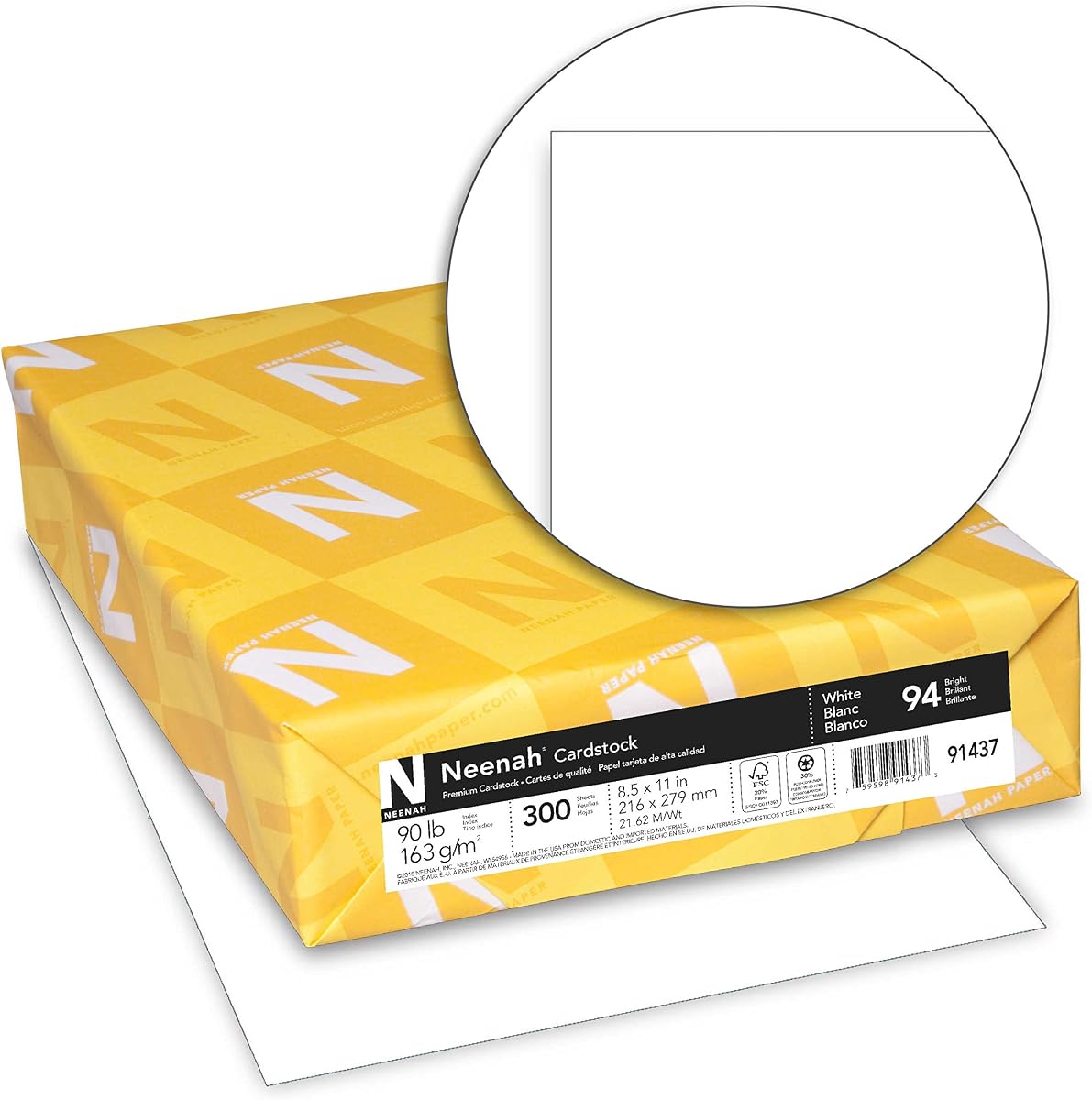
Neenah 90 lb Index cardstock offers the largest sheet count in the guide, with 300 Letter-size sheets in each pack. Its 4.6 rating reflects a well-regarded middle-heavy option that prioritizes daily usability, recognizable brand consistency, and professional document quality. At 163 gsm with 94 brightness, it is designed to create crisp images and attention-getting printed materials.
We may earn a commission when you buy through this link, at no additional cost to you.
The listing carefully explains that index and cover cardstock are measured differently. It describes this as heavier than 67 lb Bristol but lighter than 65 lb cover stock, which is why comparing pound numbers alone can be misleading. This product occupies a useful middle of the index range: sturdy enough for documents, flyers, brochures, and craft projects, but not as rigid as a heavy cover sheet.
Stated compatibility with inkjet and laser printers makes it suitable for a broad mix of home and office equipment. It is also lignin-free and acid-free for lasting results. The smooth texture and bright white color can give text, photos, and graphics added visual impact, while the 300-sheet count is especially attractive for schools, offices, and event organizers.
Choose Neenah 90 lb Index when you need a large supply of moderately heavy paper for frequent printing. It is less suitable than cover stock for rigid presentation pieces, but better suited to high-volume documents and multipurpose professional work. Confirm the printer’s media range, select a heavier paper setting when available, and avoid using a standard copy-paper mode for important jobs.
With 300 sheets, this pack reduces the need for constant replenishment in offices, classrooms, and event workflows. It is a practical selection for users who value a dependable stock of moderately heavy paper over a small craft-oriented bundle.
The 90 lb index classification falls between common Bristol and cover weight in the brand’s own comparison. Recognizing that distinction helps buyers select paper by feel and use rather than relying only on the number printed on the package.
We may earn a commission when you buy through this link, at no additional cost to you.
PrintWorks Vellum Bristol combines a 4.8 rating with a large 250-sheet pack and broad everyday usefulness. Its 67 lb, 147 gsm construction offers more substance than ordinary copy paper without entering the demanding cover-stock range. The 8.5-by-11-inch sheets have 92 brightness and a uniform, semi-smooth matte surface designed to produce crisp text and vibrant color.
We may earn a commission when you buy through this link, at no additional cost to you.
The paper is stated to work with inkjet and laser printers, copiers, and die-cutting machines. That cross-category compatibility is valuable for schools, offices, and home crafters who may use different equipment for printing and finishing. It can be used for cards, invitations, crafts, presentations, brochures, and flyers, giving it a broader role than paper intended only for home printing.
The semi-smooth texture offers a subtle compromise between a completely matte surface and a more polished finish. Buyers who prefer a strictly smooth, non-glare stock may want to handle a sheet before ordering a large quantity. As the lightest option in this roundup, it also does not provide the body of 80, 85, 110, or 130 lb cardstock, though it remains a clear step above basic printer paper.
PrintWorks is a strong choice for high-volume school, craft, and office use where versatile printer support matters. It is also suitable for users who want a durable-looking sheet without managing extra-thick media. The acid-free, lignin-free construction and SFI certification support its longevity and sourcing credentials, while 250 sheets offer convenient bulk for routine projects.
Compatibility with printers, copiers, and die-cutting machines lets the paper move through several parts of a project workflow. The 250-sheet count is especially useful for school assignments, office collateral, invitations, and repeat craft production.
The uniform semi-smooth surface is designed to balance crisp output with a subdued matte appearance. It can work well for presentations and brochures where a polished but non-glare result is desired.
We may earn a commission when you buy through this link, at no additional cost to you.
Weyew 130 lb cover cardstock is the premium choice for buyers who want maximum structural presence. It carries a 4.7 rating and consists of 50 smooth white, 8.5-by-11-inch sheets made from 350 gsm cover stock. This is a substantially heavier option than standard cardstock, intended for report covers, menus, business cards, greeting cards, brochure covers, table cards, and premium crafts.
We may earn a commission when you buy through this link, at no additional cost to you.
The product information cites dependable performance, true color reproduction, superior image quality, and excellent opacity. Those qualities can benefit projects where a dark image, dense typography, or a rigid physical presentation is central to the design. It is also suitable for calligraphy, embossing, and stamping, giving premium paper a role beyond conventional printing.
Compatibility is the central trade-off. The manufacturer specifically tells buyers to check printer compatibility for heavyweight options and calls 110, 130, and 148 lb choices super thick. The smooth finish and strong body may be excellent in a capable printer, yet an ordinary home inkjet may not feed the paper reliably. Scoring before folding is also advisable, and delicate components should be tested before committing to a larger project.
This is the best selection for high-end card making, menu design, presentation covers, embossing, stamping, and other work where substantial weight creates a noticeable difference. Its box packing adds protection during delivery, which is useful for rigid sheets. Use a compatible machine, a Heavy Paper or Cardstock setting, and careful manual feeding for the cleanest outcome.
At 350 gsm, the cardstock provides a rigid, substantial result that can elevate invitations, menus, and presentation pieces. Excellent opacity and smooth color reproduction are especially valuable for graphics and richly colored designs.
The cardstock is explicitly suited to embossing, stamping, calligraphy, brochure covers, and greeting cards. These uses justify its extra weight for buyers who want the paper to function as both a printed surface and a substantial craft material.
We may earn a commission when you buy through this link, at no additional cost to you.
Choosing heavy cardstock for a printer involves balancing thickness, device limits, finish, brightness, and intended use. The most useful purchase is not always the heaviest option; it is the sheet that provides the required structure while remaining compatible with the available printer and finishing process.
Index and cover cardstock may both use labels such as 65, 80, 90, or 110 lb, but those numbers are not directly comparable. Index weight generally reflects a thinner, more printer-friendly sheet, while cover weight describes a heavier, more rigid material. Neenah’s 90 lb Index is explicitly described as heavier than 67 lb Bristol but lighter than 65 lb cover stock, illustrating why the classification should be considered alongside the pound number.
Choose index stock for documents, menus, letterheads, and professional printing where substance is needed without the rigidity of cover paper. Choose cover stock for card bases, menus, invitations, report covers, and layered crafts. In short: check the stated classification first, then compare gsm and the manufacturer’s physical description.
Every printer has a supported media range, and cardstock can exceed it even when the sheet fits physically. Entry-level inkjet models are generally most comfortable with lighter cardstock, while laser printers with dedicated heavy-media trays may handle thicker sheets. Manual and rear feeds can improve control, but the paper must still fall within the machine’s stated weight and thickness limits.
Start with the manufacturer’s manual, locate the supported cardstock range, and use a Heavy Paper or Cardstock setting when available. Test one sheet before printing a large job. If the paper jams, curls, or feeds inconsistently, move to a lighter grade rather than repeatedly forcing the sheet through the mechanism.
Grams per square meter provides a more internationally consistent indication of thickness than pound weight alone. The selections here range from 147 gsm for PrintWorks Vellum Bristol to 350 gsm for Weyew 130 lb cover stock. The Astrobrights 65 lb product is positioned as a versatile middle option, while the 199, 230, 235, 300, and 350 gsm options provide progressively more rigid surfaces.
Choose the lowest gsm that still meets the structural requirements of your project. This improves printer compatibility and handling while controlling waste. Use a light or medium grade for printed pages, a medium-heavy grade for invitations and cards, and extra-heavy cover stock for rigid presentation pieces and premium crafts.
Smooth, matte, and semi-smooth finishes influence how the paper looks and how ink behaves. Smooth cardstock supports detailed graphics and a polished appearance, while matte surfaces reduce glare and can suit documents viewed under bright lighting. Semi-smooth Bristol falls between those extremes, offering a clean appearance without an entirely flat matte texture.
Consider the viewing environment and medium used on the sheet. Matte or semi-smooth stock is practical for presentations and office prints, while smooth stock often complements photography, branding, invitation design, and card making. Dry pens, markers, crayons, and specialty inks may also behave differently depending on tooth, so a test sheet is useful for handwritten work.
Brightness affects the contrast of black text and the clarity of images, while a bright-white shade gives projects a clean appearance. The Neenah options lead this group with 94 brightness, and PrintWorks offers 92 brightness. Several other products describe themselves as bright white without providing a numerical brightness measurement.
For formal documents, menus, and high-contrast line art, a stated brightness level can make comparisons easier. For crafts and layouts with large color fields, the undertone of the white may matter more; very bright white can look stark beside warmer papers. Always evaluate brightness together with finish because the same stock can appear different under office, daylight, and studio lighting.
Sheet counts range from 25 for the Mzj.Office 300 gsm product to 300 for Neenah 90 lb Index. A 25-sheet pack may be ideal for a handful of premium card bases, while a 300-sheet pack suits an office or classroom. Review the project before choosing so that a high rating or attractive finish does not obscure a quantity that is too small for the job.
Estimate actual output, including extra sheets for test printing and mistakes. Crafters should add a cutting and scoring allowance, while offices should think about regular replenishment. The Astrobrights 75-sheet pack, Manilaus 30-sheet pack, and PrintWorks 250-sheet pack offer different balances for occasional, focused, and frequent work.
Cardstock that is ideal for a flat printed sheet can crease poorly if it is folded without preparation. Heavier stocks benefit from scoring, and users of the Mzj.Office product are specifically advised to score before folding. Vein-cut scoring tools create a controlled hinge that helps the paper bend without visibly cracking the matte or smooth surface.
Match the stock to the finishing method. Light cardstock works for simple folds, while 110 to 130 lb cover paper is better for scored boxes, elaborate cards, menus, embossing, and stamping. Embossing also needs sufficient body to create a raised effect, but the pressure and plate settings must be tested to avoid damage.
Acid-free and lignin-free paper is preferable for documents that need to resist yellowing and deterioration. The Astrobrights, Neenah Exact Index, Neenah 90 lb Index, and PrintWorks products make these claims. Certification can add another layer of confidence: Neenah Exact Index is FSC certified, Cranium Press is FSC certified, and PrintWorks is SFI certified.
These attributes are most important for archives, certificates, menus, formal correspondence, and keepsake cards. They are less critical for disposable classroom projects, although they do not prevent a buyer from choosing the best grade for handling and printing. Consider durability alongside weight rather than treating it as a substitute for technical performance.
Begin by checking the printer manual for its supported media range. Select a Heavy Paper, Cardstock, or equivalent setting, clean the rollers if the manufacturer recommends it, and load one sheet at a time when using a manual or rear feed. Test a simple page containing both text and an image before printing the complete project, because extra-heavy stock may require adjustments to speed or quality.
Store unused sheets flat in a dry location and keep the original packaging or a protective box for premium rigid stock. Avoid leaving loose sheets exposed to humidity, sunlight, dust, or pets. When handling by hand, hold the edges rather than the center to reduce oils and fingerprints, and place finished pieces on a clean flat surface to prevent curling or transfer.
For folding, score the sheet first with a suitable scoring tool and test the score on a spare piece. Let ink dry fully before stacking, trimming, or applying adhesive, since heavy stock can trap moisture and slow absorption. Use sharp craft blades or proper paper cutters for clean edges, and store finished cards flat or upright in a rigid organizer so their surfaces remain smooth.
The best choice depends on the printer’s supported media range and the project. A 65 or 67 lb option is usually the safest starting point for many home inkjet printers, while 80 to 90 lb cardstock can suit newer models with a Heavy Paper setting. Extra-heavy 110 and 130 lb cover stock should only be used after confirming that the printer can handle it. Always test a single sheet before a full print run.
Not necessarily. Index and cover cardstock use different measurement systems, so identical pound labels do not represent identical thickness. In the examples provided, Neenah 90 lb Index is described as lighter than 65 lb cover stock, while a 110 lb index option remains lighter than 80 lb cover stock. Look at the classification, gsm, and stated thickness rather than comparing pound numbers alone.
It can if the printer does not support that weight or if the paper is fed incorrectly. Check the manufacturer’s media specifications, select a Heavy Paper or Cardstock setting, and use a manual or rear feed if available. Print one test sheet at a time and reduce the number of sheets in the tray. If the paper still curls, stalls, or jams, choose a lighter grade.
Many heavy cardstocks support both technologies, but support depends on weight, thickness, and the specific model. Products in this guide include several with stated inkjet and laser compatibility, while others recommend checking the printer manual before use. A printer’s ability to accept Letter-size paper does not guarantee that it can feed 300 or 350 gsm cardstock.
Matte stock is usually easier to read under bright light and can provide a polished, non-glare appearance, while glossy stock can make color images look more vivid but may create reflections. The options here are primarily smooth matte or semi-smooth. Choose based on the viewing environment, artwork, and the amount of glare that would be acceptable in the final use.
Score the sheet before folding, especially when it is 110 lb or heavier. A scoring tool creates a controlled hinge and reduces the chance of a cracked or uneven fold. Always test a spare sheet because scoring pressure and spacing vary by material. For boxes, elaborate cards, and other structural projects, use a bone folder or compatible tool to sharpen the crease after scoring.
An 80 lb cardstock usually feels noticeably more substantial than standard printer paper and is a common middle weight for invitations, menus, cards, and crafts. Some listings pair 80 lb with different gsm figures, so the precise feel can vary. That difference is another reason to review the current specifications and request a sample when appearance is critical.
Both labels use 110 lb, but they belong to different weight systems. Index cardstock is generally thinner and more flexible, making it more practical for documents and business printing. Cover cardstock has greater body and rigidity, making it better for premium card bases, menus, report covers, and layered crafts. Always check whether the listing specifies Index or Cover.
The strongest general choice is the 110 lb index cardstock with 100 sheets because it combines substantial weight, a generous quantity, and stated support for both laser and inkjet printers. The 85 lb white cover cardstock is a compelling budget pick for a heavier, smooth matte surface, while the Astrobrights 65 lb option serves buyers who prioritize broad device compatibility and manageable everyday printing.
Prioritize the project first and the printer second. Use medium cardstock for frequent documents, invitations, and general crafts; choose 80 or 85 lb cover stock for a sturdier card or presentation; and reserve 110 to 130 lb options for premium work on compatible equipment. White brightness, finish, archival qualities, pack size, and scoring needs can then refine the decision within that weight range.
Product details and prices can change, so check the current listing before purchasing and verify the manufacturer’s printer compatibility guidance. Test one sheet, select the correct paper setting, and confirm that the sheet size matches the job. With those checks in place, heavy cardstock can produce crisp, durable results that ordinary printer paper cannot deliver.