
Cable Matters Infrared Remote Extender Cable
4.3Editor score
Single-device IR extension
Six-foot integrated cable
USB wall charger power
Our IR Repeater Kit guide compares ten systems for range, device capacity, installation ease, IR compatibility, and dependable whole-home control options.
An IR repeater kit can make hidden entertainment equipment easier to control by carrying infrared remote commands to components inside cabinets, closets, or other rooms. A capable system should preserve the commands from your existing remote while providing dependable range, flexible emitter placement, and straightforward setup.
The ten systems in this guide are compared by supported device capacity, receiver and emitter reach, frequency compatibility, power options, installation requirements, and suitability for rooms or whole-home extension. The list includes wired multi-device systems, single-cable extenders, and wireless models designed to overcome walls and closed doors.
Each review explains the most useful features, practical limitations, and installation considerations so the right kit can be matched to a particular home theater setup. Ratings and product details reflect the supplied listings, while availability and current prices can change without notice.
4.3Editor score

4.4Editor score

4.8Editor score
This side-by-side comparison highlights each kit's device capacity, range, emitter arrangement, and installation method, from compact wired extenders to dual-channel wireless systems.





The Infrared Repeater System IR Remote Control Extender Kit is a comprehensive wired solution for controlling components hidden behind cabinet doors or placed in another room. Its 4.4 rating reflects a capable package that combines a distribution block, a five-foot IR receiver, five ten-foot dual emitters, a power plug, and an instruction manual. It is particularly useful when a home theater cabinet contains several IR-controlled components rather than just one.
We may earn a commission when you buy through this link, at no additional cost to you.
The main strength is flexibility within a wired architecture. The kit can control up to ten devices and is expandable to twelve, while the long dual emitters can be positioned over different equipment sensors. Its broadband receiver is intended to work with common IR remotes, including those used with amplifiers, cable boxes, stereo receivers, satellite receivers, CD and DVD players, and Blu-ray players. A green power light and flashing red signal light provide useful visual feedback during setup.
There are placement constraints worth considering. The instructions advise keeping the receiver away from plasma displays because those panels may emit interfering IR frequencies. When multiple receivers are connected through the distribution block, they should be separated by at least six meters to reduce interference. The system is also designed for IR equipment rather than RF, Bluetooth, Wi-Fi, or app-only devices, so a quick compatibility check can prevent disappointment.
This is a strong general recommendation for a conventional AV installation with numerous hidden components. It offers a useful balance of device capacity, cable length, and multi-location control without requiring a separate network connection. Buyers who only need to extend one remote signal may find a simpler single-device extender more efficient, but households controlling several devices will appreciate the room to expand.
The distribution block and five included emitters make this kit practical for entertainment cabinets containing several receivers, players, and set-top boxes. Additional capacity provides room to expand without replacing the main system.
Separate power and signal indicators make it easier to determine whether the receiver is active and whether a command is being relayed. The emitter cables can be routed neatly around a cabinet interior.
We may earn a commission when you buy through this link, at no additional cost to you.
The Cable Matters Infrared Remote Extender Cable is a focused solution for people who need to control one concealed A/V component from a television-mounted receiver. It carries a 4.3 rating and offers a comparatively simple alternative to a full distribution kit. The package uses a six-foot Y-cable with an IR receiver and transmitter, allowing a Blu-ray player, set-top box, DVD player, or stereo receiver to remain accessible behind a closed door.
We may earn a commission when you buy through this link, at no additional cost to you.
Installation depends on positioning the receiver where it can see the remote and attaching the transmitter near the target device's IR sensor. Adhesive backing is included for both pieces, and the blue LED on the receiver confirms that a signal is being transmitted. The system supports an IR signal range of up to fifteen feet, which provides useful flexibility without the complexity of a room-to-room network.
Its compact nature also creates two clear limitations. First, it is intended for a single video source rather than serving as a multi-device distribution hub. Second, it needs a 5V USB wall charger; the television's USB port will not supply power while the television is off. The receiver's directional design also means the blue LED should face forward rather than upward for stronger reception.
This extender is an attractive choice for a single hidden component, especially when the goal is to eliminate the need to leave a cabinet open. It will not replace a multi-emitter repeater in a large theater, and RF-controlled devices remain incompatible. Within that narrower purpose, however, it offers an uncomplicated, tidy installation.
The small receiver and adhesive-mounted transmitter can be positioned without building a large distribution network. This makes the kit well suited to a single set-top box or disc player concealed behind a television.
A blue status light confirms when the extender receives a command. Mounting the receiver with its light facing the user's normal remote position helps maintain a dependable line of sight.
We may earn a commission when you buy through this link, at no additional cost to you.
The TNP IR Repeater Kit is designed to conceal A/V components inside an entertainment cabinet while preserving control through an existing remote. Its 4.3 rating and compact controller make it appealing where cabinet space is limited. The system includes a small IR receiver, a hidden repeater controller measuring approximately 3.5 by two inches, and two dual IR emitter blasters.
We may earn a commission when you buy through this link, at no additional cost to you.
Dual-frequency support broadens its usefulness across common IR remotes, including those associated with cable and set-top boxes. A confirmation LED provides feedback when commands are received, while the controller can support as many as six emitter output connections. That expansion path is especially useful for a theater that may gain equipment over time, although additional emitters are not included for all six outputs.
The package is smaller than many full distribution kits, so users should confirm they are comfortable ordering separate accessories if more than two device connections are required. The listing also notes that an included blaster can be extended with compatible 3.5 mm and 2.5 mm adapters and a stereo audio extension cable. As with the other products here, compatibility is limited to equipment that actually uses IR commands.
This kit suits a compact home theater or cabinet where visual clutter matters. It combines a discreet controller with flexible output capacity and broad remote support, making it a practical middle ground for customers who need more than a single-cable extender but do not require a large collection of preinstalled emitter leads.
The small hidden controller can sit inside a cabinet without occupying a conspicuous amount of room. Its modest size also makes it easier to conceal than a larger distribution block.
Supporting six emitter outputs gives installers additional placement options for growing systems. The supplied two blasters cover basic multi-device needs, while more can be added separately.
We may earn a commission when you buy through this link, at no additional cost to you.
The Fourair Infrared Wireless IR Repeater is built for installations that need IR commands to travel across rooms or substantial physical barriers. With a 4.3 rating, it combines a wireless repeater module, an infrared receiver, and an emitter system. It is intended to support a neat cabinet or closet setup in homes as well as in hotels, offices, and other spaces where equipment is kept out of sight.
We may earn a commission when you buy through this link, at no additional cost to you.
Its strongest specification is the long wireless link between the emitter and receiver, described as up to 700 feet in the product information. The receiver can collect a remote signal from approximately 30 feet away within a 90-degree area, while the system operates across a 20-to-60-kilohertz IR band for mainstream devices. A built-in LED lights when a signal is received, helping with basic troubleshooting.
The listing contains a notable range inconsistency: the product title says 500 feet, while the detailed description states a 700-foot extension distance. Buyers should therefore avoid assuming either number applies in every environment. The extension cable also needs to be placed in line of sight of the source IR sensor and no farther than two inches away. Compatibility still excludes Bluetooth, Wi-Fi, and app-controlled devices.
This product makes the most sense for large homes, hospitality environments, or installations where a wired cable run would be inconvenient. It offers substantial flexibility for concealed equipment, but consumers should verify the actual room geometry and identify the target device's remote signal type before installation.
The wireless link allows the receiver to pick up commands even when the controlled equipment is separated by walls or closed doors. This reduces the need to run long IR emitter cables through inaccessible areas.
A stated 30-foot remote reception distance and 90-degree angle provide useful operating room. Placement should still account for obstacles, room layout, and interference from other IR-producing equipment.
We may earn a commission when you buy through this link, at no additional cost to you.
The Thirty-Two-Device IR System offers one of the highest stated device capacities in this guide, making it a contender for elaborate entertainment installations. It carries a 4.1 rating and is designed to operate up to 32 IR-controlled A/V components located behind closed doors or walls. The system focuses on allowing users to retain their existing remotes while keeping bulky equipment out of sight.
We may earn a commission when you buy through this link, at no additional cost to you.
A key feature is its ability to pass IR signals through solid barriers without requiring direct line of sight to the target components. The built-in confirmation LED shows when the receiver has received a command, which simplifies initial troubleshooting. The system is advertised for a wide range of brands and common component types, including cable or satellite receivers, stereo receivers, amplifiers, CD players, DVD players, and Blu-ray players.
The specification language is worth examining. Although the product is described as supporting up to 32 components, the listed hardware configuration includes one receiver input and four emitter outputs. That distinction suggests capacity is handled by the distribution design rather than by including 32 individual leads. The listed four outputs may therefore constrain direct device connections unless the system is expanded appropriately.
For a very large or professionally planned installation, the high stated capacity and barrier-crossing ability are compelling. A homeowner with a smaller cabinet may not need this scale and could achieve the same goal with a less elaborate system. Buyers should clarify how additional device connections are added and confirm the complete installation layout before purchase.
The stated ability to operate up to 32 A/V components is unusually high among the systems reviewed. It is most relevant to dedicated media rooms, studios, or installations with numerous source components.
Keeping receivers, players, and amplifiers behind closed doors removes visual clutter from the viewing area. The system's barrier capability means the components no longer need direct access to the user's remote.
We may earn a commission when you buy through this link, at no additional cost to you.
The Sewell SW-32988 Direct BlastIR Wireless Pro is a wireless repeater package aimed at professional-looking home theater installations. Its 4.1 rating accompanies a design that combines an IR receiver, wireless transmission hardware, and emitter cables. The system can bridge a remote operating position to equipment in a distant cabinet without requiring the user to aim directly at each hidden device.
We may earn a commission when you buy through this link, at no additional cost to you.
The stated wireless distance is 650 feet, although the product information notes that actual performance varies around obstacles. The IR receiver has a separate 30-foot operating range and is directional, so it must be aimed toward the place where the remote is normally used. The included IR receiver cable can be connected to improve reception and widen the usable angle, which is valuable in rooms with more than one seating position.
Emitter performance depends on close placement. The instructions recommend attaching the emitter cables directly over the IR receiving windows of up to two devices, rather than leaving them loose in front of the equipment. The package includes USB and AC power cables, extra IR cables, mounting adhesive, and rubber feet. A few specific devices are identified as incompatible, including the Yamaha HTR 6140, Arris DCX 3520E-M, and OSD ATM-7 Speaker Selector.
This is a good option for a carefully planned media room where a discreet, directional installation matters. It also suits installers who want the option of a longer receiver cable rather than relying on a fixed viewing position. The named incompatibilities and directional behavior mean the remote type and intended placement should be checked before buying.
The included receiver cable allows the main unit to remain out of view while the receiver is positioned for a better angle. This is especially helpful in wide rooms or seating areas without a direct remote path.
Sticking the included emitter tips directly over device IR windows provides a more consistent target than pointing a transmitter loosely into a cabinet. This approach is worth using for every intended component.
We may earn a commission when you buy through this link, at no additional cost to you.
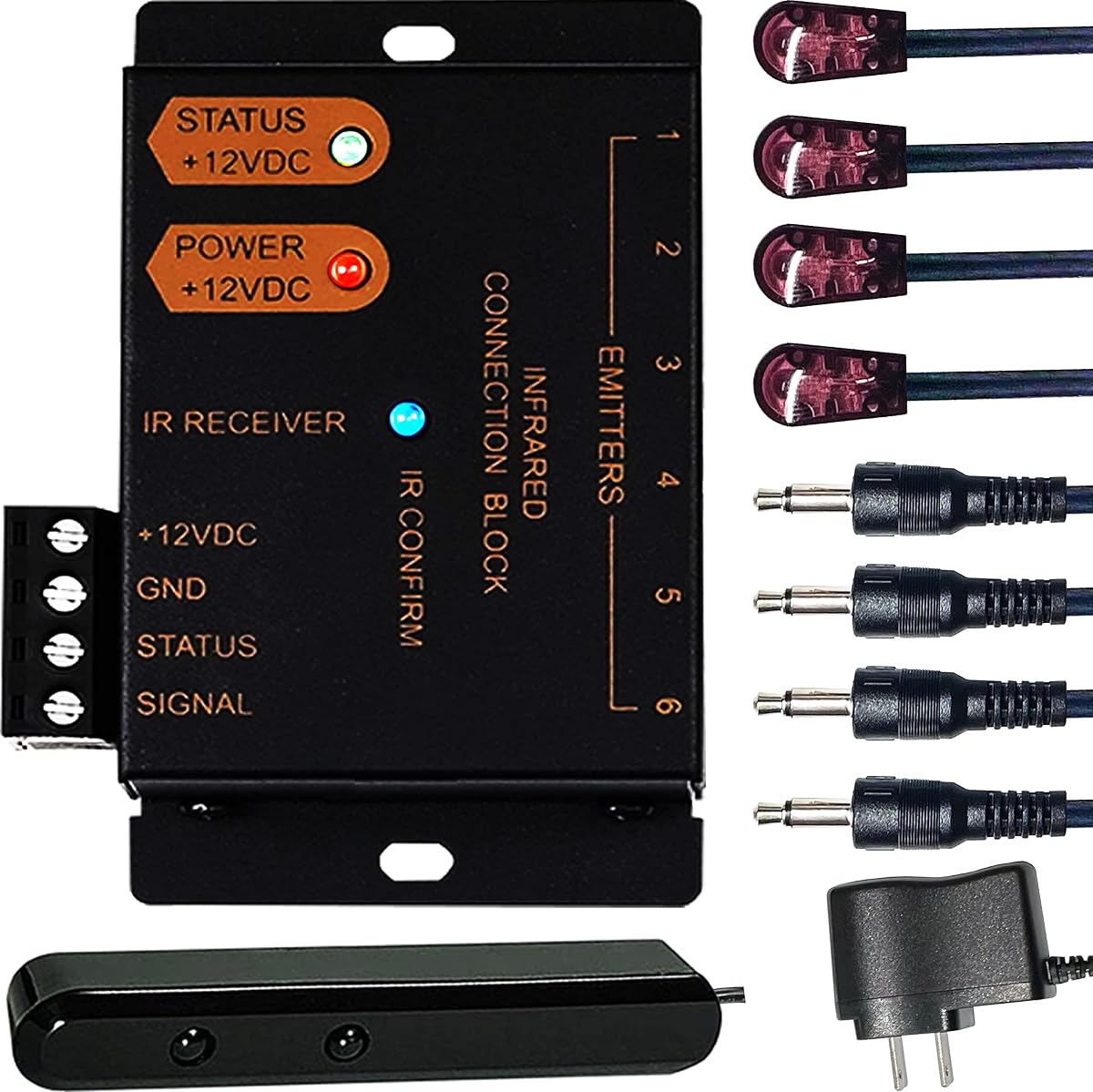
The One-by-Six IR Repeater is a flexible wired system for controlling multiple IR devices in a cabinet or remote location. Its 3.9 rating is the lowest among the ten products, but the supplied feature set offers notable installation options. The package includes an IR connecting block, four emitters, a dual-band mini receiver, a power supply, mounting screws, and a manual.
We may earn a commission when you buy through this link, at no additional cost to you.
Its defining feature is the terminal-block Ethernet input, which can extend the receiver as far as 120 meters in suitable applications. A separate terminal block is required for that arrangement. The system also supports six outputs and can be expanded to twelve using dual emitters or eighteen using triple emitters, making it a practical choice for installations that may grow over time.
The broad 20-to-60-kilohertz frequency range is intended to cover most IR appliances, with explicit mention of SKY set-top boxes and Cisco DVD players, including RCMM code support. Additional emitters are sold separately. As with every kit in this category, it cannot operate RF, Bluetooth, Wi-Fi, or app-only equipment, and a full room layout should be planned before selecting cable lengths.
Despite its lower listed rating, this system is attractive for users who prioritize scalability and very long receiver runs. It is less compelling for a small setup with only one or two hidden devices, but it provides useful infrastructure for a large or evolving installation without requiring complex software configuration.
The Ethernet-compatible connection can carry the IR receiver much farther than a conventional cable run. It is useful in homes where the listening or viewing position is far from the equipment closet.
The connecting block supports multiple expansion levels, so a basic installation can grow without replacing the core system. Users should account for separately sold emitters when planning a larger cabinet.
We may earn a commission when you buy through this link, at no additional cost to you.
The Ten-Device IR Repeater is a straightforward distribution system intended to make hidden equipment more convenient to operate. It carries a 4.3 rating and includes a console box, IR receiver, five IR emitters, and a DC 12V power adapter. The plug-and-play approach is designed for users who want to control several devices without installing software or reconfiguring their existing remotes.
We may earn a commission when you buy through this link, at no additional cost to you.
The system supports up to ten IR-controlled devices and can be expanded to twelve. Its broadband receiver is compatible with a broad selection of common A/V equipment, including amplifiers, cable boxes, set-top boxes, stereo and AV receivers, DVRs, satellite receivers, CD players, DVD players, and Blu-ray players. A green light shows that power is connected, while a flashing red light indicates that the repeater is sending a signal.
As with many multi-receiver systems, installation geometry matters. If more than one receiver is connected to the distribution block's 3.5 mm ports, the receivers should be at least six meters apart to avoid interference. The system can control equipment in another room, but it does so through wired IR extension rather than a dedicated wireless bridge. Plasma displays can also interfere with nearby IR reception.
This is a sensible recommendation for consumers who want a conventional, immediately understandable home theater repeater. Its included emitter count and simple indicators reduce setup friction, while the capacity suits a cabinet filled with common IR-controlled components. It is less suitable for installations that need a compact one-cable solution or a long-range wireless link.
The included console, receiver, emitters, and power adapter provide the core components needed for a cabinet installation. Its straightforward design makes it approachable for first-time repeater users.
Distinct green and red lights separate power status from active signal transmission. This makes it easier to determine whether a placement problem exists or whether a remote is reaching the kit.
We may earn a commission when you buy through this link, at no additional cost to you.
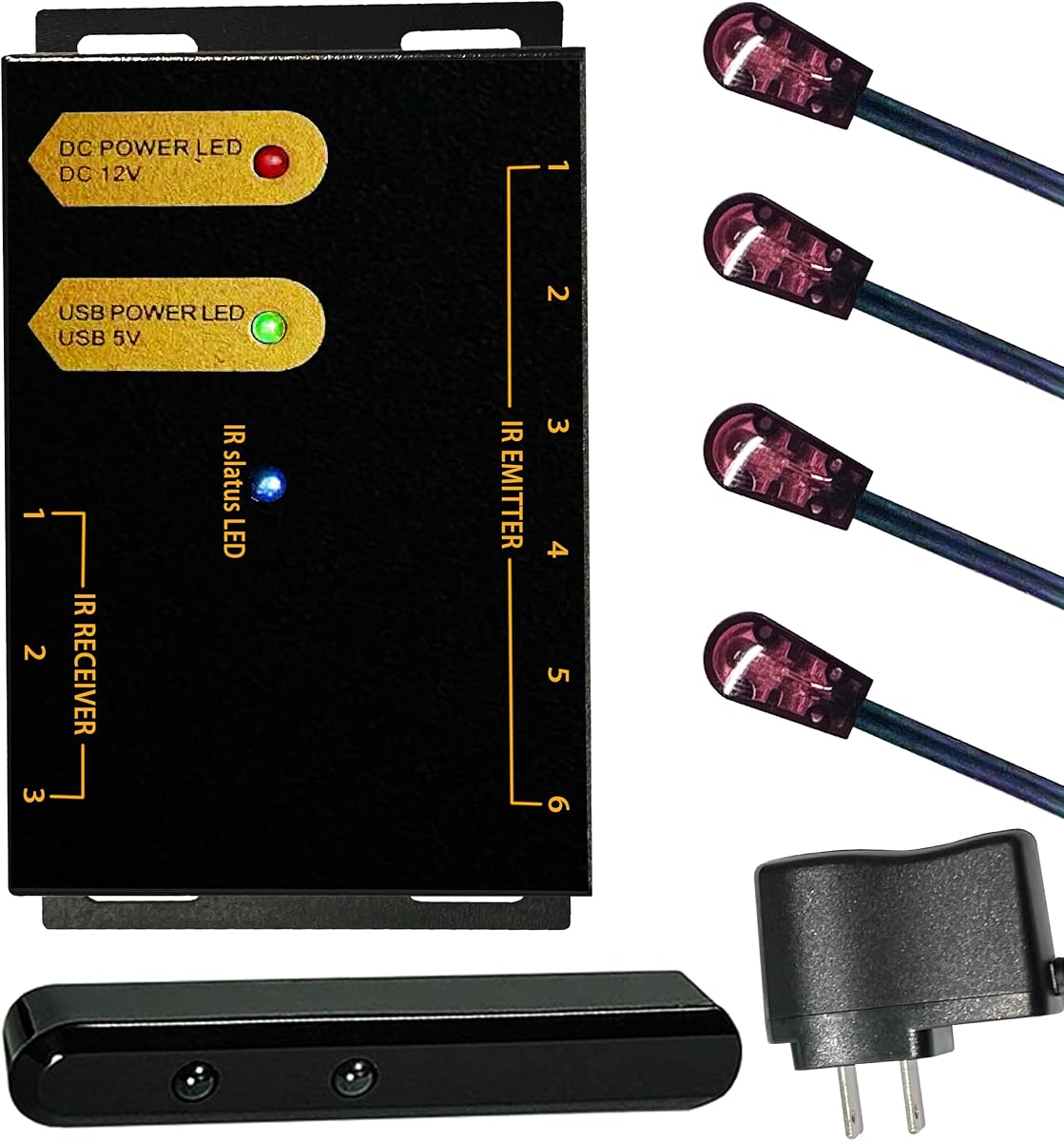
The Hidden Infrared Remote Extender System is a compact option for controlling A/V equipment in a second room. Its 4.4 rating is among the stronger results in this guide, and the package combines one receiver, four IR emitters, and a 5V USB AC power supply. It is designed for situations such as adjusting volume or changing channels on equipment located beyond the main viewing space.
We may earn a commission when you buy through this link, at no additional cost to you.
Four included emitters allow several components to be controlled from a single remote, while the receiver's LED gives immediate visual confirmation that an IR command has been picked up. The operating frequency spans 34 to 60 kilohertz, covering many mainstream IR devices, including amplifiers, cable boxes, stereo and satellite receivers, CD players, DVD players, and Blu-ray players.
The receiver cable is approximately two meters long, while each emitter lead is approximately one meter. Those lengths are sufficient for a nearby cabinet or modest room separation but may not accommodate a large house without additional routing. The operating range begins at 34 kilohertz, making it slightly less broad than systems that start at 20 kilohertz, and the remote should be aimed toward the receiver for best results.
This kit is a good fit for a user who wants multi-device control across two nearby rooms without the scale of a large distribution system. It provides an attractive balance of capacity, compactness, and straightforward USB power. It is less appropriate for long-distance wireless control or installations with unusually high-frequency remotes.
The receiver can pick up a familiar remote and relay commands to equipment in another room. This is useful for controlling shared audio components without moving near the equipment each time.
The included emitter set can serve several source devices from one receiver. One-meter leads are best suited to compact cabinets or nearby entertainment furniture.
We may earn a commission when you buy through this link, at no additional cost to you.
The 2CH IRBlast Wireless IR Repeater Kit combines long wireless reach with separate control channels, making it a strong premium choice for larger or more complex installations. It has the highest listed rating in this guide at 4.8. The package includes an IR receiver, an IR emitter, two extension cables, AC and USB power adapters, adhesive stickers, and a user manual.
We may earn a commission when you buy through this link, at no additional cost to you.
Its dual-channel design separates adjacent cable boxes or stereo units, reducing the chance that a command intended for one setup will control another. The receiver and emitter have matching adjustable channel switches. A 433-megahertz wireless signal is stated to reach 500 feet, while the product information also cites up to 300 meters in open air. The IR receiver captures remote commands within a 45-degree area and can reach 30 meters under the stated conditions.
Compatibility remains limited to standard IR equipment such as cable boxes, Blu-ray players, DVD players, and home audio receivers. Bluetooth and Wi-Fi remotes, including app-controlled streaming boxes and certain smart televisions, cannot be operated through this system. The receiver is directional, and the IR extension cables should be attached directly to a device's IR window for steady performance.
This kit is ideal for a customer who needs more than a single-cabinet extender and values clean channel management. Separate channels reduce configuration complexity in a home with multiple similar components, while the long wireless link avoids a permanent cable run. Its premium feature set makes it a compelling recommendation for advanced IR installations.
Matching channel switches on the receiver and emitter let users operate separate groups of devices. This reduces accidental cross-control when two nearby systems use similar IR commands.
The wireless link allows the receiver and emitter modules to occupy different rooms without an extensive IR cable run. Placement should still respect the stated directional and environmental limits.
We may earn a commission when you buy through this link, at no additional cost to you.
The right IR repeater kit depends mainly on the equipment being controlled, the physical distance involved, the number of devices, and the user's willingness to position and connect each component carefully.
An IR repeater can only relay commands intended for infrared equipment. Before comparing range or capacity, check whether the affected television, set-top box, receiver, player, or streaming device actually includes an IR sensor and responds to an infrared remote. RF remotes, Bluetooth controls, Wi-Fi commands, and app-only devices are outside the operating scope of every kit listed here. The 2CH IRBlast listing explicitly excludes Bluetooth and Wi-Fi smart televisions and app-controlled streaming boxes, while the Fourair system provides a similar warning. A basic visual check may reveal an IR window, but the most reliable method is to consult the equipment manual or identify the remote's signal type. This check prevents a technically capable repeater from becoming an unusable purchase.
A basic extender may serve one source, while a distribution block can control several devices from the same receiver. The Cable Matters model is designed around a single IR source, whereas the Infrared Repeater System and Ten-Device IR Repeater support up to ten devices and can expand to twelve. The TNP system lists six output connections, and the One-by-Six model can expand to eighteen. The Thirty-Two-Device IR System advertises the highest overall capacity, although its listed configuration has four emitter outputs. Count the devices that must remain hidden, allow for future additions, and verify exactly which emitter leads or outputs are included rather than relying only on the largest headline capacity.
Distance comes in two layers: how far the user's remote can reach the repeater's IR receiver, and how the repeater reaches the target equipment. The Cable Matters system supports a 15-foot IR signal range, while the Infrared Repeater System states control at locations up to ten meters away. The One-by-Six kit can extend its receiver as far as 120 meters over compatible Ethernet cabling. Wireless products advertise much larger transmission distances, but walls, floors, furniture, and other obstacles affect actual performance. Measure the route between the viewing position and equipment closet, then add room for the receiver to see the remote and for each emitter to reach its device sensor.
A wired repeater is usually simpler for a single cabinet because the receiver and emitters remain connected through a distribution block or cable. It also provides a predictable relationship between the user and the equipment. Wireless systems are more useful when a cable run would be awkward or impossible. The Fourair, Sewell BlastIR, and 2CH IRBlast products use wireless links, with stated ranges extending from hundreds of feet. Wireless does not automatically mean uninterrupted service, however, because environmental conditions and receiver direction still matter. For a home theater in one adjacent room, a wired kit with properly sized leads may be simpler. For a larger property or a difficult installation, wireless can provide valuable placement freedom.
Emitters are the parts that actually deliver commands to hidden devices. The Infrared Repeater System includes five dual emitters with ten-foot leads, while the Ten-Device Repeater also includes five emitters. Other systems may provide only two or four, with additional units sold separately. Long leads are useful when components are distributed across a cabinet, but placement quality is equally important. The Sewell and Fourair descriptions recommend putting the emitter directly over or within a few inches of the target IR window. Adhesive-backed probes can be less conspicuous than a loose blaster. Before buying, estimate the distance from each emitter connection to each device and consider whether a shared emitter or direct adhesive probe is more appropriate.
IR remotes communicate at different carrier frequencies, and a repeater should cover the range used by the intended equipment. Several systems support 20 to 60 kilohertz, including the TNP, One-by-Six, and Fourair products. The Hidden Infrared Extender operates from 34 to 60 kilohertz, while the 2CH IRBlast also lists a 20-to-60-kilohertz range. The One-by-Six product additionally mentions support for SKY set-top boxes and Cisco DVD players, including RCMM code support. Broader ranges are generally reassuring, but specific device and code support can be even more important, particularly for a particular cable box, receiver, or regional equipment.
Every system needs a reliable power source, and the requirements differ. The Cable Matters extender uses a 5V USB wall charger and will not receive power from a television's USB port while the television is off. The Ten-Device Repeater includes a DC 12V adapter, while the Sewell package includes both USB and AC power cables. The 2CH system provides dual AC and USB power adapters. Receivers also need suitable sightlines to the remote, and some systems specify minimum spacing between multiple receivers to avoid interference. Plasma displays, Wi-Fi routers, and compact fluorescent lighting can also affect IR behavior. Build the power and placement plan before opening a cabinet or drilling any mounting points.
Basic confirmation lights are common, but they can save a great deal of setup time. The Infrared Repeater System separates green power indication from red signal transmission, while the Hidden Infrared Extender includes a receiver LED. The 2CH model adds independently adjustable channels, allowing two equipment groups to be managed separately and reducing accidental cross-control. The One-by-Six kit adds Ethernet extension for unusually long receiver runs. These features are valuable when multiple similar devices share a cabinet or when the installer needs immediate feedback about where a command is stopping. More elaborate control is useful only when the installation genuinely needs it, so it should be weighed against simplicity.
Begin by identifying every target device's IR sensor and confirming that it uses an infrared remote. Clean the relevant sensor window and plan where the receiver, distribution block, and power supply will be mounted. For a wired system, route the receiver toward the normal viewing position and place each emitter close to its assigned device window. For a wireless system, position the receiver toward the user and the emitter near the concealed equipment.
Connect the receiver to the main repeater or distribution block, attach the emitters, and supply power using the specified adapter or wall charger. Test each original remote command before securing cables permanently. Listen for the expected device response and watch the receiver or repeater indicator. If a command fails, reposition the emitter directly over the IR sensor, adjust the receiver angle, and remove potential obstructions or nearby interference sources.
After confirming that every device responds, secure the wiring with appropriate ties or adhesive mounts without blocking ventilation or creating sharp cable bends. Keep power connections dry and accessible, and do not exceed the stated number of receivers, emitters, or output connections. Recheck alignment periodically because cabinet contents, lighting equipment, and furniture can shift. Troubleshooting should begin with the power indicator, followed by receiver sightline, emitter placement, remote compatibility, and channel selection on multi-channel systems.
It depends on how the smart TV receives commands. A television with an IR remote and an active IR receiver can often be controlled through a compatible repeater, but Bluetooth, RF, Wi-Fi, and app-only models cannot. Several products in this guide explicitly exclude certain newer smart TVs and streaming devices. Check the remote type and the device manual before ordering rather than assuming that a television with a remote is automatically compatible.
The IR receiver collects the infrared command from the user's handheld remote, usually over a short line of sight. The repeater then sends that command to one or more IR emitters attached near the target devices. The receiver therefore needs a clear view of the remote, while each emitter needs close and direct placement over a device's IR sensor. Confusing these roles can lead to unreliable operation even when the kit itself is functioning.
Some wireless systems are specifically designed to send a command across walls or closed doors, while basic wired extenders may need a network cable routed through the structure. The Infrared Repeater System can also support devices in other rooms through its extended connections. Actual performance depends on the product, cable route, obstacles, and receiver placement. A wireless receiver still needs to see the handheld remote, and wireless range claims do not guarantee the same result in every building.
Capacity varies substantially across this guide. The Cable Matters extender focuses on one source, several systems control around ten devices, and the Thirty-Two-Device IR System advertises support for as many as 32. The meaningful figure is the number of available outputs and included emitters, not merely the largest compatible device count. Count the equipment you need to control and check whether extra emitters or distribution hardware must be purchased.
The most common causes are an incompatible remote type, weak receiver alignment, or an emitter positioned too far from the device's IR window. Also check that the receiver and emitter are on the same channel when using a dual-channel system, and confirm the repeater has power. Moving the emitter directly over the sensor and aiming the receiver toward the remote often resolves the problem.
Some systems allow multiple receiver connections, but spacing matters. The Infrared Repeater System and Ten-Device IR Repeater advise keeping connected receivers at least six meters apart to avoid interference. Other products may use a different connection method, such as the One-by-Six model's Ethernet extension. Follow the manual for the selected kit and avoid placing receivers close together unless its instructions specifically support that arrangement.
The Infrared Repeater System, Ten-Device Repeater, and Fourair product describe real-time transmission without delay. In a well-positioned installation, the relay should feel like a normal remote command, although very long cable runs, poor emitter placement, or interference can reduce reliability. If commands work inconsistently rather than consistently lagging, focus first on alignment and sensor contact.
Only if the streaming device uses an IR remote. Older cable boxes, disc players, and some streaming hardware may use IR, while Fire TV Stick, Roku Express, and other app-controlled devices commonly rely on Bluetooth, RF, or Wi-Fi signals. The 2CH IRBlast and Fourair listings specifically identify several such exclusions. Verify the device's remote and sensor before making a purchase.
The Infrared Repeater System stands out as the most balanced general-purpose option, combining support for up to ten devices, five long emitters, separate-room control, and helpful status lights. Cable Matters is the economical choice for a single concealed source, while the dual-channel 2CH IRBlast offers the strongest premium feature set for larger homes and multiple similar entertainment systems.
Before choosing, prioritize actual IR compatibility, the number of components that need control, and the physical route between the remote, receiver, and equipment. Emitter placement is just as important as headline range. A carefully positioned wired emitter directly over a device sensor may outperform a long-distance system installed at an awkward angle.
Finally, review the current listing and price before ordering. Product bundles, included accessories, and availability can change, so confirm the receiver, emitter count, power supply, expansion method, and compatibility notes against your intended equipment at the time of purchase.
