
Boss BR-600 Digital Multitrack Recorder
4.2Editor score
Eight simultaneous playback tracks
Sixty-four virtual tracks
CompactFlash recording storage
Drum machine and effects processor
Built-in stereo microphone
Eight Track Tape Recorder guide comparing ten multitrack recorders for music, voice, field recording, portability, and analog tape use.
An eight track recorder can transform rehearsals, songwriting, podcasts, field interviews, and home recordings into polished multitrack projects. The right unit balances track capacity, sound quality, microphone inputs, portability, editing tools, and the kind of workflow that suits your experience, whether you need a compact sketchpad or a more capable production recorder.
This guide compares ten devices selected for people searching for an Eight Track Tape Recorder, including digital multitrack recorders, portable field recorders, and cassette-based machines. Features examined include simultaneous recording, input flexibility, built-in microphones, storage media, effects, USB connectivity, and ease of recording away from a studio.
Each numbered review identifies the strongest use for that model and explains any meaningful compromises. The three leading choices appear in the top picks, while the comparison table provides a quick overview of the entire field. Product availability, configurations, and pricing can change, so confirm current details before purchasing.
4.2Editor score

4.5Editor score

4.6Editor score
The comparison includes digital multitrack recorders designed for music and voice, a professional field recorder, and two cassette machines for analog workflows. Track counts and input styles vary widely, so the table is best used to identify the recording format and application that suit your needs.
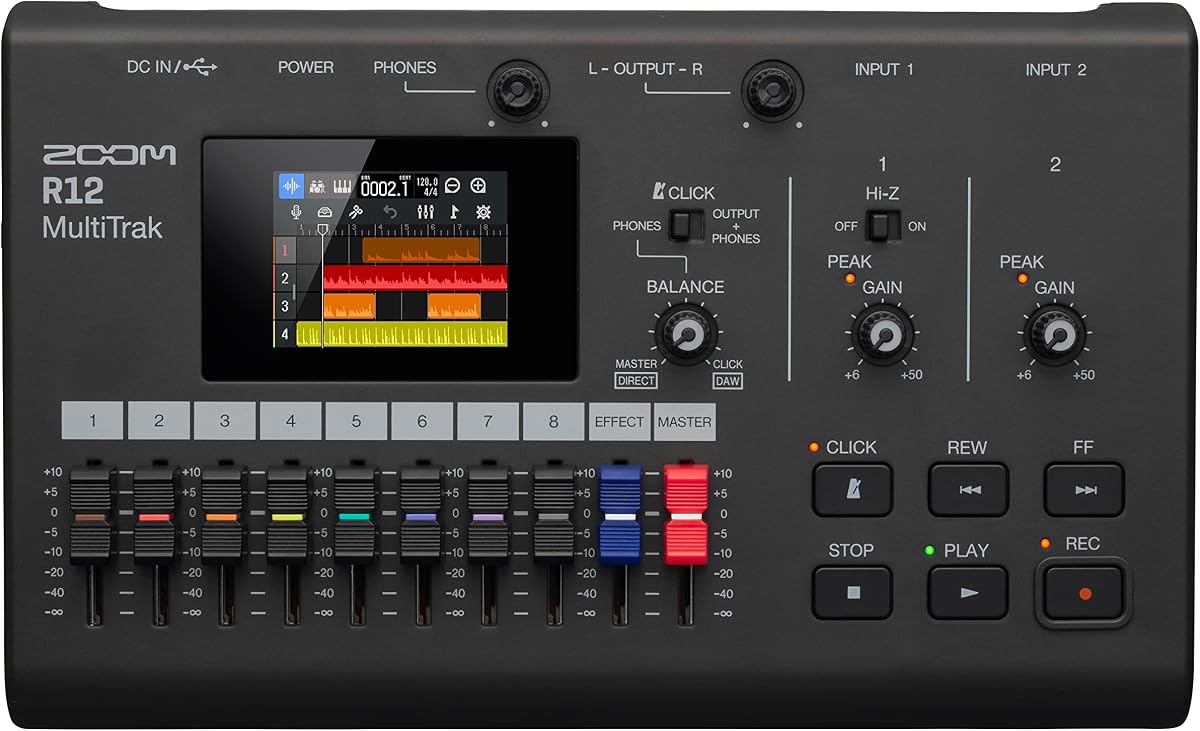



The Zoom R12 is the most complete all-in-one option in this guide, earning a 4.2 rating from its listed customer reviews. It combines eight-track recording, a full-color touchscreen, DAW-style editing, rhythm sounds, MIDI-compatible instruments, and USB-C connectivity in a portable unit. That combination makes it unusually practical for musicians who want to move from an idea to an organized arrangement without assembling a full desktop setup.
We may earn a commission when you buy through this link, at no additional cost to you.
Its two XLR/TRS inputs give users a choice between condenser microphones, line sources, and instruments. Both inputs support 48V phantom power, while input 1 includes a Hi-Z switch for direct connection of guitars and basses. The R12 can capture several parts in sequence, then cut, copy, loop, and mix those recordings directly on its touchscreen, reducing the friction associated with moving between hardware and a computer.
The built-in rhythm section includes 150 drum loops across multiple genres, and 18 FM synth instruments can be played with a MIDI keyboard or programmed from the touchscreen. Its USB-C port lets it operate as a stereo audio interface and DAW control surface, with transport controls and faders for compatible recording software. These are substantial workflow advantages, although the two-input configuration is less accommodating for recording a live band than the eight-XLR-input DP-24SD.
Battery operation offers up to five hours on four AA batteries, which makes the R12 appealing for songwriters, producers, and podcasters who regularly record away from a desk. It is the strongest general recommendation for someone seeking an eight-track workflow with modern conveniences, provided they are comfortable arranging parts sequentially and do not need many microphones connected at once.
The touchscreen is more than a display: it provides DAW-style editing for cutting, copying, looping, and mixing. A creator can capture separate ideas, organize them, and begin arranging without requiring a laptop, which is especially useful during mobile songwriting sessions.
Built-in drum loops, FM instruments, instrument effects, and MIDI control give the R12 room to function as a sketch production tool. Those internal sounds are particularly helpful when a user wants to develop an arrangement before bringing in other musicians.
We may earn a commission when you buy through this link, at no additional cost to you.
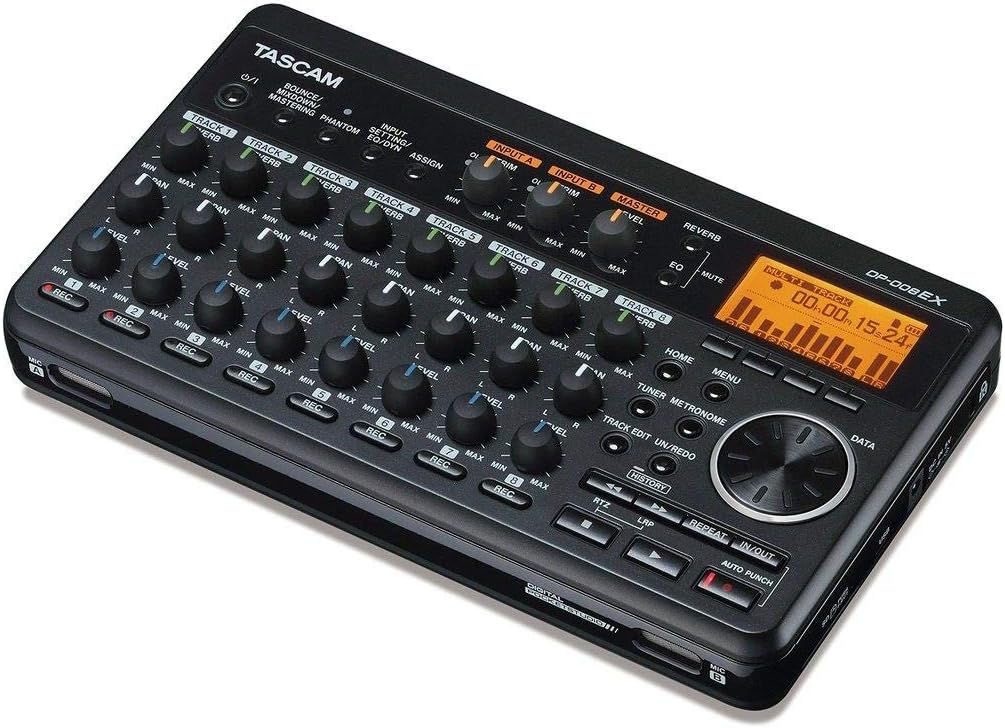
The TASCAM DP-008EX holds a 4.6 rating, placing it among the most favorably reviewed products here, and its core appeal is portability. Built as an eight-track Pocketstudio, it is intended for musicians who need a reliable way to capture ideas away from a fixed studio. Built-in microphones and battery operation support immediate recording without a wall outlet or separate microphone setup.
We may earn a commission when you buy through this link, at no additional cost to you.
Its pocket-oriented design makes it attractive for songwriters who travel, teach, rehearse, or perform at small venues. The device title emphasizes songwriting, built-in microphones, and battery operation rather than the rack-style input flexibility found in larger recorders. That focus suggests a practical tool for capturing melodic ideas, writing parts, and assembling short multitrack arrangements in a compact format.
The main limitation is that the supplied product information provides fewer technical details than the entries for the DP-03SD, DP-24SD, Zoom R12, and Portacapture X8. Buyers should therefore confirm current microphone, connector, storage, and power specifications before purchase. It is also a digital multitrack recorder rather than a literal reel-to-reel tape machine, despite matching the eight-track search theme.
For a musician who prioritizes portability, built-in microphones, and an approachable eight-track format over extensive onboard production features, the DP-008EX is a strong candidate. Its 4.6 rating also makes it one of the safest choices based on the feedback represented in the supplied data, provided its current physical inputs fit the intended recording plan.
A dedicated eight-track Pocketstudio with built-in microphones can shorten the path from inspiration to a usable arrangement. Its battery-operated format supports recording during rehearsals, lessons, acoustic performances, and other settings where a studio is not available.
The emphasis on songwriting and a pocket format suggests that ease of use is central to this model. It is worth considering for users who want to capture parts promptly rather than navigate a large, studio-style control surface.
We may earn a commission when you buy through this link, at no additional cost to you.
The TASCAM DP-03SD earns a 4.5 rating and is one of the most approachable true multitrack recorders in the group. It delivers eight-track recording, two-channel simultaneous input, built-in stereo condenser microphones, and a simple body inspired by cassette recorders. The combination gives it a clear identity: traditional, immediate music capture with a more capable digital backend.
We may earn a commission when you buy through this link, at no additional cost to you.
The input arrangement is versatile for its size. An XLR terminal supports condenser microphones, while TRS phone connections accommodate guitars and keyboards. Its stated frequency response extends from 20Hz to 20kHz with a +1/-3dB range from microphone or line input to line output. Dedicated tuner and metronome buttons help musicians keep timing and pitch under control during rehearsal and writing.
Its onboard editing and mastering effects allow a user to produce a more finished result without exporting every operation to another system. The limitation is the two-channel simultaneous recording ceiling: it is excellent for layered ideas and rehearsed parts, but it cannot capture a full band at once the way the DP-24SD can with eight XLR inputs. It remains a digital Portastudio, so the familiar cassette-inspired workflow should not be confused with actual tape media.
The DP-03SD is an excellent choice for songwriters, bedroom producers, educators, and musicians who want an eight-track recorder that feels approachable. It offers more direct recording tools than many basic field recorders while remaining simpler than a larger production console. For a balanced, music-centered recommendation, it is one of the strongest options available.
The body and intuitive operation are likened to a cassette multitrack recorder, making the learning curve approachable for users familiar with tape-based workflows. Internally, the unit provides eight-track digital recording and onboard editing for more flexible arranging.
XLR microphone support, TRS connections for instruments, and included stereo condenser microphones cover common recording needs. These options make the DP-03SD adaptable for acoustic performances, voice memos, songwriting demonstrations, and small ensemble sessions.
We may earn a commission when you buy through this link, at no additional cost to you.
The Tascam DP-24SD is the premium selection for recording musicians, with a 4.6 rating and a feature set centered on serious multitrack capture. Although the search term emphasizes eight tracks, this model can provide up to 24 tracks and eight XLR inputs, making it suitable for users who may start with a simple song but need room to grow toward larger sessions.
We may earn a commission when you buy through this link, at no additional cost to you.
Eight dedicated XLR inputs are the decisive feature. A singer, acoustic guitarist, keyboard player, drummer, and other performers can be connected without relying on a small number of shared inputs. This also makes the recorder suitable for rehearsals where capturing everyone separately is more valuable than forcing a live band through only two channels.
Onboard effects and mastering functions reduce the need for a computer during basic finishing, while the color screen helps users navigate tracks, levels, and settings more efficiently than a minimal monochrome display. The trade-off is size and complexity. Its package dimensions and weight are considerably larger than pocket recorders, and the extensive feature set may demand more setup than a songwriter wants for a quick voice memo.
The DP-24SD is the right recommendation for a home studio, rehearsal room, or mobile production setup that needs more than a sketch recorder. It earns the Best Premium designation because it moves beyond the minimum eight-track requirement with substantial input and track capacity while retaining an integrated all-in-one design.
Eight XLR inputs provide enough connections for many rehearsal and home-session arrangements. Musicians can capture separate performers cleanly, then balance and edit them on the recorder before transferring the finished project to a computer.
A color display gives the DP-24SD a practical advantage when reviewing tracks and adjusting settings. This matters in a multi-input workflow, where users may need to locate mute states, input levels, and effects more quickly.
We may earn a commission when you buy through this link, at no additional cost to you.
The Boss BR-600 is a capable budget-oriented multitrack recorder with a 4.2 rating. It supports eight simultaneous playback tracks and 64 V-Tracks, giving users a useful combination of immediate overdubbing capacity and deeper virtual-track organization. Its built-in stereo microphone and battery power also make it possible to record without a studio.
We may earn a commission when you buy through this link, at no additional cost to you.
Creative tools go beyond basic track capture. A dedicated guitar and effects processor includes vocal effects and a pitch corrector, while the integrated drum machine has velocity-sensitive pads. These features make the BR-600 attractive to singer-songwriters who want accompaniment or processing immediately instead of importing every part from a computer.
Its main practical caveat is the CompactFlash storage slot. A 128MB card is included according to the supplied information, but modern users may need additional compatible media and should consider how file formats and available space will serve their workflow. Compared with newer touchscreen devices, the BR-600 also presents a more traditional button-based operating style. Neither issue prevents it from delivering solid multitrack recording.
This model is a sensible value choice for guitarists, vocalists, and home recordists who want more than a stereo dictation device. Choose it when built-in effects, drum sounds, and fast overdubbing matter more than contemporary touch controls or a computer-independent editing display.
Sixty-four V-Tracks allow performers to test variations of a part without losing earlier takes. Eight simultaneous playback tracks make it possible to assemble a fuller arrangement while still recording new ideas over the existing material.
Velocity-sensitive drum pads, vocal effects, pitch correction, and guitar-oriented processing give users instant creative tools. These features are particularly useful for quickly auditioning a song with backing parts and polish.
We may earn a commission when you buy through this link, at no additional cost to you.
The Roland BR-80 is a portable digital recorder with a 4.4 rating and an unusually broad set of operating modes. It can function as a multitrack recorder, an eBand practice and play-along system, or a live recorder. That versatility makes it more than a track-capture device and gives it particular value to musicians who rehearse or study independently.
We may earn a commission when you buy through this link, at no additional cost to you.
Inside, it provides 64 V-Tracks and eight simultaneous playback tracks. Recording directly to SD or SDHC memory cards gives users manageable removable storage, while the built-in stereo condenser microphone supports immediate capture. A library of backing and rhythm patterns expands its usefulness for practice sessions, and world-class COSM amplifiers and effects are available onboard.
It can also operate as a USB audio interface with built-in effects, making it a bridge between portable recording and computer-based production. The included SONAR X1 LE software is a bonus for users interested in editing, although its age means modern compatibility should be verified. The variety of modes may also feel excessive to a buyer whose sole goal is straightforward linear recording.
The BR-80 is a compelling pick for guitarists, students, and musicians who practice with backing tracks or want a recorder that changes roles depending on the activity. It offers a useful balance of portability, eight-track playback, practice features, and studio connectivity.
The eBand mode is built around phrase training and play-along use. Musicians can use the built-in library of backing and rhythm patterns to rehearse phrasing, timing, and performance away from a full band.
Switching between multitrack recording, practice tools, and live capture lets the BR-80 serve different parts of a musical workflow. USB interface support adds another layer for computer-assisted recording and editing.
We may earn a commission when you buy through this link, at no additional cost to you.
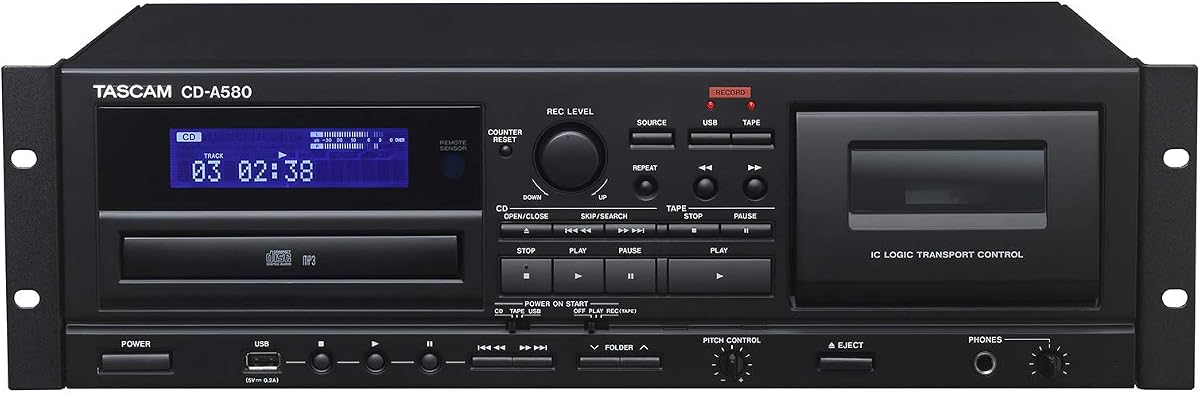
The Tascam CD-A580 is included because an Eight Track Tape Recorder search can encompass analog tape recording and archiving, but this model serves a different purpose. It is a rackmount cassette, CD, and USB player-recorder with a 4.4 rating. Rather than capturing eight synchronized tracks, it focuses on media playback, dubbing, and converting recordings into digital files.
We may earn a commission when you buy through this link, at no additional cost to you.
Cassette-to-USB recording allows collectors to digitize tape collections, while CDs can be recorded to cassette. Audio from CDs or the line inputs can be saved as MP3 files on USB flash media. These transfer options make it useful for preserving recordings or moving content between older and newer formats without using a computer for the initial capture.
The single-direction logic transport is designed for stable, long-lasting operation. During cassette playback, pitch can be adjusted within plus or minus 10 percent, which can be useful for matching playback speed or exploring tonal variations. The deck also supports CD-DA, CD-R, CD-RW, and data CDs containing MP3 files, giving it broad playback compatibility.
This is not the correct choice for someone wanting to overdub eight musical parts. It is ideal for archivists, media collectors, musicians with cassette libraries, or users who want reliable analog-to-digital dubbing in a rack setup. Its inclusion broadens the guide by showing that a tape recorder can be a media-transfer tool rather than a multitrack production machine.
Cassette-to-USB transfer provides a direct path for preserving older recordings in a digital format. The deck can also save line input and CD audio as MP3 files, making it useful for building a manageable digital archive.
The ability to move music from CDs to cassette and tapes to USB supports several common archival tasks. Wide CD support and adjustable cassette pitch add further flexibility for people working with varied physical media.
We may earn a commission when you buy through this link, at no additional cost to you.
The K8 Cassette Player is a compact, uncomplicated tape machine with a 4.1 rating. It plays conventional cassettes, records through a built-in microphone, and includes an AM/FM radio in a portable format. Its appeal lies in straightforward analog recording and nostalgic listening rather than the synchronized layering demanded by an eight-track studio recorder.
We may earn a commission when you buy through this link, at no additional cost to you.
The built-in microphone makes it easy to capture a voice, rehearsal fragment, or ambient sound directly onto tape. A 3.5mm earphone jack and included earphones support private listening, while the built-in speaker allows the radio and tapes to be heard without headphones. Operation from AA batteries or an AC adapter supports both commuting and stationary listening.
Its limitations are significant for multitrack work. Cassette machines record a limited number of discrete tracks rather than eight synchronized audio channels, and there is no indication of digital editing, effects, or computer transfer. Users who search by the keyword expecting modern music production should distinguish this simple recorder from the dedicated multitrack models at the top of the guide.
The K8 is best for children, casual users, travelers, educators, or anyone who wants an uncomplicated way to play tapes, listen to radio, and make quick analog voice recordings. It offers a five-year assurance according to the supplied description, adding reassurance for a simple consumer electronics purchase.
The integrated microphone and direct-to-cassette recording process remove the need for external recording equipment. It is well suited to brief personal messages, educational activities, or capturing a rehearsal idea in a straightforward way.
AA battery operation, earphone support, a built-in speaker, and AM/FM radio combine into a compact listening package. Users can carry the K8 while traveling or use the AC adapter for longer sessions at home.
We may earn a commission when you buy through this link, at no additional cost to you.
The Portacapture X8 is the strongest field-recording choice in this guide, with a 4.4 rating and support for multitrack, podcast, music, interview, vlog, field, and ASMR applications. Its eight-channel design goes beyond the core eight-track concept while preserving the idea of capturing several isolated sources at once in a portable format.
We may earn a commission when you buy through this link, at no additional cost to you.
Four locking XLR/TRS combination inputs accept microphones and line sources, and each has individual phantom power selectable between 24V and 48V. Support for recordings up to 192kHz in 32-bit float format is notable for high-resolution capture. The Launcher system provides an intuitive 3.5-inch color touch interface for navigating these recording options in the field.
Detachable 14.6mm large-diaphragm condenser microphones can be positioned in A-B or X-Y configurations. Stereo pairings are valuable for ambience, interviews, and location sound, while the separate combo inputs allow additional sources to be recorded. The important compatibility note is that the product is designed for the AK-BT1 adapter and is not compatible with the AK-BT2 adapter.
This is not a basic song recorder with instrument-focused effects, so it may not be the first choice for a musician wanting automatic mastering and accompaniment. For documentary sound, podcast production, detailed interviews, and ambitious location recording, however, it offers the most professional microphone preamplifier and capture specification among the listed products.
Locking XLR/TRS inputs, switchable phantom power, and dedicated HDDA microphone preamps support demanding field work. These features allow multiple microphones to be connected securely without relying on consumer-style adapters.
The detachable large-diaphragm condensators can be configured for A-B or X-Y operation. Users can compare spatial recording approaches, capture consistent stereo ambience, or employ the capsules alongside other connected sources.
We may earn a commission when you buy through this link, at no additional cost to you.
The QFX Retro-39BT combines the appeal of a portable cassette recorder with several modern connections. Its 3.8 rating is the lowest among the products listed, so it should be considered a specialized convenience model rather than a leading recommendation for serious multitrack recording. It supports cassette playback and recording, MP3 files from USB media, FM radio, Bluetooth playback, microphone input, and line connections.
We may earn a commission when you buy through this link, at no additional cost to you.
Its standout feature is bidirectional transfer. Users can record digital audio from a USB drive onto cassette, or capture cassette, Bluetooth, FM radio, microphone, or line-in audio to USB. That flexibility makes it possible to create analog copies of digital files or move selected recordings into digital storage without a full desktop conversion setup.
A built-in 3.5-inch speaker and swivel carrying handle make the unit convenient for casual listening around the home or while traveling. It can run from an included AC cord or four C batteries, although the supplied information states that batteries are not included. The microphone and line-in options also extend its use for simple spoken recordings and audio capture.
This model is appropriate for nostalgic playback, family listening, simple voice recording, and users who want a bridge between USB files and cassette media. It cannot layer eight tracks or provide a professional music-production workflow, so buyers should consider a digital multitrack recorder for that goal. Within its narrower cassette-and-connectivity niche, the source options are unusually varied.
USB-to-cassette and cassette-to-USB workflows give the Retro-39BT more flexibility than a basic tape player. It can serve as a simple bridge for creating tape copies, saving radio or voice recordings, and accessing MP3 files from USB media.
The integrated speaker removes the need for separate playback equipment, while Bluetooth expands the range of modern audio sources. A swivel handle and choice of AC or battery power keep the unit practical for use in different locations.
We may earn a commission when you buy through this link, at no additional cost to you.
The phrase Eight Track Tape Recorder can describe several different products, from literal cassette decks to modern digital multitrack recorders. Start by identifying whether you need synchronized music tracks, field capture, archival dubbing, or simple analog recording, then match the hardware to that purpose.
Choose digital for layering, editing, effects, and computer transfer; choose cassette for analog media use. Treat search labels as broad descriptions rather than proof of technical specifications.
Prioritize usable track space and sensible virtual-track organization. Choose more tracks when your arrangements are layered and complex.
Match input type and count to the recording session. Built-in microphones favor convenience; XLR and TRS favor control.
Choose a form factor you will genuinely carry. Confirm battery inclusion, runtime claims, and available power options before purchase.
Decide whether onboard finishing matters or whether you prefer to edit externally. Built-in tools are convenient but should complement, not replace, your preferred software.
Verify the exact media standard and connector layout. Budget time and storage for additional cards, drives, or cables if required.
Write down your most common recording scenario and prioritize the tools it requires. Specialized workflows should determine the purchase more than brand or track count alone.
Choose controls that match your experience. Favor immediate access to essential functions over advanced features you are unlikely to use.
Before the first recording, read the manual and verify microphone compatibility, storage requirements, power arrangements, and input levels. Set recording format and track settings, attach the correct power source, and make a short test recording. Confirm that the playback sound is clean and that no signal is clipping before committing to a full take.
For digital multitrack recording, capture the rhythm or guide track first, then use headphones to prevent bleed while adding other parts. Keep microphones at a consistent distance, record a sensible reference take, and name tracks clearly as the session develops. For cassette machines, use known-good tape, clean the heads and pinch rollers according to the manual, and avoid repeated tape changes during a critical recording.
Back up digital recordings to two separate locations and do not erase the original card until the copies are verified. Store cassettes in their cases away from heat, moisture, magnets, and direct sunlight. For portable and rack equipment, use padded cases for transport, ventilate the device during operation, and inspect connectors and power cords for visible damage.
No. Most modern devices called eight track recorders are digital multitrack recorders that store separate tracks on solid-state media. Literal cassette recorders remain available, but they normally record sequentially and cannot provide the same layered editing workflow as a digital eight-track unit.
Playback tracks indicate how many recorded parts can sound together, while virtual tracks provide additional locations for saving takes or variations. A recorder with eight playback tracks and many virtual tracks can support complex arrangements even though only eight parts are audible simultaneously.
Not necessarily. Most entry-level recorders capture one or two sources at a time and let you overdub additional tracks sequentially. Eight XLR inputs are useful for recording a full ensemble simultaneously, but they are optional for a songwriter layering parts one at a time.
It depends on the model and input. The Zoom R12 provides a Hi-Z switch on input 1 for direct guitar and bass connection, while the DP-03SD offers TRS connections for guitars and keyboards. Other units may require an instrument interface, preamp, or direct box.
Check the exact card or drive type, supported capacity, included media, and transfer workflow. The BR-600 uses CompactFlash, the Roland BR-80 records to SD or SDHC cards, and the Tascam CD-A580 uses USB flash media for digital archiving. Confirm current media support before budgeting for accessories.
Yes, if its microphone preamplifiers, inputs, storage, and controls fit the recording situation. The Portacapture X8 is particularly oriented toward professional field capture, while simpler models can handle voice notes, rehearsals, and less demanding spoken-word sessions.
A cassette recorder provides genuine tape-based recording and can be satisfying for simple analog projects, but it offers less editing flexibility than a digital multitrack recorder. For layered music production, choose digital; for media playback, dubbing, archiving, or nostalgic recording, consider a cassette-based model such as the CD-A580, K8, or Retro-39BT.
The simplest method is to copy files from the recorder's card or USB drive to a computer while preserving the original folder structure. Some models also operate as USB audio interfaces or DAW control surfaces. Check whether the connection transfers files or only carries live audio, because these are different functions.
The TASCAM DP-03SD is the most balanced recommendation for musicians seeking approachable eight-track recording, included microphones, instrument connections, and onboard mastering. The Zoom R12 stands out for its touchscreen editing, built-in rhythm section, MIDI-capable instruments, and USB-C workflow, while the Tascam DP-24SD is the premium choice for users who need eight XLR inputs and up to 24 tracks.
For a more affordable traditional multitrack workflow, the Boss BR-600 offers eight simultaneous playback tracks, 64 V-Tracks, effects, a drum machine, and portable operation. The Roland BR-80 is ideal for practice and flexible recording modes, while the Portacapture X8 leads in professional field capture. The cassette products serve distinct archival, nostalgia, and simple analog-recording needs rather than true eight-layer music production.
Before purchasing, prioritize simultaneous inputs, track capacity, storage compatibility, microphone needs, and the workflows you expect to perform. Confirm the current specifications and included accessories with the manufacturer or retailer, and check live pricing and availability because configurations and costs can change over time.