
Vezzio 512GB Magnetic Portable SSD
4.7Editor score
Up to 510MB/s reads
Direct ProRes 4K capture
Compact magnetic attachment
SSD for iPhone ProRes guide comparing 10 magnetic and USB-C portable SSDs for 4K recording, transfer speed, capacity, cooling, and iPhone compatibility.
Recording Apple ProRes on an iPhone can produce large, demanding files that expose the limits of internal phone storage. A capable external SSD gives creators more room, supports direct recording on compatible models, and provides a faster way to move footage without tying up a computer or cloud service during a shoot.
This guide compares ten SSDs advertised for iPhone ProRes workflows using the specifications and compatibility information available for each product. We focus on recording support, read and write performance, storage capacity, magnetic attachment, cooling, physical durability, and the range of devices each drive can serve.
The selections show that the best choice depends on the shoot: some models prioritize compact everyday portability, others add displays, active cooling, charging, or higher capacity, and several focus on compatibility with USB-C iPhones. Product specifications and availability can change, so confirm the current details before purchasing.
4.7Editor score

4.5Editor score
4.5Editor score
The table below compares all ten drives across their most important distinctions, including ProRes support, claimed transfer performance, capacity, attachment method, and useful mobile-creator features.




The 512G External SSD Magnetic Portable SSD is a high-speed mobile storage option for creators who want to record ProRes footage on a compatible iPhone while retaining a compact way to move large files. Its supplied rating is 4.4, and its most prominent attraction is the claimed USB 3.2 Gen 2×2 performance of up to 2,000MB/s.
We may earn a commission when you buy through this link, at no additional cost to you.
The drive is designed to snap magnetically to a smartphone for steadier handheld use, while an included magnetic ring broadens support for compatible non-MagSafe devices. Its stated recording capabilities include 4K 120fps ProRes HDR video on the iPhone 16 Pro Max. Plug-and-play support extends to Android, Windows, and macOS systems as well as USB-C iPhones, tablets, and laptops.
A 512GB capacity is the main constraint in a video-focused list because high-resolution ProRes files can consume considerable space. The 2,000MB/s figure also depends on suitable host hardware and interfaces, so it should be treated as a peak claim rather than the speed of every transfer. Even with those qualifications, the specification sheet is unusually ambitious for a compact phone-oriented drive.
This is a strong choice for iPhone 16 Pro Max owners seeking 120fps ProRes support and very fast offloading. It is less suitable for creators who need maximum recording time or expect every transfer to reach the headline speed. Confirm that the iPhone model, app, and accessory configuration support the intended recording mode before committing to a long shoot.
When the connected computer and interface support the advertised bandwidth, the drive can move large ProRes clips, RAW photographs, and project folders much faster than a typical slower external drive. That makes it useful for separating media from the phone after a shoot and for quickly preparing files on a workstation.
Magnetic attachment is especially convenient for solo creators who want external storage close at hand without adding a separate clamp. The included ring expands the option for compatible Type-C Android devices, although Lightning-based iPhones remain outside the direct USB-C workflow.
We may earn a commission when you buy through this link, at no additional cost to you.
The Sandisk 1TB Creator Phone SSD is a particularly coherent choice for an iPhone creator who wants dependable capacity, direct recording, and a straightforward magnetic mobile rig. It carries a 4.5 rating, supports up to 1,000MB/s read speeds, and is expressly designed for use with the iPhone 15 Pro, Pro Max, and iPhone 16 Pro and Pro Max families.
We may earn a commission when you buy through this link, at no additional cost to you.
Its central benefit is the combination of 1TB capacity and direct Apple ProRes 4K capture at 60fps. A magnetic attachment and supplied USB-C cable make it easy to keep the drive connected to a compatible phone, while IP65 protection adds useful resistance to dust and water for mobile production.
The product does not advertise a display, cooling fan, fingerprint reader, or integrated charging, so buyers seeking a complete mobile workstation may prefer a more specialized option. The 1,000MB/s figure is also a maximum read-speed claim, and real throughput will depend on the host, cable, file sizes, and operating conditions. Those are reasonable limitations rather than flaws for a creator-focused drive.
Overall, this model is the most balanced recommendation in the guide. It directly addresses the core needs of a ProRes workflow without adding complexity. It suits mobile filmmakers, photographers, and editors who want one dependable drive for recording, storage, and transfer across compatible iPhones and computers.
A 1TB capacity offers more breathing room than a 512GB alternative for ProRes clips, RAW images, and project assets. It is still important to monitor free space during recording, but the larger pool makes it practical to retain multiple shooting days before transferring and organizing files.
The stated IP65 rating helps protect the drive against dust and water during travel or location work. It does not eliminate the need for careful handling, but it adds confidence for creators working beyond a controlled indoor environment.
We may earn a commission when you buy through this link, at no additional cost to you.
The Sandisk 2TB Creator Phone SSD is the high-capacity member of this guide's leading creator-focused pair. It has a 4.5 rating, up to 1,000MB/s read speeds, and a 2TB capacity that gives mobile filmmakers substantially more room for ProRes footage, still images, and project material.
We may earn a commission when you buy through this link, at no additional cost to you.
Like the 1TB version, it supports Apple ProRes 4K capture at 60fps with the listed compatible iPhone 15 Pro and iPhone 16 Pro families. The magnetic body and included USB-C cable create a streamlined phone rig, while the IP65 rating helps protect the drive from dust and water encountered during mobile assignments.
Two terabytes removes the storage ceiling that can interrupt a long production day, but it does not make monitoring unnecessary. Direct recording can still fill available space quickly, especially with high-frame-rate ProRes. The lack of a built-in screen or fan also means that the drive offers fewer real-time diagnostics than feature-heavy TWOPAN alternatives.
Choose this model when recording time, local asset retention, and fewer transfers matter more than having the smallest possible accessory. It is a premium-capacity choice for professionals, but the simpler design also makes it easy to understand and use. For creators who regularly work with large ProRes libraries on an iPhone, it offers a generous and balanced solution.
Direct ProRes recording can consume storage faster than a creator expects. A 2TB pool provides more room for multiple cameras, long takes, and supplementary media, reducing the frequency with which footage must be offloaded during a busy day.
MagSafe attachment, USB-C connectivity, and direct recording support cover the essential mobile workflow without requiring a separate display or powered accessory. That simplicity can be an advantage for crews that value quick setup over advanced monitoring.
We may earn a commission when you buy through this link, at no additional cost to you.
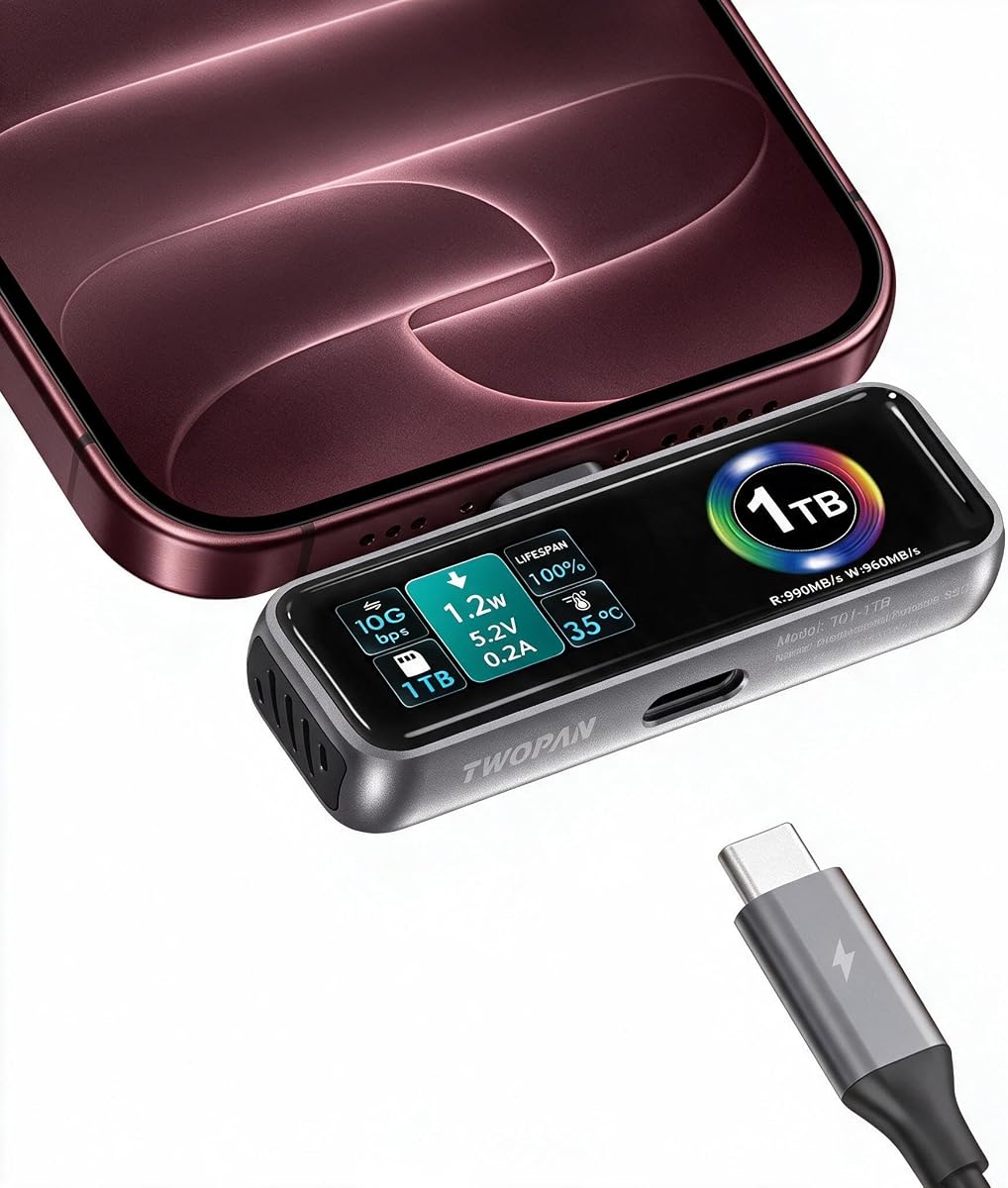
The TWOPAN 1TB Magnetic iPhone SSD is built for creators who want more than passive storage. It has a 4.0 rating, 1TB capacity, claimed read and write speeds of 990MB/s and 960MB/s, and a built-in LCD that shows storage activity and connection status.
We may earn a commission when you buy through this link, at no additional cost to you.
Its most useful differentiator is the combination of direct Apple ProRes 4K 60fps recording and active cooling. The silent fan is intended to reduce thermal throttling during intensive transfers and long recording sessions. A USB-C port with PD 3.0 support can also keep an iPhone powered while the drive is in use, and a magnetic connection provides an alternative to direct plugging.
This is a feature-rich design, but it is not as pared down as a conventional creator SSD. The display, fan, controls, and charging behavior add bulk and complexity relative to simpler magnetic models. Its own guidance also notes that the iPhone can heat during 4K ProRes recording and that excessive heat may shorten recording time, making separate phone cooling relevant for extended sessions.
The drive is best for a creator who values an integrated status display, active cooling, and charging in one mobile accessory. It may be excessive for someone who only needs occasional file storage, but for long or complex shoots, those features can make the workflow easier to monitor and manage.
A built-in noiseless fan circulates air around the drive's internal electronics during demanding transfers. This is particularly relevant for extended ProRes sessions, although users should still consider phone cooling because heat from either device can affect the overall setup.
The LCD provides quick feedback about activity and connection state. That can save time during a shoot by making it easier to confirm that the phone recognizes the drive and that transfers are progressing as expected.
We may earn a commission when you buy through this link, at no additional cost to you.
The Vezzio 512GB Magnetic Portable SSD is a compact and approachable choice for creators who need direct ProRes recording without paying for the largest or most elaborate mobile storage system. Its supplied rating of 4.7 is the highest among the ten products, and the specification combines 512GB of capacity with up to 510MB/s reads and 470MB/s writes.
We may earn a commission when you buy through this link, at no additional cost to you.
The magnetic design attaches to a compatible phone, and the included ring supports devices without native MagSafe. The drive can record 4K 60fps Apple ProRes directly with the iPhone 15 Pro, Pro Max, and newer compatible devices. Its aluminum alloy body resists scratches, dissipates heat, and is rated to withstand falls of up to 3.94 feet.
Compared with 1TB and 2TB models, half a terabyte will require more frequent transfers and is likely to be less suitable for a multi-day location shoot. Transfer speed is also lower than the 990MB/s and 2,000MB/s headline figures of certain alternatives. Nevertheless, 510MB/s is a useful speed for editing media and backing up a day's images.
The Vezzio is a sensible first external drive for a compatible iPhone filmmaker who values compactness, simple magnetic attachment, and a strong listed rating. It is particularly attractive for short productions and travel. Creators with longer schedules should consider whether the available capacity will remain sufficient throughout their project.
The slim magnetic form factor is designed to remain practical in a pocket or small production bag. A separate magnetic ring expands attachment options for compatible devices, making the drive useful across more than one mobile setup.
The aluminum alloy enclosure provides a practical surface for heat dissipation while adding scratch resistance. It remains important to use the correct connection and monitor both phone and drive during sustained high-resolution recording.
We may earn a commission when you buy through this link, at no additional cost to you.
The 960G Magnetic Portable SSD occupies a useful middle ground between the 512GB and 1TB products in this list. It carries a 4.4 rating, offers 960GB of storage, and advertises USB 3.2 Gen 2×2 transfer performance of up to 2,000MB/s through a 20Gbps computer interface.
We may earn a commission when you buy through this link, at no additional cost to you.
For ProRes shooters, the key feature is direct 4K 120fps HDR recording on the iPhone 16 Pro Max. Magnetic attachment keeps the drive near the phone during handheld work, and an additional ring extends the option to compatible Type-C Android phones. The drive also supports iPhone 15, 16, and 17 families, tablets, computers, and other compatible USB-C equipment.
Its capacity is less generous than a true 1TB or 2TB SSD, even though the marketed figure is close to one terabyte. The 2,000MB/s rate is also a peak interface claim, and recording performance will depend on the phone, application, cable, and thermal conditions. Still, the combination of speed and capacity is attractive for creators who need room without moving to a larger premium model.
Choose this drive for fast ProRes 4K 120fps workflows centered on the listed compatible iPhone models. It is a strong option for transfers between a phone and modern computer, though buyers should assess whether a higher-capacity drive would reduce interruptions during extended productions.
At 960GB, the drive provides substantially more space than a typical 512GB option while staying below a full terabyte. That can be enough for a substantial working set of high-quality clips while remaining easier to manage as a single production drive.
The 20Gbps interface offers a strong foundation for modern USB-C systems. Actual performance will vary with host hardware, so creators should not assume that a phone, tablet, or older computer will deliver the full advertised transfer rate.
We may earn a commission when you buy through this link, at no additional cost to you.
The Dylesn 512GB ProRes Creator SSD is a simple portable drive aimed at content creators who need a USB-C connection and direct ProRes recording. It has a supplied rating of 3.7, the lowest in the group, while claiming USB 3.2 Gen 2×2 performance of up to 1,050MB/s read and 950MB/s write.
We may earn a commission when you buy through this link, at no additional cost to you.
The drive supports direct 4K ProRes recording on compatible iPhone 15 and 16 Pro devices. Plug-and-play operation extends across Windows, macOS, Chromebook, and iOS systems with Type-C connections. Its lightweight aluminum-style casing is designed for portability, and the included silicone case contributes IP65 dust and water resistance and protection from drops up to three meters.
One important limitation is the absence of magnetic attachment, an LCD, charging, or a built-in fan. That keeps the design uncomplicated, but it also means the user must connect and monitor it manually. The relatively low 3.7 rating and the mixed naming within the product information warrant checking the final listing details carefully before purchase.
This model is best for creators who want a straightforward, durable external drive and already have a reliable way to attach it to the phone. It may not suit a mobile shooter who prioritizes rapid magnetic setup, real-time status information, or a powered extended-recording rig.
The drive combines high-resolution recording support with broad compatibility across computers, tablets, and Type-C phones. That flexibility allows it to serve as both an active recording target and a portable archive during the same production.
The included silicone case adds resistance to dust, water, and impacts. It is a useful companion for location work, although the drive should still be disconnected and stored safely when it is not in active use.
We may earn a commission when you buy through this link, at no additional cost to you.
The TWOPAN 2TB MagSafe Pro SSD is the most functionally ambitious product in the guide, combining high capacity with security, cooling, monitoring, charging, and creator-oriented connectivity. Its supplied rating is 4.1, and it claims 990MB/s read and 960MB/s write performance alongside 2TB of storage.
We may earn a commission when you buy through this link, at no additional cost to you.
Fingerprint security allows the user to register multiple fingers and unlock the drive without a software-based password workflow. A real-time LCD tracks transfer speed, voltage, temperature, and drive health, while a noiseless fan helps manage heat. The magnetic body supports MagSafe-compatible iPhones, and the USB-C port supports 40W Power Delivery, AR glasses, and external monitors.
For ProRes work, the drive supports direct Apple ProRes 4K 60fps recording with the iPhone 15 and 16 Pro families. It can also expand Steam Deck storage, connect to a USB-C microphone, and accept photos or 4K video from cameras. These extras make it a genuine mobile hub rather than merely a storage stick, but they also increase complexity and may be unnecessary for a simple mobile-recording need.
Choose this model for a creator who values privacy, live diagnostics, high capacity, and an expanded device ecosystem. It is a particularly compelling option for a multi-purpose production kit, although buyers should verify the fingerprint and accessory behavior on their exact devices before relying on it during a critical assignment.
Registering multiple fingerprints offers a quick way to unlock the drive without entering a conventional password. The drive remains locked on other devices until access is approved, which is useful when sensitive footage is being moved among several devices.
The USB-C connection and 40W charging can work with external displays, AR glasses, microphones, and other compatible accessories. This turns the drive into a mobile hub for creators who want more than passive file storage.
We may earn a commission when you buy through this link, at no additional cost to you.
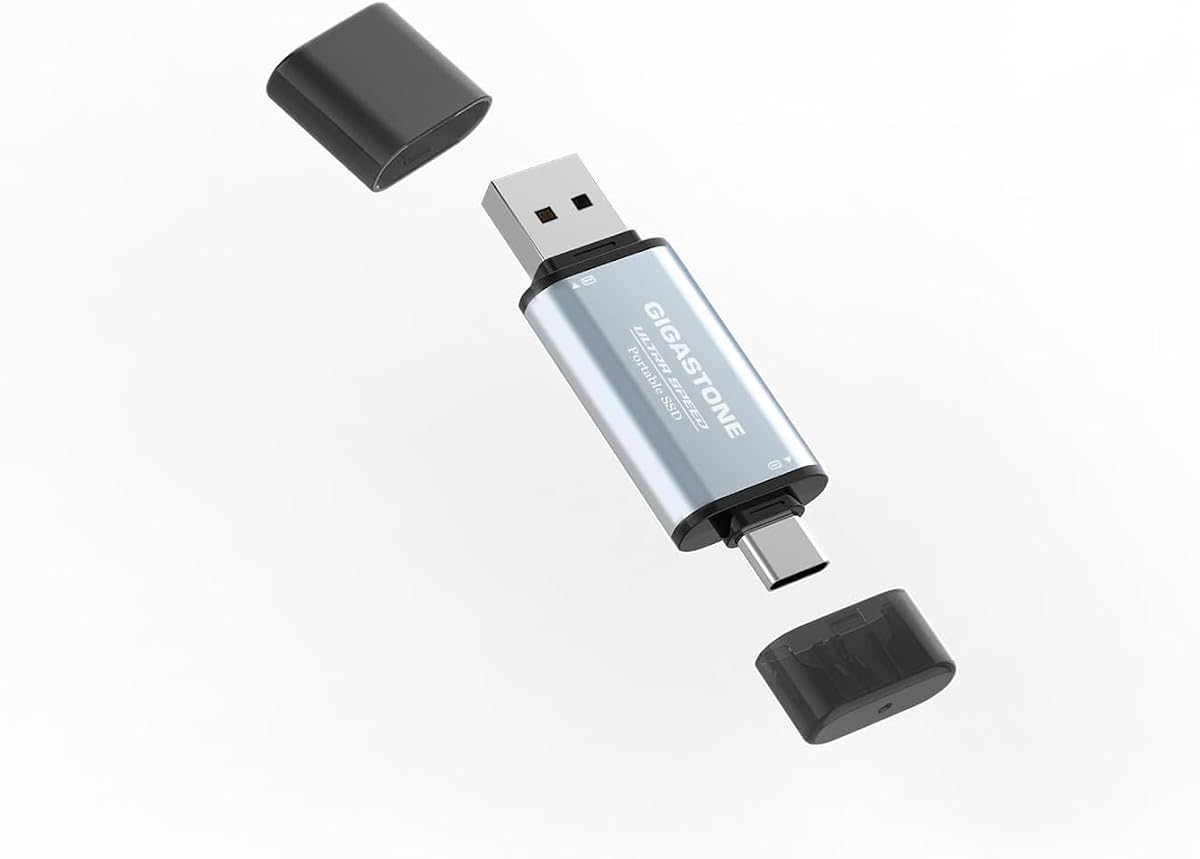
The Gigastone 1TB USB-C+A SSD is a practical traditional portable SSD that brings together a 1TB capacity, dual connectors, and direct ProRes support. Its supplied 5.0 rating is the highest listed in the group, although that figure should be considered alongside its more modest stated transfer speed.
We may earn a commission when you buy through this link, at no additional cost to you.
USB 3.2 Gen 2 performance is rated at up to 500MB/s, and the product is designed for compatible iPhone 15 and 16 Pro and Pro Max models. It supports direct 4K 60fps ProRes HDR recording, allowing a creator to save video directly to the drive rather than first filling the phone's internal storage.
The combination of USB-C and USB-A is a major practical advantage when moving between an iPhone, laptop, and other compatible systems. It also supports use with PlayStation 5, MacBook, iPad, Android, and other OTG devices. The trade-off is that it lacks magnetic attachment, a status display, active cooling, and the very high transfer rates advertised by several premium alternatives.
This drive is a strong recommendation for creators who value straightforward dual-interface compatibility and warranty coverage. It is less compelling for someone who needs a complete magnetic rig or immediate visual confirmation of recording status, but it covers the essential ProRes and transfer requirements without unnecessary complexity.
Having both USB-C and USB-A reduces the need to carry different adapters when moving between newer and legacy systems. It also gives the drive a broader role than a phone-specific accessory, especially when a production kit includes several kinds of equipment.
Saving ProRes footage directly to the drive helps prevent internal phone storage from filling during a shoot. This is especially valuable for creators using a high-quality codec, where even a short sequence can create a large collection of files.
We may earn a commission when you buy through this link, at no additional cost to you.
The SSK 4TB Dual USB SSD offers the largest storage capacity in this comparison and a fast USB 3.2 Gen 2 interface, but it sits apart from the drives explicitly designed for direct ProRes capture. Its supplied rating is 4.6, and it claims read and write performance of up to 1,000MB/s.
We may earn a commission when you buy through this link, at no additional cost to you.
The stick combines a USB-C connector with a USB-A 3.2 connector, making it convenient for moving high-resolution photos, videos, and other large files between compatible phones, tablets, computers, smart TVs, and car-audio systems. Its high-grade zinc alloy shell is designed for shock resistance and heat dissipation, while the double-head cover protects both interfaces.
Unlike several magnetic creator SSDs, the product information does not advertise direct ProRes recording, an LCD, active cooling, or PD charging. It also explicitly notes incompatibility with Lightning ports. The result is a high-capacity portable file store that may be useful for archiving completed footage, but it is not the most specialized option for recording ProRes on an iPhone.
Choose the SSK when capacity and cross-device file movement are the priorities, perhaps as an archive companion to a dedicated recording SSD. For direct mobile ProRes capture, a purpose-built model with explicit iPhone and recording support is the safer choice.
The 4TB capacity is useful for preserving completed ProRes projects, RAW libraries, and large media collections. Because it is not presented as a direct recording drive, it works best as a spacious archive or general-purpose transfer device.
The dual-head design provides broad plug-and-play compatibility across USB-C and USB-A systems. It is simple to carry and use, although it lacks the magnetic convenience and integrated status feedback offered by more purpose-built mobile creator drives.
We may earn a commission when you buy through this link, at no additional cost to you.
The right drive depends on your iPhone model, recording application, shooting duration, and need for a mobile rig. Capacity, direct ProRes support, sustained performance, attachment method, cooling, and device compatibility should be considered together rather than in isolation.
In short, verify the complete recording chain rather than relying on the drive alone.
In short, choose enough free capacity to survive a full shoot without an emergency offload.
In short, prioritize reliable sustained transfer over the largest printed number.
In short, consider both drive and phone cooling when planning an all-day recording schedule.
In short, select the attachment method that you will actually use reliably under pressure.
In short, check the exact port, iPhone model, and application rather than relying on a broad device list.
In short, prioritize core recording reliability before optional creator features.
In short, favor a rugged enclosure and protective accessories for frequent location work.
Before recording, confirm that the iPhone model and application support the intended ProRes format, connect the drive using the appropriate USB-C cable or magnetic arrangement, and verify that the operating system recognizes it. Format the drive with a compatible file system and test a short recording before committing to a full shoot. Check available capacity and keep a backup of irreplaceable footage.
During a session, avoid removing the drive while files are being written or transferred. Monitor the phone and drive for heat, particularly during long 4K ProRes takes or sustained copying. If the phone becomes too warm, pause recording, move both devices away from direct sun, and allow them to cool. A phone cooler may extend comfortable working time in a compact mobile rig.
After shooting, copy important clips to at least one additional storage location and verify that the files open correctly before formatting or erasing the drive. Store the SSD in a protective case, keep its connectors clean, and avoid moisture, crushing pressure, and abrupt unplugging. When the drive is not in use, eject it from the host and protect it from extreme temperatures.
The products in this guide advertise direct ProRes support for various iPhone 15 and 16 Pro-family models, with some listing additional compatibility. The exact combination can depend on the drive, cable, phone model, storage capacity, and recording application. Check the current product listing and the app's supported-device list before purchasing or beginning an important shoot.
Most of the mobile recording features described here depend on a USB-C connection, so they are primarily aimed at USB-C-equipped iPhones and iPads. The SSK product explicitly notes that it is incompatible with Lightning ports. An adapter may allow basic file use in some situations, but it should not be assumed to support direct ProRes recording.
The amount varies substantially with resolution, frame rate, codec variant, and clip length. High-quality ProRes files consume far more space than compressed mobile footage, so recording directly to an SSD is often more practical than relying on internal storage. Choose capacity for the entire planned shoot, then maintain a backup rather than using the final few gigabytes as working space.
No. Moving files to an SSD can reduce internal storage pressure, but it does not eliminate heat generated by the phone's camera, display, encoder, and processor. Active cooling in an SSD may help the drive maintain performance, and a phone cooler can help the phone. For long recordings, monitor both devices and pause when either becomes uncomfortably hot.
A magnetic drive is usually quicker to position for handheld shooting and can remain attached during movement. A cable-connected drive may be more universally compatible and avoid concerns about alignment or magnetic attachment. The better choice depends on the rig, available ports, and whether you value fast mobile setup or broader cross-device use.
Many editing applications can work with files stored on an external drive, provided the application supports the format and the SSD meets its performance requirements. Fast transfer speeds help with importing and previewing, but sustained performance, reliable connections, and available space are also important. A separate fast internal drive may still be useful for caching and final project storage.
No. The guide includes magnetic USB-C models, dual-interface USB-C and USB-A devices, and a traditional dual-head flash drive. Compatibility also depends on the host operating system and the application used for recording. Format the drive in a way supported by every device in your workflow and recheck compatibility before moving between systems.
Treat external SSDs as active production tools rather than the only location for irreplaceable footage. Copy clips to a second drive or computer, verify the files, and keep more than one backup before erasing the original. Protect the device from impact, moisture, extreme heat, and accidental disconnection, particularly while a recording or transfer is underway.
The Sandisk 1TB Creator Phone SSD is the most balanced choice for compatible iPhone filmmakers, combining direct 4K 60fps ProRes recording, up to 1,000MB/s reads, 1TB of capacity, MagSafe attachment, and an IP65 durability rating. The Sandisk 2TB version is the premium high-capacity alternative, while the Vezzio 512GB model stands out as a compact, well-rated option for shorter mobile productions.
The other selections cover distinct creator needs. The 512G and 960G magnetic drives emphasize very high claimed transfer rates and 120fps ProRes support. TWOPAN models add displays, active cooling, charging, and advanced connectivity, with the 2TB version also providing fingerprint security. Gigastone focuses on dual-interface practicality, while SSK prioritizes maximum capacity as a general-purpose archive.
Before ordering, verify the exact iPhone model, application, connector, recording mode, and sustained performance requirements. Specifications and product availability can change, and current pricing should be checked across retailers and at the time of purchase. Prioritize proven compatibility and enough capacity for the full shoot rather than relying only on a peak transfer figure or extra feature.