
Earthquake Acreage Tow-Behind Mower
4.2Editor score
Seventeen-and-a-half HP engine
Three-inch brush capacity
Four-foot lateral offset
Tool-less height adjustment
A brush cutter for tractor must balance cutting capacity, drivetrain protection, deck strength, and safe control in dense vegetation. The right implement depends on tractor horsepower, hitch type, terrain, and whether you need to mulch brush, clear roadside growth, or maintain pasture.
This guide compares ten tractor brush cutters, tow-behind mowers, flail mowers, and handheld-compatible attachments using published specifications, stated brush capacities, cutting widths, mounting systems, and structural features. The list covers three-point, PTO, skid-steer, ATV, and walk-behind options.
Each review identifies the strongest application and important trade-offs, from PTO compatibility to cutting-height control and debris management. Ratings and specifications reflect the supplied listing information, while prices and availability can change, so readers should verify current details before purchasing.
4.2Editor score

3.7Editor score

4.2Editor score
As an Amazon Associate we earn from qualifying purchases.
The comparison covers tractor-mounted, tow-behind, skid-steer, ATV, walk-behind, and handheld brush-cutting formats, highlighting the practical differences in cutting width, brush capacity, power source, mounting method, and terrain handling.




The Ag-Rite 48 Inch Brush Hog is a PTO-driven rotary cutter built around a reinforced 6-gauge steel deck. Its listed 48-inch cutting width, 1.5-to-11-inch height adjustment, and stated ability to cut brush up to 2 inches in diameter make it a substantial choice for medium tractors. No customer rating was supplied, so buyers should place more weight on the published specifications and tractor fit.
We may earn a commission when you buy through this link, at no additional cost to you.
The strongest feature is its mechanical protection. A cast iron gearbox rated for 65 HP and a 540 RPM PTO shaft with a slip clutch help absorb shock loads caused by rocks, stumps, and concealed debris. Two free-swinging blades ride on a balanced stump-jumper pan, allowing them to move around obstructions rather than acting as rigid cutting edges. That arrangement is especially relevant in pasture, woodland edges, and neglected ground.
The deck measures 0.19 inches thick, which the listing describes as nearly twice the thickness of many 12-gauge rotary cutters. A laminated 15-inch tail wheel provides an unusually broad height range, and front and rear chain guards help contain thrown vegetation. The trade-offs are practical: the product is restricted to tractors between 22 and 50 HP, and compatibility must include either a Cat 1 or Cat 2 three-point hitch, with Quick Hitch support listed.
This is a compelling option for owners with a mid-range tractor who need more cutting width and brush capacity than a compact rotary cutter provides. It is less appropriate for very small tractors or operators needing a pull-behind implement. Before buying, confirm hitch category, PTO speed, drawbar and clearance dimensions, and whether the tractor can operate the implement safely at the required height.
The heavy deck and stump-jumper pan target the conditions that cause ordinary rotary cutters to slow down or sustain damage. Its robust construction is most useful where hidden rocks, uneven soil, and dense vegetation are likely rather than on a regularly maintained lawn.
A 1.5-inch setting supports close pasture maintenance, while the 11-inch maximum allows taller material to be managed during a first clearing pass. This range lets one implement handle both finish mowing and substantial brush reduction.
We may earn a commission when you buy through this link, at no additional cost to you.
This 47.24-inch tow-behind flail mower offers a different approach to tractor cutting: it runs from a 15-horsepower, 420cc gas engine and is towed by an ATV or UTV through a 2-inch ball receiver. Its 4.0 supplied rating reflects generally favorable feedback, while the design emphasizes all-terrain weed removal, orchard work, roadside vegetation, and large areas of heavy grass.
We may earn a commission when you buy through this link, at no additional cost to you.
Unlike a conventional rotary cutter, the flail rotor uses multiple high-speed blades to cut and pulverize vegetation. The listing says the resulting clippings are spread evenly across the ground, helping return organic matter to the soil, retain moisture, and suppress some weed growth. A 1200mm, or approximately 47-inch, swath allows an operator to cover substantial acreage in fewer passes.
Its floating rotor, four supporting wheels, enclosed shroud, anti-tangle design, and sealed dust-proof bearings are notable for work on ridges, slopes, and gravel paths. Stepless cutting-height adjustment from 25 to 60mm provides a narrow but useful range. The 2-inch ball connection is straightforward for compatible recreational vehicles, although it is not a three-point tractor hitch and therefore limits use with conventional tractors.
Choose this mower if you already operate an ATV or UTV and need a wide flail attachment for orchards, hillsides, firebreak edges, or overgrown land. It is less appropriate for buyers who expect a tractor PTO connection or want to cut thick, woody saplings comparable to heavy-duty rotary cutters. Confirm receiver rating, towing capacity, terrain slope limitations, and available space for maneuvering.
High-speed flails are suited to tall, dense growth and crop residue because they produce a finely mulched discharge. That makes the mower useful when the objective is vegetation removal and ground coverage, not simply a neat surface cut.
The floating rotor and four-wheel support help maintain operation over ridges and slopes. The enclosed shroud and anti-tangle rotor also address common hazards in heavy weeds, where exposed moving components and wrapping vegetation can quickly become problems.
We may earn a commission when you buy through this link, at no additional cost to you.
The Titan Attachments 6-Foot PRO Series is a rear-discharge rotary cutter built for Cat 1 tractors. Its combination of a six-foot deck, 75 HP cast iron gearbox, 540 RPM PTO, and slip-clutch shaft gives it a strong specification profile for broad pasture, field-edge, and brush-clearing work. The supplied 3.7 rating is respectable, although it trails some lighter options in customer feedback.
We may earn a commission when you buy through this link, at no additional cost to you.
Its replaceable, heat-treated sheer blades are stated to handle vegetation up to 2 inches in diameter. A solid rubber tail wheel provides a generous cutting-height range from 1.2 to 12 inches, allowing close pasture mowing or a higher first pass through dense growth. Rear discharge spreads trimmed material behind the cutter, and rubber debris guards help limit flying fragments.
The 75 HP low-noise cast iron gearbox is a notable feature for owners with higher-powered tractors, while the shock-absorbing slip clutch helps protect the drivetrain during sudden overloads. The main restriction is the Cat 1 three-point hitch requirement. Quick Hitch compatibility is listed, but operators should still verify their tractor's hitch geometry, hydraulic and PTO specifications, and clearance.
This is the most compelling choice in the roundup for a high-capacity three-point implement with a large cutting width. It suits owners who routinely clear fields, tree saplings, and dense brush and want a broad adjustment range. Those with smaller tractors may find it oversized, while those seeking an offset mower or flail action should consider a different format.
A slip-clutch PTO shaft is especially valuable when the cutter encounters unexpected rocks, roots, or stumps. It helps isolate shock loads rather than transmitting every impact directly through the tractor drivetrain.
The six-foot width reduces the number of passes needed on open pasture and field edges. Rear discharge also returns chopped vegetation to the worked area rather than collecting it in a bag or side chute.
We may earn a commission when you buy through this link, at no additional cost to you.
The Earthquake Acreage is a 44-inch rough-cut mower built around a 17.5-horsepower Briggs & Stratton engine. Its supplied 4.2 rating is among the stronger results in the group, and the combination of three-inch brush capacity, pivoting break-away blades, and substantial lateral offset makes it particularly useful for properties where a standard centered mower cannot reach.
We may earn a commission when you buy through this link, at no additional cost to you.
The mower can be offset up to four feet in either direction from the tow vehicle. That makes it useful for cutting beneath tree limbs, along ditch slopes, near trails, and around obstacles without repositioning the towing vehicle constantly. Tool-less cutting-height adjustment ranges from 3.5 to 7.5 inches, allowing rapid changes as grass density and ground conditions vary.
The two pivoting blades are designed to swing away from rocks and stumps, helping protect the blades and drive system. Debris shielding, front and rear chain guards, steel wheel bumpers, and an 11-gauge steel deck add to its rough-terrain construction. An included battery powers the keyed electric start, while a blade-engagement lever provides simple remote operation.
This is a premium pick for owners who want independent engine power, pronounced offset reach, and the ability to handle brush and saplings up to 3 inches. The main complication is logistics: the listing specifies large steel-crate shipping dimensions and warns that pickup requires fork extensions and a trailer with removable sides. Check towing capacity, ball-coupler compatibility, terrain, and delivery arrangements before ordering.
The four-foot offset in either direction changes the mower's relationship to the tow vehicle. This is valuable around trees, along uneven banks, and beside obstacles where the tractor or mower would otherwise need to enter the vegetation.
The break-away blade pivots help prevent a hard collision from transferring directly into the drivetrain. Debris management and guarded cutting areas further support dependable use in tall, tangled growth.
We may earn a commission when you buy through this link, at no additional cost to you.
The Husqvarna BCA850 is a brush-cutter attachment for select Combi products, specifically the 543RBK and 336RK according to the supplied information. It has a 4.2 supplied rating and occupies a very different position from the large tractor implements in this guide: it extends an existing powered handheld platform rather than connecting to a tractor's PTO or three-point hitch.
We may earn a commission when you buy through this link, at no additional cost to you.
Its principal benefit is versatility at a relatively accessible purchase point. The attachment is described as powerful and versatile for thicker grass, weeds, and brush, while the quick, simple connection makes it convenient to switch tasks without carrying separate complete tools. The same platform can therefore support trimming, brush cutting, and other compatible applications.
The main limitations are substantial. Its listed compatibility is narrow, so owners must verify the exact model of their Combi product before purchase. It also offers no stated cutting width, brush diameter, or cutting-height information, making it less suitable for large acreage or dense woody growth. A tractor attachment would offer far more reach and cutting capacity for demanding work.
This is the budget choice for someone who already owns a compatible Husqvarna Combi product and needs a compact brush-cutting task. It may also suit landscaping or property-maintenance work requiring maneuverability around obstacles. It is not the answer for operators seeking a tractor-powered mower, wide swath, or heavy brush clearance across broad land.
The attachment approach allows an existing compatible Combi product to serve multiple cutting tasks. That versatility can be valuable for users who need maneuverability more than the productivity of a wide tractor implement.
The attachment fits the listed 543RBK and 336RK models. Confirm the exact product designation before ordering, because attachment interfaces are generally model-specific and incorrect assumptions can lead to an unusable purchase.
We may earn a commission when you buy through this link, at no additional cost to you.
The MechMaxx KDK72H is a 72-inch PTO flail mower intended for tractors from 50 to 75 horsepower. It offers a broad working width for agricultural fields and roadside maintenance, with a heavy-duty 1.375-inch Z6 PTO spline and standard 540 RPM speed for connection to compatible tractors. No customer rating was supplied, so the published configuration is the primary basis for evaluation.
We may earn a commission when you buy through this link, at no additional cost to you.
Its most useful feature is the hydraulic side-shift three-point linkage. This allows the operator to shift the cutting deck sideways while retaining the tractor's three-point mounting arrangement. That versatility can help maintain alignment along roads, access edges, or adjust the mower's position relative to obstacles. The linkage is described as rigid and stable during faster or difficult operations.
An integrated spring-loaded automatic belt tensioner is intended to maintain correct belt tension and reduce wear. Adjustable side skids help control cutting height and protect the mower from contacting the ground too aggressively on uneven terrain. The 72-inch width covers large areas quickly, making it attractive for farm-scale mowing where a smaller attachment would require numerous passes.
This mower is best for operators with a tractor inside the specified horsepower range who need a wide flail deck and hydraulic positioning. It is not the simplest choice for a lower-powered tractor, and it may be excessive for small parcels. Confirm PTO spline, hydraulic requirements, rear linkage geometry, operating clearance, and whether the tractor can safely support the machine's transport and working loads.
Side shifting lets the mower reach beyond or alongside the tractor's centerline. This is particularly helpful along roadsides, near drainage features, and around uneven boundaries where alignment changes frequently.
A spring-loaded belt tensioner is designed to keep the drive system aligned as conditions change. The stated benefit is less belt wear and more consistent transfer of power during extended mowing work.
We may earn a commission when you buy through this link, at no additional cost to you.
The Swisher RC11544CL is an 11.5-horsepower, 44-inch tow-behind rough-cut mower with a supplied rating of 5. It is explicitly designed for rough cutting rather than finish mowing, and its stated ability to cut brush and saplings up to 3 inches in diameter positions it as a capable option for neglected grass, pasture, and overgrown property edges.
We may earn a commission when you buy through this link, at no additional cost to you.
A remote operator console allows the user to engage the blades from the towing vehicle. This removes the need to leave the driver's position whenever blade engagement must change, which is convenient during long mowing sessions. The offset hitch supports left- or right-side towing, helping the operator reach fence lines, edges, and tighter spaces without moving the tow vehicle into the vegetation.
Single-point height adjustment sets the cutting height between 3 and 7 inches. That range is practical for rough grass and brush but, together with the product's explicit design purpose, confirms that it is not the right implement for a neatly manicured lawn. The 44-inch width gives a balance between coverage and towing maneuverability.
Choose this mower for property owners who need efficient rough clearing and already have a suitable towing vehicle. It is a strong choice where remote blade control and flexible offset towing matter. Buyers should confirm the hitch type, towing capacity, engine starting procedure, terrain limitations, and clearance around trees before purchase.
The towing-position console simplifies blade engagement without requiring the operator to walk to the mower. That is particularly useful when working around obstacles or changing cutting conditions frequently.
The ability to tow on either side provides access beneath branches and around close boundaries. It also helps keep the tow vehicle on firmer ground while the mower reaches into the intended cutting area.
We may earn a commission when you buy through this link, at no additional cost to you.
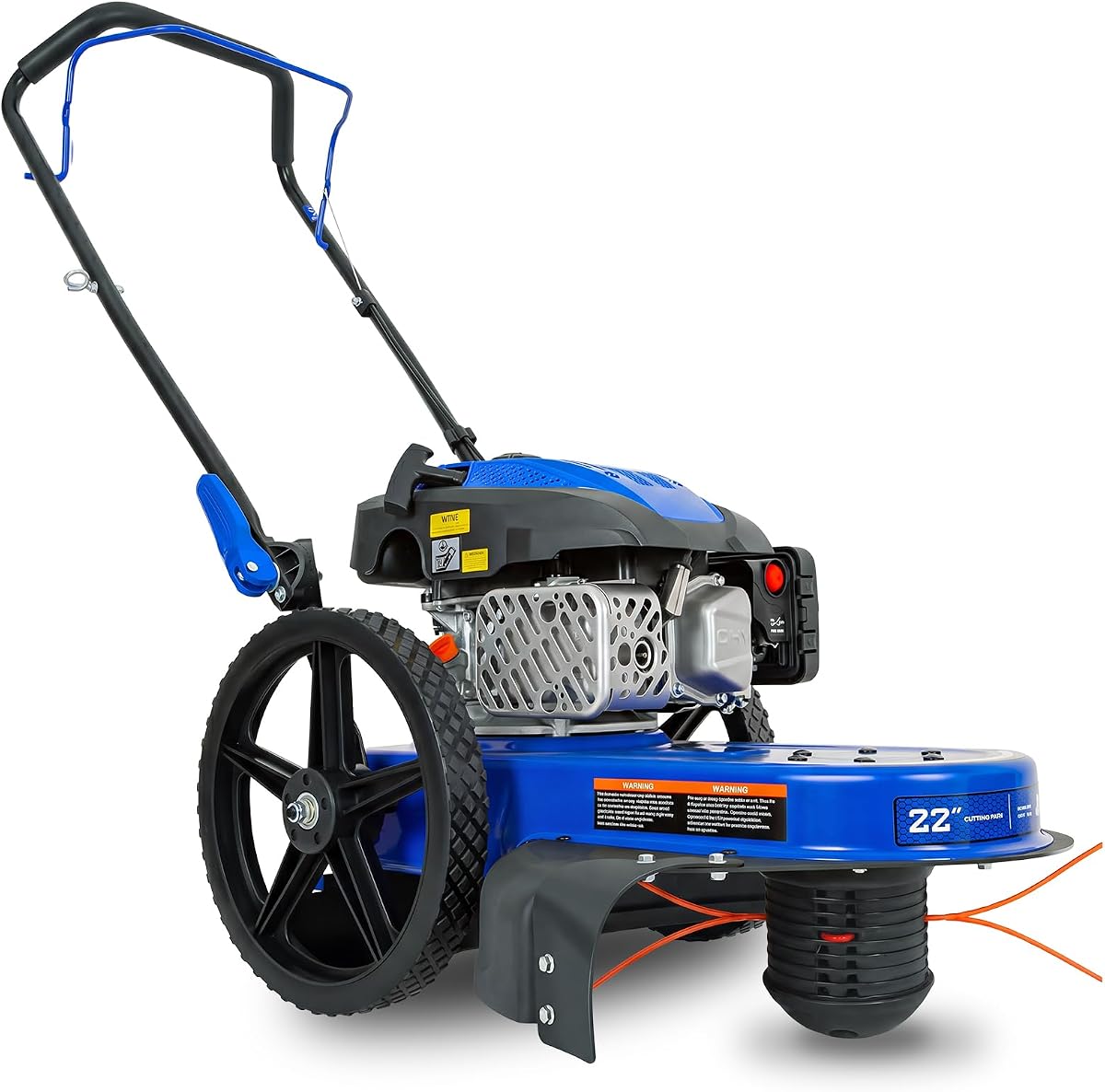
The BILT HARD Walk Behind String Trimmer is a compact 22-inch push mower powered by a 170cc four-cycle OHV gas engine. Its supplied rating is 4.1, and its defining advantage is access rather than capacity. It is designed for tall grass, weeds, and light brush in places where a tractor or full-size mower cannot maneuver easily.
We may earn a commission when you buy through this link, at no additional cost to you.
A one-piece steel deck provides a rigid foundation and is intended to reduce vibration. The nylon line creates a 22-inch cutting path, while 14-inch never-flat wheels help it travel over varied ground. A foldable ergonomic handle improves handling and allows more compact storage, useful for users with limited garage or shed space.
This machine is not intended to match a rotary cutter's ability to cut woody saplings. Its 22-inch path is much narrower than most tractor attachments, so it is better suited to fence lines, narrow paths, landscaping edges, and localized patches of overgrowth. Manual recoil starting is straightforward but offers none of the convenience of an electric-start engine.
For a farmer or property owner with large acreage, this is a complementary tool rather than a primary tractor brush cutter. It is most useful for finishing areas that a wider implement cannot safely enter. Check the available cutting line, engine servicing requirements, terrain, and local guidance concerning gas-powered equipment before operating it.
The walk-behind format lets the operator guide the mower directly through confined spaces. It is especially helpful along fences, around landscaping obstacles, and in paths where steering a tractor would be awkward or unsafe.
Four wide, flat wheels support the machine as it rolls through grass and uneven ground. Their never-flat design also reduces the chance of a puncture interrupting a small but tedious cleanup project.
We may earn a commission when you buy through this link, at no additional cost to you.
This 72-inch skid-steer brush cutter is designed for loader operators who need a wide clearing attachment for tall grass, dense brush, and brush up to 3 inches in diameter. Its 66-inch stated cutting width, 72-inch deck, 25-horsepower gearbox, and bi-directional blades support substantial cutting work. No customer rating was supplied, so fit and operating requirements deserve careful attention.
We may earn a commission when you buy through this link, at no additional cost to you.
The open-front deck allows vegetation to flow into the cutting area rather than pushing a dense wall ahead of the machine. A stump-jumper design helps the attachment move over roots, stumps, and uneven ground, while the stated 2-inch minimum cutting height provides a reasonable starting point for pasture and overgrown land management.
The loader must provide the proper hydraulic flow. The headline includes 16–22 GPM, while the detailed description specifies 14–20 GPM, so operators should resolve that discrepancy with the manufacturer or seller before operation. The attachment also weighs 1,000 pounds and measures 78 by 72 by 20 inches, making transport and storage considerations significant.
This brush cutter suits owners with a suitably equipped skid steer who need broad, rapid coverage. It is not compatible with a conventional tractor's three-point hitch, and its size may exceed the capacity of smaller loaders. Verify loader operating weight, attachment interface, hydraulic flow, skid-steer controls, gearbox oil requirements, and transport width before purchase.
The open-front arrangement helps tall vegetation enter the cutting system rather than accumulating in front. This design can improve clearing consistency in dense, overgrown areas where a fully enclosed nose would trap material.
A wide cutting deck is only effective when the loader can supply stable hydraulic flow. Matching flow, operating weight, and control requirements helps prevent poor performance or an overtaxed attachment system.
We may earn a commission when you buy through this link, at no additional cost to you.
The EGO POWER+ BCA1220 is a 12-inch brush-cutter attachment for the EGO Multi-Head System, requiring the PH1420 power head and a compatible battery. It has the second-highest supplied rating in the group at 4.6 and offers a battery-powered alternative for overgrown brush, thick stalky vegetation, and saplings up to 1 inch in diameter.
We may earn a commission when you buy through this link, at no additional cost to you.
A three-tooth steel blade rotates at up to 6000 RPM. The carbon-fiber shaft is backed by a lifetime warranty, while IPX4-rated weather-resistant construction makes the attachment suitable for ordinary outdoor work in wet conditions. As a compact cordless tool, it removes exhaust fumes from the immediate cutting area and can be moved without starting a tractor or managing a long PTO driveline.
The trade-off is capability and ecosystem dependence. At 12 inches, its cutting width is small compared with every tractor-mounted implement in the list, and its stated one-inch sapling capacity is well below the two- and three-inch brush ratings of the heavy rotary and rough-cut mowers. The PH1420 power head is sold separately, and the attachment is designed exclusively for that platform.
This is an excellent supplementary choice for homeowners, arborists, landscapers, and farmers who need quick access to brush around structures, trees, or garden edges. It should not be chosen as the main tool for clearing fields or large tracts. Confirm the full EGO ecosystem availability, battery runtime, and whether the compact attachment can reach all of the areas that need cutting.
Cordless operation removes the need to transport fuel, manage an engine starting procedure, or route a PTO shaft. That convenience makes the attachment useful for targeted work around landscaping and property structures.
The attachment is designed for the EGO Multi-Head System and the PH1420 power head. This platform approach allows owners to consolidate tasks, but compatibility must be confirmed before purchase.
We may earn a commission when you buy through this link, at no additional cost to you.
The right brush cutter depends on tractor power, attachment style, vegetation density, terrain, and the amount of area you need to cover. Begin with the tractor's capabilities, then prioritize the cutting system and protection features that match your work.
Start with the tractor's horsepower and PTO specifications because the implement's gearbox, shaft, and cutting load must operate within safe limits. The Ag-Rite is listed for 22–50 HP tractors, the Titan gearbox for tractors up to 75 HP, and the MechMaxx for 50–75 HP models. Confirm 540 RPM where specified and verify whether your tractor has a rear PTO before considering these options.
Match the implement's rated power to the tractor rather than choosing solely by cutting width. A wider deck can demand more torque and drawbar control than a smaller machine.
Rear three-point attachments must match the tractor's hitch category and geometry. The Ag-Rite supports Cat 1 or Cat 2, while the Titan requires a Cat 1 hitch and lists Quick Hitch compatibility. A three-point mower should also have adequate clearance for the deck, stabilizer, tail wheel, terrain, and the tractor's rollover protection.
Use the tractor manual to confirm hitch class and implement dimensions. Do not rely on appearance or approximate pin dimensions alone.
Tow-behind mowers offer independent engines and can be used with tractors, ATVs, or other suitable vehicles when their hitch ratings are met. The Earthquake uses a 2-inch ball coupler with an adjustable tongue, while the ATV flail mower requires a 2-inch ball receiver. The Swisher uses an offset towing arrangement with remote blade control.
Check hitch type, receiver rating, tongue height, towing capacity, and terrain before ordering. A nominally compatible hitch may still operate poorly if the tow vehicle lacks sufficient weight or braking control.
Cutting width determines how quickly you can cover open ground. The MechMaxx offers 72 inches, the Titan 6 feet, the Ag-Rite and Swisher 44 and 48 inches, while the EGO attachment cuts only 12 inches. Wider implements reduce passes but require more space, power, transport capacity, and maneuverability.
For large fields, prioritize width. For fenced properties, tree-lined areas, or narrow trails, a smaller implement may be more practical despite additional passes.
Brush diameter indicates the maximum size of woody growth an implement is designed to handle. The Earthquake and Swisher are listed for material up to 3 inches, the Ag-Rite and Titan for 2 inches, and the EGO for saplings up to 1 inch. Actual results also depend on blade speed, blade condition, density, and whether the material is green or dry.
Choose a capacity above your typical brush size rather than matching it exactly. Extra capacity adds resilience when roots, thorns, or hidden stems are encountered.
Rotary cutters use one or more rigid or swinging blades to cut vegetation into relatively large pieces. They often deliver strong brush-cutting performance and are common on tractors. Flail mowers use numerous hinged blades to chop and pulverize material, producing finer mulch that can be spread evenly across the ground.
Choose rotary action for straightforward pasture and brush reduction. Consider flail action when fine mulching, crop-residue processing, or spreading evenly chopped vegetation is the primary goal.
Deck thickness, gearbox construction, blade design, and PTO protection determine how an implement handles stones, stumps, and dense stems. The Ag-Rite highlights 6-gauge steel, a 65 HP cast iron gearbox, and a slip-clutch shaft. The Titan offers a 75 HP cast iron gearbox and shock-absorbing slip clutch, while the Earthquake uses break-away pivoting blades.
Look for multiple protection layers when entering old pasture or rocky ground. A stronger deck alone does not compensate for an inadequately protected drivetrain.
A useful height range lets one mower manage short pasture and taller brush. The Titan adjusts from 1.2 to 12 inches, the Ag-Rite from 1.5 to 11 inches, and the Earthquake from 3.5 to 7.5 inches. Offset decks, floating rotors, adjustable skids, tail wheels, and puncture-resistant wheels each influence how consistently the machine follows uneven ground.
Choose settings that preserve enough clearance for roots and stones while cutting the vegetation effectively. Test the ground first and avoid forcing the deck through obstructions.
Before first use, read the implement and tractor manuals, confirm all mounting pins, guards, chains, PTO connections, and hydraulic links, and inspect blades for cracks or damage. Match the tractor's hitch, PTO speed, horsepower, and loader flow to the manufacturer's requirements. Clear stones, wire, branches, and other debris from the work area, and keep bystanders away from the cutting deck.
Engage the PTO only while the tractor is stopped if the manual requires it, then increase speed gradually to operating RPM. On rough mowers, engage the blades at a safe distance from the tractor before entering vegetation and disengage them before backing up. Use the attachment's offset, side shift, or height adjustment as needed, but avoid abrupt turns and driving over hidden obstacles at speed.
After each session, stop the machine, disconnect the power source, and allow hot or moving components to stop before inspection. Clean grass from the deck, chain guards, wheels, gearbox, and PTO area; replace damaged line or blades; check fasteners and lubrication points; and maintain the specified gearbox oil level. The skid-steer listing specifically advises adding appropriate gear oil before use. Store the implement dry and protected from the elements.
The correct size depends on the implement's power rating and the density of vegetation. In this roundup, the Ag-Rite is intended for 22–50 HP tractors, the MechMaxx for 50–75 HP, and the Titan gearbox is rated for tractors up to 75 HP. Consider terrain, trailer and ballast requirements, and whether the tractor can safely control the implement when fully engaged.
Yes, if the implement's stated brush capacity matches the vegetation and the tractor operates within the required horsepower range. The Ag-Rite and Titan list two-inch cutting capacity, while the Earthquake and Swisher list three-inch capability. Actual performance can vary with green growth, blade condition, impact speed, and the presence of roots or stones.
A flail mower is better suited to finely chopping tall vegetation, crop residue, and dense ground cover, while a rotary cutter is often more direct for pasture and brush reduction. Flails also tend to distribute finely mulched material evenly. The best choice depends on whether your priority is aggressive brush cutting, debris processing, or finish around the edges of a property.
Not necessarily. Three-point rotary and flail mowers use the tractor's rear hitch and PTO, but tow-behind mowers connect through a trailer or ball hitch and have their own engines. Check which format your tractor supports, the implement's hitch category, and the weight and control demands of the chosen machine.
Many rough mowers can do both if their height adjustment range is suitable. The Ag-Rite offers a 1.5–11-inch range, and the Titan offers 1.2–12 inches. Always use the correct cutting height for the deck design and avoid lowering the deck into stones, roots, or very uneven soil.
Wear hearing protection, eye protection, gloves, sturdy footwear, long trousers, and other appropriate personal protective equipment. Keep people and animals outside the operating area, particularly around a 72-inch deck or an offset mower. Follow all safety instructions in the tractor and implement manuals and never remove guards.
Inspect blades before and after use, paying particular attention after striking rocks, stumps, or wire. Look for cracks, bends, looseness, and dull cutting edges, and replace damaged components according to the manufacturer's guidance. Also check that the blade hardware is tight, because vibration and repeated impacts can loosen fasteners.
Generally, no. A skid-steer brush cutter is designed for a loader with the correct mounting plate, operating weight, controls, and hydraulic flow. The 72-inch skid-steer model is not a three-point tractor implement. If you own a tractor, select a product explicitly listed as three-point, PTO, or tow-behind compatible.
The Titan 6-Foot PRO Series is the strongest tractor-focused choice for owners seeking broad cutting width, a protected cast iron drivetrain, and a two-inch brush rating. The Earthquake Acreage stands out for independent engine power, four-foot offset access, and three-inch brush capacity, while the Husqvarna BCA850 is a budget-friendly extension for compatible Combi products.
Prioritize the tractor connection before any other feature. Confirm horsepower, hitch category, PTO speed, hydraulic flow, towing capacity, and clearance, then choose cutting width and brush capacity that suit the terrain. Include debris shields, slip clutches, break-away blades, and adjustable height mechanisms when vegetation and ground conditions are difficult.
Finally, verify the latest specifications, warranty terms, delivery information, and current price directly with the seller. Product availability and pricing can change, and special shipping requirements for large or crated equipment can materially affect the total ownership experience.