
Cell Phone Booster for Home & Office
4.9Editor score
65 dB maximum gain
Up to 5,000 sq. ft.
5G and 4G LTE
All major U.S. carriers
Android Phone Signal Boosters compared for coverage, carrier compatibility, gain, installation ease, antenna options, and overall suitability.
Android phone signal boosters can improve weak cellular reception inside homes, offices, cabins, garages, and other buildings where walls, floors, or distant towers create dead zones. A worthwhile booster should receive a usable outdoor signal, support your carrier and phone frequencies, and place enough usable signal where your Android device needs it.
This guide compares ten boosters using the supplied specifications, including supported bands, maximum gain, antenna design, estimated indoor coverage, installation aids, FCC or IC certification, and customer ratings. It also distinguishes broad multi-band systems from more focused low-band boosters, helping readers compare options without assuming that every home has the same signal needs.
Each review explains who the product appears best suited for, along with its main strengths and limitations. Coverage figures are only estimates because outdoor signal, building construction, antenna placement, and carrier deployment all affect results. Product availability and pricing can change, so readers should confirm current specifications and costs before purchasing.
4.9Editor score

4.3Editor score

4.4Editor score
The table below compares the ten boosters by their intended coverage, gain, supported cellular bands, and indoor antenna arrangement. Because outdoor reception and building construction can radically change results, these specifications should be treated as planning guidance rather than guaranteed performance.



This HiBoost home office system carries a 4.3 customer rating and stands out for its unusually thorough setup experience. It combines 5G and 4G LTE support with a color LCD display, the HiBoost Signal Supervisor app, automatic gain control, and a directional outdoor antenna, making it well suited to buyers who want guidance rather than guesswork.
We may earn a commission when you buy through this link, at no additional cost to you.
Its strongest feature is the combination of real-time hardware feedback and app-based assistance. The display shows operating status and signal strength, while the app can help identify a suitable outdoor antenna position. The booster supports several low- and mid-frequency bands, including 12/17, 13, 5, 2/25, and 4, allowing it to work with major U.S. carriers such as Verizon, AT&T, T-Mobile, Straight Talk, Sprint, and U.S. Cellular.
The directional antenna can capture a stronger signal from a known tower when mounted with a clear line of sight. That makes it a sensible choice for homes where the nearest tower is known but interior walls or a basement block reception. The trade-offs are that a directional antenna requires careful aiming, the specified coverage is primarily for spaces up to 2,000 square feet, and the system still cannot create a signal where the outdoor location receives none.
This is a strong recommendation for home-office users, households wanting multiple Android devices to share improved reception, and anyone who values installation diagnostics. It may be less convenient for a quick window-mounted setup, but its LCD, app, broad band coverage, FCC approval, and three-year warranty create a well-supported package for the right building.
The color LCD and companion app provide two useful ways to evaluate reception. During setup, the display shows current signal strength and operating condition, helping installers compare antenna positions and avoid unnecessary troubleshooting.
Support for bands 12/17, 13, 5, 2/25, and 4 makes the system relevant to many U.S. networks. Its 5G capability applies to compatible services deployed in supported bands, rather than every form of 5G.
We may earn a commission when you buy through this link, at no additional cost to you.
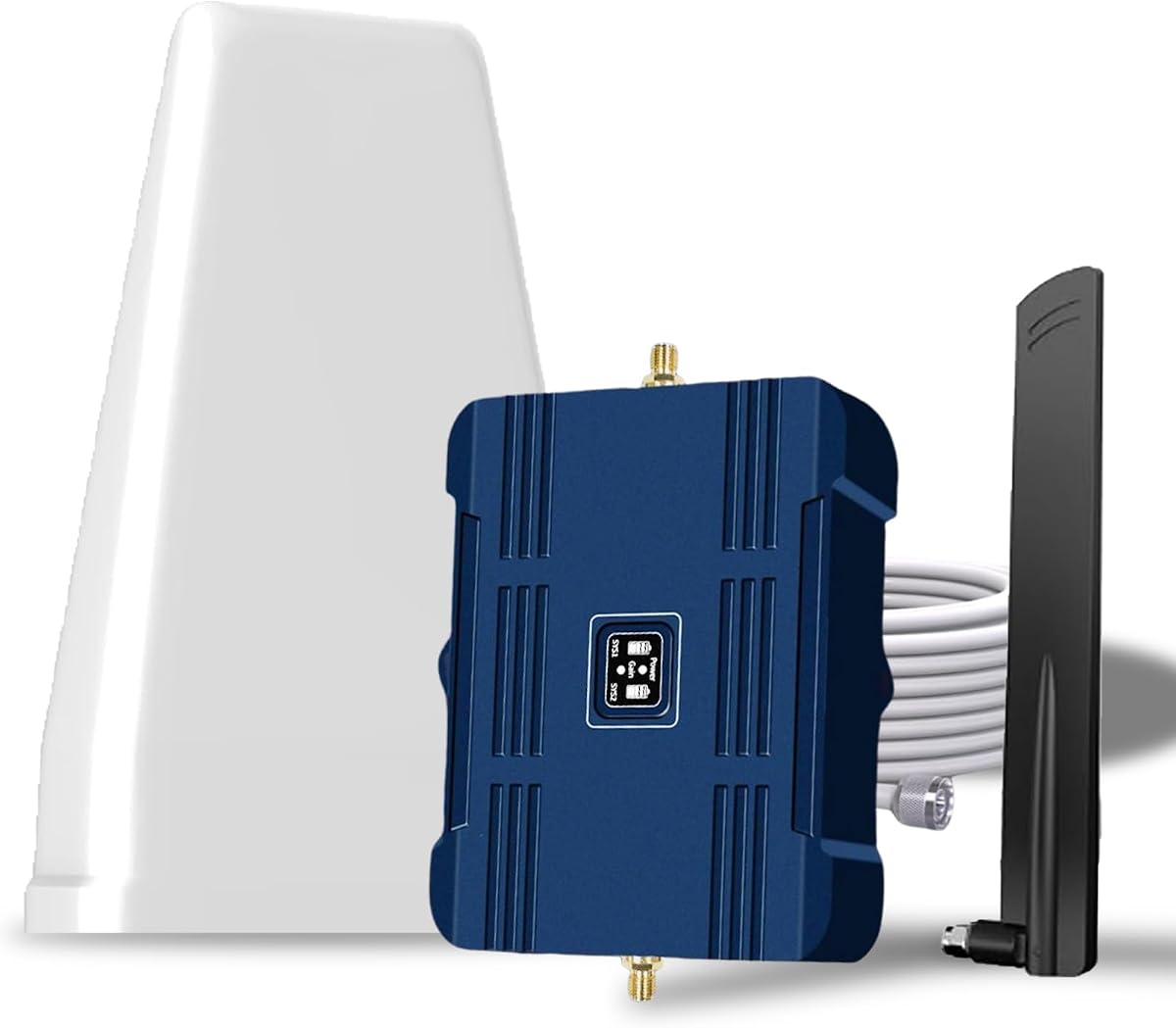
This booster has a 4.9 customer rating, the highest among the ten products listed, and offers a particularly balanced set of specifications for homes and offices. Its stated 5,000-square-foot ceiling, 65 dB maximum gain, outdoor log-periodic antenna, and support for major North American carriers make it our best budget-conscious selection.
We may earn a commission when you buy through this link, at no additional cost to you.
The specifications provide realistic coverage context. A booster with one or two outdoor bars may cover roughly 800 square feet, three or four bars may support around 3,000 square feet, and five bars may allow the full 5,000-square-foot estimate. This makes it important to test the outdoor signal before installation rather than treating maximum coverage as automatic.
Setup uses an outdoor log-periodic antenna and a separate indoor antenna. The supplied guidance calls for turning power off during installation and adjustment and recommends approximately 32 feet between the outdoor and indoor antennas. That separation helps prevent feedback, although the system is less convenient than a one-piece indoor unit. It also cannot work where no carrier signal exists at the external antenna location.
This is our best budget pick for buyers who want strong specifications, broad carrier compatibility, and a high customer rating without moving to the premium HiBoost Hero configuration. It works particularly well for moderate-to-good outdoor reception and larger rooms. Buyers in extremely remote locations should confirm carrier service and an adequate outdoor signal before choosing it.
The product's coverage estimates scale with the number of bars available outside. Checking reception at the intended antenna location is the most important step before installation because no booster can amplify a completely absent signal.
The recommended outdoor and indoor antenna separation can improve stability and reduce interference. Users should follow the manual closely and make incremental changes while power is disconnected.
We may earn a commission when you buy through this link, at no additional cost to you.
The ZORIDA ACE 5S has a 4.1 rating and distinguishes itself with a stated maximum gain of 72 dB, the highest figure in this roundup. It supports bands 12/17, 13, 5, 4, and 2/25 for major U.S. carriers, making it a compact high-gain option for homes, offices, shops, cabins, basements, and garages.
We may earn a commission when you buy through this link, at no additional cost to you.
Its core benefit is an installation ecosystem rather than only a powerful amplifier. Users can register the ZORIDA app for online technical guidance, installation videos, signal information, and help locating a better position for the outdoor antenna. The system also uses multiple high-gain antennas, supports simultaneous devices, and does not require carrier registration, subscriptions, or hidden fees.
The main limitation is its stated indoor coverage of up to 2,000 square feet, which is smaller than several competing systems. Actual performance still depends on outdoor signal, and ZORIDA specifically recommends at least one or two bars outside. Maximum gain should not be treated as the sole selection criterion because excess amplification without a strong source signal or proper antenna placement does not guarantee better reception.
This booster is most appropriate for a small home, studio, office, cabin, or workshop with usable outdoor reception and a need for multiple devices. Its app-assisted support and high stated gain make it convenient for first-time installers, while buyers needing broader floor coverage may prefer a multi-antenna system with a higher coverage ceiling.
The ZORIDA app offers installation videos, one-to-one technical support, and signal data that can help users compare antenna positions. This support may be especially valuable for customers installing the system without technical antenna experience.
A stated 72 dB maximum gain can be useful in buildings where the outdoor signal exists but indoor obstructions weaken it. The product's approximately 2,000-square-foot target remains more appropriate for focused rooms or small properties than sprawling homes.
We may earn a commission when you buy through this link, at no additional cost to you.
This green multi-room system has a 4.8 customer rating and is built around two indoor antennas, a stated maximum gain of 70 dB, and an estimated coverage area of up to 7,000 square feet. Those specifications make it particularly interesting for larger homes and buildings where distributing one indoor antenna would leave parts of the property underserved.
We may earn a commission when you buy through this link, at no additional cost to you.
Its automatic gain control detects the incoming signal and adjusts operation for performance. The description also mentions self-oscillation elimination, an LED screen, low-noise operation, and anti-interference characteristics. It supports 3G, 4G LTE, and compatible 5G services across U.S. and Canadian carriers, allowing several wireless devices to benefit at the same time.
The crucial caveat is that the coverage figure is conditional. Users need meaningful reception at the outdoor antenna position, and the available band configuration must align with their carrier deployment. Its 5G support also centers on 5G services delivered through Dynamic Spectrum Sharing in existing 4G bands, so a buyer should verify local availability rather than assume every 5G network is supported.
This product is a good fit for buyers who specifically want two indoor antennas and a larger installation footprint. It may be less attractive for users who need a wider selection of cellular bands or a very simple installation. For large homes with adequate outdoor reception and compatible carrier bands, however, the two-antenna configuration offers practical distribution flexibility.
Two indoor antennas can be placed in separate rooms or on opposite sides of a large building. This arrangement may provide more balanced reception than relying on a single indoor antenna in a centrally located room.
Automatic gain control and self-oscillation elimination are intended to maintain stable operation as incoming conditions change. These features are particularly useful for outdoor locations that receive usable but inconsistent signal.
We may earn a commission when you buy through this link, at no additional cost to you.
The Phonetone booster carries a 3.8 rating and focuses on bands 12, 13, and 17. These low-frequency cellular bands can offer valuable coverage over distance, which makes the system relevant to rural homes, cottages, cabins, and other properties where a carrier has service but indoor penetration is difficult.
We may earn a commission when you buy through this link, at no additional cost to you.
The booster supports 4G LTE, VoLTE, and compatible 5G service deployed through Dynamic Spectrum Sharing in its supported bands. Automatic gain control detects the incoming signal and adjusts gain, while an LED indicator communicates operating status. A directional outdoor antenna helps users aim toward a suitable tower, and the stated indoor coverage reaches up to 4,500 square feet.
The main limitation is frequency focus. Unlike systems that cover a broader set of bands, this model is limited to 12, 13, and 17. Buyers whose carrier or phone does not use those bands, or whose local 5G service relies on other frequencies, may receive no benefit. Its 3.8 rating is also the lowest among this group, although ratings alone cannot establish installation suitability.
This is a sensible specialist choice for locations where low-band reception is available and needed. It should not be purchased as a universal solution for every carrier or area. Confirming the outdoor signal, local band availability, and distance to a compatible tower before ordering is essential to achieving the intended results.
Bands 12, 13, and 17 are commonly valued in rural and suburban environments because lower frequencies can travel farther and penetrate structures better. The system is therefore most relevant where the carrier's local network uses these bands.
Pointing the outdoor antenna toward a known carrier tower can produce a stronger source signal than an omnidirectional arrangement. Correct aim is especially important when the desired tower is close to another transmitter using different bands.
We may earn a commission when you buy through this link, at no additional cost to you.
This all-carrier booster has a 3.8 rating and offers a practical alternative to permanent rooftop installation through its flat window cable route. It supports bands 5, 12, 13, and 17, making it relevant to major carriers such as Verizon, AT&T, and T-Mobile when those networks use the included frequencies.
We may earn a commission when you buy through this link, at no additional cost to you.
Its high-gain directional Yagi antenna focuses reception toward a particular tower, while the app helps identify the likely direction of the closest cell tower. Automatic signal detection and gain adjustment are intended to maintain stable output. The stated indoor coverage is up to 4,500 square feet, with greater coverage possible when stronger outdoor bars are available.
The trade-off is that a window-mounted outside antenna is convenient but may receive a weaker or more obstructed signal than a properly mounted outdoor unit. The supported bands are also narrower than those offered by several competitors. If the available carrier signal is only one bar, the product description suggests considering this arrangement, but all installation decisions should depend on actual measurements rather than a general rule.
This is a useful choice for renters or homeowners who cannot drill through walls and want a reversible installation. It may also suit rural properties where the carrier relies on low bands. Buyers should verify their phone and local network use one of the supported bands, and should prioritize a rooftop or exterior position if window glass significantly reduces reception.
The flat window cable allows the external antenna to receive signal while avoiding permanent wall penetration. It offers a flexible path for renters, seasonal properties, and users who may relocate the system later.
The ANNTLENT app assists with tower direction, reducing the difficulty of aiming a directional antenna. This can improve the chance of capturing a stronger signal from the intended carrier.
We may earn a commission when you buy through this link, at no additional cost to you.
The Metarepeater MG1 has a 3.8 rating and is distinguished by its large color LCD, which shows operating status and gain across five frequency bands at once. That visibility makes it attractive to technical users who want more installation feedback than a simple LED indicator can provide.
We may earn a commission when you buy through this link, at no additional cost to you.
Its five-band configuration covers 12/17, 13, 5, 4/66, and 2/25 for 5G, 4G LTE, and 3G on supported U.S. carrier networks. It supports multiple users and devices, while automatic gain adjustment helps maintain stable performance. Unlike products that depend on an app, the MG1 can be managed with its display and the supplied user manual.
The specification is unusually transparent about outdoor requirements. The product states that the external antenna location should have at least -110 dBm of signal, and it provides estimated indoor areas of approximately 400 to 1,300 square feet with one or two bars, 1,300 to 2,500 square feet with three or four bars, and 2,500 to 5,000 square feet with full signal. Roof placement may require two people.
This system is best for technically minded buyers who want precise, real-time band information and have an installation location strong enough to meet the specified threshold. It is less suitable for properties with extremely weak outdoor reception. Confirming band compatibility and arranging safe roof access should happen before purchasing.
The color display can show gain for all five bands simultaneously, allowing installers to compare locations and identify which frequencies are strongest. That level of feedback is useful when one carrier band behaves differently from the others.
The listed area estimates tie coverage closely to the outdoor signal. This transparency helps buyers set realistic expectations and avoid assuming that the 5,000-square-foot maximum reflects every installation.
We may earn a commission when you buy through this link, at no additional cost to you.
This light blue booster carries a 4.8 rating and combines a broad stated indoor range of 3,000 to 7,000 square feet with 65 dB maximum gain. It supports bands 5, 12, 13, and 17 across major U.S. carriers, offering multiple-device 5G and 4G LTE coverage without registration or subscription charges.
We may earn a commission when you buy through this link, at no additional cost to you.
Automatic gain control is the product's most important technical feature. It detects the incoming signal and adjusts gain for more stable operation, which can be helpful in areas where the outdoor source fluctuates. The stated coverage range is designed for homes, offices, garages, farms, remote properties, warehouses, and metal buildings, although the exact result depends on where the outside antenna can receive a signal.
Its main limitation is that four-band support is narrower than the selections available from some multi-band rivals. The product recommends at least one or two outdoor bars before purchase and notes that range depends on outdoor signal level. As with every booster, attempting to amplify a completely absent signal will not create usable carrier service.
This is a good option for buyers who want a high customer rating, flexible large-space estimates, and automatic adjustment without a recurring service charge. It fits homes and commercial properties where the carrier uses supported low bands. Users should check local band availability and seek the best exterior placement before deciding that the full range will be available.
The wide stated area range makes the system relevant to both conventional homes and demanding properties such as warehouses, workshops, farms, and metal-framed buildings. Construction and exterior signal remain the decisive variables.
The booster is described as working without carrier registration and without subscriptions or hidden fees. That makes it suitable for users who want improved cellular reception without managing an additional recurring service.
We may earn a commission when you buy through this link, at no additional cost to you.
The HiBoost Hero has a 4.4 rating and earns our premium selection because it combines a 65 dB booster, support for bands 12/17, 13, 5, 2/25, and 4, and two distinct indoor antenna options. It is aimed at homes and offices that need more flexible signal distribution than a single indoor antenna can provide.
We may earn a commission when you buy through this link, at no additional cost to you.
The included panel antenna can spread service across a larger area, while the compact whip antenna suits a smaller space or a more mobile arrangement. The HiBoost app helps locate a suitable directional outdoor antenna, monitor operation, and provides visual and phone-based installation guidance. The brand also offers one-to-one technical support for setup adjustments.
The product's requirements are substantial. It needs an outdoor antenna and routed cable, and the supplied guidance suggests approximately one to two hours for installation. The recommended outdoor signal is between -100 and -120 dBm, with a compatible tower generally within three to five miles. It also cannot boost hotspot devices, which may disappoint users hoping to improve tethering performance.
This is the premium choice for buyers who want selectable indoor antennas and particularly strong installation support. It suits users willing to complete external mounting and cable routing carefully. Buyers with limited outdoor signal, no suitable nearby tower, or a need for hotspot improvement should consider whether a different configuration is more appropriate.
The panel antenna is better suited to spreading a stronger signal across a larger area, while the whip antenna offers flexibility for compact rooms or repositioning. Matching the indoor antenna to the property's layout can be as important as the booster's maximum gain.
Remote monitoring and live assistance make the Hero more approachable for first-time installers. The support team can recommend antenna adjustments based on the user's location, signal readings, and building layout.
We may earn a commission when you buy through this link, at no additional cost to you.
The INVCALL multi-room system has a 4.6 rating and supports a broad selection of bands: 2, 4, 5, 12, 17, and 25. It is compatible with major U.S. carriers and can serve multiple users and rooms while improving 5G, 4G LTE, and 3G GSM reception where those services are available.
We may earn a commission when you buy through this link, at no additional cost to you.
Its defining feature is an easy installation approach. The included outdoor antenna is omnidirectional, removing the need to identify and precisely aim toward a tower. At the same time, the kit combines a built-in indoor antenna with an additional panel antenna, providing more placement flexibility than a basic single-antenna system.
The smart app adds tower-location information, real-time band and signal monitoring, installation videos, and technical support. Automatic gain control adjusts output as conditions change. On the other hand, the supplied specifications do not state a maximum indoor area, so buyers cannot compare an explicit coverage estimate with the other systems in this guide.
This booster is a good fit for buyers who prefer an omnidirectional exterior antenna and want broad band support without manually locating a tower. It also suits users who want an additional panel antenna for distributing signal within the home. The lack of a stated coverage ceiling is not inherently negative, but it means realistic expectations should be based on outdoor signal, band compatibility, and antenna placement.
The omnidirectional outdoor antenna receives signals from multiple directions, simplifying installation when the tower location is unknown or difficult to determine. It may still benefit from placing the antenna where the outdoor signal is strongest.
A built-in antenna and an additional panel unit can serve different parts of a property. Users can position the panel to fill a weak room while relying on the built-in unit for more immediate coverage.
We may earn a commission when you buy through this link, at no additional cost to you.
The best booster depends less on a universal ranking and more on your carrier, phone bands, outdoor reception, building layout, and installation options. Use the following factors to narrow the field before comparing the products in this guide.
A cellular booster cannot manufacture a carrier signal where none is available. Before purchasing, place the Android phone where the outdoor antenna is intended to go, check the bars and signal details, and test calls and data if possible. A product needs at least a minimal usable signal at that location. Many listings also specify a stronger threshold, such as one or two bars, -110 dBm, or a range between -100 and -120 dBm, depending on the system.
Choose a booster only when outdoor service exists. If the phone shows no service at the intended exterior point, investigate carrier coverage, a compatible tower, or a different antenna location before spending money on amplification.
Android phones and carriers use different cellular frequencies, and a booster must receive and rebroadcast the bands used by the local network. Compare the listing's supported bands with your carrier's local deployment and your phone's specifications. Low bands such as 12, 13, and 17 are often important in rural areas, while bands 2, 4, 5, and 25 may be necessary in other locations.
In summary, verify band compatibility before choosing. A booster that is powerful but does not support the active local bands may provide little or no benefit.
Many consumer boosters support 5G through Dynamic Spectrum Sharing, where 5G service is carried within existing 4G bands. That does not mean the unit supports every 5G frequency or every carrier's entire 5G network. Several listings explicitly warn buyers to confirm that their area offers compatible 5G service before purchasing.
Prioritize current, supported local service rather than a broad label alone. Check the booster's supported bands, the carrier's coverage map, and whether a 5G-capable Android phone is necessary to benefit.
Coverage figures are often maximum estimates based on favorable outdoor reception. The products in this guide range from approximately 2,000 square feet to 7,000 square feet, but actual indoor performance can be much smaller. Walls, floors, metal, appliances, window glass, and antenna placement all affect the result. Some products provide more transparent ranges based on one or two bars, three or four bars, or a full signal.
Use the listed area as a ceiling, not a guarantee. For a large home, calculate the usable area and consider adding or repositioning indoor antennas rather than assuming maximum gain alone will reach every room.
Outdoor antennas determine how much source signal the booster receives. Directional antennas can capture a stronger signal from a known tower, while omnidirectional antennas simplify placement when the tower direction is uncertain. Indoor antennas affect how the boosted signal is distributed. Whip antennas suit focused spaces, panel antennas can cover broader areas, and multiple indoor units can fill separate rooms.
Match the antennas to the building and tower conditions. A directional outdoor antenna plus two well-placed indoor antennas may outperform a higher-gain booster paired with poorly placed antennas.
Most systems require an exterior antenna, cable routing, an indoor antenna, and careful separation to prevent feedback. App-based tower guidance, real-time displays, installation videos, and technical support can make this process easier. The HiBoost Home Office and Hero emphasize app assistance, while the Metarepeater uses a color display and manual guidance. The INVCALL system offers a simpler omnidirectional outdoor arrangement.
Choose based on your comfort level. Guided installation is valuable for renters or first-time buyers, while a simple system may be preferable when the tower direction is already known or roof access is difficult.
Choose an FCC- or IC-certified booster so it operates within applicable regulatory requirements. Certification indicates that the system is designed to avoid harmful interference and improper operation. Warranty and return terms provide additional protection when installation or compatibility proves challenging. The listed products vary in their published service periods, from repair and replacement policies to multi-year warranties and money-back guarantees.
In short, look for certification and a clear support policy. Keep the manual, mounting hardware, and instructions, and contact the seller promptly if the displayed behavior indicates an installation or compatibility problem.
Begin by testing the outdoor location with the Android phone before mounting anything. Identify the available bars, supported carrier bands, and direction of the strongest stable signal. If using directional antennas, point them toward the intended tower, while an omnidirectional antenna should be mounted where it has the clearest view of the surrounding network.
Install the outdoor unit securely, route the cable into the building, and connect the indoor antenna. Follow the manufacturer's separation requirements because placing the outdoor and indoor antennas too close together can cause oscillation or shutdowns. Power the system on, then use the display or app to compare gain and signal readings before making further adjustments. Keep the antennas disconnected from power while moving them.
For care, protect the outdoor antenna from moisture, loose fittings, and unnecessary movement, and check connections periodically. Do not modify the booster or attempt unsupported band changes. If performance declines, first compare current outdoor signal with your original test, then check antenna aim, cable connections, and indoor placement. If hotspot performance is important, check whether the chosen model explicitly supports it.
No. A booster receives an existing outdoor carrier signal and repeats it indoors. If the phone receives no service at the outdoor antenna location, the amplifier cannot manufacture a usable network connection. It can improve reception where a weak signal is available but is blocked by walls, floors, terrain, or distance.
No, even when a product says it supports all U.S. carriers. The device must support the specific bands your carrier uses in your location, and your phone must also be compatible with those bands. Confirm local carrier deployment and your phone's frequency support before buying, especially if 5G service is important.
No. Maximum gain is only one part of performance. A stronger source signal, correctly aimed antennas, proper indoor distribution, and low interference are equally important. Excessive gain without a usable source signal or appropriate placement can lead to instability, so compare the complete system rather than choosing on the dB figure alone.
Coverage varies widely with outdoor signal and construction. Products in this guide advertise ranges from approximately 2,000 to 7,000 square feet, but these are maximum estimates. One or two outdoor bars may produce far less coverage than a strong source signal, while metal buildings and thick masonry can require more antennas or additional placement options.
A directional antenna is often best when the tower location is known and a clear signal can be captured from one direction. An omnidirectional antenna is more convenient when the tower direction is uncertain or nearby towers serve different directions. Either type can work well, but placement and access to a strong outdoor signal determine the result.
They can improve compatible 5G services carried over supported bands, especially Dynamic Spectrum Sharing deployments within existing 4G frequencies. They do not support every possible 5G frequency. Verify that your carrier offers compatible 5G in your area and that the booster explicitly supports the required bands.
Some booster models are suitable for vehicles, RVs, cabins, and other mobile applications, but the reviewed systems are primarily described for homes and offices. Vehicle installation also requires a suitable exterior antenna and careful cable routing. Check the manufacturer's intended use before adapting a home-oriented kit.
The listed systems are generally described as operating without carrier registration and without subscription fees. They still must comply with FCC or IC operating requirements, and users should follow installation instructions carefully. Proper separation and automatic gain controls help maintain compliant, stable operation.
The Home & Office Booster is the strongest budget-oriented option because it pairs a 4.9 rating with 65 dB gain and a generous stated area. The HiBoost Home Office stands out for its display, app, and broad band support, while the HiBoost Hero is the premium choice for buyers who want selectable indoor antennas and extensive assisted installation.
Prioritize outdoor signal, carrier bands, and antenna placement before focusing on maximum gain or the largest stated coverage figure. A booster with the right frequencies and realistic coverage estimate can outperform a more powerful model. Confirm the phone's bands, inspect the property, and plan where both exterior and indoor antennas will go.
Finally, recheck current specifications, availability, and pricing before purchasing, as product configurations and market conditions can change. The right Android phone signal booster is the one that matches your local network, can receive a usable signal outdoors, and has an antenna layout suited to the rooms where you need stronger service.