
Taiss RS26 Band Switch
4.5Editor score
Twelve-position, single-pole control
Compact metal-and-plastic construction
Three switches and three knobs included
Rotary selector switches provide a dependable way to choose operating modes, change circuit directions, or control equipment from a panel. A suitable model must fit the available cutout, match the required contact arrangement, and carry the electrical load expected in the application.
This guide compares ten rotary selector switches based on position count, contact configuration, mounting method, electrical ratings, construction, and intended use. The list includes compact band switches, illuminated industrial selectors, maintained panel switches, and higher-current cam changeover models.
Each review explains the strongest reason to choose a switch while also identifying important limitations or planning considerations. Ratings and specifications reflect the available product information, but availability and prices can change, so buyers should verify current listings before ordering.
4.5Editor score

4.6Editor score

5.0Editor score
As an Amazon Associate we earn from qualifying purchases.
The table below compares all ten options by position count, contact arrangement, mounting format, and application focus. Use it to narrow the field before checking terminal layouts, wiring needs, and environmental requirements.






The Taiss RS26 is a compact rotary band switch built around a single-pole, twelve-position layout. It carries a 4.5 rating, and its most useful feature is the unusually broad position count for a unit designed to fit a small panel. Three switches and three matching knobs are included.
We may earn a commission when you buy through this link, at no additional cost to you.
The switch measures approximately 2.7 by 3.8 centimeters, while the supplied knobs measure 21 by 17 millimeters. A nine-millimeter mounting-hole diameter and six-millimeter rotating shaft make it different from the standard 22mm industrial selector format used elsewhere in this guide.
Its single-pole, thirteen-pin configuration supports many selections but does not provide the independent contact paths of a two-contact industrial switch. Buyers should therefore map the available terminals to their intended circuit before installation. The modest physical size is useful when panel space is limited, although it offers less room for large wiring terminals than full-size panel devices.
This is a strong choice for compact band, channel, or multi-step selection projects where twelve indexed positions are valuable. It also suits builders who want spare knobs or multiple assemblies. It is less appropriate when the application requires two separately switched NO or NC circuits.
The twelve-position mechanism gives the RS26 a clear advantage for applications that cycle through numerous settings. Its single wafer and compact body keep the assembly practical for smaller control panels or custom equipment.
Each package includes three rotary switches and three knobs, making it convenient for spare capacity, multiple channels, or staged panel construction. The separate knobs should be matched carefully with each switch during installation.
We may earn a commission when you buy through this link, at no additional cost to you.
The APIELE LW28 is a rotary cam changeover switch built around a three-position 1-0-2 arrangement for three-phase control. It has a 4.5 rating and a listed 20A thermal current rating, making it suitable for circuits beyond the capacity of many lightweight panel selectors.
We may earn a commission when you buy through this link, at no additional cost to you.
The switch offers 12 terminals and a compact mechanism designed for direct panel mounting. Its face measures 48 by 48 millimeters with a 36 by 36 millimeter installation size, so it requires more panel space than standard 22mm devices. The center position provides a natural off or neutral point in a three-position sequence.
Its flame-retardant polycarbonate housing is combined with premium copper parts and silver-alloy contact points. Those materials suit frequent switching applications, but the switch still requires correct phase mapping and adequate conductor sizing. Product descriptions also use both 8-terminal and 12-terminal wording, making the listing and included terminal arrangement important to verify.
The LW28 is well suited to three-phase motor direction, reversing, or multi-state industrial control where a center-off arrangement is useful. Installers should confirm the terminal layout before connecting power and should use appropriate protection and isolation practices.
The stated 20A thermal current rating differentiates this model from the 10A class switches in the list. Actual suitability still depends on the circuit category, load type, and local installation requirements.
The 1-0-2 sequence allows forward, neutral, and reverse-style selection in one control. That makes the mechanism useful for compact motor-control panels.
We may earn a commission when you buy through this link, at no additional cost to you.
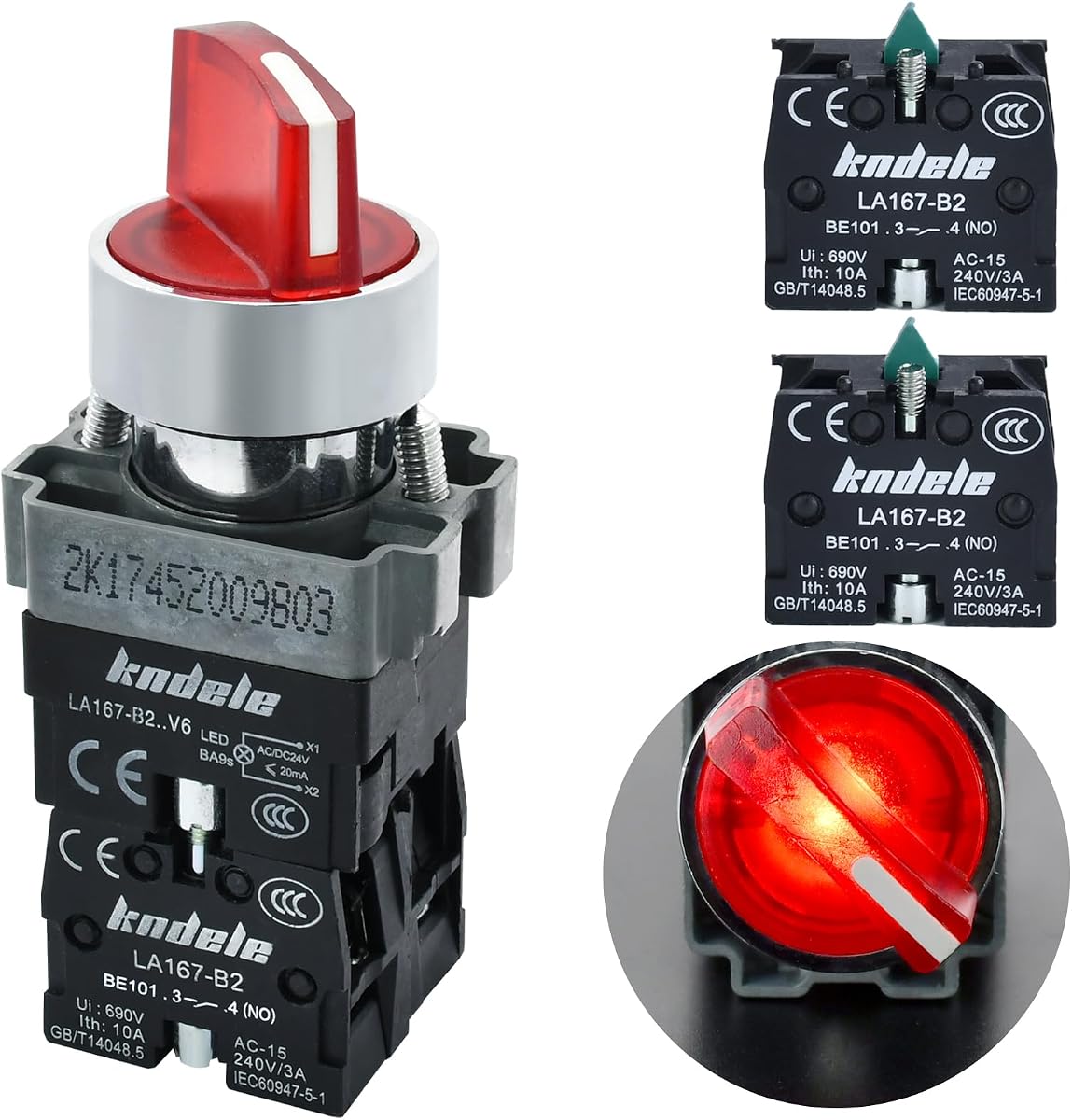
This two-pack combines green and red latching rotary selector switches with integrated 110V LED lamps. Each has two maintained positions and a combined one normally open, one normally closed contact arrangement. Both models hold their selected state until the knob is turned again.
We may earn a commission when you buy through this link, at no additional cost to you.
The green and red illumination provides immediate panel feedback, making the switches useful where operators must quickly identify whether equipment is active. The electrical arrangement is also versatile: connecting terminals 23 and 24 uses the NO path, while terminals 11 and 12 use the NC path.
The specified 10A thermal rating and 660V insulation rating look strong on paper, but the 110V LED requirement narrows the practical application. The unit fits a 22mm hole and handles panels up to approximately 8.5 millimeters thick, so both the cutout and LED supply must be confirmed before purchase.
This pair is a good choice for two-color status indication in compatible 110V control systems. It is especially useful when a machine operator must see the selected state without testing the circuit. For other supply voltages or a different indicator color scheme, a non-illuminated or differently illuminated switch may be more appropriate.
Separate green and red versions allow opposite panel functions to be recognized at a glance. Illumination also reduces ambiguity when the switch handles standby, running, or directional commands.
Both normally open and normally closed paths are available in each unit. The selected wiring method determines whether the load is energized before or after the operator turns the knob.
We may earn a commission when you buy through this link, at no additional cost to you.
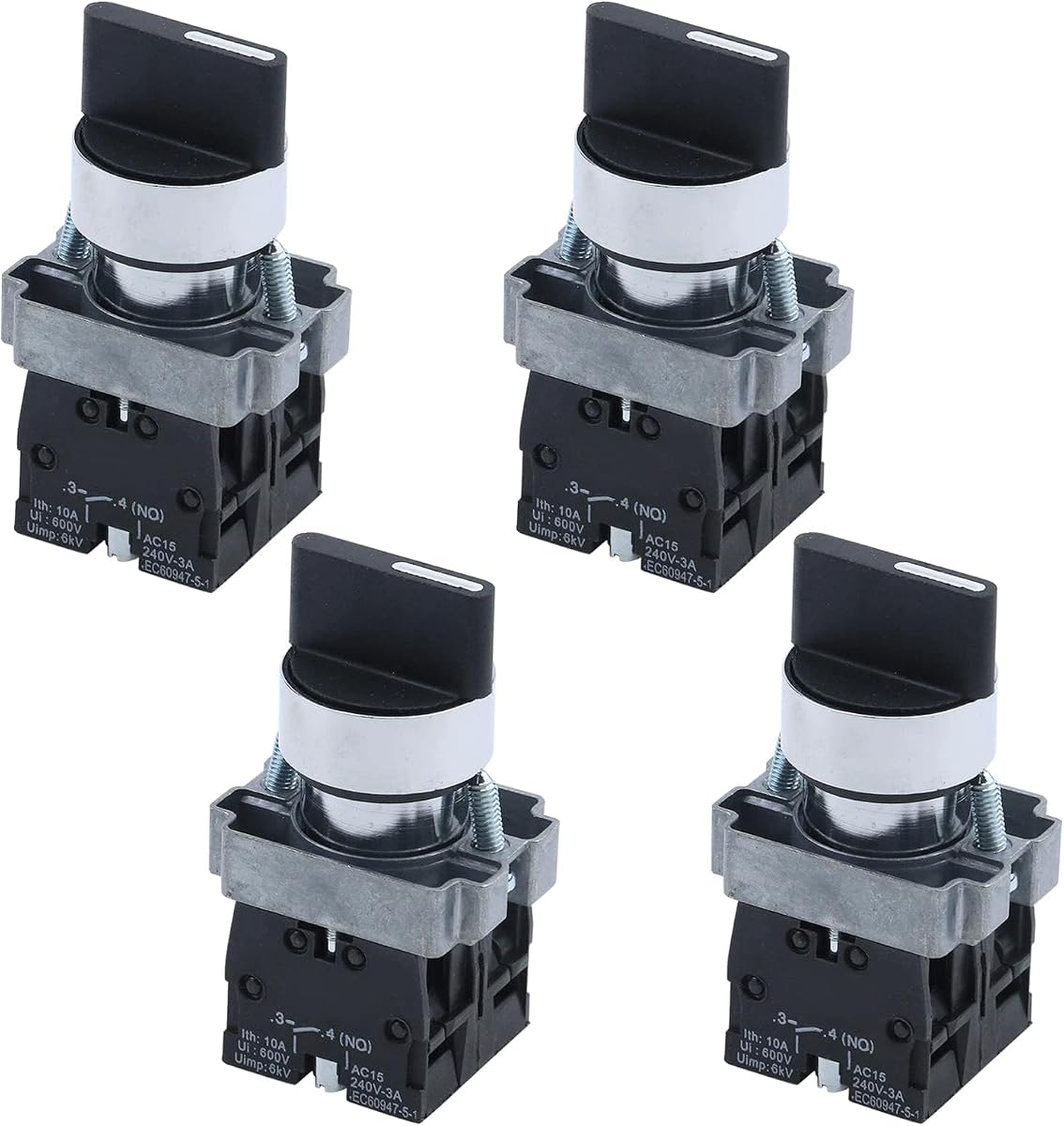
The Antrader ZB2-BE101C set contains four self-locking, three-position rotary selector switches. Each unit uses two normally open contact blocks in an SPDT-style arrangement and is listed at 10A and 600V AC. The four-piece format is especially convenient for building repeated control sections.
We may earn a commission when you buy through this link, at no additional cost to you.
A maintained action means the knob remains at the selected position, which suits control panels where a start, stop, or mode command must persist. The switches are intended for electromagnetic starters, contactors, relays, and other automatic control circuits rather than momentary push-button operation.
The primary limitation is the normally open configuration. A circuit that depends on a normally closed or break-before-make contact may not be served directly. Buyers should also compare the approximate overall dimensions against the available panel space and confirm the expected terminal arrangement.
This set is a practical choice for electricians and panel builders assembling multiple identical starter-control sections. It offers more units than most packages in the guide, making it attractive when a project needs consistent switches across several circuits.
Four matching assemblies reduce the need to source each section separately. They are well suited to standardized machine panels with repeated selector functions.
The self-locking mechanism holds a selected command without spring return. That behavior aligns with many starter, contactor, and relay control arrangements.
We may earn a commission when you buy through this link, at no additional cost to you.
The TWTADE HB2-BD33 is a versatile three-position maintained selector supplied as a two-pack. Each assembly has a metal head, detachable contact base, two normally open blocks, a 22mm mounting hole, and a stated 10A, 440V rating. Its broad application range makes it the most versatile option in the guide.
We may earn a commission when you buy through this link, at no additional cost to you.
The detachable contact base supports straightforward wiring and installation, while the metal head and anti-break plastic knob suit demanding control-panel environments. Two complete units make it easy to install a pair of related controls or retain a spare for maintenance.
It does not include an LED indicator, so users who need visible operating feedback should add one separately. It also has no normally closed block in the stated package, and the manufacturer specifically notes that the selector must be fixed to the panel for use. These are important installation constraints rather than cosmetic details.
This switch is an excellent general choice for machine tools, conveyors, HVAC control boxes, pump panels, and motor starters. It combines a familiar mounting size with straightforward wiring and useful maintained selection, making it appropriate for both professional panel builders and serious DIY projects.
The standard 22mm cutout allows the switch to fit many existing industrial panels. That compatibility is valuable when modifying a cabinet without redesigning its mounting layout.
The detachable base separates the contact assembly from the operator head. This construction supports installation and replacement while keeping the wiring scheme organized.
We may earn a commission when you buy through this link, at no additional cost to you.
This four-pack of two-position maintained selectors offers a flexible contact option and a standard 22mm mounting format. Each switch can be configured with a normally open or normally closed contact block, making the package more adaptable than a fixed-contact four-pack.
We may earn a commission when you buy through this link, at no additional cost to you.
The switches are rated for 10A and operate in AC circuits up to 380V and DC circuits up to 220V. Their IP55 front-panel protection, shock and vibration resistance, and stated operating range from -25°C to +70°C make them suitable for many industrial environments.
The listed life of up to 50,000 mechanical cycles offers a useful durability benchmark, although real service life depends on frequency, load type, and conditions. Installation involves removing the retaining nut, inserting the head, aligning the buckle, and tightening the nut securely. The switch must be fixed to the panel for proper operation.
This set works well for on-off controls spread across multiple panels or machine sections. It is less suitable when an application requires more than two positions, but the replaceable contact block and four-unit package make it practical for common run, stop, mode, and enable functions.
The ability to use either normally open or normally closed contact blocks lets the same hardware family serve different logic functions. This can simplify panel standardization.
IP55 protection, broad temperature tolerance, and resistance to shock and vibration support use beyond a protected indoor desk application. The electrical rating still needs to match the actual load.
We may earn a commission when you buy through this link, at no additional cost to you.
The IP65 illuminated selector combines a three-position left-off-right control with a 4.9 rating, the highest among the listed products. It includes a DPST arrangement with two normally open contacts and is designed for standard 22mm panel installation.
We may earn a commission when you buy through this link, at no additional cost to you.
Built-in illumination makes the active position immediately visible, which helps operators avoid unintended commands. The product title identifies a 24V red LED, while the supplied feature details refer to a 110V green LED for the left and right positions. Buyers should verify the illumination color and voltage in the current listing before ordering.
The front panel carries IP65 protection, silver-alloy contacts, brass conductors, and screw terminals accepting 0.5 to 2.5 square millimeter wire. The stated mechanical and electrical life exceeds 100,000 cycles, while double-screw fixing supports stable panel mounting. However, the panel-thickness guidance is somewhat inconsistent and should be checked against the physical product.
This selector is a strong candidate for industrial machines, automation systems, and control panels where visible status and environmental resistance are priorities. Its 10A, 660VAC rating supports substantial control loads, while the 3A, 240VAC figure should be considered for lower-rated loads.
A lit position provides immediate confirmation of the selected command. This is especially helpful on machinery where an unnoticed mode mismatch could interrupt operation.
The IP65 front-panel rating adds resistance to dust and water exposure. Secure double-screw mounting further helps the assembly remain stable under vibration.
We may earn a commission when you buy through this link, at no additional cost to you.
The BAOMAIN XB2-BD33 is a three-position latching rotary selector with a 4.8 rating. It includes two ZB2-BE101C normally open contact modules, fits a 22mm cutout, and is rated at 10A and 600V for industrial control use.
We may earn a commission when you buy through this link, at no additional cost to you.
Its left-center-right action gives operators a clear three-state selection, while the maintained mechanism keeps the chosen position in place. The two normally open blocks can support different control functions, such as separate commands for associated contactors or relays, depending on the wiring arrangement.
The metal mounting base and durable plastic knob are designed to withstand workshop conditions. On the other hand, this model has no built-in light and the supplied specification does not identify a normally closed block. Users needing a visible status indication or fail-safe NC path should account for that before installation.
This is a strong fit for electromagnetic starters, contactors, relays, and automatic control panels. It is particularly useful when a panel requires a conventional 22mm selector with two NO outputs and a high stated voltage rating.
Two normally open modules can operate separate related control paths. That flexibility makes the switch useful in starter and relay arrangements without doubling the panel footprint.
The 22mm cutout and compact maintained action align with common panel-building practices. The assembly is also easy to identify as a three-position starter control.
We may earn a commission when you buy through this link, at no additional cost to you.
The Eaton M22-WKV is a compact two-position, on-off selector with a 5.0 listed rating. It uses a lever-style actuator, a silver bezel, and a 90-degree turning radius, making it the most refined-looking conventional panel option among the ten products.
We may earn a commission when you buy through this link, at no additional cost to you.
Its straightforward on-off action is useful for equipment that does not need a center position or multiple operating modes. The lever actuator should give operators a clear mechanical indication of the selected state, while the silver bezel provides a coordinated appearance for modern control cabinets.
The available product information is much more limited than for the other models. The description does not state the contact configuration, current rating, voltage rating, mounting-hole diameter, or included contact blocks. Those omissions make the current listing especially important to consult before purchase or substitution.
This switch is best for a clean two-position panel control where appearance and straightforward operation are priorities. It is a premium pick for commercial or industrial panels, but buyers should confirm compatibility rather than assuming it shares the 22mm dimensions and contact specifications of the other M22-style products in this guide.
On-off selection eliminates unnecessary intermediate positions. That simplicity is useful for machines, appliances, or auxiliary panels with one primary operating command.
The lever actuator and silver bezel create a more finished look than many exposed industrial selectors. This makes the Eaton option relevant to visible operator panels as well as utility cabinets.
We may earn a commission when you buy through this link, at no additional cost to you.
The BAOMAIN SZW26-20/0-3.2 is a four-position rotary cam changeover switch with an 8.5 rating. Its 0-1-2-3 sequence, 45-degree switching angle, and eight-terminal structure allow several circuit states to be selected from one compact control.
We may earn a commission when you buy through this link, at no additional cost to you.
A stated thermal current rating of 20A and insulation voltage of 660V place it among the higher-capacity options here. The design supports AC-15 and DC-13 control circuits, while flame-retardant plastic and silver-alloy contact points provide a durable industrial construction.
The square faceplate measures 50 by 50 millimeters, making it larger than standard 22mm selectors. Its eight terminals and four switching stages also require more careful wiring than a simple on-off model. A truth table is included in the product images, which should be used to map each position to its contact state.
This switch is best suited to motor control, power distribution, and multi-circuit conversion where four operating states are genuinely needed. It offers considerable flexibility, but installers should confirm terminal functions and available panel space before installation.
The 0-1-2-3 mechanism consolidates several selections into a single rotary action. This is valuable when an application needs distinct modes rather than simple on-off control.
Eight screw terminals create multiple wiring paths across four switching stages. The included truth table helps translate knob positions into the corresponding electrical states.
We may earn a commission when you buy through this link, at no additional cost to you.
The right rotary selector switch depends on more than its position count. Start with the circuit logic, then confirm contact ratings, mounting dimensions, operating action, environmental needs, and wiring access before selecting a model.
Choose a position count that reflects the functions the equipment actually requires. Two-position on-off switches suit simple enable controls, three-position models often provide left-center-right or 1-0-2 logic, and four-position cam switches can replace several separate selectors. More positions add flexibility but also increase wiring complexity, so unused states should not be selected merely because they are available.
The contact arrangement determines what happens when the knob moves and when power is restored. A normally open contact remains open until its circuit is selected, while a normally closed contact conducts by default. Some switches provide both, some use two normally open blocks, and others allow the contact block to be exchanged. Match this behavior to the control logic rather than focusing only on the number of terminals.
Check thermal current, insulation voltage, and the applicable AC or DC rating before ordering. A 10A switch may appear adequate, but motor loads, inductive equipment, and certain switching categories can place greater stress on contacts than the headline rating suggests. The products here range from 10A panel devices to switches listed at 20A. Confirm that the full operating voltage and load category fall within the manufacturer's stated limits.
Measure the panel opening before selecting a switch. Standard industrial selectors commonly use a 22mm mounting hole, while compact band switches and cam models may use smaller or square formats. Also account for the selector's total depth, wiring space behind the panel, and allowable panel thickness. The listed assemblies range from the Taiss switch's nine-millimeter hole to larger 36-by-36-millimeter or 50-by-50-millimeter installations.
A maintained or latching selector remains in the selected position after the operator turns it. This is useful for persistent commands such as run, stop, forward, reverse, or operating mode. A spring-return design would move back when released, but none of the supplied products is clearly described as momentary. If an application expects automatic return, do not assume that a maintained switch will provide it.
Illuminated selectors make the active state easier to identify and can reduce operator mistakes. The two-pack LED model uses 110V illumination, while the IP65 model's title and feature details provide differing voltage and color information, so this detail should be verified carefully. IP55 or IP65 front-panel protection may also be valuable in dusty or wet control environments, but it does not remove the need for correct enclosure and wiring practices.
Terminal count is only useful when the functions are understandable. Compact single-pole switches may be appropriate for simple band selection, while eight- and twelve-terminal cam models support more elaborate changeover logic. Detachable contact blocks can simplify installation and replacement, while fixed terminal arrangements may require careful cable routing. Use the diagrams, truth tables, and terminal markings supplied with the selected model before assigning wires.
Metal heads, aluminum alloy rings, flame-retardant plastic, and silver-alloy contacts are common among these industrial designs, but the balance varies. Compact band switches prioritize size and position count, while panel selectors emphasize serviceable contact blocks and rugged knobs. Package size also matters: some products arrive as a pair or four-pack, while the BAOMAIN XB2-BD33 is a single assembly and the Eaton listing does not clearly define the included components.
Begin by de-energizing the circuit and verifying isolation before removing an existing switch or opening a control enclosure. Identify every conductor, mark its function, and compare the existing or planned wiring against the contact diagram and terminal labels. Do not rely solely on wire color, especially in older industrial panels.
Mount the switch in the correct cutout, tighten the retaining hardware evenly, and confirm that the knob rotates smoothly without binding. Connect the appropriate normally open or normally closed terminals, check conductor gauge and tightening torque, and leave enough space behind the panel for service access. When using a cam switch, label each knob position according to its truth table rather than assuming a universal terminal sequence.
Operate the selector through each position while the load is safely controlled, checking that the expected circuits respond and that illuminated models show the intended state. Periodically inspect for looseness, discoloration, unusual heat, damaged knobs, or moisture entry. Replace a damaged switch rather than forcing it, and keep the panel clean and dry so the mounting hardware and contact mechanisms remain secure.
A rotary selector switch lets an operator choose between circuit states by turning a panel-mounted knob. Common applications include on-off control, forward-reverse motor selection, band or channel selection, and operating-mode changes. The correct model depends on the required positions, contact arrangement, and electrical load.
A normally open contact does not conduct until the switch is moved into its connected position. A normally closed contact conducts in the default position and opens when the relevant position is selected. Some rotary selectors include both contact types, while others provide only NO blocks or accept replaceable contact bases.
No. A shared 22mm mounting hole does not guarantee identical terminal layouts, contact blocks, switching sequences, or electrical ratings. Compare the number and function of terminals, position behavior, and voltage and current specifications before replacing an existing device.
Three positions are common for left-off-right or forward-neutral-reverse control, while two positions are enough for simple on-off operation. Four-position cam switches can provide additional circuit states. The correct number depends on the motor circuit and control logic rather than the type of motor alone.
No. A latching or maintained selector stays where the operator places it. That behavior is intentional for persistent commands. If automatic spring return is required, choose a product specifically described as momentary or spring-return rather than assuming a maintained switch will provide it.
Only when both the switch and the surrounding enclosure are suitable for the environment. The IP55 and IP65 models offer stated front-panel protection, which can help resist dust and water. Outdoor installations also require an appropriately rated enclosure, secure cable entries, and correct protection against condensation and direct weather exposure.
First confirm the LED voltage and color because the listings provide differing illumination details for some models. Then follow the manufacturer's terminal diagram for the lamp, control contacts, and supply conductors. Incorrect voltage can damage the LED circuit, while confusing the NO and NC paths can produce unexpected operation.
Measure the panel cutout and depth, identify the required positions, and confirm the voltage, current, and contact configuration. Check whether the replacement must include a specific contact block, indicator lamp, or rotary cam arrangement. A terminal-by-terminal comparison with the original switch is the safest way to prevent wiring errors.
The Taiss RS26 stands out for affordable multi-position selection in a compact format, while the TWTADE HB2-BD33 is the most broadly practical panel option thanks to its 22mm mounting pattern, maintained three-position action, and two complete assemblies. The Eaton M22-WKV offers a refined two-position actuator for projects where appearance and simple on-off operation matter.
For more specialized needs, the APIELE LW27 and BAOMAIN SZW26 provide higher-current cam changeover logic, the illuminated products improve operating-state visibility, and the four-pack options reduce repeated sourcing for multi-section panels. Prioritize contact behavior, terminal layout, and load ratings before appearance or position count, because incorrect contact logic can prevent the panel from functioning as intended.
Product availability and prices can change, so check the current listing, included components, wiring diagram, and certification information before purchasing. Always match the switch to the actual circuit and follow appropriate electrical safety practices during installation.
