
VF-6800P Satellite Signal Meter
3.3Editor score
Broad broadcast standard support
Spectrum and motor functions
2,000mAh fast-charging battery
Compass and LED flashlight
A satellite finder meter helps installers and homeowners align dishes more efficiently by displaying signal strength, signal quality, and other useful measurements. The right model can reduce guesswork, improve fine-tuning, and make outdoor installation safer, especially when working alone or where reception is marginal.
We compared these ten products by examining their stated frequency ranges, display types, signal-reading features, buzzer functions, compass assistance, battery support, receiver compatibility, and installation-focused capabilities. The list covers compact analog-style meters, handheld digital units, and more advanced models with spectrum analysis or dish-motor support.
Each review explains who the meter suits, which capabilities set it apart, and where its feature set may be more than a basic installation requires. Ratings reflect the supplied customer feedback, while practical guidance focuses on documented specifications. Product availability and pricing can change, so confirm current details before buying.
3.3Editor score

4.4Editor score

4.1Editor score
As an Amazon Associate we earn from qualifying purchases.
The comparison below places all ten meters side by side, focusing on frequency coverage, measurement features, display or alarm functions, portability, and the kinds of satellite installations each model is best suited to support.



The WS-6933 is a compact, fully DVB-S and DVB-S2 compliant handheld meter built for installing and verifying digital television service. Its 4.4 rating is the highest among the products in this guide, and its combination of automatic angle calculation, a mechanical compass, rechargeable power, and audible locking feedback makes it a strong all-around choice for residential and multi-dwelling installations.
We may earn a commission when you buy through this link, at no additional cost to you.
The meter displays both signal strength and quality on a 2.4-inch LCD, giving installers more information than a simple analog needle. Automatic calculation of azimuth and elevation can save time when positioning a dish, while DISEQC 1.0 and 1.1 support, along with 0 and 22kHz tone options, broadens its usefulness with common satellite equipment. An integrated beep and sound-and-light alarm provide useful feedback when a signal is found.
Its integrated 7.4V, 800mAh lithium-ion battery supports cordless operation, and the included 12V adapter offers a practical charging option. LNB short protection is also useful around powered dish hardware. The limitations are that the battery is modest compared with larger-capacity models, and the meter needs appropriate receiver and LNB connections rather than operating as a completely self-contained scanner.
This is a strong recommendation for installers who want a balance of alignment guidance and digital signal information without moving to the largest or most specialized meter. It is particularly useful for technicians, property managers, and homeowners installing a compatible dish who will appreciate angle calculations and clear lock alerts. For those needs, the WS-6933 provides the most balanced feature set in this roundup.
Automatic azimuth and elevation calculation reduces the need for repeated reference lookups while aligning a dish. The mechanical compass adds a second directional aid, making the meter especially useful when the dish mounting position makes visual target identification difficult.
Signal strength and quality readings give users a clearer basis for fine adjustment than visual inspection alone. The integrated beep and combined sound-and-light alarm make it easier to recognize a locked signal without continually staring at the screen.
We may earn a commission when you buy through this link, at no additional cost to you.
The Tiiyee is a small, lightweight signal meter designed for the core job of locating and aligning a satellite dish. Its 3.6 rating reflects a mixed customer experience, but the documented sensitivity, broad 950 to 2150MHz frequency coverage, and straightforward strength display make it a practical lower-cost option for uncomplicated installations.
We may earn a commission when you buy through this link, at no additional cost to you.
Its stated sensitivity is 7dBS, with measurement accuracy specified from minus 40dBm to minus 10dBm. The LNB-to-REC connector and adjustable dB control allow installers to observe small changes while moving the dish, which is essential for reaching a clean peak rather than settling for a marginally acceptable reading.
The meter concentrates on signal strength rather than the wider diagnostics found in higher-end handheld models. It does not list an integrated battery, advanced spectrum analysis, or automatic azimuth and elevation calculations in the supplied information. That keeps the feature set and physical design straightforward, but it also means users may need external power and a separate compass or receiver assistance for coarse positioning.
The Tiiyee is best for a homeowner or installer who needs a lightweight meter for routine dish tuning and does not require advanced signal-quality menus. It is less compelling for complex motorized installations, multi-standard diagnostics, or extended cordless work. For those simpler applications, its sensitivity and compact form are worthwhile.
The ability to indicate very small signal-strength changes helps users make the final millimeter-level adjustments that produce a stable picture. Adjustable dB control can also make strong signals easier to evaluate without losing the useful part of the scale.
Its small, lightweight enclosure is easy to carry around a roof, ladder, or patio installation area. The simple display and direct dish-alignment purpose keep the learning curve modest for occasional users.
We may earn a commission when you buy through this link, at no additional cost to you.
This digital satellite finder is an uncomplicated meter for FTA installations, combining a visual strength display with tuning controls and broad frequency coverage. Its 4.2 rating makes it one of the better-rated products here, while its 950 to 2150MHz range and stated 0.2dB variation suit common dish alignment tasks.
We may earn a commission when you buy through this link, at no additional cost to you.
The unit provides adjustable strength through its dB control and connects through an LNB-to-REC arrangement. Digital tuning options for C band and peak adjustments help users move toward the strongest reading. A visual display makes the meter accessible without relying exclusively on sound, which is beneficial when an installer is wearing gloves or working in a noisy outdoor environment.
Power is supplied at 13 to 18V, so compatibility with the receiver and LNB setup matters. The supplied information does not mention an internal rechargeable battery, automatic angle calculation, compass, or spectrum analysis. Those omissions keep it focused, but buyers who require self-contained operation or detailed service menus may prefer one of the more advanced models.
This meter is a sensible choice for basic FTA dish setup where the goal is a readable signal peak rather than a full suite of digital measurements. Its straightforward construction and visual tuning approach suit cost-conscious installers and homeowners. Confirm receiver and LNB compatibility before purchase to avoid connection surprises.
A dedicated signal-strength display allows users to watch values change as they rotate or tilt the dish. This is especially helpful when fine changes produce a clearer picture but are difficult to judge by sound alone.
The stated 0.95 to 2.15GHz coverage spans the range used by many conventional satellite installations. Digital tuning of C band and peak readings makes the meter appropriately focused for FTA dish alignment.
We may earn a commission when you buy through this link, at no additional cost to you.
The DirecTV Digital Satellite Finder uses an analog 52 to 60dB strength scale, audible pitch tones, and attenuation control to help installers tune compatible dishes. Its 4.1 rating places it among the stronger options in the group, and the combination of sound and illuminated display is useful for establishing the strongest available signal.
We may earn a commission when you buy through this link, at no additional cost to you.
A higher buzzer pitch indicates a stronger signal, allowing an installer to focus on the dish while listening for the peak. The ATT function attenuates strong incoming levels, and the built-in amplifier is stated to compensate for insertion loss. These features can make the meter more useful with powerful systems, larger dishes, or receivers where the signal would otherwise sit near the top of the scale.
The 950 to 2150MHz range covers the common satellite LNB band, while 13 to 18V operation aligns with typical powered dish connections. The display is described as an analog illuminated meter rather than a detailed digital interface. It therefore provides less information about quality, bit error rate, or signal-to-noise ratio than advanced digital models.
This meter is a good fit for users who want quick audio-guided alignment and are working with DirecTV or compatible satellite equipment. It may be less attractive for technicians who need menu-based diagnostics or multiple broadcast standards. For simple peaking with clear audible feedback, however, the design remains focused and understandable.
The pitch-tone buzzer translates signal strength into an audible cue that changes as the dish moves. This lets users keep their attention on the dish and mount while still recognizing a stronger reading.
Attenuation and the built-in amplifier help place high-level signals into a more useful range. These details can improve control when a dish or LNB delivers a signal that would otherwise be difficult to compare accurately.
We may earn a commission when you buy through this link, at no additional cost to you.
The VF-6800P is the most specification-rich meter in this guide, supporting DVB-S, DVB-S2, DVB-T, DVB-T2, DVB-C, and DVB-C2 alongside MPEG2 and MPEG4. Its 3.3 rating is the second-lowest here, but that figure does not fully reflect the extensive diagnostic and configuration capabilities offered for serious installation work.
We may earn a commission when you buy through this link, at no additional cost to you.
A 2.4-inch color TFT LCD presents signal strength, quality, bit error rate, power, signal-to-noise ratio, and merged error rate information. Spectrum and loop-search functions help users locate or inspect signals, while motor setup and antenna motor control extend the device beyond basic dish pointing. Transponders can be edited, added, or deleted for users who manage more than one satellite position.
The meter also supports DISEQC 1.0, 1.1, and 1.2, 0 and 22kHz tones, multiple on-screen languages, interface color choices, and several antenna power options. A 7.4V, 2,000mAh lithium-ion battery supports portable use, and low-voltage charging can wake the device from sleep. A bright LED flashlight, backlit keys, and a compass are practical additions for outdoor work.
This is the premium choice for technicians who work across satellite, terrestrial, and cable standards or need motorized dish configuration. It may feel unnecessarily complex for a single basic alignment, and its customer rating warrants careful expectation-setting. Still, for advanced diagnostics and broad compatibility, no other product in the list offers an equivalent documented feature set.
Support for satellite, terrestrial television, and cable standards makes the VF-6800P useful beyond a single dish type. The choice of on-screen languages and interface colors also adds flexibility for varied installation environments.
BER, PWR, SNR, MER, spectrum analysis, and loop search provide more evidence than a simple peak reading. These tools help experienced users distinguish a usable signal from an apparently strong but difficult one.
The high-brightness LED flashlight and backlit controls improve visibility after dark or in shaded locations. The compass adds directional reference while the large rechargeable battery supports longer working sessions away from a mains outlet.
We may earn a commission when you buy through this link, at no additional cost to you.
The Winegard SF-1000 is a straightforward satellite finder built around audio tone alignment. Its 3.6 rating indicates moderate customer satisfaction, but the familiar 950 to 2050MHz range, 75-ohm input, and receiver-powered design make it a natural fit for users who want a simple meter without a large feature menu.
We may earn a commission when you buy through this link, at no additional cost to you.
The specified input range of minus 25 to minus 75dBm accommodates a broad set of signal strengths. An audio tone changes as the antenna is aligned, helping users identify the point of strongest reception without requiring a large display. The meter's relatively substantial 7.25 by 4.25 by 1.75-inch dimensions may also make it easier to handle with gloves or position securely during remote work.
The meter expects plus 13 to plus 18 volts DC supplied by the receiver. That arrangement reduces the need to manage a separate internal battery, but it also ties operation closely to a compatible receiver and its power feed. There is no listed spectrum analysis, digital quality menu, angle calculation, or compass in the supplied details.
The SF-1000 is best for basic alignment of a remote satellite antenna using compatible receiver equipment. It may appeal to users who prefer audible feedback and a durable, uncomplicated device. It is less suitable for advanced service diagnostics, portable use independent of a receiver, or installations that require detailed digital quality readings.
The audio tone gives a direct indication that signal strength is changing while the antenna is moved. This reduces reliance on a small display and makes the meter approachable for basic setup jobs.
Its stated suitability for remote satellite antennas emphasizes portable setup around mounted equipment. Receiver-powered operation simplifies the power chain, although compatible receiver hardware remains necessary.
We may earn a commission when you buy through this link, at no additional cost to you.
The Weytoll STF-01 is a two-in-one meter designed to locate both satellite and television antenna signals. Its 3.6 rating suggests mixed experiences, but the combination of a graphical LCD, audible pitch tones, a compass, and support for strong or weak incoming signals gives it broader practical appeal than a single-purpose analog meter.
We may earn a commission when you buy through this link, at no additional cost to you.
Its microprocessor-controlled design is presented as reliable and accurate, while the backlit LCD displays signal strength graphically for easier reading in daylight or darkness. The buzzer provides a higher pitch as the signal improves, allowing an installer to tune by ear. Strong incoming signals can be attenuated for a better reading, which is useful when working with large dishes or powered antennas.
The compass is intended for general reference rather than automatic dish-angle calculation. The supplied product information does not specify frequency coverage, input-level limits, battery capacity, or particular broadcast standards, so buyers needing those specifications should verify compatibility before ordering. The device is more versatile than some minimal meters but less documented than the advanced digital models in this list.
The STF-01 is a good choice for someone who installs both satellite dishes and conventional TV antennas. It combines visual and audible guidance in a compact package, making it useful for field service or home setup where carrying two separate meters would be inconvenient.
The two-in-one design broadens the meter's use beyond satellite dishes to TV antenna positioning. This makes it particularly valuable for technicians who handle both types of installation.
The graphical LCD and integrated backlight make the strength reading easier to follow during daytime rooftop work or nighttime setup. Pairing the display with a pitch-tone buzzer allows users to choose whichever feedback method suits the situation.
We may earn a commission when you buy through this link, at no additional cost to you.
The Hilitand Satellite Finder Meter combines a large 4,000mAh battery with a 3.5-inch LCD and advanced analysis functions. Its 4.0 rating is solid, and the combination of automatic azimuth and elevation calculation, loop search, constellation analysis, and spectrum analysis positions it as a capable cordless installer.
We may earn a commission when you buy through this link, at no additional cost to you.
The stated input frequency range is 950 to 2150MHz, with an input level range of minus 65 to minus 25dBm. The generous battery and real-time battery display reduce uncertainty during extended outdoor work. At the same time, the larger screen makes satellite lists and troubleshooting information easier to view than on a compact meter.
Automatic angle calculation is one of the most useful additions for installation planning because it provides a starting direction before the dish is physically adjusted. Loop search, constellation analysis, and spectrum analysis offer deeper insight when a conventional strength reading is not enough. The product is described for Dish Network and FTA applications, so compatibility with other receiver or dish systems should be confirmed.
This is a strong option for installers who regularly align dishes and need extended cordless operation with more than basic peak detection. It may be heavier and less pocketable than compact analog meters, but the trade-off supports a larger battery and screen. For users needing angle guidance and analysis features in a portable package, the Hilitand is an excellent fit.
The 4,000mAh built-in battery is among the highest capacities listed in this guide. A real-time battery display helps installers judge whether enough runtime remains for remote work.
Automatic azimuth and elevation calculation gives users an initial target before physical adjustment. This is particularly helpful for installations where the correct direction is not obvious from the mounting position.
Loop search, constellation analysis, and spectrum analysis provide additional ways to inspect a signal. These functions are valuable when a simple peak reading does not fully explain reception quality.
We may earn a commission when you buy through this link, at no additional cost to you.
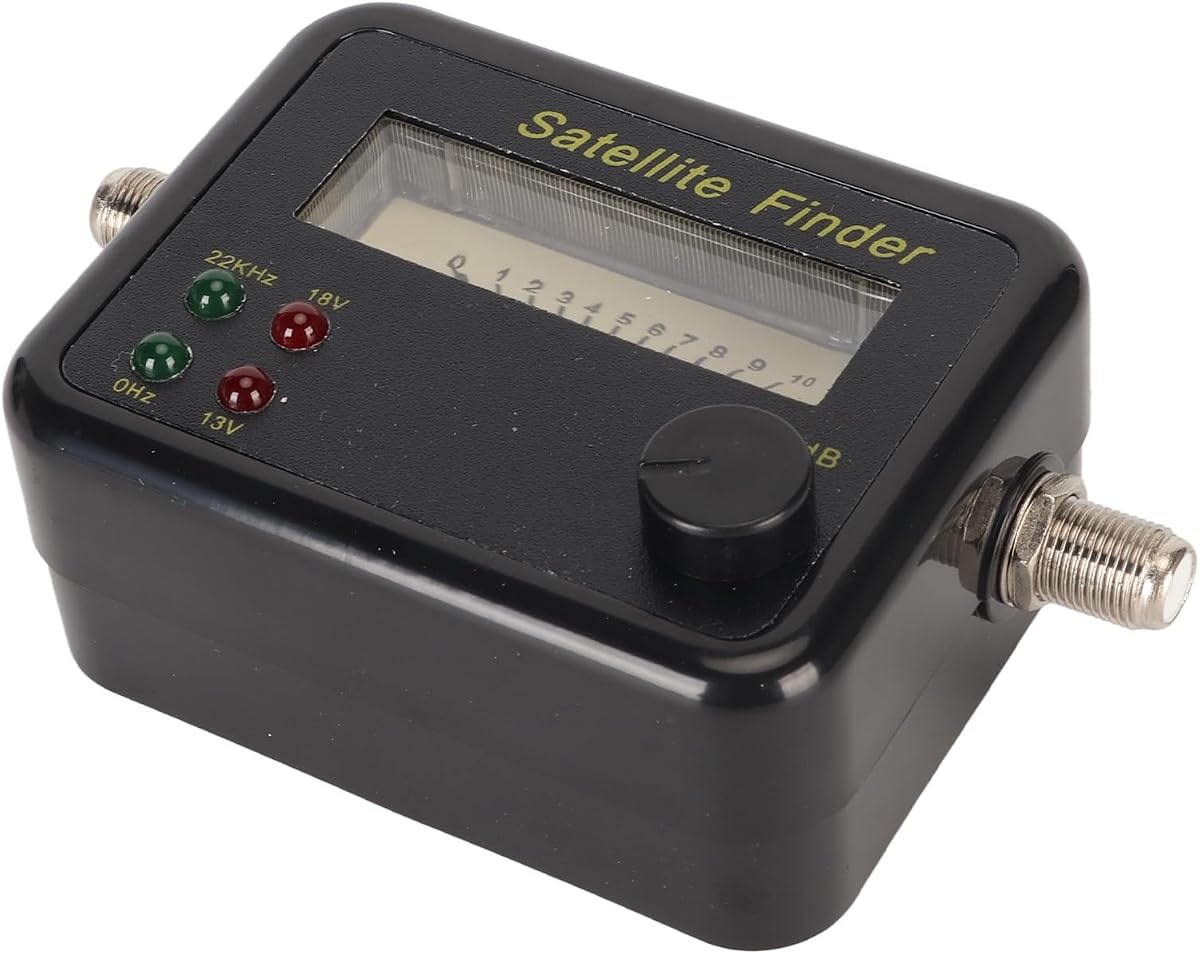
The Universal Satellite Finder delivers the core dish-alignment functions in a small, lightweight package. Its 4.1 rating is notably strong for a budget-oriented meter, while 950 to 2150MHz coverage, 7dBS sensitivity, and adjustable dB control make it suitable for routine signal locating.
We may earn a commission when you buy through this link, at no additional cost to you.
The meter is designed to connect through LNB and REC ports and can detect subtle signal-strength variations as a dish is adjusted. This sensitivity is useful for finding the true peak, particularly when the image is marginal and a coarse orientation is not enough. Its stated measurement accuracy covers minus 40dBm to minus 10dBm.
The enclosure is made from premium material and is described as sturdy, durable, compact, and light. However, the supplied information does not mention a built-in battery, compass, automatic angle calculation, spectrum analysis, or digital quality measurements. It is therefore best understood as a focused strength meter rather than a comprehensive service-analysis tool.
This is the best budget choice for a basic satellite installation that needs sensitive peak detection without a large feature set. It also suits occasional users who want a dedicated tool rather than relying on receiver menus. Buyers who need spectrum analysis, cordless operation, or detailed quality readings should consider a more advanced model.
Seven-decibel sensitivity and adjustable dB control make the meter capable of detecting meaningful changes while the dish moves. Those details are more useful for practical alignment than an expanded menu would be to many beginners.
The small, lightweight body can be moved easily between dishes or carried during outdoor setup. Direct LNB-to-REC connection supports a straightforward workflow for compatible systems.
We may earn a commission when you buy through this link, at no additional cost to you.
The DirecTV ATT Satellite Meter is a basic 950 to 2150MHz strength meter designed for quick dish adjustments. Its 3.2 rating is the lowest in this group, so buyers should evaluate it primarily as a simple alignment aid rather than a comprehensive diagnostic instrument.
We may earn a commission when you buy through this link, at no additional cost to you.
Its main strengths are easy operation, an analog signal-strength display, a variable buzzer, and an attenuation control. The higher the tone, the stronger the signal, giving installers immediate feedback without needing to interpret a dense digital interface. The built-in amplifier is stated to compensate for insertion loss, while attenuation helps keep very strong signals within a useful range.
An illuminated display makes readings easier to see at night, and the 13 to 18V power requirement fits common receiver-powered satellite arrangements. The meter connects between the LNB and receiver to identify the clearest setting. It does not list automatic angle calculation, a compass, spectrum analysis, or detailed quality metrics such as BER and SNR.
This product is suitable for a basic DirecTV or compatible satellite setup where audible peaking and a visible strength scale are sufficient. It may be less compelling if customer feedback reliability is a major concern or if the installer needs detailed digital diagnostics. Its simplicity remains its main appeal for straightforward jobs.
The variable pitch tone turns dish positioning into a direct auditory task. Users can move the dish slowly and listen for the clearest tone without constantly watching a display.
Connecting the meter between the LNB and receiver provides a direct path for tracking the clearest satellite setting. This keeps the setup understandable for users performing a routine installation.
We may earn a commission when you buy through this link, at no additional cost to you.
Choose a satellite finder by matching its supported frequency range, measurement capabilities, connection method, and power options to your dish and receiver setup. The most useful meter is not necessarily the one with the longest specification list, but the one that makes your specific installation easier and more reliable.
Start by confirming that the meter covers the frequencies used by your LNB and satellite system. Many of the products listed operate across 950 to 2150MHz, while the Winegard SF-1000 covers 950 to 2050MHz and the WS-6933 is identified as a C and KU band DVB-S/S2 device. If you also work with terrestrial or cable television, consider the VF-6800P because it supports DVB-T, DVB-T2, DVB-C, and DVB-C2 as well as DVB-S and DVB-S2.
A strength meter is enough to locate a peak, but a meter that also reports quality, BER, PWR, SNR, or MER can help distinguish a strong carrier from a genuinely usable signal. The WS-6933 displays signal strength and quality, while the VF-6800P provides the deepest documented menu of measurements. Basic analog-style units can still be effective for routine alignment, especially when paired with an audio tone, but they offer less troubleshooting detail.
Sensitivity determines how readily the meter can identify a weak signal, while the stated input range shows the levels it is intended to measure. The Tiiyee and Universal Satellite Finder specify 7dBS sensitivity and measurement from minus 40dBm to minus 10dBm. The Hilitand lists a minus 65 to minus 25dBm input range. Compare these figures carefully, because terminology and test conditions may differ between manufacturers.
Audio feedback is particularly useful while looking directly at a dish, and visual feedback helps when the installer is wearing gloves or working in a noisy environment. The DirecTV models use pitch tones and illuminated analog displays. The WF-6800P combines an audio alarm with a color LCD, while the Tiiyee, Universal, and FTA meter rely primarily on a visual strength indication. A backlight is useful for nighttime installations.
Battery operation gives an installer freedom around roofs, ladders, and remote dishes. The Hilitand has a 4,000mAh battery, the VF-6800P has a 2,000mAh battery, and the WS-6933 includes an 800mAh battery with an AC/DC adapter. Other units may draw power from the receiver through the standard 13 to 18V feed. Consider how long you work away from an outlet and whether a proprietary charger or battery is included.
Directional guidance can shorten the initial search for a satellite. The WS-6933 calculates azimuth and elevation automatically and includes a mechanical compass. The Hilitand also calculates both angles and adds constellation analysis. The Weytoll provides a compass for reference, and the VF-6800P includes one alongside its digital tools. These features are particularly useful where a dish has no clear view of the intended direction.
Motorized systems and modern LNB arrangements may require DISEQC switching, tone support, or compatible antenna power. The WS-6933 supports DISEQC 1.0 and 1.1 with 0 and 22kHz tones. The VF-6800P adds DISEQC 1.2, motor setup, and antenna motor control. If your installation uses a dish motor, these capabilities can be more important than a compass or an analog backlight.
A 2.4-inch LCD is common among compact digital meters, while the Hilitand uses a larger 3.5-inch screen and the VF-6800P uses a 2.4-inch color TFT. Larger screens can make satellite lists, spectrum views, and diagnostic values easier to read. Spectrum analysis, loop search, motor control, and editable transponders add value for frequent technicians, but they also make a basic dish alignment more complicated than necessary.
Begin by identifying the intended satellite, transponder, receiver, and LNB configuration. Connect the meter according to its instructions: most models sit between the LNB and receiver, while some require a selected receiver or channel to provide the appropriate 13 to 18V feed. Power the system and confirm the meter receives a baseline signal before moving the dish.
Set the dish to the approximate azimuth and elevation, then make small, controlled adjustments. Watch the strength and quality readings when available, or listen for the highest buzzer pitch. Adjust attenuation if the signal is too strong to compare accurately, and use the compass, automatic angles, spectrum view, or loop search only as guides that complement the live reading.
After achieving the strongest stable result, tighten the dish mount and make one final verification pass. Disconnect external power before changing cables, keep connectors dry and free of debris, and follow the device's battery guidance. Store the meter in a dry place, remove batteries if the manufacturer recommends it for long storage, and keep firmware or transponder software updated through the documented computer connection when applicable.
A satellite finder meter helps align a dish by measuring incoming signal strength and, on more advanced models, signal quality and related diagnostics. An installer uses the reading, audible tone, compass, or calculated angles to find the strongest position. It is especially useful during initial installation, dish repositioning, and troubleshooting weak reception.
No. A satellite receiver decodes television or radio services for viewing, while a finder meter is primarily an installation and alignment tool. Some advanced meters can access receiver information and provide detailed signal measurements, but their main purpose remains locating and optimizing a signal.
Choose a meter that covers the output range of your LNB and the bands used by your satellite system. Most products in this guide cover roughly 950 to 2150MHz, which is common for modern satellite LNBs. Confirm the meter and receiver specifications before connecting equipment, especially if you use older, C-band-only, Ku-band, or specialized systems.
Aim for the clearest stable reading, not merely the largest number shown. On an analog meter, use attenuation to bring a very strong signal into a readable range. On a digital meter, compare strength with quality and, where available, SNR, MER, or BER. Hold the dish at the best position briefly to verify that the reading remains stable.
They are helpful but not essential for every installation. A compass provides an initial direction, while automatic azimuth and elevation calculation can save considerable setup time. The WS-6933 and Hilitand include automatic angle calculations, and several other models add a compass for reference. A simple signal meter remains sufficient when the target position is obvious.
You can test and configure many meters indoors, but actual dish alignment generally requires the dish to be exposed to the satellite signal. Indoors, the meter may lack a usable signal unless positioned near a valid feed through compatible equipment. The safest workflow is to configure the receiver and meter indoors, then perform final pointing outdoors.
Check the cable route, connectors, selected receiver or transponder, LNB power, and frequency compatibility before assuming the dish is misaligned. A meter may need a particular receiver channel or the correct 13 to 18V feed to detect the transponder. Also verify that the meter's input range and standards match the satellite system being tested.
Keep the meter dry, protect its screen and connectors from impact, and avoid leaving it in extreme heat or direct prolonged sunlight. Charge or replace the battery according to its instructions, and use only compatible power adapters. Updating software and saving transponder settings when supported helps preserve performance, while periodic signal checks confirm that readings remain trustworthy.
The WS-6933 stands out as the best overall option because it combines a strong customer rating with DVB-S/S2 support, automatic angle calculation, a compass, rechargeable operation, and clear sound-and-light lock alerts. The VF-6800P takes the premium lead for technicians who need spectrum analysis, motor control, multiple broadcast standards, and deeper digital measurements. For basic alignment on a smaller budget, the Universal Satellite Finder offers sensitive readings and a portable design.
Prioritize compatibility before every other feature. Confirm the supported frequency range, receiver and LNB connection method, power source, DISEQC requirements, and the satellite bands you actually use. A large screen, compass, or motor menu is valuable only when your installation workflow needs it; otherwise, a sensitive and easy-to-read meter may provide the better experience.
Product availability, specifications, and pricing can change, so verify the current listing before purchasing. Review included accessories, connection cables, power adapters, and battery details as well, since they can affect whether a meter is ready for use immediately. With those checks completed, the right signal finder should make alignment faster and more confident.