
WD-40 Specialist Contact Cleaner
4.8Editor score
Targets flux and condensation
Quick-drying and residue-free
Suitable for printed circuit boards
This Circuit Board Cleaner guide compares ten options for residue, drying speed, material compatibility, precision, and electronic repair use.
Circuit board cleaners are specialized products for removing flux, grease, dust, oxidation, and other contaminants from electronic components and electrical contacts. A useful cleaner should dry quickly, leave minimal residue, penetrate crowded assemblies, and remain compatible with the plastics, metals, coatings, and adhesives found on modern electronics.
This guide compares ten cleaners using the information supplied for each product, including intended applications, drying characteristics, container format, precision features, material cautions, and customer ratings. The list covers aerosol contact cleaners, liquid cleaners supplied with brushes, and multipack options suited to regular maintenance or professional repair work.
Each review explains what the product is best positioned to handle, along with its limitations and appropriate buyer. Rankings reflect the supplied rating, practical feature mix, and relevance to the circuit board cleaning category. Product details and availability can change, so buyers should confirm the current listing and manufacturer instructions before purchase.
4.8Editor score

4.8Editor score

4.7Editor score
The table below compares all ten products by format, residue behavior, application focus, and notable handling considerations, making it easy to identify the right cleaner for electronics repair or routine maintenance.




The CRC 05103 QD Electronic Cleaner combines a 4.8 customer rating with a formulation explicitly intended for sensitive electronic components. Its defining qualities are rapid evaporation, residue-free performance, and plastic-safe use, all of which make it a strong general-purpose choice for cleaning circuit boards, contacts, sockets, switches, and related assemblies.
We may earn a commission when you buy through this link, at no additional cost to you.
The supplied product information identifies a cleaner made from petroleum distillate and alcohol. That composition supports its use for flux removal and contact maintenance, while the fast-drying nature reduces the time a board must remain exposed to moisture. Its listed applications extend well beyond motherboards to circuit breakers, relay switches, plugs, coin mechanisms, lighting components, PVC, nylon, and plastics.
The main trade-off is that it arrives as an aerosol without a separately noted brush or precision straw. Users must control application carefully and avoid spraying components indiscriminately, especially around displays, keyboards, adhesives, or other parts not covered by the stated applications. Even so, its combination of residue control, broad material compatibility, and strong rating supports the top position.
This is the most versatile recommendation for a buyer who wants one product for electronics repair and maintenance. Choose the 11-ounce CRC 05103 when the priority is quick drying, minimal residue, and dependable performance across a wide range of contacts and sensitive electronic components rather than a brush-based application system.
A fast-evaporating formula is especially helpful when cleaning populated circuit boards where trapped moisture can complicate the next power-on. The CRC product is designed to dry quickly and leave no residue, helping reduce the risk of introducing a secondary contaminant after maintenance.
The application list covers circuit boards, plugs, sockets, relay switches, coin mechanisms, and plastic components. That breadth makes the cleaner useful for electronics repair kits, household electronics maintenance, and servicing of electrical contacts that suffer from contamination.
We may earn a commission when you buy through this link, at no additional cost to you.
The WD-40 Specialist Contact Cleaner earns a 4.8 rating and is positioned as an accessible, dependable option for routine circuit board maintenance. It is specifically described as suitable for printed circuit boards, controls, switches, precision instruments, and electric panels, giving it broad relevance beyond consumer electronics.
We may earn a commission when you buy through this link, at no additional cost to you.
Its core formula quickly removes oil, dirt, flux residue, and condensation from sensitive electrical equipment. The product is described as safe for metal and most plastics, while also carrying a clear caution to test plastics first and keep the spray away from adhesives, device screens, and keyboards. Those limits make careful application essential, but they are straightforward to follow.
Compared with more specialized products, the WD-40 option may be less focused on one narrow cleaning problem. However, it brings together several useful contaminant-removal capabilities in a familiar aerosol format and maintains the same 4.8 rating as the leading CRC product. That balance of versatility and customer feedback makes it an attractive value-oriented selection.
This cleaner suits electronics hobbyists, repair technicians, and maintenance workers who want to address flux, oil, dirt, and condensation with one product. Buy it when you need a broadly applicable contact cleaner and will follow the stated plastic-compatibility and application precautions.
Oil, dirt, flux residue, and condensation create different cleaning challenges, but the WD-40 Specialist product is described as addressing all four. That range improves its usefulness for general repair benches where varied contamination is encountered.
Even a product described as safe for most plastics should be tested in a discreet area before widespread use. The cleaner should also be kept away from displays, keyboards, and adhesive-mounted components because those surfaces are specifically excluded.
We may earn a commission when you buy through this link, at no additional cost to you.
The 250ML Electronic Contact Cleaner offers a 4.4 rating and distinguishes itself with an included matching brush. The brush-based method is especially useful when a technician needs to apply cleaner directly to a localized oily area, agitate contamination, wipe the surface repeatedly, and allow the board to dry.
We may earn a commission when you buy through this link, at no additional cost to you.
Its fast-evaporating formula is intended to remove contamination without damaging electronic components or leaving material behind. The supplied information identifies computer motherboards, mobile phone repairs, and industrial control boards as suitable applications, giving it relevance across consumer and industrial electronics. Its 250-milliliber format also provides more visible liquid volume than a small aerosol.
The key limitation is material compatibility. The listing specifically says the cleaner is not suitable for ABS resin, PS, or PC, which are common plastics in electronic housings. Users must identify component materials before applying it broadly. Its 4.4 rating is also lower than those of the top two products, making it less compelling when broad compatibility is the primary concern.
This cleaner is best for repair professionals or experienced hobbyists who understand plastic identification and prefer a brush and liquid for controlled application. Choose it for localized cleaning of compatible circuit boards, not for indiscriminate use across unknown housings or plastics.
The included brush lets users direct the cleaner toward a contaminated contact rather than flooding an entire assembly. This can be helpful around dense motherboard layouts, phone repair areas, and control boards where overspray may be difficult to manage.
The stated exclusions for ABS resin, PS, and PC are significant because those materials can appear in electronic housings. Inspect the parts being cleaned and avoid treating the product as universally safe for every plastic encountered on a circuit board.
We may earn a commission when you buy through this link, at no additional cost to you.
The BW-100 Non-Flammable Electronic Contact Cleaner has a 4.6 rating and offers a distinct combination of non-flammable operation, quick evaporation, and an extension straw. The straw is valuable on densely populated circuit boards because it lets the user direct the spray into confined spaces or toward individual contact points.
We may earn a commission when you buy through this link, at no additional cost to you.
The product is described as improving conductivity by removing dust and other contaminants from sensitive electrical equipment. It is also suitable for rubber, metal, and most plastics, although a small-area compatibility test is recommended. Its listed uses include Joycons, computers, printed circuit boards, and other contact-bearing electronic assemblies.
The primary caution is that screens, keyboards, and adhesives should be avoided. Those exclusions are reasonable because surfaces and bonded components may react differently from the internal contacts the cleaner is designed to service. The product's aerosol format also requires ventilation and controlled spraying, although the stated non-flammable formulation reduces one obvious concern associated with solvent-based maintenance products.
This is a strong choice for technicians who need pinpoint access in crowded electronics and value a non-flammable option. It is especially relevant for game controller contacts, computers, and circuit boards, provided the user avoids the specifically listed surfaces and tests plastic compatibility first.
The extension straw turns the aerosol into a more precise delivery tool. Instead of applying a broad cloud over a board, the user can target a switch, connector, or contact that needs cleaning while shielding nearby components.
The non-flammable formulation is the defining specification for this option. It may appeal to repair shops and maintenance users who want a fast-evaporating contact cleaner without the flame hazard associated with some aerosol products.
We may earn a commission when you buy through this link, at no additional cost to you.
The 250ML Electronic Contact Cleaner has a 4.0 rating and focuses on rapid evaporation, broad device compatibility, and removal of surface contamination. It is presented as a contact cleaner for computer motherboards, phone repairs, industrial control boards, and other electronic equipment.
We may earn a commission when you buy through this link, at no additional cost to you.
Its standout feature is the claim that it dries within seconds, helping prevent liquid from collecting on circuit boards and connectors. The product is designed to remove contaminants from electronic components and restore optimal conductivity, while regular use is framed as a way to reduce contact failures and extend device service life.
The 4.0 rating is the lowest among the listed products, so this option does not offer the same strength of customer feedback as the leaders. The information also does not identify an included brush or precision applicator, making it less suitable for highly localized work unless the user already has a suitable wiping tool.
Buyers who value fast evaporation and a straightforward liquid format may find this product useful for routine maintenance across multiple compatible electronic devices. It is less compelling for sensitive applications where a higher rating, more detailed material guidance, or included applicator would provide greater confidence.
The claim that the cleaner dries within seconds addresses a central concern in circuit board maintenance. Rapid evaporation can reduce the period during which residual liquid might remain around connectors or component surfaces.
The stated applications span motherboards, mobile phone repairs, and industrial control boards. That range makes the liquid suitable for a shared maintenance kit, provided it is used only on compatible surfaces.
We may earn a commission when you buy through this link, at no additional cost to you.
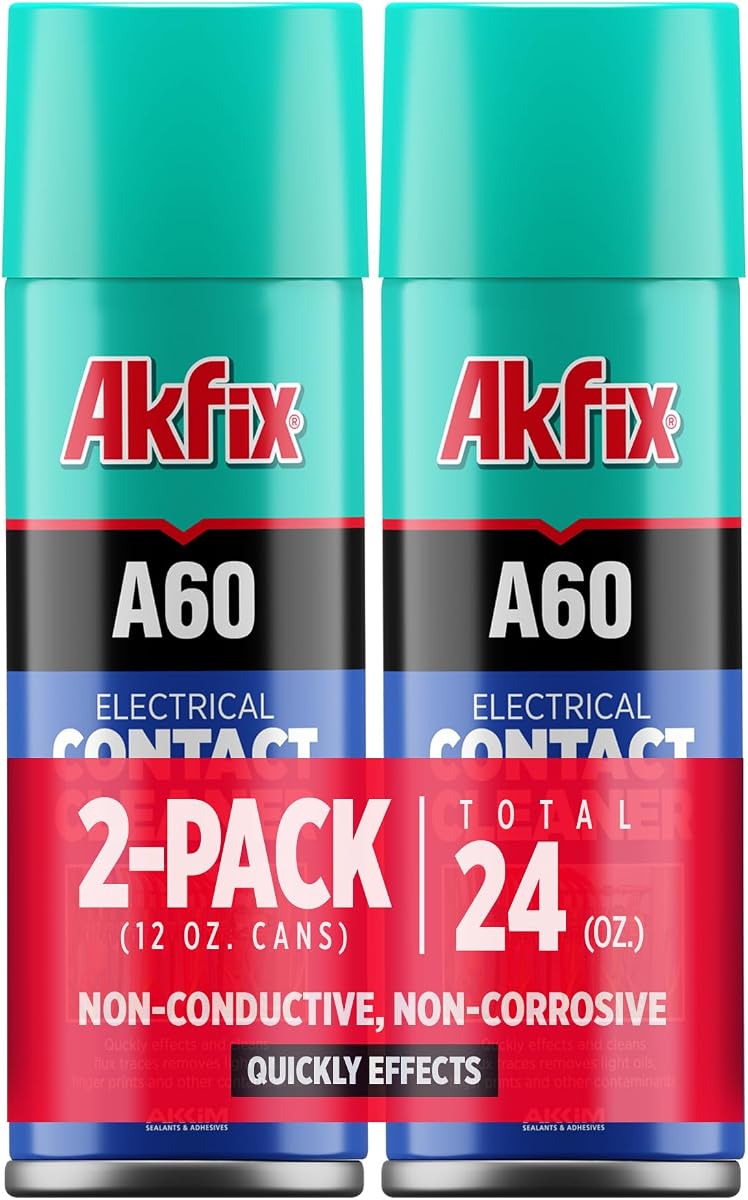
The Akfix A60 Electrical Contact Cleaner receives a 4.5 rating and stands out for its two-can format, non-corrosive formula, and residue-free performance. It is positioned for delicate electrical components, where ordinary household cleaners may not be appropriate because they can leave damaging deposits.
We may earn a commission when you buy through this link, at no additional cost to you.
The product swiftly evaporates and removes dirt, light oil, grease, flux, and dust from electronic devices and electrical equipment. Its uses include computer, battery, keyboard, and digital equipment, as well as metal connectors and contacts. The non-corrosive formula is intended to support efficient connector operation without attacking the surfaces being cleaned.
The packaging does not eliminate the need for caution. The listing recommends testing on sensitive plastics and avoiding adhesive-mounted or stressed parts. Users should also interpret the mention of keyboard equipment carefully, because several competing contact cleaners explicitly warn against spraying keyboards; controlled application and manufacturer instructions remain important.
The dual pack makes this a practical choice for active repair benches or technicians who want a spare can available. It is well suited to regular maintenance involving compatible connectors and contaminated contacts, with the understanding that sensitive plastics and bonded components require preliminary testing.
The two-pack format is useful when cleaning is frequent or when keeping one sealed can in a workshop and another in a mobile repair kit is convenient. It also reduces the likelihood of running out during a multi-board maintenance session.
A non-corrosive formula is particularly important for electrical contacts because surface damage can impair conductivity. The stated formula is designed to clean connectors and contact parts while supporting continued use.
We may earn a commission when you buy through this link, at no additional cost to you.
The CRC QD Electronic Cleaner 05101 combines a 4.7 rating with a compact 4.5-ounce aerosol format. It uses the same general positioning as CRC's larger 05103 option: a precise, fast-evaporating cleaner for electronics that leaves no residue and is designed to remain plastic safe.
We may earn a commission when you buy through this link, at no additional cost to you.
Its stated applications include computer components, circuit breakers, circuits, contacts, sockets, relay switches, plugs, coin mechanisms, lighting components, PVC, nylon, and plastics. It is also listed for flux removal, making it useful when a repair involves both general contamination and residue associated with solder work.
The obvious trade-off is capacity. A 4.5-ounce can may require more frequent replacement during heavy service work than the 11-ounce CRC 05103. No brush or extension straw is mentioned, so users still need controlled aerosol technique and appropriate protective measures when working around dense boards.
This product is a good fit for a home repair bench or technician who values the CRC formulation in a smaller package. Choose it when portability, sensitive-electronics positioning, and quick residue-free drying matter more than having a large aerosol supply on hand.
The smaller container is easier to organize in a drawer, technician's bag, or compact repair kit. It offers the same broad contact-cleaning applications as the larger CRC option while serving users who do not need the greater volume.
Fast evaporation, plastic-safe use, and residue-free performance form the core of the product's value proposition. Those qualities are relevant to routine maintenance where trapped moisture or cleaning residue could undermine electrical contact.
We may earn a commission when you buy through this link, at no additional cost to you.
The WD-40 Specialist Contact Cleaner Twin Pack pairs two 11-ounce aerosol cans with a smart straw and earns a 4.7 rating. It brings the broad contaminant-removal capabilities of the Specialist line to users who want more than one can or work across separate workstations.
We may earn a commission when you buy through this link, at no additional cost to you.
The cleaner removes oil, dirt, flux residue, and condensation from sensitive electrical equipment. It is specifically suitable for printed circuit boards, controls, switches, precision instruments, and electric panels. The quick-drying, residue-free formula is paired with a smart straw that helps direct the spray toward a contact rather than applying it indiscriminately.
The important cautions remain the same: test plastic surfaces first, and avoid adhesives, screens, and keyboards. Two cans add convenience and continuity, but they do not make these application restrictions less important. Users should still work in a ventilated area and avoid allowing cleaner to pool around powered or vulnerable components.
This pack is well suited to maintenance professionals, shared repair spaces, or frequent hobbyists who can keep the cans in separate work areas. It is a particularly strong choice when precision delivery and a larger total volume are both priorities.
The smart straw gives users better directional control than a bare aerosol nozzle. This is useful when reaching a switch or connector on a crowded board without coating unrelated components in cleaner.
The twin-pack format makes it practical to stock more than one workspace. It can help avoid repeatedly moving a single can between a bench, field service kit, and electronics repair area.
We may earn a commission when you buy through this link, at no additional cost to you.
The Electronic Contact Cleaner 8.5 Oz carries a 5.0 rating, the highest numerical customer rating in this list. It combines deep cleaning with a soft brush, rapid evaporation, and a stated ability to remove dust, grease, flux, and rosin from delicate electronic surfaces.
We may earn a commission when you buy through this link, at no additional cost to you.
The brush is intended to agitate stubborn contamination while the liquid dissolves and lifts residue. Its fast-evaporating formula is described as drying completely within seconds without leaving moisture, streaks, or residue, allowing work to continue immediately. The product is also claimed to remove oxidation and restore conductivity between metal contacts.
It goes beyond cleaning by depositing a thin, long-lasting lubricating film intended to reduce friction, limit wear, and slow future oxidation. That is a compelling feature for switches, connectors, relays, and mechanical contacts, but the protective-film claim should be considered alongside the product's less established rating history compared with the more established brands in the comparison.
This cleaner is a strong candidate for users who want deep cleaning and protection in one product rather than a basic solvent-only option. It is particularly relevant to restoration work involving oxidized contacts, provided the user confirms compatibility and allows the treated surfaces to dry fully before reassembly.
The combination of a dissolving cleaner and an agitation brush is useful for oxidation, rosin, grease, and flux. The brush can work the contaminant without requiring aggressive scraping that might damage a delicate contact surface.
The stated protective film is intended to reduce friction and help slow future oxidation. That makes the product relevant to switches and connectors where cleaning alone may not address wear-related or recurring contact problems.
We may earn a commission when you buy through this link, at no additional cost to you.
The Hosa CAIG Laboratories D5S-6 DeoxIT Contact Cleaner is a specialized five-ounce aerosol with a 5% spray formulation. Its 4.7 rating reflects a favorable response from users, while its explicit contact-cleaning focus distinguishes it from broad household spray cleaners.
We may earn a commission when you buy through this link, at no additional cost to you.
The compact can is designed for maintaining electrical contacts, making it a logical addition to a technician's kit for computer, audio, instrument, or control equipment. Its limited 5% spray format allows users to apply a controlled quantity, and the smaller container is convenient for storage in a service drawer or portable tool case.
The supplied information is much less detailed than for most competitors. It does not explicitly describe drying speed, residue behavior, compatible plastics, precision accessories, or specific circuit board applications. Those omissions make it difficult to compare the product on every dimension without consulting the current manufacturer documentation, so users should verify those details before applying it near sensitive parts.
The DeoxIT name and contact-cleaning designation make this the premium selection for users who specifically want a focused contact-care product rather than a general electronics aerosol. It is best for informed buyers who already know their equipment materials and will verify the current usage instructions.
The product is labeled specifically as a contact cleaner rather than a multi-purpose household aerosol. That focused positioning may appeal to technicians who want a dedicated maintenance option for connection and contact restoration.
The five-percent spray and five-ounce container combine a measured application format with convenient storage. Users should still check the current instructions for drying behavior, residue expectations, and material compatibility.
We may earn a commission when you buy through this link, at no additional cost to you.
Choosing a circuit board cleaner means balancing contaminant removal with fast drying, material compatibility, application control, and the type of electronics being serviced. The most suitable product is one that cleans the problem without leaving residue or introducing compatibility risks.
Fast evaporation is one of the most important qualities in a circuit board cleaner. A product that dries quickly leaves less opportunity for liquid to collect beneath components, around connectors, or inside switches. Residue is equally important because even a thin film can interfere with conductivity or attract new contamination. The CRC products are explicitly described as fast evaporating and residue-free, while the WD-40 Specialist options are also described as quick drying and residue-free.
Prioritize cleaners that explicitly state both quick drying and minimal or zero residue. If those claims are unclear, verify the current manufacturer instructions and test the product on a compatible, less critical area before cleaning a valuable board.
Circuit boards can carry several different contaminants, so identify what actually needs removal. Flux and rosin are common after soldering, while dust, grease, light oil, condensation, and oxidation require different cleaning considerations. The WD-40 Specialist formula targets oil, dirt, flux, and condensation; the Akfix A60 product lists dust, light oil, grease, and flux; and the 8.5-ounce cleaner additionally describes rosin and oxidation removal.
Choose based on the contamination present rather than assuming every cleaner is equally suited. For mixed jobs, a product that addresses several contaminant types can be more convenient than maintaining a separate solvent for each task.
Electronic assemblies combine conductive metals with plastics, rubber, adhesives, coatings, displays, and printed markings. A cleaner that works well on a connector may be inappropriate for a nearby housing, keyboard membrane, or bonded component. Several products in this guide claim use on most plastics, but they also recommend a small compatibility test.
Pay particular attention to explicit exclusions. The 250ML brush product is not suitable for ABS resin, PS, or PC, while the WD-40 products advise avoiding screens, keyboards, and adhesives. Identify component materials and treat those cautions as firm boundaries rather than optional suggestions.
Precision matters on crowded circuit boards because a broad aerosol mist can reach switches, sensors, displays, or adhesive-mounted parts that should not be wetted. Aerosol products with extension or smart straws allow more targeted delivery. The BW-100 includes an extension straw, and the WD-40 twin pack includes a smart straw. Liquid products with brushes offer another form of control, allowing the user to agitate and wipe a defined area.
For dense boards, choose a delivery method that lets you direct cleaner onto the contaminated contact. For larger service areas or straightforward maintenance, a standard aerosol nozzle may be sufficient, but it still requires measured spraying and good ventilation.
Aerosol cleaners should be used in a ventilated area and directed away from ignition sources unless the manufacturer specifically states that the product is non-flammable. The BW-100 is explicitly labeled non-flammable, while the CRC formula contains petroleum distillate and alcohol. Users should follow all label directions, wear appropriate eye and hand protection, and avoid breathing concentrated spray.
Look for practical warnings and clear application instructions. Safety does not come only from a formula's reputation; it also depends on whether the product is used on powered equipment, how much is sprayed, and whether incompatible materials are present.
The best cleaner depends partly on what you are servicing. Consumer motherboard and phone repair work may call for a small brush-assisted liquid, while electrical panels, control boards, switches, and instruments may suit a broader aerosol. Some listings explicitly include industrial control boards, and the CRC products cover a particularly wide collection of contacts, sockets, relays, plugs, and circuit breakers.
Match the stated applications to your actual workload. A cleaner for metal connectors may be inadequate for a densely assembled board, while a powerful general-purpose product may be more than necessary for occasional contact maintenance.
A basic contact cleaner removes contamination, while a cleaning-and-protection product may also leave a film intended to reduce friction or slow oxidation. The 8.5-ounce Electronic Contact Cleaner makes the strongest protection claim, describing a long-lasting lubricating film on metal surfaces and electronic components.
Protection can be useful for switches, relays, and connectors subject to repeated movement, but users should determine whether a lubricating film is appropriate for their equipment. Pure contact cleaning may be preferable when contamination removal is the only goal.
Packaging can influence value based on how often you clean. A single can may be sufficient for occasional maintenance, while multipacks are convenient for frequent service work or separate work areas. The Akfix A60 and WD-40 Specialist twin pack each contain two aerosol cans, and the CRC range offers both 4.5-ounce and 11-ounce formats.
Consider storage, portability, and expected frequency of use together. A compact can may be more practical for a small toolkit, while a larger multipack may be more useful to a technician who cleans boards frequently. Compare the delivered features rather than package size alone.
Before cleaning, disconnect the device from power, remove the battery when appropriate, and allow the board to cool. Photograph or label connectors if they may be difficult to reassemble, and identify plastics, adhesives, screens, keyboards, coatings, and other materials that the cleaner may not safely contact. Work in a ventilated area and keep the product away from ignition sources unless its label specifically states that it is non-flammable.
Apply the cleaner sparingly. For an aerosol, use short controlled bursts and direct the straw or nozzle toward the contaminated contact without flooding nearby components. For a brush product, place a small amount on the oily area, gently agitate the residue, and wipe it away with a clean, lint-free tool. Avoid forcing liquid beneath large components where it cannot be reached or fully dried.
Allow the board to dry completely before reassembly or energizing it. Confirm that no visible liquid, streaks, residue, or moisture remains, and inspect connectors and switches for proper operation. Store the cleaner according to its label, keep the applicator clean, and use manufacturer guidance if a product is used on a material or device not covered by the supplied instructions.
Yes, when the product is specifically listed for printed circuit boards and is compatible with the materials on the board. Disconnect power, apply the cleaner sparingly, and keep it away from screens, keyboards, adhesives, and unsupported plastics. Let the board dry fully before returning it to service.
Choose a product that explicitly states it removes flux residue and dries quickly without leaving residue. The WD-40 Specialist, CRC QD, and Akfix A60 products all list flux-related cleaning applications. For stubborn residue, a brush-assisted product can provide more mechanical action, but material compatibility should be checked first.
Yes. Residue can interfere with electrical contact, attract new dirt, or create problems that are difficult to diagnose. Fast-drying, residue-free claims are especially valuable around connectors, switches, and densely populated boards where liquid and film are harder to remove.
Only if the manufacturer says the cleaner is compatible with that plastic and any test instructions are followed. Some listed products are described as safe for most plastics, while the 250ML brush cleaner specifically excludes ABS resin, PS, and PC. Adhesive-mounted and stressed parts also require caution.
No. Disconnect the device from its power source and remove the battery when appropriate before cleaning. Even a fast-drying product should not be sprayed onto energized electronics, and liquid should never be allowed to pool around live components.
An extension straw generally offers more targeted delivery in crowded assemblies because it helps keep the spray away from unrelated components. The BW-100 includes one, while the WD-40 Specialist twin pack includes a smart straw. Precise delivery still requires short bursts and careful positioning.
Some formulations are marketed for both. The 8.5-ounce Electronic Contact Cleaner specifically describes removing oxidation, dust, grease, flux, and rosin, while the Akfix A60 targets dust, light oil, grease, and flux. For severe oxidation, inspect the contact for physical damage because cleaning cannot replace a damaged connector.
Follow the product's drying instructions and wait until no visible liquid or moisture remains. Products in this guide are described as drying quickly, sometimes within seconds, but crowded assemblies can trap fluid beneath components. Extra drying time is safer than powering a board before the cleaner has fully evaporated.
The CRC 05103 QD Electronic Cleaner is the strongest all-around choice because it combines a 4.8 rating, fast evaporation, residue-free cleaning, plastic-safe positioning, and a wide list of PCB and contact applications. The WD-40 Specialist Contact Cleaner is the practical value alternative for users who want one product to address oil, dirt, flux, and condensation across multiple types of electrical equipment.
For precision work, choose a product with an extension straw, smart straw, or included brush. For deep cleaning and protection, the 8.5-ounce Electronic Contact Cleaner offers the most extensive stated feature set, while the Hosa CAIG DeoxIT D5S-6 serves buyers seeking a specialized premium contact-care product. Regardless of the option, prioritize fast drying, residue control, and confirmed material compatibility over broad claims alone.
Check the current listing, manufacturer instructions, container size, applicator details, and surface restrictions before buying. Product formulations and availability can change, and the most reliable choice is the cleaner whose stated applications match the board, connectors, plastics, and contaminants in your specific repair.