
OWC Envoy Ultra 2TB
4.4Editor score
Over 6000MB/s claimed speed
Four-terabyte-class portability
Bus-powered NVMe design
Thunderbolt 5 storage solutions deliver exceptional speed and versatile expansion; this guide compares ten leading SSDs, docks, hubs, and enclosures today.
Thunderbolt 5 storage solutions combine exceptional bandwidth, flexible connectivity, and convenient external storage for demanding creative and professional workflows. The strongest choices serve very different roles, including portable NVMe SSDs, multi-bay enclosures, desktop Thunderbolt 4 storage, high-speed network docks, and compact hubs that expand a computer's connections.
This guide compares ten products using the specifications and feature information supplied for each listing. Performance claims, interface capabilities, drive compatibility, capacity, physical design, warranty coverage, and intended use are weighed alongside each other. The list includes dedicated Thunderbolt 5 storage, related Thunderbolt 4 and USB4 equipment, and docks that remain useful with modern computers.
Each review shows how the product fits into a larger storage strategy rather than treating a headline interface as the only consideration. The top selections represent the strongest balance of speed, capacity, flexibility, and convenience, while the remaining entries can be better choices for expansion, shared storage, or specific workstation needs. Product availability and prices may change, so confirm current details before buying.
4.4Editor score
4.4Editor score
4.4Editor score
The table below compares all ten products by interface, storage design, capacity, portability, and their most relevant use case. Several entries are docks or hubs rather than standalone drives, so compatibility and available connectors matter as much as raw storage performance.
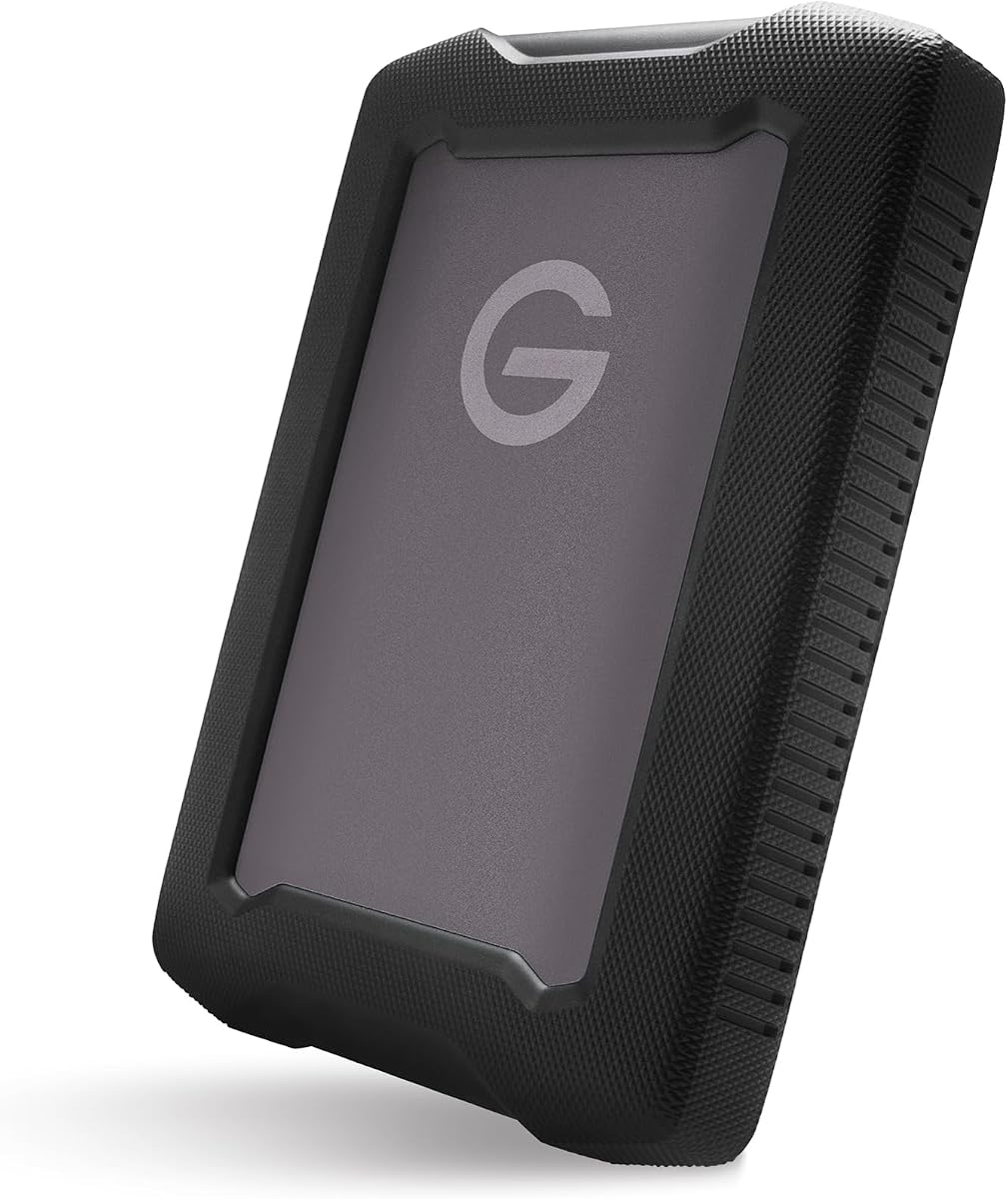




The G-DRIVE 5TB ArmorATD is a rugged portable hard drive for photographers, filmmakers, and other users who need a large amount of offline storage without paying for a premium NVMe SSD. Its supplied information emphasizes durability, including a rain-, dust-, and crush-resistant enclosure, while its listed transfer speed reaches up to 130MB/s. It supports USB-C and is compatible with Thunderbolt 3 systems.
We may earn a commission when you buy through this link, at no additional cost to you.
Its strongest benefit is the combination of five terabytes of capacity and physical protection. The anodized aluminum enclosure provides a substantial shell, and the easy-grip bumper is intended to improve handling in field conditions. This makes the drive more appropriate for archiving large camera files, completed projects, and other data that can remain disconnected from a production computer.
The trade-off is speed. A 130MB/s ceiling is suitable for backups and routine file transfers but will feel modest beside a Thunderbolt 5 NVMe SSD, particularly when working with multi-camera footage or very large project files. It is also not a native Thunderbolt 5 product, despite offering compatibility with Thunderbolt 3, so buyers should treat it as a durable high-capacity backup drive rather than a workstation-speed scratch disk.
This is a compelling choice for users who prioritize capacity, resilience, and broad USB-C usability over immediate throughput. It is less suitable for editors who need to cut multiple high-resolution streams directly from the drive. For those who can accept slower transfers, it provides a practical way to protect and carry important files.
The aluminum body, grip bumper, and stated resistance to rain, dust, and crushing give the drive a more rugged character than a basic desktop enclosure. Those qualities are especially relevant for location work where drives are repeatedly packed, moved, and exposed to less controlled environments.
Five terabytes gives creators room to separate finished work from active projects. Because it is designed for USB-C and also works with Thunderbolt 3 hosts, it can function as a broad-purpose archive without requiring the very latest computer.
We may earn a commission when you buy through this link, at no additional cost to you.
The OWC Envoy Ultra 4TB is one of the most balanced Thunderbolt 5 portable SSDs because it combines substantial capacity with the listed ability to exceed 6000MB/s. It carries a 4.4 rating and is positioned for both everyday storage and professional creative projects. The bus-powered, fanless design also keeps it simple to carry between a desktop and a compatible mobile workstation.
We may earn a commission when you buy through this link, at no additional cost to you.
OWC emphasizes compatibility with Thunderbolt 3, Thunderbolt 4, and USB4 machines, allowing it to deliver the maximum speed the attached host supports. It works with Macs, PCs, iPad Pros, Chromebooks, and Surface devices. A built-in Thunderbolt cable removes the need to pack a separate lead, while the heat-dissipating aluminum enclosure is designed to manage sustained performance without a fan.
The main limitation is that fixed 4TB capacity cannot be expanded, and the advanced speed advantage depends on a host and connection that support the relevant protocol. A USB4 system may offer less performance than a full Thunderbolt 5 setup, and older Thunderbolt 3 computers will not unlock the same headline speed. Buyers seeking a drive they can service or replace internally should look to a modular enclosure instead.
For creative professionals, this is an excellent all-purpose portable SSD. It offers enough room for substantial media caches and project files while remaining far quicker than the G-DRIVE ArmorATD. The four-terabyte version is a particularly convincing choice when capacity and portability must coexist without turning to a larger multi-bay system.
The listed performance of more than 6000MB/s places the Envoy Ultra far above ordinary external SATA and conventional USB hard drives. That makes it suitable for moving large media, maintaining active edit media, and reducing waits when a project moves between machines.
Support for Thunderbolt 3, Thunderbolt 4, and USB4 gives the drive a useful range across current and recent systems. OWC also lists Macs, PCs, iPad Pros, Chromebooks, and Surface devices, though the host determines the speed actually achieved.
We may earn a commission when you buy through this link, at no additional cost to you.
The OWC Envoy Ultra 2TB offers the core benefits of the Envoy Ultra family at a lower capacity point. It retains the claimed speed of more than 6000MB/s, a 4.4 rating, broad device compatibility, and a rugged, weather-resistant housing. For editors who already maintain separate archival storage, two terabytes can be a more focused working capacity than four or eight terabytes.
We may earn a commission when you buy through this link, at no additional cost to you.
The drive is bus-powered and includes a built-in Thunderbolt cable, making it well suited to mobile production. Its fanless aluminum design provides passive heat dissipation and silent operation, while support for Thunderbolt 3, Thunderbolt 4, and USB4 expands the range of compatible systems. The supplied information also lists a five-year OWC limited warranty.
The tradeoff is straightforward: the smaller capacity is less forgiving when a project contains many high-resolution source files, and it cannot be expanded after purchase. As with any high-speed external SSD, the advertised result depends on the host, cable, and storage workload. A USB4 connection remains useful but will not necessarily reproduce the maximum performance available over Thunderbolt 5.
This is the most value-conscious way to enter the Envoy Ultra range for a buyer who genuinely needs Thunderbolt-class speed. It is a strong fit for active project media, fast scratch storage, and transfers between compatible computers. Users building a larger library should consider the 4TB or 8TB versions or add separate archival storage.
Two terabytes is enough for many active working sets when a separate drive holds completed files. It can be a sensible middle ground for people who need high speed but do not want to carry a larger enclosure for every session.
The fanless aluminum design avoids mechanical noise, while the integrated cable reduces the chance of leaving a required lead behind. Bus power further simplifies use across compatible laptops, tablets, and desktops.
We may earn a commission when you buy through this link, at no additional cost to you.
The OWC 8TB Envoy Ultra is the high-capacity member of this portable SSD group and the most compelling choice when serious speed must accompany a large working set. It carries the same 4.4 rating and claimed performance above 6000MB/s as the smaller Envoy Ultra models, but its eight-terabyte capacity can reduce the need to shuffle large projects between drives.
We may earn a commission when you buy through this link, at no additional cost to you.
The product uses a rugged, shock-resistant, weatherproof exterior and a silent, fanless heat-dissipating aluminum design. Bus power and a built-in Thunderbolt cable support straightforward mobile use, while compatibility with Thunderbolt 3, Thunderbolt 4, and USB4 systems broadens its usefulness. Macs, PCs, iPad Pros, Chromebooks, and Surface devices are all listed as supported categories.
Capacity does not make the drive a universal solution. Eight terabytes may be more than necessary for a light user, and the premium hardware still cannot deliver maximum throughput on every host. The internal storage is not presented as user-upgradeable, so buyers should choose the capacity carefully rather than treating the enclosure as a modular multi-device system.
For a studio or mobile professional who wants one high-speed drive to hold source media, caches, and deliverables, this is the most compelling Envoy Ultra configuration. It combines the portability of an SSD with a generous amount of space and a five-year limited warranty, making it a premium choice for demanding, high-volume workflows.
Eight terabytes allows large media libraries, project archives, and caches to remain on one fast device. This can simplify a mobile workflow by reducing the need for frequent transfers between multiple external drives.
The shock-resistant, weatherproof enclosure supports use beyond a stationary desk, and the listed five-year limited warranty provides a longer stated coverage period than several other products in the guide. Passive cooling also avoids fan noise during sustained work.
We may earn a commission when you buy through this link, at no additional cost to you.
The OWC ThunderBay 8 is a desktop storage system for users who need more bays, greater flexibility, and RAID options rather than a pocketable drive. It has a 4.2 rating and supports eight universal 2.5-inch or 3.5-inch SSDs and hard drives. Its dual Thunderbolt 3 ports support older Thunderbolt 2 equipment and allow additional Thunderbolt devices to be connected through the second port.
We may earn a commission when you buy through this link, at no additional cost to you.
The enclosure can be daisy-chained with as many as six units, reaching a listed maximum of 1,152TB, while also providing five additional Thunderbolt connections in a chain. Thumb-screw release trays make drive swaps convenient, and the product is described as plug-and-play with no additional drivers required. Bundled OWC SoftRAID Premium supports several RAID configurations, Apple RAID, and Windows Disk Manager.
Thunderbolt 3 rather than Thunderbolt 5 is the main specification limitation. The enclosure can still form an effective part of a modern Thunderbolt 5 setup, but it will not exploit the newest protocol's full bandwidth. Its multi-bay size and use of mechanical drives can also make it less convenient than a compact SSD for mobile production.
This is an excellent choice for studios, editors, and backup specialists who need a growable pool of disks. It is particularly useful when drive swaps, mixed drive types, and RAID configuration matter more than maximum portability. For a single active project on one computer, an Envoy Ultra is simpler and faster.
Universal drive bays accept both 2.5-inch and 3.5-inch SATA storage, allowing capacity-oriented hard drives and faster SSDs to be mixed according to the job. SoftRAID adds management options for users who need redundancy, performance, or a mirrored working set.
Two Thunderbolt 3 ports simplify daisy-chaining additional enclosures and peripherals. With the stated support for six units and up to 1,152TB, the system scales from a compact local array into a substantial shared storage platform.
We may earn a commission when you buy through this link, at no additional cost to you.
The OWC miniStack STX 20TB combines storage, charging, and high-end hub functions in a single desktop unit. It holds a 20TB 7200RPM enterprise hard drive and includes an M.2 slot for a user-supplied 2280 NVMe SSD. Its listed Thunderbolt certification covers three downstream Thunderbolt 4 ports, while the supplied information reports up to 770MB/s for editing 4K video.
We may earn a commission when you buy through this link, at no additional cost to you.
Its host port provides up to 40Gb/s and 96W of power delivery, allowing a compatible notebook to charge while connected. The product can also support multiple displays and a mixture of Thunderbolt and USB devices. A particularly useful detail is its stated compatibility with Thunderbolt 3, Thunderbolt 4, Thunderbolt 5, and USB-equipped systems, which makes it a practical central hub for a mixed-device desk.
Although it appears in a Thunderbolt 5 guide, the miniStack STX itself uses Thunderbolt 4. That distinction matters for buyers expecting the full bandwidth of a native Thunderbolt 5 enclosure. The included enterprise hard drive is optimized around capacity and sustained storage, while the NVMe slot can provide a faster complementary workspace for files that benefit from SSD latency.
With a 5.0 rating, this is an attractive integrated solution for users who want one device to manage storage, displays, power, and peripherals. It is less appropriate for someone who only needs a single fast portable SSD, but it can reduce desk clutter and simplify a multi-device creative setup.
The three downstream Thunderbolt 4 connections, 96W host charging, display support, and USB connectivity allow the miniStack STX to act as the center of a desktop setup. It is particularly useful for laptop-based workflows that rely on frequent docking and undocking.
The included 20TB enterprise hard drive provides a large storage pool, while the open M.2 slot lets the user add a 2280 NVMe SSD. This mix works well when bulk media belongs on a hard drive and active project files benefit from solid-state performance.
We may earn a commission when you buy through this link, at no additional cost to you.
The OWC Thunderbolt 5 Dual 10GbE Network Dock is best understood as a gateway between a computer and external storage network rather than a drive itself. Its 3.3 rating reflects that specialized role, while its host interface uses Thunderbolt 5 at up to 80Gb/s bidirectional data speed. It is designed for users who need to reach shared storage over a fast network and connect multiple high-bandwidth peripherals.
We may earn a commission when you buy through this link, at no additional cost to you.
The dock provides two 10GbE RJ-45 ports and one front-facing 2.5GbE port. Three downstream Thunderbolt 5 USB-C ports, one 10Gb/s USB-C port, and three 10Gb/s USB-A ports add direct device connectivity. The host uplink also supports up to 120Gb/s display bandwidth, and the product includes a 90W external power supply.
Compatibility requires attention. Thunderbolt 5 Mac systems need the listed macOS 15.3.x or later, while Thunderbolt 5, Thunderbolt 4, and USB4 PC systems need Windows 11 or later. Linux requires the latest Ubuntu version, and some Apple silicon configurations need macOS 14.x or later. Those requirements make the dock less universal than a simple plug-and-play adapter.
The dock makes the most sense for studios managing centralized storage, high-speed NAS access, or multiple networked workflows. Its rich connectivity can simplify a demanding desk, and the high-bandwidth host link helps keep storage traffic responsive. Users who only need a local external drive do not need its networking capabilities or operating-system constraints.
Two 10GbE connections provide a direct route to high-capacity shared storage, while the 2.5GbE option supports smaller network segments and power-conscious arrangements. This makes the dock relevant to collaborative studios that do not want every computer to handle drive enclosures directly.
Three downstream Thunderbolt 5 ports, four USB-A ports, and one additional USB-C port allow storage, displays, and accessories to share one host connection. The host uplink can also provide substantial display bandwidth for demanding workstation configurations.
We may earn a commission when you buy through this link, at no additional cost to you.
The OWC Express 1M2 2TB is the most modular portable SSD in the guide, allowing the internal NVMe drive to be chosen or replaced rather than permanently fixed. It carries a 4.5 rating and claims over 6000MB/s peak real-world speed. The enclosure supports 2280 and 2242 NVMe M.2 drives across PCIe generations 3, 4, and 5.
We may earn a commission when you buy through this link, at no additional cost to you.
Its patented heat-dissipating design is intended to cool the SSD quietly and maintain consistent performance. The enclosure is bus-powered through an included USB4 cable and works with Macs, PCs, iPad Pros, Chromebooks, and Surface devices. That makes it convenient for users who want a fast portable drive without carrying a separate power supply.
The important caveat is bus power. OWC warns that PCIe Gen 5 NVMe SSDs require careful selection because host computers, docks, and hubs can limit available power; its recommendation favors a Gen 5 SSD consuming no more than 11 watts during sustained reads or writes. The enclosure is also USB4-based rather than a native Thunderbolt 5 product, although the underlying NVMe drive can be extremely quick.
This is an excellent choice for a technically confident buyer who wants to install a preferred SSD or replace it later. It offers flexibility that the fixed-capacity Envoy Ultra models cannot match. For anyone seeking a simpler ready-to-run device, OWC's preassembled Envoy Ultra line is easier to recommend.
The replaceable M.2 design lets buyers account for capacity, endurance, price, and performance preferences instead of accepting a fixed internal drive. It also creates a straightforward path to expand storage later by replacing the module.
Silent heat dissipation helps the enclosure sustain top speed, while the stated 11-watt recommendation for PCIe Gen 5 SSDs offers a useful guardrail. Users should check the power requirements of a candidate drive against the computer, hub, or dock that will supply it.
We may earn a commission when you buy through this link, at no additional cost to you.
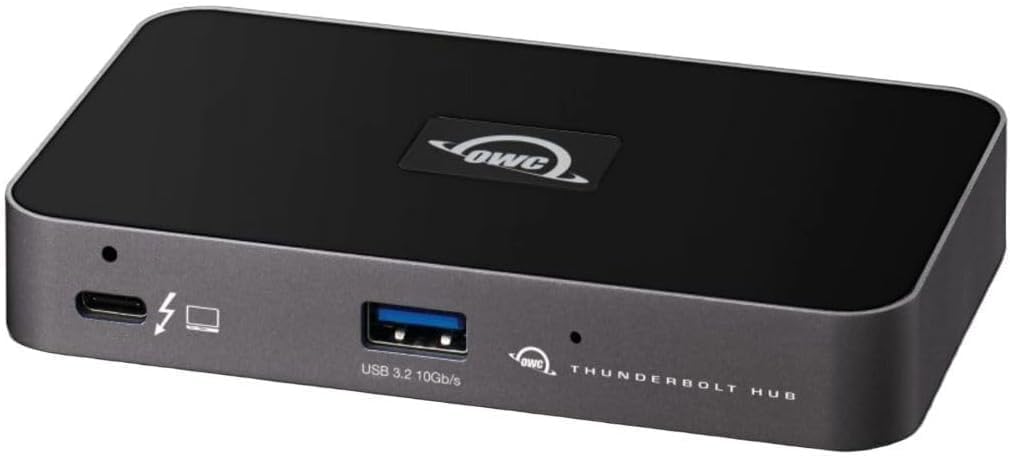
The OWC Thunderbolt Hub is a compact expansion option for Thunderbolt 4 computers that need additional ports. Its 4.4 rating reflects a well-regarded device with three Thunderbolt 4 ports, one USB 3.2 Gen 2 Type-A port, and support for displays up to 8K resolution. It is designed primarily to expand a host connection rather than provide direct storage capacity.
We may earn a commission when you buy through this link, at no additional cost to you.
The three Thunderbolt ports make it easy to connect an external SSD, a display, and another Thunderbolt accessory while preserving access to the host's original ports. An adjustable LED provides a visible status cue, and a Kensington Nano Security Slot adds a physical anchoring option for a semi-permanent desk installation.
It is not a Thunderbolt 5 hub and does not include Ethernet, card readers, or multiple USB-A ports. As a result, it suits a focused Thunderbolt ecosystem more than a broad collection of legacy accessories. Its comparatively compact form is an advantage, while the lack of storage functionality means an NVMe drive or enclosure must be purchased separately.
For a Mac or PC user with a good set of Thunderbolt 4 accessories, this hub can provide a cleaner desktop and easier device reconnection. It is particularly useful when one port must support several high-speed peripherals. A full docking station is the better option for a laptop that also needs networking, charging, and numerous USB devices.
Three downstream Thunderbolt 4 ports provide more room for external NVMe storage, displays, and high-speed accessories. This keeps the core workflow around one consistent connection standard and can simplify day-to-day desk setup.
The five-port design offers useful expansion without adopting the size and complexity of a full docking station. The included Kensington Nano Security Slot is a practical extra for a hub that may remain connected in a shared workspace.
We may earn a commission when you buy through this link, at no additional cost to you.
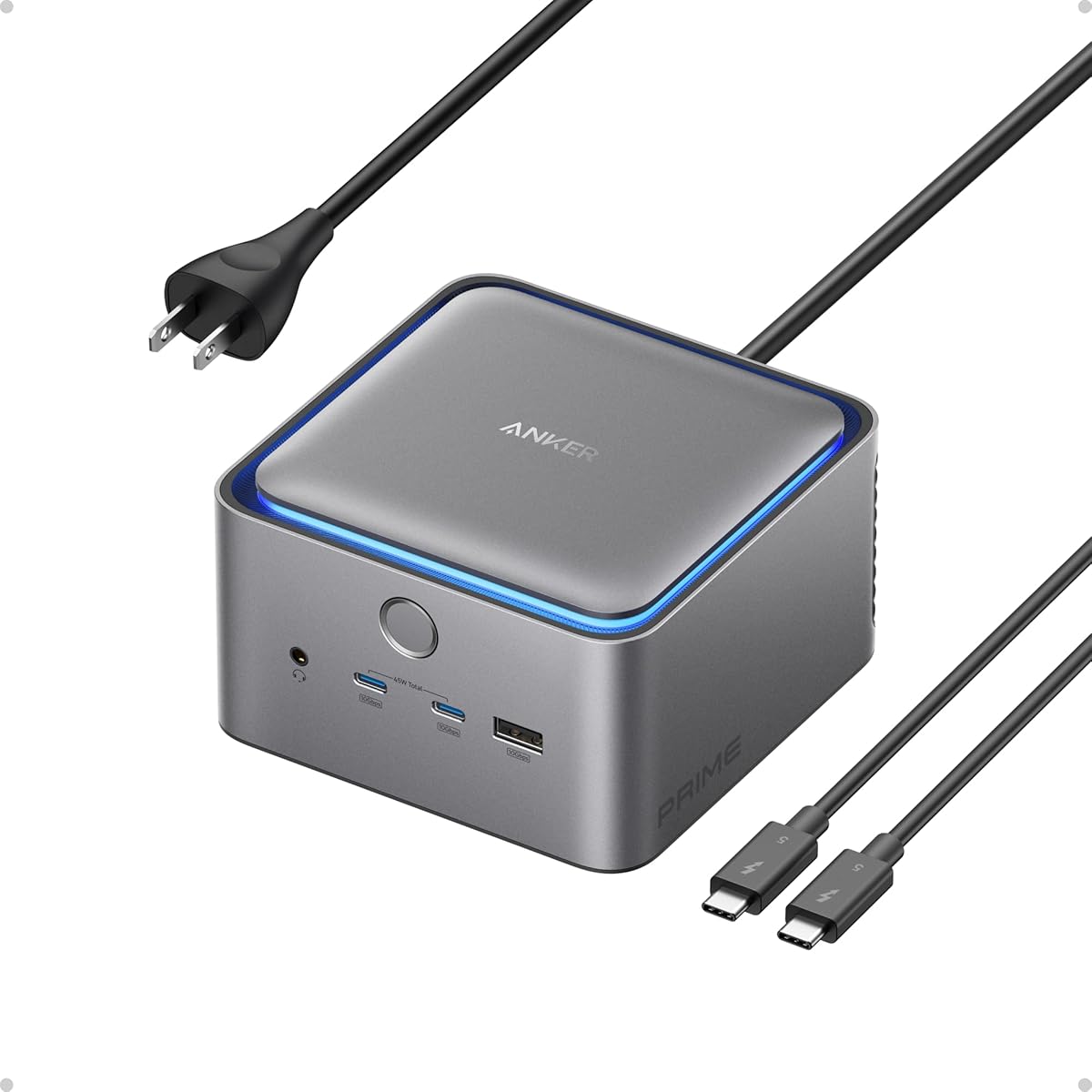
The Anker Prime TB5 is a comprehensive laptop dock for users who want one cable to handle storage, networking, displays, peripherals, and charging. It has a 4.2 rating and a 14-in-one layout built around a Thunderbolt 5 upstream connection. Two downstream Thunderbolt 5 ports, two USB-C ports, three USB-A ports, SD and TF card readers, 2.5Gbps Ethernet, audio, and display outputs are included.
We may earn a commission when you buy through this link, at no additional cost to you.
Its headline use case is moving large files quickly. Anker states that a 150GB file can move in 25 seconds through the Thunderbolt 5 connection, though actual results depend on the source, destination, computer, and workload. The dock also supports a single 8K display at 60Hz or dual 8K at 60Hz with compatible Thunderbolt 5 Windows laptops, making it relevant to high-resolution editing and monitoring.
Power delivery reaches 140W through the upstream port using PD 3.1, while the front dual USB-C ports share 45W. An advanced active cooling system is designed to prevent overheating under full load. The main limitation is that it is a dock rather than a storage device, and its advanced display and charging functions still depend on the capabilities of the connected computer and connected displays.
This is the strongest all-in-one choice in the guide for a Thunderbolt 5 laptop workflow. It can connect a fast external SSD, card readers, network access, displays, and charging through a single upstream port. Users who need one or two extra ports should choose a smaller hub, while those who want a self-contained drive should select an Envoy Ultra instead.
The extensive port selection reduces the need to carry several adapters when moving between a desk and a meeting room. Storage, card readers, Ethernet, displays, audio, and peripherals can all be organized around the Thunderbolt 5 uplink.
Active cooling addresses the heat generated when several ports operate at full load, supporting more consistent performance. Up to 140W of host charging and shared 45W USB-C charging further consolidate daily power needs.
We may earn a commission when you buy through this link, at no additional cost to you.
The right Thunderbolt 5 storage solution depends on whether you need a portable drive, local multi-bay capacity, network access, or simply more ports for existing storage. Interface speed, usable capacity, host compatibility, cooling, and expansion options should be considered together.
Summary: Choose a native Thunderbolt 5 host for maximum speed, but verify computer, cable, and accessory compatibility first.
Summary: Use NVMe for speed and responsiveness; use hard drives when affordable capacity matters more than throughput.
Summary: Account for source files, caches, deliverables, and future growth when choosing capacity.
Summary: Match enclosure durability and physical size to the portability and environmental demands of your work.
Summary: Prioritize proven thermal management and verify that the selected SSD remains within the connection's power limit.
Summary: Choose serviceable or multi-bay designs for growth, and fixed portable drives for simplicity.
Summary: Select RAID for local arrays and high-speed Ethernet for shared storage, based on how collaborators access the data.
Summary: Check operating systems, displays, charging, and downstream-port specifications before buying a dock.
Begin by confirming that the host computer supports the intended interface and that the drive or dock is using a cable capable of carrying the required bandwidth. For a new portable SSD, review any operating-system setup steps, recognize the volume using the computer's disk utility, and choose a clear label before transferring important files. For a multi-bay enclosure, install the included drives correctly, apply the desired RAID configuration, and verify the array before relying on it for important data.
Protect performance by allowing ventilation around the enclosure and avoiding long periods of heavy load without airflow. Do not disconnect a drive while a transfer, backup, array rebuild, or active import is running. Use the included ejection or ejector function when available, wait for the system to confirm that writes are complete, and then remove the device. For network-attached storage, maintain stable Ethernet links, use redundant storage when availability is critical, and treat the dock as a pathway to storage rather than as a backup by itself.
A backup plan should include at least one separate copy of critical material. Periodically test files from that copy, keep catalog and project structures consistent, and avoid using a single fast external drive as the only location for irreplaceable footage. Clean portable devices with a soft, dry method, protect connectors from debris, and use protective cases when carrying rugged equipment. Check the current manufacturer instructions and operating-system requirements whenever firmware, software, or hardware configuration changes.
No, but the available speed depends on the host connection. Thunderbolt 5 SSDs in this guide also support Thunderbolt 3, Thunderbolt 4, or USB4 systems, while some docks and hubs use earlier Thunderbolt generations. A compatible computer and suitable cable are still required, and the slowest link in the chain determines the practical transfer rate.
Not always. A direct internal NVMe drive has a short, direct path to the system, while external storage must also pass through the enclosure, cable, and host interface. A high-end Thunderbolt 5 SSD can provide extremely fast external performance, but the exact comparison depends on the internal drive, computer, workload, and file sizes being transferred.
A portable SSD is normally a self-contained, bus-powered device designed for one computer and straightforward transport. A multi-bay enclosure holds several interchangeable drives and may support RAID, hot or tool-assisted swapping, and much larger storage pools. Portable SSDs are more convenient, while multi-bay systems are better for studios and expanding archives.
Thunderbolt 5 provides the newest bandwidth in this guide, but USB4 and Thunderbolt 4 can still deliver excellent results with compatible NVMe drives. The best choice depends on the host you already own, whether you plan to upgrade, and how much the difference matters for your workload. Check the protocol, not merely the USB-C connector shape.
Yes, when the dock and host provide enough downstream bandwidth and power. The OWC Dual 10GbE Dock and Anker Prime TB5 include multiple high-speed ports, while the OWC Thunderbolt Hub offers three Thunderbolt 4 outputs. Shared bandwidth means that simultaneous drive performance may be lower than a single drive's maximum, so the number of active devices and host capabilities matter.
No. A dock connects storage and other accessories but does not automatically copy or protect data. You still need suitable drives, a backup application, and a separate copy of important files. A network dock can provide access to shared storage, but it does not replace redundancy, scheduled backups, or periodic restore testing.
Leave the enclosure's surfaces unobstructed and use it on a surface that can dissipate heat. Avoid enclosing a continuously active drive in a tight bag or poorly ventilated cabinet. For replaceable PCIe Gen 5 SSDs, choose a module with suitable sustained power consumption and verify that the host, dock, or hub can supply the required bus power.
Choose based on your working set rather than a universal rule. Two terabytes may suit users with separate archival storage, four terabytes offers a stronger balance for active media and projects, and eight terabytes is best for users who want to consolidate substantial media into one portable drive. Leaving additional free space can also help maintain consistent performance during intensive workloads.
The OWC Envoy Ultra 2TB stands out as the best-value portable option, delivering the same core high-speed, rugged, fanless design in a more modest capacity tier. The 4TB model is the strongest all-around choice for most creative professionals, while the 8TB version is the premium pick for users who want to carry a much larger active library in one device.
Prioritize host compatibility, sustained performance, usable capacity, and the way you intend to access data. A native Thunderbolt 5 SSD is ideal for direct portable work, a modular M.2 enclosure is better when upgradeability matters, and multi-bay or networked systems are stronger for shared archives and studio workflows. Docks can simplify those setups, but they do not replace the storage device or the backup strategy behind it.
Before ordering, confirm the current product details, host requirements, drive compatibility, warranty terms, and current price. Interface standards, operating-system support, and competing accessories evolve quickly, so the listing should be treated as the final source of truth. Checking those details at the time of purchase helps ensure that the selected Thunderbolt 5 storage solution fits both your present computer and your future workflow.