
LAFVIN Basic Starter Kit for ESP32 ESP-32S
4.5Editor score
Beginner-friendly ESP32 foundation
Tutorial with sample code
Supports common IoT modules
Compare the 10 best microcontroller kits for beginners across platforms, included components, tutorials, connectivity, project variety, ease of learning, and
A microcontroller kit for beginners should make the first stages of electronics feel approachable rather than overwhelming. The best bundles combine a capable development board, useful components, understandable instructions, and projects that help learners understand inputs, outputs, sensors, motors, displays, and wireless communication.
This guide compares ten popular kits built around ESP32, Arduino-compatible, Raspberry Pi Pico, and proprietary educational platforms. We considered the supplied ratings, learning materials, component selection, supported programming environments, connectivity, assembly demands, and the kinds of projects each kit makes possible, from basic blinking-light exercises to more advanced IoT and camera builds.
Each pick reveals a different route into making: budget-friendly introductory sets, comprehensive Arduino learning kits, solder-based engineering projects, camera-capable ESP32 systems, and microcontroller bundles designed for both students and self-taught hobbyists. Product availability and pricing can change, so compare the current listing, included parts, and tutorial access before ordering.
4.5Editor score

4.7Editor score

4.6Editor score
This side-by-side comparison shows how the ten kits differ in hardware platform, learning resources, component breadth, connectivity, and practical beginner suitability.


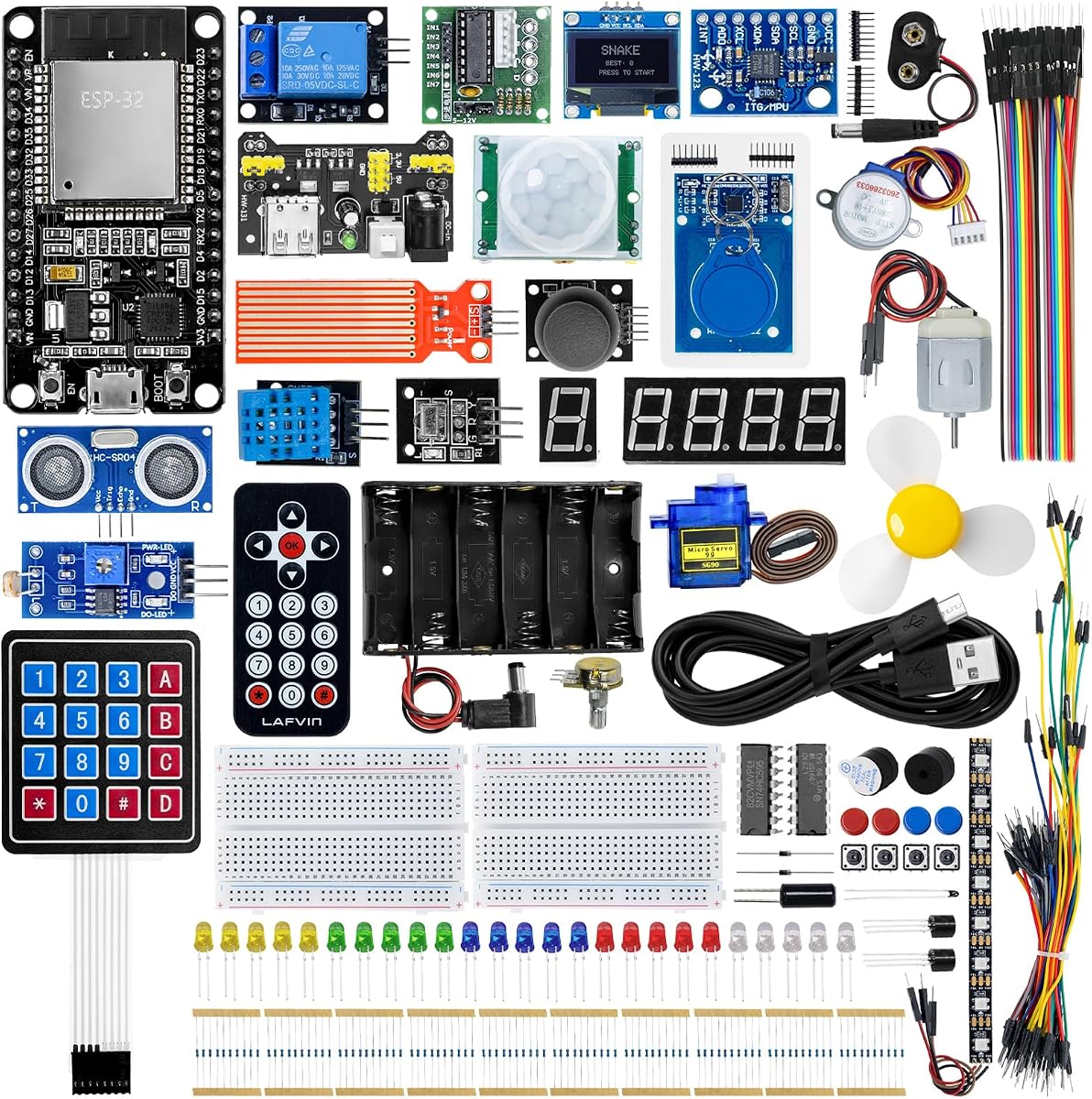


The LAFVIN Basic Starter Kit for ESP32 ESP-32S provides a practical entry into microcontroller learning without requiring a large collection of separate parts. Its 4.5 rating reflects a generally useful beginner package centered on the ESP32, a microcontroller platform known for Wi-Fi and IoT capabilities. The included tutorial and sample codes are especially important because they help connect the development board to the included modules.
We may earn a commission when you buy through this link, at no additional cost to you.
The core appeal is the combination of an ESP32 development board, Arduino IDE compatibility, and an introductory learning path. Users can begin with basic electronics and programming before controlling LEDs, displaying information, reading sensors, and exploring connected devices. The supplied information specifically mentions the ability to use the board with components such as LEDs, a DHT11 sensor, and an OLED module, giving learners a practical way to move from simple outputs to useful projects.
The main limitation is that this is a basic starter set rather than an expansive electronics laboratory. It does not present the same range of motors, sensors, displays, and specialty modules found in the larger kits in this guide. Its tutorial must also be downloaded after the goods arrive, so a learner who values a fully physical, step-by-step guide may find the Horizon kit or a Freenove system more convenient. Even so, the smaller scope can be helpful because it keeps early lessons focused.
This is our Best Budget pick for beginners who specifically want to learn ESP32 programming and wireless control without buying many individual components. Start with the provided examples, learn how each module connects, and resist the temptation to advance too quickly. For a self-directed learner willing to download the tutorial and use the Arduino IDE, it provides a focused and economical way to enter the maker world.
Using an ESP32 from the beginning helps learners connect ordinary input and output exercises with practical Wi-Fi and IoT ideas. The tutorial's staged examples can show how physical components and network-controlled projects belong in the same development environment.
The downloadable tutorial and included code reduce the initial barrier to a successful build. Working through one example at a time also creates a repeatable method for learning wiring, programming, testing, and troubleshooting.
We may earn a commission when you buy through this link, at no additional cost to you.
The REXQualis Super Starter Kit is a comprehensive Arduino UNO R3 learning bundle for people who want broad exposure to basic electronics without assembling a collection of parts one at a time. Its 4.7 rating places it among the strongest-rated products in the guide, while the Arduino UNO foundation makes the kit especially approachable for learners familiar with the wider Arduino ecosystem.
We may earn a commission when you buy through this link, at no additional cost to you.
The kit stands out through its high-quality base board and broad inventory of components. The supplied information lists compatibility with sensors, a servo, a motor, a ULN2003 driver board, and LCD modules. It also includes a 9V 1A power adapter in place of a battery-based approach, while the LCD1602 arrives with a pin header preinstalled so beginners do not need to solder that connection themselves.
Documentation is available as a downloadable PDF tutorial and datasheet through the official website or customer service. This format supports self-paced learning, but it is less convenient than a printed booklet or a structured video course. In addition, the UNO R3 platform does not provide the built-in Wi-Fi found in the ESP32 selections, so connected projects require additional hardware. That is not a flaw for learning fundamentals, but it is worth considering if wireless control is your main goal.
Choose this kit when you want a conventional Arduino course, a large collection of labeled parts, and a base board that organizes many experiments in one workspace. It is especially suitable for learners who intend to study LEDs, buttons, sensors, displays, motors, and servo control systematically. Students and teachers may appreciate the labeled organization, while experienced Arduino users can treat the kit as a well-stocked electronics workbench.
The combination of a controller base board, input devices, output devices, motors, and displays lets learners study the full circuit-building process without relying on add-on purchases for common lessons.
Individually packaged and labeled components make it easier to find the correct part during a lesson. The larger storage box also supports a tidy workspace where projects can remain partly assembled between sessions.
We may earn a commission when you buy through this link, at no additional cost to you.
The amomii Testudo Soldering Practice Kit takes a different approach from conventional sensor-and-breadboard bundles. It is designed to teach real soldering while producing a Digital Piano, an Infrared Remote, and an Arcade Console. The 4.7 rating indicates strong appeal among users, and the kit's most compelling feature is its combination of physical assembly, reusable hardware, and immediate digital interaction.
We may earn a commission when you buy through this link, at no additional cost to you.
Its complete soldering course covers joint anatomy, temperature and tip selection, circuit-board reading, and common fault correction. Color-printed instructions, detailed PDF manuals, HD video tutorials, more than 60 components, and three circuit boards create a structured learning package. The custom USB-C microcontroller serves as the reusable brain for each build, allowing learners to swap modular shields and explore more than ten software functions without starting over.
The no-code amomii Link browser tool is particularly useful for immediate engagement. A user can activate a gadget or switch between games and tools without first completing a complex software setup. However, this kit is explicitly more demanding than a standard beginner bundle because it requires soldering and basic tools, which are not included. Small parts also mean that users under 14 should work with adult supervision. Serious assembly and safe tool use are essential parts of the experience rather than optional details.
This is the strongest recommendation in the guide for a learner who wants to understand physical electronics rather than only connect preassembled modules. It suits a classroom maker lab, a family project, or an individual ready to learn soldering safely. Optional coding material expands the opportunity to move from activation to manual uploads, while open-source schematics, code, and enclosure files support deeper customization.
Building three devices teaches joint construction, component placement, circuit reading, and debugging. Those skills remain useful long after the original piano, remote, and console projects are complete.
The interchangeable shields turn the controller into more than a one-time kit component. Open-source files, optional coding guidance, and printable enclosure designs create natural paths toward personalized devices.
We may earn a commission when you buy through this link, at no additional cost to you.
The Horizon Uno Electronics Starter Kit is our Editor's Choice because it combines a broad component set with one of the clearest structured learning experiences in the roundup. Its 4.7 rating supports that recommendation. The Arduino-compatible Horizon Uno board introduces electronics, coding, and circuit design in a format aimed directly at students, educators, hobbyists, and self-learners.
We may earn a commission when you buy through this link, at no additional cost to you.
Each kit includes access to an online video course created by robotics engineers. Lessons contain lectures, labs, projects, coding examples, explanations, and problem sets, allowing learners to move from theory to practical work. A unique access code is included with each kit. This course structure is a major advantage over bundles that offer only a collection of example sketches or a basic assembly guide.
The component selection reinforces the course content with LEDs, sensors, specialty parts, jumper wires, resistors, and servos. That range supports sequential learning, from simple circuits to more involved interactive mechanisms. The trade-off is dependence on computer-based instruction and online course access. The Uno-style platform also lacks integrated wireless connectivity, so beginners interested in Wi-Fi or Bluetooth should examine the ESP32 alternatives instead.
This kit best suits someone who benefits from a guided curriculum rather than a loose collection of parts. It can serve a single self-learner, a family teaching setup, or a classroom where consistent video lessons and exercises are valuable. Choose it when clarity, progression, and access to an experienced instructional team matter more than immediate wireless capability.
Lectures, labs, projects, coding examples, and problem sets create a more complete learning cycle than a loose folder of sample code. This structure helps beginners understand why each component and programming technique is being introduced.
LEDs, sensors, servos, resistors, and jumper wires allow lessons to move from simple output control to interactive systems. Using a wider range of inputs and outputs also helps learners connect circuit behavior with programming logic.
We may earn a commission when you buy through this link, at no additional cost to you.
The LAFVIN Basic Starter Kit for Raspberry Pi Pico is a flexible STEM introduction built around the RP2040 development platform. Its 4.5 rating reflects a balanced package for learners who want more than one way to program. Instead of forcing every student into the same workflow, the kit supports MicroPython, C/C++, and Piper Make graphical programming.
We may earn a commission when you buy through this link, at no additional cost to you.
The included modules make the kit useful for demonstrating several core ideas. The LCD1602 display demonstrates output, an SG90 servo demonstrates controlled movement, the WS2812 RGB LED introduces programmable color lighting, and a human-body sensing module adds input behavior. Buttons, a buzzer, and other components expand the range of experiments involving display, sensing, input, and execution control.
Detailed project tutorials, sample code, and connection guidance are supplied to help users complete circuits, download programs, and verify results. This is particularly valuable for school labs, where consistency and visible outcomes matter. The trade-off is that the Raspberry Pi Pico platform does not include Wi-Fi in the same way an ESP32 board does, and users primarily interested in connected devices may find that limitation significant.
Choose this kit for a learner who wants flexibility across programming levels, particularly one moving from visual or block-oriented activities toward MicroPython and C/C++. The broad project inventory supports STEM instruction while remaining approachable. It is a strong fit for electronics beginners, classroom laboratories, and hobbyists who value the Raspberry Pi Pico ecosystem and a tutorial that connects wiring directly to code.
The choice among graphical programming, MicroPython, and C/C++ lets educators and learners match the programming environment to their experience. A beginner can gain immediate results visually, then transition to text-based code as confidence grows.
Displays, color LEDs, sensors, buttons, buzzers, and servos cover the main categories of input and output. Working with these categories creates a practical foundation for later projects without requiring an advanced electronics lab.
We may earn a commission when you buy through this link, at no additional cost to you.
The LAFVIN ESP32 Ultimate Starter Kit is a large all-in-one STEM learning package built around wireless development. Its 4.3 rating makes it one of the less highly rated selections, but the product data shows a substantial module collection and a clear emphasis on practical IoT projects. It is aimed at beginners, students, and makers who want to explore electronics, robotics, programming, and wireless control.
We may earn a commission when you buy through this link, at no additional cost to you.
The supplied module list includes ultrasonic and RFID sensors, servo motors, an MPU6050 angle sensor, an OLED display, temperature and humidity sensors, a PIR motion sensor, and numerous other components. That inventory supports projects involving access control, environmental monitoring, motion alarms, real-time angle visualization, servo control, and smart-home prototypes. The included tutorials, wiring diagrams, sample code, and project courses provide the structure needed to move through those ideas progressively.
Wireless learning is the distinguishing feature. Learners can create browser-based control interfaces, monitor sensor information, and remotely operate outputs through a phone, tablet, or computer. This makes the kit more engaging than a purely local starter set. On the other hand, dozens of modules can overwhelm a total beginner if the learner jumps into advanced builds without first understanding power, voltage, pin use, and safe wiring.
This is a good match for someone who already has a clear goal involving ESP32, sensors, or connected devices, or for a classroom that wants a shared source of IoT components. Begin with a simple sensor and output, verify every connection, and then progress toward browser control. Despite its lower rating, the sheer range of possible projects makes it a serious option for users who value wireless functionality above a compact parts count.
Connecting a sensor reading to a browser interface demonstrates why embedded networking matters. Remote output control, environmental monitoring, and smart-home prototypes give learners outcomes that are easy to understand and share.
The large collection of modules supports many projects, but it also demands systematic organization. Beginners should build one circuit at a time, keep power and signal connections separate, and disconnect components before rewiring.
We may earn a commission when you buy through this link, at no additional cost to you.
The GeeekPi Micro Python Programming Kit is built for Raspberry Pi Pico enthusiasts who want to learn embedded systems through MicroPython. Its 4.4 rating indicates a solid learning-oriented package, and the inclusion of a development board, breadboard, I2C 1602 LCD module, and supporting components gives learners a functional platform on which to experiment.
We may earn a commission when you buy through this link, at no additional cost to you.
MicroPython is the central attraction. A beginner can work with readable, Python-like code while learning how a microcontroller reads inputs, drives outputs, communicates with a display, and responds to physical events. The included demo code provides a starting point for each experiment, while the additional room for experimentation allows learners to adapt the examples rather than simply repeat them.
A detailed manual is included and additional tutorials can be downloaded from the product wiki or requested by email. This approach supports independent learning, although a video-oriented beginner may find the Horizon kit more immediately engaging. The hardware is also more focused than the large ESP32 collections, which can be an advantage for a learner who wants a controlled Python environment rather than an expansive parts cabinet. Wireless features are not a central part of this Pico-based system.
Choose this kit if MicroPython is your preferred language or you want to understand embedded programming through readable source code. It is also a natural fit for Raspberry Pi Pico users who already recognize the platform. The breadboard and LCD create a useful combination of wiring practice and visible feedback, making it a solid, approachable choice for individual study and structured experimentation.
MicroPython lets learners focus on core programming ideas using a familiar syntax. The result is a useful bridge between general Python practice and embedded systems, where inputs, outputs, timing, and hardware interfaces become tangible.
Each experiment includes demo code and room for modification. Changing inputs, outputs, and display behavior turns the exercises into a progression from reproducing a result to designing an original project.
We may earn a commission when you buy through this link, at no additional cost to you.
The ESP-32 Super Starter Kit pairs a modern USB-C development board with a large collection of components and guided wireless projects. Its 5.0 rating is the highest supplied rating in the roundup, making it an especially strong candidate for learners who want both a varied hardware inventory and a capable connected platform.
We may earn a commission when you buy through this link, at no additional cost to you.
At the center is a dual-core ESP32 with built-in Wi-Fi and Bluetooth 4.2. The CP2102-equipped board supports USB code uploading and works with the Arduino IDE, which lowers the barrier for people arriving from classic Arduino learning. The bundle contains more than 35 modules and components, including sensors, displays, motors, buttons, LEDs, an OLED screen, a servo, and a keypad.
The online tutorial covers more than 25 projects with code, circuit diagrams, and instructions. Projects progress from simple circuits toward weather stations, smart-home controllers, remote-control devices, and interactive gadgets, so the kit can support a long learning arc. One important purchasing consideration is the stated printing error that makes the manual's QR code point to the wrong learning-resource page. Buyers need to contact the seller for the correct tutorials and sample codes.
This is a strong recommendation for a motivated beginner who wants wireless control and a modern development-board experience. It is also suitable for students who value a large inventory and clearly structured project progression. The QR-code issue is a minor inconvenience, but the complete learning-resource replacement makes this a well-rounded option for building connected devices.
The USB-C board, CP2102 interface, dual-core processor, Wi-Fi, and Bluetooth 4.2 create a capable platform for contemporary embedded experiments. Compatibility with the Arduino IDE also gives beginners a familiar environment while the hardware remains capable of wireless work.
Displays, sensors, motors, buttons, LEDs, a keypad, and a servo cover many common project categories. The tutorial's progression from simple circuits to smart-home and remote-control builds helps users apply those components in increasingly complex combinations.
We may earn a commission when you buy through this link, at no additional cost to you.
The Freenove ESP32-S3 Camera Board Ultimate Starter Kit is our Best Premium pick because it pairs advanced camera hardware with an unusually extensive learning package. Its 4.6 rating reflects a well-regarded option for users who want to move beyond blinking LEDs and basic sensor demonstrations. The board includes a dual-core 32-bit processor reaching up to 240 MHz, 8 MB flash, 8 MB PSRAM, Wi-Fi, Bluetooth 5 LE, USB-OTG, a camera, and a memory card slot.
We may earn a commission when you buy through this link, at no additional cost to you.
The supplied information identifies 121 projects, 243 total items, and an English tutorial totaling 828 pages. Projects include schematics, wiring diagrams, complete code, and detailed explanations, with materials available as a download or online reference. A tutorial link appears on the product box rather than in a paper manual, so buyers should retain the packaging and locate the resource immediately.
Three code sets support MicroPython, C, and Processing, with the latter intended to run on a computer for graphical interfaces. This flexibility is a major advantage for learners who want to move between high-level Python, systems-level C, and visual computer interaction. The trade-off is complexity: the camera board, memory card, USB functions, and large component collection are more advanced than the simplest introductory bundles.
Choose this kit for an ambitious beginner who wants an extensive project library and is excited by image capture, wireless communication, and embedded systems. It can support a long education because the materials grow from simple projects toward complex ones. If the goal is only a first LED exercise, a smaller kit may be easier, but for sustained maker development and advanced project variety, this is the most complete option here.
The camera, memory card, USB-OTG, Wi-Fi, and Bluetooth LE expand the range of possible experiments well beyond conventional input and output exercises. These features make the board a good platform for image, connectivity, and interface-based learning.
MicroPython offers a readable entry point, C supports lower-level development, and Processing can create graphical computer interfaces. Using all three workflows can deepen understanding of how the same hardware behaves under different programming approaches.
We may earn a commission when you buy through this link, at no additional cost to you.
The Freenove ESP32 Camera Board Ultimate Starter Kit is a comprehensive learning system for Raspberry Pi Pico-style project progression applied to an ESP32 camera platform. Its 4.6 rating matches the closely related ESP32-S3 model and confirms its strong position among all-in-one kits. The included board combines a dual-core 32-bit processor, Wi-Fi, Bluetooth 4.2 LE, USB code uploading, a camera, and a memory card slot.
We may earn a commission when you buy through this link, at no additional cost to you.
The educational value comes from its scale and organization. The supplied information lists 122 projects, 240 total items, and an English tutorial of 795 pages. Lessons include electronics knowledge, schematics, wiring diagrams, complete code, and detailed explanations. MicroPython, C, and Processing examples give users several ways to work with the same hardware, while a 1 GB memory card and card reader support the camera-oriented components.
As with the ESP32-S3 Freenove kit, the tutorial is not included as a paper book; the link is found on the product box and can be viewed online or downloaded. The large scope may feel intense for someone seeking only a basic blinking-light lesson. Nevertheless, the project list can keep an engaged learner occupied for a long time and provides a structured path from simple electronics to complex camera and wireless experiments.
Choose this kit when you want the traditional ESP32 camera platform, a large curriculum, and broad component selection without moving to the more specialized S3 model. It is a good option for self-learners who enjoy downloading and working through extensive documentation. Begin with the first lessons rather than jumping to the camera, and use the supplied wiring diagrams as a check before applying power.
The 122-project collection creates a long sequence of achievable objectives. Each project combines theory, wiring, code, and verification, helping learners form a repeatable engineering process instead of copying isolated sketches.
The onboard camera, memory card, and USB uploader support a more creative platform than a standard LED-and-sensor kit. They allow learners to connect embedded programming with image capture, data storage, and connected-device ideas.
We may earn a commission when you buy through this link, at no additional cost to you.
The right beginner kit depends on the platform you want to learn, the kind of guidance you need, and whether your priority is basic electronics, wireless projects, programming, soldering, or advanced hardware.
A microcontroller kit is easier to learn when its software environment matches your existing interests. Arduino-compatible boards are familiar to many newcomers and support a large community of examples, while Raspberry Pi Pico is attractive to learners who want to work with MicroPython or C. ESP32 kits are ideal when Wi-Fi, Bluetooth, IoT, or connected-device projects are central to your goals. The Horizon and REXQualis kits emphasize Arduino-style learning, the LAFVIN and GeeekPi Pico kits center on RP2040, and most remaining selections use ESP32.
Choose the platform based on the projects you expect to build, not just on the board name. A simple learning platform is often better for fundamentals, while a more capable board makes sense when advanced peripherals or wireless communication are part of the curriculum.
Tutorials determine how much of the included hardware a beginner will actually understand and use. The strongest learning packages provide sequenced lessons, wiring diagrams, sample code, schematics, and explanations. The Horizon Uno includes a structured online video course with labs and problem sets, while Freenove provides hundreds of documented projects. REXQualis supplies a PDF tutorial and datasheet, and the smaller LAFVIN ESP32 kit provides downloadable assembly guidance and lessons.
Look for a curriculum that starts with simple circuits and gradually introduces more advanced modules. A large collection of loose examples can be less helpful than a smaller number of well-explained projects, so prioritize organization, clarity, and downloadable access.
A useful component inventory should include the input and output types required for your planned projects. LEDs and buttons cover basic control, sensors add environmental or physical awareness, displays provide visible feedback, and servos or motors introduce movement. Broad ESP32 kits frequently include RFID, PIR, ultrasonic, temperature, humidity, and angle sensors, while the Raspberry Pi Pico bundle emphasizes an LCD, servo, RGB lighting, and a human-body sensing module.
Avoid choosing a kit simply because it contains the longest parts list. More components can create clutter and wiring confusion. Match the inventory to a learning path, verify that important modules are included, and favor clearly labeled or well-organized parts for shared and classroom use.
Many beginner kits use breadboards and preassembled modules, so the main skills are wiring, programming, and troubleshooting. The amomii Testudo is a deliberate exception: it teaches soldering through three hardware builds and includes a soldering course. Its tools are not included, and the small components require attention and adult supervision for younger users.
Beginners who want immediate electronic experimentation should seek breadboard-based projects and preinstalled headers. Learners who specifically want to understand circuit-board assembly, soldering technique, and physical prototyping may find the Testudo approach more rewarding despite its greater setup demands.
The language and environment can determine how quickly you understand a project. Arduino IDE compatibility provides a familiar route for many ESP32 and Arduino-compatible kits. The LAFVIN Raspberry Pi Pico kit supports MicroPython, C/C++, and Piper Make graphical programming, making it adaptable to different experience levels. Both Freenove kits provide MicroPython, C, and Processing examples, with Processing supporting graphical interfaces on a computer.
Choose a kit whose language matches your current skills and the kind of programming you want to learn next. Beginners may favor MicroPython for readable syntax and fast feedback, while C is better for learners seeking deeper control of embedded systems. Graphical and no-code options can provide a useful first step before manual coding.
Built-in wireless connectivity changes the kinds of projects you can pursue. ESP32 boards support Wi-Fi, and several also include Bluetooth, allowing sensors to report information to a browser and outputs to be controlled remotely. The LAFVIN Ultimate kit emphasizes browser-based IoT control, while the ESP-32 Super Kit and Freenove models support connected-device experiments. Arduino UNO and Raspberry Pi Pico systems generally require added hardware for wireless communication.
Wireless support is a major advantage for IoT, smart-home, and remote-monitoring ambitions. If the kit is intended primarily for local circuits and fundamentals, its lack of wireless features is less important. Verify exactly which communication functions the board supports before choosing a model.
Digital documentation is convenient when the files are clearly organized and easy to retain, but it can be less useful for a learner who prefers a physical guide. Some products place the tutorial link on the box, while others require a download or customer-service request. The ESP-32 Super Starter Kit also states that a printing error affects its manual QR code, although corrected learning materials are available through buyer-seller messaging.
Check the current listing to see whether a paper manual, downloadable files, online course, wiki, or a combination is provided. Save important access codes and download files before discarding packaging, especially when the tutorial link is printed only on the box.
Even a comprehensive kit may require a computer, suitable cables, software, and sometimes basic tools. The amomii Testudo explicitly requires a soldering iron and basic tools, which are not included. A microcontroller also needs a suitable power source, and connected projects may require network setup and attention to local access details. Learners should also protect sensitive components from static discharge and verify voltage compatibility before connection.
Budget for genuine necessities rather than assuming every box is entirely self-sufficient. Use a ventilated soldering area when applicable, keep small parts away from children, and build one circuit at a time. Stable power, careful wiring, and an organized workspace are essential to a smooth first experience.
Begin by identifying the development board, reading the included component list, and completing the earliest tutorial without adding extra modules. Install the required software on your computer, connect only the board, and verify that a simple program runs successfully. This isolates setup problems before complicated wiring is introduced. Learn the board's power, ground, and signal labels, and keep a simple record of each connection.
Build one circuit at a time on a breadboard or according to the kit's assembly instructions. Disconnect power before changing wires, confirm that each sensor has the correct supply and signal connections, and check component orientation. Run the example code unchanged before altering it. When a project fails, review the diagram, power supply, pin assignments, and logic in that order rather than changing several variables simultaneously.
Store the kit in a dry, organized container with components in labeled bags and the board protected from conductive contact. Clean a breadboard and remove dust or debris without exposing electronics to moisture. Firmware, manuals, diagrams, and course files should be backed up locally. For any kit requiring soldering, unplug all power, allow the iron to cool, ventilate the area, and store tools safely after use.
The easiest kit is usually the one with the clearest beginner curriculum and a manageable number of components. The LAFVIN Basic ESP32 Kit is compact and focused, the Horizon Uno Kit offers structured video lessons, and the REXQualis Arduino Kit provides a broad but traditional learning setup. Choose based on whether you prefer wireless projects, guided video instruction, or a large collection of basic electronics.
Arduino-compatible kits are familiar and excellent for learning core electronics. ESP32 kits are preferable when Wi-Fi, Bluetooth, IoT, or connected projects are important. Raspberry Pi Pico kits suit learners who want MicroPython, C/C++, or a compact RP2040 platform. There is no universally best choice because the ideal board depends on the skills and projects you want to develop.
Most of the listed kits are designed for breadboard wiring and preassembled modules, so soldering is not generally required. The amomii Testudo Soldering Practice Kit is the exception because assembling its three gadgets is the central learning activity. That kit also requires a soldering iron and basic tools, which are not included.
Many Arduino-compatible and ESP32 kits use the Arduino IDE, while Raspberry Pi Pico kits commonly use MicroPython or C/C++ development tools. The two Freenove kits also provide Processing examples for graphical computer interfaces, and the amomii kit offers browser-based activation plus optional manual coding. Exact setup requirements can change, so check the current listing and supplied learning materials.
No. A larger inventory can provide more project ideas, but it can also overwhelm a new learner. Organized lessons and a logical progression are often more valuable than the sheer component count. A focused kit can teach the core concepts more effectively if the learner completes each example before moving to advanced modules.
The LAFVIN ESP32 Ultimate Starter Kit is especially relevant because its lessons focus on browser-based control, real-time sensor monitoring, and smart-home prototypes. The ESP-32 Super Starter Kit and both Freenove camera kits also provide the hardware and learning scope for connected experiments. Beginners should still begin with simpler local projects before attempting network configuration.
Yes, and that is the central purpose of most kits in this guide. They pair a development board with inputs, outputs, sensors, displays, and actuators so learners can see how code changes physical behavior. The quality and sequencing of the tutorials determine how smoothly those two subjects come together.
A modern computer with internet access is generally the safest assumption because most kits require downloadable software, tutorials, or web-based course access. The exact operating system and board-driver requirements should be checked before assembly. Camera, Processing, and browser-based projects also benefit from a larger display, while wireless kits may need both a computer and a separate mobile device for some demonstrations.
The LAFVIN Basic ESP32 Kit is the most focused budget entry, offering a tutorial, sample code, and an inexpensive introduction to wireless microcontroller work. The Horizon Uno Kit is the Editor's Choice because its video course, labs, problem sets, and component selection create the most balanced guided-learning package. The Freenove ESP32-S3 Camera Kit is the Best Premium option for ambitious learners who want extensive documentation, advanced camera hardware, and a large project library.
Prioritize the platform and curriculum that match your goals. A beginner who wants the gentlest introduction should choose a structured Arduino or ESP32 course, while a Python-focused learner may prefer the Raspberry Pi Pico selections. If physical assembly and soldering are part of the appeal, the amomii Testudo provides a distinctive path, but it also demands tools, patience, and safety awareness.
Before ordering, review the current product listing for component contents, tutorial access, software compatibility, and any included accessories. Ratings and product configurations can change over time, and prices also vary. Comparing the latest details ensures that the kit you select supports both your first project and the more ambitious experiments you hope to build later.
