
BILT HARD 14-Inch Tiller
4.6Editor score
Ten-amp AC motor
14-inch working width
Four steel tine assemblies
Lightweight folding handle
An electric rototiller turns hard, compacted ground into workable soil for vegetables, flowers, and new planting areas without the fuel storage and engine maintenance associated with gas equipment. The right machine balances tilling width, depth, tine design, control, safety features, and the size of the beds you tend.
We compared the ten models in this guide using their published specifications and listed features. The selection covers compact corded cultivators, larger high-capacity tillers, and a cordless battery model, with attention to motor power, working dimensions, wheel adjustment, folding handles, overload protection, and storage convenience.
Each review explains the model's strongest attributes, practical limitations, and most suitable gardening situation. Ratings and product details can change over time, and current prices, availability, warranties, and retailer policies should be checked before making a purchase.
4.6Editor score

4.6Editor score

4.5Editor score
As an Amazon Associate we earn from qualifying purchases.
The comparison below places all ten electric rototillers side by side, highlighting their power, working dimensions, tine configurations, and notable design features to make the differences easier to assess.




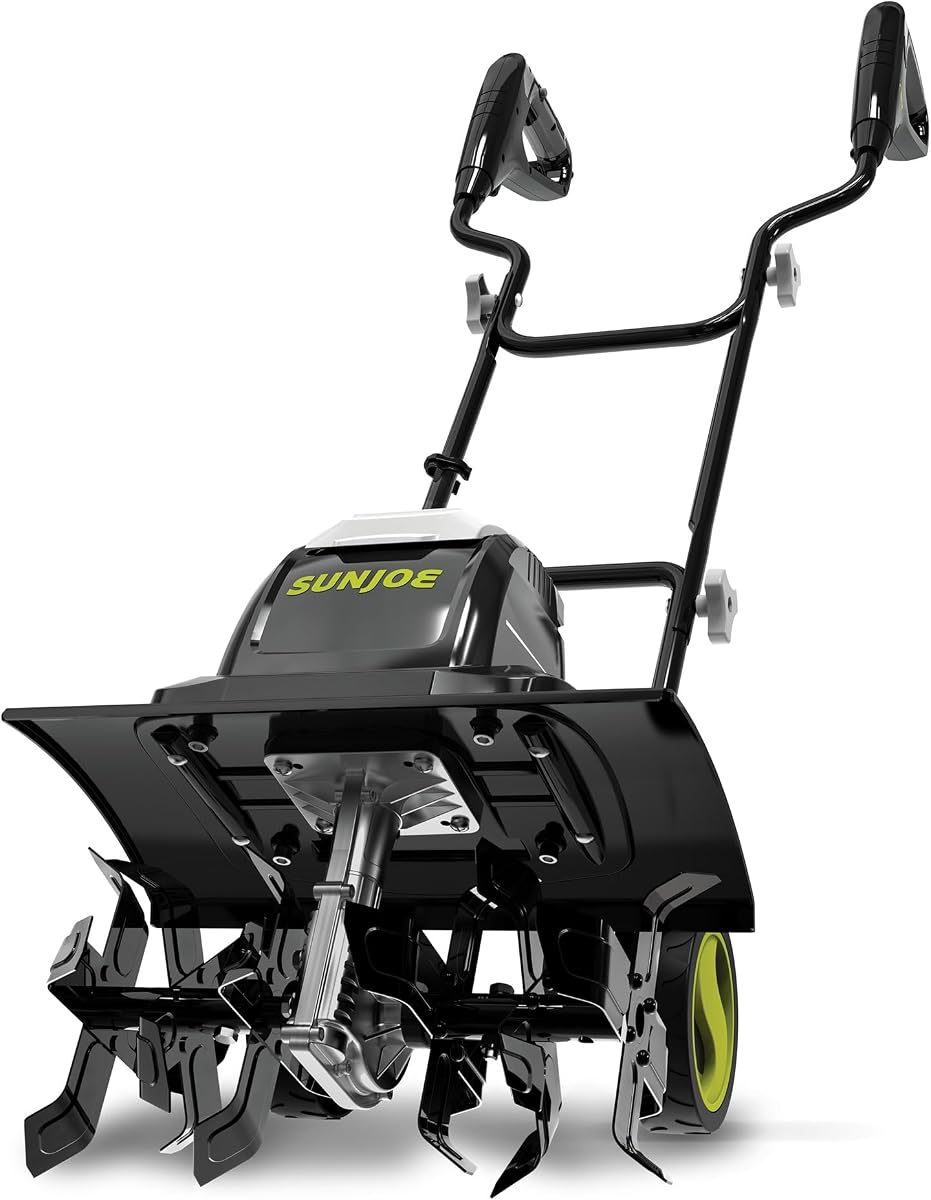
The Sun Joe TJ604E combines a relatively substantial 13.5-amp motor with a compact frame, earning a 4.6 rating among customers. Its six rust-proof, steel-angled tines, 16-inch tilling width, and maximum listed depth of 8 inches make it a capable general-purpose machine for typical home gardens. It is particularly attractive when a homeowner wants more capability than a light cultivator without moving into a large commercial-style tiller.
We may earn a commission when you buy through this link, at no additional cost to you.
The strongest feature is the balance between digging capacity and manageable proportions. A 16-inch path reduces the number of passes required in a small vegetable bed or landscaped planting area, while the stated 8-inch depth provides meaningful soil turning. The three-position wheel adjustment lets the operator alter the tilling relationship to the ground, which is useful when moving between loose seedbeds and more resistant compacted areas.
Its corded design provides continuous power without battery charging, and the absence of gasoline means no fuel mixing, oil changes, exhaust, or engine starting routine. The folding handle also improves the machine's practicality for people with limited garage or shed space. These advantages come with the normal cord-management compromise: an outlet must be reachable, and the cable can become awkward around densely planted or irregularly shaped beds.
The TJ604E is a strong recommendation for a homeowner preparing raised beds, flower borders, or a modest vegetable plot. It suits users who value steel tines, straightforward electric operation, and a useful compromise between capacity and compactness. It is less appropriate for remote work areas lacking an outlet or for exceptionally large plots where a wider, heavier machine would be more efficient.
The 16-inch working width gives the TJ604E enough coverage for routine bed preparation without making it as unwieldy as an 18-inch machine. Combined with its folding handle and adjustable wheels, it should be practical for owners who want productive capacity without a large storage footprint.
Because the machine is corded and powered by an electric motor, it eliminates gasoline, oil, and pull-start servicing. The user must still manage the power cord safely, but routine care is otherwise straightforward.
We may earn a commission when you buy through this link, at no additional cost to you.
The BILT HARD Electric Tiller Cultivator carries a 4.6 rating and targets gardeners who need a capable machine for small-to-medium beds without moving to a full-size heavy-duty tiller. Its 10-amp AC motor is specified to reach 17,000 RPM, while the tine assembly rotates at 360 RPM to break soil, loosen weeds, and incorporate compost.
We may earn a commission when you buy through this link, at no additional cost to you.
Published dimensions indicate a 14-inch tilling width and up to 8.7 inches of depth, which is impressive for a relatively lightweight machine listed at 17.98 pounds. The four quick-bolt handle positions create an H-style configuration that can be adjusted and folded for storage. Two-position 6-inch wheels support transport and help set the machine's working depth.
Four angled, rust-resistant blades provide the actual soil-cutting action, and their configuration is intended to help the tiller turn earth rather than merely move loose material on the surface. That makes the machine more useful for initial bed preparation, mixing compost, and breaking down small weeds. It is still a corded product, so access to a suitable outlet and careful handling of the cable remain necessary.
This is a compelling selection for patios, small gardens, flowerbeds, and homeowners who value portability and storage convenience. Its lighter weight may also make it easier to move than many 18-inch models, although actual handling varies with soil resistance and operating conditions. Buyers wanting to cover a large plot in the fewest possible passes would benefit from a wider machine instead.
The 17.98-pound listed weight, folding handle, and adjustable wheels prioritize movement and storage. These traits are useful for compact spaces, seasonal beds, and users who do not want to maneuver a large tiller between work areas.
A listed depth of 8.7 inches makes the tiller relevant for loosening compact soil and incorporating amendments below the surface. Its 14-inch path remains more manageable than many full-width machines.
We may earn a commission when you buy through this link, at no additional cost to you.
The MZK 12-Inch 10.5A Electric Tiller has a 4.4 rating and presents a compact option for breaking up soil, preparing seedbeds, and mixing soil in vegetable plots, orchards, and flower gardens. Its 12-inch working width is narrower than the other conventional tillers in this list, but that compact footprint can be an advantage in confined growing areas.
We may earn a commission when you buy through this link, at no additional cost to you.
At the heart of the machine is a 10.5-amp pure-copper motor operating at a listed 430 RPM. The tine system contains 16 rust-resistant steel blades, giving the cultivator more individual cutting elements than several models whose tine counts refer to assemblies rather than individual blades. The published digging depth reaches 8 inches, which is substantial for the machine's compact format.
MZK positions the product for repeated cultivation tasks such as loosening soil, removing weeds, and incorporating compost. Electric operation avoids the fuel and engine maintenance required by gas tillers, while a simple plug-in design means there is no battery charging routine. The main trade-off is the relatively narrow 12-inch path, which may require additional passes in a broad vegetable garden.
The model is best suited to gardeners who work in defined beds, want a manageable machine for close quarters, and need considerable blade speed from a 10-amp motor. It is less attractive for someone whose priority is finishing an expansive plot quickly. Cord placement, soil moisture, and tine clearance still require careful planning before every session.
The 16 steel blades and 430-RPM motor specification indicate an aggressive cutting system. That combination is well suited to repeated loosening and mixing in small, well-defined planting areas.
The 12-inch width helps with maneuvering among beds, paths, and plantings. It can also make short, precise passes more practical than operating a full-width model in a confined space.
We may earn a commission when you buy through this link, at no additional cost to you.
The LawnMaster TE1318M is a 4.5-rated electric tiller designed for medium and large gardens, combining a 13.5-amp motor with a maximum 18-inch cutting width. Its ability to switch between six blades for an 18-inch path and four blades for a 12.6-inch path gives it a useful degree of flexibility that single-width compact cultivators cannot offer.
We may earn a commission when you buy through this link, at no additional cost to you.
Six rust-resistant steel blades turn at a listed 380 RPM and are intended to cut rough ground. The maximum stated depth is 9 inches, while three wheel positions allow changes in depth and transport setup. Mechanical overload protection is another meaningful feature, as the cultivator automatically turns off if a foreign object blocks the blades.
The detachable tine system is the model's defining advantage. A gardener can use the narrower configuration between close rows or in a smaller bed and select the wider setup for open ground. The folding handles support compact storage, and electric operation avoids gas, oil, and direct emissions. These features make it particularly relevant for owners who expect to move between several kinds of tilling jobs.
This is a strong option for medium-to-large plots and mixed gardening tasks. Its cord remains a limitation when the nearest outlet is distant, and the 18-inch configuration may be less suitable for very narrow paths than the smaller models. Buyers should consider the machine's total size, storage access, and proximity to power before committing.
Switching between 18-inch and 12.6-inch configurations allows the operator to match the tilling path to the available space. This flexibility is particularly useful for gardens containing both broad beds and constrained planting rows.
Mechanical overload protection automatically stops the cultivator if a foreign object becomes lodged. The feature reduces the chance of continuing to strain the motor after a jam.
We may earn a commission when you buy through this link, at no additional cost to you.
This 18-Inch Electric Garden Tiller and Cultivator has a 4.5 rating and is engineered for gardeners who want substantial capacity in a corded format. Its 15-amp motor operates at 380 RPM and is advertised as delivering consistent torque, while the 18-inch width and 9-inch depth place it among the strongest conventional tilling specifications in this roundup.
We may earn a commission when you buy through this link, at no additional cost to you.
Fewer passes are one of the model's most persuasive advantages. An 18-inch path can cover a broad vegetable garden, flower bed, or planting area more efficiently than a 12- or 14-inch cultivator. Four adjustable wheel positions offer control across varying soil conditions, and the listed 24-pound weight remains relatively restrained for a machine of this stated capacity.
The foldable handle supports storage in a garage or shed, while the electric motor removes gas, oil, pull-start, and most engine-maintenance concerns. Built-in overload protection automatically shuts off the motor if the tines become jammed or overloaded. That protection is especially relevant in a high-capacity machine likely to encounter roots, stones, or compacted sections.
This tiller is best suited to owners with medium or large plots who want to minimize passes and do not mind arranging a dependable extension cord. It may be excessive for a handful of small planters, and the 18-inch path could be difficult to use between closely spaced rows. Storage space and maneuverability should be assessed alongside the capacity advantage.
The 18-inch width is a meaningful efficiency advantage in a large garden because every pass covers more soil. Users should still allow room to turn the machine and manage the cord around the perimeter.
Automatic shutdown helps protect the motor when the tines encounter excessive resistance or a jam. It is a useful safeguard for a high-capacity tiller expected to work in uneven ground.
We may earn a commission when you buy through this link, at no additional cost to you.
The Sun Joe TJ603E earns a 4.6 rating through a straightforward combination of a 12-amp motor, 16-inch width, and 8-inch depth. It is designed for garden and landscape preparation where owners want electric convenience without paying for the highest-capacity configuration in the category.
We may earn a commission when you buy through this link, at no additional cost to you.
Six rust-proof, steel-angled tines form the core of the rotary system. Their angled geometry is intended to bite into the ground and turn soil while the machine advances. Three-position wheel adjustment supports changes in depth and control, and the folding handle makes the unit easier to transport and store than a fixed-frame design.
The electric motor means no gasoline, oil, fuel mixing, or pull cord. That makes the TJ603E convenient for owners who want a machine ready for occasional seasonal work without maintaining a small combustion engine. The tradeoff is a lower amperage than several 13.5-, 15-, and 15-amp competitors, which may matter in very hard or root-filled soil.
It is a sensible recommendation for flowerbeds, modest vegetable plots, and yard renovation projects where a 16-inch path is useful. The cord should be positioned behind the machine during operation and kept away from the tines. Those willing to accept a shorter working radius in exchange for simple operation will find the TJ603E approachable and reasonably capable.
The 16-inch width and 8-inch depth give the TJ603E enough capability for standard bed preparation. It offers a middle ground between compact 12-inch cultivators and broad 18-inch tillers.
The folding handle reduces the amount of space the tiller occupies when not in use. This is particularly useful in shared garages or compact garden storage areas.
We may earn a commission when you buy through this link, at no additional cost to you.
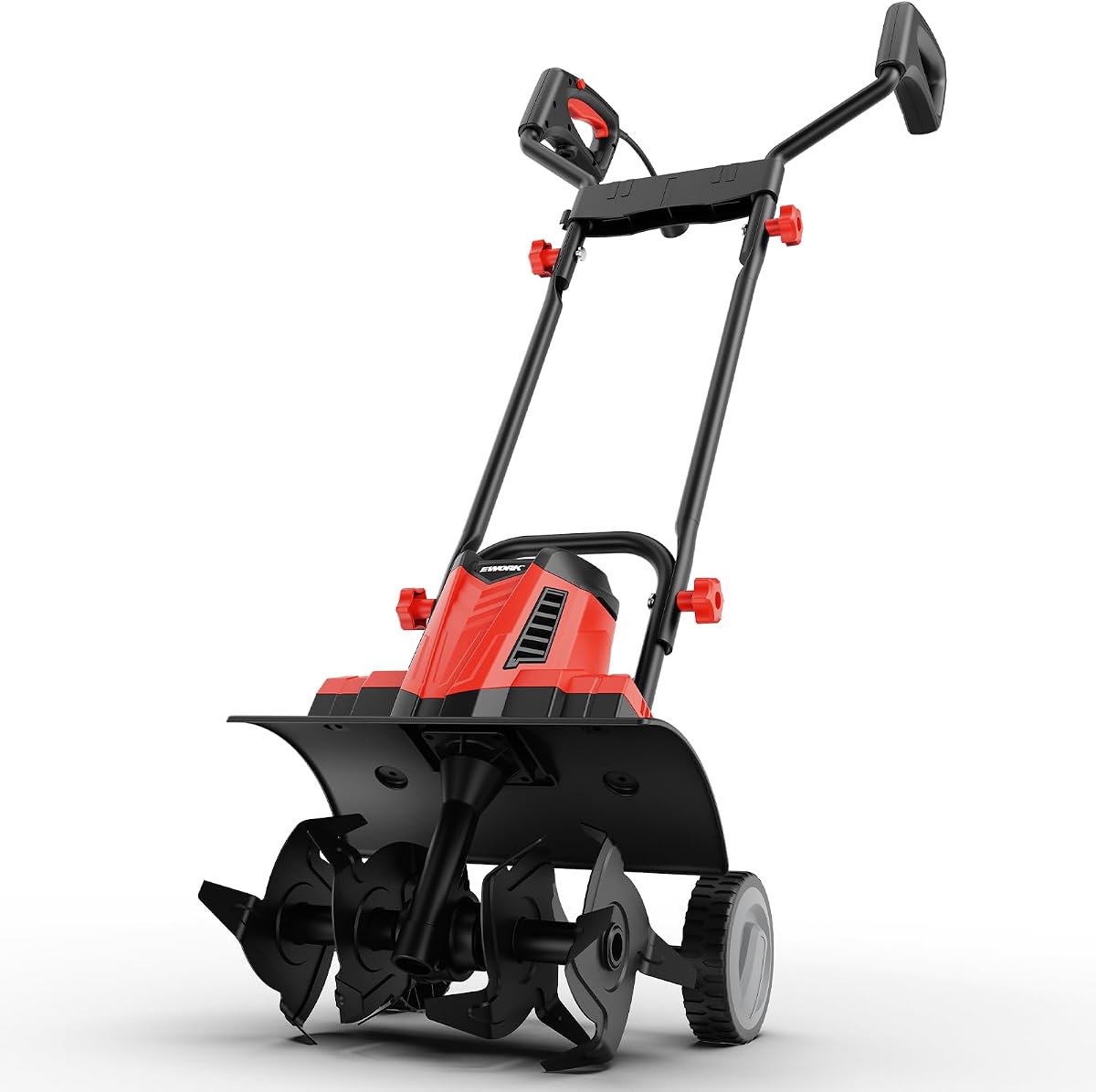
The EWORK 10Amp Corded Electric Tiller has a 3.8 rating and emphasizes a distinctive one-piece manganese-steel claw tine disc, compact 14-inch width, and multiple safety provisions. It is aimed at users who want focused soil breaking, aeration, bed leveling, and clod reduction in a corded package.
We may earn a commission when you buy through this link, at no additional cost to you.
The claw design is intended to penetrate compacted ground while resisting the grass wrapping that can affect other tine shapes. Mechanical overload protection shuts the unit down if it becomes jammed, while adjustable wheels help set the tilling depth. The 14-inch working width and 7-inch depth offer useful capacity for a small or medium garden.
Safety is a particularly visible part of the design. Dual safety switches help prevent unintended operation, and an anti-loose cord clip is intended to keep the cable stable and reduce accidental disconnections. The product also includes a one-year warranty that the manufacturer says can be activated through registration.
The lower customer rating gives prospective buyers reason to examine current reviews closely and consider the warranty and support terms. Nevertheless, the specification set is attractive for a compact tiller. It is best for compact beds and regular cultivation where the claw-style disc and safety controls matter more than maximum depth or the widest possible pass.
The one-piece manganese-steel disc uses a claw design intended to enter compact material and resist curling at the edges. It also aims to limit grass winding around the rotating assembly.
Dual safety switches, overload shutdown, and an anti-loose cord clip provide several layers of protection. Each should be kept unobstructed and checked according to the manufacturer's instructions.
We may earn a commission when you buy through this link, at no additional cost to you.
The Westinghouse 18-Inch Corded Electric Tiller has a 4.4 rating and combines a 15-amp motor, 18-inch working width, and 9-inch depth for medium-to-large garden preparation. Its integrated 6-by-4 steel blade configuration is designed to provide fast, even soil turnover across beds, flower patches, and vegetable areas.
We may earn a commission when you buy through this link, at no additional cost to you.
The motor operates at up to 400 RPM, giving the machine one of the higher listed rotational speeds among the corded models here. That speed is complemented by a broad path and deep stated cultivation capability, making the tiller suitable for users who want to cover meaningful acreage without repeated shallow passes.
The H-type handle is designed for maneuverability, and its folding structure helps reduce storage space. The listed dimensions are 39.4 by 17.1 by 40.2 inches when open, while the stated weight is 24 pounds. Factory functional testing and a two-year limited warranty add reassurance for buyers who value manufacturer support and a defined warranty term.
This tiller is most appropriate for a homeowner with ample garden space and a straightforward plan for powering the cord. It is less suitable for very narrow beds or small storage spaces, where a compact cultivator would be easier to maneuver. The depth and width specifications make it a compelling option for substantial soil preparation.
The listed 400-RPM motor speed complements the 15-amp output and 18-inch path. Together, these specifications are oriented toward efficient bed preparation across medium and large gardens.
The product includes a two-year limited warranty and lifetime technical support. Buyers should retain their purchase documentation and review the warranty's exclusions and registration requirements.
We may earn a commission when you buy through this link, at no additional cost to you.
The Seesii Cordless Tiller Cultivator has a 4.5 rating and brings genuine cord-free mobility to the category. Powered by two 20V 4.0Ah lithium batteries, it is designed to break ground, loosen compact soil, mix compost, and aerate beds without requiring an outlet near the work area.
We may earn a commission when you buy through this link, at no additional cost to you.
Its listed 10.6-pound weight is among the lightest machines in this comparison, and the dimensions are designed for raised beds, narrow rows, and tight spaces. A height-adjustable main handle and front assist handle support control on uneven ground. The tine system reaches 360 RPM and includes 48 rust-resistant steel tines for a large number of cultivation elements.
The dual-battery arrangement can offer an advantage over a single-battery design by allowing one pack to charge while the other is in use, subject to the manufacturer's charging and battery-care guidance. Detachable tines make cleaning easier because soil and plant debris can be removed without working around a permanently installed assembly.
A dual-button safety lock is included to guard against accidental starts. Cordless operation is especially valuable around isolated plots, ornamental beds, or areas where extension cords would be inconvenient. The tradeoff is that battery output and runtime can fall under heavy load, so users should keep both batteries charged and expect charging time between substantial work sessions.
The cordless design allows the tiller to move between isolated beds without a power outlet. It also removes the need to route and constantly reposition a cable around the work area.
Detachable tines allow the user to remove the cultivation assembly for cleaning. The electric system also avoids oil changes and gasoline engine upkeep, although battery health remains important.
We may earn a commission when you buy through this link, at no additional cost to you.
The Sun Joe TJ605E has a 4.4 rating and pairs a 15-amp motor with a 15.7-inch working width. Its tines rotate at up to 400 RPM, and the machine is positioned for breaking compact soil, aerating lawns, maintaining garden beds, and supporting planting preparation.
We may earn a commission when you buy through this link, at no additional cost to you.
The tilling depth reaches 7.7 inches, slightly less than the maximum claimed by several 18-inch competitors, but the nearly 16-inch path still offers useful coverage. Four-position wheel adjustment allows the operator to vary depth and handling, while the foldable handle improves storage. The six rust-proof, steel-angled tines are built for repeated seasonal work.
The 15-amp motor provides a relatively strong power figure without making the listed path as broad as the full 18-inch models. Electric operation means no gasoline, oil, or pull cord, which keeps routine ownership simpler. The corded arrangement, however, places a hard limit on how far the operator can work from an outlet.
The TJ605E is a good middle-to-large garden choice for owners who want high rotational speed and 15-amp power in a somewhat narrower package. It may also suit users who regularly cultivate lawns and beds but do not need the absolute maximum width. Current feature availability, warranty terms, and customer feedback should be reviewed before purchase.
A listed 400-RPM tine speed supports rapid soil cultivation, while four wheel positions help manage depth across changing conditions. These controls are useful for maintaining consistent passes.
The 15.7-inch path falls between compact 14-inch models and full 18-inch tillers. It offers useful coverage while remaining somewhat easier to guide in a landscaped garden.
We may earn a commission when you buy through this link, at no additional cost to you.
Choosing an electric rototiller means matching motor capability, working dimensions, tine design, and power configuration to the size and condition of your garden. The most useful machine is the one that can reach your bed safely, work the soil effectively, and fit the space where you plan to store it.
Tilling width determines how much soil the machine can disturb in one pass. Compact models commonly cover approximately 12 to 14 inches, while broad garden tillers approach 18 inches. A narrower path is easier to maneuver between close rows and in irregular spaces, but it can require more passes across a large plot. A wider path improves efficiency over open ground but demands more turning room and may be less comfortable around tightly arranged beds.
Choose the narrowest width that still lets you complete your normal beds efficiently. For small gardens, 12 to 14 inches can be highly practical. For a larger plot, a 15.7- to 18-inch path may reduce labor significantly.
Maximum depth is important when compacted ground must be broken below the surface. Listed capabilities in this roundup range from 7 inches to 9 inches, while the compact MZK and BILT HARD models publish 8 and 8.7-inch figures. Actual depth varies with soil density, moisture, tine condition, and how the wheels are set, so the published maximum should be treated as a potential rather than a guaranteed result.
Match depth to your task. Shallow cultivation is enough for repeated bed maintenance, while deeper specifications matter for opening new ground or incorporating substantial compost. Check wheel adjustment instructions to understand how each model establishes depth.
Motor amperage provides a basic indication of available electrical power, but tine design also influences how effectively a machine enters soil. The roundup includes conventional angled steel tines, detachable multi-blade systems, a one-piece claw disc, and a high-count cordless tine arrangement. These configurations differ in penetration, turnover, resistance to grass wrapping, and behavior when a root or stone is encountered.
Consider both the motor and cutting system rather than focusing on one figure. A higher-amperage motor can help with resistant soil, while a well-designed tine assembly determines how efficiently that energy reaches the ground. Also check whether replacement tines are available and whether changing their width is possible.
Corded tillers provide continuous power as long as they remain connected to an outlet, making them suitable for a fixed garden near a power source. Their main limitation is cable management, especially around isolated beds or where extension cords create trip hazards. Cordless tillers eliminate that issue and can move freely around the property, but battery runtime, charging time, and battery replacement become part of the ownership equation.
Choose corded for sustained work near an outlet and lower ongoing battery complexity. Choose cordless for mobility, small raised beds, and areas where extension cords are inconvenient. Whichever format you select, use only outdoor-rated extension equipment and follow all manufacturer instructions.
A tiller that performs well in a showroom can still be awkward in a real yard. Weight, wheel positions, handle geometry, and tine depth all influence turning and control. Folding handles are especially valuable for gardeners with limited garage space, while adjustable wheels help move the machine without dragging the tines deeply. The listed weights range from the cordless Seesii's 10.6 pounds to several 24-pound conventional models.
Check the open dimensions and turning radius before buying, and consider whether you will need to carry the unit over steps or thresholds. A slightly heavier model may be stable in soft soil, while a lighter design is easier to reposition between raised beds.
Tines rotate quickly and can catch roots, stones, and loose clothing. Dual safety switches, overload shutdown, mechanical circuit breakers, and cord-retention clips are all meaningful safety or equipment-protection features. Their presence does not replace careful operation: check the area before every pass, keep hands away from the tines, stop the machine before clearing a jam, and disconnect power as required by the manual.
Prioritize models with clear safety controls and understandable operating instructions. Overload protection is especially useful in compacted or root-filled ground because it stops the motor when resistance becomes excessive. Review the warranty and replacement-parts policy as part of the safety decision.
Different machines are better suited to new ground, maintained beds, compost mixing, weed removal, and routine cultivation. Compact cultivators can work well in loose soil and defined beds, while higher-power 15-amp models are more appropriate for compact ground and larger planting areas. Very wet soil is heavy and can clog tines, while extremely dry ground may create excessive resistance. A machine that is underpowered for the task can stall repeatedly.
Assess the condition and extent of your normal work before deciding. A small vegetable patch may need only a narrow cultivator, while a lawn renovation or large annual garden benefits from greater width and depth. If you expect multiple hard-soil projects, prioritize motor output and robust tines over added convenience features.
Warranty coverage varies across the products in this guide. The EWORK model includes a one-year product warranty, the Westinghouse tiller has a two-year limited warranty, and the BILT HARD listing mentions a warranty for defects in materials and workmanship. Other support terms may vary, so the current listing and manual are more authoritative than a general product description.
Check the length, registration process, replacement-parts coverage, and exclusions before buying. Reliable technical support can be particularly valuable for a first-time tiller owner who needs guidance on depth settings, assembly, or maintenance.
Begin by reading the complete manual, assembling the handle and any adjustable tines as directed, and inspecting the machine for loose fasteners, damaged cables, bent tines, or missing guards. Clear the work area of stones, roots, irrigation parts, and other obstacles. If using a corded model, use an appropriately rated outdoor extension cord and route it behind the machine so it cannot enter the tines.
Set the wheels for the intended depth and begin on a shallow pass in loose soil. Let the tines establish their bite before advancing, keep the machine moving steadily, and avoid forcing it into severely compacted ground. Use overlapping or evenly spaced passes to create a uniform planting area. Stop and disconnect power before clearing a jam, removing debris, adjusting the tines, or repositioning the cord. On a cordless model, follow the manufacturer's battery and charger instructions.
After each session, switch off and disconnect the power, then remove wrapped weeds and soil from the tines and wheel area. Use a brush or cloth for general cleaning and avoid directing powerful water into the motor housing unless the manual permits it. Store the tiller in a dry location with the handle folded where applicable. Cordless models should be stored according to the battery guidance, while every machine benefits from periodic checks for loose hardware, frayed cables, worn tines, and damaged switches.
They can be effective for many residential jobs, especially when the soil is workable and the machine has adequate motor and tine capability. Models with higher amperage, deep listed cultivation capability, and robust tine systems are better suited to compacted ground than compact cultivators. Very hard, wet, or stone-filled soil can overload any machine, so removing major obstructions and working in suitable conditions matters.
Cordless models provide better mobility and eliminate cord-management problems around isolated beds. Corded models offer continuous power without battery charging and may be simpler for prolonged work close to an outlet. The right choice depends on garden layout, access to power, expected session length, and willingness to maintain rechargeable batteries.
A compact model with a 12- to 14-inch tilling width is generally more maneuverable in a small garden. It may require more passes than an 18-inch model, but it is easier to guide around paths, raised beds, and plantings. A wider tiller is more attractive when substantial open ground must be prepared quickly.
The useful depth depends on the soil and your purpose. Routine cultivation and compost mixing may work at shallower settings, while new beds and compacted areas benefit from deeper passes. Published depth figures represent maximum capability under suitable conditions, and actual results vary with moisture, density, wheel position, and the operator's technique.
It can remove small weeds and cut some surface roots, but it is not intended to replace a stump grinder or tree-root removal tool. Dense root mats may jam the tines, and underground pipes or large stones can create hazards. Always inspect the ground before tilling and stop the machine if an obstruction becomes lodged.
They generally require less routine maintenance than gas-powered tillers because there is no engine oil, fuel system, spark plug, or pull starter. Users should still clean the tines, check fasteners, inspect the cord or batteries, and replace worn components. Overload protection does not eliminate the need to clear obstructions promptly.
Slightly moist, workable soil usually offers a better balance than bone-dry ground or saturated mud. Excessively wet soil is heavy and tends to clump around the tines, while dry compacted ground can place excessive strain on the machine. Check a small patch for how it breaks up before beginning the full bed.
Use an outdoor-rated extension cord with suitable capacity and connect it according to both manufacturers' instructions. Keep the cable behind the tiller, away from the rotating blades, and do not wrap it around the handle while the machine is operating. Stop and disconnect power before repositioning the cord or inspecting a jam.
The Sun Joe TJ604E stands out as a balanced all-around recommendation, combining a 13.5-amp motor, 16-inch width, steel tines, and a folding handle. The BILT HARD 14-Inch Tiller offers a lighter and highly portable approach for smaller gardens, while the 18-Inch 15-Amp Electric Tiller provides the greatest working width among the featured high-capacity corded options.
Prioritize the dimensions of your actual soil-preparation area, the depth of work required, and access to electrical power. A compact model is easier to maneuver, a broad model covers more ground per pass, and a cordless design is ideal where extension cords are inconvenient. Tine construction, overload protection, wheel adjustment, handle folding, warranty coverage, and customer feedback should also influence the final decision.
Before purchasing, verify the latest specifications, package contents, warranty terms, and availability on the current product page. Prices and retailer offers can change, so compare the final cost of the machine and any required accessories at the time of purchase. The right electric rototiller is the one that fits the garden, the soil, and the storage space without creating unnecessary operating compromises.