
Bingfu Dual Band WiFi 2.4GHz 5GHz 5.8GHz 3dBi MIMO RP-SMA Male Bluetooth Antenna
4.6Editor score
Dual-band 2.4 and 5GHz
3dBi omnidirectional gain
RP-SMA male connectors
Two-antenna two-pack
Our Antenna for Router guide compares 10 dual-band, tri-band, outdoor, and mobile-hotspot antennas by range, gain, connector, placement, and compatibility.
An antenna for a router can improve wireless coverage, strengthen reception, and help a network perform more consistently across rooms or outdoor spaces. The right choice depends on connector type, supported frequencies, gain, directional pattern, mounting options, and the distance between your router and connected devices.
We compared ten antennas using the specifications and compatibility details supplied for each product. The list covers compact dual-band models, Wi-Fi 6E tri-band options, high-gain outdoor antennas, a mobile-hotspot kit, and a router upgrade requiring pigtail cables, with both budget-conscious and more specialized choices represented.
Each review explains the antenna's strongest use case, installation considerations, and important limitations. Ratings reflect the supplied customer feedback, while technical details are drawn from the product information. Product availability and market conditions can change, so readers should confirm current specifications and fit before purchasing.
4.6Editor score
4.5Editor score

4.5Editor score
This side-by-side comparison highlights each antenna's frequency coverage, gain, connector configuration, and practical specialty, helping you narrow the field before checking exact router compatibility.


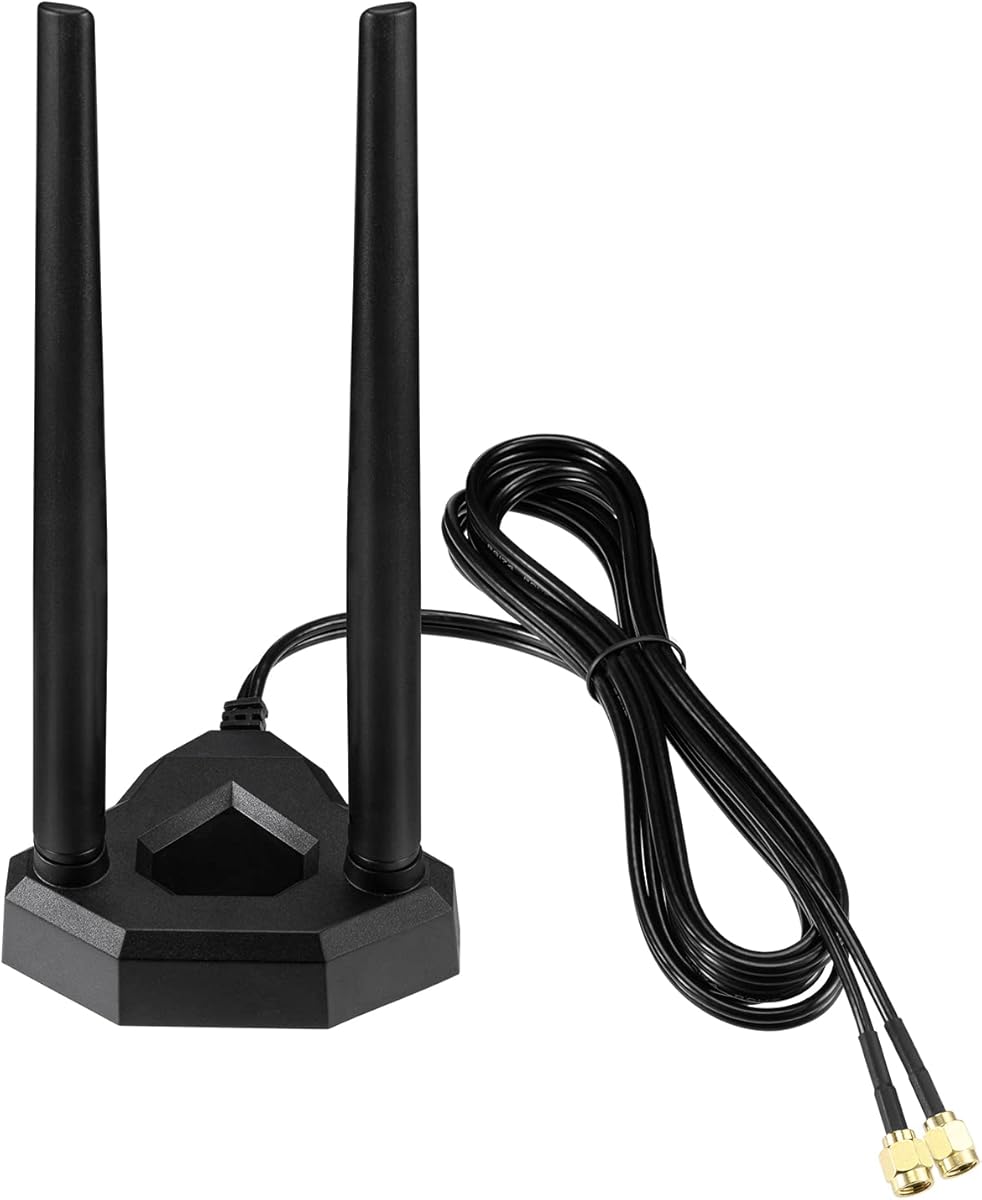
The Bingfu Dual Band WiFi antenna is a compact, two-antenna upgrade for routers and compatible wireless equipment. Its supplied rating is 4.6, placing it among the strongest customer-feedback results in this group. It supports 2.4GHz and 5GHz/5.8GHz signals, uses an omnidirectional pattern, and provides 3dBi gain. The two-pack makes it especially relevant to systems that benefit from multiple external antennas or MIMO-style arrangements.
We may earn a commission when you buy through this link, at no additional cost to you.
The broad compatibility list is its most useful feature. The antennas are listed for wireless routers, Wi-Fi hotspots and modems, USB wireless adapters, desktop and Mini PCI Express network cards, IP security cameras, DVR systems, vehicle backup cameras, industrial routers, IoT gateways, and FPV equipment. A user can therefore select this option for a router replacement or for another supported device without moving to a completely different antenna format.
The important technical caveat is connector type. Each antenna uses an RP-SMA male connector, described as having a hole in the center and no pin. That must mate with an RP-SMA female port, which has external threads and a center pin. It will not be interchangeable with every SMA fitting, so inspecting the router's existing antenna and its connector threads is essential before ordering. There is also no stated extension-cable length, so buyers who need distance from the router should consider that limitation.
This is a strong general recommendation for anyone seeking an inexpensive way to add or replace dual-band router antennas. The two-pack, 3dBi gain, and wide range of supported applications make it versatile, while the 4.6 rating provides a positive customer-feedback signal. It is best suited to indoor setups with RP-SMA female ports and modest placement needs, rather than distant outdoor installations requiring a long cable and high-gain directional design.
Receiving two matched antennas simplifies replacements and may suit routers with two external antenna ports. Installing them in different orientations can help users test which arrangement provides the most stable connection across nearby devices.
The same dual-band package can serve compatible routers, security cameras, network cards, USB adapters, and FPV equipment. That flexibility makes it a practical option for users who manage several types of wireless hardware.
We may earn a commission when you buy through this link, at no additional cost to you.
The Eightwood Dual Band WiFi Antenna is an adaptable indoor option with a 4.5 supplied rating. It combines 2.4GHz and 5.8GHz coverage, an omnidirectional radiation pattern, a 6.5-foot extension cable, and a magnetic base. That combination gives router owners more freedom to move the antenna away from obstructions or place it near a metal surface where a stable mount is available.
We may earn a commission when you buy through this link, at no additional cost to you.
Its stated device support covers 802.11 b/g/n/ac/ax and Wi-Fi 6, along with routers, PCI and PCIe network cards, built-in Wi-Fi motherboards, notebook and desktop adapters, WLAN access points, hotspots, range extenders, and security cameras. The product information also states that it can improve Bluetooth reception for devices such as headsets, wireless controllers, and Bluetooth network cards. That makes it a useful option for a mixed wireless setup rather than a router-only replacement.
The product's standout feature is placement flexibility. A short, movable antenna can be positioned in a better reception area without relocating the router. The magnetic base adds another practical advantage, while the instruction to try different locations and adjust both stubs suggests that users should treat installation as a small optimization process. Although no numerical gain is supplied, the design focuses on practical signal stability rather than publishing a headline gain figure.
This is the strongest choice for someone who needs to move an antenna around a home or office. It is particularly attractive if the router sits in a crowded area, near electronics, or inside a cabinet. Buyers should still verify the router connector, because the product title identifies an RP-SMA antenna without providing the same detailed male-versus-female explanation included with some other products. Once fit is confirmed, its cable and magnetic base make placement unusually easy.
The 6.5-foot extension cable allows the antenna to be moved away from the router's immediate surroundings. In difficult indoor layouts, even a modest change in location can help reception more than leaving the antenna fixed in one crowded position.
A magnetic base provides a quick way to attach the antenna vertically to a steel surface. It also makes iterative testing easier because the user can relocate the base without tools and compare results in different rooms or elevations.
We may earn a commission when you buy through this link, at no additional cost to you.
The Eightwood Wi-Fi 6E Tri-Band Antenna is a modern option for routers that operate across 2.4GHz, 5GHz, and 6GHz. Its supplied rating is 4.4, and the specifications emphasize support for 802.11 b/g/n/ac/ax, Wi-Fi 6, and Wi-Fi 6E. It combines those standards with an omnidirectional design, RP-SMA male connectors, and a magnetic base attached to a 6.5-foot cable.
We may earn a commission when you buy through this link, at no additional cost to you.
The 6GHz capability is the distinguishing feature. The product information describes the 6GHz band as offering greater bandwidth, faster throughput, lower latency, and less interference than the lower bands, making it relevant to online gaming and high-resolution streaming. The antenna is also listed for wireless routers, PCIe network cards, desktop and notebook adapters, access points, hotspots, extenders, and security IP cameras, giving buyers several potential uses.
Connector compatibility requires particular care. The two connectors are identified as RP-SMA male with internal threads and no center pin, and they fit only RP-SMA female ports with external threads and a center pin. This specificity is helpful, but it means a visually similar connector may still be electrically or mechanically wrong. The package contains one tri-band antenna, so buyers needing a matched pair should plan accordingly.
This antenna makes the most sense for a recent router or upgrade involving Wi-Fi 6E hardware. The flexible cable and magnetic base allow users to optimize placement, while the three-band range ensures it does not limit the antenna to older 2.4GHz and 5GHz networks. It is less appropriate for a router with only a single-band port or a different connector standard. Subject to those checks, it is a well-rounded choice for modern indoor wireless systems.
Supporting all three major Wi-Fi bands helps the antenna accommodate newer 6GHz equipment while remaining useful on 2.4GHz and 5GHz networks. This broad frequency range is valuable when a home contains devices using different wireless standards.
The 6.5-foot cable and magnetic base make it practical to test the antenna at different heights and angles. The included guidance recommends adjusting both stubs in multiple directions to find a stable signal.
We may earn a commission when you buy through this link, at no additional cost to you.
The Eifagur Outdoor 7dBi antenna is intended for users who need more range than a compact desktop antenna can provide. It has a supplied rating of 3.6, the lowest among the listed products, but its technical specifications target long-range dual-band installations. It operates across 2.4GHz and 5GHz/5.8GHz, uses an omnidirectional pattern, and delivers a stated gain of 7dBi.
We may earn a commission when you buy through this link, at no additional cost to you.
A three-meter RG174 cable and included wall-mount bracket distinguish it from the shorter indoor antennas. The package contains one antenna, a mounting bracket, and four screws. It can be positioned farther from the router or access point, which is useful for backyards, offices, stores, warehouses, restaurants, and other broad properties. Its compatibility list includes routers, hotspots, network cards, USB adapters, extenders, security cameras, DVR recorders, vehicle cameras, industrial equipment, and FPV monitors.
The lower customer rating warrants realistic expectations. A higher gain figure and longer cable can help cover larger areas, but no antenna can completely overcome obstructions, interference, or an unsuitable placement. RG174 is also a relatively thin cable type, so routing it carefully through walls and around sharp edges matters. The supplied information does not state the exact connector gender in the same descriptive detail as some alternatives, making physical connector verification especially important.
This product is a sensible candidate for outdoor extension or a router located away from the area that needs coverage. It is less compelling for a small indoor desk setup where a compact magnetic antenna would be easier to arrange. Buyers should confirm RP-SMA compatibility, identify a clear mounting location, and accept that a 3.6 rating is less emphatic than the alternatives. With those considerations in mind, it remains a functional high-gain outdoor option.
The three-meter cable allows the antenna to be mounted away from the router, which is often essential when the connection point and coverage area are in different locations. A wall bracket also supports a more permanent installation.
A stated 7dBi gain and omnidirectional pattern make the antenna relevant for broad properties and exterior equipment. Placement should still account for walls, vegetation, buildings, and other sources of signal loss.
We may earn a commission when you buy through this link, at no additional cost to you.
The Superbat Wi-Fi 6E Tri-Band Antenna combines 2.4GHz, 5GHz, and 6GHz operation with a 4.3 supplied rating. It is designed for 802.11 b/g/n/ac/ax, Wi-Fi 6, and Wi-Fi 6E networks, using an omnidirectional pattern and an RP-SMA male connector. A six-foot extension cable and magnetic base give it more installation flexibility than a fixed stub antenna.
We may earn a commission when you buy through this link, at no additional cost to you.
The product information emphasizes the 6GHz band's greater bandwidth, lower latency, and potential for higher capacity in congested areas. It also identifies demanding uses such as 4K and 8K streaming, online gaming, and large file transfers. Compatible equipment includes wireless routers and hotspots, PCI and PCIe cards, desktop and notebook computers, external USB adapters, built-in Wi-Fi and Bluetooth motherboards, FPV systems, and security cameras.
The magnetic base can attach to a metal surface, and the six-foot cable lets the user move the antenna away from the router or computer. This is useful when the device sits in a weak-signal position. As with the Eightwood tri-band model, though, the RP-SMA male connector has no center pin and must connect to an RP-SMA female port with a center pin. Visually similar SMA fittings are not automatically interchangeable.
This is a good pick for users modernizing a Wi-Fi 6E setup who also value easy placement. The three-band support provides more flexibility than a dual-band antenna, while the magnetic base avoids a permanent mounting process. It is best suited to indoor or semi-protected locations with a suitable metal mounting surface and an RP-SMA female port. Confirming connector fit before purchase is the most important precaution.
The antenna can operate across 2.4GHz, 5GHz, and 6GHz, making it suitable for mixed modern networks. It avoids forcing users to choose between legacy support and access to the 6GHz band.
The six-foot RP-SMA cable separates the antenna from the connected device, while the magnetic base provides a stable attachment point on metal. Together they make iterative signal testing straightforward.
We may earn a commission when you buy through this link, at no additional cost to you.
The Eightwood WiFi Antenna with RP-SMA Male Connector is a dual-band indoor model offering a stated 6dBi gain. Its 4.5 rating aligns it with several well-reviewed products in the group. It supports 2.4GHz, 5GHz, and 5.8GHz, uses vertical polarization and an omnidirectional pattern, and has a nominal impedance of 50 ohms. The antenna includes a magnetic base and a 200-centimeter, or 6.5-foot, extension cable.
We may earn a commission when you buy through this link, at no additional cost to you.
The dual RP-SMA male connector arrangement makes the product appropriate for equipment that accepts two external antennas. Its listed applications include routers, hotspots, PCI and PCIe cards, notebook and desktop adapters, WLAN access points, range extenders, wireless security cameras, vehicle backup cameras, FPV goggles, receivers, cameras, and drone controllers. That range shows it can serve as a general Wi-Fi replacement rather than an accessory limited to one device category.
Installation advice is notably specific: the antenna should be placed high and unobstructed, the two stubs can be adjusted to different angles, and orientation should align with the router or access point. Those recommendations matter because the stated gain does not guarantee better performance if the antenna is blocked or poorly oriented. The package contains one dual-antenna unit, so buyers needing two separate antennas should verify their requirements before ordering.
This is a compelling all-around indoor antenna for users who want more than a minimal stub but do not need 6GHz. Its 6dBi specification, 50-ohm design, adjustable cable, and magnetic base provide a balanced feature set. It is well suited to a router in a central but crowded room, an access point near a ceiling, or compatible FPV and camera equipment. The absence of the 6GHz band keeps it from being the top choice for a Wi-Fi 6E router.
The product guidance recommends trying one stub in a vertical position and another horizontally. This can reduce signal loss caused by alignment between antenna and access point, especially in cluttered indoor spaces.
Keeping the antenna high and unobstructed gives the radio a clearer path through a room. The long extension cable makes this possible without forcing the router itself into an elevated position.
We may earn a commission when you buy through this link, at no additional cost to you.
The Eifagur 9dBi Long Range antenna has the highest supplied customer rating in the group at 4.7. It is a dual-band outdoor model designed for 2.4GHz and 5GHz/5.8GHz networks, with a stated 9dBi high-gain design. The main selling point is straightforward: provide a stronger replacement antenna for a router, access point, security camera, RV camera, or another supported outdoor wireless device.
We may earn a commission when you buy through this link, at no additional cost to you.
The listed applications include routers, access points, security IP cameras, RV cameras, and outdoor wireless networks. The product information describes it as easy to upgrade without complex installation or extra equipment, which makes it approachable for users replacing a weak built-in antenna. Its outdoor-ready construction is also relevant for exterior cameras and other equipment exposed to weather rather than used in a protected indoor location.
The specifications are less detailed than those of several competing products. The supplied information does not identify the connector type, cable length, polarization, impedance, or mounting hardware. As a result, buyers must inspect the existing antenna and verify the full physical specification before ordering. The high gain also calls for realistic expectations: omnidirectional coverage can be less useful when a specific direction would be preferable, and surrounding structures still influence the result.
This antenna is a strong candidate for an outdoor router or access point needing a higher-gain replacement. Its 4.7 supplied rating and 9dBi specification make it appealing for RV and exterior camera installations where distance from the transmitter matters. The lack of detailed connector and mounting information is the main drawback, so careful compatibility checks are essential. Once those details are confirmed, it is a focused option for long-range dual-band coverage.
At 9dBi, this model offers the highest numerical gain among the listed antennas. That specification can be valuable for exterior equipment or a router placed a substantial distance from the intended client.
Outdoor-ready construction makes the antenna relevant for RV cameras, security cameras, and exterior access points. The enclosure should be positioned where it can receive a clear signal and remain securely mounted.
We may earn a commission when you buy through this link, at no additional cost to you.
The TRENDnet TEW-A057 is a comprehensive outdoor antenna kit with a supplied rating of 4.5. It includes a pair of tri-band omnidirectional antennas, each measuring 20 by 178 millimeters. It supports 2.4GHz, 5GHz, and 6GHz radio transmissions, including the 6GHz band used by Wi-Fi 7. Detailed peak-gain figures are provided, making it one of the most clearly specified options in the roundup.
We may earn a commission when you buy through this link, at no additional cost to you.
The gain varies by frequency: 3dBi at 2.4GHz, 6.2dBi at 5GHz, and 7dBi at 6GHz. That frequency-specific approach is useful for multi-band networks because stronger gain at higher frequencies helps compensate for their shorter propagation characteristics. The antennas use N-Type female connectors and are designed for compatible routers and access points. They also have an operating temperature range from -40 to 70 degrees Celsius, supporting outdoor deployment in varied seasonal conditions.
The main compatibility issue is the N-Type female fitting. It differs from the RP-SMA and SMA connectors used by many consumer routers, so a router may require an additional compatible cable or adapter. The product also does not list a complete mounting kit, and each antenna's 178-millimeter length means placement needs adequate clearance. NDAA and TAA compliance is stated for the United States and Canada.
This is the premium choice for a dedicated outdoor router, access point, or surveillance installation that uses N-Type connections. It is particularly attractive for users building a tri-band or Wi-Fi 7 network, as the kit supplies two matching antennas and clearly documents their gains. For a basic indoor router with RP-SMA ports, it is unnecessarily specialized. Those who need its outdoor tri-band capabilities and can confirm N-Type compatibility will receive a more complete and technical package than most alternatives.
Rather than applying one headline gain across every band, the specification gives separate values for 2.4GHz, 5GHz, and 6GHz. This makes it easier to understand how the antenna is intended to perform across a tri-band network.
The stated -40 to 70 degree Celsius operating range supports use in cold and warm environments. Secure installation and suitable weather exposure remain important even when an antenna is marketed for outdoor use.
We may earn a commission when you buy through this link, at no additional cost to you.
The NETGEAR Omnidirectional MIMO Antenna is a specialized solution for mobile broadband users rather than ordinary Wi-Fi routers. It has a supplied rating of 3.9 and is compatible with the NETGEAR M5 MR5200 and M6 MR6150 and MR6550 hotspot routers. Its purpose is to improve performance where cellular 4G or 5G reception is weak, such as inside buildings, vehicles, or remote locations.
We may earn a commission when you buy through this link, at no additional cost to you.
The antenna supports a broad collection of cellular bands, including GSM, EDGE, UMTS, HSPA, HSPA+, CDMA, EV-DO, WiMAX, LTE, and 5G frequencies from 600 to 5925MHz. Its omnidirectional MIMO format is appropriate for mobile hotspot use, while the slim profile helps with convenient placement. The package includes two TS-9 converters, two SMA connectors, clips, and two suction cups for attaching the antenna to suitable surfaces.
Installation is described as simple and requires no software. A user can connect the antenna to a compatible hotspot and use the included suction cups or clips to position it near a window or other location with a better cellular signal. This is different from replacing a standard Wi-Fi router antenna because the relevant signal may be between the hotspot and a cellular tower. The supplied information also limits use to the United States and Canada.
This is the right antenna for a compatible NETGEAR mobile hotspot used in a weak cellular-coverage area. It offers a clearer use case than a generic dual-band Wi-Fi antenna because it is designed around LTE and 5G reception. The model-specific compatibility and regional limitation make it less versatile, and its 3.9 rating is modest. Buyers who own one of the supported hotspots and need cellular reception improvement will find the specialized package worthwhile.
The antenna targets weak 4G and 5G cellular coverage rather than ordinary distance from a Wi-Fi router. It can help a compatible mobile hotspot receive a better signal from the local cellular network.
Included suction cups and clips make it possible to attach the antenna to a window, dashboard, or another suitable surface. Trying several positions is often more useful than leaving the antenna beside a metal enclosure.
We may earn a commission when you buy through this link, at no additional cost to you.
The Indoor 6dBi Omni-Directional WiFi Antenna kit is a specialized solution for routers that lack usable removable antennas. Its supplied rating is 4.5. The package includes two 6dBi omnidirectional antennas and two 20-centimeter U.FL or IPEX-to-RP-SMA pigtail cables. These short internal-style cables let a compatible router connect to external antennas mounted in better positions.
We may earn a commission when you buy through this link, at no additional cost to you.
The kit's primary advantage is compatibility with router designs that ordinarily do not support removable external antennas. The RP-SMA female end of each pigtail can connect to the included antenna, while the U.FL or IPEX end attaches internally to the router's radio interface. With a stated 6dBi gain and omnidirectional radiation, the antennas may improve reception when the router's built-in antennas are trapped in a cabinet or poorly positioned.
This is a 2.4GHz-only product, so it cannot be used with a 5GHz or 6GHz radio. It also involves more involved installation than a standard screw-on router antenna because the router may need to be opened and the pigtail routed internally. Buyers must ensure the router has accessible U.FL or IPEX antenna connectors and that the cable length is sufficient for the available enclosure space.
This kit is best for a technically inclined user whose 2.4GHz router has weak internal antennas and no external ports. It is less suitable for modern dual-band systems, where a dual-band RP-SMA antenna can be installed without internal modification. The two-antenna arrangement, 6dBi gain, and 4.5 rating make it a focused but effective option when the router's internal antennas are the main problem.
The pigtail system lets external antennas sit outside a router enclosure while the radio remains connected inside. This is particularly helpful when metal, plastics, or an enclosed shelf prevent the built-in antennas from performing well.
Two antennas and two matching cables provide a complete basic kit. They can be positioned separately for better indoor signal distribution or arranged according to the router's antenna layout.
We may earn a commission when you buy through this link, at no additional cost to you.
A useful router antenna is defined less by a single gain number than by correct electrical compatibility, suitable frequency support, and placement that gives the radio a clear path to clients.
In summary, match both thread style and center-pin configuration, and verify the connector type in writing when the listing is not clear.
Choose a band plan that covers every radio you intend to use, and avoid assuming that a modern router's label guarantees support for every standard an antenna lists.
Treat gain as one factor in the installation. Range, signal quality, congestion, obstruction, and antenna position ultimately determine the result.
Use omnidirectional coverage for clients in several directions, and reserve directional patterns for clearly fixed links where focused reach is more important than broad room coverage.
Choose a cable that provides meaningful placement freedom, then optimize the location. A clear signal path is more valuable than extra cable length by itself.
Match environmental design to the installation. Use secure, weather-appropriate equipment outdoors, and compare that with the convenience of an indoor window placement.
Verify the exact device model, supported bands, number of antenna ports, and connector before purchase. Generic compatibility labels are not a substitute for a fit check.
Match the antenna's installation demands to your comfort and the intended location. Proper placement and secure attachment are more valuable than a headline specification alone.
Begin by identifying every radio you intend to improve and confirming that the antenna supports its frequency band and connector. Disconnect the router from power before attaching or removing a screw-on external antenna. If the router uses U.FL or IPEX pigtails, open the enclosure only if you are comfortable doing so, keep the internal cable away from sharp edges, and reconnect the antenna cables according to the router's labeling. Do not force a connector that does not align.
Install the antenna as high and as unobstructed as practical. For a magnetic model, attach the base to a suitable metal surface and allow the antenna to stand as intended. Move it through several positions rather than judging the result from a single location, and compare performance from the same client device and at the same distance. Adjust the stub angles as needed, and avoid enclosing the antenna in a cabinet, behind a television, or directly beside large metal objects.
For ongoing care, inspect exposed cables for pinching, sharp bends, moisture, or damaged connectors. Outdoor installations should be checked after severe weather and tightened if mounting hardware shifts. Keep indoor antennas away from direct heat, water, and unnecessary cable bends. If signal quality changes suddenly, test with the original antenna or another device to determine whether the issue is the antenna, the router, network congestion, or a changed physical environment.
Look at the removable antenna or the port where it attaches, and check the router manual for its connector specification. An RP-SMA male connector has internal threads and no center pin, while an RP-SMA female port has external threads and a center pin. SMA male also has external threads but includes a center pin. If the router has no removable antenna, it may use internal U.FL or IPEX connections instead. When a listing does not clearly identify the fitting, contact the manufacturer or retailer before buying.
It can improve signal strength and stability, which may support faster practical throughput, but gain does not increase the speed of the internet plan. Actual performance depends on distance, walls, interference, router hardware, network congestion, and the client device. A higher-gain antenna also concentrates energy, so a carefully positioned moderate-gain model may work better than a larger-gain antenna mounted in a poor location. Measure the connection in the same room or location before and after the change.
Only for the router's 2.4GHz radio. A 2.4GHz antenna cannot receive or transmit 5GHz or 6GHz signals, and a single-band antenna cannot improve those bands. If the router exposes separate connectors for each radio, a suitable antenna can be connected to each one, but connector and band support must both be verified. Replacing all external antennas with 2.4GHz-only models would prevent the router from using its faster wireless bands.
The primary difference is the thread arrangement and center-pin configuration. SMA male generally has external threads and a center pin, while RP-SMA male has internal threads and no center pin. RP-SMA female is the opposite configuration, with external threads and a center pin. Because the pieces can look almost identical at a glance, matching the exact type is essential. A connector that screws in incorrectly can damage the port or leave the radio unable to operate.
Place it high, uncovered, and as far as practical from dense metal, electronics, and obstructions. A window, exterior wall, or elevated shelf may provide a better path to wireless clients than a cabinet or floor-level position. For an omnidirectional antenna, keep it upright unless testing shows another orientation performs better. The product guidance for several models recommends changing the location and adjusting the stubs, because small placement changes can materially affect signal stability.
Not necessarily. Moving a router, reducing interference, or repositioning an indoor antenna near a window may solve the problem at a lower effort. An outdoor antenna becomes more relevant when the router must remain deep inside a building or when the client is outside. The Eifagur and TRENDnet outdoor options target those larger or more exposed installations, but they require compatible connectors and secure mounting. A window-mounted indoor antenna is often a sensible first step.
Some dual-band Wi-Fi antennas are also designed to support Bluetooth reception within their frequency range. The Eightwood dual-band product specifically lists compatibility with Bluetooth headphones, headsets, wireless controllers, and network cards. The result still depends on the device's connector, antenna circuitry, and placement. Bluetooth and Wi-Fi sharing an antenna can introduce considerations around radio performance, so the device manufacturer's guidance should take priority.
Compare the same client, network, and location before and after the upgrade. Look at signal strength, connection stability, transfer speed, latency, and the number of dropped connections rather than relying on a single reading. A speed test can help, but a consistent test environment is important because nearby interference and network load can change naturally. If results do not improve, reposition the antenna or confirm that the connector and band are correct.
The Bingfu dual-band two-pack stands out as the best budget and general-purpose choice, particularly for routers with RP-SMA female ports. The Eightwood dual-band antenna is the most flexible indoor option thanks to its long cable and magnetic base, while the TRENDnet TEW-A057 is the premium pick for dedicated outdoor tri-band installations using N-Type connections. Each of these choices serves a distinct need rather than attempting to be the only suitable antenna.
Prioritize the connector first, then confirm that the supported bands match your router and clients. After that, choose based on placement: a compact or magnetic antenna works well indoors, a longer cable helps the antenna reach a clearer location, and a high-gain outdoor model is useful when the router must be separated from the client by distance or walls. Cable length, mounting hardware, pattern, and environmental needs should all be considered before making a final choice.
Finally, confirm the exact product specifications and current availability before ordering, as models and product details can change. Do not rely only on a router's generic label or an antenna's broad compatibility list. A careful connector check, realistic expectation about gain, and willingness to reposition the antenna are the most important steps toward a more stable and useful router network.