10 Best LCD Controller Board for Laptop Screen (November 2026) Expert Guide
Written by admin · Updated November 2026
An LCD controller board for a laptop screen can restore a damaged display, reuse a retired panel, or turn salvaged laptop hardware into a standalone monitor. A successful installation depends less on the board's appearance than on exact panel compatibility, including native resolution, connector pin count, signal type, supported backlight, and input connections.
This guide compares ten controller boards for small laptop panels and universal LVDS displays. The analysis considers resolution support, 30-pin and 40-pin interfaces, eDP and LVDS compatibility, VGA, DVI, HDMI, USB, and display options, power requirements, included cables, model-specific guidance, and the troubleshooting information provided with each product.
Each review identifies the project best suited to that board and explains where the alternatives are stronger. Ratings reflect the available customer feedback rather than a personal laboratory test, and compatibility claims should always be checked against the exact panel model. Listing details and component availability may also change over time.
Top 3 Picks for Best LCD Controller Board for Laptop Screen
As an Amazon Associate we earn from qualifying purchases.
Top 10 Best LCD Controller Board for Laptop Screen in 2026 Compared
The table below summarizes the most important distinctions: supported panel sizes, native resolution, connector or signal type, and available video inputs. Use it as a shortlist, then verify the exact panel model, backlight system, power requirements, and included accessories before buying.
This H/D board is a focused solution for 1366×768 laptop panels using a 30-pin eDP connection. Its 4.4 rating reflects generally favorable customer feedback, while the stated compatibility range covers popular 11.6-, 13.3-, 14-, and 15.6-inch models. It is not a universal controller, and the explicit exclusion of Full HD panels is an important limitation.
Pros
Broad small-panel model list
Preconnected signal cable
Clear pin-one alignment mark
Useful reset guidance
Low standby consumption
Cons
Excludes 1920×1080 panels
Requires a separate power adapter
We may earn a commission when you buy through this link, at no additional cost to you.
Its strongest feature is the amount of installation guidance supplied with the product. The signal cable is already connected to the controller, and pin one is marked by a red circle, reducing the risk of reversing the eDP cable. The board accepts a standard 12-volt, 2-amp-or-higher adapter through a 5.5 by 2.1-millimeter connector, while standby consumption is listed below 0.3 watts.
The trade-off is a narrow resolution target, but that specificity is also what makes the board useful. Generic boards often claim broad compatibility while failing because their timing parameters, connector arrangement, or backlight output does not match the panel. Here, the product identifies several exact panel families, including NT156WHM-N42, B156XTN04.1, LP156WHU-TPA1, N140BGE-E33, B140XTN02.1, N133BGE-E31, and B116XTN02.3.
Choose this controller when the replacement panel is 1366×768, has a 30-pin eDP connector, and appears in the supported model list. It is particularly suitable for a repairer rebuilding a small laptop display or an enthusiast adapting a compatible panel to a DIY monitor. Do not select it for a 1920×1080 panel, and confirm the panel's power and backlight requirements before ordering.
Model-Level Compatibility Reduces Guesswork
The inclusion of exact panel numbers is more useful than a size-only claim. A laptop panel can share a diagonal measurement with another panel while using a different connector, resolution, voltage, or timing configuration, so checking the printed model is essential.
Simple Signal Connection
The preconnected cable and marked pin-one location make the board approachable for first-time builders. The cable should still be inspected for damage, and the panel should be supported during connection so that leverage cannot pull the socket or ribbon connector.
This VSDISPLAY controller targets 15.6-inch, 1366×768 WLED panels with 40-pin LVDS connections. It carries a 4.4 rating and supports a substantial list of common screen families, including LP156WH2, LP156WH3, LP156WH4, LP156WHB, BT156GW02, N156B6, B156XTN03, B156XW02, and B156XW04. The emphasis is on salvaged and donor panels rather than general-purpose conversion.
Pros
Covers numerous panel families
Supports two video standards
Offers audio output
Includes self-check guidance
Uses common DC connector
Cons
Limited to 15.6-inch class
Power adapter sold separately
We may earn a commission when you buy through this link, at no additional cost to you.
VGA and DVI inputs give the builder more ways to connect a source, while a four-pin 2.0-millimeter speaker connector is provided for compatible audio output. A 12-volt DC source greater than 2 amps is required through a 5.5 by 2.1-millimeter socket. The board's plug-and-play description is helpful, although compatibility still determines whether the display will actually initialize.
Its diagnostic guidance is unusually practical. Powering the board by itself should produce a green or red indicator when the controller is functioning. A visible no-signal message points toward the input cable or source, whereas a white or black image calls for checking the panel connection, selected resolution, the 3.3-volt jumper, and the active signal source. A restart loop generally calls for more power.
This is a sensible choice for a technician converting one of the named 15.6-inch panels into a freestanding display. It is less suitable if the panel uses 30-pin eDP, if the native resolution is not 1366×768, or if a laptop-specific backlight and keyboard arrangement must be preserved. Confirm all three before assembling the project.
Useful for Donor-Laptop Panels
The extensive list of supported 15.6-inch families gives this board a clear advantage for builders working with common donor panels. Matching the suffix and revision matters, so obtain the complete panel number rather than relying on a shortened model name.
Inputs and Diagnostics
VGA and DVI broaden the available source devices, and the stated self-check process helps separate board problems from signal or panel problems. The LED test is useful only as one part of a careful diagnostic sequence.
This controller is designed for 1920×1080, 30-pin eDP panels ranging from 11.6 to 17.3 inches. Its 4.0 rating is solid but trails the strongest options in this guide. The long compatibility list includes N116HSE, N133HSE, B140HAN01, B156HAN01, LP156WF4-SP, N156HGE-EA1, NV156FHM, LTN156HL01, and several N173-series panels.
Pros
Extensive supported model list
Covers five screen sizes
No driver installation required
Supports 17.3-inch panels
Straightforward VGA connection
Cons
Only 4.0 customer rating
VGA-only source connection
Adapter not included
We may earn a commission when you buy through this link, at no additional cost to you.
The board accepts VGA video and requires no driver installation, which can simplify a basic monitor conversion. A 12-volt DC adapter greater than 2 amps is needed through the common 5.5 by 2.1-millimeter connector. The stated operating sequence is straightforward: connect the ribbon cable and ports, apply power, watch the keyboard indicator turn green, and then select the matching source and resolution.
The main compromise is input flexibility. Compared with products offering DVI, HDMI, or USB, this board is limited to VGA, and its lower rating suggests that some customers may have encountered installation or compatibility difficulties. The troubleshooting notes associate a black screen with missing or incorrect input, a white screen with a reversed ribbon cable or wrong resolution, and repeated restarts with inadequate power.
It remains a useful option for someone restoring a compatible Full HD laptop panel and already has a VGA source. For a polished desktop monitor or a system with modern digital outputs, one of the multi-input boards will be less restrictive. Exact panel-family matching and a stable power supply are essential before beginning installation.
One Board Across Multiple Sizes
The stated 11.6-, 13.3-, 14-, 15.6-, and 17.3-inch coverage is valuable for repairers with mixed inventory. Because panel electronics still differ, the supported model list remains more informative than diagonal size alone.
Resolution and Signal Source
This board is intentionally specialized for 1920×1080 eDP panels. Its VGA input is simple and widely available, but buyers using HDMI or USB sources should choose a controller with those inputs instead of adding unnecessary conversion hardware.
This H/D board combines a 4.6 rating with support for 17- and 19-inch, 1280×1024 panels using a 30-pin LVDS interface. It is one of the strongest-rated products in the guide and stands out for users converting a 17-inch laptop panel or a compatible 19-inch screen into a freestanding display.
Pros
Highest rating among eDP models
Useful 17 and 19-inch support
VGA and DVI inputs
Speaker audio connection
Clear board self-check
Cons
Limited to 1280×1024
Needs 3A-rated power supply
We may earn a commission when you buy through this link, at no additional cost to you.
Video input is available through VGA or DVI, and the board includes a speaker output using the specified 8-ohm, 2-watt, four-pin 2.0-millimeter connection. Power requirements are higher than those of many small-panel alternatives: the product calls for 12-volt DC at more than 3 amps through a 5.5 by 2.1-millimeter port. That requirement should be planned before installation.
The listed compatibility set includes LTM170EU, LTM170EH, LTM170E5, LTM170E6, HSD170ME13, M170EG01, M170EG02, M170EN01, M170EN04, M170EN05, M170EN06, LM170E03, LM190E02, LM190E03, LM190E08, G190EG01, M190EG02, M190EN01, HSD190ME11, HSD190ME12, HSD190ME13, and LTM190EX.
The stated failure check is useful: the board should illuminate a green or red LED when powered directly, after which the panel and signal source can be connected. A no-signal message suggests a source or cable issue, while black or white output points toward panel connections, resolution, the 5-volt jumper, or the selected resource. This is a compelling option for compatible 1280×1024 projects.
A Practical 17-Inch Conversion
The many listed M170, LTM170, and HSD170 families give the board a practical advantage for old laptop-panel conversions. A 19-inch display may also be supported, but the full model and revision should be verified rather than inferred from screen size.
Power for Stable Operation
The stated requirement for more than 3 amps is the detail to take most seriously. A low-current adapter may permit power-on but cause flickering, no-signal behavior, or repeated restarts, so adequate current is essential to a clean installation.
This VSDISPLAY board is intended for larger 1920×1080 monitor panels with 30-pin LVDS connections. It supports 21.5-inch models such as T215HVN01.0, M215HW03 versions 1 and 2, M215HGE-L23, and M215HTN01.1, along with 23.8-inch LM238WF1-SLE3. The product explicitly does not work with the LM215WF3-SLA1 display.
Pros
Broader monitor-size support
Includes 30-pin signal cable
Package includes inverter board
Keyboard controls included
VGA and DVI inputs
Cons
Excludes LM215WF3-SLA1
Adapter not included
We may earn a commission when you buy through this link, at no additional cost to you.
It accepts VGA and DVI video, includes audio output through a speaker connector, and operates from a recommended 12-volt DC adapter greater than 3 amps. The package is notably complete for a conversion project: it includes the controller, a 30-pin signal cable, inverter board, keyboard with cable, and a USB cable for the LM238WF5-SSA1 touch screen. A power adapter is not included.
That accessory list can simplify assembly compared with a bare controller, although the included inverter may not be needed for every panel design. The presence of a compatible 30-pin signal cable is useful, but the panel's backlight requirements still need to be checked. The keyboard provides the usual control functions for an independent display, while the USB cable is tied to a specific touch-screen model.
This board is a good fit for someone building a dedicated 21.5- or 23.8-inch desktop display from one of the supported panels. It offers more complete hardware than a basic eDP board and a greater range of source connections than the VGA-only option. The exclusions and panel-specific accessory limits are the main reasons to compare it carefully before purchase.
More Than a Bare Board
The inverter, 30-pin signal cable, and keyboard provide a more integrated starting point than a controller sold with only a ribbon cable. Builders should still verify that every included component matches the selected panel and backlight arrangement.
Designed for Larger Panels
Support for 21.5- and 23.8-inch panels moves beyond the small laptop formats covered by several eDP products. The board is better suited to a dedicated desktop monitor project than to a small internal screen repair.
This H/D controller is a purpose-built option for 1920×1080 laptop panels connected through a 30-pin eDP interface. It covers the broad 11.6- to 17.3-inch size range and includes several common panel families, such as B156HAN01.1, B156HAN01.2, LP156WF4-SP, NV156FHM-N31 and N41, B140HAN01 variants, N133HSE-EA1 and EB1, N173HCE-E31, and N173HGE-E11.
Pros
Clear Full HD specialization
Preconnected signal cable
Marked pin-one location
Extensive model examples
Support for common eDP panels
Cons
Excludes 1366×768 panels
Only 4.1 customer rating
No digital video input
We may earn a commission when you buy through this link, at no additional cost to you.
The signal cable arrives connected to the controller, and a red circle identifies pin one at the screen connection. A 12-volt, 2-amp-or-higher adapter with a 5.5 by 2.1-millimeter plug is recommended. The board description also advises using its supplied signal cable instead of the original laptop cable, which can simplify assembly and reduce confusion about connector orientation.
Its 4.1 rating indicates satisfactory but not exceptional customer feedback. The board's narrow focus is both its strength and its limitation: it is optimized for Full HD eDP panels and explicitly excludes 1366×768 models. Troubleshooting guidance associates a black screen with connection or input errors, a white screen with a reversed cable or wrong resolution, and restarts with insufficient power.
Choose it for a compatible 1366×768 replacement or a DIY Full HD display built around a supported 30-pin panel. Its installation process is among the more clearly explained in the guide, although users who require HDMI, DVI, or USB video sources should look to one of the multi-input LVDS controllers instead.
Designed Around the 30-Pin eDP Ribbon
A preconnected ribbon and visible pin-one marker reduce one of the most common causes of failure: an incorrectly oriented display connection. The panel's own connector still needs careful inspection, and the cable should never be forced into a reversed position.
Model Guidance and Support
The product lists representative compatible families and invites buyers to request help for unlisted models. That is a reason to compare the full panel number carefully, not permission to assume that every similarly sized laptop display will work.
The Taidacent board is a universal-style LVDS controller for DIY notebook and desktop display projects. It is advertised for panels from 10 to 65 inches and accepts HDMI, DVI, or VGA input. Its 4.0 rating places it among the mid-tier options in this collection, while its NT68676 chipset and broad OSD language support distinguish it from the more narrowly model-specific boards.
Pros
Broad advertised panel range
Three common video inputs
Extensive OSD language support
Physical menu controls
Single-board DIY format
Cons
Sparse listed specifications
Requires configuration knowledge
4.0 customer rating
We may earn a commission when you buy through this link, at no additional cost to you.
The controller provides familiar on-screen menu functions: power, menu, volume up, volume down, and adjust or exit. Optional OSD languages include Simplified Chinese, Traditional Chinese, English, French, German, Italian, Spanish, Portuguese, Japanese, and Korean. The physical control layout can be useful for a finished monitor enclosure, although the supplied information does not detail every jumper, timing table, or panel configuration option.
Its greatest appeal is flexibility. Rather than being tied to one laptop-panel family, it is positioned for broader LVDS screen adaptation. The tradeoff is that the listing offers less explicit model-by-model guidance than the purpose-built eDP controllers. A buyer must understand the panel's resolution, bit depth, channel layout, timing, and backlight requirements, then configure the board correctly.
This is most appropriate for an experienced builder creating a custom display from a known LVDS panel and needing several source options. It is less attractive for someone who wants guaranteed laptop-panel compatibility from an exact model number. The product should be considered a configurable platform rather than a one-size-fits-all repair board.
One Platform for Multiple Inputs
HDMI, DVI, and VGA support lets the finished system accept many source devices without changing controller hardware. This is particularly valuable for a custom monitor that may be connected to laptops, desktops, media players, or game consoles over time.
Configuration Is the Key
Universal compatibility depends on correct panel timing, interface, and backlight configuration. Users should obtain the full panel datasheet before ordering and be comfortable adjusting settings if the first configuration does not produce an image.
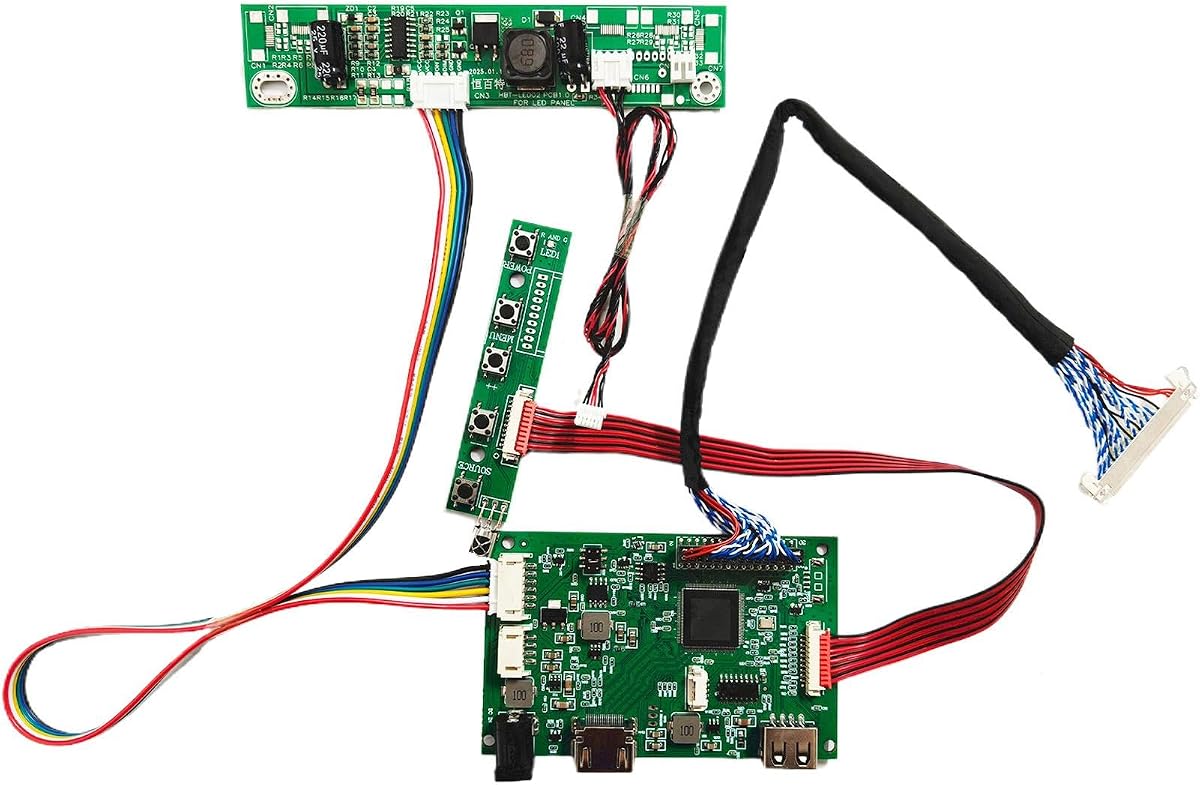
This VSDISPLAY board is a strong all-around choice for compatible 21.5- and 23.8-inch, 1920×1080 LVDS monitor panels. It has a 5.0 customer rating and adds capabilities not found on most alternatives, including USB video playback, picture playback, text playback, and 180-degree image rotation. It is an especially interesting option for custom display enclosures with unusual mounting orientations.
Pros
Perfect 5.0 customer rating
Supports USB video playback
Adds 180-degree rotation
Includes inverter and keyboard
Broad 1080p panel support
Cons
Adapter not included
Excludes LM215WF3-SLA1
Not for eDP panels
We may earn a commission when you buy through this link, at no additional cost to you.
The H/D input supports H/D 1.4, while the USB input can handle video, pictures, and text. Audio is provided for 8-ohm 2-watt or 4-ohm 2-watt speakers. A 12-volt DC source greater than 2 amps is recommended. The included package contains the 30-pin controller board, inverter board, 30-pin signal cable, and keyboard with cable, although a power adapter is not supplied.
Compatible panels include T215HVN01.0, M215HW03 versions 1 and 2, M215HGE-L23, M215HTN01.1, LM238WF1-SLE3, and LM238WF5-SSA1. The listing expressly excludes LM215WF3-SLA1. As with other monitor boards, the full panel model and revision should be verified before installation, and the included inverter should be used only when it matches the panel's backlight requirements.
The combination of a perfect available rating, multiple inputs, rotation, and a practical accessory package makes this a compelling pick for a modern DIY monitor. It is best suited to 30-pin LVDS panels at 1080p rather than small 30-pin eDP laptop panels. For compatible hardware, it provides more flexibility than a conventional VGA-and-DVI controller.
Flexible USB Media Support
USB playback can turn the panel into a simple information display for compatible media, text, or picture sources. This expands the board's usefulness beyond a conventional computer monitor and can simplify kiosk-style installations.
Rotation for Custom Enclosures
The 180-degree image rotation is a meaningful advantage when the physical mounting arrangement places the panel upside down. It helps avoid awkward software-side adjustments and supports a cleaner finished enclosure.
This 15.6-inch controller is aimed at 1366×768, 40-pin LVDS panels and provides HDMI plus VGA video inputs. It names LP156WH4, LTN156AT17, B156XW02, and LP156WH2 as compatible families. Because no customer rating is available, the product offers less evidence of broad field experience than the highly rated boards in this guide.
Pros
HDMI for modern source devices
VGA for legacy equipment
Adjustable display parameters
Supports multiple source types
Targets common 15.6-inch panels
Cons
No customer rating available
Limited listed panel models
Sparse power specifications
We may earn a commission when you buy through this link, at no additional cost to you.
The stated signal-processing features are designed to support stable decoding and reduce artifacts such as lagging or distortion. Its controls reportedly allow adjustment of brightness, contrast, and color, while the system is described as responding quickly to remote-control commands. It also advertises compatibility with external devices such as set-top boxes and game consoles through signal switching.
Compared with the VSDISPLAY 40-pin alternative, this option uses a more modern input combination. HDMI is convenient for current laptops and media devices, while VGA preserves compatibility with older equipment. The product information is less complete about power consumption, voltage, included cables, and exact configuration procedure, so those details should be confirmed with the seller before work begins.
It is best suited to a builder with a named compatible 15.6-inch panel who wants HDMI and VGA without a more specialized eDP controller. The absence of a customer rating means the usual rating-based confidence is unavailable. Confirm the full panel number, 40-pin arrangement, native timing, backlight type, and power requirements before treating this as a ready-to-build solution.
HDMI Without Sacrificing VGA
Providing both HDMI and VGA makes the board practical across newer and older source devices. This mixed-input approach is useful for a portable display that may alternate between a modern computer and legacy equipment.
Uncertainty in the Listing
The product has no available customer rating and offers fewer installation specifics than most alternatives. Prospective buyers should request the missing electrical and accessory information rather than relying only on the stated panel compatibility.
This model-specific 17.3-inch controller is designed for B173HW01 V0 and V5 panels as well as B173HW02 V0 and V1 panels, with the title emphasizing the B173HW02 V.1 version. It supports 1920×1080 images, a 40-pin LVDS interface, and VGA or HDMI source connections. Its 5.0 rating gives it one of the strongest available feedback signals in the guide.
Pros
Perfect 5.0 customer rating
Targets specific panel families
Supports modern HDMI sources
40-pin 17.3-inch interface
Handles brightness and color
Cons
Very narrow panel compatibility
Requires exact revision matching
Not suitable for eDP panels
We may earn a commission when you buy through this link, at no additional cost to you.
The controller converts a host video signal into the format recognized by the target panel and processes brightness and color commands. Its design is intended for strict matching among the screen model, native resolution, and panel technology. Mismatched parameters may produce an abnormal image, so exact family and revision identification is more important here than with a general-purpose configurable board.
The listing also contrasts this external board with a notebook's original internal controller. A dedicated notebook motherboard normally supplies both power and signal to a highly integrated driver board, whereas this product offers a separate enclosure-friendly route with standard video inputs. It supports power and power-consumption management, including low-power behavior when paired with suitable laptop power systems.
It is a premium choice not because it is universally compatible, but because it narrows the target to a defined 17.3-inch panel family and offers a convenient way to drive it with HDMI or VGA. If the exact panel number matches, it may be more suitable than a broad universal board. If it does not match, look to one of the wider compatibility options rather than forcing the installation.
Exact Matching Matters
The product's narrow model list is both its defining feature and its main constraint. Full panel numbers, revisions, timing, and interface must align; an apparently similar 17.3-inch panel is not automatically a suitable substitute.
A Cleaner External Integration
VGA and HDMI make the panel usable with external systems without reproducing every function of the original notebook motherboard. The result can suit a custom display, repair fixture, or portable monitor project using a precisely identified panel.
We may earn a commission when you buy through this link, at no additional cost to you.
Buying Guide – How to Choose the Best LCD Controller Board for Laptop Screen
The right controller is defined by the panel rather than by the project alone. Begin with the full model number, native resolution, connector, backlight system, and signal type, then narrow the list by power, input ports, and the form of the finished display.
Panel Model and Revision
A panel's diagonal size is only a starting point. Two panels of the same size can have different native resolutions, 30-pin or 40-pin arrangements, eDP or LVDS signaling, supported timing ranges, backlight voltages, and even incompatible pin assignments. Locate the complete model number printed on the rear of the panel, including suffixes such as V1, V2, SP, or a manufacturer-specific revision, and compare it with the controller's supported list. A close visual match is not sufficient evidence of compatibility.
Match the complete model and revision before considering any other feature.
Native Resolution and Timing
The controller must support the panel's native resolution and refresh rate. Boards in this guide commonly target either 1366×768 or 1920×1080, and choosing the wrong one can produce a blank, unstable, distorted, or incorrectly scaled image. For a universal board, verify that its programmable timing range includes the exact resolution, pixel clock, refresh rate, and sync requirements listed in the panel datasheet.
Never substitute a nearby resolution for the panel's native mode.
Connector and Signal Type
Count the connector pins and distinguish eDP from 40-pin LVDS. A 30-pin connector alone does not make two boards interchangeable because pin assignments and signaling standards may differ. A conventional laptop panel may use 30-pin eDP, while a 40-pin board often uses LVDS for monitor or laptop applications. Connector shape and pin count must agree, and the supplied ribbon cable should match the intended panel interface.
Confirm both pin count and signal standard before ordering.
Backlight and Inverter Requirements
The controller supplies signals and power to the panel, but the backlight system must also be powered correctly. LED panels generally need a suitable constant-current driver rather than a conventional CCFL inverter. Some packages include an inverter board, but that does not mean it is appropriate for every listed panel. Check the original backlight part number, rated voltage, and connector arrangement, and ensure every cable corresponds to the exact display.
Match the backlight driver and connector to the panel.
Video Input Ports
The board's input determines which source devices can be connected. VGA is inexpensive and widely available, while DVI, HDMI, and USB video can provide more modern connections. Universal boards may accept several formats simultaneously, but the source must also support the correct resolution and refresh rate. For a permanent installation, prioritize the ports actually used; for a portable display, a wider selection may justify a more configurable board.
Choose inputs based on the devices you expect to connect.
Power Supply Requirements
The stated voltage alone is not enough. Current capacity, connector dimensions, and stability all matter, especially when driving a backlight, inverter, audio amplifier, and controller together. Several products specify a 12-volt supply with minimum current ranging from 2 to more than 3 amps. A low-current source may cause flickering, no-signal messages, or restart loops. Use the specified barrel size and avoid undersized or poorly regulated adapters.
Follow both the voltage and minimum-current requirements.
Included Accessories and Controls
A complete package may include a preconnected signal cable, inverter, keyboard controls, speaker connector, and USB cable. These accessories can reduce assembly time, but each should be checked for compatibility with the selected panel. A keyboard with controls is particularly useful in a permanent enclosure because it allows power, menu, volume, and adjustment functions without access to the original laptop buttons.
Verify included parts rather than assuming every accessory fits.
Housing and Intended Use
A laptop-panel controller may be installed inside a salvaged laptop shell, while a monitor board is often built into a freestanding enclosure. Consider the board dimensions, connector orientation, heat dissipation, cable bend radius, access to controls, and whether image rotation is needed. The 180-degree rotation feature on one product can be valuable for upside-down panel installations. A secure enclosure also protects the exposed panel edges and ribbon connection.
Design the enclosure around the controller and panel together.
How to Use and Care for Your LCD Controller Board for Laptop Screen
Begin by recording the panel's full model number, native resolution, connector type, and backlight requirements. Inspect the ribbon socket, panel edges, and backlight connector before handling the board. Compare every recorded specification with the controller's instructions, then gather the specified 12-volt power adapter and the correct video cable. A small amount of organized documentation will make troubleshooting much faster than repeated visual guesswork.
With all devices disconnected, connect the controller's ribbon to the display while the power is off. Align pin one with the marked orientation, seat the cable evenly, and secure the latch without forcing it. Connect the appropriate backlight or inverter arrangement, speaker lead if required, and source cable. Check for short circuits or loose contacts, then apply power and select the correct input and native resolution. A black or white screen should prompt a power-down and inspection rather than repeated adjustments.
After installation, inspect the controller for heat, loose connectors, or visible damage and verify that the image is stable. Use the correct adapter current, avoid sharply bending the ribbon cable, and do not block ventilation openings. Keep moisture and conductive debris away from the board. If the display flickers, restarts, or loses synchronization, disconnect power and recheck the power capacity, signal source, resolution, ribbon orientation, and backlight connection before trying another component.
Frequently Asked Questions
Can any LCD controller board work with any laptop screen?
No. A controller must match the panel's native resolution, connector pin count, signal type, timing, and backlight requirements. Even two 15.6-inch panels can use incompatible interfaces. Locate the complete panel model and revision before purchasing, and contact the seller when that exact number is not listed.
What is the difference between a 30-pin eDP board and a 40-pin LVDS board?
A 30-pin eDP controller is designed for certain internal laptop panels using embedded DisplayPort signaling. A 40-pin LVDS controller is intended for compatible 40-pin LVDS panels, which are common in other laptop and monitor designs. The connector shape alone is not enough; the electrical standard, pin arrangement, voltage, and supported panel must all match.
Will a 1366×768 controller display a 1920×1080 panel?
Not correctly in most cases. The products clearly marked for 1366×768 are limited to that resolution and may not initialize with a Full HD panel. Likewise, a 1920×1080 board is not a suitable substitute for a 1366×768 panel. Choose a controller designed for the panel's exact native resolution.
What power adapter should I use with these controller boards?
Use the voltage and minimum current stated in the product instructions. The guide includes boards requiring 12 volts and at least 2 amps, as well as options requiring more than 3 amps. The connector is commonly 5.5 by 2.1 millimeters, but the physical plug should still be checked. An undersized adapter can cause flickering, no-signal behavior, or repeated restarts.
Why does the screen stay black, white, or show no signal?
A black or no-signal result can indicate a missing source, wrong resolution, loose signal connection, or insufficient power. A white screen may result from a reversed ribbon cable or incorrect signal configuration. Power down, verify pin one and every connector, select the native resolution, use a known-good source, and then confirm that the power supply meets the required current.
Do I still need an inverter for an LED laptop panel?
Many modern panels use LED backlights, but their exact driver requirements still need to be checked. Some controller packages include an inverter for compatible CCFL panels, while LED panels may need a constant-current driver. Never connect an included inverter automatically; verify the backlight type, voltage, and connector before applying power.
Can these boards turn a laptop panel into a desktop monitor?
Yes, when the controller supports the panel's exact model, resolution, connector, and backlight system. The finished display also needs a suitable enclosure, power supply, signal cable, and possibly a keyboard controller for power and menu functions. The process is most approachable when the panel belongs to one of the explicitly supported model families.
Is a universal LVDS board easier to use than a model-specific board?
A universal board offers broader input and panel options, but it requires more configuration knowledge. It may suit an experienced builder working from a complete panel datasheet, while a model-specific eDP board is often more convenient for a straightforward repair. Choose based on technical confidence as well as the available panel and project requirements.
Final Thoughts on Choosing the Best LCD Controller Board for Laptop Screen
The strongest general-purpose choice in this guide is the VSDISPLAY H/D USB controller for compatible 21.5- and 23.8-inch 1080p panels. It combines a 5.0 rating with USB media support, image rotation, and a useful accessory package. For 17- and 19-inch 1280×1024 panels, the H/D VGA DVI board offers a strong 4.6 rating and broad model support.
The B173HW01 and B173HW02 board is the most focused premium selection, providing a refined solution when the exact 17.3-inch panel family matches. For small laptop repairs, the H/D eDP boards offer simpler installation, but one targets 1366×768 and the other targets 1920×1080. Prioritize exact panel-model matching, native resolution, connector type, backlight requirements, and power capacity before considering input convenience or extra features.
Finally, verify the seller's current compatibility list, package contents, electrical requirements, and accessory details before ordering. Component revisions and listing information can change, and a seller can confirm whether a panel number is supported. Those checks are the best protection against an otherwise capable controller becoming an expensive mismatch.