
CORSAIR 4000D RS ARGB
4.7Editor score
Modular FRAME case system
Three pre-installed ARGB fans
Flexible InfiniRail mounting
Explore the best PC case for B650 motherboard, comparing airflow, expansion, cable management, cooling, and build features.
A B650 motherboard is a versatile foundation for an AM5 gaming or productivity build, but its case must accommodate the board, graphics card, power supply, cooling hardware, and a layout that remains practical after installation. A good enclosure balances usable interior space, unobstructed airflow, tidy cable routing, and a front panel that suits the rest of the system.
This guide compares ten ATX and Micro-ATX cases for their stated motherboard support, expansion options, included fans, radiator capacity, GPU clearance, dust filtration, and cable-management features. It also distinguishes standard and reverse-connector layouts, making the list useful whether the planned B650 board has conventional headers or connections located on its rear side.
Each pick highlights the case most likely to suit a particular build style, from compact mainstream systems to panoramic dual-chamber designs and highly expandable enclosures. Ratings reflect the supplied customer feedback, while practical trade-offs remain important because case compatibility depends on the exact motherboard, cooler, graphics card, and power supply selected.
4.7Editor score

4.7Editor score

4.5Editor score
The comparison covers motherboard format, included cooling, radiator capability, graphics card clearance, and distinctive layout features, helping readers identify the enclosure that best matches their B650 build.



The NZXT H5 Flow is a compact ATX mid-tower with a 4.7 rating, and its strongest quality is the balance between a restrained exterior and a cooling layout that is immediately useful with a B650 system. It arrives with two 120mm Quiet Airflow fans, one positioned at the front and one at the rear, giving builders a sensible starting point without requiring every fan position to be filled immediately.
We may earn a commission when you buy through this link, at no additional cost to you.
Its perforated power-supply shroud is a particularly important detail for a modern gaming PC. The side and bottom openings allow two additional 120mm fans to draw air toward the power supply and lower interior, which can improve circulation beneath a high-performance graphics card. Meanwhile, the top, front, and side panels use ultra-fine mesh to admit air while helping filter dust. The result is an airflow-oriented design rather than a case that relies only on decorative openings.
Cooling flexibility is broad for a compact chassis. A 360mm radiator can be mounted at the front, while a 240mm radiator fits at the top. That gives a B650 builder room for a large air cooler or a substantial liquid-cooling loop, although the H5 Flow does not offer the same multi-position radiator freedom as larger dual-chamber designs. The main compromise is that it omits ARGB lighting and does not include a 360mm reverse-blade fan arrangement for a fully panoramic illuminated look.
This is the strongest general recommendation for readers who value airflow, tidy construction, and a relatively compact ATX layout without giving up meaningful radiator support. It is especially appropriate when the selected B650 motherboard uses conventional front-facing connectors and the system will benefit from clean, modern styling rather than extensive lighting customization. For those priorities, the H5 Flow delivers a balanced foundation for a high-performance build.
The perforated power-supply shroud creates a useful secondary intake path, while the pre-installed front and rear fans establish a basic front-to-back cooling route. Adding fans at the shroud can help move air around the graphics card and power supply area, which is particularly valuable in a compact ATX enclosure.
Wide routing channels, hooks, and straps are provided behind the motherboard tray, reducing the visual clutter that can otherwise dominate a glass-sided build. Those same spaces help preserve airflow around the motherboard and its heatsinks.
We may earn a commission when you buy through this link, at no additional cost to you.
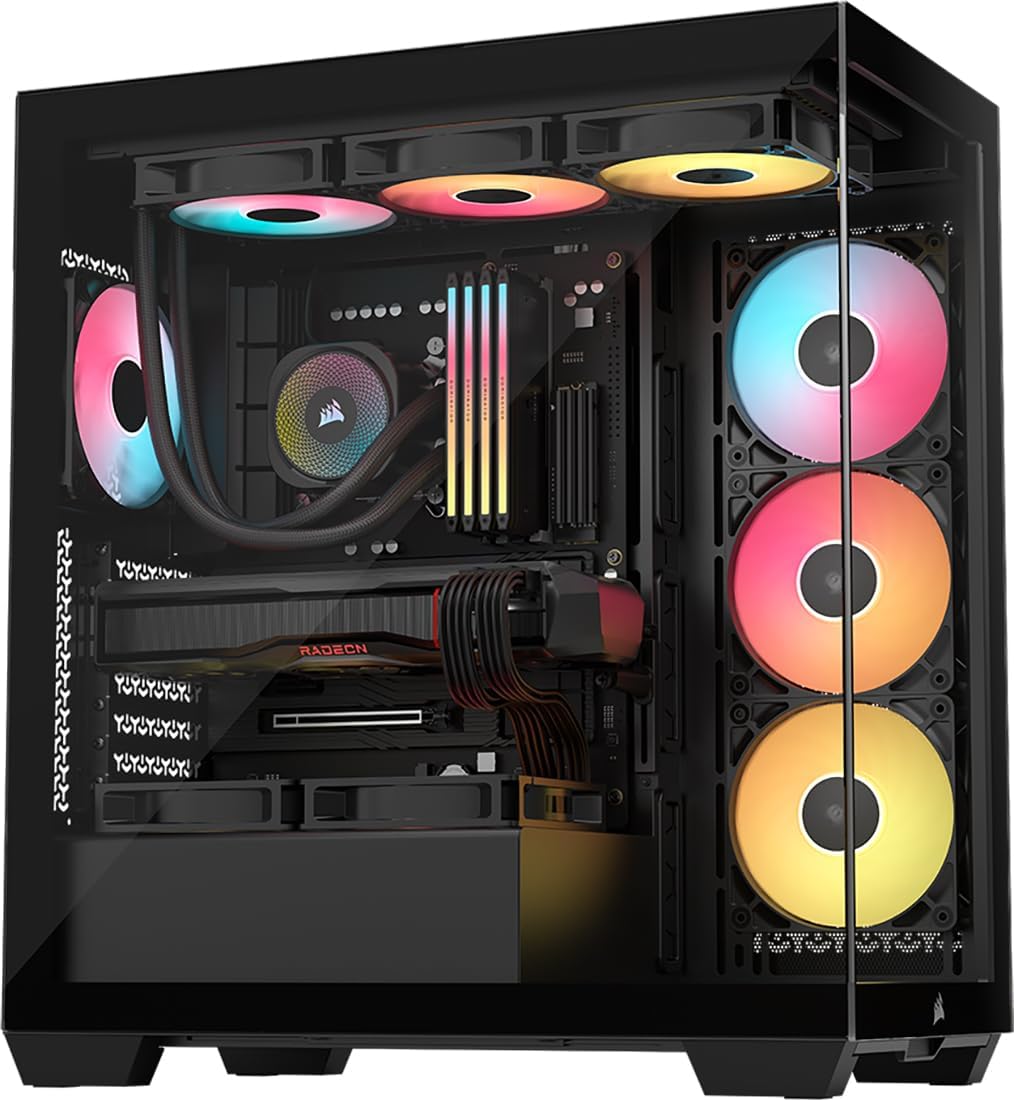
The CORSAIR 4000D RS ARGB combines a 4.7 rating with a genuinely different approach to enclosure design. Its FRAME modular system is intended to evolve with the build rather than remain a fixed shell. The stated customization options include a billet-aluminum motherboard tray, alternative front I/O panels, and other interchangeable elements, giving the case a premium character that goes beyond decorative lighting.
We may earn a commission when you buy through this link, at no additional cost to you.
Three CORSAIR RS ARGB PWM fans are pre-installed at the front and use daisy-chainable four-pin PWM connections with Zero RPM support at low loads. Each fan has eight addressable LEDs and can be controlled through a motherboard's five-volt ARGB connector. The InfiniRail steel mounting system adds further flexibility by allowing fans to be positioned along the rails, including mounts for larger fans at the front and 140mm options in the roof.
The three-dimensional Y-pattern steel front panel is engineered for high airflow with limited obstruction, which fits a B650 build equipped with a powerful CPU and a long graphics card. A removable internal side panel can serve as a cable cover for a cleaner appearance or be detached to create another fan position. The trade-off is that a modular premium system introduces more design elements and optional configurations, and the ARGB lighting requires compatible control software and a five-volt ARGB header.
Choose the 4000D RS ARGB when future customization, polished presentation, and flexible airflow placement matter more than minimum enclosure size. It is a strong match for a B650 build that will receive a capable graphics card and multiple fans, especially if the owner wants a case capable of adapting as components or layout priorities change over time.
The FRAME system separates core case design from specific components such as the motherboard tray and front I/O. That structure gives owners an option to alter appearance or functionality instead of replacing the entire enclosure when their requirements change.
The InfiniRail system allows fans to slide into more useful positions, helping builders target intake and exhaust openings. A removable internal side panel adds another decision point: conceal the cables for a clean view or remove it when additional cooling is warranted.
We may earn a commission when you buy through this link, at no additional cost to you.
The Cooler Master Q300L V1 is the value-oriented choice for a B650 build based on a Micro-ATX or Mini-ITX motherboard. Its 4.5 rating reflects a well-regarded package, and the case offers a more thoughtful component allowance than many compact alternatives, including support for CPU coolers as tall as 159mm, graphics cards as long as 360mm, and power supplies as long as 160mm.
We may earn a commission when you buy through this link, at no additional cost to you.
Its open thermal design uses perforated surfaces on multiple sides to encourage airflow, while the transparent side panel allows the selected B650 motherboard, memory, graphics card, and cooler to remain visible. The removable I/O panel can be placed at the front, top, or bottom on either side, making it easier to place ports where they are most convenient for the builder's desk and cable arrangement.
The case supports a 240mm liquid cooler and up to five fans, giving a compact system room for a dedicated cooling loop. That flexibility is useful with B650 processors because it allows the builder to choose between a tall tower air cooler and a more restrained liquid-cooler solution. The limitation is motherboard format: full ATX is not supported, and the enclosure does not include RGB or ARGB lighting, so it favors function over visual effects.
This case is recommended for a Micro-ATX B650 system that needs good component clearances in a relatively compact package. It is particularly sensible for builders who want a straightforward design, useful cooler options, and a visible interior without paying for an elaborate lighting ecosystem. Confirm the board format before ordering and measure any unusually long power supply or graphics card.
The stated 159mm CPU cooler and 360mm GPU allowances provide room for substantial components despite the smaller motherboard format. This makes the Q300L V1 more flexible for performance-oriented parts than its compact footprint might initially suggest.
The modular I/O panel can move between several positions and either orientation. This is a small feature with a meaningful effect on daily use because it lets the builder align the USB and audio ports with the available space and preferred cable path.
We may earn a commission when you buy through this link, at no additional cost to you.
The FOIFKIN F600 is built around a high-fan-count configuration, arriving with seven 120mm ARGB PWM fans: six reverse-blade models and one conventional forward fan. That 4.6-rated package is aimed at builders who want an immediately populated cooling configuration and a panoramic display rather than a bare chassis requiring immediate fan purchases.
We may earn a commission when you buy through this link, at no additional cost to you.
Its dual-chamber design separates the motherboard and graphics-card area from the power supply and drive area. Beyond tidier cable management, that separation can make it easier to create distinct intake and exhaust paths. The stated cooling capability extends to three simultaneous 360mm radiators, an unusually high figure that provides exceptional configuration options for liquid cooling and large fan arrays.
The case also offers substantial room for current and future components. It supports ATX, Micro-ATX, and Mini-ITX motherboards; graphics cards up to 400mm; power supplies up to 200mm; one hard drive; and two solid-state drives. Fully transparent, high-hardness tempered glass provides a 270-degree presentation, while the front Type-C connection adds convenience for compatible devices. The trade-off is that the dense lighting and fan arrangement may feel visually busy or leave little room to add additional airflow hardware.
The F600 is best for an enthusiast who wants extensive cooling hardware, dramatic lighting, and strong expansion allowances without assembling the fan configuration from scratch. It pairs particularly well with a B650 board that supports five-volt ARGB control and a system that can use separate front, side, and rear intake or exhaust zones. Buyers who prefer a restrained appearance should consider a simpler lighting setup.
Seven included PWM fans can establish a dense airflow network immediately, reducing the need to install a basic kit after the case is delivered. Users who do not want constant lighting can disable the visual effect while retaining the physical cooling configuration.
Separating the power supply and drive area from the main hardware chamber reduces tangled cable paths across the visible side. It also creates a clearer foundation for planning dedicated intake and exhaust zones.
We may earn a commission when you buy through this link, at no additional cost to you.
The CORSAIR 3500X RS ARGB is a panoramic mid-tower with a 4.6 rating and a strong emphasis on presentation. Its wraparound glass aesthetic, supported motherboard formats ranging from Mini-ITX to EATX, and total capacity for ten 120mm fans make it a versatile option for a B650 system where the motherboard, graphics card, and lighting are intended to form a coordinated display.
We may earn a commission when you buy through this link, at no additional cost to you.
Three RS120-R ARGB fans are pre-installed and can be controlled through a motherboard five-volt ARGB header. The case also provides mounting points at the side, roof, and power-supply area, allowing additional fans to be installed as the cooling plan develops. Removable front and side glass panels simplify initial assembly and later access, which is useful in a highly visible enclosure where the build process may involve repeated adjustments.
A particularly relevant feature for newer B650 board layouts is compatibility with rear-connection motherboards. The case has been validated with ASUS BTF, MSI Project Zero, and Gigabyte Project Stealth boards, keeping cables behind the motherboard when that board is designed for concealed connections. This avoids the visual interruption caused by plugs projecting into a windowed view. The main trade-off is that only three fans are included despite support for as many as ten, so additional fans may be necessary for a heavily populated airflow layout.
Choose the 3500X RS ARGB for a polished gaming build with a strong glass-component focus, particularly if the selected B650 motherboard uses hidden or rear-facing connectors. It balances cooling capacity, motherboard flexibility, and visual appeal well, although buyers should budget for additional fans if they intend to fill every mounting position.
The wraparound glass and lighting-oriented fan set make internal component placement especially important. A B650 board with visible VRM heatsinks, coordinated memory, and a clean cable path can become the visual center of the completed system.
Validated support for ASUS BTF, MSI Project Zero, and Gigabyte Project Stealth layouts helps maintain a clean display when the board routes connectors toward the rear. This is especially valuable in a case where the motherboard tray would otherwise be highly visible.
We may earn a commission when you buy through this link, at no additional cost to you.
The DARKROCK EC2 is a straightforward ATX mid-tower that emphasizes airflow, serviceability, and modern front-panel connectivity. Its 4.4 rating makes it a practical option for a B650 build, particularly when the priority is a mesh front, tempered glass display, and a case that can accept several fans without using a complicated modular layout.
We may earn a commission when you buy through this link, at no additional cost to you.
The front panel uses mesh to promote air movement into the enclosure, while separate magnetic dust filters at the top and bottom are intended to reduce the entry of dust. The chassis can support up to eight 120mm fans, providing ample mounting flexibility. It is also Type-C ready and supports ATX, Micro-ATX, and Mini-ITX motherboards, so a B650 board in any of those formats can be accommodated if the remaining dimensions fit.
Graphics card and power supply allowances are more restrained than those of many large dual-chamber cases. The stated GPU limit is 340mm, with power supplies up to 200mm, and the front radiator provision is listed for one 360mm unit. No included fans are specified in the supplied product information, so buyers should determine whether they want a complete fan set or prefer to choose every fan themselves. Its understated feature set is the main limitation for builders seeking extensive lighting or advanced modularity.
The EC2 works well for a conventional B650 gaming PC where airflow and clean access matter more than decorative complexity. Its dust filters are convenient for routine maintenance, the mesh front supports straightforward cooling, and the tempered glass side provides a suitable view. Confirm the exact power supply and graphics card dimensions before purchase, and plan the fan configuration according to the components selected.
The mesh front provides a clear intake route, and separately mounted magnetic filters at the top and bottom can be removed for cleaning. This combination makes it easier to preserve airflow over time rather than allowing dust to accumulate against a fixed screen.
Type-C readiness gives the build a modern connection option, while the mesh panel and tempered glass side keep the enclosure visually restrained. The result is suitable for users who want useful features without a fan-dense or highly illuminated design.
We may earn a commission when you buy through this link, at no additional cost to you.
The ASUS A31 pairs a 4.7 rating with a design centered on visibility and a clean motherboard area. Its dual-sided tempered glass panels use a frameless, pillar-free layout, removing structural obstructions from the side view and allowing the B650 motherboard, graphics card, memory, and cooling hardware to form a continuous visual composition.
We may earn a commission when you buy through this link, at no additional cost to you.
The BTF hidden connector design is particularly relevant for systems built around a motherboard with connections on its rear. Instead of allowing modular cables to project into the main chamber, the design conceals them behind the motherboard. That creates a cleaner build and supports the panoramic intent of the chassis. The case also supports 360mm AIO coolers with the listed 80mm clearance, accommodating a large liquid-cooling radiator for a B650 processor.
An eight-degree angled base is the most distinctive design feature. It is described as improving airflow and expanding the viewing angle while also emphasizing ARGB effects. That styling creates memorable presentation value, but it also means the case is not a flat-bottom traditional tower. The supplied information does not list included fans, so cooling hardware must be accounted for separately, and buyers sensitive to minor movement should consider the angled base carefully.
The A31 is an excellent recommendation for an ASUS-centered AM5 build, particularly one using a board with hidden connectors and an emphasis on an uninterrupted glass presentation. It combines strong airflow-oriented styling, large AIO support, and discreet cable routing. It is less suitable for someone who wants a conventional rectangular base or a confirmed bundle of pre-installed fans.
The hidden connector arrangement is designed to keep modular cables behind the motherboard, where they remain out of the main viewing area. It can be especially effective with a B650 board designed around BTF or equivalent rear-facing connections.
The eight-degree base is not merely a visual detail; the product information links it with airflow and a wider view of the hardware. It also gives the enclosure a distinct identity that can complement an illuminated or carefully color-matched B650 build.
We may earn a commission when you buy through this link, at no additional cost to you.
The H2 HYXN is a large dual-chamber ATX mid-tower aimed at builders who want generous component clearances and extensive cooling options. Its 4.4 rating reflects a capable package, and the included eight non-ARGB fans provide a substantial airflow foundation: six 140mm reverse fans and two 120mm forward fans are supplied.
We may earn a commission when you buy through this link, at no additional cost to you.
The case supports exceptionally large radiators, including two 420mm units or three 360mm units at the same time, including dual-layer fan configurations. This makes it suitable for a high-end B650 processor paired with an ambitious liquid-cooling configuration. Component allowances are similarly expansive, with graphics cards up to 455mm and power supplies up to 220mm supported. Motherboard formats range from E-ATX and ATX to Micro-ATX and Mini-ITX.
The dual-chamber layout separates the power supply and drives from the primary hardware area, while an extra-large rear compartment includes built-in Velcro straps and mounting points for cable organization. The front I/O panel provides a Type-C 3.2 port, USB 3.0, USB 2.0, microphone and audio connections, and a power button. The trade-offs are the absence of ARGB in the included fans and the substantial physical size of the enclosure, which can affect desk space and ease of installation.
The H2 is a strong recommendation for a spacious, performance-focused build where long GPUs, large power supplies, extensive radiators, and numerous fans are priorities. It is less suitable for a small-form-factor desk arrangement. Users should measure the available area and plan the radiator layout before committing, particularly if multiple large cooling units are intended.
Supporting two 420mm or three 360mm radiators gives the case exceptional freedom for liquid-cooling arrangements. The included mix of 140mm and 120mm fans also allows a builder to create a high-airflow layout without immediately buying a complete matching set.
The extra-large rear compartment and integrated straps keep wiring away from the main chamber. This is especially useful in a case of this size, where enough room for multiple fans and radiators can otherwise make cable management more complicated.
We may earn a commission when you buy through this link, at no additional cost to you.
The MOROVOL 621-N4 is an ATX mid-tower built around useful fundamentals: a mesh front, a removable tempered glass side panel, and four pre-installed 120mm RGB fans. Its 4.2 rating is the lowest in this group, but the product provides a clear package for a B650 system that prioritizes airflow and visible hardware over addressable lighting effects.
We may earn a commission when you buy through this link, at no additional cost to you.
The included fans have fixed RGB illumination rather than addressable control, an important distinction for buyers comparing it with the ARGB-equipped alternatives in this guide. The diamond-shaped mesh front creates a visually distinctive intake surface and supports the case's airflow orientation. A removable side panel makes component installation and later access more convenient while preserving a broad window into the system.
Motherboard support includes ATX, Micro-ATX, and Mini-ITX formats, making the case suitable for standard B650 boards. Component limitations are the main consideration: GPU clearance is listed at 300mm, PSU clearance at 160mm, and CPU cooler height at 155mm. Storage support includes two 2.5-inch solid-state drives and two 3.5-inch hard drives. The front I/O includes one USB 3.0 port, two USB 2.0 ports, HD audio and microphone connections, plus reset and power buttons.
The 621-N4 is a sensible recommendation for a budget-conscious B650 build that still wants four fans and a glass side included. It is especially appropriate when the graphics card falls comfortably within the 300mm allowance and fixed-color illumination meets the desired look. For very long graphics cards, taller power supplies, or fully addressable lighting, one of the more spacious or feature-rich models may be a better match.
The diamond mesh front reduces the need for a heavily restrictive decorative panel. Combined with four included fans, it provides a straightforward intake-and-exhaust foundation for a B650 gaming configuration.
The RGB lighting is fixed and not addressable, so software-based effects and per-zone control are not part of its feature set. This simplifies the visual design, but it also limits customization for enthusiasts who want synchronized lighting across several components.
We may earn a commission when you buy through this link, at no additional cost to you.
The HYTE Y50 RGB is a distinctive snow-white dual-chamber case with a 4.7 rating and a clear focus on panoramic presentation. Its three-piece glass design is intended to showcase the B650 motherboard, graphics card, memory, and lighting from multiple angles, while the white finish offers an alternative to the many all-black mid-towers in this comparison.
We may earn a commission when you buy through this link, at no additional cost to you.
The included fan package consists of one 120mm FE12RS addressable RGB fan and one 360mm FE12RTR addressable RGB reverse-blade unibody fan. Both use standard ARGB and PWM connections. The large reverse fan can produce a dramatic illuminated look while moving substantial air, although the total of two included fans means the chassis is not supplied with every mounting position populated.
Like several modern showcase cases, the Y50 uses a dual-chamber arrangement and supports ASUS BTF, Gigabyte Stealth, and MSI Project Zero rear-connection motherboards. That allows cables to sit behind the motherboard rather than crossing the main viewing area. Full-size horizontal graphics-card slots also preserve additional expansion and drive-space options. The main limitation is that the case arrives with a high-impact but relatively small fan bundle for a design capable of appearing fully populated.
The Y50 RGB is recommended for a coordinated white build where the reverse 360mm fan and panoramic glass are central to the intended appearance. It is a natural fit with a rear-connection B650 board and a restrained or light-colored component theme. Buyers wanting a fully illuminated enclosure should plan the remaining fan configuration in advance and verify the power-supply and cooling layout.
The snow-white finish makes the Y50 easy to distinguish from conventional black gaming cases. Combined with panoramic glass, it can suit a coordinated B650 build using white cooling hardware, light memory modules, or visible internal cable accents.
The included 360mm reverse-blade fan creates a strong visual focal point from the front while supporting airflow. Rear-connector motherboard compatibility helps preserve that view by keeping attached cables behind the board rather than across the main chamber.
We may earn a commission when you buy through this link, at no additional cost to you.
Choosing a B650-compatible case involves matching board format and component dimensions while balancing airflow, cooling, presentation, cable management, and the practical constraints of the intended desk or room.
Begin with the exact B650 board rather than the chipset family alone. A full-size ATX board needs an ATX-compatible enclosure, while a Micro-ATX board can fit both Micro-ATX and ATX cases. Mini-ITX boards are highly compact but can be mounted in larger cases when their I/O and mounting standards align. Among the cases reviewed, the Cooler Master Q300L V1 is limited to Micro-ATX and Mini-ITX, whereas the ASUS A31, CORSAIR 4000D RS ARGB, FOIFKIN F600, and several other models accept ATX boards. The ASUS A31 and HYTE Y50 also support rear-connection motherboard layouts, which can produce a cleaner cable layout if the selected B650 board uses that design.
A motherboard is rarely the component that determines whether a build fits. Graphics-card length, power-supply length, CPU-cooler height, and radiator dimensions are more likely to create a conflict. The cases in this guide state GPU allowances ranging from 300mm to 455mm and CPU cooler heights up to 159mm in the Q300L V1. Large cases may accommodate more, but every allowance should be treated as a hard limit rather than an estimate. Check the dimensions of the exact power supply because modular cables and connectors can also affect the usable space behind the tray.
Airflow depends on an open intake, a clear path through the case, and exhaust openings positioned to move heat away from components. Mesh panels generally support this objective better than restrictive decorative fronts, as seen in the DARKROCK EC2, MOROVOL 621-N4, NZXT H5 Flow, and CORSAIR 4000D RS ARGB. A pre-installed fan arrangement provides a useful starting point, but the location and orientation of every fan matter more than the count alone. Plan the front, rear, side, and lower intake or exhaust roles before adding components that could block one another.
The included fans can simplify a build and determine how much cooling hardware must be added later. The FOIFKIN F600 and H2 HYXN arrive with seven and eight fans respectively, while the CORSAIR 3500X RS ARGB supports up to ten 120mm positions but includes only three. The ASUS A31 and DARKROCK EC2 do not list included fans in the supplied information. Compare both fan quantity and type, especially whether reverse-blade models are included for a front or side showcase panel. Addressable ARGB also requires a compatible five-volt header and suitable control software.
B650 processors can be paired with large tower coolers or liquid-cooling radiators, so case support should be chosen with the cooling hardware in mind. The NZXT H5 Flow supports a 360mm front radiator and a 240mm top radiator. The FOIFKIN F600 supports three 360mm radiators, while the H2 HYXN supports dual 420mm or triple 360mm installations. The ASUS A31 supports 360mm AIO coolers with the stated clearance. The Q300L V1 supports a 240mm liquid cooler and up to 159mm CPU coolers. For air cooling, compare the maximum height directly with the selected cooler's dimensions, including its heat pipe and fan assembly.
Cable management determines whether a glass-sided build feels orderly. Dual-chamber cases such as the FOIFKIN F600, H2 HYXN, and HYTE Y50 separate the power supply and storage area from the main hardware chamber. The CORSAIR 4000D RS ARGB provides a convertible internal side cover and dedicated routing features, while the NZXT H5 Flow uses wide channels, hooks, and straps. Reverse-connection boards can further improve the result in the ASUS A31, CORSAIR 3500X RS ARGB, and HYTE Y50 because attached cables remain behind the motherboard.
Lighting can transform a showcase build, but it adds another compatibility and management consideration. ARGB fans in the CORSAIR 4000D RS ARGB, CORSAIR 3500X RS ARGB, FOIFKIN F600, and HYTE Y50 require a five-volt ARGB header for motherboard control. The MOROVOL 621-N4 uses fixed RGB rather than addressable lighting, while the NZXT H5 Flow, Cooler Master Q300L V1, ASUS A31, and DARKROCK EC2 do not list lighting in their supplied feature sets. Consider whether synchronized effects, simple fixed color, or no lighting best suits the rest of the build.
A case is easier to build and maintain when panels, filters, and I/O can be accessed without dismantling the entire system. The Q300L V1 and CORSAIR 3500X RS ARGB have removable glass panels, while the MOROVOL 621-N4 also uses a removable tempered glass side. Separate magnetic dust filters on the DARKROCK EC2 simplify cleaning, and the Q300L V1's adjustable I/O panel can be positioned according to the desk layout. Check the location of front USB, audio, and power controls as well as removable drive access before ordering.
Before installing the B650 motherboard, lay out the case, verify that the standoffs align with the board's mounting holes, and remove any protective covers from panels and filters. Confirm the planned graphics card, power supply, CPU cooler, and radiator all fit, then install the power supply with its fan facing the correct direction for the case design. Connect the front-panel wires only after the motherboard and major components are secured, following the board manual for each header.
Install the B650 motherboard with the correct I/O alignment, secure it evenly, and install the CPU and memory before fitting a large graphics card if space is tight. Route power and data cables through the designated channels as the build progresses rather than attempting to tidy everything after every component is installed. Connect case fans to the appropriate PWM and lighting headers, confirm that the system starts with adequate airflow, and then use monitoring software to check operating temperatures and fan behavior.
For maintenance, power the system down and disconnect it before opening the case. Clean removable dust filters on a regular schedule, especially if the computer sits near a carpeted floor or another dusty area. Use gentle methods to remove dust from mesh panels and fan surfaces, avoid pushing debris into the case, and inspect cable connections and filter placement whenever the system is opened. Keeping the interior uncluttered also makes it easier to notice unusual heat, noise, or cable interference.
No. B650 is a chipset family available in several motherboard sizes, including ATX, Micro-ATX, and Mini-ITX forms. A full ATX board needs a case with matching mounting support, while a smaller board can often be installed in a larger case. Always check the board's exact dimensions, mounting-hole pattern, and I/O layout before selecting an enclosure.
Yes, provided the particular B650 board is in Micro-ATX format and the case supports that format. Micro-ATX cases can still accommodate powerful graphics cards, substantial air coolers, and liquid-cooling radiators, although component clearances may be tighter than in a full ATX case. The Cooler Master Q300L V1 is a Micro-ATX-focused example with stated support for 360mm graphics cards and 240mm liquid coolers.
No, but pre-installed fans make a new build faster and ensure a basic airflow configuration is present from the start. Cases such as the NZXT H5 Flow, CORSAIR 4000D RS ARGB, FOIFKIN F600, and H2 HYXN include multiple fans, while the ASUS A31 and DARKROCK EC2 do not list included fans in the supplied information. Compare fan positions and radiator support before deciding what additional hardware to buy.
A rear-connector motherboard places sockets on the back of the board, allowing power and other cables to plug in from behind the motherboard tray. The ASUS A31, CORSAIR 3500X RS ARGB, and HYTE Y50 support this style, with the latter two also naming ASUS BTF, Gigabyte Stealth, and MSI Project Zero compatibility. Such a layout can make a panoramic B650 build look cleaner because fewer cables project into the viewing area.
The appropriate number depends on the graphics card, CPU cooler, radiator size, room size, and desired noise level. More fans can improve airflow, but they also require sufficient mounting positions and a capable power-supply and motherboard header arrangement. A case that supports up to ten 120mm fans offers more flexibility than one with only a few positions, although good placement and unobstructed paths matter more than a high count by itself.
Not necessarily. Glass is primarily a viewing material, and modern cases can use mesh on intake and exhaust openings while retaining tempered glass on the side. The NZXT H5 Flow, CORSAIR 4000D RS ARGB, ASUS A31, and several other models combine visible panels with dedicated airflow paths. As with any case, filter cleanliness, fan configuration, and unobstructed internal placement remain essential.
A Type-C front port is convenient for compatible phones, cameras, storage devices, and other accessories. Cases including this feature include the DARKROCK EC2, FOIFKIN F600, and H2 HYXN. It does not replace the standard USB-A ports, and the case connection must also match the device and its cable. Consider the full front I/O layout rather than treating one port as the deciding factor.
Compare each component's longest dimension with the case's published clearance, allowing extra room for cables and connectors. GPU allowances in this guide range from 300mm to 455mm, while PSU limits vary by model. Check the exact product rather than relying on a series name, and consider the graphics card's power connector orientation because a side or top power cable can require additional depth beyond the card itself.
The NZXT H5 Flow is the most balanced overall recommendation because it combines a compact ATX format, two useful pre-installed fans, mesh airflow, tidy routing, and meaningful radiator support. The CORSAIR 4000D RS ARGB stands out for its modular FRAME system, flexible InfiniRail positioning, and illuminated front fans, while the Cooler Master Q300L V1 provides the most economical route into a compact B650 build with useful CPU cooler and graphics-card clearances.
For other priorities, the FOIFKIN F600 suits builders wanting seven included ARGB fans and extensive radiator capacity. The CORSAIR 3500X RS ARGB and ASUS A31 are strong panoramic choices, with the latter particularly suited to hidden-connector layouts. The DARKROCK EC2 favors practical mesh airflow, the H2 HYXN prioritizes very large clearances and cooling arrays, the MOROVOL 621-N4 provides a simpler four-fan package, and the HYTE Y50 RGB offers a distinctive white dual-chamber design.
Before ordering, verify the exact B650 board format, graphics card length, power supply length, CPU cooler height, radiator placement, and front-panel connections. Included fan counts and lighting are useful comparisons, but physical fit and a coherent airflow path should come first. Prices and availability change, so check current listings and confirm the case specifications against the exact components before making a final purchase.

