
Bambu Lab P1S
4.5Editor score
Fully enclosed design
Up to sixteen colors
Automatic bed leveling
Discover the best easy to use 3D printer options for beginners, kids, and home makers, with key features, capabilities, and setup needs compared.
An easy to use 3D printer should turn digital creativity into dependable physical objects without demanding advanced calibration, complicated assembly, or constant supervision. The best models for beginners emphasize automatic bed leveling, guided setup, clear interfaces, useful app support, and manageable maintenance so new users can focus on creating rather than troubleshooting.
We compared all ten featured printers across the factors that most strongly affect day-to-day usability, including setup requirements, calibration, motion and print speed, build volume, filament handling, monitoring features, safety-oriented design, and access to beginner-friendly model libraries. The guide covers compact introductory machines, enclosed printers, high-speed models, and multicolor systems for different needs.
Each pick reveals what it does best and where its compromises may matter, helping you match the machine to your skill level, available space, and preferred type of project. Product listings and technical details can change over time, so shoppers should confirm current specifications, bundle contents, filament requirements, and pricing before making a final purchase.
4.5Editor score

4.7Editor score

4.4Editor score
This side-by-side comparison highlights each printer's usability, speed, size, automation, and intended use so you can identify the most appropriate beginner machine for your home, classroom, or creative workspace.




The Bambu Lab A1 combines an explicitly beginner-oriented design with the speed and automation that make it one of the most complete general-purpose choices in this roundup. Its 4.7 rating reflects a strong balance of features, and the ready-to-use positioning is well supported by full-auto calibration, active flow-rate compensation, and a user-friendly touchscreen. The result is a printer designed to reduce the number of early obstacles that often discourage new users.
We may earn a commission when you buy through this link, at no additional cost to you.
Its major strengths begin with the setup process. The A1 handles bed leveling, Z-offset calibration, and other calibration procedures automatically, removing many of the repeated adjustments associated with entry-level FDM machines. Active flow-rate compensation uses readings to adjust extrusion, which supports consistent results as conditions change. A listed acceleration of 10,000 mm/s² also allows it to complete projects quickly, while active motor noise canceling helps preserve a quieter home or office environment.
There are trade-offs to consider. Multicolor printing requires the AMS lite, which is not inherently included with every configuration, and the open-frame design is less suitable than an enclosed printer for materials that benefit from chamber stability. The one-clip quick-swap nozzle is convenient, but users still need to understand basic nozzle care and select settings appropriate to the filament and model. None of these issues undermines its lead position because each concerns an optional or advanced use case.
The Bambu Lab A1 is a strong recommendation for first-time buyers, families, and users who want a capable machine without having to learn extensive maintenance routines immediately. It suits people who value a polished app-driven experience, fast results, quiet operation, and room to grow into multicolor printing. For those wanting a fully enclosed or expanded multicolor system, the P1S may be a better fit.
Automatic bed leveling, Z-offset calibration, and full-auto calibration reduce the manual work usually associated with first prints. Beginners can begin with a model more quickly and focus on learning design, slicing, and filament handling.
The printer combines high acceleration with active motor noise canceling. That balance suits shared rooms, home offices, and evening projects where rapid completion matters but persistent mechanical noise would be disruptive.
We may earn a commission when you buy through this link, at no additional cost to you.
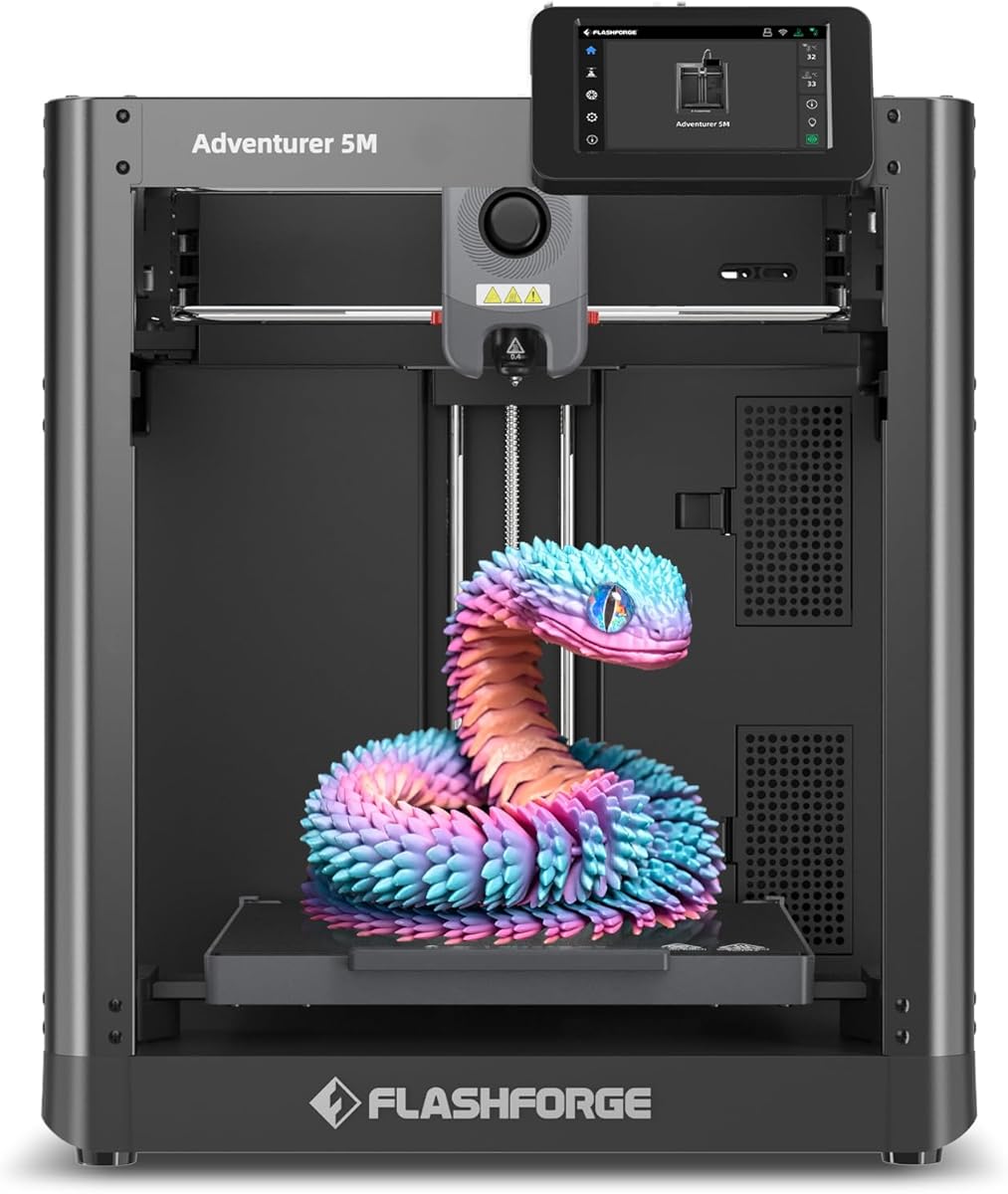
The FLASHFORGE Adventurer 5M is built around speed, automatic leveling, and a practical 220 x 220 x 220 mm build volume. Its 3.9 rating places it behind the highest-rated choices, but the supplied specifications present a compelling package for beginners who want quick results without repeatedly preparing the bed. One-click automatic bed leveling helps establish a reliable first layer, while the CoreXY all-metal structure supports controlled movement.
We may earn a commission when you buy through this link, at no additional cost to you.
The headline travel speed is 600 mm/s, supported by acceleration of 20,000 mm/s². A high-flow 32 mm³/s nozzle and a stated 35-second warm-up to 200°C also help reduce waiting time. The 280°C direct-drive extruder expands material options, while the standard 0.4 mm nozzle and optional sizes from 0.25 mm to 0.8 mm make it adaptable to both detailed and efficient work. The three-second nozzle-change design is particularly useful for beginners who may switch between tasks.
The main caution is that maximum speed is not the same as a guaranteed output rate for every model or material. Accurate results still depend on slicer settings, filament behavior, cooling, adhesion, and the geometry of the object. The 3.9 rating also suggests that some purchasers may have encountered issues or simply found the overall experience less balanced than the top-rated models. Real-time app monitoring is a welcome convenience, but it does not replace proper preparation.
Choose the Adventurer 5M if rapid prototyping, frequent model changes, or larger introductory projects are your priorities. It is a good option for users comfortable learning a slicer and willing to tune settings for specialized prints. Those seeking a more polished beginner ecosystem, quieter refinement, or stronger customer perception may prefer the Bambu Lab A1.
The detachable nozzle can be changed in three seconds, making it easier to move between standard, fine, or large formats without a lengthy adjustment process. This convenience is valuable for users still discovering which project types they prefer.
Real-time status alerts and remote monitoring make it easier to start a job and check on it from elsewhere. The feature is useful for longer prints, although final quality still depends on model preparation and compatible settings.
We may earn a commission when you buy through this link, at no additional cost to you.
The Bambu Lab A1 mini is presented as a ready-to-use printer for beginners, and its compact format makes it especially approachable for children, students, and first-time makers. The included LED Lamp Kit gives the package a clear creative purpose: users can print compatible lamp models to create decorative lights, room accents, or personalized gifts. Its 4.4 rating supports its reputation as a capable compact introduction to 3D printing.
We may earn a commission when you buy through this link, at no additional cost to you.
Automatic calibration and simplified setup remove much of the early configuration burden. The printer connects to the Bambu Handy app, where users can find ready-to-print designs in MakerWorld and manage projects through a connected workflow. It also offers high-speed, high-quality printing and quiet operation, which can be helpful in homes, studios, and shared workspaces where a large or noisy machine would be inconvenient.
Its central limitation is physical size. The mini format is ideal for toys, organizers, decorative objects, and other relatively small projects, but it cannot accommodate the same models as a full-size enclosed printer. The LED lamp models must also be compatible with the kit's design, and users will need suitable filament and some familiarity with the app's printing workflow. Those limits are reasonable for the product's focus, but they should influence expectations before buying.
The A1 mini is an excellent choice for users who want a simple introduction rather than a maximum-capacity workshop machine. It is especially appealing for children, families, classroom activities, and compact creative projects. Pick it when small builds, convenient app access, and an immediately understandable project type matter more than large-scale production or advanced multicolor capability.
The included LED lamp kit turns a general-purpose printer into a guided creative experience. It gives beginners a visible goal while teaching the basic process of finding, slicing, printing, and assembling a model.
The A1 mini preserves automatic calibration, connected app features, and quiet operation in a smaller footprint. That makes it practical where space, noise, and approachable setup are more important than maximum build dimensions.
We may earn a commission when you buy through this link, at no additional cost to you.
The Bambu Lab P1S is the most versatile premium entry in this guide, combining a fully enclosed body, high-speed motion, and multicolor capability in a ready-to-use package. Its 4.5 rating reflects a strong overall feature set, while the enclosure differentiates it from open-frame beginner options. That structure is particularly useful for advanced filaments and projects that benefit from a more controlled printing environment.
We may earn a commission when you buy through this link, at no additional cost to you.
A listed maximum print speed of 500 mm/s and acceleration of 20,000 mm/s² help reduce the time required for both everyday and prototype work. Automatic bed leveling supports first-layer consistency, and the product information states that setup can take about 15 minutes. For color, the P1S can use up to 16 colors when connected to a Bambu Lab AMS unit, creating a clear path for users who want more than single-color output.
The premium features are not automatically included. The AMS must be connected separately for multicolor printing, and the P1S costs more than basic machines. It also has a larger physical footprint and more demanding setup than a compact mini printer. Filament compatibility is broad, including PLA, PETG, TPU, PVA, PET ABS, and ASA, with PA and PC listed as capable but carbon- or glass-fiber-reinforced polymers not recommended.
The P1S is best for enthusiasts and advanced beginners who want room to expand without starting with the simplest possible machine. It suits makers who value enclosure, speed, and multicolor possibilities, particularly when those features will actually be used. If your projects are consistently small, simple, and single-color, the A1 or A1 mini may deliver a more streamlined experience.
The fully enclosed body helps create a more controlled environment for PLA, PETG, TPU, PVA, PET ABS, ASA, and selected advanced materials. It is a meaningful advantage for users who may outgrow PLA.
Connecting a Bambu Lab AMS enables prints using as many as 16 colors. This makes the P1S a strong choice for decorative models, articulated figures, identification parts, and projects where color improves communication.
We may earn a commission when you buy through this link, at no additional cost to you.
The AOSEED AI 3D Printer is designed specifically around children, families, and guided creative use, with a 4.5 rating and an unusually broad set of included features. Its enclosure, pinch-resistant construction, quiet operation, leveling-free platform, and use of TÜV Rheinland ISO 16000-tested PLA distinguish it as a family-focused option rather than a conventional maker printer with a child-themed model library.
We may earn a commission when you buy through this link, at no additional cost to you.
The software experience is central to its usability. AI Doodle can create custom models from voice, text, or image prompts, while AI MiniMe transforms photographs into cartoon-style figures and MINIMAKIE supports personalized avatars. A built-in assistant guides users through the process, and the stated library contains more than 8,000 human-reviewed, print-tested models organized into 17 thematic modules. One-tap printing lets children select a project without managing a complex slicer interface.
Its main limitation is explicit: the printer supports single-color printing only. Multicolor designs must be created as separate parts and assembled afterward. It is also a specialized system, so advanced users may find the AI-focused ecosystem less flexible than a general-purpose slicer workflow. Despite these restrictions, the included eight rolls of PLA, tools, magnetic build plate, and stickers make it a convenient all-in-one family package.
Choose this printer when a child is the primary user and the goal is safe, engaging, simplified creativity rather than technical control or advanced color mixing. It is also useful for family projects and supervised educational activities. Adults who want a general-purpose upgrade path should look instead toward the Bambu Lab A1 or P1S.
Voice, text, and image prompts allow children to begin without advanced modeling skills. The built-in assistant and one-tap workflow make the path from an idea to a queued print feel more like a guided creative app than a technical tool.
The enclosed, pinch-resistant body, quiet operation, and tested PLA create a more considered home setup. These features do not eliminate adult supervision, but they address several practical concerns when children are printing.
We may earn a commission when you buy through this link, at no additional cost to you.
The Entina Tina2C focuses on removing the perceived complexity of getting a first print underway. Its fully assembled design, Poloprint Cloud app, and stated ability to start the first print in as fast as eight minutes make it a compelling option for children and first-time users. The 4.4 rating indicates a well-received product, particularly within its intended educational and compact-project category.
We may earn a commission when you buy through this link, at no additional cost to you.
The app provides guided setup, AI-powered search, photo-to-print features, more than 20 creative modules, and regularly updated STEM courses. Users can print over WiFi or use a TF card for offline operation. Automatic leveling reduces early adjustments, while power-loss recovery can protect a print when an interruption occurs. The flexible magnetic build plate and quick-swap printhead simplify removal and maintenance, both of which are important when a printer is used by students or younger family members.
The main limitation is the listed 3.9 x 3.9 x 3.9 inch print volume. That is large enough for many toys, organizers, STEM pieces, and small decorative items, but not for larger enclosures or tall models. As with most compact introductory printers, advanced users will also need to work within the supplied ecosystem and may find the small platform less adaptable for practical parts. The product supports Windows, macOS, Linux, Chromebook, Cura, and Simplify3D, which adds useful flexibility.
The Tina2C is best for guided learning, family creativity, and small STEM projects where a short setup time and approachable interface are priorities. It is less suitable for large functional parts or workshops that need substantial build volume. For a first compact printer with an educational focus, its combination of assembly, connectivity, recovery, and guided modules is particularly compelling.
STEM courses, interactive creative modules, AI search, and photo-to-print features give students a structured path beyond downloading random models. The platform is designed to make experimentation part of learning.
WiFi printing is convenient for app-based projects, while TF card support provides a useful offline alternative. That flexibility can be valuable in classrooms or homes where network access and workflow requirements vary.
We may earn a commission when you buy through this link, at no additional cost to you.
The FLASHFORGE AD5M is an accessible high-speed machine for users who value automation, a stable motion system, and straightforward maintenance. Its 4.2 rating reflects a capable but less universally favored feature balance than the leading models. A one-click leveling system automatically measures nozzle-to-plate distance and sets offsets, directly addressing one of the most common frustrations for novice users.
We may earn a commission when you buy through this link, at no additional cost to you.
The all-metal CoreXY structure is designed to maintain stable, low-noise movement at speed, and the maximum speed is listed at 600 mm/s. Its tool-free nozzle can be changed in about three seconds across 0.25, 0.4, 0.6, and 0.8 mm options. The flexible double-sided PEI steel plate makes finished models easier to remove by bending and provides a surface suited to PETG on the reverse side. The machine also saves an ongoing layer and resumes after a power outage.
Software control comes through the Orca-flashforge slicer, which supports one-click batch transfers and multi-printer network monitoring. The Flash Maker app provides remote status, parameter adjustments, and printer management. These are useful features, though beginners still need to learn which settings are appropriate for each filament and model. The open architecture also means it is not the same as an enclosed machine for materials that benefit from chamber control.
Choose the AD5M if rapid output, easy nozzle changes, and low-effort leveling are priorities. It is well suited to prototyping, models that need several nozzle sizes, and users who want remote management. If enclosure, a more established beginner model ecosystem, or the highest customer ratings are your main criteria, compare it carefully with the Bambu Lab models before deciding.
The calibration routine measures the distance between the nozzle and build plate, then applies accurate offsets. This reduces manual leveling and makes a reliable first layer more attainable for a new user.
The quick-release nozzle supports several diameters and can be replaced in roughly three seconds. Users can move between detail-oriented and faster workflows without a lengthy disassembly process.
We may earn a commission when you buy through this link, at no additional cost to you.
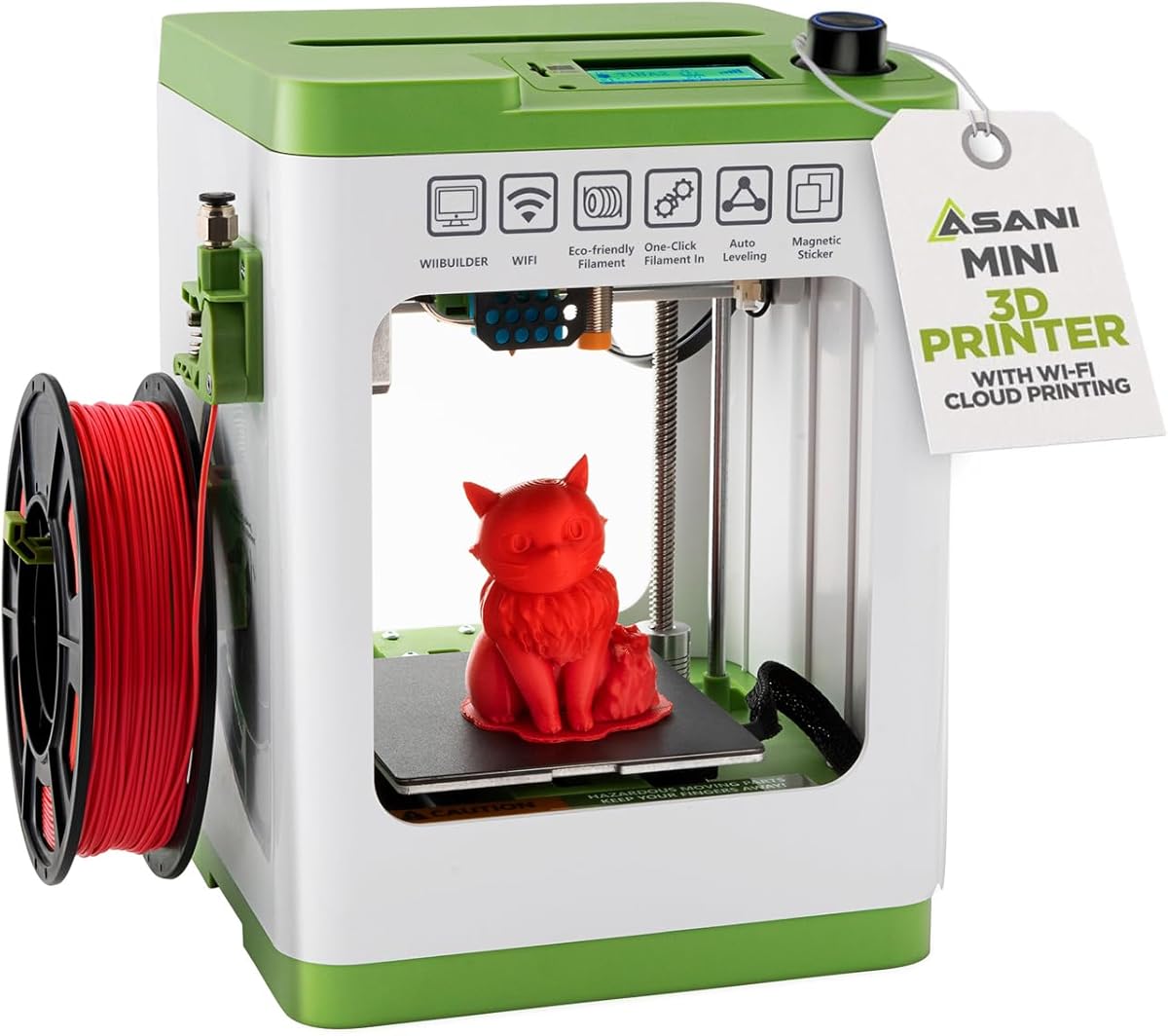
The TINA2S is a compact, fully assembled starter kit designed to make a first printer purchase feel uncomplicated. Its 4.6 rating is the second-highest among the featured products, making it a notable option for buyers who prioritize a ready-to-use package. Rather than requiring assembly, it arrives prepared for setup and includes 10 meters of PLA, a preinstalled microSD card with models and slicing software, and other accessories.
We may earn a commission when you buy through this link, at no additional cost to you.
Automatic leveling, a dual Z-axis rail, a 2.4-inch LCD screen, and a flexible magnetic build plate help simplify operation. One-touch filament loading removes another familiar obstacle, and active pause-and-resume functions add control during longer jobs. It supports 1.75 mm PLA, PLA Pro, and TPU, covering common introductory materials. Its 8.3 x 8.3 x 11.4-inch body fits naturally into a home, classroom, or dorm setting.
The significant warning is that users should use the included TINA2S platform plate or another comparable magnetic metal plate. A nonmetal or nonmagnetic plate can prevent the proximity sensor from functioning correctly. WiFi is supported, but the printer also works with Mac, Windows, and Linux and accepts common slicers including WiiBuilder, Cura, Simplify3D, and Slicr3d. As with any mini printer, the compact build area limits larger projects.
The TINA2S is a strong recommendation for a first-time buyer who wants a complete, assembled kit and broad software options. It is particularly suitable for students, children under supervision, and users creating small decorative or practical objects. Choose a full-size machine instead if large models, multicolor output, or an enclosed printing chamber are important to your plans.
A fully assembled printer eliminates the possibility that a beginner will assemble components incorrectly or struggle with unfamiliar hardware. The included filament, card, software, and accessories create a coherent first project experience.
The LCD provides direct machine information, while one-touch loading and unloading streamline material changes. Automatic leveling reduces the need for tools and manual adjustment during routine use.
We may earn a commission when you buy through this link, at no additional cost to you.
The Creality Ender 3 V3 SE is a conventional beginner FDM printer with several features designed to remove familiar setup obstacles. It can be assembled in a few simple steps, while CR Touch auto leveling and automatic Z-offset calibration help produce a reliable first layer. Its 4.1 rating suggests a solid but less refined overall proposition than the top-rated beginner machines.
We may earn a commission when you buy through this link, at no additional cost to you.
The Sprite direct-drive extruder is designed for smooth, consistent filament feeding and supports PLA, PETG, and TPU. A maximum speed of 250 mm/s and acceleration of 2,500 mm/s² can shorten job times when suitable materials and settings are used. Dual synchronized Z-axis lead screws and precision Y-axis linear shafts help reduce vibration and Z wobble during longer prints, supporting more consistent layer alignment.
A 32-bit silent mainboard reduces operating noise, while the flexible PC spring-steel plate allows models to be removed with less effort. Unlike fully assembled options, this printer still requires basic assembly, although the process is described as straightforward. Its lower rating may reflect value, appearance, or reliability concerns that differ by user, and those considerations should be checked through current customer feedback. The open design also does not provide controlled-chamber benefits.
The Ender 3 V3 SE makes sense for buyers who want an approachable Creality option, understand basic assembly, and plan to work with common FDM materials. It is a reasonable pick for everyday models, prototypes, and learning. Buyers who prioritize the simplest possible start or a fully guided app ecosystem should consider an assembled alternative such as the TINA2S or Bambu Lab A1 mini.
CR Touch leveling and automatic Z-offset calibration remove the two adjustments beginners are most likely to struggle with. This makes a first successful print more approachable without hiding the underlying process.
The silent mainboard and spring-steel plate improve the comfort of routine printing. These features are particularly helpful for students or home users who cannot dedicate a separate workshop area.
We may earn a commission when you buy through this link, at no additional cost to you.
The Anycubic Kobra X is the clearest choice in the guide for a buyer whose priority is built-in multicolor printing. Unlike systems that require a separate AMS, the Kobra X arrives with four-color capability and can expand to 19 colors using four compatible ACE 2 Pro units. Its 4.2 rating reflects a feature-rich package, although users should account for the additional complexity and consumable cost of multicolor printing.
We may earn a commission when you buy through this link, at no additional cost to you.
The machine advertises an 81.25% reduction in filament and travel path used for purging, along with twice the speed and lower material use compared with the conventional process described by the manufacturer. A hardened steel nozzle, vibration compensation, and maximum speed of 600 mm/s support fast output. LeviQ 3.0 uses 49 calibration points and automatic bed leveling, with a stated readiness time of about 15 minutes after pickup.
The system supports mixed rigid and flexible filaments, including PLA, PETG, TPU, PVA, and ASA, and has a 300°C nozzle temperature. App control, dual-band WiFi, LAN connectivity, spaghetti detection, and foreign-object detection add useful automation. Filament is not included, however, and ACE Pro units are incompatible with ACE 2 Pro hardware. Users should also account for the learning curve involved in preparing multicolor jobs.
Choose the Kobra X if immediate color capability is worth the additional complexity. It is a strong fit for decorative models, figures, signs, educational projects, and makers who want to avoid sourcing a separate multicolor unit. If one-color prints are enough, a simpler Bambu Lab or FLASHFORGE model can provide a more streamlined path with fewer purge-related variables.
Four built-in color channels remove the need to purchase a separate multicolor accessory before starting. Expansion to 19 colors is possible with compatible ACE 2 Pro units, giving the platform a clear upgrade path.
LeviQ 3.0 combines 49-point measurement with an automatic leveling algorithm. The more detailed bed map supports reliable first-layer adhesion, particularly when multiple materials or colors are used.
We may earn a commission when you buy through this link, at no additional cost to you.
The easiest printer is not always the one with the longest feature list. The right choice depends on your experience, project size, preferred materials, space, supervision needs, and willingness to learn a connected software workflow.
Beginners often underestimate the time and difficulty involved in assembling a printer, tightening belts, connecting wiring, and checking the initial mechanical alignment. A fully assembled unit such as the TINA2S removes those steps entirely, while the Bambu Lab A1 mini and P1S are sold with ready-to-use positioning. The Ender 3 V3 SE requires assembly but describes the process as a few simple steps. Compare not only whether assembly is required, but also whether the machine includes the tools and replacement parts needed to perform it correctly.
Bed leveling, nozzle height, and Z-offset determine whether filament sticks to the build plate and sits at the correct height. Automatic systems use sensors and algorithms to measure these variables, reducing the need for calibration tools and repeated test prints. The Bambu Lab A1 offers full-auto calibration, the Adventurer 5M and AD5M use one-click leveling, and the Ender 3 V3 SE combines CR Touch with automatic Z-offset calibration. More calibration points can improve bed mapping, but the interface, repeatability, and instructions matter as much as the headline procedure.
Compact printers are convenient but impose a hard limit on every dimension of a model. The Entina Tina2C has a 3.9 x 3.9 x 3.9 inch volume, making it suitable for small toys and STEM pieces, while the Bambu Lab A1 mini occupies less space and is best viewed as a small-project machine. The FLASHFORGE models offer 220 mm cubic volumes, and the Anycubic Kobra X provides a larger 260 mm cube. Consider clearance around the printer, the size of your largest planned objects, and whether you need tall parts as well as a broad bed.
A high maximum speed can shorten print times, but real results depend on acceleration, motion structure, cooling, filament, model geometry, and slicer settings. The Adventurer 5M and AD5M list 600 mm/s travel speeds, the P1S lists 500 mm/s, and the A1 specifies 10,000 mm/s² acceleration. Warm-up time also affects short jobs. Fast travel is valuable for prototypes, while consistent extrusion and simple software remain more important for a first-time user who will not optimize every profile.
An enclosed design can improve consistency with advanced or higher-temperature materials by limiting environmental changes and helping contain fumes and particles. The Bambu Lab P1S and AOSEED AI printer are enclosed, whereas many other picks use open frames. PLA is the most common starting material across this category, but several machines also support PETG, TPU, ABS-family materials, PVA, PA, or PC. Check the exact recommended list, nozzle temperature, and any explicit limitations rather than assuming every filament will perform equally well.
Multicolor systems can create more expressive models, but they introduce extra hardware, filament changes, purging, and compatibility questions. The Anycubic Kobra X provides native four-color printing and can expand with compatible ACE 2 Pro units. The Bambu Lab A1 supports multicolor with AMS lite, while the P1S requires a Bambu Lab AMS and can use up to 16 colors. For single-color models, one-touch loading on the TINA2S, the A1's quick-swap nozzle, and the FLASHFORGE quick-release systems may be more relevant than color capability.
A beginner-friendly printer should make it easy to find a model, prepare it, and monitor the job. The Bambu ecosystem provides MakerWorld access and app management, while the AOSEED system emphasizes AI creation and a large curated library. The Entina Tina2C offers guided setup, educational modules, and offline printing. The TINA2S works with major desktop slicers, and the Kobra X includes app monitoring, automated detection features, and a large model library. Make sure the preferred operating system and software are supported before purchasing.
A printer used around children or in a shared home should be evaluated for enclosure, noise, accessibility, and easy cleaning. The AOSEED AI model uses a pinch-resistant enclosed design and quiet operation, while the A1 mini and TINA2S suit compact spaces. Maintenance can determine long-term convenience: quick-swap nozzles, flexible removable plates, simple filament loading, and self-cleaning features reduce direct contact with hot or fragile components. Regardless of the model, ventilation, adult supervision, and responsible filament handling remain important.
Begin with a clean, level surface and verify that the build plate is secured properly before loading filament. Confirm that the printer is configured for the material you selected, because nozzle temperature, bed temperature, retraction, cooling, and flow settings can vary significantly between PLA, PETG, TPU, and advanced filaments. Use the printer's guided calibration process if it has one, then run a small test model before committing to a long job. This simple check can reveal bed adhesion, nozzle movement, and filament-delivery issues while they are still easy to correct.
Choose a ready-made model from the manufacturer's supported library to establish a baseline, then move on to sliced files from a trusted source. Keep the original file intact, use a sensible layer height, and avoid making several major changes at once. If you are new to the software, begin with the recommended profile and adjust only one variable at a time. Monitor the first layers closely, and use the app or camera to check progress without repeatedly interrupting the print. For multicolor machines, check purge behavior and confirm that every filament type is supported by the attached material unit.
For care, turn off the machine according to its instructions, allow the hotend to cool, and remove loose debris from the build plate and nozzle area. Use a soft tool or the printer's provided cleaning method rather than scraping delicate surfaces. Keep filament sealed and dry, and replace a spool promptly if it has become brittle, dusty, or tangled. Check nozzles for visible wear, clean the exterior with a dry cloth, and make sure vents remain unobstructed. If a print repeatedly fails, inspect calibration, filament condition, model orientation, and adhesion before replacing hardware or changing many settings at once.
The Bambu Lab A1, Bambu Lab A1 mini, and TINA2S are among the most approachable choices because they emphasize automatic calibration, guided workflows, and minimal initial configuration. The best option depends on project size and whether you value a full-size frame, a compact format, or a fully assembled package. A first-time user should also consider the software ecosystem and whether a connected app or open desktop slicer feels more comfortable.
Some models arrive fully assembled, while others require basic assembly. The TINA2S is fully assembled, and the Bambu Lab A1 mini and P1S are positioned as ready-to-use products. The Creality Ender 3 V3 SE requires assembly, although the manufacturer describes the process as straightforward. Buyers who have never calibrated a printer should consider how much they value avoiding assembly against the overall features and cost of each option.
PLA is generally the easiest starting material because it has a relatively low printing temperature and usually provides good bed adhesion with standard settings. Several printers in this guide also support PETG or TPU, but those materials usually need different preparation and tuning. Follow the filament manufacturer's temperature recommendations and the printer's supported material list, and make sure the filament diameter matches the extruder.
Yes, a mini printer can serve adults who mainly make small organizers, decorative objects, toys, accessories, and other compact projects. It may be less suitable for large functional parts, tall items, or a high-volume workflow. Consider not only the stated build dimensions but also whether the smaller plate is difficult to clean and whether your expected prints will frequently approach the available space.
Enclosure can make certain materials more consistent and provides a more controlled printing environment, but it does not remove the need for correct settings or maintenance. The Bambu Lab P1S pairs enclosure with automatic leveling and a polished beginner workflow, while the AOSEED AI printer uses enclosure as part of a child-focused safety design. Choose enclosure when material needs justify it rather than assuming it alone guarantees easier operation.
Bundle contents vary. The AOSEED AI listing includes eight rolls of PLA along with tools and accessories, while the TINA2S starter kit includes 10 meters of PLA. The Anycubic Kobra X does not include the four displayed filament spools, and other configurations may vary. Always check the current package contents, especially when comparing a printer that includes accessories with one sold as a standalone machine.
App control can substantially improve ease of use by simplifying model preparation, print monitoring, firmware updates, and remote status checks. It is especially useful for children, students, and beginners who do not want to begin with advanced slicing controls. However, desktop flexibility may be more valuable to experienced users or schools that teach slicer skills, so consider whether the printer supports both connected and conventional workflows.
Inspect the nozzle and build plate between major projects, and clean them whenever residue or poor adhesion becomes apparent. Keep filament dry, remove tangles, and check for debris near cooling fans and movement axes on a regular basis. Follow the manufacturer's cleaning schedule and replace worn nozzles or damaged plates when needed. Consistent light maintenance usually matters more than a complicated cleaning routine performed only after a failed print.
The Bambu Lab A1 stands out as the strongest all-around choice because it combines automatic calibration, fast motion, quiet operation, active flow compensation, and an approachable interface. The Bambu Lab P1S is the premium option for users who need enclosure and a clear multicolor upgrade path, while the Bambu Lab A1 mini offers a compact, creative introduction centered on a ready-to-make LED lamp project.
Your priorities should determine the runner-up choices. The TINA2S is attractive for a complete, assembled starter package, the AOSEED AI printer serves families seeking guided child-focused creation, and the Entina Tina2C emphasizes education and a very fast start. The FLASHFORGE Adventurer 5M and AD5M suit users who want high speed and quick nozzle changes, the Ender 3 V3 SE offers a conventional Creality path, and the Anycubic Kobra X is the pick when native four-color output is the main attraction.
Before purchasing, verify the latest build volume, supported filaments, app and operating-system requirements, included accessories, warranty information, and current price. Printer technology and bundle contents evolve, and marketplace listings can change. Choosing the machine that matches your actual project size, skill level, space, and preferred workflow will provide a more satisfying experience than choosing solely by the largest headline specification.