
Sonos Era 300
4.6Editor score
Six directional audio drivers
Dolby Atmos Music support
WiFi and Bluetooth connectivity
Omni directional speakers spread sound broadly through a room or across a listening area, making them useful for conference calls, computer audio, smart home listening, and outdoor entertainment. The right model depends on microphone coverage, room size, connectivity, weather resistance, and whether you prioritize portability or immersive sound.
This guide compares ten relevant products across several distinct uses rather than treating them as interchangeable. We examined the published specifications, pickup patterns, connection options, platform compatibility, installation requirements, and practical feature sets to show why each product may or may not fit your needs.
The selections range from a conference microphone without built-in loudspeaker audio to portable USB speakerphones, a 2.1 computer system, a wireless smart speaker, and two landscape speakers. Read each review for the relevant trade-offs, and check current prices and availability before purchasing because costs and configurations can change.
4.6Editor score

4.5Editor score

4.3Editor score
As an Amazon Associate we earn from qualifying purchases.
The table below compares the ten products by their core role, sound or voice coverage, connection method, and most important practical feature. Because the list includes conference devices, smart speakers, computer audio, and outdoor speakers, the comparison is most useful when matched to your intended setting.


The TONOR G11 is a conference microphone rather than a complete speakerphone, an important distinction when interpreting its 360-degree specification. It has a 4.3 rating and uses an omnidirectional condenser pickup pattern to capture subtle sound from all directions. Its stated pickup distance of 11.5 feet gives it unusually broad reach for a desktop microphone intended for small and medium meetings.
We may earn a commission when you buy through this link, at no additional cost to you.
The core strength is straightforward voice capture. A single USB connection works with Windows and macOS without additional drivers, while a blue indicator light shows operating status and a physical button handles muting. The shielded 1.8-meter nylon cable, sturdy metal construction, and anti-slip base are practical details for a device expected to remain on a desk during calls, training sessions, seminars, or legal reporting.
The trade-off is that this model does not reproduce sound through a built-in loudspeaker. Participants will hear other people through the computer's own speakers or headset, and the G11 cannot serve as an all-in-one room audio solution. Its wide pickup range may also capture more ambient noise in an open space, making microphone placement and room control important despite the noise-related benefits offered by full speakerphone systems.
Choose the TONOR G11 when the priority is flexible, all-direction microphone coverage on a modest budget and your computer already has suitable output audio. It is especially useful for presenters, remote trainers, and interviewers who want people around a table heard without leaning toward the microphone. If you need a self-contained speakerphone with echo control, a full conference unit such as the Q95mini or Luna Plus would be a closer fit.
The 11.5-foot stated pickup range allows participants to sit around a table rather than crowd a single microphone. The 360-degree pattern is particularly useful when the speaker's position changes, although choosing a quieter room can still improve clarity.
USB plug-and-play operation removes the need for complicated setup, while the compact base and anti-slip mat keep the microphone stable. Cable management may be less convenient than a wireless design, but it also eliminates battery charging and radio-latency concerns.
We may earn a commission when you buy through this link, at no additional cost to you.
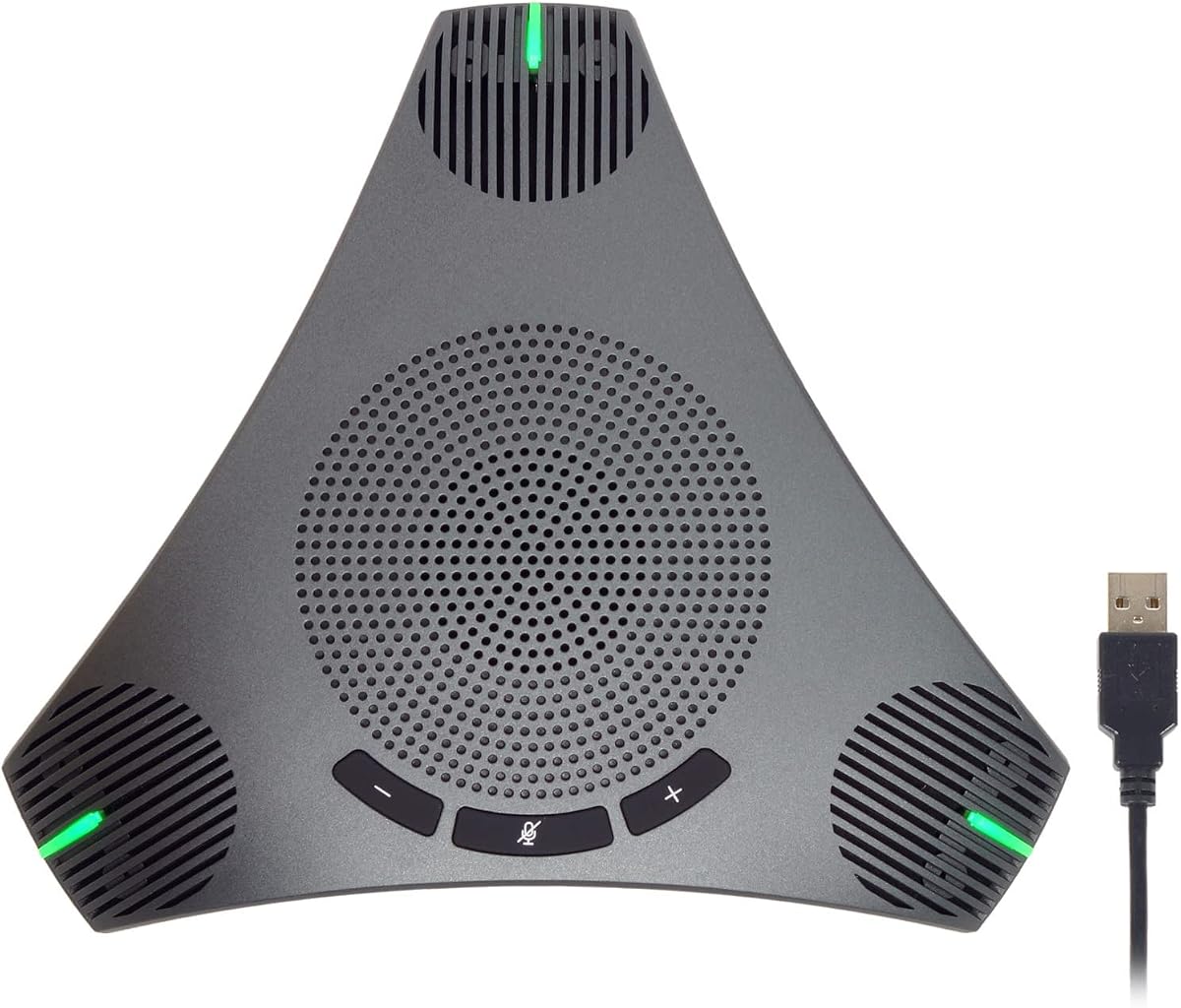
The Q95mini is a USB conference speakerphone with a 360-degree omnidirectional microphone, built-in speaker, and an integrated USB hub. Its 4.3 rating reflects a practical all-in-one design for business calls, online courses, meetings, and casual group conversations. Voice pickup is advertised across a three-meter radius, allowing people to move around a home office or meeting room without repeatedly approaching the device.
We may earn a commission when you buy through this link, at no additional cost to you.
Digital signal processing adds acoustic echo cancellation and automatic noise suppression, both useful when a loudspeaker and microphone share the same table. Setup is uncomplicated: the included three-meter cable connects to a computer, and no drivers are required. Compatibility includes Windows 7 through 10, macOS, and major services such as Zoom, Skype, Lync, Microsoft Teams, WebEx, GoToMeeting, FaceTime, and Google Voice.
The built-in hub is unusual and practical for people with limited USB ports. A mouse, keyboard, flash drive, handset, or another conferencing system can be connected through it. The physical mute control applies specifically to the conference microphone, not the speaker, so users should understand that distinction before expecting the entire device to silence. As a wired unit, it also has less freedom of placement than a battery-powered wireless model.
The Q95mini is a strong choice for a fixed desk or conference table where one cable can power the full room-audio setup. It is more complete than the TONOR G11 because participants hear and speak through one device. However, buyers planning to move the unit between locations or support a very large meeting should consider the wireless Luna Plus Kit and its satellite microphone instead.
Combining a loudspeaker with an omnidirectional microphone creates a self-contained conference endpoint. Echo cancellation and noise suppression help the microphone avoid picking up its own speaker output, which is essential for natural two-way conversation.
The integrated hub can reduce port pressure on a laptop and simplify peripheral connections. It is especially useful for workers who need a mouse, storage device, or handset attached without carrying a separate dock.
We may earn a commission when you buy through this link, at no additional cost to you.
The EMEET Luna Plus Kit is a feature-rich conference speakerphone with a 4.5 rating and an unusually flexible approach to meeting coverage. Its main unit contains eight omnidirectional microphones, while the included dedicated satellite microphone extends pickup into a larger space. The combined kit is designed for conferences of up to 14 people, with the main unit alone handling as many as 10.
We may earn a commission when you buy through this link, at no additional cost to you.
VoiceIA processing adds dynamic noise reduction intended to reduce distractions such as air-conditioning noise and keyboard clicks. Full-duplex operation and echo cancellation support natural, interrupt-resistant conversations. A five-watt speaker, maximum stated output of 89 dB, and a built-in 2,600mAh battery round out the core hardware, with up to ten hours of call time between charges.
Connection options include USB 2.0 and Bluetooth 5.3, and the upgraded A350 dongle is designed for low-latency communication. The system works with Windows, macOS, iOS, Android, Zoom, Microsoft Teams, and Skype for Business. Its daisy-chain capability can expand coverage to as many as 25 attendees when two kits are linked, but the required EMEET cable is sold separately, adding a cost and setup step.
The Luna Plus Kit is the strongest choice here for medium-to-large meetings that need room-filling coverage and some flexibility. It is less appropriate for a tiny office desk where eight microphones and a satellite would be excessive, but its wireless operation, noise controls, and expansion potential make it especially versatile for regular collaboration. Users who expect to use daisy chaining should budget for the additional compatible cable from the outset.
Eight omnidirectional microphones and a separate satellite let a room be covered without requiring everyone to sit near the main unit. The distinction between a main-unit pickup range and a larger kit capacity is important when estimating whether the satellite will actually be used.
Bluetooth 5.3 and USB give the kit more placement options than a permanently wired conference phone. Its wired daisy-chain pathway also offers a stable way to extend larger installations, although the required cable is an additional accessory.
We may earn a commission when you buy through this link, at no additional cost to you.
The Jabra Speak 510 UC is a portable conference speakerphone with a 4.7 rating, the highest customer rating among the products reviewed. Its 360-degree microphone is designed to capture speakers around a table, while the integrated speaker lets remote participants hear the room through one dedicated device. The product is aimed at business calls, home offices, travel, and meeting rooms that need quick setup.
We may earn a commission when you buy through this link, at no additional cost to you.
Setup requires no specialist IT involvement. Users can connect over Bluetooth or USB and then dial into a meeting, and the speakerphone is compatible with leading unified communications platforms. It is also certified for Avaya, Cisco, Skype for Business, and other communication systems, while the product title specifically highlights Zoom and Google Meet certification.
Portability is a major advantage. The slim enclosure, integrated cable management, and included carrying case make it easier to move between a home office, shared workspace, and hotel room. The trade-off is that it lacks the dedicated satellite microphone and high-capacity expansion seen on the Luna Plus Kit. It is therefore most naturally suited to a small table or temporary meeting space rather than a large boardroom.
The Jabra Speak 510 UC is an excellent choice for mobile professionals who need a recognizable, uncomplicated conference device without advanced installation. It offers the most polished balance of portability, ease of use, and meeting-focused features in this group. Confirm that the particular cable and connector arrangement supplied matches your computer before committing, since the product is not identified as a Bluetooth model.
The included case and compact body remove much of the friction associated with moving a meeting room. A 360-degree microphone preserves broad participant pickup, while a built-in speaker keeps the device self-contained.
Certification for major unified communications platforms gives the device a clear professional focus. USB and Bluetooth connection paths also make it adaptable across different meeting applications, subject to the ports available on the host computer.
We may earn a commission when you buy through this link, at no additional cost to you.
The SoundTech CM-1000 is a 3.5mm conference microphone offering full 360-degree omni-directional pickup and a 4.3 rating. Unlike USB speakerphones, it is a capture-focused device that can serve as the microphone for a Mac, PC, or compatible portable recording setup. Its simpler analog connection gives it a different appeal for users who want broad pickup without wireless setup.
We may earn a commission when you buy through this link, at no additional cost to you.
Built-in echo cancellation and noise reduction are valuable additions for conference use. Echo cancellation helps prevent a microphone from picking up audio reproduced by nearby computer speakers, while noise reduction can make voices more prominent in an imperfect environment. The stated Mac and PC compatibility broadens its potential use, although the selected computer must have a suitable 3.5mm microphone input.
Its main limitation is the lack of a built-in speaker. Users must provide separate output through a computer, display, soundbar, or headset. Legacy-style connectivity can also be less convenient on modern devices that lack a traditional audio jack, potentially requiring an additional adapter. The available product information does not describe USB operation, so it should not be treated as a universal plug-and-play USB solution.
Buy the CM-1000 when a wired analog microphone, broad room pickup, and basic call-processing features are the priorities. It may suit classrooms, small offices, interviews, and portable recording arrangements where a simple 3.5mm interface is preferable. For a self-contained meeting endpoint, choose a USB or wireless speakerphone with a built-in speaker instead.
The 3.5mm interface avoids wireless pairing, radio interference, and battery management. That simplicity can be valuable in a permanently installed or predictable recording location, provided the host device has the correct input.
Full 360-degree capture allows people to speak from different positions without turning or repositioning the microphone. Echo and noise processing make that broad coverage more practical for calls involving nearby playback.
We may earn a commission when you buy through this link, at no additional cost to you.
The OSD Forza 8 is a passive landscape speaker designed to distribute music in a full 360-degree pattern around an outdoor entertainment area. It has a 4.2 rating and is built around an eight-inch woofer and one-inch PEI dome tweeter. The 200-watt power handling and frequency response from 42Hz to 20kHz target listeners in patios, gardens, walkways, and backyards.
We may earn a commission when you buy through this link, at no additional cost to you.
Its outdoor design is more substantial than a decorative Bluetooth unit. The UV-resistant ABS enclosure has an IP65 weather-resistance rating, and silicone-sealed internal components are intended to withstand rain, sun, and changing climates. An eight-ohm impedance and 88 dB sensitivity make it suitable for many home amplifiers and distributed outdoor audio systems.
Installation requires planning. The speaker is designed for direct burial using outdoor-rated wire, allowing it to blend into landscaping with a low-profile appearance. Because it is passive, it cannot play music independently; an amplifier and compatible system are required. A single speaker provides circular coverage, while adding another suitably placed unit can extend sound into a larger landscape.
The Forza 8 is the most practical choice for homeowners seeking integrated, evenly distributed outdoor sound rather than portable entertainment. Its robust enclosure, full-range drivers, and low-profile installation make it a strong candidate for permanent landscape audio. Confirm amplifier compatibility, cable routing, drainage, and local installation requirements before buying, and use direct-burial wire for the intended application.
A 360-degree design is particularly useful when listeners can move freely around a patio, pool, or garden. It removes the need to aim a conventional directional outdoor speaker at one specific seating area.
The IP65 enclosure, sealed components, and UV-resistant body address common outdoor exposure. Direct-burial installation also keeps visible wiring to a minimum, although the project requires an amplifier, appropriate cable, and attention to drainage.
We may earn a commission when you buy through this link, at no additional cost to you.
The OSD OmniRock 8 is a passive outdoor speaker with a naturalistic rock enclosure and a 360-degree sound pattern. Its 3.6 rating is the lowest in this list, so buyers should weigh the visual design and outdoor application carefully. The enclosure is intended to blend into flower beds, lawns, pool areas, and hardscapes while providing broadly distributed music.
We may earn a commission when you buy through this link, at no additional cost to you.
A two-way system pairs an eight-inch polypropylene woofer with a one-inch soft-dome tweeter. The stated range extends from 30Hz to 18kHz, with 200-watt power handling, eight-ohm impedance, and 87 dB sensitivity. That configuration should provide fuller low-end output and clearer treble than a basic small outdoor unit when paired with a suitable amplifier.
The enclosure and internal components are described as weather resistant against rain, sun, snow, pool chemicals, dirt, and insects. Nevertheless, the instructions recommend covering the speaker during extreme weather for the longest life. It remains a passive unit that connects to a stereo amplifier or AV receiver, so it does not offer independent Bluetooth or WiFi control.
Choose the OmniRock when visual integration matters as much as sound coverage. Its realistic appearance is especially attractive for gardens where a conventional box speaker would look out of place. Because its customer rating trails the other selections, consider checking recent owner feedback, matching the amplifier carefully, and following the recommended protective measures before installing it permanently.
The rock-style enclosure keeps technical equipment visually integrated into a landscaped setting. Its circular radiation pattern further reduces the need to orient the unit toward a particular listener.
The woofer and soft-dome tweeter are intended to cover both bass and high frequencies from a single enclosure. Achieving that performance still depends on using an amplifier with adequate power and appropriate wiring.
We may earn a commission when you buy through this link, at no additional cost to you.
The Sonos Era 300 is a premium wireless smart speaker with a 4.6 rating and a distinctly different purpose from the meeting products. Six drivers are positioned across the front, sides, and top to create a broad three-dimensional soundstage. Custom waveguides direct sound right, left, forward, and upward, allowing the speaker to project music through a room rather than toward one seating position.
We may earn a commission when you buy through this link, at no additional cost to you.
Dolby Atmos Music support adds height and spatial effects to compatible content. The speaker can stream from services over WiFi, accept Bluetooth playback, and use the Sonos Line-In Adapter to connect a turntable or other analog source. It also supports hands-free Sonos Voice Control and provides access to Sonos Radio, original content, and regularly updated features.
It can also function as part of a larger Sonos home-theater arrangement. When paired with a compatible Sonos Arc or second-generation Beam, the Era 300's lateral and overhead channels help create an enveloping surround presentation. This makes it more versatile than a conventional outdoor omni speaker, but the experience depends on compatible service content, the surrounding room, and whether additional Sonos equipment is owned.
The Era 300 is the choice for listeners who want expansive music from a single wireless unit rather than conference voice coverage. It excels as a room-filling smart speaker and can grow into a multichannel system. Buyers should check service availability, network requirements, and adapter needs before purchasing, and they should understand that its broad dispersion differs fundamentally from a microphone's 360-degree pickup.
Multiple upward- and side-facing drivers distribute music throughout the room, making the listening position less critical. This is a speaker dispersion design, not an omnidirectional conference microphone, and it is optimized for entertainment rather than voice pickup.
WiFi streaming, Bluetooth, voice control, and line-in support cover several common listening methods. Pairing with compatible Sonos soundbars further extends the speaker into a home-theater role, although accessories are required for some connection types.
We may earn a commission when you buy through this link, at no additional cost to you.
The Klipsch ProMedia 2.1 is a powered computer speaker system with a 4.5 rating. It combines two compact satellite speakers with a larger 6.5-inch side-firing, ported subwoofer. Rather than using a true omnidirectional pickup or dispersion design, it aims controlled sound from separate satellite positions, creating a conventional stereo image with dedicated low-frequency output.
We may earn a commission when you buy through this link, at no additional cost to you.
Klipsch Microtractrix horn technology is central to the satellites' clarity and controlled dispersion. The two-way satellites use three-inch midrange drivers, while the subwoofer supplies bass. The system has a stated peak output of 200 watts and is THX certified, making it suitable for games, films, and music when more presentational impact is needed than a pair of basic desktop speakers can deliver.
The wired control pod provides main volume and subwoofer gain adjustment. A convenient 3.5mm input makes connection straightforward for computers, televisions, music players, and gaming consoles. Unlike the smart and conference products, the ProMedia system does not include an omnidirectional microphone, Bluetooth, WiFi, echo cancellation, or a USB conference interface. It is audio playback equipment rather than a speakerphone.
Choose the ProMedia 2.1 for a powerful, wired desktop or entertainment setup with separate bass control. It is particularly effective for gaming and film viewing where a subwoofer and directed stereo imaging are priorities. It should not be selected for group calls or broad room coverage, and a device without a headphone-style output may require an appropriate adapter.
The two satellites create a defined left-right soundstage, while the side-firing subwoofer handles low frequencies. Placing the satellites around a monitor can produce a more convincing image than a single compact speaker.
The 3.5mm input and separate control pod make the system approachable for many source devices. Adjusting the subwoofer gain independently allows users to balance bass with the satellites for different rooms and content.
We may earn a commission when you buy through this link, at no additional cost to you.
The Lenovo Go Wired Speakerphone is a compact meeting device designed around USB-C connectivity and Microsoft Teams certification. It carries a 4.2 rating and uses two omnidirectional microphones to capture voices consistently from around the device. The physical interface includes a dedicated Teams button, a smooth volume wheel, tactile response controls, and LED indicators.
We may earn a commission when you buy through this link, at no additional cost to you.
Its processing stack is extensive for a portable speakerphone. Acoustic Echo Cancellation prevents the microphone from capturing speaker output, while Automatic Gain Control keeps levels consistent. Environmental Noise Cancellation and Active Noise Cancellation are also included to reduce distracting background sound and improve perceived call clarity.
Plug-and-play operation is a central advantage for users with compatible USB-C computers. The cable can be tucked into the base after use, which improves transport and desk management. Unlike a Bluetooth conference unit, however, it has no stated wireless connection or battery, so it remains tied to its cable and host device. USB-C-only connectivity may also prevent use with older systems that lack the appropriate port.
The Lenovo Go Speakerphone is a good fit for Teams-centered offices, hot desks, and focused small meeting rooms. Its dedicated shortcut, wired reliability, and advanced processing make it convenient for daily collaboration. Choose a more flexible conference unit if Bluetooth pairing, battery operation, or a wider selection of physical connection methods is essential.
Certification and a dedicated Teams control point streamline recurring online meetings. The USB-C connection also reduces the number of cables needed on modern laptops that already use that interface for power and data.
Echo, gain, environmental-noise, and active-noise controls work together to improve communication quality. The device is built for consistent voice pickup rather than broad entertainment audio, making it a specialist conference-room tool.
We may earn a commission when you buy through this link, at no additional cost to you.
The phrase omni directional can describe microphone pickup, loudspeaker dispersion, or both. Start by identifying the job you need the product to perform, then evaluate room size, connection method, processing features, portability, and installation constraints.
Choose a full speakerphone for complete meetings, and choose a microphone-only model when separate computer speakers are acceptable.
Select the smallest pickup system that comfortably covers your usual room, and favor an included satellite for long tables.
Check the physical port, operating system, and conferencing platform before buying, then budget for any adapter or separate cable.
For conference use, favor echo cancellation and noise control over features that do not improve conversation clarity.
Choose battery power for mobility and stable wired power for a permanent desk, especially when uninterrupted calls are the priority.
Verify amplifier power, impedance, outdoor-rated wire, and placement before purchasing a passive landscape speaker.
For music, choose a smart speaker by room-filling dispersion and streaming compatibility; for calls, choose a dedicated conference device.
Prioritize products certified for your primary meeting platform, then confirm the device works with any secondary applications you use.
Begin by identifying the product's role. For a conference microphone or speakerphone, connect it to the specified input, select it as the microphone and speaker within the operating system or conferencing application, and confirm that sound levels remain stable. Place the unit near the center of the discussion, away from obvious noise sources such as air vents, kitchen appliances, and active video screens.
For outdoor passive speakers, turn off and disconnect the amplifier before changing wiring. Mount the enclosure in a stable location with the intended drainage around it, use outdoor-rated direct-burial cable, and confirm that the amplifier's impedance and output suit the speaker. Cover naturally styled units during extreme weather and inspect connections periodically for corrosion, moisture, or physical damage.
General care includes keeping microphones and speakerphone grilles away from moisture and dust, charging wireless models before long meetings, and routing cables so they are not pinched. Smart speakers benefit from stable WiFi, current software, and compatible service subscriptions. For every category, testing the complete setup with real participants and real meeting content is the best way to identify placement or processing issues.
An omnidirectional microphone captures sound from all directions, while an omnidirectional speaker disperses audio outward around the room. Conference speakerphones can contain both, but a microphone-only product will need separate output audio. Always check whether a listing includes a built-in loudspeaker before buying for group meetings.
For a small room with a computer, the Q95mini is a practical all-in-one choice because it combines a 360-degree microphone, speaker, echo cancellation, USB connectivity, and a hub. The Jabra Speak 510 UC is better for users who value portability. The Luna Plus Kit offers the most room coverage and expansion but is more complex.
A satellite is useful when participants are spread beyond the reliable pickup area of the main unit. The EMEET Luna Plus Kit includes one and supports up to 14 people with the kit. Larger deployments can use daisy chaining, although the required EMEET cable is sold separately.
It depends on the connector. The TONOR G11 and the Q95mini use USB and are designed for modern computer meetings. The SoundTech CM-1000 uses a 3.5mm connection and needs a compatible audio input. Check the available port and any adapter requirements before purchasing.
The OSD Forza 8 and OSD OmniRock 8 are passive wired speakers, not wireless products. They connect to an existing stereo amplifier or AV receiver using outdoor-rated cable. Bluetooth or WiFi would need to come from the amplifier or a separate connected system.
No. Broad pickup or dispersion can make a device more sensitive to ambient sound, so processing remains important. Conference models with acoustic echo cancellation, noise suppression, and gain control are better suited to calls than entertainment speakers, which generally do not include those features.
A smart speaker can provide room-filling playback, but it usually lacks the microphone pickup, echo cancellation, and call controls required for reliable conferencing. The Sonos Era 300 is intended for music and entertainment. For calls, choose a dedicated conference speakerphone with platform support and appropriate voice processing.
Place it close to the center of the conversation, ideally where no person is consistently much closer than the others. Keep it away from HVAC vents, fans, keyboards, and other noise sources. Test the device with participants seated in their normal positions because room acoustics and reflected sound can affect clarity.
The strongest meeting-oriented choice is the EMEET Luna Plus Kit, whose eight-microphone array, included satellite, noise reduction, and expansion options suit medium and large rooms. The Jabra Speak 510 UC is ideal for portable business calls, while the Q95mini offers a simple fixed-desk combination of speaker, microphone, and USB hub. For voice capture on a smaller budget, the TONOR G11 covers 360 degrees but requires separate output audio.
Prioritize the use case before comparing specifications. Conference users should evaluate pickup coverage, echo cancellation, platform compatibility, and connector type; outdoor buyers should think about weather resistance, amplifier requirements, wiring, and enclosure appearance; music listeners should consider soundstage, streaming services, and room size. Products that share the term omni directional do not necessarily perform the same function.
Finally, check current prices, availability, included accessories, and warranty details before ordering. Optional daisy-chain cables, line-in adapters, USB-C hubs, amplifiers, and outdoor installation wire can add to the total cost. Confirming those requirements first helps ensure that the selected speaker integrates properly with the intended room, computer, platform, and audio system.

