
VEVOR 8 Outlet Horizontal 1U Rack Mount PDU
4.6Editor score
Eight NEMA 5-15 outlets
Surge and overload protection
Integrated outlet control switch
Includes rack mounting screws
Reinforced fire-resistant housing
Compare 10 leading rack PDUs for server power distribution, covering outlet count, rack fit, surge protection, cord length, mounting options, and controls for
A rack PDU is one of the most important pieces of infrastructure in a server cabinet, yet choosing the right model requires balancing outlet capacity, electrical protection, physical fit, cable routing, and control options. The best unit provides dependable power without consuming unnecessary rack space or complicating maintenance.
This guide compares ten rack-mountable power distribution units across server racks, network closets, mini racks, offices, and AV installations. We considered outlet quantity, voltage and amperage, surge protection, circuit breakers, mounting options, cord length, housing, indicators, and the practical differences between basic and more specialized designs.
Each review explains who benefits most from the selected PDU, along with its strongest features and important trade-offs. The list includes conventional 19-inch models, compact 10-inch units, basic power distribution, and surge-protected options; current prices and availability can change, so confirm final details before ordering.
4.6Editor score

4.5Editor score

5.0Editor score
The table below compares all ten PDUs by rack size, outlet layout, protection, and installation details, making it easier to identify the model that matches your equipment and cabinet.



The StarTech 8-Outlet 1U PDU is a compact, practical choice for server cabinets and network racks where power needs are clear and space is limited. It carries a 4.8 rating and stands out for its straightforward 120V/15A design, eight NEMA 5-15 outlets, integrated six-foot cord, and combination of surge protection, circuit breaker, indicators, and resettable power controls.
We may earn a commission when you buy through this link, at no additional cost to you.
The horizontal 1U enclosure is compatible with 19-inch server racks at least four inches deep and follows ANSI/EIA RS-310-D rack standards. Its rugged steel chassis is appropriate for IT environments, while the six-foot cord gives administrators some freedom to position a mobile rack without placing it directly beside the wall outlet. Power and reset switches add visible control, and LEDs indicate ground and surge-protection status.
The main limitation is outlet count. Eight outlets may be sufficient for a compact server, network switch, storage enclosure, and several peripherals, but it leaves less room for expansion than the 10-, 13-, 14-, and 16-outlet models in this guide. The horizontal format also places receptacles on the rear of the PDU, so cable management depends on the layout of the rack rather than a front-facing connection panel.
This is a strong recommendation for a small 19-inch installation that needs reliable basic distribution with surge protection and monitoring indicators. Buyers building a cabinet for substantial future growth should consider one of the higher-capacity models, while those with eight or fewer connections will find this configuration direct, durable, and easy to manage.
The built-in circuit breaker, reset switch, surge protection, and LED indicators make this more protective than a simple power strip. Those status lights can help IT personnel verify that grounding and surge protection remain active.
Its horizontal 1U design fits standard racks at least four inches deep. The six-foot cord provides additional placement flexibility while preserving a compact, organized cabinet.
We may earn a commission when you buy through this link, at no additional cost to you.
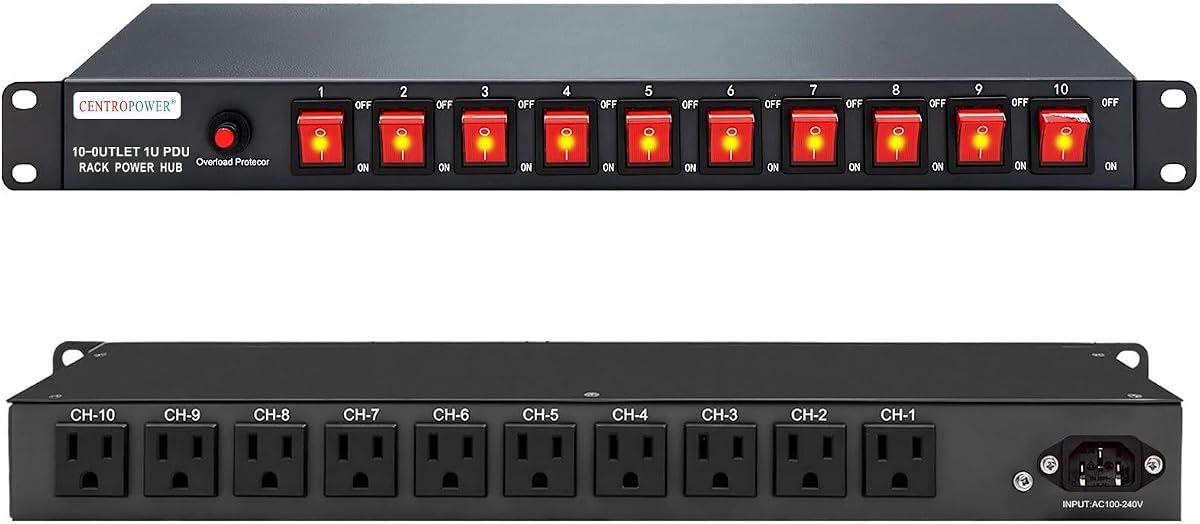
The 1U PDU Horizontal Rackmount Power Strip is built for administrators who want more outlet-level control than a conventional strip provides. It has a 4.4 rating, ten NEMA 5-15 outlets, a 15A rating, a six-foot cord, and an illuminated switch for each outlet. That layout makes it easier to isolate connected equipment without unplugging every device.
We may earn a commission when you buy through this link, at no additional cost to you.
Its stated 100-240V range also makes the unit suitable for varied AC environments, although connected equipment must remain compatible with the selected outlet type and electrical rating. The industrial-grade metal housing, copper wire construction, and cord retention tray reinforce its suitability for network racks and other demanding installations. A built-in circuit breaker and reset function provide overload protection.
There are trade-offs to consider. Independent switches consume some front-panel attention and do not provide network-based remote management. Users should also follow the stated reset procedure: disconnect the attached output plugs and manually press the overcurrent protection switch before restoring operation. The unit offers fewer outlets than several larger models and remains a horizontal rather than front-and-rear design.
Choose this model when individual device control is important in a 19-inch rack and the installation does not require remote monitoring. It is particularly useful for mixed equipment where administrators want convenient power isolation for maintenance. For compact installations, its ten outlets offer more capacity than eight-outlet alternatives.
Each receptacle has its own illuminated switch, allowing equipment to be turned off individually. This is useful during troubleshooting and routine service without disturbing every connected device.
Industrial-grade metal, copper wiring, a retention tray, and a resettable overload protector provide a durable foundation for network and server-rack installations.
We may earn a commission when you buy through this link, at no additional cost to you.
The CyberPower CPS1215RMS is a 120V/15A rack-mount surge protector designed for data centers, network closets, and VoIP phone systems. It earns a 4.8 rating and distinguishes itself with twelve NEMA 5-15R outlets divided evenly between the front and rear, plus the flexibility to install vertically or horizontally.
We may earn a commission when you buy through this link, at no additional cost to you.
That six-front, six-rear arrangement is especially useful in crowded cabinets. Front receptacles permit convenient temporary connections or service access, while rear outlets support permanent equipment cabling. A 15-foot input cord provides generous reach to a wall outlet or rack power feed. Network-grade plugs and receptacles, an industrial-grade metal housing, and a cord retention tray support organized, dependable installation.
The design does not include individual outlet switches, so technicians cannot isolate a single connection directly from the faceplate. It is also built around a fixed NEMA 5-15 configuration for 120V service rather than offering a universal mix of international sockets or higher-voltage outlets. Those limitations matter when equipment requires a different plug format or amperage.
This is an excellent option for a mixed 19-inch installation that benefits from front access and rear cable routing. It is also well suited to offices, network closets, and phone-system racks where surge protection and a long cord are priorities. Users wanting more individual controls should examine the 10-outlet switched model instead.
Six outlets on the front make temporary connections easier without reaching behind equipment. Six rear outlets keep routine server and network cabling organized at the back of the cabinet.
The 15-foot input cord offers considerable reach from the rack to a suitable outlet. That flexibility is useful in larger rooms or cabinets positioned away from a wall connection.
We may earn a commission when you buy through this link, at no additional cost to you.
The StarTech 13-Outlet 1U PDU is our Editor's Choice because it balances capacity, flexible access, and straightforward protection for small to mid-sized IT environments. It has a 4.5 rating and supplies thirteen 120V NEMA 5-15 outlets: one front-facing connection and twelve rear-facing connections for clean cabling.
We may earn a commission when you buy through this link, at no additional cost to you.
Its included four-way brackets allow installation horizontally or vertically on EIA-310 19-inch racks and cabinets at least four inches deep. The rugged SPCC steel housing and powder-coated finish suit continuous rack use. An eight-foot cord reaches distant AC outlets, while a user-resettable 15A breaker protects connected equipment from overloads.
This is not a network-managed PDU and does not offer a switch for each receptacle. Its value comes instead from a generous number of connections, a front access point, and flexible physical orientation. Thirteen outlets may also exceed the requirements of a very compact installation, so rack depth and available socket space should be checked before purchase.
The model is well suited to offices, AV racks, edge deployments, and small on-premises cabinets that need more capacity than an eight- or ten-outlet strip. It is also a sensible choice for buyers who want the option to mount it vertically in a two-post rack while maintaining organized rear cabling.
Thirteen outlets provide room for a server, network equipment, and several peripherals without moving to a high-density strip. The predominantly rear layout also supports cleaner permanent cabling.
The single front-facing outlet offers a convenient connection point for maintenance or an additional device, while the remaining outlets are positioned for cable routing behind rack equipment.
We may earn a commission when you buy through this link, at no additional cost to you.
The CyberPower CPS1215RM is a basic power distribution unit for data centers, network closets, and electrically demanding rack applications. It has a 4.8 rating and provides ten rear-facing NEMA 5-15R outlets through a 100-125V/15A input, paired with a NEMA 5-15P straight plug and 15-foot cord.
We may earn a commission when you buy through this link, at no additional cost to you.
Its main virtue is clarity. Unlike the CPS1215RMS, this model does not claim surge suppression, so it is best viewed as a rack-oriented distribution strip rather than a surge protector. Network-grade plugs and outlets, a durable metal housing, and a cord retention tray help it integrate cleanly into professional cabinets. Vertical or horizontal mounting provides flexibility for different rack designs.
All ten outlets are on the rear. That is advantageous for orderly permanent cabling, but it makes front-panel service access less convenient than a model with front outlets. There are no individual switches either, so power-state management is less granular. Buyers who require surge suppression should select the CPS1215RMS or another protected option.
This basic PDU is a sensible match for administrators who already have separate surge protection or whose equipment environment does not call for that feature. It also works well when a long cord and ten dedicated rear outlets matter more than front access or outlet-level controls.
This unit focuses on reliable 15A power distribution without surge suppression. It suits installations that already have a separate protection strategy or do not need integrated surge handling.
Ten outlets on the rear keep connection activity behind mounted equipment. The retention tray and long input cord help route and support the input power connection.
We may earn a commission when you buy through this link, at no additional cost to you.
The VEVOR 8 Outlet Horizontal 1U Rack Mount PDU combines useful protection with a straightforward rack installation. It has a 4.6 rating, eight NEMA 5-15P outlets, a 110-125V/15A rating, and a six-foot 14AWG cord. It is a compelling choice for smaller network and server racks that need more than an unprotected power strip.
We may earn a commission when you buy through this link, at no additional cost to you.
The included screws simplify mounting in a 19-inch server rack. Its integrated switch provides a convenient way to manage outlet power, while thickened copper wire cores support conductivity. The unit is also described as a high-capacity 15A design, although the product instructions specify that individual receptacles should not be used with devices drawing more than 15A.
Protection is the defining feature. A built-in 1800-joule surge protector absorbs and disperses voltage spikes, while an external resettable breaker interrupts power during overloads or short circuits. The reinforced metal casing is described as fire-resistant, adding another layer of physical protection for a rack environment.
This model fits users who want surge and overload protection without paying for a larger outlet count or premium construction. Its limitation is capacity: eight receptacles and one shared control may be insufficient for a densely equipped cabinet. For those situations, the StarTech 13-outlet or 16-outlet options offer more expansion room.
The 1800-joule surge suppressor works alongside a resettable breaker. Together they help shield sensitive equipment from spikes and prevent continued power flow after an overload.
Screws for mounting in a 19-inch rack are included, reducing the need for separate installation hardware. The horizontal 1U format supports an organized cabinet layout.
We may earn a commission when you buy through this link, at no additional cost to you.
The 10-inch Rack PDU is purpose-built for mini racks, half-racks, wall cabinets, and compact network installations. It has a 4.5 rating and supplies six 125V/15A NEMA 5-15 outlets, divided between two front positions and four rear positions. Its unusual rack width makes it most relevant when a full 19-inch PDU would be too large.
We may earn a commission when you buy through this link, at no additional cost to you.
The upgraded design adds surge protection, overload and reset switches, and two USB-A ports. A 1020-joule surge suppressor helps protect sensitive devices from lightning-related spikes and voltage disturbances. The industrial-grade metal housing is described as impact resistant, while the circuit breakers support dependable distribution from an alternate UPS or generator in network racks and enclosures.
It occupies one horizontal rack unit and can also act as a spacer while helping the mini-rack maintain a professional appearance. The included six-foot 14AWG cord offers reasonable reach. Installation is designed to be quick, but buyers should confirm that their enclosure actually accepts a 10-inch-wide rack unit rather than assuming it is interchangeable with standard equipment.
This is a good fit for owners of 10-inch mini racks who need more than a loose power strip. The front outlets improve service access, and the USB-A ports can support compatible peripherals. Its six-outlet limit and compact form mean it should not be selected for a full-size server rack simply because the mounting process appears similar.
The 10-inch width targets half-racks and compact wall cabinets that cannot accommodate conventional 19-inch rack power distribution units. A one-unit-high profile preserves valuable space.
The 1020-joule surge suppressor, overload reset, and circuit breakers add protection, while two front outlets make temporary connections easier.
We may earn a commission when you buy through this link, at no additional cost to you.
The 10-inch Eight-Outlet Rack PDU targets mini server racks that need more receptacles than a small six-outlet unit can offer. It carries a 4.4 rating and provides eight rear outlets with a 15A, 125V, 1875-watt capacity. Its front-mounted switch and rear connection layout help keep the cabinet visually clean.
We may earn a commission when you buy through this link, at no additional cost to you.
The design is particularly suited to 6U-or-larger mini server racks with sufficient internal clearance. Eight rear outlets create a conventional cable-routing arrangement, while the aluminum alloy housing is intended for long-lasting durability. A six-foot power cord provides flexibility in where the rack is positioned relative to the power source.
Space is the most important caveat. The manufacturer specifically notes that the extension cords and eight rear outlets take up extra room. A PDU that fits a 10-inch rack in theory may still be impractical inside a shallow cabinet, so buyers should measure the available depth and account for plug bodies and bend radius before ordering.
The model does not claim surge suppression, making it closer to a basic distribution unit than a protected power strip. It is best for users who prioritize outlet density and tidy rear access in a suitably spacious mini rack. Those requiring surge protection can consider the 10-inch six-outlet model instead.
With the control switch at the front and all plugs at the rear, connected equipment and power leads remain behind the rack. This supports a cleaner visual presentation in office and networking environments.
The eight rear outlets need adequate depth behind mounted equipment. The stated suitability for 6U-or-larger mini racks is helpful, but internal clearance should still be verified.
We may earn a commission when you buy through this link, at no additional cost to you.
The StarTech 14-Outlet 1U PDU is our Best Premium selection because it combines a high outlet count with strong surge protection and an unusually accessible mixed layout. It has a 5.0 rating and offers fourteen 120V NEMA 5-15 outlets: six on the front and eight on the rear, supported by an eight-foot power cord.
We may earn a commission when you buy through this link, at no additional cost to you.
The front outlets are valuable for quick connections and service work, while the eight rear outlets support clean permanent cable routing. A 3,000-joule surge protector offers substantial spike protection for network equipment, servers, and sensitive peripherals. The illuminated power switch includes a cover intended to reduce accidental shutdowns, and a user-resettable 15A breaker guards against overloads.
Four-way included brackets support horizontal or vertical installation on EIA-310 19-inch racks and cabinets over four inches deep. The rugged SPCC steel housing and powder-coated finish suit professional edge, on-premises, AV, and data-center deployments. The tradeoff is physical density: six front receptacles and their plugs require adequate clearance in front of the rack.
This model is recommended for busy professional racks where high surge capacity, useful front access, and a generous number of connections all matter. Its five-star rating also makes it an attractive choice, although ratings should complement rather than replace a careful review of voltage, plug type, rack depth, and available outlet space.
The 3,000-joule surge rating is the standout specification in this guide. It supplements the 15A resettable breaker to help protect connected equipment from power spikes.
Six front outlets make temporary connections convenient, while eight rear outlets keep routine cabling behind the equipment. This mixed arrangement balances serviceability and capacity.
Included four-way brackets permit horizontal or vertical mounting. The steel enclosure and powder-coated finish suit continuous IT installations.
We may earn a commission when you buy through this link, at no additional cost to you.
The StarTech 16-Outlet 1U PDU offers the greatest outlet capacity among the standard 19-inch models in this guide. It has a 4.6 rating and supplies sixteen 120V/15A NEMA 5-15 outlets in a single horizontal rack unit, divided into six front-facing and ten rear-facing receptacles.
We may earn a commission when you buy through this link, at no additional cost to you.
That outlet density is useful for small racks containing numerous low-power devices, network appliances, storage systems, and peripherals. The mixed front-and-rear layout gives technicians quick access to six connections while preserving ten rear connections for organized cabling. A six-foot cord allows the rack to be moved without immediately disconnecting power.
The steel chassis supports durability, while built-in surge protection, a circuit breaker, and LED indicators for ground and surge detection add operational visibility. The enclosure fits 19-inch network and data racks with a minimum depth of four inches and meets ANSI/EIA RS-310-D standards. Its main challenge is managing sixteen bulky power plugs in limited rack depth.
This is a good selection for installers seeking one-unit outlet concentration without moving to a larger enclosure. It should not be chosen for a compact cabinet without checking plug clearance, nor is its shorter cord as flexible as the 15-foot alternatives. Buyers also need to consider whether a 15A branch circuit can support the combined load.
The high outlet count consolidates numerous low-power connections into a single horizontal strip. This is useful for equipment-heavy cabinets with limited vertical space.
LED indicators report ground and surge-protection status, while the built-in breaker adds overload protection. These status features help administrators identify power conditions more quickly.
We may earn a commission when you buy through this link, at no additional cost to you.
The right rack PDU depends on your cabinet width, connected equipment, electrical environment, and maintenance workflow. Use the following factors to narrow the field before comparing outlet count and protection features.
Start with the physical dimensions of the cabinet rather than assuming every rack PDU is interchangeable. Most products in this guide fit standard 19-inch server racks at least four inches deep, while the two 10-inch models are intended for mini racks and half-rack enclosures. Confirm whether your equipment is mounted in a two-post rack, four-post rack, wall cabinet, or other enclosure. Horizontal mounting is common, although several StarTech and CyberPower models also support vertical orientation.
Choose a PDU that matches your rack width and available mounting depth exactly.
List every device that needs a receptacle, including network switches, storage arrays, servers, and powered peripherals. A small setup may work with eight outlets, while a growing rack may benefit from ten, twelve, thirteen, fourteen, or sixteen. Account for power bricks that occupy more depth than a standard plug, and remember that an outlet count alone does not guarantee adequate capacity for every configuration.
Select enough outlets for current equipment plus reasonable future expansion without overcrowding the rack.
Most listed units use NEMA 5-15 connections and are intended for 120V environments, with some descriptions stating a broader 100-240V input range. The 15A designation defines the maximum current for the PDU and also relates to the upstream branch circuit. Do not assume a high-outlet model can support any combination of equipment; calculate the combined load and confirm that it remains within the unit's electrical rating.
Match plug type, voltage, current, and branch-circuit capacity to your equipment.
Basic PDUs distribute power without adding surge suppression, while other models include it. The CyberPower CPS1215RM is explicitly a basic distribution unit, whereas the CPS1215RMS, StarTech models, VEVOR unit, and 10-inch six-outlet model advertise surge protection. Surge ratings range from 1,020 joules on the compact 10-inch model to 3,000 joules on the StarTech 14-outlet PDU. Higher joule ratings generally indicate greater energy absorption capacity.
Choose surge protection when sensitive or costly equipment needs added defense against voltage spikes.
Front outlets improve service access, while rear outlets produce a cleaner appearance behind mounted equipment. Mixed designs such as the StarTech 13-, 14-, and 16-outlet models provide both approaches. Basic and compact models often place every receptacle at the rear. Plug bodies also consume space behind equipment, so rear-heavy configurations should be checked against the rack's internal depth. Cord retention trays and structured cable routes help reduce accidental disconnections.
Prioritize the outlet layout that matches how technicians access equipment and manage daily cables.
The 10-outlet horizontal model provides an independent illuminated switch for every receptacle, allowing administrators to isolate equipment during maintenance. Many competing models use one illuminated or non-illuminated master control instead. Individual switches are convenient for targeted power cycling and troubleshooting, but they can add visual complexity and do not provide remote management. Ensure that any selected method is operated only by trained personnel.
Choose per-outlet switches when routine device-level control is a priority.
Power-cord length affects where a cabinet can be placed. The two CyberPower models provide 15-foot cords, the larger StarTech models use eight-foot cords, and several smaller designs use six-foot cords. Longer cords provide more reach but should be routed without creating a trip hazard or interfering with service access. Shorter cords may be easier to manage in a tight location. Compare the stated length with the distance between the rack and a suitable outlet.
Choose a cord long enough for placement without creating excess slack or routing hazards.
Metal housings are standard across the professional models, with options including rugged steel, industrial-grade metal, and aluminum alloy. Some units add LED indicators for power, grounding, or surge status, while others include a cord retention tray and illuminated controls. These details make fault recognition and daily operation easier. Also consider warranty coverage and the availability of technical support when comparing units intended for continuous uptime.
Favor durable construction, clear status indicators, and documented support for professional use.
Confirm the rack type, mounting orientation, voltage, amperage, and plug compatibility before installation. Check that the PDU fits without crowding the front of the cabinet and that the input cord can reach a properly grounded outlet without being stretched tightly. Install the unit in accordance with its included instructions, and use the specified mounting hardware where provided.
Connect equipment progressively and watch the total load rather than evaluating each device separately. Avoid using receptacles above their stated current limits. Leave working clearance around switches, breakers, plugs, and cord-retention features. Route server and network cables behind the rack where possible, while keeping the input cord and rear receptacles accessible for inspection.
Periodically check connections for heat, discoloration, looseness, or physical damage, and use the power and reset controls as directed. Never reset a breaker while connected loads remain in an abnormal state; for the 10-outlet horizontal model, disconnect attached output plugs before manually resetting the overcurrent protector. Replace a damaged PDU or cord through the appropriate manufacturer or supplier rather than attempting unsafe repairs.
A basic rack PDU primarily distributes AC power to multiple rack-mounted devices and includes basic safety features such as a circuit breaker. A surge-protected rack PDU adds circuitry intended to absorb and disperse voltage spikes. The CyberPower CPS1215RM is explicitly a basic model without surge suppression, while several other options in this guide include surge protection.
No. A 10-inch rack PDU is designed for 10-inch mini racks, half-rack enclosures, and compatible compact cabinets. The two 10-inch models in this guide are not substitutes for full-width 19-inch PDUs. Check the width and mounting pattern of the enclosure before purchasing either compact option.
Count each powered device that needs a direct connection, including servers, switches, storage units, and powered peripherals. Then allow some room for future expansion. An eight-outlet model may suit a compact setup, while twelve to sixteen outlets can support denser equipment, provided the rack has sufficient physical clearance for all plugs.
No. A higher surge rating indicates greater energy-absorption capacity, but overall suitability also depends on outlet count, rack compatibility, cord length, controls, and installation needs. The 3,000-joule StarTech 14-outlet model is particularly strong for protected high-capacity installations, while a smaller protected PDU may be more appropriate for a limited rack.
Several products support both horizontal and vertical installation, including the StarTech 13-, 14-, and 16-outlet models and the CyberPower CPS1215RM and CPS1215RMS. Other products are specified for horizontal mounting only. Confirm the orientation and included brackets before installation to avoid unnecessary rework.
No. The 15A rating describes the PDU and its overall electrical limit, not a promise that every individual receptacle can safely run a separate 15A load. The combined connected load must remain within the PDU, upstream circuit, and manufacturer specifications. Follow all product instructions and have an electrician address electrical uncertainties.
The receptacle layout may fit within one rack unit vertically while still consuming substantial depth behind the equipment. Plug bodies and cable bends need space to remain accessible and avoid force on connected devices. The StarTech 16-outlet model and the 10-inch eight-outlet model are particularly relevant cases where internal clearance should be measured before installation.
No. The products in this guide are local rack power distribution units, and the listed features focus on physical outlets, switches, indicators, breakers, and surge protection. None of the supplied product information indicates network-based remote monitoring or remotely controlled outlets.
The strongest all-around choice in this guide is the StarTech 13-Outlet 1U PDU because it combines a useful front connection, twelve rear outlets, flexible mounting, and a resettable breaker in a professional 1U enclosure. The VEVOR 8-Outlet model stands out for buyers seeking essential surge and overload protection in a smaller installation, while the StarTech 14-Outlet model offers the strongest combination of high outlet density, front access, and 3,000-joule surge protection.
Before choosing, prioritize exact rack dimensions, plug clearance, voltage and amperage requirements, and the number of devices that need connections. Decide whether front access, individual switches, surge suppression, or a longer input cord matters most. Compact installations should use the 10-inch products only when their enclosure is genuinely compatible, and basic distribution should be selected only when separate surge protection is already in place.
Ratings, promotions, availability, and prices can change, so review the current listing before buying. Confirm the full product title, electrical rating, mounting hardware, warranty details, and return terms. Taking a few minutes to verify compatibility helps ensure that the selected rack PDU integrates cleanly and supports the equipment it is intended to power.