
GIANDEL 300 Watt Pure Sine Wave
4.5Editor score
Low total harmonic distortion
USB-C and QC3.0 charging
Low 0.3-amp idle draw
Our 300W Car Power Inverter guide compares 10 models for output quality, charging ports, vehicle compatibility, protection, portability, and ease of use today.
A 300W car power inverter can turn a vehicle’s 12V DC outlet into household-style AC power, making it useful for laptops, cameras, medical devices, game consoles, and other travel electronics. The best model balances clean output, useful ports, dependable protection, manageable size, and compatibility with your vehicle’s electrical system.
We compared the ten inverters using their stated output, waveform, charging options, protection features, input range, physical design, and intended applications. The list includes pure sine wave and general-purpose models, compact cigarette-lighter designs, portable all-purpose adapters, and heavier-duty options that support direct battery-clamp connections.
Each review explains the product’s strongest benefits, practical limitations, and ideal use case so you can choose by priority rather than specification alone. Product availability, promotion details, and current prices can change, so confirm the latest listing information before purchasing and verify that your vehicle and intended devices are compatible.
4.5Editor score

4.5Editor score

4.5Editor score
The following comparison brings all ten inverters together, highlighting their power paths, output approach, charging options, and portability. The distinctions are important because a compact cigarette-lighter model, a pure sine wave unit, and a battery-clamp-capable inverter suit very different users.



The BESTEK 300W Pure Sine Wave Power Inverter combines clean AC output, modern charging, broad vehicle compatibility, and a compact form that suits everyday travel. Its stated 4.5 rating reflects a strong overall package, particularly for users who want one inverter to handle both conventional AC appliances and USB-C or USB-A devices.
We may earn a commission when you buy through this link, at no additional cost to you.
Pure sine wave output is the model’s defining advantage. It provides a smoothly varying waveform designed for electronics that may be sensitive to lower-quality power. The inverter delivers 300W continuously and 700W during startup surges, while two AC outlets let you connect more than one supported device at a time without exceeding the aggregate rating.
Its charging side is unusually useful for a 300W unit. The USB-C port supports PD output up to 30W, while the USB-A connection supports QC output up to 18W. A built-in 40-amp fuse, short-circuit and temperature controls, under-voltage and over-voltage protection, and an adjustable cooling fan reinforce the inverter’s safety-oriented design.
This is a compelling choice for road trips, mobile work, and camping, especially when your devices include a laptop, tablet, phone, camera, speaker, light, game console, or other moderate-load electronics. The main limitation is the shared 300W ceiling, and the cigarette-lighter connection should not be treated as an unlimited 300W supply. Within those limits, it is one of the most complete and versatile choices in this guide.
The flexible 11–17V input range also makes it relevant to modern electric vehicles and other systems operating above a conventional 12V baseline. Confirm your socket, planned load, and connector fit before use, but for travelers seeking both clean output and fast charging, this model offers an excellent balance.
The pure sine waveform is a meaningful benefit for laptops, audio equipment, cameras, and other devices that may behave poorly with a harsher waveform. It also makes the inverter more appropriate for inductive or otherwise demanding loads when they remain comfortably within the 300W continuous limit.
Two AC outlets, a 30W USB-C port, and an 18W USB-A port reduce the need to carry several separate car chargers. Simultaneous use is convenient, provided the combined load stays within the inverter’s rated output and the connected devices negotiate charging protocols correctly.
We may earn a commission when you buy through this link, at no additional cost to you.
The BESTEK Pure Sine Wave Power Inverter is a versatile 300W option aimed at drivers who want clean AC output and several ways to charge devices. With a stated 4.5 rating, it combines two household-style AC outlets, two smart USB ports, and a broadly compatible 11–17V input design.
We may earn a commission when you buy through this link, at no additional cost to you.
The inverter produces 300W continuously and up to 700W in peak power, which gives compatible appliances some breathing room during startup. Its pure sine wave output is especially relevant to sensitive electronics, precision equipment, audio products, and inductive loads that may not behave as predictably with a modified waveform.
Smart USB charging detects connected devices and provides up to 2.4 amps per port, with a stated maximum of 4.8 amps across the pair. The model also includes vents and a smart fan for heat dissipation, while a 40-amp fuse and protections against overheating, under-voltage, over-voltage, short circuits, overloads, and overcharging add practical safeguards.
It makes sense for travelers who regularly carry a mix of AC-powered and USB-powered electronics. Two outlets are useful for sharing power without moving the inverter, and the broad input range supports use with Tesla and other newer vehicles that may not provide a standard 12V accessory socket. Battery or emergency kits can also benefit from the combination of clean output and USB charging.
Compared with newer models, its USB ports offer less advanced charging than PD or QC connections, and all output shares the same overall system limits. Still, if your priority is dependable pure sine output, broad vehicle compatibility, and a generous number of AC sockets, this BESTEK remains a strong, uncomplicated choice.
The 11–17V input range is a key distinction because it allows the inverter to work with a broader selection of vehicles than a unit restricted to exactly 12V. It was specifically designed with Tesla and other new-energy vehicles in mind, although the socket and voltage should still be checked before connection.
Two AC outlets and two USB ports make it easy to maintain several low-to-moderate devices during a long drive. The smart fan adjusts to load and temperature, helping manage heat without making the inverter feel like a continuously noisy accessory.
We may earn a commission when you buy through this link, at no additional cost to you.
The BESTEK Power Inverter DC 12-17V to AC 110V is a straightforward, compact model for travelers who need basic AC and USB power without a large footprint. It holds a 4.5 rating and focuses on practical utility: 300W continuous output, 700W instantaneous power, two AC outlets, and two USB connections.
We may earn a commission when you buy through this link, at no additional cost to you.
Its small enclosure is easy to carry and store, while a 32-inch cigarette-lighter cord gives rear-seat passengers more usable reach. The broad 11–17V input range improves compatibility with contemporary vehicles, and the aluminum housing is designed to withstand the bumps associated with road trips, vacations, and camping.
Protection features include a built-in 40-amp fuse plus safeguards against overheating, under-voltage, over-voltage, and short circuits. A temperature-responsive cooling fan increases its speed when the inverter becomes warmer or output rises above 70W, helping it remain stable without adding unnecessary noise during lighter use.
This is the option to consider when your devices are straightforward rather than unusually sensitive and you want a durable, uncomplicated inverter for charging a phone, tablet, laptop, camera, or small travel appliance. The two USB ports provide a total of 4.8 amps, but they do not advertise the newer PD or QC protocols found on several competing models.
Its main tradeoff is output quality: the product information does not claim a pure sine waveform. If you are powering straightforward consumer electronics, this compact BESTEK offers an attractive balance of size, protection, and long warranty coverage. For audio, medical, precision, or other sensitive equipment, a pure sine wave option is generally the more prudent choice.
The enclosure is close to the size of a phone, which makes storage in a console or travel bag uncomplicated. The longer 32-inch cord helps offset the compact body by placing the outlets where they are easier to reach.
A 40-amp fuse and multiple electrical protections reduce the consequences of common connection or load errors. The responsive fan also manages heat as output increases, making this a sensible general-purpose option for standard travel electronics.
We may earn a commission when you buy through this link, at no additional cost to you.
The BESTEK 300W Pure Sine Wave Power Inverter stands apart because it supports both a cigarette-lighter plug and direct alligator-clip battery connections. Its 4.5 rating, clean waveform, and 300W continuous capacity make it a flexible option for road travel, camping, mobile work, and vehicle-based emergency equipment.
We may earn a commission when you buy through this link, at no additional cost to you.
The included battery clamps unlock the inverter’s full potential more effectively than many compact adapters. A typical cigarette-lighter socket is commonly protected around 150W, so the product recommends keeping plug-connected loads under that level. Direct battery clamps can support the advertised 300W when the vehicle, cable, and installation are appropriate.
Its intelligent protection system covers over-voltage, under-voltage, overheating, overload, reverse polarity, and short circuits. Overload triggers an automatic AC shutdown, after which the unit is reset with the power switch. The model also uses two accessible replaceable external fuses for battery-clamp operation, allowing a damaged fuse to be replaced rather than discarding the whole inverter.
A four-speed cooling fan adjusts to temperature and load. The manufacturer notes that the fan may rotate very slowly or appear inactive at startup and during no-load conditions, which is a normal design feature rather than a malfunction. The aluminum housing provides physical protection for travel and outdoor use.
This is the best match for someone who may need more than a casual phone or laptop charger and wants the option of drawing directly from the vehicle battery. It is less convenient than a tiny plug-only model because the clamps and longer cable add bulk, and proper battery connection is essential. In exchange, you gain flexibility and cleaner output for sensitive equipment.
Use the cigarette-lighter connection for convenient short-term travel and the included clamps when a higher sustained load is needed. This flexibility lets one inverter serve ordinary road trips, stationary camping, and more intensive vehicle-based use.
The smooth sine waveform supports sensitive electronics and reduces potential interference with radios, communications, and precision equipment. It also strengthens the case for running compatible medical devices or other equipment that benefits from stable power.
We may earn a commission when you buy through this link, at no additional cost to you.
The Portable 300W Vehicle Inverter is built for travelers who want to charge many small electronics at once. Its 4.4 rating reflects a versatile port selection, compact dimensions, and straightforward 12V-to-110V conversion, while its six outputs distinguish it from many basic two-outlet inverters.
We may earn a commission when you buy through this link, at no additional cost to you.
Four USB charging ports are rated at 24W, with USB-C and USB-A connections represented in the product information. Two AC outlets can support compatible laptops, cameras, breast pumps, nebulizers, game consoles, Kindles, televisions, and DVD players. Together, those connections make the unit convenient for family trips, mobile offices, and outdoor work.
Its physical design is exceptionally travel-friendly. At 5.4 by 2.75 by 1.4 inches and 9.17 ounces, it can fit into a glove box or small travel organizer without consuming much room. An upgraded intelligent cooling fan is designed to operate quietly and consistently during prolonged use, helping limit unwanted cabin noise.
The limitation is explicit: it accepts only DC 12V input and is not intended to power high-draw equipment such as hair dryers or electric heaters. Although the headline capacity is 300W, the connection method and the product’s warning mean it should be reserved for devices that remain within realistic vehicle-socket limits.
Choose this model when simultaneous device charging and portability matter more than pure sine wave sophistication or battery-clamp flexibility. It is a compelling organizer for a weekend trip, a family charging station, or a mobile workstation containing several modest USB-powered tools. Verify the input socket and keep the load conservative.
Most travelers carry a mixture of cables and devices. Separate AC and USB sections allow a phone, tablet, camera, and other accessories to charge together without repeatedly swapping a single adapter.
The small, light body is easy to move between vehicles, pack with camping equipment, or store in a center console. Its footprint is one of its clearest advantages over larger metal units.
We may earn a commission when you buy through this link, at no additional cost to you.
The Pro Chaser 400W Power Inverter offers more continuous capacity than most 300W models in this guide, making it attractive for users who want additional headroom. It has a stated 4.5 rating, a 400W continuous output, 800W peak output, dual AC sockets, and two high-speed USB ports.
We may earn a commission when you buy through this link, at no additional cost to you.
Its 30-inch power cord provides useful reach from a vehicle outlet, while the compact body remains close to the size of a large phone. That balance makes it more flexible for road trips, outdoor activities, and everyday travel than a permanently mounted power station.
The stated 400W output can handle a broad mix of devices, including laptops, breast pumps, DVD players, bottle warmers, cameras, and tablets. Two 3.1-amp USB ports can charge several smaller devices simultaneously, reducing dependence on separate wall adapters. The total system still has one power ceiling, so every attached device contributes to the load.
Protections include overload, voltage, and overheating safeguards. The smart fan activates at 113 degrees Fahrenheit, giving the inverter a defined thermal-response point. A 12-month warranty is included, and the manufacturer emphasizes use in a cool, dry environment because the output is comparable to household AC.
The important caveat is connection capacity. A 400W continuous rating is meaningful, but many cigarette-lighter sockets are not designed for that sustained draw. The listing does not describe this as a pure sine wave model, either. It is best viewed as a flexible travel inverter for compatible loads that remain within the vehicle wiring’s limits.
The 400W continuous rating provides additional margin for compatible devices and is backed by 800W of surge capacity for startup. That makes the model useful when a supported appliance has a brief inrush demand above its normal running load.
A 30-inch lead makes it easier to place the outlets where passengers can use them without stretching the body awkwardly. The compact housing remains convenient to carry, while the extra length improves in-car reach.
We may earn a commission when you buy through this link, at no additional cost to you.
The BESTEK 300W Car Power Inverter is a clean, modern travel inverter centered on flexible vehicle input and fast USB charging. Its 4.5 rating and feature set make it a practical choice for drivers carrying USB-C phones, Android devices, tablets, and other relatively modest AC-powered electronics.
We may earn a commission when you buy through this link, at no additional cost to you.
The input range extends from 11 to 17 volts, with particular attention to the 16V accessory socket found in the Tesla Model Y. This broad compatibility is valuable as more vehicles use accessory systems above a conventional 12V level. The supplied cigarette-lighter plug keeps the overall design simple and travel-ready.
USB-C Power Delivery output reaches 30W, while the USB-A port supports QC 3.0 output up to 18W. The manufacturer states that compatible Android devices can charge from zero to 80 percent in 30 minutes, although actual results depend on the device, protocol, temperature, and other factors. Two US-standard AC outlets provide additional flexibility.
A smart circuit and efficient heat-dissipation design support quieter operation and lower energy use. Short-circuit, overload, over-voltage, and overheating protection help manage common errors, while the compact metal housing offers some resistance to the bumps and drops expected during travel. The inverter is sold with the cigarette-lighter connection and manual; clamps are not included.
Choose it when your priority is modern fast-charging in a compact package. Pure sine wave output further improves its suitability for sensitive electronics, although the 300W total still applies across all ports. The lack of included battery clamps reinforces that this is primarily a convenient plug-and-play model rather than a stationary power setup.
A 30W USB-C port and 18W QC USB-A port cover many current charging protocols, allowing compatible devices to negotiate suitable output. This can simplify a travel kit while leaving the AC outlets available for other equipment.
The 11–17V range is more accommodating than a fixed 12V specification and specifically supports use with the Tesla Model Y accessory socket. Confirm the socket type and its permitted load before connecting any inverter.
We may earn a commission when you buy through this link, at no additional cost to you.
The GIANDEL 300 Watt Pure Sine Wave inverter is a premium-oriented model for users who prioritize electrical quality and efficient standby behavior. Its 4.5 rating, low harmonic distortion, 91% maximum efficiency, and 0.3-amp maximum idle draw distinguish it from basic travel inverters.
We may earn a commission when you buy through this link, at no additional cost to you.
Pure sine wave output is especially relevant to Starlink equipment, laptops, tablets, smartphones, and other electronics that can be disrupted by a harsher waveform. The stated total harmonic distortion is under 3%, and the smooth output is designed to help devices run consistently. Two AC outlets provide conventional household-style connections.
The charging section adds USB-C Power Delivery up to 30W and a USB connection supporting QC3.0, with automatic device detection and stated current delivery up to 3.6 amps. This makes it practical for travelers who want to charge several modern devices while also operating a supported AC-powered product.
Efficiency is another significant strength. Maximum idle current is listed at 0.3 amps, equivalent to 3.6 watts, reducing the drain associated with leaving the inverter connected. Isolated input and output, over-voltage, low-voltage, overload, short-circuit, and overheat protections improve operational safety.
The aluminum alloy housing provides durability, and an integrated cooling fan helps manage heat. Its trade-off is the relatively larger enclosure compared with ultra-compact models, plus the absence of an included battery-clamp option. For someone seeking clean, efficient AC power for electronics rather than basic phone charging, it is a strong premium choice.
The pure sine waveform and sub-3% total harmonic distortion provide a cleaner output profile than modified-wave designs. That makes the inverter more appropriate for sensitive, communication-related, or precision equipment when the connected load remains within its rating.
A maximum idle draw of 0.3 amps is valuable for anyone who connects the inverter during a long trip or parks for extended periods. Lower standby consumption helps preserve the vehicle battery, although the inverter should still be switched off when it is not needed.
We may earn a commission when you buy through this link, at no additional cost to you.
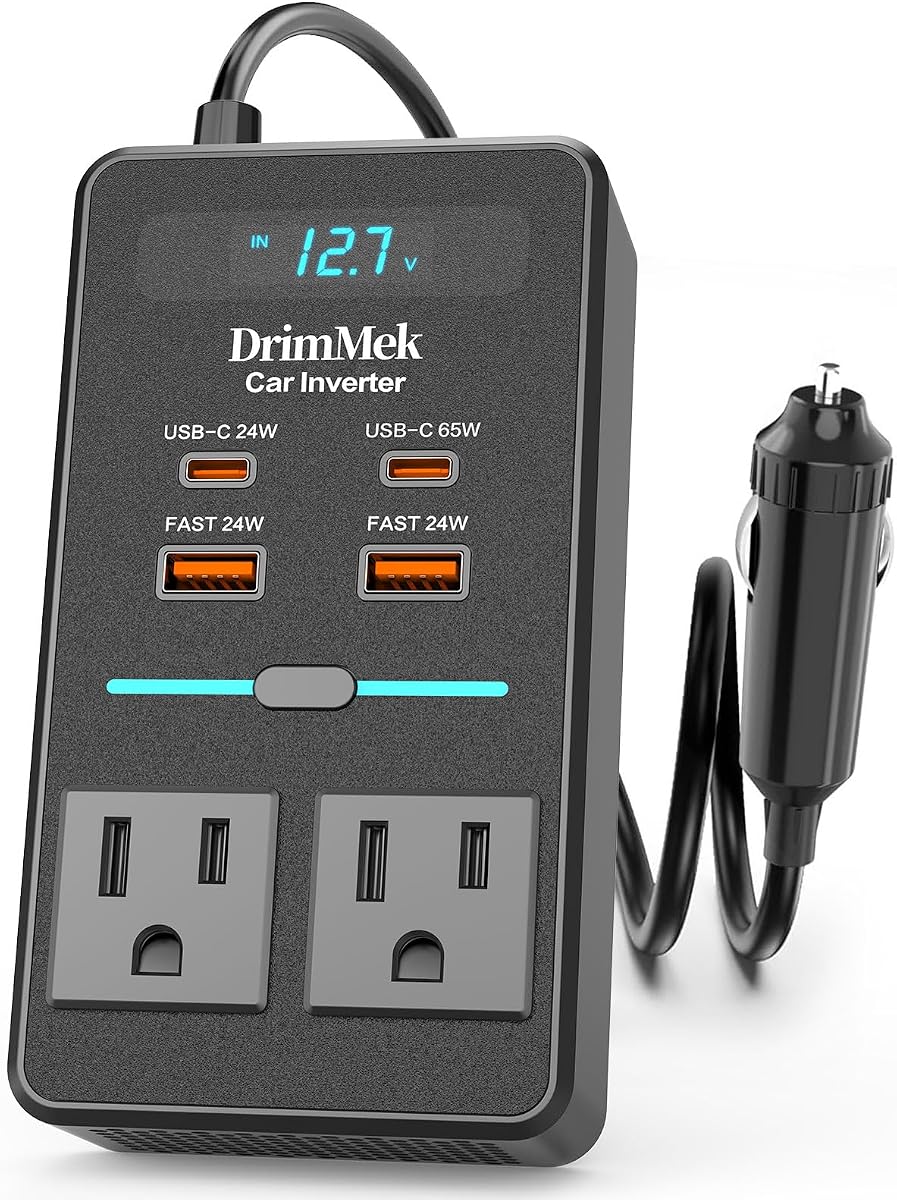
The Compact 300W Car Outlet Adapter combines six output connections in a vehicle-focused package. Its 4.5 rating reflects a generous selection of two AC outlets, two USB-C ports, and two USB-A ports, making it a strong contender for families or mobile offices that need to power several devices together.
We may earn a commission when you buy through this link, at no additional cost to you.
Both USB-C and USB-A connections provide stated 24W and 65W capabilities across the USB-C options, while the USB-A ports are also described as 24W. The two AC outlets can handle supported laptops and small appliances. That breadth of connections reduces cable clutter and can eliminate the need for separate adapters.
The enclosure is designed to be lightweight and easy to place in a glove box or center console. A built-in quiet fan manages cooling during extended use, while the plug-and-play format requires no complicated installation. It is a natural fit for long trips, camping, mobile work, and emergency kits.
Multiple safeguards cover overload, short circuits, overheating, and low voltage. The product also provides a one-year quality guarantee with replacement-only handling, free refunds, and stated 24-hour customer support. The warranty is less extensive than some competing products, so it should be considered as part of the overall value equation.
The critical compatibility note concerns vehicle output voltage. This inverter converts 12V to 110V, and some vehicles operate above 12V, so users should verify the accessory socket specification before use. It does not claim pure sine wave output, making a clean-wave model preferable for especially sensitive equipment.
Six outputs let phones, tablets, laptops, cameras, and other small devices charge from one unit. This is particularly useful for passenger vehicles where several people may need power at the same time.
The lightweight housing and direct vehicle connection minimize installation. Keeping it in a glove box or console means it is available during long drives, overnight camping, or an unexpected roadside need.
We may earn a commission when you buy through this link, at no additional cost to you.
The ALLWEI 300W Car Power Inverter is a straightforward travel inverter with a notably long input cord. Its 4.4 rating reflects a useful mix of two AC outlets, USB-C PD charging, USB-A QC charging, durable construction, and a design that reaches conveniently toward rear-seat passengers.
We may earn a commission when you buy through this link, at no additional cost to you.
The 33-inch cord is longer than the leads commonly included with compact inverters, reducing the need to place the unit in an awkwardly central location. Two AC outlets support laptops, game consoles, televisions, DVD players, and other compatible electronics, while a 27W USB-C port and 18W USB-A port provide faster charging for many phones and tablets.
Its aluminum alloy housing supports heat dissipation and resists the impacts associated with ordinary road use. Intelligent chips detect device voltage and current requirements, while protections cover overheating, under-voltage, overcurrent, over-voltage, overload, and short circuits. A temperature-controlled fan adjusts automatically and is designed to remain quiet.
One operating note is significant: the product information recommends battery clips when operating a load above 180W. A standard cigarette-lighter connection may also be limited by the vehicle socket’s fuse, so the inverter should not be treated as a free-standing 300W source under every driving condition.
This is a practical pick for users who prioritize a long cord, recognizable fast-charging protocols, and a durable body at a straightforward 300W level. It is less compelling for sensitive or medical-style equipment because pure sine wave output is not specified. For standard travel electronics, it offers a clear and useful feature set.
The 33-inch cable gives rear-seat occupants easier access than a short lead, and the body can remain secured near the front outlet. The included fastening tape further helps keep the inverter stable during travel.
USB-C PD 27W and USB-A QC 18W support current charging routines, while the aluminum housing helps dissipate heat. Automatic cooling and extensive electrical protections support stable use with compatible travel devices.
We may earn a commission when you buy through this link, at no additional cost to you.
Choosing a car power inverter requires matching electrical output, connection method, waveform, and thermal design to the devices and vehicle you actually use. The most important first step is to calculate the combined load of everything you plan to power.
Choose an inverter with continuous capacity above your realistic combined load.
Choose pure sine wave output when device sensitivity matters.
Match the plug, voltage, and amperage to your vehicle.
Choose ports that match the devices you carry most often.
Balance pocketability against usable cable reach.
Look for layered electrical and thermal safeguards.
Favor low idle draw for long trips.
Compare warranty coverage and practical accessories together.
Begin by identifying the input voltage of your vehicle and the power requirements of every device you intend to connect. Insert the inverter into the appropriate accessory socket or connect the supplied battery clamps with polarity correct. Turn the inverter on before connecting loads, and begin with one modest device to confirm stable operation.
Keep the unit in a cool, dry location where airflow is not blocked. Do not exceed the continuous power rating, avoid high-draw appliances unless the manufacturer expressly supports them, and account for startup surges. If the overload indicator activates, disconnect devices, reduce the load, and follow the product’s reset procedure rather than repeatedly cycling a tripped unit.
Unplug the inverter when it is no longer needed, especially during extended parking, to reduce standby battery consumption. Inspect the cord, plug, fuses, and connectors for damage, keep moisture away from the openings, and avoid opening the housing. If a fuse blows, disconnect everything and identify the cause before replacing it with the specified type.
Yes, most laptops operate comfortably within a 300W inverter, especially when only one or two devices are connected. Check the laptop’s power adapter label and add the draw of any other attached device. A pure sine wave model is the safer choice when minimizing electrical noise or supporting sensitive electronics matters.
A pure sine wave inverter produces smoother, more utility-like AC, while a modified sine wave uses a simpler stepped waveform. Basic chargers and robust appliances may work with either, but sensitive electronics can behave more reliably with pure sine output. The type should be matched to the equipment rather than chosen solely on price.
No. Many vehicle accessory sockets are protected below the inverter’s full 300W capacity, with a common recommendation to keep plug-connected loads under 150W. Check the socket fuse, vehicle instructions, and cable rating. Battery clamps may be required for higher sustained loads, and vehicles with a voltage above 12V require compatible input ranges.
It can if used for a long time with the engine off, because both connected devices and the inverter itself consume energy. A running engine can often recharge what is used, but prolonged engine-off operation is best avoided. Switch the inverter off when it is not needed and choose a low-idle-draw model for long journeys.
It may be suitable if the device falls within the inverter’s output range and the manufacturer permits inverter use. Pure sine wave output is generally preferable for sensitive medical equipment, and you should carry any required backup power as a safety measure. Test the setup before relying on it away from a conventional outlet.
Some intelligent fan designs rotate slowly or appear inactive when the inverter is powered without a meaningful load. The fan generally speeds up as temperature or output demand increases. The manual and status indicators should be used to confirm that the inverter is operating normally.
Usually not. High-draw heating appliances often approach or exceed the inverter’s continuous limit, and the vehicle’s cigarette-lighter circuit may have a lower limit. Use battery clamps only when the complete system is rated for the load, and avoid operating any appliance that causes an overload shutdown.
The number of ports does not determine the safe number of simultaneous devices; the combined power draw does. Two AC outlets and several USB ports are convenient, but every connected device shares the inverter’s overall capacity. Add expected wattages and stay safely below the continuous rating.
The BESTEK Pure Sine Wave PD30W is the strongest all-around choice because it combines clean output, 300W continuous capacity, modern charging ports, and broad 11–17V input compatibility. The GIANDEL 300W Pure Sine is the premium alternative for excellent power quality, low harmonic distortion, and low idle consumption, while the compact BESTEK Power Inverter offers the most straightforward value for standard travel electronics.
Prioritize the connection method and waveform before considering the number of ports. Drivers who need full output from a stationary vehicle should look toward battery-clamp support, while sensitive electronics benefit from pure sine wave power. For ordinary phone, tablet, laptop, camera, and light use, a compact cigarette-lighter model may be all that is required, provided the combined load remains conservative.
Finally, verify the current listing specifications, included accessories, compatibility details, and current prices before ordering. Vehicle configurations, accessory sockets, device requirements, and available models can change, and the most suitable inverter is the one that safely fits your car, your intended load, and the way you travel.
