Cell Phone Signal Booster for Home
4.5Editor score
Up to 5,000 square feet
All major U.S. carriers
Complete outdoor and indoor kit
Our cellular booster for off grid cabins guide compares ten options for coverage, carrier support, antennas, gain, installation, and multi-device use.
A cellular booster for off grid cabins can restore usable reception in locations where nearby towers are too distant, blocked by trees, or weakened by metal, masonry, and other building materials. The right system combines adequate gain, compatible carrier bands, well-positioned outdoor and indoor antennas, and a practical power source.
We compared all ten products using their stated coverage areas, gain levels, supported networks and bands, antenna arrangements, installation requirements, and intended environments. The list includes fixed cabin systems, mobile RV and truck kits, dual-output home boosters, and designs that can serve homes, offices, barns, and other remote buildings.
Each review explains the strongest use case, meaningful limitations, and installation expectations so you can match the equipment to your cabin rather than relying on a single maximum-gain figure. Ratings and product details reflect the supplied marketplace information, while prices and carrier arrangements can change.
4.5Editor score

2.9Editor score

4.3Editor score
The table below compares the ten boosters by their principal outdoor and indoor coverage features, supported cellular networks, and practical installation approach. Coverage claims are maximum figures and depend on available tower signal, terrain, building materials, antenna placement, and the number of connected devices.


The weBoost Cabin is a purpose-designed system for extending cellular service into an off-grid building, and its supplied rating is 2.9. Its standout combination is up to 65dB of gain, support for 4G LTE and 5G, compatibility with all U.S. carriers, and a coverage target of as much as 5,000 square feet. The product is particularly relevant to cabins surrounded by dense trees or positioned beyond convenient tower access.
We may earn a commission when you buy through this link, at no additional cost to you.
The directional outdoor antenna is the defining feature. It is paired with a 24-foot telescoping pole and stabilizing mounting bracket so an installer can place it above obstructions and aim it toward a usable cell tower. A fabric-covered panel antenna provides the indoor side of the system, while the wall-mount hardware is intended to reduce visual clutter. That balance of purposeful outdoor targeting and relatively discreet indoor distribution makes it a natural fit for a remote cabin rather than a conventional living room.
The principal drawback is the 2.9 rating, the lowest among the products in this guide. That does not erase the listed capabilities, but it makes customer feedback especially important when making a final decision. Maximum gain and area figures are also not guarantees: usable signal still depends on the strength of the nearest compatible tower, building materials, cable placement, and how well the outdoor antenna is aimed. The installation demands more planning than simply placing a desktop repeater near a window.
This is our top overall recommendation for readers who want a dedicated fixed-cabin solution and can position a directional antenna toward a tower. It is worth considering before a generic home booster because the included pole and mounting hardware are tailored to rural placement. Buyers should verify carrier compatibility at their location, compare the product with the alternatives in this guide, and review current customer feedback before installing.
A directional antenna can concentrate reception toward a known tower, making the system useful where terrain or a forest would weaken an omnidirectional signal. The telescoping pole gives the installer more height and placement flexibility than a basic window antenna.
The supplied fabric-covered panel and wall-mount brackets are designed to distribute service without the appearance of a conspicuous piece of communications equipment. Multiple phones, tablets, and connected devices can use the boosted signal simultaneously.
We may earn a commission when you buy through this link, at no additional cost to you.
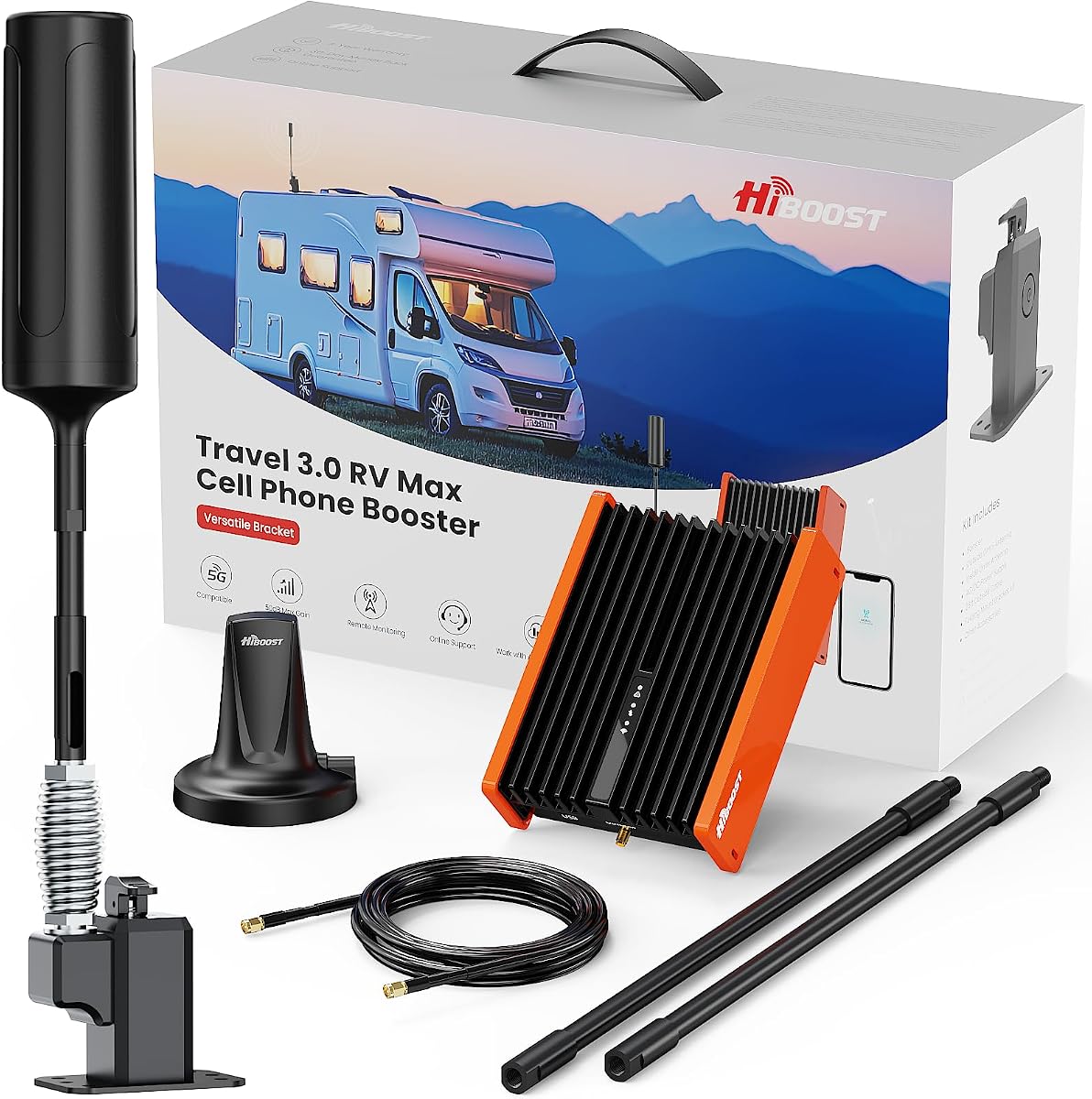
The HiBoost Travel 3.0 RV Max carries a supplied rating of 4.4 and is built for RVs, vans, and trailers that may spend time at remote campsites or mountain passes. It supports 4G LTE and 5G networks, works with all major U.S. carriers, and uses a 360-degree indoor antenna to distribute service throughout a vehicle living area. It is also a practical option for a cabin that doubles as an off-grid base for a mobile home, van, or trailer.
We may earn a commission when you buy through this link, at no additional cost to you.
Its folding outdoor antenna and magnetic indoor antenna make the system unusually adaptable. The 180-degree foldable outdoor antenna improves clearance in garages, covered lots, and height-restricted areas, while the magnetic indoor unit can be repositioned as cabin layouts change. It can run from a 12V vehicle outlet or a standard wall socket, and the HiBoost app provides setup videos, performance monitoring, installation guidance, and troubleshooting support.
This is not a conventional fixed-home booster, so buyers should not confuse its mobile convenience with dedicated cabin coverage. It lacks a stated square-foot indoor coverage target, and its design assumes a nearby vehicle power source. As with every cellular booster, the outdoor location still needs to receive a usable signal. A stronger signal at the antenna produces better results than a weak signal that the system must work hard to recover.
Choose the Travel 3.0 RV Max if your cabin arrangement is mobile, your travel vehicle needs its own reliable connection, or you want one flexible kit to use in several off-grid locations. It is less appropriate if you need permanent wide-area distribution throughout a large, stationary building. For those circumstances, the fixed directional and multi-antenna systems in this guide provide a more natural fit.
The dual power options and mobile antenna arrangement let the kit move between a powered cabin, a campsite, or a vehicle. That flexibility is valuable when the strongest available tower changes from one remote location to another.
The HiBoost app supplies installation aids, signal monitoring, and troubleshooting information. The manufacturer also provides U.S.-based technical support, a 30-day money-back guarantee, and a three-year manufacturer warranty.
We may earn a commission when you buy through this link, at no additional cost to you.
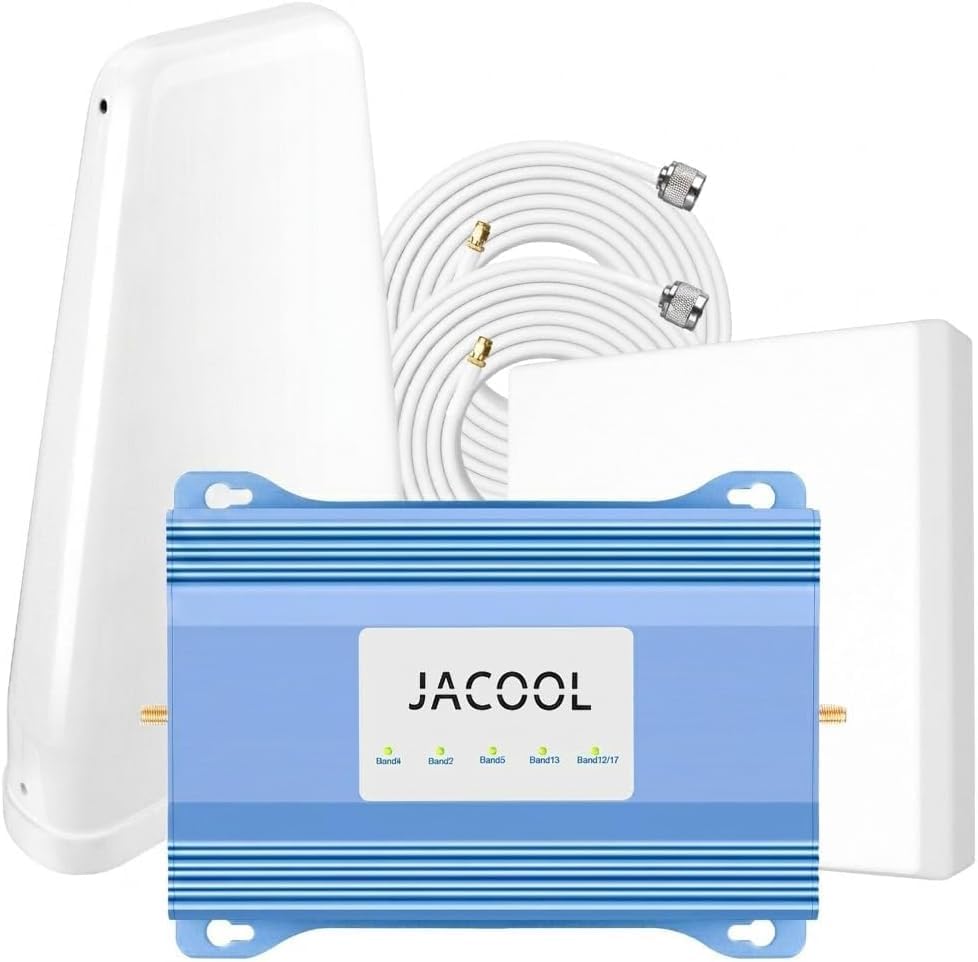
The Home Booster Up to 5,000 Sq Ft has the highest supplied rating in this group at 4.5, and it combines a broad carrier list with a complete antenna-and-cable package. It is designed to improve indoor coverage in houses, offices, cabins, basements, garages, and metal buildings, making it a versatile and value-conscious option for a fixed off-grid cabin.
We may earn a commission when you buy through this link, at no additional cost to you.
The system supports 4G LTE and 5G service when the active cellular signal uses a supported frequency band. It works with Verizon, AT&T, T-Mobile, U.S. Cellular, and other major U.S. carriers across bands 2, 4, 5, 12, 13, 17, 25, and 66. Its directional indoor panel can be aimed toward the areas that need the strongest service, while the outdoor antenna should be placed where a usable tower signal exists and aimed toward a compatible cell tower.
The 5,000-square-foot claim is an upper limit rather than a promise. Results vary with outdoor signal strength, construction materials, antenna placement, and the number of simultaneous users. The instructions recommend at least 20 feet of vertical or 50 feet of horizontal separation between the outdoor and indoor antennas to help prevent oscillation. A basic home installation also demands care when routing and grounding coaxial cables.
This is a strong recommendation for buyers who want broad carrier compatibility and a complete kit without choosing a highly specialized mobile system. It is especially useful for a cabin where calls, texts, data, and simultaneous phone or tablet use are the priority. Confirm that a usable signal reaches the proposed outdoor antenna position and that the supported bands match the carrier serving the property.
Support for major U.S. carriers and numerous lower and mid-frequency bands makes this kit suitable for properties where the active carrier and local tower configuration may vary. The included panel antenna provides focused indoor distribution.
The package includes an outdoor antenna, an indoor panel antenna, and coaxial cables. A careful installation can improve calls, texts, upload and download performance, and reception for multiple cellular devices in the same property.
We may earn a commission when you buy through this link, at no additional cost to you.
The Rural Metal Building Booster is a fixed installation with a stated coverage target of up to 6,000 square feet and a supplied rating of 4.2. Its two independent indoor output ports distinguish it from simpler single-output systems, making it a candidate for a large cabin, barn, garage, basement, or metal building where the goal is service in separate rooms or on different floors.
We may earn a commission when you buy through this link, at no additional cost to you.
Its real-time LCD displays outdoor signal strength and frequency information, helping an installer find a better outdoor antenna position. Automatic gain control adjusts signal power and is designed to limit tower interference without constant manual tuning. The system supports 5G, 4G LTE, and 3G signals and is optimized for AT&T, T-Mobile, and U.S. Cellular across bands 2, 4, 5, 12, 17, 25, and 66.
Verizon compatibility is the critical caveat. The product supports Verizon bands 2, 4, and 5 in urban areas but does not support Verizon Band 13, which is common on rural Verizon towers. That limitation could be decisive at an isolated cabin, so checking the active band in Field Test Mode is essential. Actual coverage still depends on available outdoor signal, construction, and placement.
This system is a good fit when two independent indoor outputs would eliminate extra splitters or couplers and when the property is served by a compatible carrier and tower band. It is less suitable for a rural Verizon property that depends on Band 13. For those users, the weBoost Cabin or another product with broader stated carrier support may be the safer choice.
Two independent output ports can serve different parts of a property without adding external splitters. This is useful in long cabins, workshops, converted barns, and buildings where bedrooms and living areas are far apart.
The LCD provides signal-strength and frequency data, while automatic gain control manages output in real time. Together, these features make the system more approachable for first-time booster installers.
We may earn a commission when you buy through this link, at no additional cost to you.
The Truck RV Overland Booster is built for vehicles traveling through remote and fringe coverage areas, and its supplied rating is 3.9. It supports 5G, 4G LTE, and 3G networks across bands 4, 12, 17, 5, 2, and 25, with up to 70dB of gain. It is intended for calls, data, streaming, browsing, and hotspot use when a cabin or campsite lacks dependable service.
We may earn a commission when you buy through this link, at no additional cost to you.
The outdoor antenna is upgraded for mobile use, with a waterproof, shockproof, wear-resistant design and a flexible spring base. A compact indoor antenna and high-resolution LCD help with installation and signal monitoring. The product supports simultaneous use by multiple smartphones, tablets, and data modems, which is useful for families or work teams traveling in the same vehicle.
Compatibility requires careful attention. Although the listing describes compatibility with major U.S. networks, it explicitly excludes Verizon Band 13. It also states that the outdoor location should have at least one bar, approximately -110 dBm, for optimal performance. The stated 5-8-mile communication range should therefore be treated as a maximum rather than a guaranteed distance from any tower.
Choose this kit when ruggedness and mobile use matter more than permanent whole-cabin antenna placement. It is particularly suitable for an off-road cabin reached by truck, RV, or overland vehicle, where a durable outdoor antenna can tolerate travel and changing locations. Buyers using Verizon should check whether their local tower relies on Band 13 and select a different model if it does.
The outdoor antenna is described as waterproof, shockproof, and wear-resistant. Its spring base also adds flexibility where a fixed mast could be vulnerable during travel or in exposed locations.
Multiple smartphones, tablets, and data modems can connect at the same time. The system is therefore useful for shared travel, work-from-vehicle tasks, navigation, and communication in sparsely covered areas.
We may earn a commission when you buy through this link, at no additional cost to you.
The HiBoost Off Road Booster is a rugged vehicle-oriented system with a supplied rating of 4.2. It supports 4G LTE and 5G and is compatible with major carriers including AT&T, Verizon, and T-Mobile. The product is aimed at remote trails, mountain routes, and deserts where a cabin may be a base for an off-road vehicle or where cellular coverage is unreliable across changing terrain.
We may earn a commission when you buy through this link, at no additional cost to you.
The rotating antenna mount folds down to accommodate garages, parking structures, and low-clearance areas, making it easier to store or reposition. Its metal construction is paired with a protective silicone cover that helps resist bumps, scratches, and outdoor conditions. An app assists with signal detection, installation guidance, and setup, while three years of dedicated support are included.
Compared with the Travel 3.0 RV Max, this model emphasizes a particularly rugged enclosure and fold-down convenience rather than a stated whole-RV indoor coverage area. It is still a booster, not a satellite link, so it cannot create service where the outdoor antenna receives no compatible cellular signal. Its effectiveness also depends on a suitable tower, supported network, and correct antenna placement.
This is a good option for owners who need a durable system in a truck, camper, or off-road vehicle used around a remote cabin. It is less compelling for a permanently installed cabin requiring broad room-to-room coverage, where a dedicated fixed panel system would be easier to position. Confirm carrier and band compatibility, then evaluate the protective mounting system against the conditions the vehicle will encounter.
A metal body and silicone outer cover help the unit tolerate impacts, scratches, and outdoor exposure. That construction is meaningful for remote routes where a fragile desktop-style system would be unsuitable.
The rotating mount folds the antenna down for confined parking areas. Signal-detection and installation guidance in the app makes the system approachable for owners without advanced antenna experience.
We may earn a commission when you buy through this link, at no additional cost to you.
The HiBoost Home Office Booster has a supplied rating of 4.3 and offers a more compact fixed-system proposition for cabins, home offices, and small remote workspaces. It supports 5G and 4G LTE, multiple simultaneous devices, and all major U.S. carriers, including Verizon, AT&T, Sprint, T-Mobile, Straight Talk, and U.S. Cellular.
We may earn a commission when you buy through this link, at no additional cost to you.
Its professional directional antenna is designed to receive a distant base-station signal with more gain than an omnidirectional antenna. A color LCD presents real-time signal strength, and the HiBoost Signal Supervisor app helps users locate a stronger outdoor antenna position. The stated target is up to 2,000 square feet, with automatic gain control adjusting operation to support stable performance.
The system requires at least one bar of signal at the outdoor antenna location to improve the result. A directional antenna also needs proper aiming, and the included whip antenna offers a different placement option than the high-gain outdoor unit. Those installation details make the product better suited to a small building where one strong outdoor direction is available than to a property requiring 360-degree reception from many directions.
This booster is a sensible pick for a small cabin that needs dependable calls and data but does not require the 5,000- to 7,000-square-foot claims of larger systems. It also suits part-time or work-from-cabin use. Buyers should test signal outdoors, install with the booster off during antenna adjustment, and use the LCD or app to identify the best position.
The directional outdoor antenna can favor a specific tower, providing a useful advantage where the nearest usable signal comes from one predictable direction. AGC then helps keep amplification stable.
Real-time signal readings and the Signal Supervisor app make it easier to compare installation positions. A 30-day money-back guarantee and three-year warranty provide additional support for first-time buyers.
We may earn a commission when you buy through this link, at no additional cost to you.
The Hiboost Hero has a supplied rating of 4.4 and is aimed at homes, offices, garages, farms, remote areas, warehouses, and metal buildings. It offers up to 65dB of maximum gain and a stated indoor coverage target of 3,000 square feet, providing enough scale for many cabins without claiming the largest area in the guide.
We may earn a commission when you buy through this link, at no additional cost to you.
Two indoor antenna options give the installer a choice between a high-power panel for wider distribution and a compact whip for mobile or more targeted use. The Hiboost app assists with finding the strongest location for a high-gain directional outdoor antenna, while one-on-one technical support can help with installation and adjustments. The system is compatible with 5G and 4G LTE across the listed U.S. carrier bands.
The product gives unusually specific prerequisites. Outdoor signal should be between -100 dBm and -120 dBm, approximately one to two bars, with a compatible tower within roughly 3-5 miles. Outdoor antenna mounting and cable routing are required, and the listing estimates an installation time of about one to two hours. Hotspot devices cannot be boosted, even though ordinary phones, tablets, and other cellular-connected equipment can benefit.
The Hero is a strong choice for a cabin owner who values installation guidance and wants flexible indoor antenna options. It is particularly suitable for a moderately sized property with one identifiable tower direction. Buyers should perform the stated signal checks before purchase and accept that app guidance cannot replace careful physical placement or professional help for unusually difficult installations.
The extended-range panel is intended for larger spaces, while the compact whip can be repositioned more freely. This makes the kit adaptable to both a permanent cabin installation and a less fixed arrangement.
The stated one-to-two-bar outdoor requirement and approximate tower-distance guidance offer a practical way to assess feasibility. Verifying the active band before installation helps prevent an otherwise well-positioned system from underperforming.
We may earn a commission when you buy through this link, at no additional cost to you.
The Blue 7,000 Sq Ft Booster offers the largest stated indoor area in this guide and a supplied rating of 4.2. It includes two indoor panel antennas and is aimed at improving weak cellular service across three to five rooms in a home or office, making it relevant to a large cabin, converted residence, workshop complex, or rural property.
We may earn a commission when you buy through this link, at no additional cost to you.
Maximum gain is listed at 70dB, with maximum output of 17 dBm. The system supports 5G and 4G LTE voice, text, and data for North American carriers, including Verizon's 5G Nationwide data signals. It is FCC and IC certified, and its installation instructions specify approximately 32 feet of separation between the outdoor log-periodic antenna and the indoor antennas to reduce the chance of feedback oscillation.
The area figure varies substantially with the signal at the outdoor antenna. The product's own guidance associates one to two bars with roughly 800 square feet, three to four bars with about 3,000 square feet, and five bars with as much as 7,000 square feet. If no signal is available at the outdoor antenna, the booster cannot provide a usable result. Two indoor panels also require thoughtful placement rather than simply placing both beside the booster.
This product is best for a large, well-received property with a strong outdoor signal and a need to cover several rooms. It may be excessive for a tiny cabin with marginal reception. Before buying, check the signal at the exact outdoor position, identify available bands, and plan a safe mounting point that meets the separation guidance while keeping the system accessible for maintenance.
Two directional indoor panels can distribute boosted service into separate areas of a larger building. Proper placement allows the system to cover multiple rooms without relying on a single central panel.
The product clearly links usable indoor area to the strength of the received signal. A strong outdoor reading can support broad distribution, while a weak reading limits the system regardless of its stated maximum gain.
We may earn a commission when you buy through this link, at no additional cost to you.
The SureCall Fusion4Home Max has a supplied rating of 4.3 and centers on a distinctive extended-range approach for homes and off-grid cabins. Rather than relying only on signal arriving at the building, its architecture amplifies the outdoor signal at its strongest received point and then distributes it indoors. That approach is particularly relevant to properties beyond comfortable tower range.
We may earn a commission when you buy through this link, at no additional cost to you.
The system supports 5G and 4G LTE, works with AT&T, T-Mobile, Verizon, U.S. Cellular, Mint Mobile, Boost Mobile, and more, and supports simultaneous use by phones, tablets, hotspots, and other cellular devices. SureCall describes the product as designed, assembled, and tested in the United States, with FCC certification, a three-year warranty, and lifetime U.S.-based support.
No specific indoor square-footage target is supplied, so it should not be compared directly with products making 2,000-, 3,000-, 5,000-, 6,000-, or 7,000-square-foot claims. The outdoor-first architecture can be valuable, but it still requires usable signal outside and a correctly positioned receiving antenna. Material gains also depend on carrier network conditions, building construction, and installation quality.
This is a strong recommendation for a cabin far from a tower or one that has struggled with indoor reception despite a usable outdoor signal. Its broad carrier list and simultaneous-device support suit families sharing a property. Compare it with the explicitly sized weBoost Cabin and budget home booster based on the cabin's dimensions, carrier, and how difficult it is to position an outdoor antenna.
The extended-range design emphasizes receiving signal at a favorable point outside before distributing it indoors. That can improve the practical result at cabins where wall losses are substantial or the tower is distant.
Multiple cellular devices can be supported at once, and compatibility spans major carriers plus several popular mobile brands. A one-time purchase model avoids the need for a recurring connectivity subscription.
We may earn a commission when you buy through this link, at no additional cost to you.
The most important factors are usable outdoor signal, compatible carrier bands, realistic coverage needs, and an installation that suits the cabin and its surroundings. A booster cannot replace a cellular tower, so confirming the signal environment before selecting equipment is essential.
Confirm that the signal belongs to a carrier and frequency band supported by the chosen booster. Check the active band through the phone's Field Test Mode or another reliable network diagnostic. An outdoor antenna positioned toward a tower on an unsupported band will not produce the expected result.
Match the advertised area to the building rather than choosing the largest number available. Oversized systems can add cost and installation complexity without producing better results when the outdoor signal is weak.
Never rely solely on the carrier logo printed on the package. Confirm the supported frequency list and, when possible, test the intended antenna position with a phone that operates on the same network as the booster.
For a fixed cabin, favor a directional outdoor antenna if you know where the tower sits and can safely aim toward it. For a mobile cabin or changing campsites, an omnidirectional system offers more flexibility.
The outdoor antenna should also be mounted securely and kept away from electrical conductors. Plan cable routing, grounding, weather protection, and maintenance access before drilling or attaching equipment.
List the available power sources, the distance between the booster and antenna locations, and the route for each cable. If those logistics are difficult, a more compact system may deliver a better result than a high-gain model that cannot be installed properly.
For a cabin used for work or online calls, test the specific devices and services you intend to use. A stronger 4G LTE connection that remains stable is often more useful than a theoretical 5G improvement that drops when signal conditions change.
Before buying, download the manual and read the compatibility and separation requirements. Choose a system supported by accessible technical assistance and realistic expectations for your installation site.
Begin by identifying the carrier and band used at the property, then test signal strength at multiple outdoor locations. Install the system with power turned off, mount the outdoor antenna securely, and aim it toward a compatible tower. Route and secure the coaxial cable while observing the product's required antenna separation, then place the indoor panel or whip antenna where connected devices need the strongest reception.
Power on the booster only after checking the antenna connections. Use the display or manufacturer app to compare the received signal, adjust the outdoor antenna's direction, and make small changes one at a time. If oscillation, unstable service, or a decline in performance occurs, check antenna separation and cable connections before increasing or reducing amplification. Do not operate the unit if the carrier network or local regulations prohibit its use.
For ongoing care, inspect exposed mounts and cable connections after severe weather, check that the outdoor antenna remains aimed toward the tower, and keep the indoor antennas clear of obstructions. Clean the system according to its manual, avoid placing it in an unventilated or wet enclosure, and record the initial signal readings. Comparing those readings later can reveal antenna movement, cable damage, or changing network conditions.
No. A booster amplifies an existing cellular signal received by its outdoor antenna, so it still depends on a compatible tower being within usable range. A product may improve a marginal one-bar signal into a strong indoor connection, but it cannot generate service from nothing. Check the signal and band outside before purchasing or installing a system.
At least one usable bar outside is a common minimum among the products in this guide, and some list an optimal approximate range of -100 dBm to -120 dBm. More signal generally allows more stable indoor coverage, especially with long cable runs or several simultaneous users. Test at the actual outdoor antenna position because indoor phone readings can be misleading.
They can, but only when the carrier's active 5G service uses a supported band. Many current 5G networks are delivered through 4G bands using Dynamic Spectrum Sharing, and not every booster supports every frequency. Verify the local carrier, active band, and device requirements before buying a system advertised for 5G.
No. Stated square-foot figures are maximum targets under favorable conditions. Outdoor signal strength, terrain, trees, building materials, antenna placement, cable loss, and user count all affect the result. A system advertised for several thousand square feet may cover much less if the outdoor signal is weak or the cabin contains metal and masonry.
A directional antenna is often best for a fixed cabin when the usable tower is in a known direction because it concentrates gain toward that tower. An omnidirectional antenna is more forgiving when the strongest signal may come from different directions or when the equipment must remain mobile. The nearby-booster placement and the need to move frequently should also influence the choice.
Yes, provided you follow the product's FCC-approved installation requirements, use compatible frequencies, and separate the outdoor and indoor antennas enough to prevent feedback. A cabin with metal siding, a metal roof, masonry, or thick walls may need careful antenna placement and more than one indoor antenna. The booster and its power source also need suitable protection from moisture and temperature extremes.
It depends on the product. A cellular booster can generally improve service for compatible phones, tablets, and cellular-connected equipment, but the Hiboost Hero specifically notes that hotspot devices cannot be boosted. Even where hotspots work with other systems, the device must use a supported carrier and band. Confirm the limitation with the manufacturer before relying on a hotspot as your cabin's primary connection.
Start by comparing the current outdoor signal readings with the readings from the initial installation. Check the outdoor antenna's direction, cable connections, power supply, and separation from the indoor antenna. Also verify that the tower is using a supported carrier and band. Support displays and apps can help identify weak reception, while manufacturer technical support can assist with more difficult placements.
The weBoost Cabin stands out as the most purpose-built overall choice, with a directional outdoor antenna, telescoping pole, 65dB maximum gain, and a cabin-oriented coverage target. The Home Booster Up to 5,000 Sq Ft is the strongest budget-oriented fixed option because of its broad carrier support, complete antenna kit, and supplied 4.5 rating. The SureCall Fusion4Home Max takes the premium position through its extended-range, outdoors-first architecture and broad multi-device support.
Prioritize outdoor signal and carrier-band compatibility before comparing maximum gain or square-footage claims. A smaller, properly positioned system can outperform a larger one that is aimed incorrectly or installed too close to its indoor antenna. For mobile cabins and travel equipment, the HiBoost Travel 3.0 RV Max and rugged off-road models add folding mounts, vehicle-oriented antennas, and flexible power options.
Finally, compare the current listing, customer feedback, installation requirements, and complete package details at the time of purchase. Prices, seller offers, product configurations, and carrier network behavior can change, so the information in this November 2026 guide should be used as a framework rather than a substitute for checking the latest listing.