
SilverStone RM4A
3.6Editor score
Up to 360mm radiator support
Eight PCI expansion slots
SSI-EEB motherboard compatibility
Front USB Type-C connection
A 4U rackmount GPU server chassis must balance accelerator capacity, airflow, storage flexibility, power delivery, and serviceability. The right enclosure gives multi-GPU systems room to operate without turning every upgrade into a cooling or accessibility compromise, while remaining practical for installation in a standard data-center rack.
We compared ten chassis and GPU server systems using their published specifications, including expansion slots, motherboard support, drive bays, cooling provisions, power configurations, and GPU-related design details. The list covers conventional server enclosures, storage-oriented models, liquid-cooling options, and complete barebone systems.
Each selection reveals a different balance of capabilities: some emphasize affordable liquid cooling, others prioritize dense accelerator deployments, and several target data-center storage. Product ratings and configurations can change, so buyers should verify the current listing, exact board revision, included accessories, and compatibility details before ordering.
3.6Editor score

5.0Editor score

4.3Editor score
As an Amazon Associate we earn from qualifying purchases.
The comparison below organizes all ten systems around GPU-relevant capacity, cooling, storage, power, motherboard fit, and expansion. It is intended to simplify the first screening stage before checking the exact motherboard, accelerator dimensions, cooling hardware, rack, and accessory requirements.


The SilverStone RM44 is a 4U rackmount server chassis with a 4.3 rating and a clear emphasis on cooling flexibility. Its standout specification is support for a radiator up to 360mm, making it appealing for builders planning a densely populated GPU system where conventional air cooling could restrict accelerator selection.
We may earn a commission when you buy through this link, at no additional cost to you.
The enclosure accepts SSI-EEB and Extended ATX motherboards, giving it more flexibility than a chassis limited to standard ATX boards. Eight PCIe or PCI expansion slots create room for accelerator cards and other add-in hardware, while sliding rail mounting holes are intended to shorten the process of installing the enclosure in a rack.
The supplied information does not describe drive-bay capacity, redundant power support, or included cooling hardware, so those points require verification before purchase. The lack of listed storage detail also makes this a better fit for GPU-focused projects than for buyers who require a known high-density drive configuration out of the box.
The RM44 is a strong choice for a custom liquid-cooled GPU server assembled around a large motherboard. It is especially relevant when radiator capacity is the priority, although buyers should confirm card clearances, pump mounting, tubing routes, storage needs, and the power-supply arrangement against the manufacturer or current listing.
Support for a radiator up to 360mm gives builders a broader thermal envelope than enclosures limited to smaller radiators. That additional capacity can help when several high-output accelerators operate under sustained heavy workloads, although the final loop still requires suitable fans, pump, tubing, and a compatible CPU block.
SSI-EEB and Extended ATX motherboard support accommodates larger server platforms, while eight expansion slots create a useful foundation for multiple accelerators. Exact GPU compatibility depends on card thickness, slot spacing, riser requirements, and the power configuration selected for the completed system.
We may earn a commission when you buy through this link, at no additional cost to you.
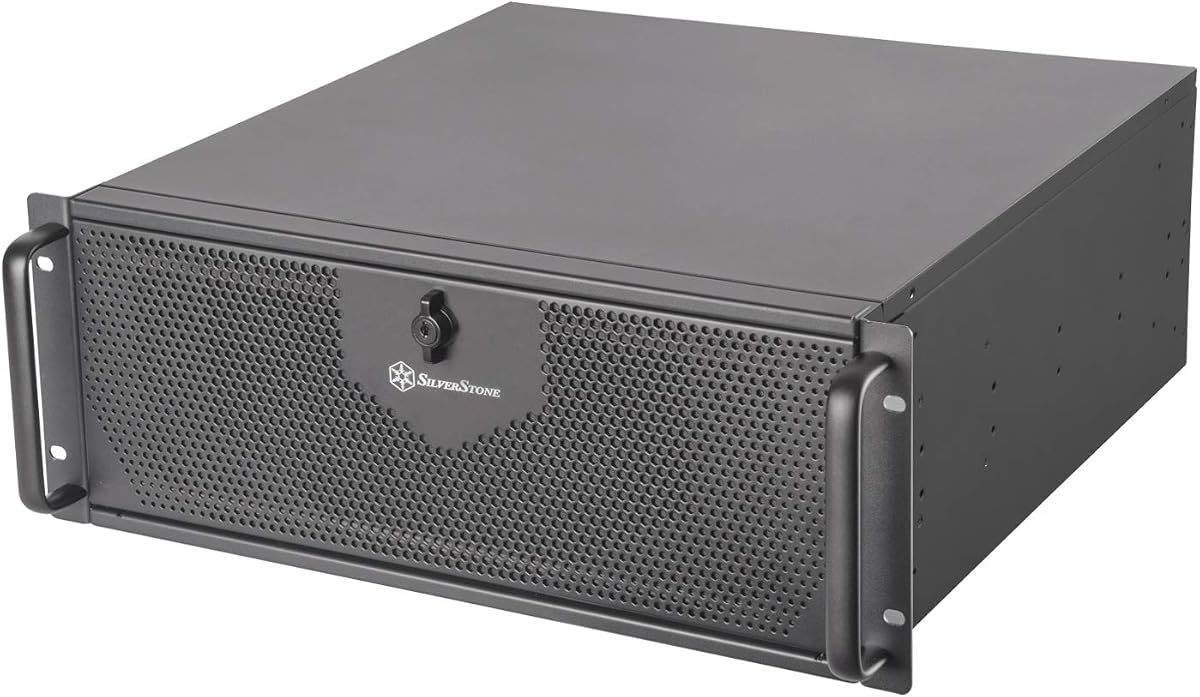
The SilverStone RM4A is a value-oriented 4U server chassis rated 3.6, with support for 360mm radiators and two 80mm fans. That cooling allowance is unusually useful in a GPU enclosure because it can provide a foundation for a custom loop intended to manage the heat generated by several accelerators.
We may earn a commission when you buy through this link, at no additional cost to you.
The chassis supports SSI-EEB motherboards and eight PCI expansion slots, offering a useful combination of board compatibility and room for add-in cards. It also permits hard-drive mounting on the expansion-card retainer and includes a front USB Type-C interface for convenient peripheral connectivity.
Its lower rating and more limited published feature set make it less compelling for buyers seeking a fully documented enterprise platform. The supplied information does not clearly identify a redundant power configuration, detailed cooling arrangement, or the quantity and interface of installed drive bays, all of which should be checked.
The RM4A makes sense for a cost-conscious custom GPU server whose owner is comfortable confirming enclosure details and assembling the cooling and power systems. It is less suitable for a turnkey deployment where a complete backplane, redundant power supply, and detailed service specifications are required.
The listed 360mm radiator compatibility gives the RM4A a useful foundation for a custom liquid-cooling loop. Its two 80mm fan positions should be matched carefully to the radiator and pump arrangement because fan orientation and static pressure requirements can materially affect the finished cooling performance.
Eight PCI expansion slots provide a workable base for GPU and I/O cards, while retainer-based drive mounting adds some storage flexibility. Builders using multi-slot accelerators should map the slot arrangement and physical card clearances before purchasing components.
We may earn a commission when you buy through this link, at no additional cost to you.
The ZhenLoong X412 is a storage-heavy 4U rack server case designed for GPU, E-ATX, and enterprise storage configurations. Its most impressive features include 12 hot-swappable drive positions, 11 full-height PCI slots, and a pair of 2000W CRPS power modules.
We may earn a commission when you buy through this link, at no additional cost to you.
The listed drive arrangements support 12 SAS or SATA drives, or a mixed configuration of four SAS or SATA drives with eight U.2 SSDs. The backplane includes Mini SAS connections using SFF-8643 and SFF-8654, while screwless 3.5-inch caddies support U.2, SAS, and SATA devices.
Its power board can deliver up to 3000W and automatically switch the dual modules between redundant and stacked operating states. These are substantial server-oriented features, but the absence of a customer rating, the approximately 30-to-40-day transportation cycle, and the long supplier title require extra care when comparing it with established alternatives.
The X412 is well suited to combining substantial GPU processing with large local storage, especially for data-center or private-cloud configurations. Buyers should confirm controller support, exact backplane wiring, motherboard model fit, GPU spacing, operating-system requirements, and delivery timing before committing.
Twelve tool-free 3.5-inch positions and broad SAS, SATA, and U.2 support distinguish the X412 from GPU-focused enclosures with limited storage. Mixed solid-state and hard-drive configurations can help balance capacity, endurance, and workload performance in enterprise storage builds.
Two included 2000W CRPS modules and a maximum output of 3000W provide substantial power headroom for demanding accelerators. Automatic switching between redundant and stacked states adds operational flexibility, though the final component mix still needs to respect per-rail and system limits.
We may earn a commission when you buy through this link, at no additional cost to you.
The RackChoice 4U is an 8-bay rackmount chassis with a 4.0 rating and broad motherboard compatibility. It supports E-ATX, ATX, MicroATX, and Mini-ITX boards, making it a practical starting point for GPU systems built on either compact or extended platforms.
We may earn a commission when you buy through this link, at no additional cost to you.
Eight hot-swappable 3.5-inch SAS or SATA bays, additional fixed storage, three 120mm PWM ball-bearing fans, and eight full-height expansion slots provide a balanced foundation for compute and storage. The power section can accept a standard ATX supply or a redundant CRPS unit, offering flexibility as the system develops.
Mini SAS backplane wiring and two included reversed SFF-8643-to-SATA cables simplify connections for listed drive arrangements. The limitation is that no explicit maximum GPU count appears in the supplied information, so buyers must assess card width, slot spacing, cooling direction, and available power rather than assuming a fixed accelerator count.
This chassis fits buyers who want a versatile 4U platform without committing to a fully integrated barebone system. It is particularly attractive for small teams assembling a GPU appliance with moderate storage needs, provided they confirm physical compatibility, cooling requirements, and the exact power supply option before ordering.
Support spanning E-ATX through Mini-ITX helps buyers reuse components and adapt the platform as accelerator requirements change. The chassis can therefore serve as a general-purpose foundation rather than locking the build to one narrow motherboard ecosystem.
The hot-swap backplane, included SATA cables, and choice of ATX or redundant CRPS power create several upgrade paths. A Mini SAS controller or compatible backplane behavior should be confirmed, especially for mixed drive configurations or nonstandard U.2 requirements.
We may earn a commission when you buy through this link, at no additional cost to you.
The Rosewill RSV-AI01 is a 4U AI-oriented chassis with a 3.0 rating and an explicit support claim for up to four GPUs. It is designed for E-ATX motherboards and combines accelerator capacity with eight hot-swappable 3.5-inch or 2.5-inch SATA and SAS drive positions.
We may earn a commission when you buy through this link, at no additional cost to you.
Cooling includes three hot-swappable 12038 PWM fans and two rear 8038 fans, creating a defined airflow layout for a multi-accelerator system. The chassis also offers USB 3.0 and USB 3.2 Type-C connectivity, while the included rail kit supports installation in a standard 19-inch server rack.
The published specifications are strong for a purpose-built AI enclosure, but the lower rating and absence of details about power redundancy, expansion-slot quantity, liquid cooling, and exact GPU clearance warrant careful verification. A stated four-GPU maximum also does not eliminate the need to check connector placement, card length, and riser use.
The RSV-AI01 is best suited to a builder who has already established a four-GPU configuration and wants hot-swap storage and active front-to-rear cooling. It is a less obvious choice for a high-density eight-accelerator deployment or a turnkey enterprise appliance requiring comprehensive power and management documentation.
The explicit capacity for up to four GPUs makes the RSV-AI01 easier to shortlist for AI and machine-learning projects. Buyers should still match the enclosure to specific card dimensions, slot widths, and connector arrangements because the physical accelerator configuration can vary widely.
Hot-swappable front fans can simplify replacement without removing the entire enclosure, while eight drive bays support fast service and local data retention. The combination is useful in a production server where storage and cooling maintenance both need to be efficient.
We may earn a commission when you buy through this link, at no additional cost to you.
The Supermicro CSE-747BTQ-R2K04B is a 4U chassis with a 5.0 rating and one of the clearest accelerator layouts in this group. Its 11 full-height, full-length expansion slots are specifically optimized for a four-double-width GPU solution, making it a natural centerpiece for a dense compute server.
We may earn a commission when you buy through this link, at no additional cost to you.
The enclosure supports E-ATX boards up to 15.2 by 13.2 inches, along with ATX and Micro ATX alternatives. Eight hot-swappable 3.5-inch SAS or SATA positions use a backplane with SES2 support, which gives the chassis useful storage flexibility for operating systems, datasets, and scratch space.
Cooling is handled by four lower-middle 92mm PWM fans and two additional rear 80mm PWM fans. A front HDD door lock and side-panel intrusion switch add physical and administrative security features that make more sense in a shared data-center environment than in a temporary workstation enclosure.
This Supermicro model is the strongest general recommendation for buyers who want a well-balanced four-GPU server chassis rather than a complete barebone appliance. It requires compatible motherboards, accelerators, memory, storage controllers, and power supplies, but the documented GPU layout and enterprise chassis features make it especially compelling for experienced builders.
The expansion arrangement is optimized around four double-width GPUs instead of offering only a generic slot count. This focus reduces ambiguity when planning a multi-card build, provided the selected cards fit the expected slot spacing, power connectors, and cooling envelope.
Hot-swappable storage, a front door lock, and a side-panel intrusion switch make the chassis more suitable for shared facilities. These features support maintenance practices and physical access control in environments where an open workshop-style tower would be less convenient.
We may earn a commission when you buy through this link, at no additional cost to you.
The ASRock 4U8G-GNR2/RF is an integrated 4U barebone GPU server designed around eight full-height, full-length PCIe 5.0 x16 accelerators. Unlike a basic enclosure, it combines the chassis, dual-socket motherboard platform, memory capacity, cooling provisions, and redundant power architecture in a defined server design.
We may earn a commission when you buy through this link, at no additional cost to you.
Its dual Socket E2 platform supports Intel Xeon 6700P, 6500P, and 6700E processors. Sixteen plus sixteen DIMM slots accept DDR5 RDIMM and MRDIMM, while four hot-swappable 2.5-inch NVMe bays offer a compact storage option. A larger 24-bay SATA or SAS version is also listed, with a RAID or HBA card required.
The platform is designed to move substantial quantities of air for 600W GPUs and accelerator cards. Its three-plus-one 80-Plus Titanium 2700W CRPS arrangement provides high power capacity, but accelerator power limits, cooling demands, and component compatibility still require careful engineering. No customer rating is listed for this listing.
The system is appropriate for organizations that want a dense, eight-accelerator platform and are prepared to install supported CPUs, memory, GPUs, storage, and an operating system. It is less suitable for buyers seeking only a shell, since the added integration comes with a much broader bill of materials and more complex support considerations.
Eight PCIe 5.0 x16 accelerator positions create one of the densest GPU layouts represented in the guide. The design is aimed at substantial parallel-compute workloads, where high memory bandwidth, large CPU memory capacity, and coordinated accelerator deployment can be more important than a simple tower-style build.
Thirty-two DDR5 DIMM positions provide considerable capacity for data-intensive services. Support for RDIMM and MRDIMM expands platform options, but buyers should confirm processor-specific memory rules, population arrangements, supported modules, and firmware requirements with the vendor.
We may earn a commission when you buy through this link, at no additional cost to you.
The ASRock 4U8G-GNR2/RF listing describes a high-density 4U GPU server with eight full-height, full-length PCIe 5.0 x16 positions. Its supplied specifications describe an AMD Socket SP5 implementation with support for EPYC 9005 and 9004 families, although the product title incorrectly references Intel Xeon processors.
We may earn a commission when you buy through this link, at no additional cost to you.
That mismatch makes careful listing verification essential. The detailed specifications state 12 plus 12 DIMM slots, DDR5 RDIMM and RDIMM-3DS support, 16 hot-swappable 2.5-inch NVMe bays, and an alternative 24-bay SATA or SAS arrangement. A RAID or HBA card is required for the larger storage configuration.
The power design uses three plus one redundant 3200W CRPS units, providing exceptional headroom for a densely configured accelerator system. Airflow is engineered for 600W GPUs and accelerator cards, but actual operating conditions depend on the installed hardware, intake restrictions, rack position, and ambient temperature.
The platform is compelling for buyers who need a complete eight-GPU architecture and can resolve the title-versus-specification discrepancy before ordering. It is a barebone system rather than a chassis-only purchase, so the total deployment includes processors, memory, accelerators, storage controllers, drives, and operating-system support.
The 3200W CRPS configuration provides one of the strongest listed power foundations in the group. That headroom is relevant for several 600W accelerators, but the system still needs a professionally planned power topology, appropriate cables, and thermal monitoring.
The detailed specifications point to AMD EPYC support on Socket SP5, while the title names Intel processors. Buyers should request the exact board revision and compatibility matrix before ordering, since choosing CPUs or memory for the wrong platform could make the system unusable.
We may earn a commission when you buy through this link, at no additional cost to you.
The ASRock 4U8G-TURIN2/RF is a 4U dual-socket GPU barebone built for as many as eight full-height, dual-slot PCIe 5.0 x16 accelerators. It supports AMD EPYC 9005 and 9004 families and explicitly targets GPUs with a thermal design power of up to 600W.
We may earn a commission when you buy through this link, at no additional cost to you.
Its 12 plus 12 DIMM arrangement provides 24 DDR5 slots for RDIMM and RDIMM-3DS memory. Storage choices include four hot-swappable 2.5-inch NVMe bays and 20 hot-swappable 2.5-inch SATA positions, giving the platform both low-latency and higher-capacity configurations.
A three-plus-one 80-Plus Titanium 2700W CRPS supplies redundant power, while enhanced airflow is designed for high-output accelerator cards. The complexity and expense of assembling the full system are significant, and the lack of a customer rating means buyers should review current firmware, accessory, and component-support information carefully.
This model is aimed at sophisticated eight-GPU deployments based on the AMD platform, especially where accelerator power and PCIe 5.0 bandwidth are central to the workload. It is less appealing as a simple enclosure because the barebone package requires a carefully matched set of processors, memory, GPUs, storage, and cabling.
Supporting eight full-height dual-slot cards gives the system a clear high-density role in a 4U enclosure. The layout is optimized for large accelerators, so physical dimensions, cooler height, slot spacing, and power connector placement must all be checked against the selected GPU models.
Twenty-four DDR5 DIMM slots and both NVMe and SATA hot-swap options allow the platform to adapt to different data tiers. The four NVMe positions are particularly useful for operating systems, database structures, or active datasets that benefit from low-latency access.
We may earn a commission when you buy through this link, at no additional cost to you.
The SilverStone RM42-502 is a 4U rackmount server chassis with a 4.7 rating and a practical mix of security, cooling, and placement flexibility. It supports SSI-EEB motherboards, making it suitable for extended server boards that can accompany multi-GPU configurations.
We may earn a commission when you buy through this link, at no additional cost to you.
The enclosure accepts a 240mm liquid-cooling radiator, which provides a smaller cooling target than the 360mm options offered by the RM44 and RM4A. Two 5.25-inch drive bays can directly accept 3.5-inch or 2.5-inch drives, and the front panel includes a USB Type-C connection.
Sliding rail mounting holes simplify installation, while an anti-theft lock on the front panel improves physical security. The chassis can also be positioned upright or horizontally, although buyers should verify that the intended orientation preserves the required airflow path and does not interfere with accessible components.
The RM42-502 is a good option for a smaller custom GPU server where a 240mm radiator and modest drive capacity are sufficient. It is less appropriate for projects requiring high-density hot-swap storage, a large radiator, or explicit multi-GPU expansion details that are not provided in the supplied listing.
A 240mm radiator is still a meaningful thermal component for a 4U server and can support a custom cooling loop with moderate accelerator density. The enclosed rack environment and card placement make radiator fit, fan direction, and pump clearance especially important to verify.
The front anti-theft lock and sliding rail mounting holes improve both security and installation workflow. The option to place the chassis upright or horizontally can help with rack planning, but the final orientation should match the chassis airflow design and the space available for cables and services.
We may earn a commission when you buy through this link, at no additional cost to you.
Choosing a 4U GPU server enclosure requires matching physical capacity to the intended compute, storage, cooling, and power design. The most important checks are the number and thickness of accelerators, motherboard format, airflow path, drive architecture, and rack-rail compatibility.
Start with the exact accelerator models rather than a generic GPU count. A chassis may support several full-length cards while still failing to fit their combined slot widths, cooler heights, power connectors, or bridge hardware. Models marketed for four GPUs often assume double-width cards, while eight-accelerator barebones may use specialized risers, power distribution, or a fixed motherboard layout. Measure the usable expansion area and check whether the selected cards require additional spacing for high-current power connectors.
Prioritize the number of cards you can operate at the intended power level, not merely the number that physically fit.
The enclosure must support the board and the components installed on it. E-ATX and SSI-EEB are common in server platforms because they provide more expansion and memory options than compact consumer boards, but they also increase depth and can affect cable routing. ATX, MicroATX, and Mini-ITX support may make parts easier to source or reuse. Check the stated board dimensions against the chassis specifications and verify whether a particular board revision includes features such as seven expansion slots on the rear.
Choose the board format around processor, memory, storage-controller, and accelerator requirements rather than physical size alone.
GPU servers can generate enough heat to restrict accelerator clocks or shorten component life if airflow is poorly directed. Look for a documented front-to-rear path, hot-swappable fans, and enough high-speed fans for the radiator or heatsink load. A 360mm radiator allowance is a strong starting point for dense custom builds, while 240mm support may suit more modest installations. Liquid cooling still requires a pump, reservoir or compatible layout, tubing, fittings, and a CPU block, and the GPU loop depends on an appropriate block or supported water-cooling arrangement.
Treat radiator size as one part of the entire airflow and thermal design, not as a guarantee of GPU temperatures.
Determine whether the system needs hot-swap SATA, SAS, U.2 NVMe, or a mixture. Hot-swap bays are valuable where disks must be replaced without shutting down the full platform, but they require a compatible backplane, controller, cable set, and operating-system support. A Mini SAS or SFF-8643 backplane may need suitable cables or an HBA, and a controller card can consume a valuable expansion slot. Compare both the number of 2.5-inch and 3.5-inch positions because a large bay count does not always translate directly into usable NVMe capacity.
Confirm connector types, lane sharing, controller requirements, and the exact mix of supported drives before finalizing the storage plan.
Power redundancy is especially relevant for multi-GPU systems because a large accelerator load can make a single power-supply approach less resilient. CRPS modules offer a common server form factor and may support redundant operation, while a standard ATX supply can simplify parts selection but may not provide equivalent redundancy. Review total output, efficiency rating, connector types, and the power topology supported by the board and GPU distribution hardware. High-capacity systems also need to determine whether their listed maximum output reflects one operating state or a combined state.
Plan power around the complete server, including CPUs, memory, drives, fans, and expansion cards, while allowing sensible headroom.
A 4U chassis must use rails appropriate for a standard 19-inch server rack and for the rack's hole pattern. Sliding rail mounting holes can speed installation, while tool-free inner rails simplify initial setup, but the supplied instructions and included hardware still need to be checked. Consider whether the system will be serviced while operating, whether front controls and doors are accessible, and whether the side panels, drive caddies, and expansion cards can be reached without disturbing the entire build.
Good serviceability can reduce downtime and make expansion much less disruptive in a production environment.
A front door lock can protect a system located in a shared equipment room, and a side-panel intrusion switch can support physical monitoring. USB Type-C is increasingly useful for fast front-panel peripheral access, while USB 3.x may be needed for installation media, maintenance laptops, or storage devices. These features are secondary to compute compatibility but can simplify daily operation. Confirm that the listed connectors are present on the front panel rather than elsewhere in the enclosure and that the chosen peripheral standards match your equipment.
Match physical-access and front-panel features to the location and daily workflow of the finished server.
A chassis-only product provides an enclosure and usually basic accessories, while a barebone server includes a substantial motherboard platform and may include power supplies and fans. Barebones simplify processor, memory, and motherboard compatibility because the platform is predefined, but they expand the bill of materials and support considerations. Chassis-only systems offer more freedom to mix components but place more responsibility on the buyer. Compare the exact included list, as storage controllers, CPUs, GPUs, memory, rails, and even installed power modules may vary by model.
Choose a barebone for a turnkey platform strategy and a chassis for a custom, component-led build.
Before installing components, read the chassis manual, identify the rail hardware, and confirm that the enclosure fits the selected rack and the surrounding equipment will not obstruct front intakes. Assemble the motherboard, memory, storage controller, and power components on a suitable work surface where possible, then transfer the completed system into the rack. Keep track of every cable, connector, rail screw, and data lead, and confirm that the installed accelerator cards do not obstruct drive access or airflow components.
Bring the system into service gradually. Verify fan direction, radiator mounting, pump operation, accelerator seating, and every power connection before the first heavy workload. Use the platform's monitoring tools to observe CPU temperatures, GPU temperatures, fan speeds, power consumption, storage health, and error logs. A short controlled test can reveal airflow reversal, missing power rails, loose data cables, or memory population problems before they become disruptive.
For routine care, keep the intake area clean and avoid blocking front drive doors or rear exhaust paths. Check hot-swap fans, storage caddies, and physical connections during scheduled maintenance, and replace failed components with equivalents that meet the chassis voltage and connector requirements. Keep firmware, accelerator drivers, storage controller drivers, and management utilities current, and maintain an updated record of the installed motherboard revision, GPU models, memory configuration, drive topology, and power distribution.
A GPU server chassis is primarily an enclosure designed to hold a motherboard, accelerators, storage, cooling, and power components. A GPU server barebone normally includes a predefined motherboard platform and may include power supplies and fans, but still requires CPUs, memory, GPUs, storage, and an operating system. The chassis route offers more freedom, while the barebone route can reduce motherboard compatibility guesswork.
The number depends on card width, slot spacing, cooling, risers, and power distribution rather than the 4U height alone. The products in this guide range from systems explicitly designed for four GPUs to barebones supporting eight full-height accelerators. Always compare the selected card dimensions and the chassis reference configuration with the manufacturer's compatibility documentation.
Not every multi-GPU server requires liquid cooling, but dense configurations can produce heat that is difficult to remove with chassis air alone. Server-grade fans, carefully directed airflow, and well-designed card spacing can support some builds. Liquid cooling may improve thermal headroom, but it introduces pump, tubing, radiator, leakage, and maintenance considerations that should be planned deliberately.
E-ATX and SSI-EEB are common for servers that need numerous memory slots, expansion lanes, and integrated connectivity. A smaller ATX, MicroATX, or Mini-ITX board can work when component availability and physical clearance are favorable. Confirm the board dimensions, seven rear expansion slots where relevant, connector placement, and the chassis rail and cable layout before selecting a motherboard.
They can be valuable when the server needs local datasets, high write volumes, rapid replacement, or storage that remains accessible during maintenance. A hot-swap backplane still requires a compatible controller or HBA, correct cables, supported drive protocols, and suitable operating-system support. Tool-free caddies help with service, but they do not remove the need to validate the complete storage topology.
The correct choice depends on the total server load, GPU power requirements, connector format, redundancy goals, and the motherboard's power architecture. CRPS supplies are common in enterprise chassis and barebones because they support server-oriented power management, while standard ATX units may provide greater parts flexibility. Calculate the full draw, include appropriate headroom, and confirm that the listed maximum output applies to the intended operating mode.
It should be designed for a standard 19-inch rack, but buyers should still verify the external dimensions, rail type, mounting hardware, and required depth. Adjacent equipment, cable management arms, and rear airflow can affect installation and service. Some chassis can also be placed horizontally, but the chosen orientation should preserve the intended airflow path.
Check card length, height, slot width, connector position, thermal requirements, and the chassis reference configuration. Also verify motherboard slot spacing, riser requirements, power connectors, and whether a specific number of cards is tested. A broad statement such as support for four or eight GPUs is a useful starting point, but the exact card model still requires a direct compatibility check.
The Supermicro CSE-747BTQ-R2K04B is the most balanced standalone chassis in the group, with a 4.0 rating, a clear four-double-width GPU layout, eight hot-swap drive bays, and eleven full-height expansion slots. The SilverStone RM4A stands out for a more value-oriented 360mm liquid-cooling foundation, while the SilverStone RM44 offers a broader premium cooling and motherboard platform.
Prioritize the components your finished system actually needs: exact GPU dimensions, motherboard format, accelerator power, airflow, storage topology, and rack access. Dense barebones such as the ASRock systems can integrate more of the platform for you, but they also require substantially more component planning. Chassis-only models offer flexibility and may suit builders who already own compatible hardware.
Product listings, ratings, included accessories, and market conditions can change, so verify the current specification and compatibility matrix before ordering. Review the exact board revision, power configuration, cooling hardware, rail kit, and enclosure contents, and ensure every major purchase still aligns with the planned GPU server architecture.