
5000W Split Phase Hybrid Solar Inverter
5.0Editor score
48V split-phase inverter charger
120A MPPT solar controller
Up to 15,000W peak output
Explore the best 5000 Watt Solar Inverter options, comparing output, charging, phase support, battery compatibility, protection, and installation requirements.
A 5000 watt solar inverter is a substantial power conversion system, but the strongest choice depends on battery voltage, output phase, surge demand, and charging strategy. A useful model should coordinate solar, battery, and utility power without forcing users to compromise on efficiency, control, or protection.
The products in this guide include true 48V hybrid inverter chargers, compact 12V vehicle-oriented power inverters, and models designed for parallel operation or split-phase output. We compared their supplied output ratings, MPPT capabilities, charging options, battery support, phase configurations, safety features, and intended installation environments.
Each review explains where the inverter fits and what trade-offs accompany its feature set. Ratings reflect the supplied customer feedback and can change over time, while product configurations and prices also evolve. Always verify current specifications and system compatibility before purchasing.
5.0Editor score

5.0Editor score

4.6Editor score
This side-by-side comparison highlights the differences between 48V solar hybrid inverter chargers and 12V portable power inverters, with particular attention to MPPT charging, continuous and surge output, phase support, battery chemistry, controls, and protection.


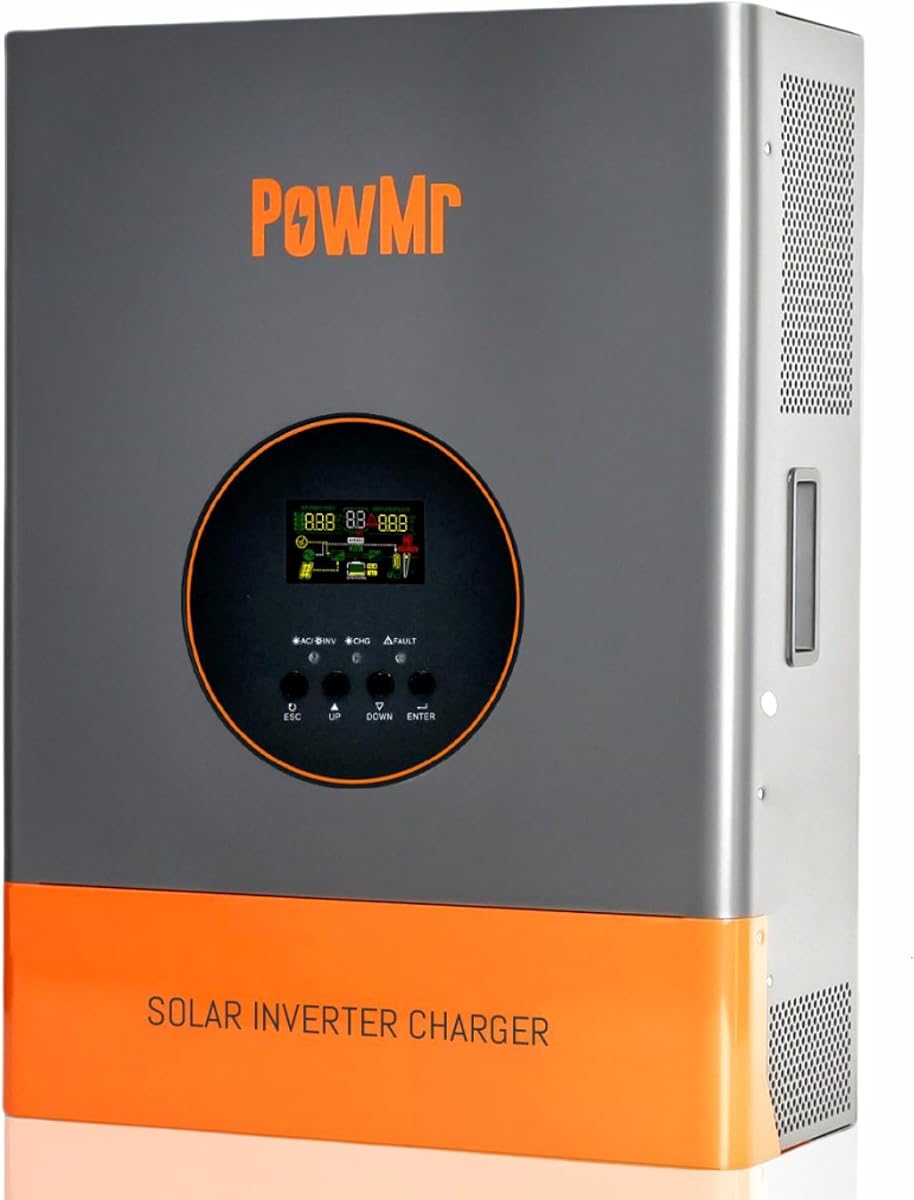

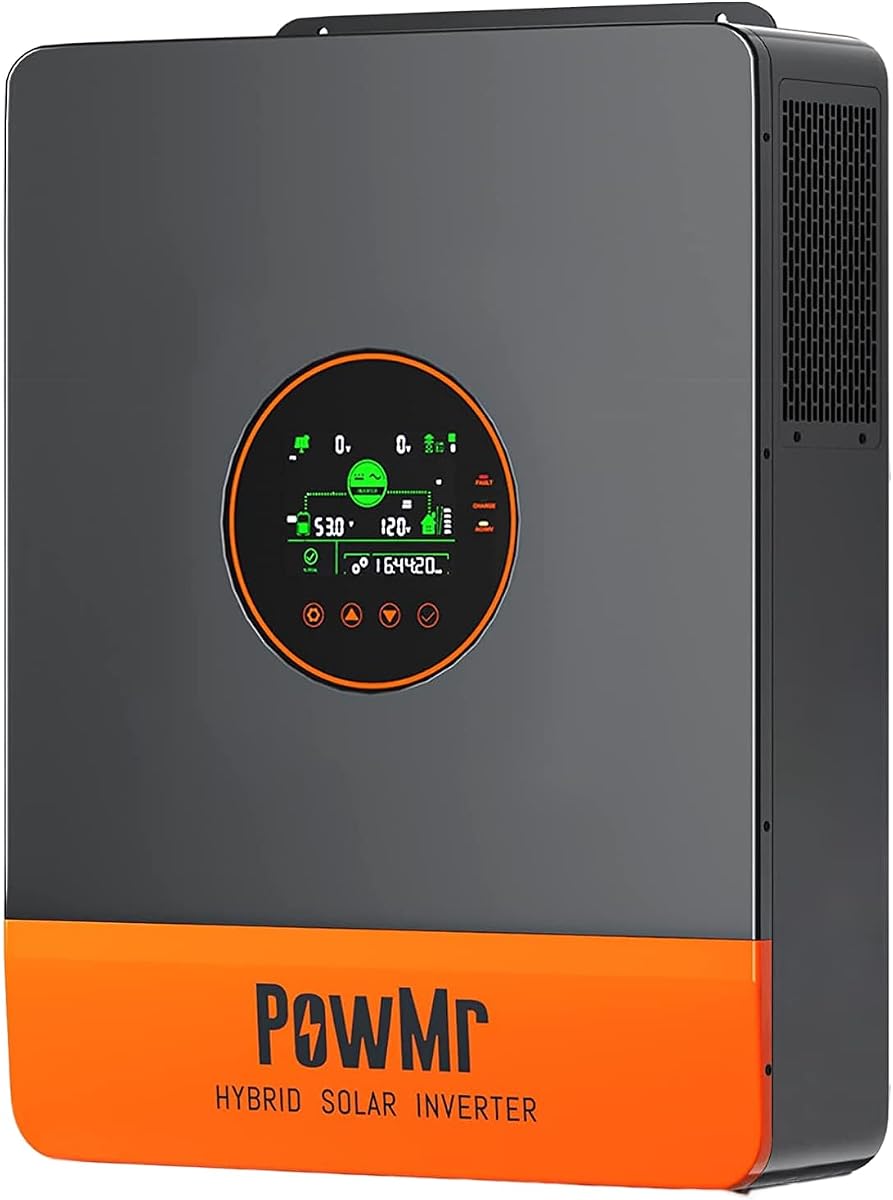

The PowMr 5000W Hybrid Solar Inverter combines a 5000W pure sine wave inverter, 120A MPPT solar controller, and flexible hybrid charging controls in a 48V system. Its supplied 5.0 rating reflects particularly strong customer satisfaction, while the 110V and 220V output capability distinguishes it from many competing 5000W units.
We may earn a commission when you buy through this link, at no additional cost to you.
Its major strength is the breadth of the power system it can manage. Maximum PV input is listed at 6400W, and the 60–105VDC MPPT range offers meaningful flexibility for compatible 48V solar arrays. Users can select solar-only, utility priority, or solar priority charging, while output control includes utility priority, solar priority, and inverter priority behavior.
The 15,000W peak rating and larger toroidal transformer make it appealing for appliances with substantial startup demand. That capability should not be confused with a continuous 15,000W rating, however. The continuous output remains 5000W, and the inverter must be installed within the specified PV voltage, current, and array-power boundaries to avoid internal damage.
This is a strong recommendation for a home or small commercial installation that needs 48V battery storage, substantial solar charging, and flexible AC output. Installation requires careful PV configuration, appropriate cable sizing, and sound electrical workmanship. Buyers who need several independent units or automatic phase creation should instead consider a model with explicit parallel and split-phase support.
The built-in 120A MPPT controller is the defining feature for solar-focused buyers. It can accept up to 6400W of PV input within the documented 60–105VDC operating range, helping the inverter serve as a central component of a larger 48V renewable-energy system.
Native 110V and 220V outputs make this model more adaptable than fixed-voltage competitors. Separate charging and discharge priorities also let users decide when solar, stored battery energy, and utility power should carry essential loads.
We may earn a commission when you buy through this link, at no additional cost to you.
The ECO-WORTHY UL1741 5000W 48V Solar Inverter Charger is a hybrid unit designed for home backup, renewable-energy storage, and expandable three-phase or split-phase systems. Its supplied 4.1 rating is lower than those of the leading models, but its parallel capacity and broad PV voltage range make it distinctive.
We may earn a commission when you buy through this link, at no additional cost to you.
The inverter supplies 5000W continuously and up to 10,000W at peak. Its integrated 100A MPPT controller works across a 120–500VDC PV input range, while the battery charger can be supplied by solar, AC, or a combined charging strategy. Four operating choices—solar only, mains priority, solar priority, and hybrid charging—provide meaningful control over energy flow.
Its major advantage is scalability. Up to six units can operate in parallel, and the documentation describes configurations capable of producing 120V, 208V, or 240V outputs when enough units are installed. This makes the product attractive for buyers who may start with a smaller system but expect to expand as storage, property, or household demand grows.
The trade-off is a fixed 120V rated output and a less favorable customer rating than the top selections. Users need multiple units and careful configuration for split- or three-phase output, so it is less convenient than the PowMr and LiTime alternatives for straightforward expansion. It remains a strong choice for installers seeking a 48V hybrid with unusually wide PV input limits.
Parallel support for as many as six units gives this inverter a path toward larger residential, office, or commercial systems. Buyers can plan for present-day 5000W use while preserving a route to increased capacity and more advanced phase arrangements.
The listed 120–500VDC PV input range is especially useful for higher-voltage arrays. Combined with the 100A MPPT controller, it provides a flexible foundation for a professionally designed solar charging system.
We may earn a commission when you buy through this link, at no additional cost to you.
The SUNGOLDPOWER 5000W DC 48V All in One Solar Inverter is a standalone 48V system with a 5.0 rating and a particularly broad mode-selection feature set. It combines pure sine wave AC output, an 80A MPPT solar charger, and a 40A AC battery charger in one enclosure.
We may earn a commission when you buy through this link, at no additional cost to you.
Maximum solar array support is listed at 5500W and 500V, giving the MPPT section more headroom than a simple portable inverter. Four charging modes and four output modes cover solar priority, utility priority, inverter priority, hybrid operation, solar-only charging, and other configurations. These controls help users align the inverter with changing energy availability.
The inverter supports AGM, sealed, gel, flooded, and lithium batteries, along with a user mode for custom battery settings. It also includes a 40–60V charging range and RS485 communication for BMS connectivity. A stated 4HP loaded-motor capacity and overload protection make it potentially useful for demanding household and office equipment.
The defining limitation is explicit: it does not support parallel operation. It also uses a 120V output rather than offering multi-voltage flexibility. Buyers who expect to scale beyond one unit or need split-phase output should favor a parallel-capable design. For a fixed 48V backup installation, however, its all-in-one construction, mode variety, and 5.0 rating make it a compelling option.
Integrating the inverter, MPPT controller, and AC charger reduces the number of separate major components in a standalone off-grid design. The multiple operating modes add further control over how solar, utility, and battery energy interact.
Compatibility with several lead-acid formats, lithium batteries, and a custom user mode makes the unit adaptable to different storage preferences. The RS485 BMS connection also supports more informed battery communication when used with compatible equipment.
We may earn a commission when you buy through this link, at no additional cost to you.
The TOPBULL 5000W 12V inverter is designed for vehicles, RVs, mobile offices, camping, emergency response, and temporary off-grid power. It carries a 4.6 rating and converts 12V or 12.8V battery power into 120V or 110V AC output with 5000W continuous capacity.
We may earn a commission when you buy through this link, at no additional cost to you.
Its outlet selection is unusually useful for portable use. Four 20A AC receptacles, two 3.4A USB fast-charging ports, a 30W Type-C port, and three AC terminal blocks provide multiple ways to connect equipment. A color display reports voltage, power, and operating status, while the included remote supports switching from up to 200 feet away.
Safety coverage is a major strength. The listed protections address low voltage, high voltage, overload, short circuit, overheating, reverse connection, grounding, overcurrent, leakage, and battery issues. An intelligent dual-fan system helps manage heat, while the metal enclosure is described as impact- and weather-resistant for mobile environments.
This is a compelling budget-oriented choice for consumers who need AC power from vehicle batteries rather than a complete residential solar system. It does not include a solar charge controller, so connecting panels requires separate equipment. Its 12V architecture also places greater current demands on wiring than a 48V system, making cable sizing and ventilation particularly important.
The range of AC sockets, USB ports, Type-C connection, and hardwired terminals makes the unit convenient for campers, contractors, and travelers. The remote-controlled display reduces the need to reach a cabinet or installed inverter whenever power status needs checking.
Ten listed protection functions address common electrical and thermal risks. These features are particularly relevant in vehicles and temporary installations where vibration, changing temperatures, and unattended equipment can complicate operation.
We may earn a commission when you buy through this link, at no additional cost to you.
The LVYUAN 5000 Watt Power Inverter delivers 5000W continuous 12V-to-120V conversion and 10,000W of surge capability. Its supplied 4.5 rating reflects a balanced feature set aimed at RV, truck, camping, vehicle, and small solar-system users who need flexible AC outlets.
We may earn a commission when you buy through this link, at no additional cost to you.
Four AC outlets and a hardwire terminal let the unit support both ordinary plugs and fixed installations. Its LCD reports voltage, battery level, load, and alerts, providing the kind of information users need to avoid overloading a battery or inverter. A wireless remote adds convenient control where the inverter is installed out of reach.
The cooling system activates above a stated 104°F internal temperature or when load exceeds 45 percent, according to the supplied information. Protections cover overvoltage, undervoltage, overload, short circuit, reverse polarity, and overheating. This combination of monitoring and safeguards supports use in mobile environments where heat and vibration are normal.
The LVYUAN is a good fit for mobile power and basic off-grid AC needs, but it is not a complete solar inverter charger. There is no integrated MPPT controller, and the 12V input requires high-current cables. Users planning a stationary house system with substantial solar charging and battery storage should favor a 48V hybrid unit with higher-voltage array support.
The dedicated LCD provides more operational context than a basic indicator light. Seeing battery level and load status can help users determine whether available battery power is appropriate for the connected equipment.
Four standard AC receptacles suit temporary use, while the hardwire terminal supports a more permanent connection. The wireless remote is useful when the unit is placed in a cabinet, truck bed, camper, or other location that is inconvenient to access.
We may earn a commission when you buy through this link, at no additional cost to you.
The PowMr 5000W Hybrid Solar Inverter is a 48V pure sine wave system with a 4.8 rating, dual 110V and 220V output, and a listed 15,000W peak capability. It closely resembles the first-ranked model but offers a slightly lower customer rating and a somewhat different enclosure and thermal-management design.
We may earn a commission when you buy through this link, at no additional cost to you.
Its charging section uses a 120A MPPT controller with a 60–105VDC input range and supports up to 6400W of PV power. Three charging modes and three discharge modes give users control over solar priority, utility priority, and inverter-priority operation. Compatibility includes flooded, LiCoMnNiO2, LiFePO4, AGM, gel, and user-defined battery types.
The large transformer and optimized high-load handling are designed for demanding appliances, including refrigerators and industrial machinery. Dual cooling fans help dissipate heat, while a corrosion- and dust-resistant enclosure is intended to extend service life. The LCD and three LED indicators provide system and operating-status information.
This model suits users who need 110V and 220V flexibility without giving up strong solar charging or high surge capacity. As with the other PowMr hybrid listed here, the PV limits must be followed exactly. It is better treated as a professionally installed system component than as a plug-and-play consumer appliance, particularly where household wiring and battery safety are involved.
The 15,000W peak specification provides additional starting headroom for motor-driven and compressor-based appliances. Continuous loads should still remain within the 5000W rating, and load management remains important when several large devices could operate simultaneously.
The ability to select 110V or 220V output expands the range of supported loads and installation regions. Combined with three charging and three discharge priorities, it provides a flexible foundation for custom 48V energy systems.
We may earn a commission when you buy through this link, at no additional cost to you.
The 5000 watt Power Inverter 12V to 110V/120V is a portable power converter designed for vehicles, RVs, campers, marine use, off-grid setups, and emergency backup. Its 4.4 rating is supported by a straightforward feature set that emphasizes efficient conversion, remote monitoring, and broad protection.
We may earn a commission when you buy through this link, at no additional cost to you.
Continuous output is 5000W with 10,000W of surge capacity for compatible high-startup loads. The listed conversion efficiency exceeds 90 percent, which can reduce energy losses when a 12V battery must support household-style devices. Four AC sockets, one USB port, a hardwire port, and included pure copper cables provide several connection options.
A 16.5-foot wired remote allows operation from outside a cabinet or installation area. The LCD displays input and output voltage, battery level, and load status, while the temperature-controlled fan activates when internal temperature or loading reaches the specified threshold. Eight protection categories cover undervoltage, overvoltage, overload, overheating, short circuit, reverse polarity, leakage, and overcurrent.
This model is most appropriate for users with 12V or 12.8V batteries who want a portable AC supply rather than a fully integrated renewable system. Solar panels can support a broader off-grid setup, but a separate charge controller is required. Its 24-month warranty and technical-support offering add reassurance for a portable product category where installation quality can vary widely.
Conversion efficiency above 90 percent helps preserve more battery energy during AC use. That makes the inverter more practical for extended mobile use, although battery capacity, cable losses, and appliance demand still determine real runtime.
The included 16.5-foot remote is useful in installations where the display and switches are hidden or difficult to reach. Real-time load and voltage information also helps users identify overloads and avoid depleting a battery more quickly than expected.
We may earn a commission when you buy through this link, at no additional cost to you.
The PowMr 5000W Hybrid Solar Inverter is the most architecturally advanced unit in this comparison, supporting 120V single phase, 240V split phase, and 208V two- or three-phase arrangements. Its 3.9 rating is the lowest supplied rating, so buyers should weigh that against its exceptional configuration flexibility.
We may earn a commission when you buy through this link, at no additional cost to you.
The inverter is rated at 5000VA with 10,000VA peak output. Its 100A MPPT controller operates across a 120–450VDC range, and maximum PV input is listed at 5500W. The system can operate without a connected battery, drawing from PV or the AC grid to power loads, which is unusual among the alternatives and useful for specific backup arrangements.
Up to six units may be paralleled. The supplied details state that single-phase and split-phase can be combined, while two or more inverters are required to create split phase. Compatibility with AGM, gel, lead-acid, lithium-ion, and LiFePO4 batteries broadens the range of storage configurations.
This is the natural choice for buyers planning a larger or professionally engineered power system rather than a single compact inverter. CAN, USB, and RS485 connections create useful monitoring options, and time-slot controls can coordinate charging and discharging around local utility patterns. The complexity, lower rating, and need for multiple units for advanced phases mean it is not the easiest option for beginners.
Single-phase, split-phase, and three-phase possibilities distinguish this model from most 5000W competitors. The flexibility is most valuable for installers designing a system that can evolve as power demands and available equipment expand.
The ability to power loads from PV or grid without a battery connected is a specialized advantage. It may suit systems where a battery is not required for every operating scenario, although overall energy resilience will still depend on the chosen architecture.
We may earn a commission when you buy through this link, at no additional cost to you.
The LiTime 5000W Hybrid Solar Inverter combines a 5000W inverter, 100A MPPT controller, and 40A battery charger in a 48V system. Its supplied 4.2 rating sits in the middle of the group, while parallel support, broad battery compatibility, and multiple operating priorities make it a practical choice for expandable home systems.
We may earn a commission when you buy through this link, at no additional cost to you.
Peak surge capacity is listed at 10,000W. Two charging modes are identified—PV-only and hybrid—while four output modes include inverter priority, PV priority, utility priority, and mixed-load operation. Following an outage, the system can transfer essential loads to battery or PV power, providing an UPS-style function for compatible equipment.
The model works with 48V lithium, lead-acid, and user-mode batteries. It can be paralleled with as many as six units, and the supplied information states that single-phase and split-phase arrangements can be used together. Multiple units can produce 120V or 240V output, enabling future expansion beyond one inverter.
Users can also schedule charging and discharging according to local utility rate periods. This is helpful for reducing grid dependence, but scheduling alone should not be treated as a guarantee of lower energy costs. A 4.2 rating, single-unit 120V output, and dependence on multiple units for split phase temper the otherwise broad feature set.
Four output modes let users choose among stored energy, solar, utility power, and a mixed approach. That level of control is useful for households that want different behavior during outages, peak utility periods, and periods of strong solar production.
Supporting up to six units allows the initial installation to be scaled as needs change. A second or additional inverter is needed for split-phase output, so buyers with near-term demand for 240V should plan the complete system before installation.
We may earn a commission when you buy through this link, at no additional cost to you.
The 5000W Split Phase Hybrid Solar Inverter is a 48V inverter charger with a supplied 5.0 rating, native 110V and 220V output, a 120A MPPT controller, and 15,000W peak capability. It targets homes, offices, RVs, and trucks that need flexible load support and substantial solar charging.
We may earn a commission when you buy through this link, at no additional cost to you.
Its maximum PV input is listed at 6400W, with a 60–150VDC MPPT range and up to 50A of AC input. The inverter can charge from utility power, a generator, or solar energy. An upgraded transformer is intended to support refrigerators, industrial machinery, air conditioners, fans, and other demanding loads without treating the 5000W continuous rating as a surge rating.
Three charging modes and three output modes provide clear energy priorities. Flooded, AGM, gel, LiFePO4, and user-defined batteries are supported. BMS/RS485, RS232, and dry-contact interfaces broaden monitoring and control options, while dual cooling fans and a corrosion- and dust-resistant enclosure support longevity.
This is an excellent high-output choice when a single unit needs to cover both 110V and 220V loads, particularly if startup-heavy equipment is present. Installers must still respect the maximum PV voltage, current, and array power, and they should confirm wiring, grounding, battery sizing, and transfer behavior. For buyers who need true multi-unit phase creation rather than selectable output, the multi-phase PowMr may be more appropriate.
Providing 110V and 220V outputs from one 5000W unit simplifies planning for mixed household or business loads. This avoids the need to choose a fixed-voltage inverter when both common appliance classes must be supported.
The 120A MPPT controller, 6400W maximum PV input, and 60–150VDC range create a strong solar-charging foundation. These limits should be treated as firm design boundaries, with arrays configured to remain within all documented voltage and current values.
We may earn a commission when you buy through this link, at no additional cost to you.
Choosing a 5000 watt solar inverter requires matching the converter to the battery bank, solar array, household loads, and intended operating mode. The most important distinction in this roundup is between a 48V hybrid inverter charger for complete renewable-energy systems and a 12V power inverter for mobile or simpler battery use.
Start with the battery bank because it determines inverter compatibility, cable current, charging voltage, and overall system design. The 48V hybrid models support lead-acid, lithium, or user-defined configurations, while the 12V units work with 12V and 12.8V batteries. A 48V architecture generally reduces the current required for a given power level, but it also requires a larger series battery bank and more specialized installation planning.
Choose the voltage and chemistry that match your existing storage, then confirm that the inverter's charging range is suitable. Do not assume that a battery marketed as lithium will automatically pair with every lithium setting; BMS communication, charge voltage, cell chemistry, and manufacturer recommendations all need confirmation.
A 5000W continuous rating describes the output available for sustained operation, while surge ratings cover short startup events. Several models reach 10,000W of surge capacity, and the leading PowMr and split-phase hybrid options are listed at 15,000W. Larger peaks can help with refrigerators, pumps, compressors, and motor-driven tools, but they do not mean the inverter can operate a 15,000W load continuously.
List the intended appliances, identify their running and starting demands, and add a safety margin. A household that cycles a refrigerator, freezer, water pump, and office equipment may exceed 5000W even when no single appliance reaches that level. Proper load management can be more practical than choosing an oversized inverter for infrequent peaks.
An MPPT controller improves solar energy capture by tracking the array's maximum operating point, but the controller and inverter must accept the array's voltage and current. The 48V hybrids in this guide offer different combinations, including 60–105VDC, 60–150VDC, and 120–500VDC input ranges, with MPPT currents of 80A, 100A, or 120A. These are not interchangeable specifications.
Calculate the array's open-circuit voltage, operating voltage, current, and total power before connecting panels. Temperature can raise a panel's open-circuit voltage, especially in cold weather, so the design must include a suitable margin. Exceeding the documented PV limits can damage internal switching components even when the array's advertised rated power appears acceptable.
Voltage and phase decisions depend on the loads and the electrical system being served. Several hybrid units provide 110V or 220V output, while the multi-phase PowMr supports 120V single phase, 240V split phase, and 208V two- or three-phase configurations. The ECO-WORTHY, SUNGOLDPOWER, and LiTime models have parallel capabilities, but paralleling does not automatically create every output arrangement.
Single-unit 120V output is sufficient for many ordinary 120V loads. A 240V appliance or subpanel may require a unit with native 220V or 240V capability, while true split-phase or three-phase service generally requires a carefully configured multi-inverter system. Confirm equipment grounding, neutral and hot routing, and transfer behavior with a qualified electrician.
Hybrid inverters can decide when to use solar, utility power, or stored battery energy. Common choices include solar-only charging, utility priority, solar priority, and combined charging, with output priorities that can favor the grid, PV, battery, or inverter operation. The ECO-WORTHY and SUNGOLDPOWER provide particularly broad mode selections, while the PowMr hybrids offer three charging and three discharge modes.
Choose priorities that reflect actual outages, solar production, and utility behavior. Time-slot controls available on some models can schedule charging and discharging around peak and off-peak periods. These functions improve control, but they are not substitutes for a correctly sized battery bank or a load analysis.
Expansion support is valuable when power demands will grow. The ECO-WORTHY, multi-phase PowMr, and LiTime support up to six units, while the SUNGOLDPOWER explicitly does not support parallel operation. Most of the 12V portable-style inverters in the list are standalone devices without multi-inverter coordination.
Verify what can actually be achieved when units are combined. Parallel operation may increase total capacity, create split phase, or enable three-phase output, but it may also require matching firmware, communication cables, configurations, and battery voltage. A product that is easy to expand is more useful than one that offers an unsupported combination of units.
Displays and remote controls make it easier to monitor input voltage, output voltage, battery level, load, operating mode, and fault conditions. LCD-equipped hybrids are better suited to permanent installations, while the TOPBULL, LVYUAN, and other 12V models offer remotes for convenient switching in vehicles, cabinets, and temporary setups. RS485, CAN, USB, dry contacts, and BMS communication add integration options.
Choose the interface that matches the installation environment and the amount of supervision required. A remote display is convenient, but it does not replace automatic shutoff functions or electrical protection. For advanced systems, communication capabilities can help integrate the inverter with monitoring equipment and battery management systems.
Every inverter needs solid protection against overload, short circuit, over- or undervoltage, overheating, reverse polarity or reverse flow, and other documented fault conditions. Some models add leakage, grounding, overcurrent, PV night reverse-current, backfill, and PV input power-limiting protection. Cooling fans, dust-resistant finishes, and corrosion resistance matter in hot, dusty, or mobile installations.
Installation complexity varies significantly. The 12V vehicle models may include cables and a remote, while 48V hybrid systems involve PV design, battery-bank sizing, grounding, cable sizing, disconnects, transfer behavior, and load connections. Follow the manual, stay within all input limits, and use a qualified electrician whenever the wiring or installation is beyond your experience.
Before connecting equipment, identify the inverter's input voltage, output configuration, maximum PV limits, compatible battery types, and required charge settings. Confirm that the battery bank, solar array, disconnects, grounding, and cables are correctly sized. A 12V vehicle inverter and a 48V hybrid system are not interchangeable, and changing the nominal battery voltage can create serious damage and safety risks.
Follow the manufacturer's configuration sequence and the supplied manual. Set charging parameters for the actual battery chemistry, configure output priority according to normal grid availability, and use the LCD or remote to verify voltage, battery level, load status, and fault messages. If the inverter offers several operating modes, test each one under realistic loads before relying on it for an outage. Never exceed the continuous output or peak-start assumptions of connected appliances.
Maintain the inverter by keeping ventilation openings clear, checking connectors for heat or corrosion, monitoring cables for damage, and cleaning dust from fans and filters where applicable. Test the display, remote, and automatic transfer function periodically. If protection activates, identify and correct the cause rather than repeatedly resetting the unit. Record the installation date, firmware or configuration changes, and maintenance actions, and consult the manufacturer when behavior differs from the manual.
A 5000W inverter may run a refrigerator and some smaller air conditioners, but not every combination at once. Motor-driven compressors can create substantial startup surges, and continuous loads should remain within the inverter's rating with reasonable headroom. Check each appliance's running wattage and startup demand, then stagger high-draw equipment where possible. A larger battery bank may also be needed to maintain operation during an outage.
A 48V inverter is generally better suited to a full residential or commercial solar-storage system because it can move substantial power with lower current and less cable loss. A 12V inverter is more convenient for vehicles, campers, mobile offices, and simple battery backups. The right choice depends on the existing battery bank, solar array, installation environment, and required loads rather than wattage alone.
An MPPT controller helps extract the maximum available energy from a compatible photovoltaic array by tracking its optimal operating point. It also regulates charging for the connected battery bank. The inverter, controller, array voltage, current, and battery chemistry must all match, and the array's open-circuit voltage must remain within the inverter's documented maximum under expected temperature conditions.
Some models in this guide provide 110V or 220V output, while others are limited to 120V in a single-unit installation. The multi-phase PowMr also supports split-phase and three-phase arrangements when the necessary units and configuration are used. Always verify the exact model, output mode, wiring diagram, and load requirements before connecting a 240V appliance.
Several models support parallel operation, including the ECO-WORTHY, multi-phase PowMr, and LiTime, while the SUNGOLDPOWER explicitly does not. Paralleling may increase total output, create split phase, or support three-phase service, but it also requires compatible settings, communication, and coordinated wiring. Follow the manual rather than assuming that any number of units can create any desired phase arrangement.
The 48V hybrid inverters listed here generally support flooded, AGM, gel, LiFePO4, lithium-ion, and user-defined batteries, but exact compatibility depends on the individual model. Battery chemistry, nominal voltage, charge voltage, BMS behavior, and inverter settings must be aligned. A lithium battery with a BMS should also be checked for the required communication interface before it is connected.
Continuous power is the output the inverter can sustain for ongoing use, while peak or surge power is intended for brief startup events. A 5000W unit with a 10,000W or 15,000W surge rating may start a compatible motor, but it should not be treated as a 10,000W or 15,000W continuous source. Sustained loads and the combined demand of several appliances must remain within the continuous limit.
Professional installation is strongly recommended for 48V hybrid systems because they involve high-current battery wiring, PV arrays, grounding, disconnects, transfer behavior, and potentially 220V or 240V output. Even portable 12V models benefit from correct fusing, ventilation, cable sizing, and secure connections. Users without appropriate electrical experience should follow the manual and seek qualified help rather than improvise.
The PowMr 5000W Hybrid Solar Inverter ranks as the leading all-around option because it combines a 120A MPPT controller, native 110V and 220V output, broad 48V battery support, and a 15,000W peak rating. The 5000W Split Phase Hybrid Solar Inverter is an equally strong alternative for flexible voltage output and high surge capability, while the TOPBULL 5000W Power Inverter is the most accessible choice for vehicle and mobile use.
Prioritize the system architecture before focusing on headline wattage. A complete solar-storage installation needs a 48V hybrid inverter with a suitable MPPT range, compatible battery bank, and correctly sized PV array. Mobile users should prioritize 12V compatibility, outlets, remote controls, and protection. Anyone planning future growth should confirm parallel support, phase creation, and communication requirements before installation.
Finally, recheck the current product specification, customer rating, configuration, and price at the time of purchase. Inverter features, firmware, bundle contents, and availability can change, and a listing title may not reveal every operating limitation. Use the manual as the final authority and hire a qualified professional for permanent, high-voltage, or grid-interactive installations.