
Fosi Audio MC331
4.4Editor score
Integrated DAC and tube preamp
Five versatile digital inputs
Replaceable tube and headphone output
Explore the best amp for bookshelf speakers, comparing power, connectivity, DAC features, sound controls, design, and room flexibility today.
An amplifier for bookshelf speakers must do more than provide loud sound. It should provide a clean signal, supply adequate power for the speakers’ impedance, offer convenient source selection, and fit naturally into the room where you listen. The right mini or integrated amplifier can also add Bluetooth streaming, HDMI connectivity, DAC conversion, or tonal controls without turning the setup into a complicated project.
We compared ten amplifiers using the specifications and features supplied for each model, focusing on channel power, speaker compatibility, input options, control features, enclosure design, and support for passive bookshelf speakers. The list includes compact Class D units, a tube-inspired integrated amplifier, a streaming amplifier, and feature-rich models designed for more advanced home audio setups.
Each review explains what the amplifier is best suited for, where it offers clear advantages, and where compromises may matter. The top selections range from a straightforward Bluetooth amplifier to a more versatile streaming model and an all-in-one DAC and tube amplifier. Product specifications and availability can change, so readers should confirm current details and pricing before purchasing.
4.4Editor score

4.6Editor score
4.5Editor score
The table below compares the ten amplifiers by power, speaker compatibility, source connectivity, and standout functionality, making it easier to identify the model that matches your speakers, sources, and listening habits.


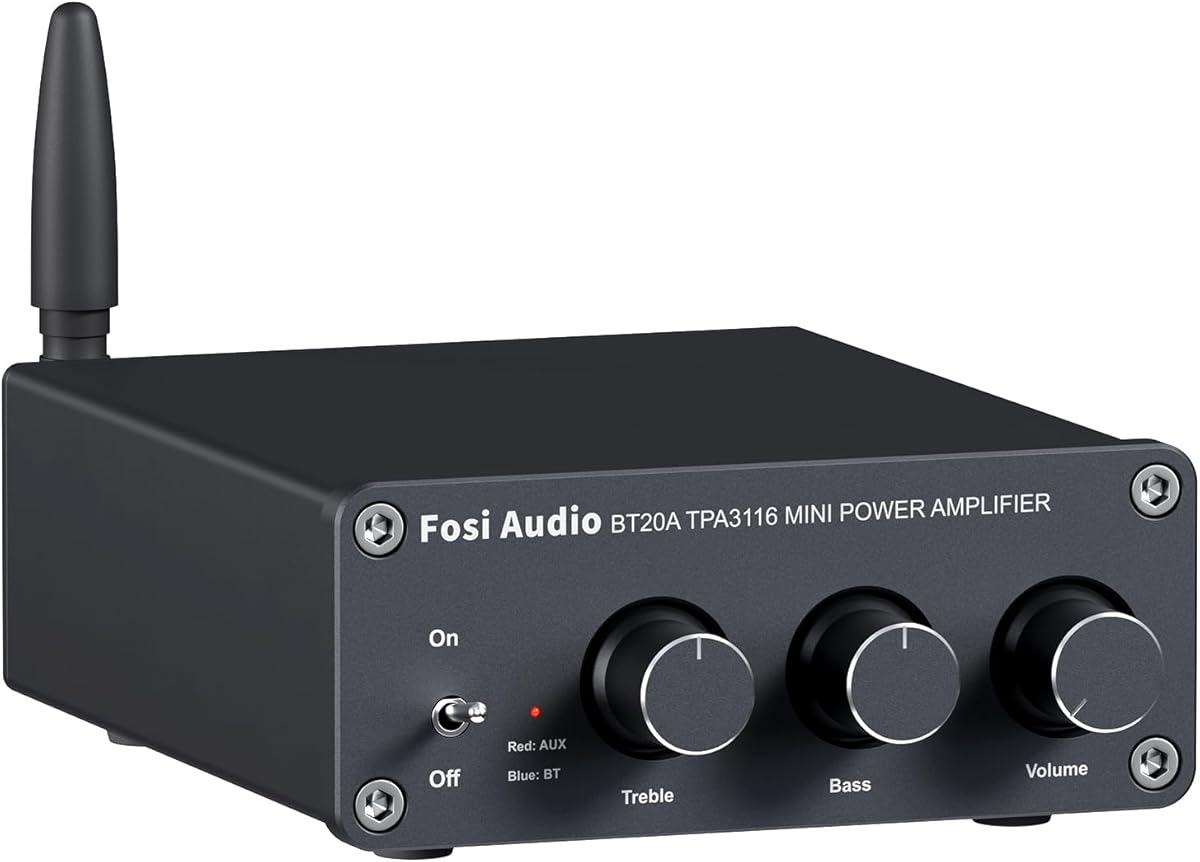
The Fosi Audio BT20A is a straightforward two-channel Class D amplifier built around simplicity. It carries a 4.5 rating and offers Bluetooth streaming, an RCA input, and up to 100W x 2 maximum output. Its small black enclosure is easy to place beside passive bookshelf speakers, while the front-panel tone controls let listeners adjust the balance without reaching into a menu or opening an app.
We may earn a commission when you buy through this link, at no additional cost to you.
The strongest part of this amplifier is how few steps it adds to a listening room. Bluetooth covers everyday phone and tablet streaming, while the RCA input accommodates a turntable with a built-in phono preamp, a CD player, television, or another stereo component. The integrated design, one-touch power switch, and separate bass and treble controls make it particularly approachable for a first compact stereo or an upgrade from basic powered speakers.
The main limitation is that it focuses on core stereo functions rather than networking or advanced home theater control. There is no Wi-Fi, HDMI, integrated DAC, multiroom platform, or voice assistant mentioned in the supplied specifications. Buyers should also distinguish the stated maximum output from a continuous power rating and consider their speakers’ impedance and sensitivity to ensure the amplifier operates comfortably.
This is a strong choice for someone who wants a compact amplifier for passive bookshelf speakers without a complicated setup. It is particularly useful in a bedroom, office, den, garage, patio, or modest living room where Bluetooth convenience and basic tone adjustment matter more than expansive connectivity. For those needs, the BT20A delivers a focused feature set and an attractive, furniture-friendly design.
Bluetooth handles the most common source with very little setup, while RCA connectivity preserves a simple path for wired components. This combination makes the amplifier practical for listeners who alternate between phones and home audio equipment without wanting to manage network accounts or complicated switching routines.
Separate bass and treble controls provide useful room and speaker adjustments in a very compact enclosure. The all-black housing also helps the amplifier blend into shelves, cabinets, and entertainment areas rather than dominating the room visually.
We may earn a commission when you buy through this link, at no additional cost to you.
The Fosi Audio MC331 combines a DAC, tube preamplifier, stereo power amplifier, and headphone amplifier in one enclosure. Its 4.4 rating reflects a versatile feature set, while the visible tubes and VU meter give the unit a distinctive, warm presentation. Maximum output is listed at 105W x 2 into 4Ω, making it suitable for a range of passive bookshelf speakers.
We may earn a commission when you buy through this link, at no additional cost to you.
Its primary strength is source flexibility. Bluetooth, USB, coaxial digital, optical digital, and RCA inputs allow the amplifier to serve computers, phones, CD players, and turntables that already include a phono preamp. The remote simplifies source selection and bass or treble adjustment, while pre-out and 3.5mm headphone outputs provide additional ways to expand or personalize the system.
The MC331 is not the smallest or simplest option. Its tube presentation takes more space, and it does not offer HDMI connectivity or Wi-Fi-based multiroom features. Source switching may also require more attention because of the number of available inputs. Buyers comparing it with basic mini amplifiers should be choosing it for integration and visual appeal rather than minimalism alone.
The amplifier is well suited to a dedicated listening shelf, desktop hi-fi system, or stylish two-channel setup where the owner values DAC functionality and a distinctive presentation. It is especially appealing for listeners who want one box to handle several digital and analog sources. For that purpose, the MC331 offers more refinement and flexibility than a basic Bluetooth-only amplifier.
The broad input selection can replace several separate boxes, reducing cable clutter on a shelf. USB, optical, and coaxial inputs are especially useful for computers and digital sources that would otherwise require an external DAC.
Visible tubes and the VU meter create an inviting focal point, but the appeal extends beyond appearance. Replaceable tubes, remote operation, pre-out functionality, and a headphone jack make the visual design part of a genuinely flexible listening hub.
We may earn a commission when you buy through this link, at no additional cost to you.
The Fosi Audio V3 is a performance-oriented mini Class D amplifier for listeners who want substantial power and component-level customization. It has a 4.5 rating and supports speakers from 2 to 8Ω. A TPA3255 amplification chip, Japanese and German passive components, and a claimed maximum output of 600 watts position it as a more ambitious alternative to entry-level compact amplifiers.
We may earn a commission when you buy through this link, at no additional cost to you.
The V3 focuses on clean signal handling. Its supplied specifications list SINAD up to 88dB, signal-to-noise ratio up to 110dB, and a low noise floor of 140 microvolts. A whole-body heatsink and ventilation at the top and bottom support heat dissipation, while the pre-out level follows the main volume control for more flexible integration with another power amplifier.
Its most distinctive feature is op-amp rolling. The stock NE5532 modules can be replaced with several compatible dual op-amp options, allowing experimentation with different input and gain characteristics. That is appealing to experienced listeners, although it adds complexity for anyone simply looking to connect speakers and begin listening. Maximum power claims should also be considered alongside speaker sensitivity, impedance, and real-world use.
The V3 suits a dedicated desktop system, book-and-record setup, or larger shelf installation where additional power headroom is valuable. It is a strong option for listeners who enjoy technical control without needing a full-size separate power amplifier. For straightforward Bluetooth listening, a simpler model would be easier, but for passive speaker performance and customization, the V3 makes a compelling case.
Supporting 2–8Ω passive speakers gives the amplifier broad compatibility, while the TPA3255 platform provides the foundation for high-volume listening. Speakers with low sensitivity or substantial power demands can benefit from the additional headroom compared with a basic mini amplifier.
Replaceable op-amps let technically inclined listeners explore changes to the amplifier’s sound and gain characteristics. The feature is a meaningful reason to choose the V3 when technical involvement is enjoyable rather than merely decorative.
We may earn a commission when you buy through this link, at no additional cost to you.
The Fosi Audio BT20A Pro upgrades the basic wireless mini-amplifier concept with a TPA3255 chip, Bluetooth 5.0, higher stated maximum output, and replaceable op-amps. Its 4.4 rating reflects a model that combines approachable connectivity with more technical potential than a simple Bluetooth receiver. It is designed to drive passive speakers through two channels and fit into a compact home or outdoor audio arrangement.
We may earn a commission when you buy through this link, at no additional cost to you.
Bluetooth pairing can be reset by holding the volume control for five seconds, and a memory function is designed to make reconnection convenient. An alert tone provides basic operational feedback. The amplifier also includes bass and treble controls, with the neutral position allowing listeners to hear the speakers without added tonal emphasis.
Its audio specifications include a signal-to-noise ratio of at least 108dB and total harmonic distortion no greater than 0.005%. The replaceable NE5532 op-amps can be exchanged for several compatible alternatives, giving users a path to customize the input stage. However, the amplifier still prioritizes a narrow source list, with Bluetooth as the central feature rather than a broad collection of digital inputs.
This Pro model is a good match for someone who wants more power and customization than the standard BT20A but still values a simple wireless setup. It works well for casual listening in a living room, office, or covered outdoor area where bookshelf speakers are already installed. Buyers seeking television integration, DAC conversion, or multiroom streaming should choose a more specialized amplifier.
Bluetooth 5.0, pairing memory, and a clearly described reset procedure reduce the friction of using the amplifier repeatedly. The result is a more convenient centerpiece for everyday wireless listening.
The 300W x 2 maximum rating provides a higher stated ceiling, while plug-in op-amps offer a less permanent way to alter sound characteristics. Neither feature replaces careful speaker matching, but both add flexibility for informed listeners.
We may earn a commission when you buy through this link, at no additional cost to you.
The Fosi Audio TB10D is a versatile two-channel mini amplifier with a stated 300W per channel maximum output and support for passive speakers between 2 and 8Ω. It carries a 4.5 rating and uses a TPA3255 chip. Unlike many basic wireless amplifiers, it also includes a subwoofer output, making it useful for building a compact 2.1 system around bookshelf speakers.
We may earn a commission when you buy through this link, at no additional cost to you.
RCA inputs and passive speaker terminals keep the signal path approachable. The subwoofer output can add low-frequency reinforcement for movies or gaming, while bass and treble knobs allow broad tonal adjustments. Its power switch and front-facing controls also suit a living room, desktop, game room, dining area, or personal studio where quick operation matters.
The main limitation is the lack of modern wireless features. There is no Bluetooth, Wi-Fi, HDMI, or integrated DAC listed for this model, so the amplifier depends on an external source. The headline power figure describes maximum capability rather than sustained output across every impedance and frequency, making it important not to judge the amplifier only by that number.
The TB10D is most appealing to buyers who already have reliable sources and want a powerful, flexible analog amplifier. Adding a powered subwoofer is especially useful because it provides a path beyond the two main channels. It is less appropriate for someone who expects to stream directly from a phone or control a television through a single modern connection.
The dedicated subwoofer output distinguishes this mini amplifier from many simple stereo models. It lets listeners retain the bookshelf speakers for mids and highs while assigning bass duties to a separate powered subwoofer.
RCA inputs and straightforward speaker terminals make the TB10D easy to integrate with existing components. The broad impedance support and generous stated maximum output provide room for different passive speaker configurations.
We may earn a commission when you buy through this link, at no additional cost to you.
The WiiM Amp is the most connected amplifier in this comparison, earning a 4.6 rating while serving as both a streaming amplifier and a television audio hub. It provides 60 watts per channel into 8Ω and 120 watts per channel into 4Ω, enough to power a wide range of passive bookshelf, floor-standing, architectural, and outdoor speakers when their electrical requirements are suitable.
We may earn a commission when you buy through this link, at no additional cost to you.
HDMI ARC is the standout feature for home theater use because it allows a television to send sound to the amplifier over a single cable. Music streamers are available through the WiiM Home App, including high-resolution playback up to 24-bit/192 kHz from supported platforms. The app also provides room correction, independent EQ, favorites, alarms, volume management, and speaker synchronization.
This capability comes with a few constraints. The amplifier is a Wi-Fi and app-based product, so its setup demands more attention than a simple Bluetooth or RCA unit. It can receive AirPlay 2 streams but cannot transmit those streams to other AirPlay-enabled speakers, which may matter in a carefully planned wireless ecosystem. Voice-control support is another benefit, though it depends on the chosen assistant.
For a listener who wants one compact box to handle music, television, voice commands, and multiroom grouping, the WiiM Amp is exceptionally versatile. It is an especially strong recommendation for modern homes where passive speakers should not be tied to a legacy receiver. Those who only need basic wired amplification may find its network features unnecessary, but for broad everyday functionality, it is the standout choice here.
HDMI ARC turns the unit into more than a network music receiver. Passive bookshelf speakers can serve as a compact stereo home theater system, and an optional powered subwoofer can extend the low-frequency presentation.
The Home App consolidates streaming services, EQ, room correction, alarms, favorites, volume, and multiroom organization. This software depth gives the amplifier advantages that cannot be summarized by output wattage alone.
We may earn a commission when you buy through this link, at no additional cost to you.
The AIYIMA A07 Premium is a compact TPA3255 stereo amplifier aimed at hi-fi desktop and passive bookshelf speaker systems. Its 4.4 rating reflects a capable mini power amplifier with a maximum output of 300W x 2 and support for 2–8Ω speakers. The metal housing, solid knobs, upgraded cooling, and audiophile-grade components give it a more substantial feel than a basic plastic classroom amplifier.
We may earn a commission when you buy through this link, at no additional cost to you.
Its most useful feature is the 3.5mm pre-out, which carries a full-range signal and is controlled by the main volume. That output can feed an active subwoofer, active speakers, or another power amplifier, enabling a small 2.1 arrangement or a larger system. The stock NE5532 dual op-amps are also replaceable with compatible OPA-, LM-, and MUSES-series modules for users who want to experiment.
The A07 has no Wi-Fi or Bluetooth, so it is better suited to an existing analog source than to direct phone streaming. Its stated maximum output also depends partly on the power supply. The supplied information identifies a 32V 5A adapter and notes that a compatible 48V 10A supply can be used for maximum output, but industrial or incorrect supplies should be avoided.
This amplifier fits listeners who want a compact analog power stage with room for technical growth. It works well with a computer, TV, CD player, or turntable that includes a phono preamp, especially when the pre-out may later be used to add a subwoofer. It is not the easiest choice for a completely wireless setup, but it offers focused performance and expandability for an enthusiast desktop system.
The full-range pre-out is more versatile than a dedicated subwoofer output because it can feed several kinds of active equipment. It allows a listener to begin with passive speakers and expand the system without replacing the main amplifier.
Japanese ELNA capacitors, WIMA capacitors, filter capacitors, and an enhanced cooling system support the amplifier’s component-focused design. The replaceable op-amps add another layer of user control for technically inclined listeners.
We may earn a commission when you buy through this link, at no additional cost to you.
The Fosi Audio ZA3 is a flexible TPA3255 amplifier designed to work as a stereo unit, a mono amplifier, or one half of a more elaborate multi-amplifier system. It has a 4.5 rating, with maximum output listed at 180W in stereo mode and 235W in mono mode. The compact enclosure is backed by a 48V power supply and a cooling system designed for sustained higher-power use.
We may earn a commission when you buy through this link, at no additional cost to you.
Balanced input is the defining connection feature. A single combo connector accepts XLR or 1/4-inch TRS plugs, and the supplied specifications state that this balanced path can minimize interference and reduce the noise floor. A 12V trigger input allows the amplifier to start and stop with other equipment, making it more appropriate to a controlled home theater or multi-device system than a completely standalone mini amp.
The ZA3 also supports numerous plug-in dual op-amps across left and right channels, balanced input, and subwoofer output. That broad compatibility supports experimentation, though it asks the owner to understand component standards and make careful choices. As with other high-output mini amplifiers, maximum output is not the same as continuous power under every load.
The ZA3 is a strong choice for a technically minded listener who wants balanced connectivity or plans to use multiple amplifiers in a larger installation. It can drive bookshelf speakers directly in stereo, operate in mono for specialized setups, or integrate with triggered equipment. For a simple Bluetooth shelf system, it offers more capability than necessary, but for balanced and multi-amp systems, its design is unusually flexible.
Support for both XLR and quarter-inch TRS balanced connections can reduce susceptibility to interference when the source and cable support balanced signaling. It is especially valuable in systems where the amplifier sits farther from the source.
The ability to move between stereo and mono modes makes the ZA3 adaptable to different speaker layouts. Two units can be configured for mono operation when a larger or more specialized amplified-speaker design requires it.
We may earn a commission when you buy through this link, at no additional cost to you.
The Ampapa x Douk Audio D1 combines a 300W x 2 maximum-output stereo amplifier with Bluetooth 5.2, balanced input, a digital VU meter, and several system-control features. Its 4.4 rating and extensive specification set make it a strong option for listeners who enjoy visible equipment feedback and want more control than a conventional entry-level mini amplifier provides.
We may earn a commission when you buy through this link, at no additional cost to you.
The OLED screen can display real-time operating information in several VU styles and color treatments. For functionality, the adjustable 30–200Hz high-pass filter can remove low frequencies from the main speakers, helping them focus on mids and highs in a system that includes a subwoofer. A full-range pre-out can feed an active subwoofer, power amplifier, or active speaker.
TRS balanced input, 12V trigger, infrared remote, one-touch mute, Bluetooth reset, and adjustable tone controls round out the feature set. Plug-in NE5532 op-amps and PFFB technology are intended to improve load independence and provide an upgrade path. The many options also create a steeper learning curve than a simple amplifier with only volume and tone knobs.
The D1 suits a visually oriented desktop or entertainment setup where the display adds enjoyment to the listening experience. It is also practical for a 2.1 system because the HPF and pre-out offer clearer speaker assignment than a simple subwoofer jack alone. It does not provide Wi-Fi multiroom control, but it covers Bluetooth, balanced wired sources, remote operation, and home-theater triggering in one compact unit.
The digital VU display provides immediate feedback and gives the amplifier a purposeful centerpiece appearance. Multiple display styles allow the presentation to be matched to a living room, studio, or desktop setup.
The adjustable high-pass filter and full-range pre-out make it possible to divide low and high frequencies more deliberately. This is valuable when the main speakers need cleaner midrange and upper-bass information from a separate subwoofer.
We may earn a commission when you buy through this link, at no additional cost to you.
The Douk Audio A5 is a compact two-channel TPA3255 amplifier intended for home theater, passive bookshelf speakers, and dedicated stereo listening. It has a 4.3 rating and a stated maximum output of 300W x 2. The distinctive tempered-glass access panel exposes the internal components, while adjustable LED lighting and multiple color options give it a decorative, modern appearance.
We may earn a commission when you buy through this link, at no additional cost to you.
Its adjustable high-pass filter operates from 30 to 200Hz. When a separate subwoofer handles bass, the filter can reduce low-frequency content sent to the main speakers, supporting clearer midrange and high-frequency reproduction. The amplifier also uses Post-Filter Feedback technology and a four-layer immersion-gold PCB, with the manufacturer specifying total harmonic distortion of 0.002%.
A major enthusiast-oriented feature is the plug-and-play op-amp arrangement. The tempered glass panel allows replacement without fully disassembling the unit, making sound customization more convenient. On the other hand, the amplifier offers only a relatively basic source and control package, with no Bluetooth, Wi-Fi, HDMI, remote control, or balanced input mentioned in the supplied specifications.
The A5 is most appropriate for a listener who already has an external source and values internal component access. It can work well in a compact living room or studio where its internal lighting becomes part of the visual design. Those wanting convenient streaming or television control should look elsewhere, but for a hands-on analog-style mini amplifier with a subwoofer-friendly filter, the A5 offers a distinctive combination of features.
A transparent access panel and plug-in op-amp layout reduce the effort required to change the amplifier’s input-stage modules. This gives listeners a practical way to experiment without treating the process as a major electronics project.
The adjustable high-pass filter is especially relevant to passive speakers used alongside a subwoofer. By reducing unnecessary low-frequency content at the main outputs, it creates a more logical division of responsibilities within a compact 2.1 system.
We may earn a commission when you buy through this link, at no additional cost to you.
Choosing an amplifier for bookshelf speakers requires balancing electrical capability, available sources, controls, physical placement, and listening goals. The right choice is not necessarily the model with the largest headline power number; it is the one that matches your speakers and makes the system convenient to use every day.
Begin with each speaker’s rated impedance, commonly 4Ω, 6Ω, or 8Ω, and confirm that the amplifier supports it. Power requirements depend on speaker sensitivity, enclosure design, room size, and preferred listening level. A sensitive pair of bookshelf speakers may sound well with modest amplification, while less efficient models benefit from an amplifier with greater power headroom. Headline maximum wattage should not be treated as a direct measure of everyday performance because it can reflect short-term limits under specific conditions.
In short, verify impedance support and use realistic power expectations rather than choosing on headline output alone.
Think about every source the amplifier must serve. Phones and tablets benefit from Bluetooth, computers and digital components may need USB, optical, or coaxial inputs, and television audio usually calls for HDMI ARC. A network streamer adds access to music services, radio, firmware updates, multiroom control, and room correction, but it also requires configuration and a reliable wireless network. RCA remains useful for turntables with built-in phono preamps, CD players, and other analog components.
In short, select the connectivity required by your real sources and avoid paying for functions that will remain unused.
A digital-to-analog converter allows the amplifier to accept digital signals directly. USB, optical, and coaxial inputs can simplify a digital desktop system by reducing the number of separate boxes needed. It is especially useful when a computer or streaming source does not offer a convenient analog connection. An integrated DAC does not automatically guarantee better sound than a well-matched external DAC, but it can improve convenience and shorten the signal path.
In short, choose an integrated DAC when convenience and compact system design matter more than component swapping.
Bass and treble controls allow quick compensation for speaker placement, room acoustics, and individual preferences. They are useful for correcting overly bright or dull presentation, but they should not be treated as substitutes for proper speaker placement. Some network amplifiers also offer parametric EQ, automatic room correction, and per-room settings, which provide finer control. For most listeners, adjustable high-pass filters are valuable when a subwoofer is included because they can reduce the bass workload on the main bookshelf speakers.
In short, favor simple broad tone controls for basic rooms or detailed EQ for complex installations.
A dedicated subwoofer output simplifies a 2.1 system by providing the correct connection and often the appropriate filtering. A pre-out is more flexible because it can feed an active subwoofer, active speakers, or another power amplifier. On a 2.1 setup, the main amplifier’s high-pass filter can remove low frequencies from the bookshelf speakers, allowing the subwoofer to reproduce bass more effectively. Buyers should confirm the connection type and supported output level before planning a larger system.
In short, use a subwoofer output for straightforward bass integration and a pre-out for broader expansion options.
Class D amplifiers are efficient, but high output still creates heat that must be dissipated. Look for a chassis with adequate ventilation, a substantial heatsink, and room around the amplifier rather than placing it in a closed cabinet without airflow. A full-metal enclosure can improve durability and reduce electromagnetic interference. Decorative top panels and internal lighting may enhance appearance but should not prevent ventilation. For continuous high-volume use, cooling design is more important than an attractive transparent panel.
In short, prioritize stable cooling and an enclosure that can remain ventilated during demanding playback.
Balanced inputs can reduce interference over longer cable runs, while XLR, TRS, RCA, USB, optical, coaxial, and HDMI connections each serve different sources. A 12V trigger can synchronize an amplifier with a preamplifier or home-theater processor. Remote control, app operation, voice assistants, and multiroom grouping make a system easier to manage after installation. However, each additional feature adds complexity, so the best amplifier is often the one whose controls align with how the listener already operates equipment.
In short, select advanced inputs and automation only when they solve a real installation or usability problem.
Swappable op-amps and replaceable tubes offer a way for technically engaged listeners to alter gain characteristics, noise behavior, or sound preferences. They can also turn a basic stereo component into an ongoing hobby. Accessibility matters, so a clear access panel and straightforward replacement procedure are more useful than extensive compatibility lists alone. Listeners who simply want reliable playback should prioritize sound, connectivity, and fit over the number of components that can be exchanged.
In short, treat upgradeability as a bonus for interested enthusiasts rather than a substitute for good core performance.
Start by placing the amplifier on a stable, level surface with enough ventilation around its vents and chassis. Connect passive speakers while the unit is powered off, observing correct left and right channel polarity. Attach the appropriate source using RCA, balanced, digital, HDMI, or Bluetooth according to the amplifier’s design, and use the included or a compatible power supply. Turn the listening volume down before switching the amplifier on, then increase it gradually after the source is ready.
After installation, begin with the amplifier’s tone controls centered and the high-pass filter disabled unless a subwoofer is part of the setup. Play familiar music at a moderate level, check that both speakers are active, and listen for hum, crackling, imbalance, or unwanted distortion. If a subwoofer is used, adjust the crossover gradually and reduce the main amplifier’s high-pass setting as needed. For network models, complete the app setup before judging streaming stability or room-correction results.
Care for the amplifier by keeping liquids away from the enclosure, avoiding blocked ventilation, and using a dry microfiber cloth for cleaning. Do not open a powered unit or touch exposed internal components. Unplug it before moving it or changing speaker wiring. Update firmware and app software when updates are available, and preserve the supplied power supply, remote, antennas, and accessories. Periodically check connections for looseness and ensure speaker and amplifier channels remain correctly matched.
A stereo Class D amplifier is a practical choice for most compact passive bookshelf systems because it offers efficient operation, manageable heat, and useful power in a small enclosure. The best model also needs to support the speakers’ impedance and provide the inputs required by the listener. A DAC-equipped or streaming amplifier is useful when digital sources dominate the setup.
Yes, a Bluetooth amplifier connects wirelessly to a phone, tablet, or computer and sends the audio to passive speakers through conventional speaker outputs. Bluetooth makes casual listening convenient, although it cannot provide the channel bandwidth or low-latency behavior needed for some high-end wired sources or gaming. The BT20A, BT20A Pro, and D1 are examples in this comparison with Bluetooth capability.
The right amount depends on speaker sensitivity, impedance, room size, and listening level. More power is useful for low-sensitivity speakers, larger rooms, or high-volume playback, but extra power alone cannot fix poor speaker placement or mismatched impedance. Always verify the amplifier’s supported load and compare realistic power requirements rather than relying solely on maximum wattage.
A DAC-equipped amplifier can be convenient when the computer has only digital USB output or when the listener wants fewer boxes. USB, optical, and coaxial inputs convert digital files into an analog signal for the power amplifier. An external DAC remains useful when it offers better connectivity, controls, or a preferred sound and is not physically inconvenient.
A pre-out sends a line-level signal to another powered device. It can connect an active subwoofer, powered speakers, or a second power amplifier, making it more flexible than a dedicated subwoofer jack. Models with an adjustable pre-out, such as the A07, TB10D, or D1, can serve as the central hub of a larger analog or 2.1 system.
HDMI ARC is highly convenient when the amplifier will provide stereo sound for a television because it carries video control and audio over a single connection. It is not necessary if the television has a suitable analog or digital output that the amplifier supports. The WiiM Amp is the model in this list built specifically around HDMI ARC and streaming-home integration.
They can be, provided the amplifier is matched to the speakers and its cooling system has adequate airflow. Class D efficiency helps control heat, but maximum output and long-term thermal behavior still matter. Models with a full-body heatsink, side or vertical vents, and a supplied high-capacity power supply are better candidates for sustained demanding use.
Swappable op-amps are most useful to listeners who enjoy experimenting with sound characteristics and are comfortable following component compatibility instructions. They are not required for reliable high-quality playback, and changes should be made with the amplifier unpowered. If straightforward operation is the priority, prioritize connectivity, fit, power, and controls instead.
The WiiM Amp stands out as the most versatile choice for modern listening because it combines music streaming, HDMI ARC television connectivity, app-based EQ, voice support, and multiroom organization in a compact enclosure. The Fosi Audio MC331 is the premium all-in-one option for listeners who want an integrated DAC, tube-style presentation, multiple wired inputs, and headphone output. The Fosi Audio BT20A remains the simplest route to a compact passive-speaker system with Bluetooth and basic tone controls.
For more specialized goals, prioritize the features your setup actually requires. The BT20A Pro and D1 emphasize wireless convenience, the V3 and A07 support higher-power and op-amp experimentation, the TB10D offers a direct path to subwoofer integration, the ZA3 adds balanced and mono functionality, and the Douk Audio A5 focuses on accessible internal upgrades and visible design.
Before buying, verify the amplifier’s supported speaker impedance, connection requirements, physical dimensions, power-supply details, and compatibility with the rest of the system. Product specifications, firmware, ratings, and prices can change, so check the current manufacturer and retailer information before making a final purchasing decision.