
Solar Outdoor Motion Sensor Alarm
4.2Editor score
Thirteen looping sound options
Solar-only outdoor power
Four intelligent operating modes
IP55 weatherproof housing
Our barking dog alarms guide compares 10 options for coverage, sound, power, weather resistance, wireless range, and easy installation at home or outdoors.
Barking dog alarms imitate the sound of a watchful canine to discourage intruders and alert occupants when movement is detected. A useful model should be easy to position, produce a convincing warning, and suit the intended location, whether that is an indoor entry, driveway, yard, farm, or commercial property.
We compared the alarms in this guide by examining their detection technology, sound options, range, power arrangements, weather resistance, installation requirements, and practical limitations. The list includes plug-in indoor units, wireless receiver-and-sensor kits, radar detectors, and solar-powered alarms intended for outdoor use.
Each review identifies the feature that makes a particular model most useful and explains where it falls short. Ratings reflect the supplied customer feedback, while availability and deal conditions can change at any time, so readers should confirm the latest listing information before ordering.
4.2Editor score

4.2Editor score

3.4Editor score
The comparison below shows how the ten barking dog alarms differ in detection method, sound, wireless reach, power, and intended placement. These distinctions help separate indoor warning devices from outdoor perimeter systems and standalone solar alarms.



The Rex Plus is a straightforward electronic watchdog for people who want an indoor alarm without assembling a complicated sensor-and-receiver network. It has a 3.9 customer rating and stands out for its uncomplicated design: place the unit indoors, connect it to a standard electrical outlet, and allow its movement detection to activate a barking sound. The closer an intruder approaches, according to the product information, the more frequent the simulated barking becomes.
We may earn a commission when you buy through this link, at no additional cost to you.
Its primary strength is the reduction of installation friction. There is no stated pairing process, separate receiver, or complex configuration. The progressive response also gives the unit a more purposeful character than a single fixed bark. A person entering a room, hallway, garage, or other indoor area can trigger the detector, while the increasing bark frequency is intended to communicate that someone is approaching.
The trade-offs are equally clear. The Rex Plus is designed for indoor use, so it should not be treated as a weatherproof driveway or yard alarm. It also lacks the multiple sound choices, adjustable sensitivity, remote controls, and long-range wireless features found in several newer systems. Those omissions are acceptable only if the goal is a simple alarm for an indoor protected space rather than a flexible perimeter-security network.
This model is most appropriate for apartment occupants, homeowners seeking an interior warning, or anyone who values a familiar plug-in design over advanced detection. It is less suitable for people who require outdoor protection, multiple zones, or customizable sound output. For those uncomplicated indoor needs, the Rex Plus remains a practical choice, but shoppers should verify placement and outlet access before deciding.
The changing bark pattern is one of the Rex Plus's most useful distinctions. Rather than repeating an identical recording, the alarm becomes more frequent as movement gets closer, reinforcing the impression that a dog is actively monitoring the area.
The unit connects directly to a standard outlet and handles detection internally. That simplicity makes it attractive for a first-time alarm buyer who does not want to install and configure several paired components.
We may earn a commission when you buy through this link, at no additional cost to you.
The 1000-Foot Wireless Alarm combines a PIR motion detector with a separate receiver and six available sounds. Its 4.0 rating reflects generally positive customer feedback, while the advertised 1,000-foot transmission distance makes the system appealing for larger properties. The kit includes one receiver and one motion detector, giving buyers a way to monitor a remote entrance without running cable between the two parts.
We may earn a commission when you buy through this link, at no additional cost to you.
Sound versatility is one of its strongest features. The choices include a general alarm, ding-dong, welcome tone, and two melodies, with additional realistic dog-barking audio intended to function as a watchdog deterrent. Four volume levels let users tailor the output to the environment. The receiver can operate from USB power or batteries, and the detector may also use batteries when deployed outdoors, allowing more flexible placement.
Important setup details should be considered before purchase. The product information states that batteries and a power adapter are not included, so the full kit may require additional accessories. Actual detection and transmission results can vary with temperature, humidity, obstacles, and other environmental factors. It also describes weather-related improvements to the infrared detection chip, but does not provide the same clearly stated IP rating found on some competing outdoor models.
This alarm is a strong fit for someone wanting one wireless sensor, a long open-area signal, and several alert styles in a single system. It can suit a driveway, yard, garage, or indoor entry depending on power and placement. Buyers who need several protected zones, a remote controller, or a confirmed waterproof enclosure may prefer one of the more comprehensively specified multi-sensor systems.
With a stated transmission range of up to 1,000 feet, the system can separate the detector from the receiver more widely than a compact plug-in alarm. Open areas generally provide the most dependable path for the wireless signal.
Dog barks support deterrence, while the alarm, ding-dong, welcome, and melody sounds can serve everyday entry alerts. This makes the receiver useful for more than one household or business scenario.
We may earn a commission when you buy through this link, at no additional cost to you.
The Dog Barking Alarm with Motion Sensor & Remote is the most balanced all-around model in this guide. It has a 4.2 rating, one of the highest among the ten products, and combines a wireless motion detector, a separate receiver, a remote control, six sound options, and four adjustable volume levels. That combination gives it broad utility for a house, garage, yard, office, barn, RV, or warehouse.
We may earn a commission when you buy through this link, at no additional cost to you.
The sensor uses infrared detection to capture movement up to 23 feet away across a wide angle, while the receiver and detector maintain a stated 656-foot transmission distance in open spaces. The supplied battery makes the detector ready for installation, and the receiver can use a standard outlet through the included USB cable or AAA batteries for temporary operation during outages. Its IP43 construction is designed for indoor and outdoor use, although the receiver and sensor should still be placed according to the instructions.
The main limitations are practical rather than fundamental. AAA batteries for the receiver are not included, and the stated 656-foot range is most realistic without walls, dense vegetation, or other obstructions. IP43 indicates weather resistance rather than complete waterproofing, so exposed installations should avoid locations where the unit could be directly drenched. Buyers wanting a longer specified range or a larger group of sensors may find a multi-detector kit more appropriate.
This is the most versatile option for a buyer who wants one system to cover several common security applications. The included remote is especially convenient for arming, disarming, and changing settings, while dual receiver power offers useful resilience. It earns the Editor's Choice position because its detection capability, power flexibility, sound selection, and documented outdoor suitability create the strongest balance across the roundup.
The included remote allows the user to manage the alarm without repeatedly reaching the receiver. It is particularly helpful when the receiver is positioned where operating buttons would be inconvenient.
The receiver can remain connected through USB power while using AAA batteries as backup, and the remote sensor arrives with its own alkaline battery. This arrangement supports more adaptable installation than a permanently wired-only design.
We may earn a commission when you buy through this link, at no additional cost to you.
This three-detector alarm is designed for buyers who need to identify movement in more than one part of a property. It includes three outdoor-capable PIR sensors and one receiver, and it has a 4.0 rating. With a stated 1,000-foot wireless range, it can be used to watch separate doors, windows, trees, fence posts, or walls while keeping the receiver in a convenient occupied location.
We may earn a commission when you buy through this link, at no additional cost to you.
The receiver offers six sound options and four volume levels, with maximum output stated at 110dB. The sensors may be secured with double-sided adhesive or screws, and the system supports matching individual receivers with different sensors when larger properties need more precise source identification. The listed construction is suitable for indoor and outdoor use, which broadens its applications across homes, offices, garages, yards, and shopping areas.
There are some setup and performance caveats. Each sensor requires three AA alkaline batteries, which are not supplied, and the receiver uses a USB power cable. The listing also warns that wireless range and detection behavior can change with temperature, humidity, and obstacles. Although the construction is described as waterproof, buyers should still follow the included mounting guidance and avoid exposing connection points in locations where water accumulates.
This system is most useful for a property with multiple entries or perimeter positions. The three included sensors offer better coverage than a single-sensor kit without requiring the buyer to assemble a more complex network. It may be less attractive for a small apartment or a single doorway, where the extra detectors would add setup without delivering much practical benefit.
A separate sensor can watch each of three selected locations while the shared receiver displays the alert. This makes the kit useful for driveways, side entrances, yards, or other separated points around a home.
The sensors can be attached with double-sided adhesive or screws to doors, windows, walls, trees, and fence posts. This flexibility makes repositioning the system easier as security needs evolve.
We may earn a commission when you buy through this link, at no additional cost to you.
The ChunHee Solar Motion Alarm is a standalone outdoor deterrent built around a 110-degree PIR sensor and a 130dB sound-and-light output. It has a 4.1 rating and distinguishes itself through a recording function, three operating modes, and a solar-powered design. It can be used around farms, coops, barns, gardens, yards, campsites, and homes where an independent alarm is preferable to a receiver-based kit.
We may earn a commission when you buy through this link, at no additional cost to you.
Detection reaches approximately five to eight meters, and the included strobe helps make the activation visible. Users may record their own alarm sound or choose defaults such as a barking dog and gunshots. The three modes cover continuous operation, nighttime operation, and a timer setting. Its ABS housing carries an IP65 rating, allowing outdoor use in rain, snow, and extreme heat while the solar panel supplies the energy.
The product information includes useful cautions. The unit should receive at least one full day of sunlight before installation so its battery can charge properly. It also notes that some animals may not respond immediately and that visible results can take two to four weeks. Placement under trees, beside buildings, or in another shaded area could reduce charging performance even if the alarm is otherwise suitable for the location.
This alarm is a compelling option for a standalone outdoor installation because it combines solar power, customizable audio, and selectable schedules without a separate receiver. It is less appropriate for someone seeking a multi-zone indoor system or detailed notification of which entrance was crossed. With direct sunlight and a position that captures approaching animals or people, it offers a flexible approach to outdoor deterrence.
Owners can record their own sound instead of relying only on the default barking dog and gunshot options. That flexibility can make the warning more distinctive or better suited to a particular setting.
A high-capacity solar panel and weatherproof housing make the alarm easier to place in remote areas. The initial charging period is important, so the panel needs an unobstructed view of sunlight.
We may earn a commission when you buy through this link, at no additional cost to you.
The 120dB Radar Dog Alarm offers one of the most advanced detection approaches in this roundup. It uses radar rather than a conventional line-of-sight PIR sensor, providing 360-degree coverage and detection up to 12 meters. The unit can perceive movement through glass, wood, interior walls, and concrete up to seven inches thick when mounted indoors, allowing it to monitor outdoor approaches from inside the home.
We may earn a commission when you buy through this link, at no additional cost to you.
Its sound system includes a realistic dog bark, siren, and doorbell. A built-in ten-centimeter speaker reaches a maximum stated output of 120dB, and eight volume levels allow adjustment from 70dB to the maximum. Sensitivity also has three settings. The alarm can run from the included power adapter or eight AA batteries, which provides temporary operation where an outlet is unavailable.
The design has important constraints. Radar waves cannot pass through a metal front door, and actual performance varies with wall thickness and material. The alarm is not waterproof and must be installed indoors, so it is not suitable for exposed yards, driveways, or other outdoor positions. Its 3.4 rating is the second-lowest in the list, indicating that some customers may have found the installation or performance less satisfactory than the premium feature set suggests.
This product is best for a homeowner seeking a single indoor unit that can detect movement beyond a conventional doorway and produce a very loud, customizable warning. It is less suitable for renters seeking a simple compact unit, outdoor users, or people who need multiple separately identified zones. The wide coverage and strong output justify premium consideration, but the indoor restriction and lower rating should be weighed carefully.
The radar detector can register movement through several common building materials, making it useful when a direct line of sight to the entrance is inconvenient. Metal remains an important signal-blocking material.
Volume adjustment from 70dB to 120dB provides greater control than many competing systems. The lower settings can reduce the intensity of notifications in occupied or shared spaces.
We may earn a commission when you buy through this link, at no additional cost to you.
The Two-Detector Outdoor Alarm provides a middle ground between a single-sensor kit and a larger multi-zone installation. Its package includes two PIR detectors and one receiver, and the listed wireless range reaches 1,000 feet. The system has a 3.8 rating and is intended for homes, offices, garages, yards, and shopping areas where two distinct approaches need monitoring.
We may earn a commission when you buy through this link, at no additional cost to you.
Its receiver provides six sound selections, including general alarm, welcome, ding-dong, and two melodies, and uses four volume levels with maximum output stated at 110dB. Sensors are powered by three AA batteries apiece, while the receiver connects to an outlet using the included USB power wire. The detectors are described as waterproof and suitable for indoor or outdoor mounting on doors, windows, walls, fence posts, and trees.
The batteries required by each detector are not included, adding a small but necessary setup step. The listing also notes that range and detection can be influenced by humidity, temperature, and physical obstructions. The shared receiver does not identify which of the two sensors triggered, although the product family supports matching additional chimes and sensors for more precise differentiation.
This kit is a good choice for a property with a main entrance and a secondary driveway, porch, or side door. It provides more comprehensive monitoring than one detector while remaining simpler than a three-sensor package. Buyers with only one protected point should consider a less elaborate option, while those needing precise source identification may prefer a larger expandable system.
The two sensors can watch separate entrances while sharing one indoor receiver. This is a practical arrangement for properties where the main route and a secondary path both need alerts.
Double-sided adhesive or screws can secure the sensors to several types of surfaces. The ability to move or add sensors makes the system easier to adapt as the property layout changes.
We may earn a commission when you buy through this link, at no additional cost to you.
The Solar Outdoor Motion Sensor Alarm combines standalone solar operation with an unusually broad sound library. It has a 4.2 rating, tying for the highest customer rating in the guide, and includes 13 looping sounds that include dog barking, a gunshot, an eagle cry, and a police siren. The continuous loop is intended to prevent people from becoming accustomed to a single repeating pattern.
We may earn a commission when you buy through this link, at no additional cost to you.
The alarm provides four operating modes: continuous sound and light, continuous light without sound, nighttime sound and light, and nighttime light only. Its infrared sensor detects movement associated with body heat within approximately five to eight meters, using a 110-degree horizontal and 60-degree vertical angle. The IP55 casing is designed to operate in rain, snow, and temperatures from -10°C to 50°C, making it well suited to exposed outdoor locations.
Solar power removes the need for routine wiring or disposable battery changes. The listing states that the unit can fully charge in eight hours and remain on standby for as long as 300 days, although actual performance depends on sunlight, mode, and environmental conditions. Because a light-only mode exists, users in quiet neighborhoods can suppress audible alerts while retaining visual warning behavior.
This model is the strongest budget-oriented recommendation for buyers who want a complete standalone alarm rather than a receiver-based kit. Included mounting hardware supports a wall, ground stake, or pole strap, allowing placement around a driveway, orchard, farm, warehouse, or yard. It is less suited to someone who needs indoor-only placement, exact zone identification, or a receiver that displays the source of movement.
Rotating through 13 sound patterns keeps the warning from becoming as predictable as a single repeated bark. The selection includes animal, siren, and gunfire styles for different outdoor settings.
Users can choose whether sound and light operate continuously, only at night, or not at all. This makes the alarm adaptable to both higher-traffic areas and more peaceful surroundings.
We may earn a commission when you buy through this link, at no additional cost to you.
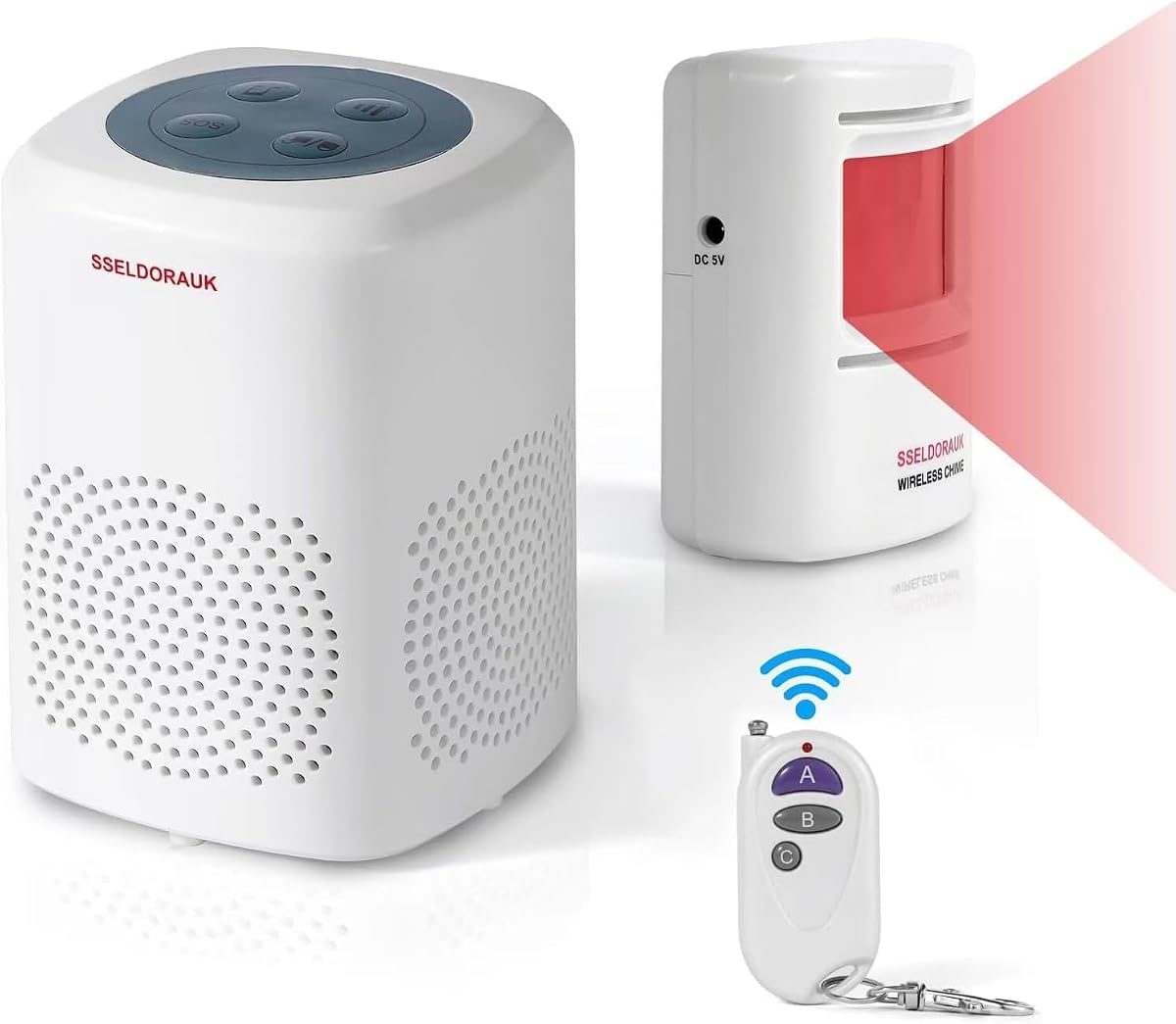
The S SELDORAUK Motion Sensor Alarm stands out for its wider selection of natural dog recordings. It has a 4.0 rating and provides 11 sound modes: six bark recordings captured from real dogs, one alarm tone, two ding-dongs, one melody, and one welcome chime. The electronic recordings are intended to sound more lifelike than a single synthesized bark, though they are not identical to a live dog.
We may earn a commission when you buy through this link, at no additional cost to you.
The wireless system includes one receiver, one detector, and one remote. Its receiver can operate from USB power or three AA batteries, while the sensor's range is listed as up to 200 meters in an open area. PIR detection reaches seven meters with a 110-degree horizontal and 30-degree vertical angle. Four volume levels are available, and maximum output is stated at 110dB, with the important qualification that wind, distance, and obstacles can reduce the sound heard outdoors.
The receiver and detector power accessories need careful review. A USB cable is included, but the listing states that the power adapter and AA batteries are not included. The PIR detector cannot detect through obstacles such as glass, so it must have a clear view of the area it is intended to monitor. Although the detector is described as waterproof for indoor or outdoor use, the receiver should be kept in a dry location.
This alarm is a good fit for buyers who care more about realistic barking audio and simple entry notification than about long-distance reception. It works well for a home, yard, garage, or office entrance and can be paired with additional chimes and sensors using the internal frequency control. It is less appropriate for a large property that requires several hundred meters of reliable communication through obstacles.
Six electronic bark recordings give the alarm a more varied and natural canine effect than systems offering one repeated sample. They are still recordings, not live animal sound, but the additional options can make alerts less predictable.
The included remote lets users operate the alarm without approaching the receiver. It is useful when the receiver is mounted in a location that is difficult to reach regularly.
We may earn a commission when you buy through this link, at no additional cost to you.
The ST-BARKINGDOG is a remote-controlled electronic watchdog built around microwave motion detection. Its 3.2 rating is the lowest in the roundup, so buyers should consider it with particular care. Nevertheless, the unit offers a familiar set of functions: barking dog, chime, and alarm modes, an included AC adapter, and a wireless remote that can reach more than 50 feet and operate through walls.
We may earn a commission when you buy through this link, at no additional cost to you.
The microwave signal can detect someone approaching from over 10 feet away, making the product useful for monitoring an indoor approach without requiring a direct line of sight. The remote can arm or disarm the alarm, change sound modes, and activate the panic function. If a nearby outlet is unavailable, the unit can run temporarily with eight AA batteries, although those batteries are not included.
The chief weakness is its low customer rating, which may reflect differences in real-world detection, sound quality, or installation experience. The 10-foot detection figure is also considerably shorter than the stated reach of several radar and PIR systems in this guide. It lacks multiple receiver-and-sensor zones, long-range transmission, adjustable volume levels, and documented outdoor weather protection.
This model is most appropriate for an indoor location where the owner values a wireless remote and wants to change the sound mode without approaching the unit. It may suit an entry hall, nearby room, or other protected indoor area where microwave detection through a wall is useful. It is less appealing for expansive coverage, precise outdoor perimeter monitoring, or buyers who place substantial importance on customer feedback and a broad feature set.
The included remote can control the alarm from more than 50 feet away, even through walls. That makes it convenient for arming the unit or triggering its panic function from another part of the home.
Barking dog, chime, and alarm settings allow the owner to change the nature of the warning. The bark mode supports deterrence, while the chime and alarm tones can serve as ordinary household alerts.
We may earn a commission when you buy through this link, at no additional cost to you.
The right barking dog alarm depends on where it will be installed, how it receives power, and whether you need one alert point or a multi-location system. The following factors explain the most important differences among the ten models.
PIR sensors generally detect changes associated with moving people or animals within a defined field, while microwave or radar units can react to movement through certain building materials. A PIR detector is usually mounted with a clear view of the approach and may be affected by obstacles, changing weather, ambient temperature, and sunlight. Radar products can offer wider angular coverage and may detect movement behind interior walls or glass, but solid metal can block their signal. Stated detection distance is not the only consideration: mounting height, angle, nearby objects, and the type of movement all affect actual performance.
Choose PIR for a conventional outdoor approach with a clear line of sight, and radar for an indoor unit intended to watch an entrance through a wall or window. Compare the stated reach with the geometry of your property rather than focusing only on the largest number.
A convincing bark can make an occupied property appear to have a dog present, but sound quality, variety, and volume remain subjective. Some systems include one repeated electronic bark, while others provide recorded barks, looping patterns, chimes, melodies, sirens, or even a recording function. A loop with numerous options may be less predictable than a fixed sound. Maximum output can help alerts carry through a property, although wind, walls, distance, and ambient noise may reduce what is actually heard outside.
Prioritize natural recordings and several warning choices if realism is important. If shared walls or nearby residents are a concern, look for adjustable volume levels and a night-only or light-only operating mode.
Wireless systems separate the receiver from the detector, allowing an alert to be heard indoors while a sensor watches a remote entrance. The listed maximum range generally assumes an open path, and walls, dense foliage, buildings, and weather can reduce it. Single-sensor kits suit one protected location, while two- and three-detector packages can cover separate doors, windows, driveways, or sections of a yard. Some systems also support frequency pairing between multiple receivers and sensors, which can help identify the source of an alert.
Match the number of sensors to the number of areas that genuinely need monitoring. For a small home, one detector may be enough; for a larger property, more sensors and a confirmed signal path are more useful than a very long headline range.
Power configuration affects installation convenience and resilience. Plug-in models require access to a standard outlet but avoid routine battery replacement. Receivers that support both USB and batteries can continue operating during an outage, while battery-powered sensors are easier to place in remote locations. Solar alarms remove wiring and disposable battery changes, but they need adequate sunlight and may not perform as expected beneath trees, beside tall buildings, or during extended poor weather.
Check the included and excluded power components carefully. Several receiver systems include a USB cable but not an adapter, and many sensor systems require batteries that are not supplied. For an important entry point, backup power is a worthwhile priority.
An outdoor alarm needs a housing designed to tolerate rain, snow, heat, and general moisture exposure. IP43, IP55, and IP65 appear among the products in this guide, with IP65 representing the strongest stated weather protection in the roundup. Even a weather-resistant sensor should be mounted according to the manual, with seals and connection points properly oriented. Indoor-only radar units should remain inside; their ability to detect through glass is a feature, not a reason to expose them to rain.
Match the stated rating to the exposure level. Covered porches may suit lower-rated equipment better than open driveways, while farm, yard, and orchard installations benefit from a higher-rated weatherproof housing.
The simplest indoor option is a single plug-in unit with no separate receiver. Wireless kits add installation steps because each sensor must be placed and associated with its receiver, but they provide much more flexible coverage. Adhesive strips and screws are commonly included, allowing sensors to be mounted on doors, windows, walls, trees, and fence posts. Remotes can make arming, disarming, sound selection, and panic activation more convenient, especially when the receiver is not easily accessible.
Before purchasing a multi-sensor kit, map the intended locations and confirm that each mounting surface is appropriate. Choose a remote-controlled model if you do not want to walk to the receiver every time the operating mode changes.
A unit that runs continuously offers consistent monitoring but may be unnecessarily disruptive. Night-only modes reduce daytime noise and preserve power, while light-only modes provide a visual warning without barking. Timer settings and custom recordings add further control. These options are especially useful for properties near neighbors, for businesses that need daytime awareness but nighttime quiet, and for solar alarms trying to conserve stored energy.
Look for a mode that matches normal traffic patterns rather than leaving every alert at maximum intensity. Adjustable output and sound selection also make it easier to distinguish an entry notification from a deliberate deterrence alarm.
A property with one important doorway can be served well by a single receiver-and-sensor kit, while multiple entries require additional detectors. Larger kits may include two or three sensors and a shared receiver, allowing one alert device to monitor different parts of a home or business. If precise source identification matters, check whether the system supports separate chimes with separate sensors. A large detection number does not compensate for a receiver that cannot reach a poorly positioned sensor.
Count the areas that need continuous attention and include backup approaches such as a side gate, garage, or rear door. The best configuration is usually a focused one that covers those points reliably rather than a larger kit with unused sensors.
Begin by mapping the exact approach you want to monitor and choosing a location that gives the sensor a suitable view. For PIR equipment, avoid pointing it through glass or directly into intense sunlight, and keep the detection path clear of foliage that could move in the wind. Radar models can be placed indoors to observe certain outdoor approaches, but they must not be exposed to weather. Mount the unit high enough to reduce casual interference while still covering the intended movement zone.
Power the components according to their instructions, pair each detector with its receiver, and test the alert before relying on it. Solar alarms need sufficient direct sunlight and the recommended initial charging period. Install batteries in the stated orientation, connect USB power where applicable, and confirm that the remote can reach the receiver. Then walk through the protected area, verify the trigger delay and sound level, and adjust sensitivity, volume, and operating mode as needed.
Care for the alarm by checking the battery or solar charge periodically, cleaning the sensor lens gently, and inspecting mounts for looseness. Keep the housing and openings free of dirt, debris, moisture, and spiderwebs. After severe weather, verify that the unit still powers on and triggers correctly. Do not ignore unusual sounds, repeated false alerts, or a damaged seal; a warning device that cannot perform reliably provides less security than a properly maintained one.
They can be useful as part of a broader security approach because the warning may discourage someone who believes a dog is present. Their effectiveness depends on sound realism, placement, volume, and the intruder's behavior. They do not replace locks, cameras, exterior lighting, professional monitoring, or other appropriate security measures.
Some radar-based models can detect movement through wood, glass, interior walls, and limited concrete thickness. The 120dB Radar Dog Alarm in this guide states that radar can pass through those materials, but metal front doors block the signal. PIR sensors generally require a clear line of sight and cannot reliably detect through glass.
A PIR sensor detects changes in infrared energy associated with moving people or animals and usually works best without obstacles. Radar detects movement by reflecting radio waves and can offer wider coverage or detection through certain materials. Radar may be useful indoors or across larger open areas, while PIR is often well suited to directed outdoor approaches.
Only if the specific model is designed for outdoor use. Products with stated IP43, IP55, or IP65 protection are better candidates for exposed locations, while the 120dB Radar Dog Alarm is explicitly indoor-only. Even outdoor-rated units should be installed according to the manual, with attention to the orientation of seals and connection points.
One sensor is generally enough for a single doorway or focused approach. Two or three sensors are more useful for a home with a driveway, garage, side entrance, or rear door. Count the separate areas that need coverage and confirm that the receiver can receive each sensor's signal from its planned position.
They can work, but adequate sunlight and charging time are essential. Cold, snow cover, shade, and extended cloudy weather may reduce charging or standby performance. Position the panel where it receives the strongest available sunlight and follow the manufacturer's recommended charging period before installation.
A higher maximum can make a warning more noticeable or intimidating, but the sound received at a particular location depends on distance, wind, walls, and other obstacles. Several models offer multiple volume settings, allowing users to reduce the output during quiet hours or in shared spaces without disabling the alarm.
A receiver-and-sensor system is useful when you want the alert heard indoors or in another convenient location while the sensor watches a remote entrance. A single plug-in watchdog is simpler and more compact, but it must be placed where it can hear the protected approach. Choose based on convenience and coverage rather than the number of components.
The Solar Looping-Sound Alarm is the best budget-oriented choice for a standalone outdoor deterrent, offering 13 looping sounds, four operating modes, and a weatherproof solar design. The Motion Sensor and Remote Alarm is the Editor's Choice because it balances 23-foot PIR detection, 656-foot wireless transmission, dual receiver power, and a supplied remote. For premium indoor coverage, the 120dB Radar Dog Alarm provides 360-degree radar detection, eight volume settings, and the ability to sense movement through several common materials.
Prioritize the environment and coverage pattern before selecting sound features. A property needing two or three monitored locations is better served by a multi-sensor receiver system, while a remote entrance without a convenient wired location may benefit from a solar alarm. Indoor users who want to monitor through a wall can consider radar, but they should verify the material and thickness involved. Outdoor users should look for a stated weather rating and provide the sensor with an unobstructed field of view.
Also account for what is included. Some systems need batteries, adapters, or other accessories that are not supplied, and remote range can fall well short of the maximum figure when walls or vegetation intervene. Before ordering, confirm the current listing details, included components, compatibility, and placement requirements so the selected alarm fits the intended location.