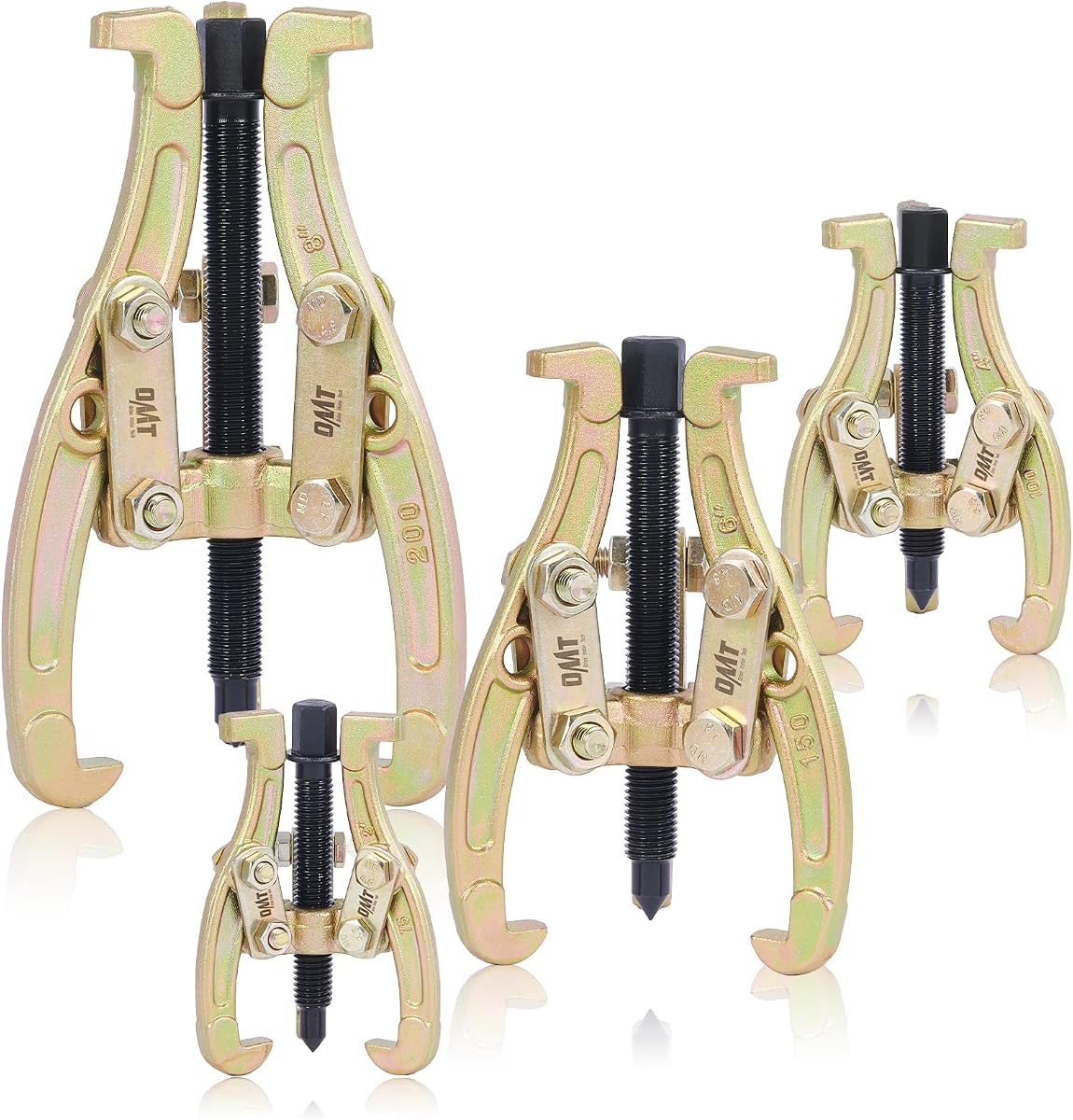
OMT 3" 4" 6" 8" Gear Puller Set
4.5Editor score
Four puller sizes
Reversible jaw options
Two- and three-jaw formats
A bearing puller set is a specialized toolkit for removing bearings, seals, gears, bushings, pulleys, and other press-fit components without relying on improvised prying. The best choice depends on whether the part sits on a shaft, inside a blind housing, or within a tight mechanical assembly, as well as the reach and force required.
We compared the ten sets in this guide by their stated construction, pulling methods, jaw or collet range, included components, vehicle applications, storage, and customer ratings. The list covers internal collet extractors, external separator kits, versatile two- and three-jaw pullers, and larger combinations intended for varied workshop tasks.
Each review identifies the product most suitable for a particular job, from compact internal extraction to high-reach gear removal. Ratings and product details reflect the supplied listings, while prices and availability can change, so shoppers should confirm the current listing and included components before purchasing.
4.5Editor score

4.2Editor score
4.4Editor score
As an Amazon Associate we earn from qualifying purchases.
The comparison below highlights each set's principal pulling style, component range, construction, and best-fit applications, making it easier to match a tool kit to a specific bearing-removal job.



The Orion Motor Tech OMT Bearing Puller Set has a 4.4 customer rating and combines two bearing separator jaws with a yoke, forcing screw, extension screws, and L-type legs. It is designed for removing large or small bearings from front and rear hub axle shafts, while also handling gears, pulleys, steering wheels, and related press-fit components.
We may earn a commission when you buy through this link, at no additional cost to you.
Its strongest feature is the combination of a three-inch separator jaw and a two-inch jaw. The tapered, knife-like profile is intended to move behind a bearing and maintain contact during the pull, while the listed five-ton capacity gives the jaws a useful level of strength for demanding automotive work. Four extension screws in two lengths and two L-type legs expand the options for different shaft depths and access conditions.
The principal limitation is that this is an external separator system rather than a blind-hole extractor. It needs space behind or around the component, and the shaft or housing geometry must allow the jaws to seat correctly. It also does not include a slide hammer, threaded adapters, or the split collets found in internal-pulling kits, so it is not the most complete option for every workshop.
This is a strong choice for a home mechanic or technician who regularly works on hub bearings, axle shafts, gears, pulleys, and steering wheels. The two jaw sizes, broad component list, and heat-treated Cr-V steel construction make it a versatile first choice for external pulling tasks without requiring a much larger all-in-one system.
The yoke, forcing screw, four pairs of extension screws, and L-type legs give the separator setup several ways to bridge the distance between the forcing point and the bearing. This assortment is particularly useful when a component sits at different positions on a shaft or when a direct pull is difficult because of surrounding hardware.
The jaws are described as five-ton-capacity, heat-treated Cr-V steel components with a black oxide finish. That combination targets the resistance and corrosion exposure commonly encountered when removing seized hub bearings, pinions, pulleys, and similar parts from vehicles, ATVs, and light trucks.
We may earn a commission when you buy through this link, at no additional cost to you.
This OMT Bearing Puller Set also carries a 4.4 rating and shares a broad external-removal configuration. The kit includes three-inch and two-inch separator jaws, a six-inch yoke, a 7-1/5-inch forcing screw, four 4-1/3-inch extension screws, four 5-1/3-inch extension screws, and two 5-3/5-inch L-type legs.
We may earn a commission when you buy through this link, at no additional cost to you.
It is designed for pulling large and small bearings from wheel hub axle shafts as well as gears, pulleys, and steering wheels. The tapered jaws are intended to get behind a bearing rather than bear against its outer edge, and the extension hardware makes the set more adaptable to parts that are not positioned immediately next to the yoke.
Like other external separator tools, it depends on adequate room for the jaws and yoke to move. It cannot lock into an inaccessible bearing bore in the way a split collet can, so users dealing with sealed housings or blind cavities should choose an internal extractor instead. Its value lies in specialized, direct-force pulling rather than offering every conceivable removal method.
This set suits owners and technicians who work on cars, ATVs, and light trucks and want a dedicated separator for hub bearings and related components. It is especially attractive when two jaw sizes and several extension arrangements are preferred, providing more configuration options than a minimal two-jaw puller.
Providing both two-inch and three-inch separator jaws lets the user match the separator to the component and available access. The smaller jaw can suit tighter areas, while the larger jaw provides another option for larger bearings, gears, and pulleys without requiring a separate kit for each category.
The included yoke, forcing screw, extension screws, and L-type legs form a complete separator-style system. It is best suited to shafts and hubs where the tool can reach behind the part and apply controlled axial force without converting the job into improvised hammer-and-pry work.
We may earn a commission when you buy through this link, at no additional cost to you.
The OMT Blind Hole Collet Bearing Race and Seal Puller Extractor Kit has a 4.2 rating and is intended for internal components that cannot be reached with conventional separator jaws. Its 16-piece configuration includes a slide hammer, counterstay puller, spare pin bolt, three screw adapters, and ten split collets covering diameters from 6 to 59 millimeters.
We may earn a commission when you buy through this link, at no additional cost to you.
The expandable collets lock into the inside of a bearing or similar component, allowing axial force to be transferred directly to the inner race. For routine removal, the listed procedure is to fit and lock the appropriate collet and then draw back the slide hammer. For tighter or more delicate work, the counterstay provides a slower, controlled alternative.
A major advantage is that the set does more than provide one extraction method. Slide-hammer action can free a tight or jammed part, while the counterstay is useful when sudden impacts are undesirable. Conversely, choosing the wrong collet or failing to seat it correctly can reduce the effectiveness of the pull, and the system is still intended for components it can physically reach.
This is a practical choice for technicians and serious do-it-yourself users dealing with bearings, bushings, and sealed or race components inside housings. The ten-collet range supports many automotive sizes, while the organized blow-molded case helps prevent the many small components from being lost between jobs.
The split-collet design expands inside the component's bore, creating a grip that transfers pulling force to the inner race. This makes the set more appropriate than a flat separator for bearings buried inside a housing, where a jaw cannot get behind the outer edge.
The slide hammer offers a direct method for freeing a jammed component, while the counterstay lets the user turn the threaded force slowly. Having both approaches lets the operator choose the level of force and impact appropriate to the part and repair.
We may earn a commission when you buy through this link, at no additional cost to you.
This second OMT blind-hole kit combines the same 16-piece concept with a 4.2 rating. It includes a slide hammer, counterstay puller, spare pin bolt, three screw adapters, and ten split collets, allowing it to address internal parts ranging from 6 to 59 millimeters in diameter.
We may earn a commission when you buy through this link, at no additional cost to you.
The body of the tool is made from forged AISI 1045 medium-carbon steel and galvanized for durability, while the collets are described as chromoly steel. The construction is intended to withstand repeated extraction work involving stubborn bearings and bushings without relying on the outer edge of the component for leverage.
The kit's controlled-pull option is its most useful differentiator. Rather than beginning every job with a hammer strike, the user can tighten the counterstay gradually and observe how the component responds. The slide hammer remains available for parts that need an impact-assisted release, giving the set flexibility across a wider range of internal conditions.
It is well suited to vehicle repair involving inaccessible bearings, axles, and bushings, especially when a technician wants more than a simple slide-hammer set. As with any internal extractor, access and collet selection determine the result, so users should compare the component dimensions with the stated range before beginning.
Forged AISI 1045 steel provides the main structural strength, while the galvanized finish is intended to resist corrosion during storage and use. Chromoly steel collets focus material strength in the part that expands and grips the bearing or bushing.
With ten collets spanning 6 through 59 millimeters, the set covers a substantial assortment of internal sizes. That breadth is valuable for users who want one organized internal extractor rather than separate tools for each bearing bore.
We may earn a commission when you buy through this link, at no additional cost to you.
The OMT 3" 4" 6" 8" Gear Puller Bearing Puller Kit has a 4.4 rating and is the most configurable set in this guide. It contains 24 pieces, including four puller bodies with maximum spreads of three, four, six, and eight inches and corresponding reaches of 4.3, five, 7.3, and 9.2 inches.
We may earn a commission when you buy through this link, at no additional cost to you.
Straight and triangular jaw brackets allow the components to be assembled as two-jaw or three-jaw pullers. Reversible jaws can pull from the inside or outside of a component, while dual fixing holes on the four-, six-, and eight-inch pullers create short, standard, long, and extra-long reach configurations.
The primary trade-off is complexity. This larger assortment can feel excessive for a single straightforward hub-bearing job, and every piece needs a proper home in the custom blow-molded case. It is an external pulling system, however, and does not solve the specific problem of extracting a bearing from a blind internal bore.
This premium kit is a strong fit for technicians, repair shops, and advanced enthusiasts who move among gears, bearings, pulleys, and flywheels. The combination of four sizes, reversible jaw orientation, and selectable reaches makes it the most adaptable option for external components that vary significantly in diameter, depth, and mounting position.
Four puller sizes allow the operator to select a body that matches the component rather than forcing one small set to work on everything. The stated reaches increase as the spread grows, providing better leverage and clearance for deeper, larger assemblies.
Reversible jaws can be turned to pull from either the inside or outside of a component. Straight and triangular brackets add another layer of configuration, helping the same kit handle parts that are accessible from different directions.
We may earn a commission when you buy through this link, at no additional cost to you.
The OMT 3" 4" 6" 8" Gear Puller Set has a 4.5 customer rating, the highest among the ten products listed here. It includes four puller sizes with maximum spreads of three, four, six, and eight inches and reaches of 4.3, five, 7.3, and 9.2 inches.
We may earn a commission when you buy through this link, at no additional cost to you.
Its reinforced three-jaw design is intended to grip components tightly and distribute pulling force evenly. Reversible jaws allow the tool to work from either the inside or outside, while the six- and eight-inch units provide four configurations through dual fixing holes. A wrench or ratchet can be used to drive the puller.
It is versatile across gears, bearings, crank pulleys, and flywheels, making it more broadly useful than a small bearing-specific puller. However, it still operates externally and cannot expand a collet inside a blind bore. A workshop that regularly services sealed or recessed housings may need to add an internal extraction kit.
This is an appealing budget-oriented choice for DIY mechanics and professionals who want multiple puller sizes and a strong three-jaw arrangement. The drop-forged, heat-treated carbon steel construction and corrosion-resistant coatings are also reassuring for a tool expected to handle worn, broken, or seized components.
Three jaws contact the component around more of its circumference than a two-jaw arrangement. The listing specifically emphasizes an even distribution of pulling force, which can reduce unwanted rotation and improve control during removal.
Turning the jaws over changes the direction from which the puller engages. This makes the set useful for both externally mounted parts and components that can be reached from inside a larger hub or wheel assembly.
We may earn a commission when you buy through this link, at no additional cost to you.
The 21-in-1 Bearing Puller has a 4.3 rating and is built around an internal, three-jaw puller design. Its six different collet dimensions and three additional curved hooks are intended to remove bearings with varying shapes and sizes, while the complete set is stored in a fitted hard-plastic case with a handle.
We may earn a commission when you buy through this link, at no additional cost to you.
The puller is made from drop-forged, heat-treated red steel, while the inner-hole three-jaw component has a black oxide finish. To use the main collet system, the appropriate collet is placed inside the bearing's inner ring and the top threaded rod is turned with a wrench to expand the puller and extract the component.
The included lubricant recommendation is important because a well-lubricated threaded rod reduces friction and helps the tool turn more smoothly. Users must still confirm that the selected collet can expand safely inside the bearing and that the part's dimensions are compatible. The tool is designed to transfer force to the inner race rather than to the outer ring.
This kit is a good option for maintenance work involving common industrial and mechanical bearing series, as well as gears and related parts that the three grips can handle. It provides a wider assortment of internal accessories than a basic collet set, making it useful for users who want more options without moving to a slide-hammer kit.
Six collet dimensions create several starting sizes for internal extraction, and the three curved hooks add alternative contact shapes. Those accessories broaden the range of components the user can approach without relying on external separator jaws.
The listing specifically recommends applying lubricant to the threaded rod before use. This can make turning easier, reduce binding, and help protect the tool while the puller develops force against the bearing inner race.
We may earn a commission when you buy through this link, at no additional cost to you.
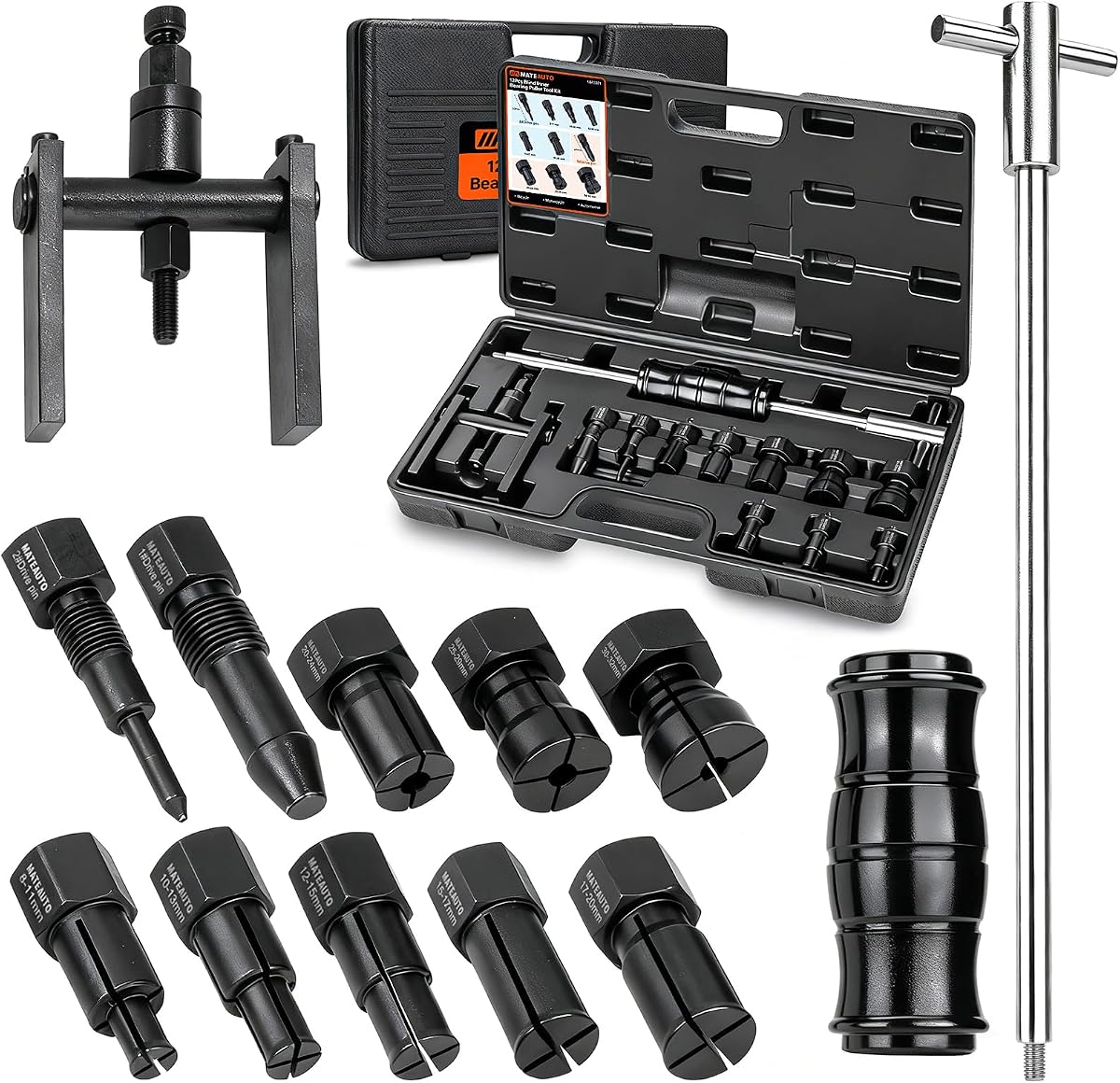
The 12-Piece Motorcycle Blind Hole Collet Bearing Puller Set has a 4.2 rating and focuses on internal extraction in a compact package. It includes eight expandable collets ranging from 8 to 32 millimeters, a 1.2-foot, or 360-millimeter, slide hammer, and a storage box.
We may earn a commission when you buy through this link, at no additional cost to you.
The operating concept is straightforward: select the collet that fits the internal component, insert it so it expands within the bore, and attach the slide-hammer assembly. The set is intended for recessed parts and is listed as suitable for motorcycles, compact cars, and medium-sized cars, giving it broader relevance than its motorcycle-focused name might suggest.
Its narrower eight-to-32-millimeter range and smaller piece count make it less comprehensive than the OMT internal kits that cover up to 59 millimeters. The slide hammer is well suited to freeing a stuck bearing, although users must ensure the hammer motion stays aligned so the collet does not strike the housing unevenly.
This is a focused choice for motorcycle owners, motorcycle mechanics, and technicians who repeatedly service compact bearings. It is easier to organize than a large kit, includes instructions for first-time users, and provides a practical set of collets and a hammer in one portable package.
Eight collets cover internal diameters from 8 to 32 millimeters, creating a practical selection for many motorcycle and compact automotive bearings. The set is more focused than a broad blind-hole kit and may be easier for occasional users to organize.
The 360-millimeter slide hammer adds direct impact to the puller assembly. Combined with expandable collets, it provides a compact method for freeing a bearing that is seated inside a housing and cannot be reached with outside jaws.
We may earn a commission when you buy through this link, at no additional cost to you.
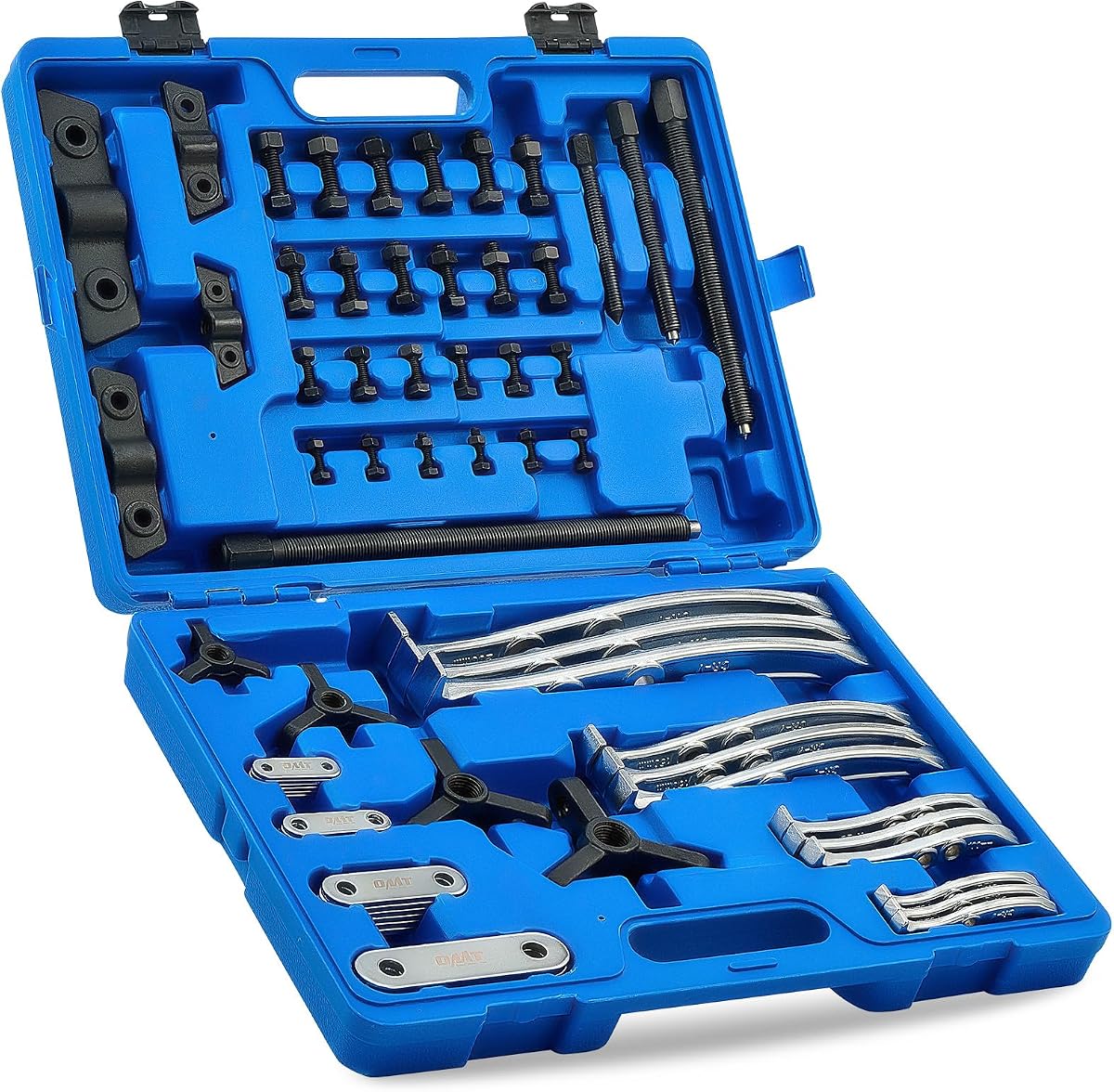
The OMT 30pc Bearing Puller and Blind Hole Bearing Race and Seal Extractor Kit has a 4.2 rating and combines both major removal styles in one package. It includes internal split collets, screw adapters, a slide hammer, a counterstay puller, separators, a yoke, a forcing screw, puller legs, and extension screws.
We may earn a commission when you buy through this link, at no additional cost to you.
This distinction matters because a component may be visible and easy to reach in one repair while another is buried inside a blind housing. The external separator system has a stated five-ton capacity, while ten split collets cover parts from 6 to 59 millimeters in diameter. The combination allows the same kit to address a broad range of bearings, gears, pulleys, axles, and bushings.
As the largest assortment in the guide, it creates more organizational demands than a specialized single-purpose kit. The listing addresses that concern with two robust cases containing sized compartments for each tool. The trade-off is simply the number of choices: a user performing occasional, predictable jobs may carry less than they need, while a busy technician benefits from having the appropriate method nearby.
This is the strongest all-in-one recommendation for a repair shop, advanced home workshop, or user who wants to avoid owning separate internal and external bearing tools. Its combination of ten collets, a five-ton separator arrangement, multiple extensions, and organized storage gives it unusually broad practical coverage.
The split collets and slide hammer address components inside blind housings, while the separator jaws, yoke, and extensions handle parts mounted on shafts. Combining both approaches means the kit is not limited by the geometry of a single repair.
The assortment includes the hardware needed to configure different pulls rather than a small number of interchangeable pieces. Two compartmented cases provide dedicated places for the tools, improving transport and helping keep small adapters and collets together.
We may earn a commission when you buy through this link, at no additional cost to you.
The KOOPOOL 14Pcs Bearing Puller Set has a 4.2 rating and is a conventional separator and splitter kit centered on external removals. It includes two-inch and three-inch separator jaws, a seven-inch forcing screw, four push-pull legs, four extension legs, a yoke, and two L-legs.
We may earn a commission when you buy through this link, at no additional cost to you.
Its listed five-ton capacity and heat-treated 45# carbon steel construction are designed for stubborn bearings, gears, pulleys, axle shafts, pinions, and steering wheels. The push-pull and extension legs provide several ways to adapt the puller to different shaft lengths, while the two jaw sizes cover a useful range of component dimensions.
The main limitation is the absence of an internal collet system. If a bearing is enclosed in a blind housing, this separator cannot expand inside the bore to establish a grip. It is also less configurable than the 24-piece and 30-piece OMT sets, which provide more puller sizes, jaw arrangements, and internal extraction options.
This kit is a straightforward selection for owners and mechanics who mainly remove mounted components from cars, ATVs, and light trucks. The blow-molded case with a handle and latches is a useful addition for transport, and the focused component list can make the toolkit easier to understand than a larger multi-method set.
Four push-pull legs and four extension legs give the user several bridge lengths between the yoke and separator jaws. These options are important when the component sits at a different depth or when the available shaft length does not match the standard setup.
Two common separator jaw sizes, a forcing screw, yoke, and L-legs create a clear system for mounted bearings, gears, pulleys, and shafts. It is an economical specialist option rather than a comprehensive internal extraction package.
We may earn a commission when you buy through this link, at no additional cost to you.
The right bearing puller set depends primarily on component location, required reach, and the type of pull the job permits. Reviewing those factors before buying helps prevent an incomplete toolkit or an unsuitable extraction method.
External separator tools place jaws behind a component mounted on a shaft, making them appropriate for hub bearings, gears, pulleys, pinions, and similar parts. Internal blind-hole kits use expandable split collets to lock into a bearing or bushing bore, which is necessary when the component is recessed inside a housing. A two-jaw or three-jaw puller offers another approach when the component can be gripped around its exterior. Choosing the correct geometry is more important than simply selecting the set with the most pieces.
A puller must fit the component's diameter and bridge the distance from the forcing point to its edge. Multi-size sets offer maximum spreads and reaches across several dimensions, while extension screws or legs add clearance when a component is positioned deeper on a shaft. Consider both the stated spread and reach, along with the physical space available around the assembly. A tool that offers enough reach but cannot center properly is less useful than a correctly sized setup.
Two-jaw pullers are straightforward and often economical, while three-jaw pullers can distribute force more evenly around a component. Reversible jaws increase flexibility by allowing pulls from the inside or outside. For internal work, collet size is critical: the selected collet should fit safely inside the inner race and expand without excessive clearance. Curved hooks and other accessories may broaden compatibility, but they should complement rather than replace correctly sized primary attachments.
Capacity indicates the load the tool is designed to handle and helps distinguish a light-duty separator from a more substantial workshop puller. The Orion separator kits and KOOPOOL set state five-ton capacity for their jaws. Capacity alone does not guarantee safe use on every part, because geometry, condition, and leverage determine actual loading. A correctly sized tool with sound components is generally preferable to an undersized tool forced beyond its intended application.
Heat-treated steel is common among the listed kits because pulling tools must resist bending, wear, and repeated loading. Some products use Cr-V steel, AISI 1045 medium-carbon steel, 45# carbon steel, or red steel with a black oxide finish. Forged construction is also highlighted in several descriptions. While material specifications help indicate durability, users should still inspect threads, jaws, collets, and fasteners for wear or damage before applying significant force.
A larger set can provide valuable options, but piece count is not the same as usefulness. The 30-piece OMT combination kit includes both internal and external methods, while the 24-piece set offers four sizes and multiple jaw arrangements. Smaller 12-, 14-, and 16-piece kits may be easier to organize and sufficient for a narrow specialty. Compare the actual functions, sizes, and storage solution rather than assuming the biggest collection will suit every user.
Most products in this guide target automotive work, including cars, ATVs, motorcycles, and light trucks. The listed tasks extend beyond bearings to gears, pulleys, steering wheels, axle shafts, bushings, crank pulleys, and flywheels. Check whether the component falls within the manufacturer's stated applications and whether the set can physically access it. A kit that handles many jobs is valuable for a working technician, while a focused set can be preferable for a user with one recurring repair.
Small collets, adapter screws, pins, and legs are easy to lose unless the set includes a fitted case. The OMT 30-piece kit provides two compartmented cases, while the 21-in-1 and 12-piece kits use portable boxes and the KOOPOOL set has a handled blow-molded case. A dedicated case makes it easier to inventory missing pieces, transport the set, and keep oily tools separated from other workshop equipment. Confirm that the supplied case actually matches the full collection.
Begin by identifying how the component is mounted. For an external separator puller, clean the shaft and bearing area, assemble the appropriate jaws and legs, position the yoke clear of nearby components, and ensure the puller bears directly against the correct race or surface. For an internal collet extractor, measure the bore or inner race, select a properly sized collet, verify that it can expand safely, and attach the specified adapter or hammer assembly.
Apply the manufacturer's recommended lubricant to moving threads and contact points. Turn threaded forcing screws evenly with a wrench, and use the slide hammer only when the component and tool are aligned correctly. For delicate work, controlled counterstay pulling can be preferable to impact. Stop if a jaw slips, a collet does not seat correctly, threads turn with excessive resistance, or the component starts to tilt; forcing a misaligned pull can damage the tool or the part being removed.
After use, remove grease and dirt from the threads, jaws, collets, screws, and storage compartments. Inspect for bent jaws, worn collets, damaged threads, and missing adapters, then return each piece to its designated place. Lightly protect exposed steel according to the product instructions and store the case in a dry location. Periodic checks help reveal damaged parts before they fail during a critical repair.
An internal blind-hole puller with expandable split collets is generally the appropriate choice for a bearing recessed inside a housing. The collet expands within the component's inner race, transferring pulling force directly to the part. The OMT 16-piece kits and the 30-piece combination kit are examples of sets that include this approach.
Yes, when the gear or pulley is mounted on a shaft and the separator jaws can reach behind it. Separator kits are widely used for pressed-on gears, pulleys, pinions, and steering wheels. The component must have sufficient clearance for the jaws and yoke, and the pull should be directed along the shaft.
A three-jaw puller can distribute force more evenly around a circular component, while a two-jaw puller may be simpler and more adaptable to limited access. The best choice depends on the component's geometry and the space around the assembly. Reversible and multi-position jaw systems offer useful flexibility when one configuration cannot provide a secure connection.
Measure the inside diameter of the component or the bearing's inner race and choose a collet that matches while still allowing it to expand and grip securely. An undersized collet may not provide enough contact, while an oversized collet may not enter the bore. The OMT internal kits cover 6 to 59 millimeters, while the 12-piece motorcycle-focused set covers 8 to 32 millimeters.
Neither method is universally better. A slide hammer delivers sudden impact that can free a tight component, while a counterstay applies controlled threaded force that may be preferable for delicate work or when heavy impact should be avoided. Having both methods available lets the user match the extraction technique to the condition of the part.
Only a combination toolkit that includes both internal and external components can cover both situations. The OMT 30-piece kit is the clearest example in this list because it includes split collets, a slide hammer, a counterstay, separator jaws, a yoke, a forcing screw, legs, and extensions. A dedicated separator set is limited to exposed components.
Use only enough force to maintain a centered, secure grip and overcome the bearing's retention. Abrupt or excessive force can damage the bearing race, shaft, housing, or puller components. If the tool has begun to slip or the load is not centered, stop and correct the setup before continuing.
Clean off grease and debris after each use, inspect threads and working faces, and store every component in its designated case space. Protect exposed steel from prolonged moisture and check for bent jaws, worn collets, damaged pins, or missing adapters. A complete inventory helps ensure the correct part is available for the next job.
The OMT 30-piece combination kit is the most complete all-in-one choice because it includes internal collets, a slide hammer, a counterstay, and external separator components. The OMT 24-piece kit stands out for external size and jaw configuration versatility, while the four-size OMT gear puller offers a strong budget option for common workshop removals.
Prioritize the geometry of the job over the number of pieces. Use a blind-hole collet set for a bearing buried inside a housing, a separator for a mounted component with shaft access, and a reversible two- or three-jaw puller for external gears, pulleys, and flywheels. Then compare component range, reach, material, capacity, and whether the storage case will make the tools easier to manage.
Ratings and product configurations can change, and current prices and availability may also vary. Before purchasing, confirm the exact contents, dimensions, and application notes in the current listing. That final check ensures the selected bearing puller set is compatible with the component, access, and removal method required for the repair.