
Fokuse FKS-1001
4.9Editor score
10 needles for multi-color work
14.2 by 9.5-inch area
Automatic color and thread changes
Cap driver and hoops included
Wi-Fi, USB, and LAN transfers
A commercial embroidery machine turns artwork into consistent, repeatable stitched products, but the right model depends on your order types, hoop requirements, and experience level. Important considerations include needle count, embroidery area, cap capability, controls, software connectivity, and how much support is available after purchase.
This guide compares ten multi-needle machines using the specifications and features supplied for each product. It covers flat-embroidery speed, cap performance, work area, automatic functions, file transfer, included accessories, and business-oriented features such as design management and cost calculation.
Each review explains where a machine appears strongest and where buyers may need to compromise. Ratings and product details can change, as can retailer availability and pricing, so confirm the current listing, package contents, warranty terms, and support coverage before making a purchase.
4.9Editor score

5.0Editor score

5.0Editor score
As an Amazon Associate we earn from qualifying purchases.
This side-by-side overview compares needle count, embroidery area, stated speed, and major workflow features across all ten machines, making it easier to identify the right balance of capacity, space, and automation.


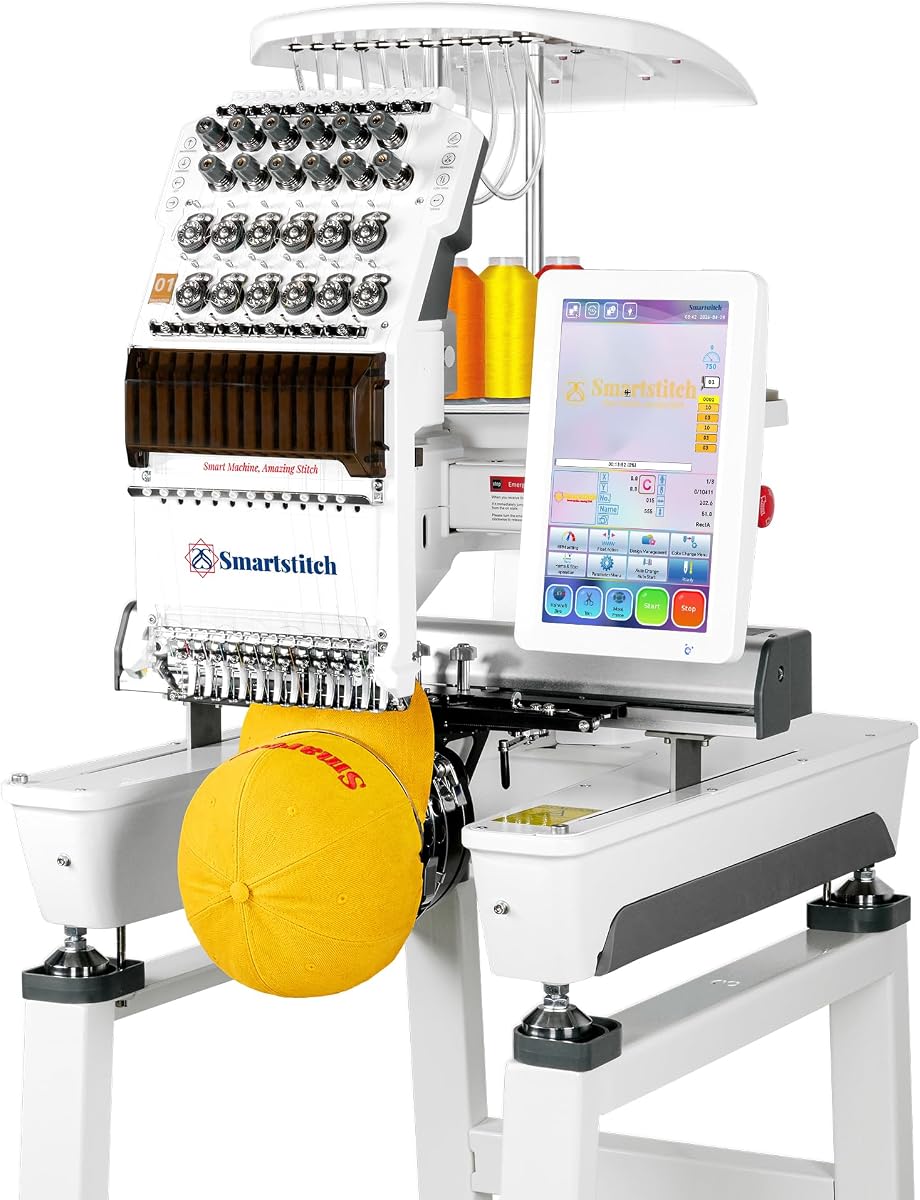


The Smartstitch S-1001 combines ten needle positions with a stated maximum speed of 1,200 stitches per minute and a 9.5-by-14.2-inch embroidery area. Its 4.8 rating reflects a strong balance of production features, and the machine is particularly appealing to operators who want multi-needle capability without moving to the largest available framework.
We may earn a commission when you buy through this link, at no additional cost to you.
Automation includes automatic thread trimming, automatic color changes, thread-break detection, a self-lubrication system, laser positioning, and physical control buttons. DST and DSB files can move from a computer through USB or Wi-Fi, while the starter pack includes embroidery threads, stabilizers, and bobbin threads for a broad selection of caps, shirts, shoes, bags, leather, canvas, denim, and vinyl.
The main compromise is capacity. Ten needles are enough to reduce interruptions on moderately complex designs, but a 15-needle machine can hold more colors without returning to the same needle. The 7-inch screen is also smaller than the 9-, 10-, and 12-inch displays offered by several competitors. Conversely, the listing describes a compact, relatively light machine that may be easier to position than a maximum-size production system.
This model makes sense for a developing shop that needs more color capacity than a single-needle machine, especially if caps and medium-size garments form the core of its order book. The supplied manuals, video training, online assistance, community resources, and local technical support also reduce the steep learning curve associated with a first multi-needle investment.
Automatic trimming, color changes, and thread-break detection directly reduce the repetitive work associated with multi-color orders. Laser positioning also supports repeatable logo placement, while the stated 100-million-stitch memory provides ample room for complex design libraries.
USB and Wi-Fi connectivity simplify the movement of DST and DSB files from a computer. The stated material range includes common apparel, caps, bags, footwear, canvas, denim, leather, and vinyl, giving the S-1001 broader relevance than a garment-only machine.
We may earn a commission when you buy through this link, at no additional cost to you.
BAI The Mirror is a 15-needle production machine with a 20-by-14-inch work area and a 4.8 rating. It targets custom apparel businesses, sellers, and shops moving beyond occasional jobs, with the ability to handle hats, shirts, jackets, patches, uniforms, logos, and other custom orders.
We may earn a commission when you buy through this link, at no additional cost to you.
Its strongest specifications are the 1,200-SPM stated flat speed and 850-SPM cap speed. The 15-needle arrangement allows more colors to remain loaded during multi-color logos, uniforms, and hats. Institch OS5 provides guided setup, design editing, hoop or frame selection, and output control through a workflow described as requiring one to three steps for common tasks.
Like many 15-needle machines with a large field, The Mirror requires adequate floor space and a stable operating position. The listing emphasizes preset accessories and brand-name components, but buyers should confirm the exact included items before assuming every hoop, cap attachment, and supply is present. Local technical support, free training, and a large user community are meaningful additions for a business purchase.
The Mirror is a compelling option for buyers who prioritize a generous embroidery area, faster color transitions, and dedicated cap performance without moving to an even larger premium model. It is especially appropriate for growing shops producing a mix of apparel, patches, and hats where multi-color efficiency is more important than the smallest possible footprint.
A 20-by-14-inch field can accommodate larger logos and reduce the need to rehoop oversized garment designs. Fifteen needles improve color-change efficiency, making the machine well suited to detailed uniforms, layered logos, and other work involving several thread colors.
Institch OS5 presents setup and design tasks in a guided manner, which may shorten onboarding for a new operator. Free training, local technical support, community access, and tutorial resources provide practical help beyond the initial setup.
We may earn a commission when you buy through this link, at no additional cost to you.
The Smartstitch S-1201 Plus combines 12 needles with a 12-by-16-inch work area, a 10-inch touchscreen, and a stated maximum speed of 1,200 stitches per minute. Its 4.8 rating places it among the strongest options here for operators who want more capacity than a compact 10-needle machine.
We may earn a commission when you buy through this link, at no additional cost to you.
The machine uses a direct vertical guiding system that the manufacturer says improves stability and reduces noise. It includes automatic thread trimming, automatic color changes, thread-break detection, laser positioning, a self-lubrication system, physical buttons, and Smart Control System V7 with up to 100 million stitches of memory.
Twelve needles place the S-1201 Plus between the smaller 10-needle models and the full 15-needle production configurations. That middle position can be practical when designs need a moderate palette but a shop does not routinely run jobs with the maximum number of colors. The listing identifies USB transfer for DST and DSB files, while the model title also highlights Wi-Fi.
This machine is a strong fit for apparel and cap specialists working with medium-to-large designs who value a roomy touchscreen and quiet, stable operation. Training materials, professional support, a user community, and local technical assistance help new owners build confidence, while the starter pack supplies threads, stabilizers, and bobbin threads.
The 12-by-16-inch field offers meaningful room for garments, caps, shoes, bags, and larger decorative elements. Its 12 needle positions hold more colors than a 10-needle unit without requiring the footprint and color capacity of a full 15-needle production machine.
The direct vertical guiding approach is intended to limit vibration and operating noise. A 10-inch screen provides more room for reviewing designs, selecting hoops, and adjusting settings, while dedicated physical buttons offer visible controls during production.
We may earn a commission when you buy through this link, at no additional cost to you.
The Poolin EOX is a 15-needle commercial machine with a 20-by-14-inch embroidery area and a 5.0 rating. It is positioned as a workhorse for businesses serving customers with a wide assortment of products, including caps, apparel, shoes, bags, towels, stuffed animals, quilts, and personalized gifts.
We may earn a commission when you buy through this link, at no additional cost to you.
The 270-degree cap system supports front, side, and back placement along with 3D puff designs. Flat production reaches a stated 1,200 SPM, while cap work reaches 850 SPM. Automatic color changes, thread trimming, and laser positioning reduce repetitive tasks, and the 9-inch InStitch OS4 touchscreen gives operators direct access to core controls.
DST and DSB files can be transferred wirelessly or by USB. InStitch digitizing software supports pattern organization, lettering, tracing, and conversion of uploaded artwork into stitch-ready files, while cloud storage provides a place to retain projects. The supplied data also identifies an integrated cost-estimation tool for evaluating material use and custom-order pricing.
The EOX is best suited to an expanding shop that cannot limit itself to one garment category. Its combination of 15 needles, a large field, advanced cap placement, and connected design tools gives it unusually broad commercial utility. U.S.-based technical support, a dedicated stand, and embroidery supplies add practical value for a buyer establishing a production workspace.
The EOX is unusual among the machines in this guide because it is presented as a solution for caps, garments, oversized logos, footwear, bags, towels, stuffed animals, and gifts. That range lets a business test new product categories without changing machines.
Wireless and USB file transfer support a flexible production workflow. InStitch combines digitization, cloud project storage, file preparation, and cost estimation, helping operators move from uploaded artwork toward organized and commercially priced orders.
We may earn a commission when you buy through this link, at no additional cost to you.
The Poolin EOM is a 15-needle machine intended for single-needle owners, home studios, and small shops preparing for more substantial production. It has a 4.6 rating, a 14.2-by-9.5-inch area, and stated speeds of 1,200 SPM for flat work and 850 SPM for caps.
We may earn a commission when you buy through this link, at no additional cost to you.
Its primary strength is access to 15 colors without adopting the footprint of a larger industrial system. Automatic color changes, automatic thread trimming, and thread-break detection reduce interruptions, while the 270-degree cap system supports front, side, and back positions on structured and unstructured hats, including 3D puff work.
The 9-inch InStitch OS4 interface and Wi-Fi or USB transfer provide a manageable onboarding path. InStitch also includes pattern browsing, lettering, tracing, artwork conversion, cloud storage, and an integrated material-use cost estimator. The supplied accessory list is extensive, covering a stand, handrails, five standard hoops, a cap station, two cap hoops, prewound bobbins, thread, stabilizer, and basic tools.
This is an appealing choice for an operator who has outgrown a single-needle machine but still values a relatively practical all-around format. Its main limitation is the smaller embroidery field, which may require more rehooping for oversized jacket backs or similarly large products. Buyers who prioritize cap work and color variety over maximum work area should examine it closely.
The EOM's guided touchscreen workflow is designed to make the move from one needle to 15 manageable. Automatic functions support repeat orders by reducing color-change and trimming interruptions, which can be more noticeable when every minute affects throughput.
The listed accessories cover common starting needs for flat work and caps, including hoops, cap equipment, bobbins, thread, stabilizer, and tools. This reduces the number of separate purchases required before a new owner can begin training and sample production.
We may earn a commission when you buy through this link, at no additional cost to you.
The Smartstitch S-1501 provides 15 needle positions, a 14-by-20-inch work area, a 12-inch touchscreen, and a stated maximum speed of 1,200 stitches per minute. Its 4.7 rating makes it a solid all-around option for apparel, flat products, and structured caps.
We may earn a commission when you buy through this link, at no additional cost to you.
The 270-degree wide-angle cap system is a central feature, allowing side and 3D cap embroidery in addition to conventional placements. Laser positioning and automatic color changes improve repeatability and production flow. Other operating features include automatic thread trimming, a self-lubrication system, thread-break detection, physical buttons, and Smart Control System software.
This machine occupies substantial floor space, and its large field does not eliminate every need for rehooping because the maximum jacket-back area can exceed the available field. Compared with the S-1501 Plus Beast, however, it offers a smaller framework while retaining 15 needles, a large touchscreen, and the same stated maximum speed.
The S-1501 is a strong option for a shop beginning an embroidery business with mixed cap and garment orders. Training, online assistance, local technical support, and an available live demonstration provide a useful foundation for evaluating a substantial commercial purchase. The starter pack includes threads, stabilizers, and bobbin threads.
The 270-degree cap arrangement supports multiple positions around the head and is designed for structured cap production. For businesses centered on branded hats or team headwear, this capability may matter more than maximum capacity for occasional oversized garments.
The 12-inch display is among the largest offered in this roundup and offers room for design review and machine control. Physical buttons remain available for direct operation, which can be useful during long production sessions.
We may earn a commission when you buy through this link, at no additional cost to you.
The Smartstitch S-1501 Plus Beast stands apart with a 24-by-16-inch embroidery area, 15 needle positions, a 12-inch touchscreen, and a 5.0 rating. It is the strongest option here for large back panels, quilting, home textiles, and other designs that would require frequent rehooping on smaller machines.
We may earn a commission when you buy through this link, at no additional cost to you.
Its cap system uses a driver described as reinforced with nylon and carbon fiber, along with a raised needle plate, rotating trimming system without a picker, direct vertical guiding, and 270-degree cap rotation. Laser positioning, automatic color change, a self-lubrication system, thread-break detection, physical buttons, and Smart Control System V6 support production work.
The tradeoff is physical scale. A 24-by-16-inch field requires a substantial operating footprint, adequate ceiling clearance, and careful bench or stand placement. Buyers should also consider the effect of a larger frame on transport, setup, and routine maintenance. The machine is therefore less relevant to an operator whose orders are exclusively small and simple.
For a production operation that regularly handles large garments, bed sheets, tablecloths, rugs, applique, picture embroidery, or quilting, the extra area can make the machine more versatile than any other model here. The 15 needles, wide controls, cap capability, training, and support make it a particularly complete premium choice for serious multi-product businesses.
The 24-by-16-inch field substantially reduces the need to split a large design into multiple sections. That can reduce preparation time, alignment steps, and visible interruptions in large panels, particularly for jackets, quilts, bed linens, and decorative textiles.
The reinforced cap driver, raised needle plate, direct vertical guiding, and 270-degree rotation are all intended to improve stability and reduce noise. These features complement the large field, making the Beast suitable for shops that handle both oversized products and structured headwear.
We may earn a commission when you buy through this link, at no additional cost to you.
The Poolin PEM150101 uses a heavy-duty cast aluminum frame and reinforced steel structure to support a stated 1,200-SPM operating speed. It carries a 4.6 rating and combines 15 needles with a 20-by-14-inch field, positioning it as a stable multi-needle production platform.
We may earn a commission when you buy through this link, at no additional cost to you.
The stated stitch range extends from fine 1 mm details to bold 9 mm satin stitches. The design is intended to reduce vibration while maintaining consistent results across structured caps, sleeves, pockets, backpacks, and finished garments. Its 270-degree cap arrangement supports hat production, while the large field reduces rehooping for jacket backs, hoodies, quilts, bags, uniforms, and oversized logos.
A 10-inch HD touchscreen runs InStitch OS5 and supports Wi-Fi, USB, Institch Cloud, DST, and DSB files. Eleven hoops are listed for common product categories. Poolin also offers a live video demonstration before purchase, direct engineer contact through WhatsApp, a user group, YouTube tutorials, and local technical support.
The PEM150101 is most appropriate for a serious buyer who values mechanical rigidity and a large work field. Buyers should confirm included accessories, dimensional requirements, and local service arrangements before purchase. For a shop ready to handle premium garments, caps, and finished products, it offers a convincing stability-focused feature set.
A cast aluminum exterior and reinforced steel structure are intended to control vibration as the frame moves through demanding designs. Stability is especially relevant at higher speeds because excessive movement can affect registration, tension consistency, and stitch appearance.
The 10-inch display, wireless transfer, USB, and Institch Cloud create several ways to move designs into production. The available live demonstration and direct engineer contact offer useful ways to evaluate operation before committing to the machine.
We may earn a commission when you buy through this link, at no additional cost to you.
BAI The Vision is a 15-needle production machine with a 20-by-16-inch embroidery area, a 4.6 rating, and a stated maximum speed of 1,200 SPM. Its construction and business tools indicate that it is aimed at operators who want long-term production stability rather than occasional customization.
We may earn a commission when you buy through this link, at no additional cost to you.
The welded frame, German belts, Swedish bearings, and oil-point maintenance system are presented as supporting vibration control, smoother motion, lower noise, reduced wear, and easier servicing. The machine reaches a stated 950 SPM on structured caps, which distinguishes it from most of the other models in this comparison that list 850 SPM cap speed.
Institch OS5 operates through a 10-inch touchscreen. Wi-Fi design transfer, cloud file management, and software for labor, rent, materials, and preset costing can help operators evaluate jobs more efficiently. Memory extends to 100 million stitches or 1,000 designs, and the accessory set is described as complete for immediate production.
The Vision is a logical choice for an established or serious startup operation that values cap speed, mechanical construction, and integrated business management. Its acquisition tier is the highest in the list, so buyers should consider the total service, training, and operating commitment required by a premium production system.
Welded construction and named belt and bearing components are intended to limit movement and wear over a long service life. The oil-point maintenance approach may also simplify routine servicing compared with systems that require lubrication at more numerous access points.
Cost calculation, file organization, cloud storage, and wireless transfer give the Vision an administrative focus. These tools can help a growing operation evaluate labor and material requirements, though their value depends on consistently entering accurate job information.
We may earn a commission when you buy through this link, at no additional cost to you.
The Fokuse FKS-1001 is a 10-needle commercial machine with a 14.2-by-9.5-inch work area, a stated 1,200-SPM maximum, and a 4.9 rating. It offers an accessible route into multi-needle production for operators who need more color capacity than a single-needle model.
We may earn a commission when you buy through this link, at no additional cost to you.
Automatic color changes, automatic thread trimming, a broken-thread alarm, laser positioning, LED illumination, self-lubrication, and anti-collision protection provide a practical automated foundation. The machine stores up to 100 million stitches and accepts DST and DSB files through USB, Wi-Fi, or LAN.
Its starter kit includes a stand, tool box, bobbin winder, four garment hoops, cap rings, a cap driver, and a frame holder. The listed product range includes cotton, polyester, denim, towels, leather, hats, bags, socks, and dolls, with built-in lettering templates and monogram options for simpler designs.
The FKS-1001 is the most practical choice here for a new business or experienced home operator who wants a relatively compact, movable multi-needle machine. The trade-offs are ten needle positions and a 7-inch screen, but the included equipment, 4.9 rating, and broad transfer options make it a well-rounded starting production platform.
Automatic color changes, trimming, and thread-break alerts reduce common sources of delay and material waste. Built-in lettering templates and beginner-oriented monogram functions provide shortcuts for customers seeking names, initials, and short text.
The machine is described as lightweight, easy to install, and easy to move, which may help owners arrange a temporary or compact production space. The stand, hoops, cap rings, cap driver, and frame holder provide the basic physical setup for common orders.
We may earn a commission when you buy through this link, at no additional cost to you.
The right commercial embroidery machine depends on the products you plan to stitch, the size of your operation, and the degree of automation your operators need. Compare physical capacity, color handling, workflow tools, included equipment, and support before making a final decision.
Needle count determines how many thread colors can remain loaded at once. Ten-needle machines are useful for moderate designs and lower-complexity repeat orders, while 12-needle models provide more room for multicolor artwork. A 15-needle system is better suited to detailed logos, uniforms, team apparel, and layered designs because it reduces the frequency of stopping to change needles and threads.
More needles do not automatically produce better stitches, but they can improve workflow efficiency when designs consistently use many colors. Consider your actual order mix rather than the theoretical maximum, and leave room for future work if your product catalog is likely to expand.
The embroidery area determines the maximum product region that can be stitched in one setup. The machines here range from 9.5-by-14.2 inches to 24-by-16 inches. Compact fields suit logos, chest embroidery, caps, and smaller decorative pieces, while larger areas reduce rehooping for jacket backs, quilts, totes, uniforms, and oversized logos.
Compare the outer dimensions with the usable hoop area, because the maximum frame size does not always represent the largest standard hoop in every configuration. Request a hoop list and check whether the types you need most are included or must be purchased separately.
Flat speeds are commonly listed as high as 1,200 SPM, but cap systems operate under different mechanical demands. Several models state 850 SPM for caps, while BAI The Vision lists 950 SPM. Cap arrangements vary from wide-angle 270-degree systems to included cap stations and drivers, so assess positioning options as well as headline speed.
Structured caps demand accurate registration and controlled movement around curved surfaces. If caps represent a meaningful share of your orders, prioritize a dedicated cap frame, secure garment positioning, repeatable placement features, and a supplier who can train your operator on cap loading and distortion control.
Automatic thread trimming, automatic color changes, thread-break detection, self-lubrication, and laser positioning reduce manual work and support repeatable results. These features become increasingly valuable as order volume rises because a small interruption repeated across many garments can consume substantial production time.
Look for automation that is genuinely useful in your workflow rather than assuming every function will be used daily. Laser placement is especially helpful for repeated logos, while color-change and trimming automation matter most for detailed, multicolor orders. Confirm that the controls are accessible and understandable to the operator who will use them daily.
Touchscreen sizes range from 7 to 12 inches. Larger displays can make design editing, hoop selection, and production monitoring easier, but software clarity matters more than screen size alone. Institch OS4, OS5, Smart Control System V6, and Smart Control System V7 appear across the range, with differences in digitizing, cloud storage, costing, and transfer methods.
Check the required DST and DSB support, wireless transfer availability, USB connections, and any cloud or design-management subscription considerations. Software should also integrate cleanly with the file creation and pricing process you already use. A sophisticated interface will not save time if your team cannot quickly navigate it.
Some packages include an extensive startup kit. Poolin EOM lists a stand, handrails, five standard hoops, a cap station, two cap hoops, bobbins, thread, stabilizer, and tools. Fokuse includes a stand, tool box, bobbin winder, hoops, cap rings, a cap driver, and a frame holder. Other machines may include threads, stabilizers, and bobbin threads but require more separate purchases.
Compare complete packages rather than comparing only the machine head. Make a checklist of required hoops, cap attachments, bobbins, thread, stabilizers, tools, stands, and software accessories. Also account for local engineering visits and other support that may not be included with the purchase.
Commercial output depends on a stable frame. The Poolin PEM150101 emphasizes a cast aluminum body and reinforced steel structure, while BAI The Vision highlights a welded frame. Other models use direct vertical guiding systems intended to improve stability and reduce noise. These claims should be compared with the workspace and vibration conditions of your actual shop.
Large work areas and 15-needle heads demand more floor space than compact 10-needle configurations. Measure the room, including clearance around the frame and access to the control screen. If the machine must be moved, transportability and weight become important, but for continuous production a stable dedicated setup is usually more practical.
A commercial embroidery machine represents a substantial operational commitment. Smartstitch offers manuals, video training, online assistance, community access, and local technical support across its featured models. BAI includes training and technical support, while Poolin offers U.S.-based support, live demonstrations, and direct engineer contact.
Verify what support is included in your region, including response time, on-site service availability, warranty coverage, replacement-part procedures, and return requirements. Keep the shipping pallet and accessory packaging for the recommended period because several listings specifically require intact packaging, documentation, and inspection media for a return.
Begin with a stable operating location and a careful unboxing process. Retain the wooden pallet, inner accessory boxes, metal brackets, mounting bolts, and other shipping materials for the period recommended by the seller. Confirm that the head, stand, cap equipment, hoops, cables, and accessories are present before assembly. Follow the supplied manual rather than relying on generic commercial-machine instructions.
Prepare each product by selecting the correct stabilizer, hoop, backing, and thread combination. Load the design in DST or DSB format, confirm the hoop size, check thread colors, and use automatic positioning where appropriate for a repeat logo. Before running a full order, make a sample, inspect registration, thread tension, trim quality, and backside coverage, and adjust settings for the material and stitch type.
During daily operation, keep the frame and needle area clear, remove thread fragments as directed, and monitor thread-break warnings. Follow the manufacturer’s lubrication and cleaning schedule, and avoid using compressed air or liquids that could drive debris into the mechanism. Keep serviced components and software versions current, back up design files, and record the settings used for each material and product type.
The right number depends on your designs. Ten needles can handle many common logos and personalization jobs, while 12 needles offer more flexibility for multicolor artwork. A 15-needle machine is preferable when you routinely produce detailed uniforms, team apparel, layered logos, or other designs requiring many colors without frequent thread changes.
No. A larger field is valuable for jacket backs, quilts, totes, bed linens, and oversized logos because it can reduce rehooping. However, a compact machine may be more practical for small logos, chest embroidery, and cap orders in a limited workspace. Choose the smallest area that comfortably covers the products you expect to sell.
Flat embroidery typically uses a flat or garment frame, while cap embroidery uses a specialized frame that rotates around a structured hat. Curved surfaces, garment bulk, and alignment demands can reduce operating speed. In this roundup, most machines list up to 1,200 SPM for flat work, while cap figures are commonly lower, except for BAI The Vision at a stated 950 SPM.
The machines in this guide use software ecosystems that include or reference functions such as digitizing, lettering, design transfer, cloud storage, and cost calculation. Smartstitch models list Smart Control System versions, while Poolin and BAI models use InStitch systems. Verify which features are included, what hardware or internet access they require, and whether any services carry separate charges.
Yes. All ten models are presented as suitable for caps, shirts, or flat garments to varying degrees, and the supplied information lists broader material compatibility for several machines. The quality of cap results also depends on the cap attachment, stabilizer, digitizing, positioning, and operator technique, not simply the machine’s headline specifications.
Start by reviewing included hoops, cap attachments, stands, threads, stabilizers, and other accessories. Confirm the machine’s physical dimensions, power and electrical requirements, operating space, warranty, local service coverage, and return procedure. A live demonstration, training session, or engineer consultation can also help verify that the machine meets your specific production needs.
These functions become increasingly important as production volume and design complexity rise. Automatic trimming reduces manual intervention, while automatic color changes save time when a design uses several needles. For a high-volume shop handling multicolor orders, they can materially improve workflow; for occasional simple work, they may be less transformative but remain convenient.
Follow the manual for cleaning, lubrication, tension checks, and scheduled service. Keep the work area free of thread fragments and dust, address thread-break warnings promptly, and use the specified oil points rather than over-lubricating. Preserve design files and production settings, and arrange qualified service when troubleshooting involves drive components, calibration, or mechanical adjustment.
The Fokuse FKS-1001 stands out as the most accessible ten-needle option, with a 4.9 rating, 1,200-SPM maximum speed, a starter accessory package, and flexible file transfer. The Poolin EOX is the all-around production choice, combining 15 needles, a 20-by-14-inch area, advanced cap placement, and InStitch business tools. For maximum design space, the Smartstitch S-1501 Plus Beast provides a 24-by-16-inch field and 5.0 rating.
Prioritize the product mix you already know you can sell, the embroidery area those products require, and the number of colors common in your designs. Multi-needle capacity, cap performance, automation, a usable interface, and dependable support should be balanced against available space and your production volume rather than judged by speed alone.
Before ordering, verify the current listing, exact accessory package, dimensions, software terms, warranty, service availability, and return instructions. Product configurations, ratings, promotions, and retailer availability can change, so checking the current offer ensures that the selected commercial embroidery machine matches your present production needs.