
ULTIMEA Skywave X70
4.7Editor score
Fully wireless surround design
Seven channels with four heights
Large wireless subwoofer
A Dolby Atmos home theater system can transform movies, television, gaming, and live sports by placing dialogue, effects, and bass around the listening area rather than confining them to a television or conventional speaker arrangement. The best system is not simply the one with the largest channel count, but the one that integrates cleanly with your room, sources, and viewing habits.
We compared ten soundbar-based, component-based, and hybrid systems using their channel configurations, height effects, subwoofers, room-calibration tools, video support, smart features, connectivity, and practical setup requirements. The guide includes compact wireless systems, a complete receiver-and-speaker bundle, and larger cinema-style configurations for rooms of different sizes.
Each product entry highlights the strongest reasons to consider that system, along with its limitations and the types of listeners it suits best. The Samsung Q990F stands out for extensive channel coverage and room optimization, while the ULTIMEA Skywave X70 and Nakamichi Dragon represent different approaches to wireless surround and high-output home cinema. Prices and configurations can change, so verify current details before purchasing.
4.7Editor score

4.3Editor score

4.6Editor score
As an Amazon Associate we earn from qualifying purchases.
This comparison makes the major architectural differences clear, from compact 5.1-channel packages to elaborate wireless cinema systems. The table highlights channel count, height effects, bass hardware, and the most useful setup or connectivity feature for each model.




The Samsung Q990F is an 11.1.4-channel Q Series system that combines a main soundbar, wireless subwoofer, and rear speakers. Its 4.3 rating reflects a broad feature set rather than a simple design, but the strongest attraction is the amount of spatial coverage it attempts to create. Eleven main channels, a subwoofer channel, and four up-firing channels provide material for both horizontal surround and overhead effects without requiring a separate receiver and a collection of wired loudspeakers.
We may earn a commission when you buy through this link, at no additional cost to you.
Its most practical strengths are room calibration, dialogue handling, and ecosystem integration. Sensors in the soundbar analyze the room and adjust the output, including bass, rather than expecting every listener to manually balance a large system. The system can also emphasize voices according to background noise, which is useful in living rooms where conversations, appliances, or imperfect acoustics compete with movies. Q-Symphony allows compatible Samsung televisions and certain other Samsung audio devices to contribute to the overall soundstage.
The main trade-off is that its richest features are most coherent when paired with compatible Samsung equipment. Voice assistants, streaming services, and television integration add convenience, but they do not eliminate the need for a compatible display or source device. The wide arrangement also demands realistic positioning of the rears and adequate clearance around the soundbar. Although the height channels are up-firing rather than independently placed overhead speakers, they remain a convenient way to add vertical dimensionality to a room where ceiling installation is impractical.
This is the most balanced recommendation for a buyer who wants a complete, wireless-looking home theater package with numerous height effects, automatic tuning, strong bass, and television integration. It is especially persuasive for Samsung television owners, while other listeners can still benefit from its extensive channel layout. The Q990F delivers more spatial capability than most compact systems without moving into the physical scale and complexity of a cinema-grade installation.
The embedded microphones and SpaceFit-style calibration give the Q990F a practical way to adapt to furniture, walls, and speaker placement. That automation is particularly helpful because the system's many channels can otherwise be difficult to balance consistently. The calibration also targets bass behavior, allowing the subwoofer to integrate more smoothly with the rest of the presentation.
Four up-firing channels create overhead cues from the main enclosure, which is useful when installing permanent ceiling speakers is impractical. Their effectiveness still depends on ceiling height, nearby reflective surfaces, and correct placement of the soundbar. In a suitable room, they add the sense that sound originates above rather than simply projecting forward.
We may earn a commission when you buy through this link, at no additional cost to you.
The Sony BRAVIA Theater System 6 is a 5.1-channel package built around three front-firing speakers, two rear speakers, and an included subwoofer. The 4.4 rating is among the stronger figures in this guide, and the system's appeal lies in a clear, conventional surround layout rather than an emphasis on maximum channel count. It is a sensible option for viewers who want Dolby Atmos and dedicated rear audio without assembling a full component system.
We may earn a commission when you buy through this link, at no additional cost to you.
The dedicated center channel helps anchor dialogue, while the rear speakers extend sound behind the listening position. Sony also provides support for Dolby Atmos and DTS:X, allowing compatible source material to reproduce spatial cues even though the package has fewer channels than the larger Samsung and Nakamichi systems. Multi Stereo can play matching content across the speaker array to create a fuller background sound, although that mode changes the original channel presentation and should not be mistaken for native discrete surround.
BRAVIA integration is a notable advantage for Sony television owners. The soundbar can be controlled from the television menu, and Voice Zoom 3 is listed as an available dialogue feature. The BRAVIA Connect app adds control over volume, sound profiles, and advanced settings, while Bluetooth provides a straightforward route for music. The main limitation is that there are no dedicated overhead channels, so Atmos content may feel less vertically expansive than it does on the 11.1.4-channel models.
The BRAVIA Theater System 6 is best for buyers seeking a straightforward, attractive, and relatively approachable surround package. It works particularly well with a compatible BRAVIA television and offers a stronger dedicated-speaker approach than a typical compact all-in-one soundbar. Those who prioritize height effects or want the largest possible soundstage should look upward, but for conventional surround and clear dialogue, this system is compelling and well rounded.
The included center speaker and separate rear speakers give the system a familiar home theater foundation. That makes it easier to understand which speaker handles dialogue and which directions provide rear effects. While it lacks specialized height channels, the physical separation of the speakers can still produce a convincing sense of space.
Controlling the system through a compatible BRAVIA television reduces the need to memorize a separate remote or navigate a complex application. Voice Zoom 3 adds another way to improve dialogue intelligibility, while the dedicated app exposes profiles and advanced settings when more control is wanted.
We may earn a commission when you buy through this link, at no additional cost to you.
The Yamaha YHT-4970U bundles a Yamaha RX300A 8K/4K AV receiver with two front speakers, a center speaker, two surround speakers, a powered subwoofer, and the necessary connection cables. Its 4.5 rating and complete package make it the strongest choice here for someone who wants the familiar flexibility of a receiver-based home theater. Dolby Atmos and DTS Virtual:X support are built into the processing platform.
We may earn a commission when you buy through this link, at no additional cost to you.
One of the system's major advantages is measured room correction. The included setup microphone evaluates room acoustics and speaker characteristics, allowing the receiver to optimize output rather than relying only on preset processing. The receiver also supports 4K at 120, 8K at 60, Dolby Vision, HDR10+, HDMI eARC, ALLM, and VRR. These capabilities make it a natural fit for modern televisions, high-frame-rate gaming, and a dedicated media setup.
The trade-off is complexity. Compared with a soundbar-based system, the YHT-4970U requires physical speaker placement, wiring, receiver inputs, and a more involved setup process. Its height presentation comes from virtual processing rather than dedicated upward-firing drivers or physical height speakers, so the most convincing overhead effects would require adding compatible speakers or selecting compatible processing options. The complete bundle nevertheless avoids the difficulty of choosing every component separately.
This Yamaha package is ideal for a buyer who values component-system control, extensive receiver features, and guided room setup. Its Quick Guide, on-screen menus, included microphone, and four custom scene presets make it accessible despite the larger number of connections. It is a particularly strong fit for a dedicated room, while users wanting nearly invisible equipment should consider the wireless soundbar alternatives.
A dedicated AV receiver separates signal processing, amplification, and speaker control from the loudspeakers themselves. That architecture makes the YHT-4970U easier to expand conceptually than a sealed soundbar ecosystem. It also provides direct access to the receiver's input, video, sound-field, and network settings.
Support for 4K120, 8K60, ALLM, VRR, Dolby Vision, and HDR10+ aligns the system with contemporary displays and game consoles. The broad video support is a meaningful reason to favor this package over systems designed primarily around television audio and simpler soundbar integration.
We may earn a commission when you buy through this link, at no additional cost to you.
The ULTIMEA Skywave X70 is a 7.1.4-channel wireless surround system that seeks to combine a wide soundstage, height processing, and a large subwoofer without a separate receiver. Its 4.7 rating is the highest among the products considered, making it a notable option for buyers who want extensive features and a wireless layout at a comparatively accessible tier.
We may earn a commission when you buy through this link, at no additional cost to you.
Dual 5GHz wireless transmission is intended to provide stable communication among the soundbar, surrounds, and subwoofer while reducing interference. The supplied subwoofer uses a ten-inch driver with stated peak output of 980 watts and low-frequency extension to 20Hz. Above that, a GaN amplifier and triple-core DSP architecture support detailed multichannel processing, while the app provides a ten-band equalizer and numerous sound presets.
The specification-heavy design deserves some context. Figures such as 24-bit/192kHz processing, very low distortion, and support for numerous channels describe internal capabilities rather than a guarantee of a particular listening result. Placement, room acoustics, source mixing, and wall reflections still matter. Even a fully wireless system needs correct speaker locations, and the X70's vertical presentation depends on the processing and orientation of its height-capable drivers rather than dedicated speakers mounted overhead.
The X70 is best for buyers who want a complete wireless home theater package with a substantial subwoofer, strong app control, and credible surround coverage. It avoids the wiring and rack space associated with a traditional receiver system while retaining a multi-speaker presentation. That combination makes it a particularly flexible option for renters, apartments, and living rooms where permanent in-wall or ceiling wiring is undesirable.
The fully wireless design allows each speaker to be positioned where it supports the intended soundstage rather than where a cable run permits. Dual 5GHz transmission is intended to improve stability compared with congested lower-frequency wireless environments. As with any wireless audio system, maintaining sensible distances and avoiding obstructed components remains important.
A ten-inch driver gives the X70 more visible and physical bass hardware than many soundbar packages include. The low-frequency reach and stated power can help reproduce explosions, engine rumble, and electronic bass, although room boundaries and calibration determine how much output is usable. Placement away from corners may also provide cleaner results than maximum-volume placement.
We may earn a commission when you buy through this link, at no additional cost to you.
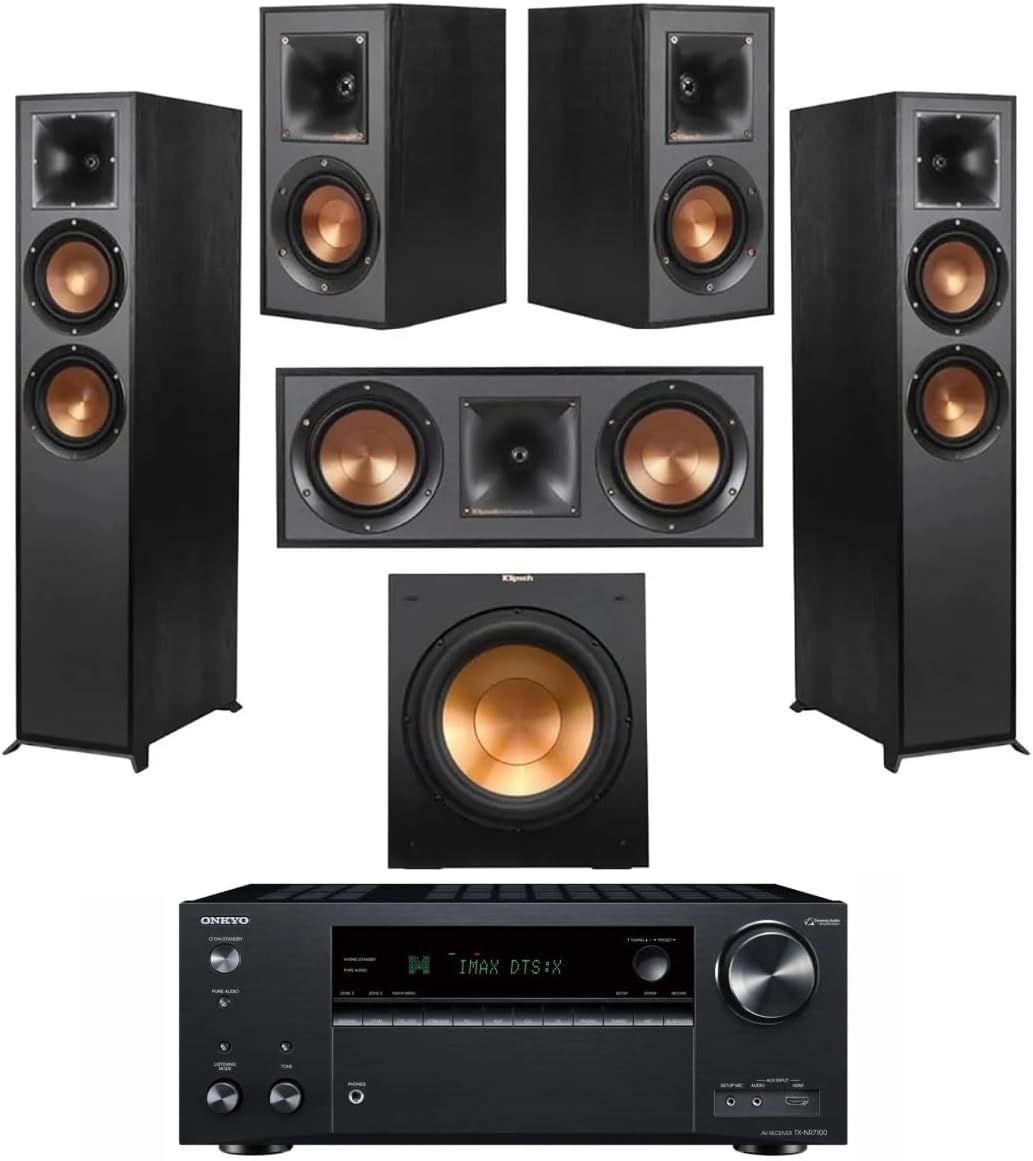
This Klipsch and Onkyo bundle combines Reference loudspeakers with an R-12SW powered subwoofer and Onkyo TX-NR7100 9.2-channel receiver. Its 4.4 rating reflects a system with genuine dedicated height capability: the dual R-625FA floorstanding speakers contain up-firing elevation channels, while the R-52C center and R-41M surrounds complete the main soundstage.
We may earn a commission when you buy through this link, at no additional cost to you.
The receiver provides eight-channel and 4K video support, Dolby Atmos processing, and automatic room calibration. HEOS streaming and voice-control support add connected functions without eliminating the traditional receiver workflow. Most importantly for Atmos shopping, the package can reproduce height effects through physical elevation drivers rather than relying entirely on a soundbar's upward-firing array or virtual processing. This tends to provide more repeatable placement and greater separation among height cues.
The cost is physical and operational. Two floorstanding speakers occupy meaningful space, and every component requires connection to the receiver and appropriate placement. The twelve-inch subwoofer, housed in a scratch-resistant black wood-grain cabinet, is another substantial object that must be positioned thoughtfully. The bundle therefore suits a dedicated media room or a listener who values traditional loudspeaker design over a visually minimal installation.
This package is an excellent choice for buyers who want convincing dedicated overhead effects, substantial low-frequency output, and receiver-based flexibility. The R-625FA towers and R-12SW give the system a scale that a compact soundbar cannot duplicate, while the TX-NR7100 adds extensive source and video support. If available wall area is limited or a minimal appearance is the priority, one of the wireless soundbar systems will be easier to accommodate.
The built-in elevation channels in the R-625FA speakers provide a direct path for overhead information. Because each tower contains its own height drivers, the system can separate upper-front effects more convincingly than a compact array with a limited number of upward-firing channels. Their placement remains critical, with adequate distance from the listening position and suitable ceiling geometry.
The TX-NR7100 supports nine channels and 2-channel subwoofer output, providing room to expand beyond the included package when desired. Automatic calibration helps align the varied speaker types, while 8K and 4K video support prepares the system for current displays and game consoles. This makes the bundle a foundation rather than merely a fixed collection of speakers.
We may earn a commission when you buy through this link, at no additional cost to you.
The Samsung HW-Q990H is another 11.1.4-channel Q Series system, combining a main soundbar, wireless subwoofer, and wireless rear speakers. Its 3.8 rating is the lowest in this comparison, so buyers should examine the current customer feedback carefully. The model nevertheless addresses many of the same needs as the newer Q990F, including four up-firing height channels, wireless Dolby Atmos, automatic room adjustment, and Q-Symphony integration.
We may earn a commission when you buy through this link, at no additional cost to you.
Q-Symphony is the system's defining feature. When used with compatible Samsung televisions and additional Samsung speakers, it can combine audio from several devices to create a fuller presentation. The soundbar's own SpaceFit calibration analyzes the room and adjusts the output, while AI Dynamic Bass Control is intended to optimize the included subwoofer while reducing distortion. Voice assistants and services such as Alexa, Googlecast, and Airplay 2 add convenient control and streaming options.
The disadvantages are ecosystem dependence and the uncertainty suggested by the comparatively low rating. Some advanced features require compatible hardware, and buyers looking only at channel counts could mistake that number for guaranteed performance. The system's actual spatial results still depend on source mixing, placement, and the room. A soundbar and wireless rears cannot recreate the stable physical separation of dedicated floorstanding height speakers.
The HW-Q990H is most appropriate for a Samsung household seeking a feature-rich 11.1.4-channel soundbar package with wireless rears and television integration. It may offer an attractive way to obtain high channel counts without a complex receiver setup. However, buyers should compare its current rating and feature availability with the Q990F, and anyone prioritizing dedicated speakers or the highest confidence should investigate the Yamaha, Klipsch, or Nakamichi options instead.
Compatible Samsung televisions and wireless speakers can contribute channels to the overall presentation, potentially filling gaps around the listening area. This is a meaningful benefit in a Samsung-centered room because it can create broader coverage without another full receiver system. The feature remains dependent on compatible models, supported content, and appropriate network configuration.
AI Dynamic Bass Control adjusts the included subwoofer to help maintain impact while controlling distortion. Together with SpaceFit sound, it provides a more consistent result across different room sizes. Manual low-frequency adjustment remains useful for unusual furnishings, but the automatic controls reduce the need for detailed technical setup in many living rooms.
We may earn a commission when you buy through this link, at no additional cost to you.
The Nakamichi Dragon is fundamentally different from a conventional compact soundbar. It uses an 11.4.6-channel architecture, a 58.1-inch-wide main unit, two opposed eight-inch subwoofers, and six surround speakers with bipolar height capability. Its 4.6 rating reflects a system designed for listeners who want a large, cinema-like presentation rather than a space-conscious television accessory.
We may earn a commission when you buy through this link, at no additional cost to you.
The Pro Cinema Engine supports Dolby Atmos configurations up to 24.1.10 and DTS:X Pro up to 30.2, with maximum output listed at 3,000 watts across the system. Opposed subwoofers can reduce the chance that bass wavefronts cancel one another when the cabinet is positioned in a room, while the 3000-watt aggregate figure is not equivalent to a single amplifier's continuous output. The system instead combines a very wide front stage, substantial low-frequency hardware, and physical surround speakers.
Physical scale is the central compromise. The main chassis weighs 32.2 pounds, each dual subwoofer enclosure weighs 34.4 pounds, and each surround speaker weighs 8.8 pounds. The package ships in three boxes and is not designed for a compact shelf or narrow media console. HDMI eARC, three HDMI 2.1 inputs, 4K at 120Hz, Dolby Vision, HDR10+, Bluetooth, optical input, and an auxiliary input provide modern connectivity, but placement must be planned around furniture and traffic paths.
The Dragon is best for a large viewing area or a listener who prioritizes a cinema-like soundstage over visual minimalism. It offers the most elaborate dedicated height and surround arrangement in this guide, paired with the most substantial bass system. For a smaller apartment or a television placed on a narrow console, a soundbar-based model such as the ULTIMEA Skywave X70 or Samsung Q990F will be easier to position, but few options provide the Dragon's scale and physical surround presence.
Two eight-inch drivers facing opposite directions can help maintain stronger low-frequency output than two similarly sized drivers facing the same way. The arrangement is particularly useful when the main cabinet must be placed near a wall or in a common living-room position. Room gain still matters, so the system should be calibrated rather than judged solely at its highest volume.
Unlike an upward-firing-only soundbar, the Dragon includes six surround speakers that project sound from the sides and above. This can place overhead effects more clearly around the audience and reduce reliance on ceiling reflections from the front cabinet. The PerfectHeight mechanism is intended to align those upper effects with the listening area, making correct speaker placement particularly important.
We may earn a commission when you buy through this link, at no additional cost to you.
The Klipsch Reference Cinema 5.1.4 is a compact speaker-based system that differs from the typical horizontal soundbar. Four satellite speakers incorporate Dolby Atmos technology to provide height effects from both the front and rear, while the central speaker and powered subwoofer complete the package. The 4.5 rating makes it one of the strongest-rated options in the guide.
We may earn a commission when you buy through this link, at no additional cost to you.
The use of separate satellite speakers is the system's defining advantage. Front and rear height drivers can create overhead effects with more physical separation than a compact soundbar's upward-firing array, while Tractrix 90-by-90-degree horn technology and aluminum tweeters shape the high-frequency response. The subwoofer's all-digital amplifier is designed for efficiency and source accuracy, and the entire system is less dependent on a large front cabinet than the Nakamichi Dragon.
The limitation is the relatively conventional 5.1-channel foundation. There is no multichannel amplifier or flexible receiver platform in the bundle, and the included satellites do not give the same expansion path as a Yamaha receiver package or an Onkyo-based system. Buyers should also confirm that the connected television, source, and any separate processing hardware can deliver the required Dolby Atmos signal to the system. Its physical layout is still more involved than a single soundbar, although less cumbersome than floorstanding speakers.
This Klipsch system is an excellent fit for a medium-sized room where dedicated front and rear height speakers are desired without installing in-ceiling units. It is also attractive to listeners who appreciate Klipsch's horn-loaded design and want a more conventional speaker presentation. The best choices are those who value real satellite speakers more deeply than broad receiver connectivity or minimal visual footprint.
Atmos height effects work best when the upper channels are physically separated from the main horizontal stage. The four satellites distribute those effects between the front and rear positions, creating a more dimensional presentation. A moderate distance from the sofa and suitable ceiling height help the vertical cues merge convincingly.
The subwoofer's built-in all-digital amplifier is designed to provide efficient amplification with accurate output. In a smaller room, that efficiency can be more useful than a very large driver that is difficult to position. The included subwoofer also consolidates the bass channel, simplifying the overall visual footprint.
We may earn a commission when you buy through this link, at no additional cost to you.
The Bose Home Theater System combines a Smart Ultra Dolby Atmos soundbar, Bass Module 700, and two wireless surround speakers. Its 4.2 rating reflects a solid overall proposition built around polished design, wireless convenience, and smart features. The included accessories cover the essential parts of a television-based home theater setup, including a remote, headset, optical and HDMI cables, and a power cord.
We may earn a commission when you buy through this link, at no additional cost to you.
The two surround speakers extend audio behind the listening area without requiring long speaker wires, while the Bass Module 700 supplies a separate low-frequency channel. The soundbar supports Dolby Atmos and uses Bose's ADAPTiQ setup headset for calibration. Voice4Video is another useful convenience, allowing a compatible smart display to lower entertainment volume and emphasize spoken information when the viewer asks for it. Alexa and Google Assistant support add voice-command options.
The available information does not expose a detailed channel map or detailed amplifier specifications, so it is difficult to compare raw output and processing depth with the channel counts published for Samsung, ULTIMEA, and Nakamichi. That is not necessarily a weakness, because perceptual quality and room integration matter more than a headline number. However, buyers seeking visible drivers, independently controlled height speakers, or receiver-level flexibility will find less information and fewer obvious expansion paths in this package.
This Bose system is best for a design-conscious household that wants an uncluttered, wireless home theater arrangement with smooth integration into a larger smart-home ecosystem. It is particularly suitable for people who value a recognizable soundbar form, simple wireless rears, and voice-assisted viewing. It is less appropriate for an enthusiast who wants to compare detailed processing architecture, wire dedicated speakers, or build around a separate AV receiver.
The included rear speakers can be placed behind the seating area without running cables across the room. That flexibility makes it easier to create a surround field while keeping the floor uncluttered. Wireless performance still depends on maintaining a stable connection and keeping the speakers within a sensible range of the main unit.
Voice4Video can improve spoken content during compatible television viewing, while ADAPTiQ calibration helps establish the system's output for the room. Together with Alexa and Google Assistant support, these features make the system approachable for everyday use rather than limiting it to specialist cinema listening.
We may earn a commission when you buy through this link, at no additional cost to you.
The Sonos Arc Ultra is a premium soundbar that uses a 9.1.4-channel spatial architecture and Sound Motion technology to distribute audio through a room. Its 4.6 rating is tied for the highest in the guide. Unlike the packages that include rear speakers and a subwoofer, the Arc Ultra is designed to serve as the foundation of a broader Sonos system that can be expanded as needed.
We may earn a commission when you buy through this link, at no additional cost to you.
AI-powered Speech Enhancement detects human voices and aims to clarify dialogue, a valuable feature in rooms where ambient noise is common. Trueplay adjusts the presentation for the room, while a single HDMI eARC connection and guided app setup make integration with a television straightforward. Wi-Fi, Bluetooth, Apple AirPlay 2, and Spotify Connect provide extensive music-streaming options, and control is available through a television remote, the Sonos app, touch controls, Sonos Voice Control, and Amazon Alexa.
The trade-off is that the best complete surround experience is not included in the box. Adding the Sonos Sub and Era 300 rear speakers is specifically identified as the route to a more expansive Dolby Atmos presentation, so the final cost and footprint depend on how much of the ecosystem the buyer wants. The soundbar's 9.1.4 processing cannot fully substitute for every benefit of physically separate rear and height speakers, particularly in a large room.
The Arc Ultra is an excellent choice for listeners already invested in Sonos, for people who want a soundbar-first system that can expand gradually, and for anyone who values simple setup, music streaming, and polished app control. It is less suited to a buyer who wants a complete wired or wireless theater package on the shelf. With careful placement and appropriate added speakers, however, its spatial processing and ecosystem integration can deliver a highly satisfying Dolby Atmos experience.
The Arc Ultra can operate as the central component of a broader Sonos theater, with a subwoofer and rear speakers added as needs or room size dictate. That modular approach avoids forcing every component into a fixed bundle. It also allows the setup to be expanded while preserving a consistent control experience through the Sonos application.
Trueplay uses the Arc Ultra's processing to adjust the sound for the room's surfaces and layout. The process helps a single soundbar create a more stable front and height presentation, although it cannot remove the physical limitations of a compact cabinet. Larger or irregularly furnished rooms benefit from careful placement and the most accurate calibration information available.
We may earn a commission when you buy through this link, at no additional cost to you.
Choosing a Dolby Atmos home theater system means balancing spatial processing, physical speaker placement, room size, source compatibility, and everyday convenience. The most important decision is whether you want a self-contained soundbar package, a conventional receiver-based theater, or a modular ecosystem that can expand over time.
A channel count describes the number of audio channels the system can process or reproduce, but it does not directly reveal how many speakers are physically present. The Samsung Q990F and HW-Q990H use 11.1.4-channel processing with up-firing height drivers, whereas the ULTIMEA Skywave X70 advertises 7.1.4 channels through a fully wireless arrangement. Dedicated systems such as the Klipsch and Onkyo package separate front, center, surround, and height loudspeakers, which can produce more precise physical placement. Compare not only the largest number, but also how many channels are active, how they are driven, and whether the system requires a receiver to decode the source.
Prioritize an architecture that matches your room and listening habits rather than buying the highest number available. A compact system with well-positioned speakers may sound more convincing than a large array placed incorrectly.
Atmos height effects sound most credible when a speaker is physically above or beside the listening position and aimed toward the correct area. The Klipsch and Onkyo bundle includes up-firing drivers in its floorstanding speakers, while the Nakamichi Dragon uses a larger group of physical surround and height speakers. Up-firing soundbar channels are more convenient but depend on ceiling reflections and favorable room geometry. If your ceiling is low, unusually high, or heavily obstructed, virtual or reflective height channels may be less consistent than carefully positioned dedicated speakers.
When accurate overhead cues matter, favor designs with separate height drivers. When simplicity and appearance matter most, an up-firing system is the easier compromise.
A larger subwoofer can produce deeper, more visceral bass, but size alone does not guarantee better results. The ULTIMEA Skywave X70 includes a ten-inch driver, the Klipsch and Onkyo bundle uses a twelve-inch model, the Nakamichi Dragon pairs two eight-inch opposed enclosures, and the Samsung systems use a single wireless subwoofer. Consider room volume, nearby walls, the ability to place the enclosure without obstructing walkways, and whether the included low-frequency controls can manage boom. A dual-subwoofer arrangement can increase output and reduce cancellation, while a single well-positioned subwoofer may be easier to blend.
Choose a subwoofer that can be placed cleanly and adjusted with the rest of the system. Excessive output in a small room is less useful than controlled bass that complements dialogue and effects.
Automatic calibration can save considerable time and reduce the frustration caused by uneven speakers or reflective room surfaces. The Yamaha YHT-4970U includes a measurement microphone, the Samsung models use embedded sensors, and the Bose system includes an ADAPTiQ headset. Calibration is especially useful for larger systems with multiple height and surround channels because it can help the processor balance output and integrate the subwoofer. It does not replace sensible placement, and some users still prefer manual adjustment after the automatic pass.
Check whether the system provides a guided process, an easy-to-follow remote, and useful on-screen controls. A calibration feature is valuable only when the initial speaker positions are reasonably close to their intended locations.
Modern home theaters must handle more than compressed movie audio. Look for HDMI eARC or suitable return-audio support, optical or auxiliary input for legacy equipment, and compatible Bluetooth or wireless streaming. Gamers should pay attention to 4K at 120Hz, VRR, and ALLM, while television owners may value Dolby Vision and HDR10+ passthrough. The Yamaha and Onkyo receiver-based systems naturally offer the most direct control of inputs and video modes, while modern soundbars often provide an equally simple route for television viewing.
Match the connection features to the sources you already own. Buying a system with unused processing power is unnecessary, but failing to confirm the required format can lead to compatibility disappointments.
Wireless rear speakers and subwoofers reduce cable clutter and make placement much easier. The ULTIMEA Skywave X70 uses dual 5GHz transmission, while the Samsung, Bose, and Sonos ecosystems each use their own wireless approach. Wireless does not mean installation-free: power cables are still required, and the signal path may depend on congested radio environments. App control can be valuable for volume, presets, room calibration, and source selection, but it should supplement rather than replace the system's primary controls.
Look for stable dual-band or 5GHz communication where possible and confirm that the speaker arrangement can be placed without obstructions. Also check whether the subwoofer and rears are included or offered only as separate purchases.
Smart assistants, streaming services, and television integration can make a system more pleasant for daily use. Q-Symphony is most relevant within Samsung's ecosystem, BRAVIA Connect enhances Sony television setups, and Sonos provides a mature multi-room platform. Alexa and Google Assistant support appear across several models, while Apple AirPlay 2 serves music-focused households. Ecosystem features are useful when they complement hardware you already own, but they should not distract from basic requirements such as dialogue clarity, bass control, and proper Atmos playback.
Choose smart features for their usefulness in your routine. If you already use one platform for television, speakers, and music, its tighter integration may matter more than a longer list of incompatible options.
The largest channel count cannot overcome poor speaker placement or a room that is too small. The Nakamichi Dragon needs a wide main unit, two substantial subwoofer enclosures, and six surround speakers, while the Klipsch and Onkyo package includes two floorstanding speakers and a large subwoofer. The Sony, Samsung, Yamaha, Klipsch Reference Cinema, and Bose packages use more compact arrangements, although the Sony and Bose systems still require separate rear speakers. Measure the intended area, inspect doorways for delivery, and leave room for listening distance and furniture circulation.
Choose a system that can fill the room without overwhelming it. A smaller room may benefit from controlled output and compact speakers, while a large or open space may need greater physical separation and stronger low-frequency capability.
Begin by identifying the primary listening position and placing the main soundbar or front speakers directly in front of it. Keep the center speaker or central soundbar section aimed toward seated listeners, position the left and right speakers with adequate separation, and place the rear speakers behind and slightly to the sides of the audience. For systems with up-firing height channels, leave open space above the enclosure and avoid placing towels, cabinets, or other objects that could obstruct upward sound paths.
Connect the system using the most appropriate cable for the equipment and enable the correct audio format on the television, game console, or source device. Allow Dolby Atmos to remain unprocessed in the source when the system provides its own decoding. For HDMI systems, use eARC or the appropriate pass-through setting, verify that the correct input is selected, and confirm that high-frame-rate video, VRR, or dynamic-range features are active only when every device in the chain supports them. Run the manufacturer's calibration process with the room in its normal listening configuration.
For daily care, keep the subwoofer and rear speakers away from carpets that may obstruct their vents or drivers, and avoid placing the subwoofer where cables create a trip hazard. Dust the grilles and cabinets with a dry, soft cloth, and follow the manual's cleaning instructions rather than using wet cleaners on drivers or touch controls. Check firmware and app updates periodically, update wireless speakers together when the manufacturer recommends it, and re-run calibration after moving furniture, changing the room layout, or adding new equipment.
A 5.1 system uses five main channels and one bass channel, while 7.1.4 adds two rear channels and four height channels. An 11.1.4 configuration adds further horizontal surround channels alongside four height channels, creating a more comprehensive spatial map. The larger numbers do not automatically guarantee better results because speaker placement, calibration, room acoustics, and source mixing are equally important.
No. Many soundbar-based systems include their own processors and amplifiers and decode Atmos directly through HDMI. Component systems such as the Yamaha YHT-4970U and the Klipsch and Onkyo bundle include a receiver, which offers more control over inputs and expansion. The receiver-based route is useful for dedicated rooms, while an integrated soundbar is generally simpler and less visually dominant.
Modern wireless systems can provide excellent surround performance when the signal is stable and the speakers are placed correctly. Wireless rear speakers simplify installation and reduce cable clutter, but they still need power and can be affected by interference or poor positioning. Wired speakers remain the most predictable option in complex installations or acoustically demanding rooms.
Yes, because larger rooms generally need more physical speaker separation and greater output to maintain an immersive effect. A compact system can work well in a small or furnished room, while a large open area may benefit from a large soundbar, dual subwoofers, or dedicated rear and height speakers. Measure the space and plan furniture before choosing a system based only on channel count.
Place the soundbar below or near the television, centered with the seating area, and keep the area above it free from obstructions. A flat, solid ceiling generally provides more consistent reflections than a high or irregular ceiling. After positioning the system, run its room-calibration routine and avoid moving the speakers afterward unless you repeat the calibration process.
Expandability differs considerably. The Yamaha and Onkyo receiver-based packages use conventional speaker connections and offer clearer expansion paths, while Sonos is designed for modular additions within its ecosystem. Samsung and ULTIMEA also support wireless surround arrangements, but compatibility is model-specific. Check the manufacturer's current support information before assuming additional speakers can be paired.
A larger driver can deliver lower frequencies and greater physical impact, but room size and placement determine how much benefit is audible. A large subwoofer in a small room may create boomy results, while a well-positioned smaller unit can integrate more cleanly. Look for useful controls, room calibration, and the ability to reduce output before pursuing maximum volume.
Confirm that the included speakers, subwoofer, receiver, and height channels match your room, and verify the required HDMI and audio-format support. Consider placement, cable management, app compatibility, voice-assistant needs, and whether the system can expand. Current ratings and configuration details can change, so review the latest manufacturer information and customer feedback before ordering.
The Samsung Q990F is the most balanced overall recommendation because it combines an 11.1.4-channel layout, four height channels, wireless rear speakers, a subwoofer, room calibration, dialogue enhancement, and strong television integration. The ULTIMEA Skywave X70 is the standout value choice for buyers prioritizing fully wireless placement, a large subwoofer, and extensive app control, while the Nakamichi Dragon leads the premium category with its large cabinet, dual subwoofers, and dedicated height surround architecture.
The right alternative depends on your priorities. Choose the Yamaha YHT-4970U for receiver-based control, modern gaming features, and guided room correction. Choose the Klipsch and Onkyo bundle for dedicated height drivers and substantial floorstanding speakers. The Sony BRAVIA Theater System 6 suits a conventional surround package, the Bose system emphasizes smart-home convenience, and the Sonos Arc Ultra works best for listeners who want a modular soundbar-first ecosystem.
Before purchasing, confirm current specifications, included components, compatibility, room measurements, and the latest customer feedback. Prices, promotions, app features, and product configurations can change, and a system that appears attractive on paper still needs to fit the actual room. Prioritize correct placement, useful controls, dialogue clarity, and a layout you can maintain for long-term everyday use.