
KOSMEGAL SUP Pump
4.0Editor score
20 PSI maximum pressure
12V DC car connection
Seven interchangeable nozzles
Backlit LCD and flashlight
An electric paddle board pump removes the most tiring part of preparing a stand-up paddle board for the water. A worthwhile model should inflate quickly, reach and maintain the intended pressure, pack easily, and provide dependable power at the beach, lake, or campsite. These are the essential qualities examined in this guide.
The ten products were compared using the supplied specifications, focusing on maximum pressure, inflation time, battery capacity, power options, cooling, auto shutoff, deflation, displays, lighting, size, weight, and included accessories. The list covers compact cordless models, higher-capacity pumps, and cordless designs that can also run from a vehicle outlet.
Each review explains the pump's strongest features and practical trade-offs to help you choose according to your board, trip style, and need for portability. Inflation results are manufacturer-provided and may vary with board size, starting pressure, and accessories. Prices and availability can change, so confirm current listing details before purchasing.
4.0Editor score

4.5Editor score
4.2Editor score
As an Amazon Associate we earn from qualifying purchases.
This side-by-side comparison highlights the differences in pressure, inflation speed, power, portability, and useful features across ten electric paddle board pumps.




The KOSMEGAL SUP Pump is a straightforward 12V electric pump with a 4.0 customer rating. Its standout qualities are a 20 PSI maximum, automatic shutoff, a digital display, an integrated flashlight, and a reported eight-minute inflation time for a 10.6-foot board to 12 PSI. It is a practical option for paddlers who can conveniently power it from a vehicle.
We may earn a commission when you buy through this link, at no additional cost to you.
Inflation performance comes from a one-stage approach designed to move a strong volume of air, while the control panel allows pressure to be set in PSI, KPa, BAR, or KG/CM². Once the selected pressure is reached, the pump shuts off automatically. The backlit screen, simple button controls, and flashlight make setup easier around dusk, while seven supplied nozzles extend compatibility beyond H3 paddle board valves to items such as kayaks, tents, air mattresses, pools, and yoga balls.
Its main limitation is the absence of an integrated rechargeable battery. It needs a 12V DC connection, and the product information also notes that deflation requires manual shutdown rather than automatic completion. Its 20 PSI ceiling is ample for typical SUP inflation, and the supplied guidance recommends 10 PSI with a 15 PSI maximum for paddle boards, so buyers with unusually high-pressure requirements may need a different model.
This pump is best for owners who already carry a car or suitable 12V power source, want a simple pressure display, and prefer not to manage a rechargeable battery. It is also a sensible value-oriented choice for inflating campsite equipment. The recommendation is strongest for vehicle-based lake trips, while portable-only adventures may be better served by a cordless pump.
The large backlit LCD provides real-time visibility while the plus and minus controls establish the target pressure. Automatic shutoff reduces the need to watch the gauge continuously, although deflation still calls for manual stopping.
Seven nozzle adapters make the pump useful for a broader collection of inflatables. The carry bag also helps keep the hose, cables, and adapters together, which is useful for organized storage with other board gear.
We may earn a commission when you buy through this link, at no additional cost to you.
This Portable Rechargeable SUP Pump combines cordless convenience with a 4.3 rating and dual-stage inflation. Its 13,500mAh USB-C rechargeable battery is one of the most substantial capacities in this group, and the manufacturer states that a full charge can inflate three to four 10.6-foot boards consecutively. It also includes a 12V DC connector for longer outings away from an outlet.
We may earn a commission when you buy through this link, at no additional cost to you.
The pump reportedly fills a 10.6-foot SUP to 12 PSI in seven minutes and 15 PSI in nine minutes. Three adjustable inflation settings, automatic pressure shutoff, and a clear digital LCD make operation fairly direct. Fast deflation simplifies folding a board after use, while the battery can support three to four board inflations before requiring another charge. A full recharge takes approximately four to five hours.
The compact dimensions of 6.69 by 5.9 by 3.07 inches and 2.86-pound weight are favorable for travel, and the supplied information also lists it as useful for inflatable boats, rafts, kayaks, and tents. The tradeoff is that the 20 PSI maximum is not intended to replace a high-pressure tire inflator, and cordless performance will depend on the battery's remaining charge. Customer support includes a one-year warranty and replacement assistance for a cracked or broken hose.
Buyers who prioritize genuine cordless operation and want enough capacity for several boards will find this model compelling. It is particularly appropriate for beach trips, campgrounds, and group outings where charging opportunities may be limited. The recommendation is especially strong for users who need more runtime than a smaller internal battery can offer.
A claimed three-to-four-board range makes this one of the stronger choices for families or groups. The 12V DC connection provides a backup when the internal battery runs low or when continuous operation is preferred.
The digital screen supports real-time monitoring and straightforward pressure selection. At 2.86 pounds, the pump is light enough for a beach bag while remaining substantial enough to handle routine SUP inflation and deflation.
We may earn a commission when you buy through this link, at no additional cost to you.
The OutdoorMaster Shark 2 is a 12V high-pressure pump with a 4.3 rating and an active cooling system. Its two-stage motor separates rapid volume filling from high-pressure refinement, and the manufacturer reports inflating a 10.6-foot paddle board to 15 PSI in about 12 minutes. It is designed for repeated use around a vehicle or campsite with access to a 12V outlet.
We may earn a commission when you buy through this link, at no additional cost to you.
The first stage reaches up to 350 liters per minute, while the second delivers up to 70 liters per minute for pressure. Automatic shutoff activates when the target is reached, and the digital display shows real-time pressure. A 12A fuse is included for electrical protection, while a 12V connector and three-meter cord offer some flexibility around a vehicle. The full nozzle collection includes C7 and H3 valve adapters alongside fittings for beds, kayaks, boats, arches, pools, and tents.
The main tradeoff is that it is not a cordless pump, so planning around a 12V source is essential. The stated working noise reaches 85 dB, which may be noticeable in quiet campsites. It also carries more weight and bulk than ultra-compact models, making it better suited to a car trunk or gear station than a minimal travel kit.
This is a strong recommendation for owners who want reliable active cooling, high-volume inflation, and a complete accessory set. It is particularly useful for people inflating boards and other equipment at a fixed base or during group trips where a vehicle can supply continuous power. Cordless-only users should look instead to one of the battery-powered models.
Moving large air volumes quickly is important for rigid inflatable boards. The Shark 2's first stage handles that work at up to 350 liters per minute, followed by a lower-flow stage for reaching and refining the target pressure.
The active cooling system is designed to support consecutive inflating and deflating cycles. That makes the pump more relevant to group outings or users who also maintain several large inflatables.
We may earn a commission when you buy through this link, at no additional cost to you.
The 50PSI Multi-Mode Pump has a 4.5 rating and combines a high-pressure ceiling with a versatile 10,000mAh battery. It can inflate a 10.6-foot board to 12 PSI in about six minutes or 15 PSI in roughly eight minutes. That balance of speed, capacity, and broader inflating functions makes it the most versatile model featured here.
We may earn a commission when you buy through this link, at no additional cost to you.
Three operating modes cover SUP inflation, tire inflation, and deflation. The rechargeable battery can handle up to four board inflations on a charge, while the 12V DC connection allows extended operation from a vehicle. Type-C charging is supported, with a stated full recharge time of approximately 3.5 to 4.5 hours. A large LED display shows real-time pressure, and automatic shutoff stops inflation at the selected setting.
Its emergency light offers white illumination, a red warning flash, and an SOS mode, adding value for roadside use or low-light setup. The included kit contains a Type-C cable, 12V cord, tire hose, and seven universal nozzle adapters. The tradeoff is that 50 PSI does not automatically make it the best dedicated SUP pump; some of that capability is aimed at tires, and the multi-mode design adds complexity compared with a focused board pump.
This is the recommendation for households that want one electric pump for boards, kayaks, mattresses, cars, and bicycles rather than a dedicated SUP-only device. It also suits users who value a strong 4.5 rating and useful emergency lighting. Dedicated paddlers focused on maximum compactness may prefer a lighter 20 PSI model.
SUP, tire, and deflation modes expand the pump beyond a typical paddling accessory. The supplied tire hose and universal adapters make it practical for road trips, camping, and family outings involving several inflatable items.
The reported six-minute fill to 12 PSI and approximately eight-minute fill to 15 PSI make this one of the quicker models listed. Real-time readings and automatic shutoff add control once the desired pressure is reached.
We may earn a commission when you buy through this link, at no additional cost to you.
The 50PSI Three-Stage Pump carries the highest listed customer rating at 4.6. Its standout features are a 12,000mAh battery, three-stage inflation, an upgraded active cooling system, and a claimed two-minute deflation time. It is aimed at users who may inflate several boards or other large inflatables in warm conditions.
We may earn a commission when you buy through this link, at no additional cost to you.
The motor moves incrementally at up to 420 liters per minute before shifting to a 70-liter-per-minute high-pressure stage. A 10.6-foot paddle board can reportedly reach 12 PSI in 8.5 minutes or less. The battery is stated to handle inflating and deflating up to four boards at 12 PSI on one charge, and 12V DC vehicle power can extend working time when required.
The pump weighs 2.9 pounds and measures 6.88 by 3.54 by 6.88 inches. A built-in nylon handle and carrying bag aid transport, while the large display shows real-time and target pressures. The active cooling system is designed for continuous cycles without overheating. The trade-offs are that a 50 PSI ceiling adds capability that a dedicated paddle board user may not need, and the two-minute deflation claim is considerably less impressive than the headline inflation figures.
This is the strongest recommendation for group trips, hot-weather use, and owners who want high-pressure capability in a rechargeable package. It suits people who appreciate a higher customer rating and want a pump that can continue through several inflate-and-deflate cycles. Solo paddlers with minimal gear may find smaller alternatives easier to carry.
The upgraded active cooling system is particularly relevant when several boards or large inflatables are processed consecutively. It is designed to reduce the likelihood of overheating during extended group use.
The 50 PSI limit makes the pump relevant to cars and other high-pressure accessories, while the 12,000mAh battery supports cordless board use. The handle and compact footprint help retain portability despite the broader capability.
We may earn a commission when you buy through this link, at no additional cost to you.
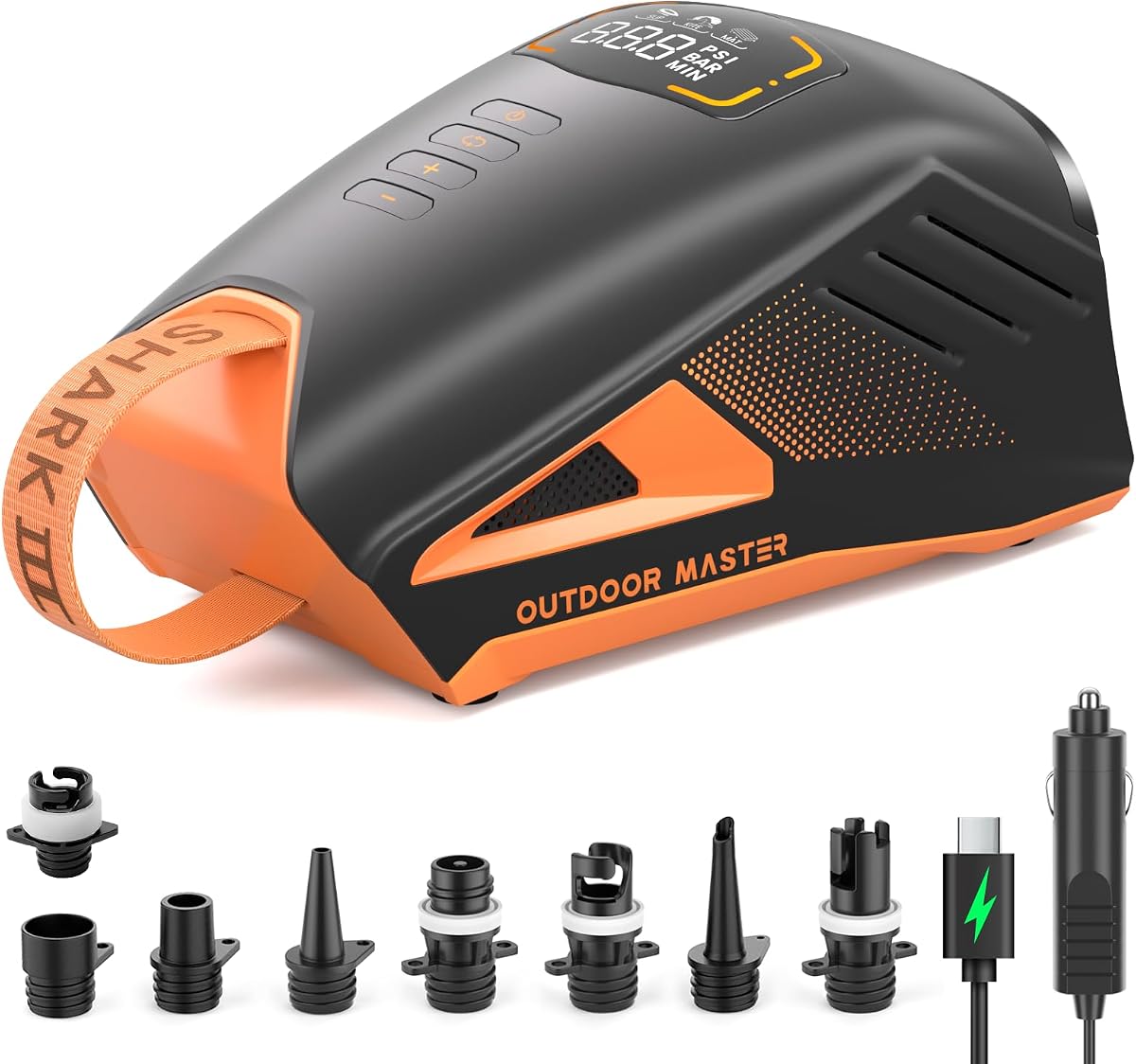
The OutdoorMaster Shark 3 is the speed-focused premium choice, with a 4.2 rating and a stated inflation time of 3 minutes 50 seconds for a 10.6-foot board to 15 PSI. It also deflates that board in 1 minute 20 seconds. That exceptional speed is backed by a 74Wh rechargeable battery, a cooling system, and dual vehicle charging inputs.
We may earn a commission when you buy through this link, at no additional cost to you.
The battery is stated to inflate and deflate four 10.6-foot boards at 15 PSI from a full charge. It supports 45W Type-C fast charging, with a full charge in about one hour and 40 minutes, and can also draw power from a vehicle's 12V or 15.8V DC port. The listed compatibility includes Tesla and other vehicles. A digital display allows pressure or inflation time to be set, and automatic shutoff prevents operation beyond the target.
The main disadvantage is physical: the Shark 3 weighs 3.2 kilograms, or about 7 pounds, and measures 18.7 by 17.2 by 32.3 centimeters. It also produces up to 88 dB of noise during high-pressure inflation. The emergency power-bank function is useful, but the large body makes this more of a base-camp or vehicle-adventure pump than a lightweight hiking accessory.
This premium model is ideal for users who prioritize the shortest inflation time and extended battery capability, especially when preparing multiple boards. It is also well suited to owners of compatible vehicles who want a fast charger and emergency power source. Travelers who prize low weight over speed should consider a smaller cordless model instead.
The stated 3:50 inflation and 1:20 deflation times materially reduce setup and packing time. This advantage is most valuable for frequent paddlers, instructors, and groups trying to prepare several boards in sequence.
USB-C fast charging, 12V and 15.8V vehicle inputs, and phone charging create several ways to manage power. The 74Wh battery is substantial, although the larger housing makes the Shark 3 less suitable for minimalist travel.
We may earn a commission when you buy through this link, at no additional cost to you.
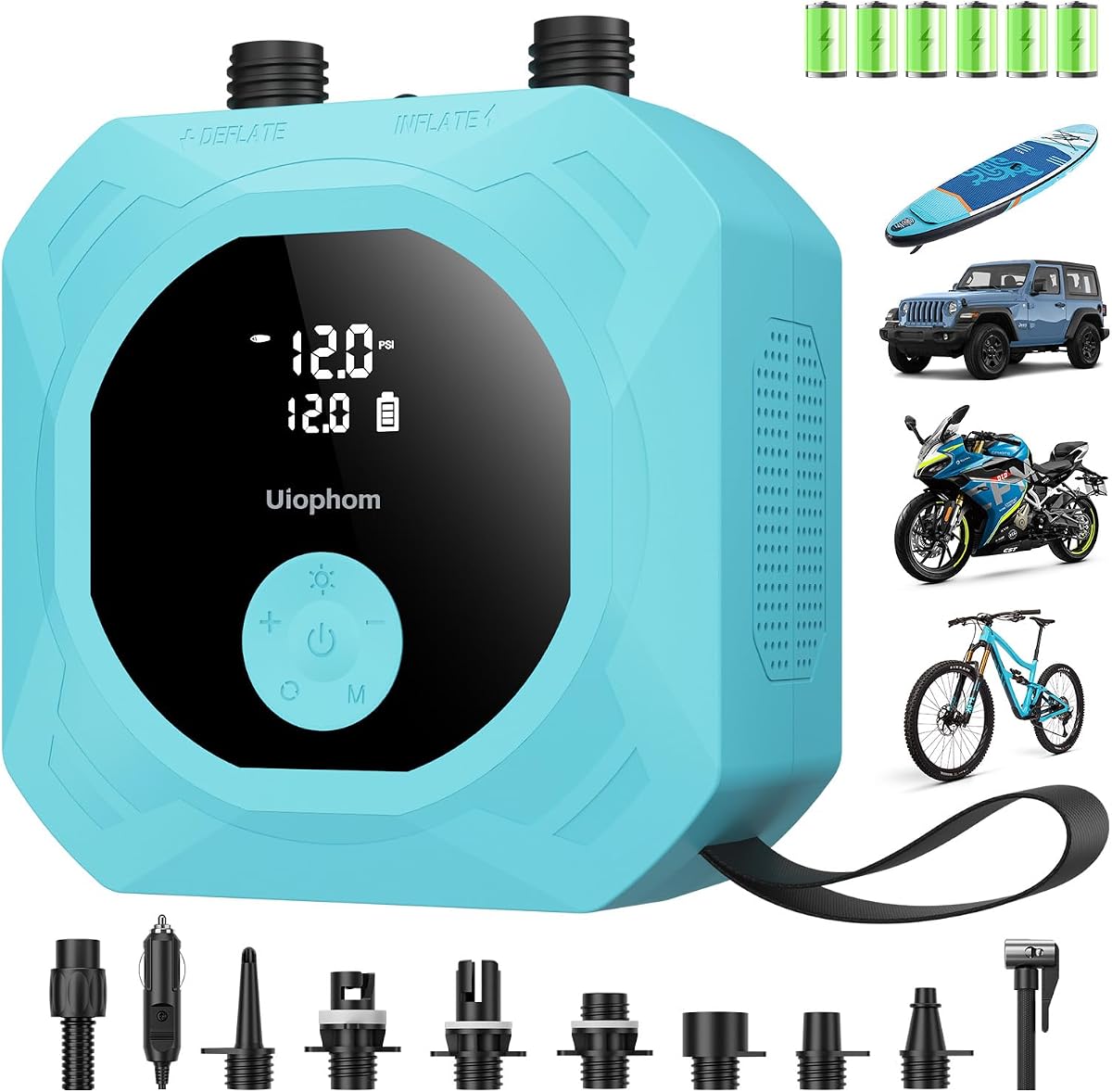
The 15,600mAh 50PSI Pump is built around exceptional cordless capacity. It has a 4.2 rating and uses six 2,600mAh batteries, with the manufacturer claiming enough charge for five 10.6-foot SUP inflations to 12 PSI or four inflations to 15 PSI. A 12V DC connection provides another way to keep working away from mains power.
We may earn a commission when you buy through this link, at no additional cost to you.
Dual-stage technology moves air at up to 420 liters per minute during rapid filling and then uses a 100-liter-per-minute stage for high-pressure precision. A 10.6-foot board can reach 12 PSI in under seven minutes. Automatic shutoff, a large LED display, active cooling, and a multifunctional light make it suitable for extended sessions. The 50 PSI ceiling also allows use with car, motorcycle, and mountain bike tires.
Its disadvantages include a three-pound weight and an 18W charging arrangement, which is less advanced than the premium model's faster charging. The battery count also explains why the unit is larger than many competitors. A factory reset can be performed by holding the plus and minus buttons for three to five seconds if readings appear abnormal, and the product guidance advises waiting for a stable reading after inflation stops.
This pump is a strong recommendation for people who want to move away from a vehicle power source without sacrificing session capacity. It suits families, instructors, and touring paddlers who may inflate several boards per day. Those seeking the lightest option or the quickest recharge should prioritize a smaller battery design instead.
The six-cell battery arrangement supports an impressive claimed cycle count, particularly at 12 PSI. That endurance can be more valuable than a smaller battery in remote locations where recharging is inconvenient.
The display instructions explain how to obtain a stable reading by pressing the connector vertically into the valve and waiting after inflation stops. A built-in reset procedure provides a way to address abnormal readings without immediately abandoning the pump.
We may earn a commission when you buy through this link, at no additional cost to you.
The 22 PSI Rechargeable SUP Pump stands out for portability, weighing 2.73 pounds and including a carrying bag. It has a 4.0 rating, a rechargeable battery, and a 22 PSI maximum, which is slightly above the common 20 PSI ceiling among several competitors. It is a focused cordless option for paddlers who value low weight.
We may earn a commission when you buy through this link, at no additional cost to you.
Dual-stage inflation and deflation are controlled through a digital pressure system with automatic shutoff. The manufacturer states that a 10.6-foot board reaches 12 to 15 PSI in approximately 8.5 to 10.5 minutes. One battery charge is claimed to handle up to three 10.6-foot boards, while a 12V car outlet provides unlimited operating power during group trips. Type-C charging is built in.
An upgraded metal pump core uses smart temperature control to cool more quickly and resist overheating. Seven nozzles cover paddle boards, kayaks, air mattresses, and kites. The built-in flashlight and emergency charging port add useful field functions. The trade-off is that the exact battery capacity is not stated, making runtime harder to compare with models that publish watt-hour or milliamp-hour figures.
This is a good recommendation for backpackers, solo paddlers, and travelers who need a lighter cordless pump. It is less suitable for buyers whose main criterion is maximum rated customer feedback or an exact battery specification. The combination of a 22 PSI limit, temperature control, and low weight is nevertheless well matched to mobile SUP use.
At 2.73 pounds, this is the lightest pump in the comparison, and the included bag simplifies packing. The design is well suited to carrying between a vehicle and a launch point without adding excessive bulk.
The temperature-controlled metal core is designed for longer operation and faster cooling. Cordless use is supported by an internal battery, while the 12V connection provides a reliable alternative for group outings.
We may earn a commission when you buy through this link, at no additional cost to you.
The 13,500mAh SUP Pump pairs a 4.2 rating with fast reported inflation and a large cordless battery. According to the manufacturer, a 10-foot board reaches 12 PSI in five minutes and 15 PSI in seven minutes. It can handle four 10.6-foot boards at 12 PSI or three at 15 PSI on a full charge, making it one of the more balanced options for group use.
We may earn a commission when you buy through this link, at no additional cost to you.
Its dual-stage system provides a rapid 400-liter-per-minute burst followed by a 100-liter-per-minute precision stage, with a maximum pressure of 20 PSI. Type-C charging restores the battery in approximately four hours, and a 12V DC connector supplies another operating method. The pump also doubles as a 5V/2A emergency power bank. Automatic shutoff follows the selected pressure setting.
Seven replacement nozzles, a storage bag, gift box, and English manual form the accessory package. The ABS body includes a stainless-steel air intake and an enhanced cooling system intended to resist sand, drops, and wear. The 20 PSI maximum is standard for a paddle board pump, however, and does not offer the broader high-pressure ceiling of several tire-capable models.
This is a strong fit for owners who want a quick, cordless pump without paying for premium-level charging or an oversized battery system. It works well for camping, family outings, and everyday board maintenance. Those needing to inflate high-pressure vehicle tires or the fastest possible board setup may prefer another model.
The five-minute claimed fill to 12 PSI is among the fastest figures in the group. A 400-liter-per-minute initial stage moves volume quickly before the pump changes to controlled high-pressure filling.
The emergency power-bank function and wide nozzle set add value beyond paddling. Type-C charging, a 12V connector, and the cooling system make the pump adaptable to extended outdoor use.
We may earn a commission when you buy through this link, at no additional cost to you.
The AIRBANK PUFFER Pro combines a 4.5 rating with precise pressure monitoring in a 2.78-pound package. Its standout feature is a differential barometer that maintains a stated reading error within plus or minus 0.2 PSI, compared with the plus or minus 1 PSI figure cited for peers in the product information. That makes it appealing to paddlers who value consistent readings.
We may earn a commission when you buy through this link, at no additional cost to you.
Dual-stage inflation moves up to 400 liters per minute during the high-volume stage and 75 liters per minute during high-pressure operation. A 10.6-foot board reportedly reaches 12 PSI in 7.5 minutes and 15 PSI in 9.5 minutes. The 20 PSI maximum is appropriate for a broad set of inflatables, and automatic shutoff stops the pump at the target pressure. Deflation simplifies packing after paddling.
The pump measures 6.46 by 3.39 by 7.48 inches and includes a nylon handle and storage bag. A digital LED screen presents set and real-time pressure, while the lighting function supports dark-area use. Seven nylon and fiberglass nozzles cover C7 and D7 paddle board valves, wing foils, kites, kayaks, pools, swimming rings, tents, and other inflatables. The main uncertainty is that the supplied specifications do not state a battery capacity.
This is a refined recommendation for paddlers who prioritize accurate gauge readings, compact construction, and broad nozzle compatibility. It is well suited to regular users who want confidence that a selected pressure has been reached. Users prioritizing a stated battery endurance or tire inflation may want to compare the other rechargeable and 50 PSI options.
The differential barometer is the defining feature, with the manufacturer stating an accuracy range of plus or minus 0.2 PSI. That precision is useful for repeatable inflation across multiple outings.
At 2.78 pounds, the PUFFER Pro remains portable while offering a dual-stage motor, digital display, and light. Seven reinforced nozzles provide extensive compatibility without requiring a separate pump for each type of inflatable.
We may earn a commission when you buy through this link, at no additional cost to you.
The best electric paddle board pump for a particular user depends on power access, expected group size, portability requirements, and the range of inflatables it must handle. The following factors help narrow the field before making a purchase.
Maximum pressure indicates the pump's upper operating limit, but it does not necessarily reflect the pressure every board needs. Most paddle boards are inflated in the range represented by the product guidance, commonly around 10 to 15 PSI. A 20 PSI pump is generally more than sufficient for normal SUP use, while 22 or 50 PSI models provide extra headroom for other inflatables. Confirm the valve type and the manufacturer's recommended pressure before selecting a target.
Cordless freedom is valuable at beaches, lakes, and campsites without vehicle access. Battery capacity determines how much work can be completed between charges, while the claimed number of board cycles is usually more useful than capacity alone when comparing products. Models advertise anywhere from three board inflations to as many as five at specific pressures. Consider board volume, starting pressure, tire use, and whether the battery also powers a phone. A 12V DC connection remains a valuable backup.
Fast inflation matters when launching near a reserved area, preparing for an organized outing, or handling several boards. Inflation times depend on board size, target pressure, battery condition, and starting pressure, so published figures are best treated as comparisons rather than guarantees. Deflation is often overlooked but can dominate the trip home, especially for large rigid inflatable boards. A dedicated or quick-deflation function is valuable for frequent users.
A two-stage motor usually fills a large volume of air quickly before slowing down for high-pressure work. Three-stage designs add another stage of incremental control. Active cooling is especially useful in hot weather or during repeated inflate-and-deflate cycles, where motor and electronics generate heat. Consider whether the intended use involves one board on a quiet morning or multiple boards in a group session.
There are three common power arrangements: a 12V vehicle-only connection, an internal rechargeable battery with optional vehicle input, or a rechargeable model that also offers USB-C charging. Vehicle-only pumps are simple and dependable but tie the user to a suitable outlet. Cordless models offer greater freedom, while USB-C fast charging can reduce downtime. Check connector compatibility, stated recharge times, and whether a car plug is included.
A backlit digital display makes target pressure and real-time readings easier to see in daylight or at night. Digital sensors and automatic shutoff reduce the need to monitor the pump manually, particularly when inflating a board away from a vehicle. Pressure precision may also matter to experienced paddlers who want repeatable results. Deflation behavior varies, since some pumps stop automatically while others require manual switching.
A portable pump should fit comfortably with the rest of the paddling equipment without making the trip cumbersome. The lightest cordless options are best for walking from a vehicle to the water, while larger high-capacity batteries and premium motors suit base camps or vehicle trunks. Also examine the handle, hose length, storage bag, and included nozzles. A broad fitting set can eliminate the need to buy adapters separately for tents, kayaks, or other equipment.
An integrated flashlight is useful when inflation begins near dusk or occurs in a dim launch area. Some models add red warning and SOS modes, which are relevant for roadside tire inflation or campsite emergencies. Power-bank functionality is another convenience when the internal battery can charge a phone. These are secondary features, but they can add meaningful value without making the pump less focused on its main job.
Begin by checking the paddle board manufacturer's recommended pressure and confirming that the appropriate valve adapter is attached securely. Place the pump on a stable, dry surface away from water and sand. For a cordless model, ensure the battery is adequately charged; for a vehicle-powered model, connect the 12V plug with the engine off or in the accessory position recommended by the vehicle manufacturer. Connect the hose to the pump before attaching it to the board.
Turn on the pump, select the desired pressure, and allow it to begin inflation. A dual-stage system should move to a slower, higher-pressure stage as the board becomes firm. Keep the connector vertical and firmly locked to obtain an accurate reading, then wait a few seconds after inflation stops for the pressure to stabilize. Automatic shutoff should stop the pump at the selected pressure, but remain nearby so it can be switched off if the hose is disconnected or a setting changes.
After paddling, disconnect the hose and use the deflation function to remove air before folding the board. Allow the pump to cool, remove any sand or moisture from the intake, and store the unit in its bag with adapters organized. Recharge cordless models before prolonged storage, and inspect the hose, connector, and cables for damage. Follow the manufacturer's charging, cleaning, and battery guidance for the specific model.
Most electric SUP pumps with a 20 PSI maximum provide ample capacity for common inflatable paddle boards. The important values are the time required to reach the board's recommended pressure and whether the pump can maintain or accurately measure that pressure. Models rated above 20 PSI are useful when the same pump must also inflate car or bicycle tires, but the additional capability is not essential for every paddler.
Published times among these products range from about five minutes to 12 minutes for common board sizes and pressures. Actual performance can vary with board volume, starting pressure, target PSI, battery charge, hose restrictions, and ambient conditions. Treat the listed times as comparative guidance and verify the board's recommended pressure before beginning.
A cordless pump offers more freedom because it can be carried away from a vehicle and powered from its internal rechargeable battery. A 12V pump is simpler and can run for as long as the vehicle supply allows, but it requires access to a compatible outlet. Many cordless models include a 12V connection as a backup, providing the most flexible arrangement.
Use the pressure printed in the board manufacturer's instructions or on the board itself, as the recommended range can vary by model and size. Do not automatically inflate every board to the pump's maximum PSI. The supplied guidance for one product recommends 10 PSI with a 15 PSI maximum, illustrating why the manufacturer's instructions should take priority.
A dual-stage pump is helpful because it moves a large volume of air quickly during early inflation and then uses a slower stage for final pressure. This approach is generally efficient for rigid inflatable boards. If your priority is compactness and simple operation, a single-stage 12V model can still be sufficient, especially when a vehicle supplies continuous power.
Most models in this guide include several nozzle adapters and are designed for more than paddle boards. Common compatible items include inflatable kayaks, boats, tents, air mattresses, pools, swimming rings, kites, and other accessories. Always confirm the valve type and required pressure before using a nozzle, and avoid forcing an adapter that does not fit securely.
An inaccurate reading can result from a loose connector, a leaking valve, residual pressure in the hose, an obstructed sensor, or a board that is still settling. Press the connector vertically into the valve until it locks and wait several seconds after the pump stops. One listed model also provides a factory-reset procedure involving the plus and minus buttons, so consult that product's manual before resetting other models.
Follow the battery instructions supplied with the exact pump. For one product, the manufacturer advises fully charging it before a prolonged period of non-use and recharging it fully before operating again. Store the pump in a dry, temperature-appropriate location and avoid leaving a partially inflated board under pressure for long periods.
The KOSMEGAL SUP Pump is the value-focused 12V choice, while the 50PSI Multi-Mode Pump offers the broadest everyday functionality and a strong customer rating. For buyers seeking the highest level of performance and capacity, the OutdoorMaster Shark 3 stands out with exceptionally fast inflation, a 74Wh battery, and flexible charging options. Each serves a distinct need rather than attempting to be identical.
Prioritize the features that affect your actual outings: sufficient pressure, realistic battery life, a power source available at the launch site, manageable size, accurate shutoff, and accessories for the equipment you use. Large groups and roadside users may value cooling and high-pressure versatility, while backpackers should give close attention to weight and compactness. Check valve compatibility before every major inflation task.
Finally, confirm the current listing details, included accessories, warranty information, and latest manufacturer guidance before purchasing. Technical specifications and product availability can change, and published inflation times may vary under real-world conditions. Choosing the pump that best matches your board, power access, and typical group size will provide the most dependable experience.