
Marantz Slimline Integrated Stereo Amplifier with 45W
4.3Editor score
Five analog inputs
192kHz/24-bit DAC
Integrated MM phono stage
Our Hi End Amplifier for Audiophiles guide compares ten integrated amplifiers, network receivers, streaming models, and a tube preamp for sound and features.
A high-end amplifier should provide more than sheer power. It should preserve the character, dynamics, and spatial detail of every recording while driving your speakers with control. Audiophiles therefore need to examine circuit design, connectivity, DAC performance, phono support, build quality, and practical system compatibility.
This guide compares ten noteworthy components, including traditional integrated amplifiers, hybrid designs, network receivers, wireless streaming amplifiers, and a fully balanced vacuum-tube preamplifier. Rather than claiming personal listening tests, the analysis evaluates verified specifications, features, ratings, and the different roles each product is designed to fulfill.
The selections show that there is no single solution for every audiophile. Some models emphasize analog purity, others combine streaming convenience with high-resolution conversion, and one offers tube-based preamplification in a compact separate chassis. Product availability, feature bundles, and prices can change, so confirm current details before purchasing.
4.3Editor score

4.8Editor score

4.8Editor score
This side-by-side comparison covers ten high-performance audio components with different strengths, from an analog-only integrated amplifier to network receivers, streaming systems, a hybrid power amplifier, and a balanced tube preamplifier.


The Marantz PM6007 combines a traditional integrated amplifier with a surprisingly broad set of source options, earning a 4.3 rating. Its headline attraction is the combination of five analog inputs, one coaxial input, two optical inputs, a moving-magnet phono stage, and a reference-class AK4490 DAC capable of handling 192kHz/24-bit files.
We may earn a commission when you buy through this link, at no additional cost to you.
The slim chassis hides a high-current power supply and advanced thermal compensation, giving the amplifier more operating reserve than its modest 45-watt headline suggests. Marantz HDAM-SA3 discrete modules form the core of the amplification section, while the selectable digital filters allow listeners to choose between two DAC filtering characteristics. Speaker A/B switching and a subwoofer output make the unit easier to integrate into a flexible home system.
The principal limitation is power. While the high-current design and thermal system are intended to help with demanding loudspeakers, the PM6007 is not specified like the much more powerful Advance Paris models in this guide. It also lacks built-in Wi-Fi and streaming, so listeners who want services such as Spotify Connect or AirPlay will need a separate streamer or network player.
That trade-off is acceptable for anyone who wants a compact, feature-rich centerpiece capable of handling records, CDs, components, and digital sources. It is an especially compelling entry point for audiophiles who value Marantz circuitry, a built-in DAC, and flexible connectivity without moving to a much larger or more elaborate separates system.
The PM6007 is particularly useful when a listening room contains several source types. Its mix of analog and digital inputs, dedicated phono connection, speaker switching, and subwoofer output can replace multiple boxes while keeping the signal path compact.
The AK4490 DAC and two selectable digital filters add high-resolution playback without displacing the amplifier's traditional analog identity. HDAM-SA3 modules remain the central amplification technology, preserving Marantz's established approach to musical presentation.
We may earn a commission when you buy through this link, at no additional cost to you.
The Advance Paris A12 Classic is a high-output hybrid integrated amplifier with a 4.8 rating. It combines a dual Class A/AB architecture with up to 190 watts per channel at eight ohms and 280 watts per channel at four ohms, positioning it as a capable centerpiece for larger speakers and demanding rooms.
We may earn a commission when you buy through this link, at no additional cost to you.
Connectivity is a major strength. Balanced XLR inputs allow compatible sources to feed the amplifier without the usual single-ended connection path, while multiple RCA inputs, optical and coaxial digital inputs, and USB-B provide options for a wide range of equipment. An integrated phono stage supports turntable use, reducing the need for an external box in a conventional vinyl system.
Its oversized toroidal transformers and audiophile-grade internal components are intended to provide a stable power foundation, low noise, and strong dynamic behavior. The brushed aluminum enclosure and dual VU meters give it a conspicuous centerpiece appearance. Those visible meters are not just cosmetic, however; the enclosure and power capacity also make this a physically substantial piece of equipment.
The tradeoff is that the A12 Classic is not a compact or minimalist modern network component. It does not provide built-in Wi-Fi or streaming services, and its price and footprint place it well above conventional entry-level integrated amplifiers. It makes the most sense for listeners who prioritize balanced connectivity, high power, and analog control over wireless convenience.
The amplifier's 190-watt eight-ohm specification and 280-watt four-ohm output provide meaningful headroom for large floorstanding speakers or demanding rooms. Its high-current design also makes it more appropriate than a low-powered mini amplifier for sustained, high-level listening.
The inclusion of XLR inputs gives the A12 Classic a direct path to balanced source components. This is valuable for listeners using a capable preamp, DAC, or other source with matching balanced outputs, particularly in systems where longer interconnects are involved.
We may earn a commission when you buy through this link, at no additional cost to you.
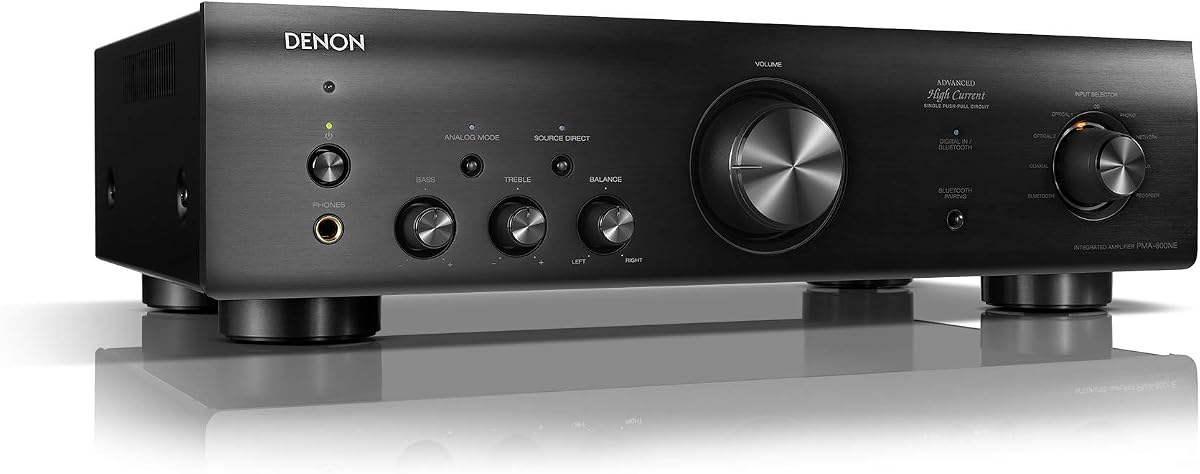
The Denon PMA-600NE is a compact two-channel amplifier with a 4.6 rating and a 70-watt specification at four ohms. It is designed for listeners who want a straightforward integrated amplifier that accepts both traditional components and modern wireless sources without taking up the space of a full-size receiver.
We may earn a commission when you buy through this link, at no additional cost to you.
Its input selection includes two optical connections, one coaxial connection, a phono input, and Bluetooth. The Bluetooth pathway includes a built-in DAC, while the divided circuitry allows the digital circuits, including Bluetooth, to be disengaged for a more purely analog listening session. Denon Advanced High Current push-pull amplification is intended to balance output strength with musical detail.
The design prioritizes practicality over expansive features. There is no MusicCast, HEOS, or other network streaming platform, and the specified output is modest compared with the Advance Paris integrated amplifiers. However, 70 watts at four ohms can be useful with moderately demanding bookshelf speakers and compact floorstanders in normal-sized listening spaces.
The PMA-600NE is a strong fit for a secondary room, a straightforward two-channel system, or an upgrade from basic Bluetooth speakers. Buyers seeking a more comprehensive network receiver may prefer a Yamaha R-N2000A, while those wanting the Marantz treatment should examine the PM6007. For uncomplicated power with broad source support, the Denon remains compelling.
Bluetooth makes the PMA-600NE useful for casual listening from a phone or computer without requiring a complex network configuration. Disconnecting the digital circuitry creates a clearer separation between convenient wireless playback and dedicated analog listening.
Its 70-watt four-ohm rating, slim enclosure, and restrained feature set suit rooms where a very high-power amplifier would be unnecessary. It offers more flexibility than a fixed-purpose Bluetooth speaker while remaining easier to operate than a full network receiver.
We may earn a commission when you buy through this link, at no additional cost to you.
The Marantz Model M1 condenses streaming, television audio, and 100-watt-per-channel amplification into a compact enclosure, earning a 4.4 rating. Designed and built at Marantz's Shirakawa Audio Works facility in Japan, it targets listeners who want a simple network-centered system with the amplifier's established sonic identity.
We may earn a commission when you buy through this link, at no additional cost to you.
HEOS Built-in enables high-resolution music through streaming services, a local network, or USB, including support for 24-bit/192kHz PCM and DSD. AirPlay 2, Spotify Connect, and Bluetooth broaden the ways music can reach the unit. A dedicated subwoofer output permits a 2.1 arrangement when full-range bass in the main speakers is not desired.
Its HDMI eARC input and onboard Dolby Digital Plus decoding allow it to improve television sound while retaining familiar volume and audio adjustments from the television remote. Marantz Musical Digital Filtering is included to preserve warmth, detail, and spaciousness, while the soft-touch finish, metal grille, and dimmable panel help it blend into a living environment.
The M1 is less conventional than a full-size integrated amplifier, and its compact, appliance-like design does not expose the same variety of physical controls and system connections. It is consequently more dependent on network software and compatible source equipment. For a compact, stylish, streaming-first setup, however, it offers an unusually complete and flexible package.
HEOS, AirPlay 2, Spotify Connect, Bluetooth, USB, and high-resolution network playback allow the Model M1 to serve as the central source for an entire listening setup. Its multi-room support also makes it easier to integrate with compatible Marantz products around the home.
HDMI eARC provides a straightforward route for television audio, while onboard decoding handles compatible Dolby Digital Plus material. The result is a simpler way to improve television sound without requiring a separate surround receiver for basic stereo viewing.
We may earn a commission when you buy through this link, at no additional cost to you.
The Marantz Model 50 is a focused analog integrated amplifier with a 4.8 rating. Its 70-watt high-current Class A/B design, six analog inputs, and completely analog signal path make it an attractive proposition for audiophiles who want the amplifier to remain a purist playback component rather than a multifunction media hub.
We may earn a commission when you buy through this link, at no additional cost to you.
Marantz's HDAM SA-3 discrete modules form the foundation of the amplification stage, replacing standard integrated operational amplifiers with proprietary discrete designs intended to improve speed, bandwidth, and distortion behavior. The circuit is described as warm, rich, spacious, and transparent, with a direct path from source to speakers designed to avoid interference from digital circuitry.
A built-in moving-magnet phono stage uses HDAM technology and JFET input circuitry, making vinyl playback simple and reducing the need for an external phono box. The amplifier also includes stereo preamplifier outputs, a power amplifier input, a subwoofer output, and speaker A/B switching, giving owners meaningful options for later system expansion.
The absence of a built-in DAC, streaming platform, Bluetooth, and television connectivity is the main compromise. It is not a flaw within the model's stated philosophy, but it means a modern listener may need an external streamer or DAC. For those who prioritize an uncomplicated analog core, abundant inputs, and future-ready expansion, the Model 50 is among the most compelling choices in this guide.
By excluding digital circuitry from the signal path, the Model 50 maintains a clear design philosophy. Audiophiles who prefer to make network and DAC decisions with a separate component can do so without introducing conversion circuitry into the integrated amplifier.
Preamp outputs allow the Model 50 to feed a more powerful power amplifier later, while the power-amplifier input permits a different preamp to take control. Speaker switching, a subwoofer connection, and a dedicated phono input add practical flexibility for evolving two-channel systems.
We may earn a commission when you buy through this link, at no additional cost to you.
The Yamaha R-N2000A in silver is a high-end network receiver that combines traditional stereo performance with broad digital and streaming capability. Its 4.4 rating reflects its position as a feature-rich home audio hub, offering an ESS SABRE ES9026PRO Ultra DAC, MusicCast, phono support, and high-resolution USB playback.
We may earn a commission when you buy through this link, at no additional cost to you.
The USB DAC function supports DSD at 11.2MHz and PCM at 384kHz, while the integrated DAC handles digital conversion for compatible sources. MusicCast provides access to familiar streaming services and connected music throughout the home. A toroidal power transformer underpins the receiver, contributing to a stable and spacious presentation according to the supplied specifications.
As a receiver, the R-N2000A serves more roles than a straightforward integrated amplifier. It can organize networked music, conventional source components, and television-related functions within one enclosure, depending on the selected connections. This makes it a strong candidate for a modern household where the listening system must cover more than a dedicated two-channel setup.
The tradeoff is physical and operational complexity. A receiver of this class occupies more space than a slim integrated amplifier, and its menus and network features may feel excessive to someone who only wants analog amplification. For audiophiles who prioritize high-resolution conversion and seamless integration with streaming services, the silver R-N2000A offers a remarkably complete package.
The ESS SABRE ES9026PRO Ultra DAC is the centerpiece of the digital side, supported by USB playback up to 384kHz and native DSD 11.2MHz. MusicCast connects those capabilities to a broader networked listening experience.
The R-N2000A suits listeners who want one central device to manage streaming, local files, traditional sources, and vinyl. Its broad role justifies the larger enclosure when convenience and comprehensive source support are priorities.
We may earn a commission when you buy through this link, at no additional cost to you.
The Marantz Model 60n is a network integrated amplifier designed to combine Marantz-style component design with modern streaming and high-resolution playback. It carries a 4.4 rating and supports music, vinyl, CDs, and television use while offering HEOS Built-in Wi-Fi, AirPlay 2, Bluetooth, and Roon Ready operation.
We may earn a commission when you buy through this link, at no additional cost to you.
Its network section supports high-resolution audio up to 24-bit/192kHz, and proprietary Marantz HDAM circuits are used for detailed audio reproduction. The 2.1-channel output allows a pair of loudspeakers to be joined by a subwoofer, a practical arrangement for rooms in which the speakers struggle to deliver satisfying full-range bass.
Compared with the Model M1, the 60n presents a more traditional integrated-amplifier identity. Compared with the Model 50, it adds network convenience and digital playback. This makes it a middle ground between the purist analog and appliance-style wireless models in the Marantz range, although the supplied specifications do not provide a specific wattage figure.
The trade-off is that the Model 60n does not offer the extensive feature list of the Yamaha R-N2000A or the explicit high-output specification of the Advance Paris models. Its appeal lies in the combination of familiar Marantz design, network functionality, and a subwoofer option. It is especially well suited to listeners building a modern system around HEOS or compatible home audio products.
HEOS Built-in Wi-Fi, AirPlay 2, Bluetooth, and support for 24-bit/192kHz content cover most modern listening habits. HDAM amplification circuitry gives the network model a familiar technical foundation rather than treating streaming as a separate function.
Adding a subwoofer through the dedicated output can improve low-frequency performance in smaller rooms. The arrangement also gives owners flexibility when their main speakers are optimized for midrange and treble rather than deep bass reproduction.
We may earn a commission when you buy through this link, at no additional cost to you.
The black Yamaha R-N2000A is the finish alternative to the silver version, offering the same 4.5-rated network receiver design in a darker finish suited to home theaters and restrained listening environments. It combines a next-generation hi-fi network platform with an ESS SABRE ES9026PRO Ultra DAC and extensive format support.
We may earn a commission when you buy through this link, at no additional cost to you.
Its USB DAC section handles DSD at 11.2MHz and PCM at 384kHz, while MusicCast connects the receiver to compatible music services and devices around the home. The built-in phono stage broadens its usefulness for vinyl, and the toroidal power transformer supports the stated goal of spacious, realistic sound with a stable power foundation.
This is a receiver built for broad responsibilities. It can be the central entertainment and music component in a household, bringing network services, digital files, traditional components, and record playback into one operating environment. The black finish helps it blend naturally with other dark-colored electronics and furniture.
Listeners seeking only a lean analog amplifier will find its network platform and receiver layout excessive. The enclosure also has a larger visual and physical presence than the slim Marantz PM6007. For a buyer who values comprehensive digital conversion, reliable streaming integration, and flexible source support, however, this version delivers the same technical foundation as the silver R-N2000A in a more versatile aesthetic.
MusicCast, high-resolution USB playback, phono connectivity, and digital conversion combine in a single unit. This reduces the need for separate network players and converters when the goal is a centralized home listening system.
The black finish gives listeners a straightforward alternative to the silver model's brighter appearance. It is particularly convenient when the amplifier must coordinate with dark speaker grilles, media furniture, or other home electronics.
We may earn a commission when you buy through this link, at no additional cost to you.
The Flyinsky PRT13A-BAL is not a power amplifier but a remote-controlled, fully balanced vacuum-tube preamplifier built around two ECC82 6N11 tubes. Its 5.0 rating reflects a specialized design that appeals to audiophiles assembling a separates system and seeking a dedicated control center with tube-based signal characteristics.
We may earn a commission when you buy through this link, at no additional cost to you.
The balanced circuit draws on a classic US ARC reference topology, while the power supply uses a capacitor array and high-voltage MOS regulation to provide low internal resistance and strong transient behavior. A customized 50VA pure-copper tape-shielded R-core transformer is used for the power supply, while independent stabilization of the left and right filament supplies is intended to minimize crosstalk.
The all-aluminum chassis is sandblasted for a refined appearance, and the remote control adds practical preamp convenience. As a preamplifier, it provides source selection, level control, and balanced signal routing rather than speaker-driving power. It must therefore be paired with a suitable power amplifier and source components.
The main limitation is obvious but important: this product cannot serve as the central amplifier for a pair of passive speakers by itself. It also depends on a compatible power amplifier that accepts its outputs and on the correct interaction among tubes, cables, source, and downstream electronics. For a dedicated separates enthusiast, that dependency is the purpose rather than a problem.
Fully balanced construction is the defining feature, and the preamplifier is intended to feed a suitable downstream power amplifier. The architecture suits listeners who already understand the role of each separates component and want balanced control throughout the audio chain.
The ECC82 6N11 tubes are paired with a supply designed for low resistance, strong transients, and reduced unwanted noise. Independent filament stabilization for each channel is an unusual attention to detail intended to preserve channel separation and signal purity.
We may earn a commission when you buy through this link, at no additional cost to you.
The Advance Paris A10 Classic is a hybrid integrated amplifier with a 4.5 rating, combining Class A analog amplification with Class D digital efficiency. It delivers 130 watts per channel at eight ohms and 190 watts per channel at four ohms, giving it meaningful power without moving into the A12 Classic's larger 190-watt eight-ohm specification.
We may earn a commission when you buy through this link, at no additional cost to you.
Its connectivity is impressively broad for an integrated amplifier. RCA and XLR analog inputs are joined by optical, coaxial, and USB-B digital inputs, while a built-in phono stage serves turntables directly. Premium components and dual toroidal transformers support stable operation, clear sound, and low noise according to the supplied product information.
The brushed aluminum front panel and retro-inspired VU meters give the amplifier a distinctive appearance that can become a visual centerpiece. These meters also provide a visual indication of operating activity, although actual signal interpretation depends on the unit's behavior and setup. The enclosure is substantial enough to reflect its transformer-based power supply.
The A10 Classic does not provide built-in Wi-Fi, Bluetooth, or a streaming platform, so it is not as immediately flexible as the Marantz Model M1 or Yamaha R-N2000A. Its advantage is a strong combination of balanced connectivity, high output, digital input support, and phono functionality in a single integrated design.
XLR and RCA inputs provide more source options than many integrated amplifiers, while digital connections allow compatible components to join the system. This makes the A10 Classic practical for a mixed-source setup that still wants one central power and control unit.
With 130 watts at eight ohms and 190 watts at four ohms, the A10 Classic provides useful amplifier capability for larger speakers. Its dual Class A/D approach is designed to balance musical presentation, efficiency, and practical output in a single chassis.
We may earn a commission when you buy through this link, at no additional cost to you.
The right high-end amplifier depends on your speakers, room, source components, listening habits, and willingness to manage separate equipment. Use the following factors to narrow the field before making a final decision.
Amplifier power should be considered alongside speaker impedance, sensitivity, room size, and preferred listening levels. A sensitive pair of bookshelf speakers may behave very well with a modest integrated amplifier, while low-sensitivity floorstanders in a large room benefit from a high-current design with greater power at four ohms. The Advance Paris A12 Classic and A10 Classic offer the strongest stated power ratings in this selection, while the PM6007 is better suited to efficient speakers or moderate rooms.
Choose enough power for clean headroom, but do not assume the largest number always produces the best result. Speaker compatibility, damping behavior, and the amplifier's stable operation under load matter more than headline wattage alone.
An analog-focused amplifier can provide a direct, uncomplicated path from source to speakers. The Marantz Model 50 is explicitly built around a pure analog signal path, whereas the PM6007 combines analog inputs with a high-resolution DAC. Network-oriented models such as the Model M1, Model 60n, and Yamaha R-N2000A add wireless services, local network playback, and digital conversion.
Match the amplifier to the sources you already own or strongly intend to use. An external streamer and DAC can preserve flexibility, but they add boxes, cables, and another level of system complexity.
Count the source types your system actually requires rather than choosing by input total alone. Vinyl listeners should confirm moving-magnet phono support and, if they use a moving-coil cartridge, verify whether an external phono stage is necessary. CD, streamer, computer, television, and tape users may require optical, coaxial, USB, RCA, XLR, or HDMI connections.
Prefer a connection mix that matches the equipment without leaving important functions inaccessible. Balanced inputs are valuable only when the source offers compatible balanced outputs and the rest of the system supports a balanced approach.
A built-in DAC can simplify a system by accepting digital audio directly, but the relevant question is which formats the amplifier can actually decode. The PM6007 supports up to 192kHz/24-bit through its AK4490 DAC, the Model M1 supports high-resolution PCM and DSD, and the Yamaha R-N2000A reaches 384kHz and DSD 11.2MHz through its USB DAC function.
Resolution labels alone do not guarantee a better listening experience. Compatibility with the user's files, network services, control software, and source components is more practical than chasing the highest printed specification.
Integrated amplifiers combine preamplification and power amplification in one chassis, which simplifies wiring and reduces footprint. A separate preamplifier offers a different kind of flexibility: it can be paired with different power amplifiers and upgraded independently. The Flyinsky PRT13A-BAL belongs to this category and therefore requires a separate power amplifier.
Choose an integrated model for convenience and a preamplifier when separates flexibility is central to the system. Expansion outputs on the Model 50, including preamplifier outputs and a power amplifier input, can offer some of the benefits of separates without starting with two boxes.
A high-end amplifier should feel appropriately substantial and remain stable during operation. Models with large toroidal transformers, vibration-resistant enclosures, and all-metal construction may provide a sense of quality, but weight alone is not a measure of sound. The practical question is whether the device fits the intended shelf or cabinet and can be properly ventilated.
Pay attention to the complete physical design, including connectors, front-panel controls, feet, and finish. A component that is difficult to operate or cannot accommodate required cables may be less satisfying than a simpler model that integrates cleanly into the room.
A compact network amplifier may be ideal for a secondary room, office, or modest living space, while a full-size receiver can serve as the central hub for a busy household. The Marantz Model M1 offers HEOS multi-room integration, and the Yamaha R-N2000A uses MusicCast to connect compatible devices and services.
Consider whether the system needs television audio, several rooms, or a traditional two-channel listening area. The best component is often the one whose capabilities align with the room's actual use rather than one that offers the largest specification sheet.
Begin with placement, ventilation, and source setup. Keep the amplifier on a stable, level surface with adequate clearance around vents, and use good-quality speaker cables terminated securely. Connect one source at a time before adding digital services, and confirm that every device is powered off during cable changes.
After connecting equipment, begin with modest volume and allow the amplifier to warm up naturally. Select the correct input, verify that the intended speakers are assigned to the active A or B terminals, and set the amplifier to the correct operating mode for integrated, preamp, or power-amplifier use. For streaming and network models, complete software setup and firmware updates before fine-tuning sound or room placement.
Maintain the system by keeping the ventilation paths clear, avoiding placement in enclosed cupboards, and cleaning the exterior with a dry or lightly damp soft cloth. Do not open a chassis containing high-voltage circuitry, especially in the tube preamplifier. Check connections periodically, retain compatible spare tubes if applicable, and follow the manufacturer's guidance for cleaning contacts and updating network software.
An amplifier can reveal more detail, improve control, and provide greater headroom, but it cannot correct poor speaker placement, room acoustics, or mismatched system design. The most audible improvement usually comes from a properly matched amplifier-speaker pairing in a suitable room. Audiophiles should improve the weakest part of the chain rather than expecting new electronics alone to transform mediocre speakers.
It depends on the model and your sources. The Marantz Model 50 has a pure analog design, so it needs an external DAC for digital audio. The PM6007 includes an AK4490 DAC, the Model M1 and Model 60n support network playback, and the Yamaha R-N2000A includes a high-performance DAC. Using a separate DAC can still be worthwhile if it offers formats, controls, or connectivity the built-in converter does not.
Consider speaker sensitivity, impedance, room dimensions, and how loudly you listen. Efficient speakers can work well with lower-powered amplifiers, while low-sensitivity models in a large room benefit from more current and power at four ohms. The 190-watt A12 Classic and 130-watt A10 Classic are more naturally suited to demanding loads than lower-output models, provided the rest of the system is equally capable.
Most turntables produce a low-level phono signal that requires equalization and gain before it can drive speakers through a normal line input. An integrated moving-magnet phono stage simplifies the process and is appropriate for many MM cartridges. Moving-coil cartridges usually need a compatible moving-coil stage with adjustable loading, so check cartridge requirements before choosing an amplifier.
An integrated amplifier is simpler, takes up less space, and usually reduces both cost and cable complexity. Separates provide more freedom to change preamplification or power amplification independently, which can be valuable in a long-term enthusiast system. The Flyinsky PRT13A-BAL is a dedicated preamplifier and therefore needs a separate power amplifier, while the Model 50 offers expansion outputs for future development.
Balanced XLR connections carry a three-wire signal designed to resist interference and can offer a cleaner path between compatible components. Single-ended RCA connections are simpler and work with more source equipment. The A12 Classic and A10 Classic include XLR inputs, but the benefit can only be realized when the source provides matching balanced outputs and the system is configured properly.
Not necessarily. If a dedicated streamer, DAC, or network player already provides excellent source control, an analog amplifier may integrate more cleanly into the system. Conversely, built-in HEOS or MusicCast can greatly simplify a modern setup by reducing the number of boxes required. The choice depends on whether convenience or dedicated component separation matters more to you.
Placement affects both speaker performance and the amplifier's operating conditions. Adequate ventilation helps thermal stability, while the speakers' distance from walls and position relative to the listening seat influence bass response, imaging, and tonal balance. The amplifier's impact through placement is usually secondary, but placing it in a confined, poorly ventilated cabinet can shorten component life and potentially introduce instability.
The Marantz PM6007 stands out as the most approachable high-end option in this roundup, combining a moving-magnet phono stage, high-resolution DAC, multiple inputs, and compact construction. The Advance Paris A12 Classic is the strongest all-round choice for high power and balanced connectivity, while the Marantz Model 50 best serves listeners who want a pure analog core with room for future expansion.
For network-oriented systems, the Marantz Model M1 provides compact streaming and television integration, the Model 60n adds a more traditional Marantz integrated-amplifier identity, and the Yamaha R-N2000A offers the broadest digital conversion and receiver functionality. The A10 Classic serves as a high-output balanced hybrid alternative, while the Flyinsky PRT13A-BAL occupies a specialized separates role.
Ultimately, prioritize speaker compatibility, source needs, room conditions, and the features you will genuinely use rather than choosing solely on output wattage or feature count. Confirm the amplifier's current specifications, connectivity, dimensions, and compatibility before purchasing, and check current prices because they can change independently of the product's capabilities.