
Polk Audio MM842 DVC
4.4Editor score
IP56 marine certification
Dual 4-ohm voice coils
Titanium-plated composite cone
Stainless steel hardware
Marine subwoofers are built to deliver deep, controlled bass in environments where ordinary speakers would struggle. Sun, salt, spray, humidity, vibration, and limited installation space make durability and electrical compatibility just as important as raw output. A suitable marine model should sound good, resist the elements, and fit the intended boat, vehicle, or outdoor enclosure.
We compared the ten featured products using the information supplied for each listing, focusing on enclosure construction, marine protection, power handling, impedance, mounting options, and practical features such as lighting or passive radiators. The list covers bare drivers, preloaded enclosures, shallow-mount speakers, and both conventional and dual voice-coil configurations.
Each selection highlights a different path for a marine audio upgrade, from high-output bare speakers to compact loaded systems and illuminated models. Ratings reflect the listed customer feedback, while technical details come directly from the product descriptions. Marketplace offers and availability can change, so confirm current specifications and compatibility before purchasing.
4.4Editor score
5.0Editor score

5.0Editor score
As an Amazon Associate we earn from qualifying purchases.
This side-by-side comparison covers the ten marine subwoofer choices in the guide, making it easy to compare driver size, construction, electrical loading, output specifications, and practical features before choosing the right model for a boat, off-road vehicle, or outdoor audio system.
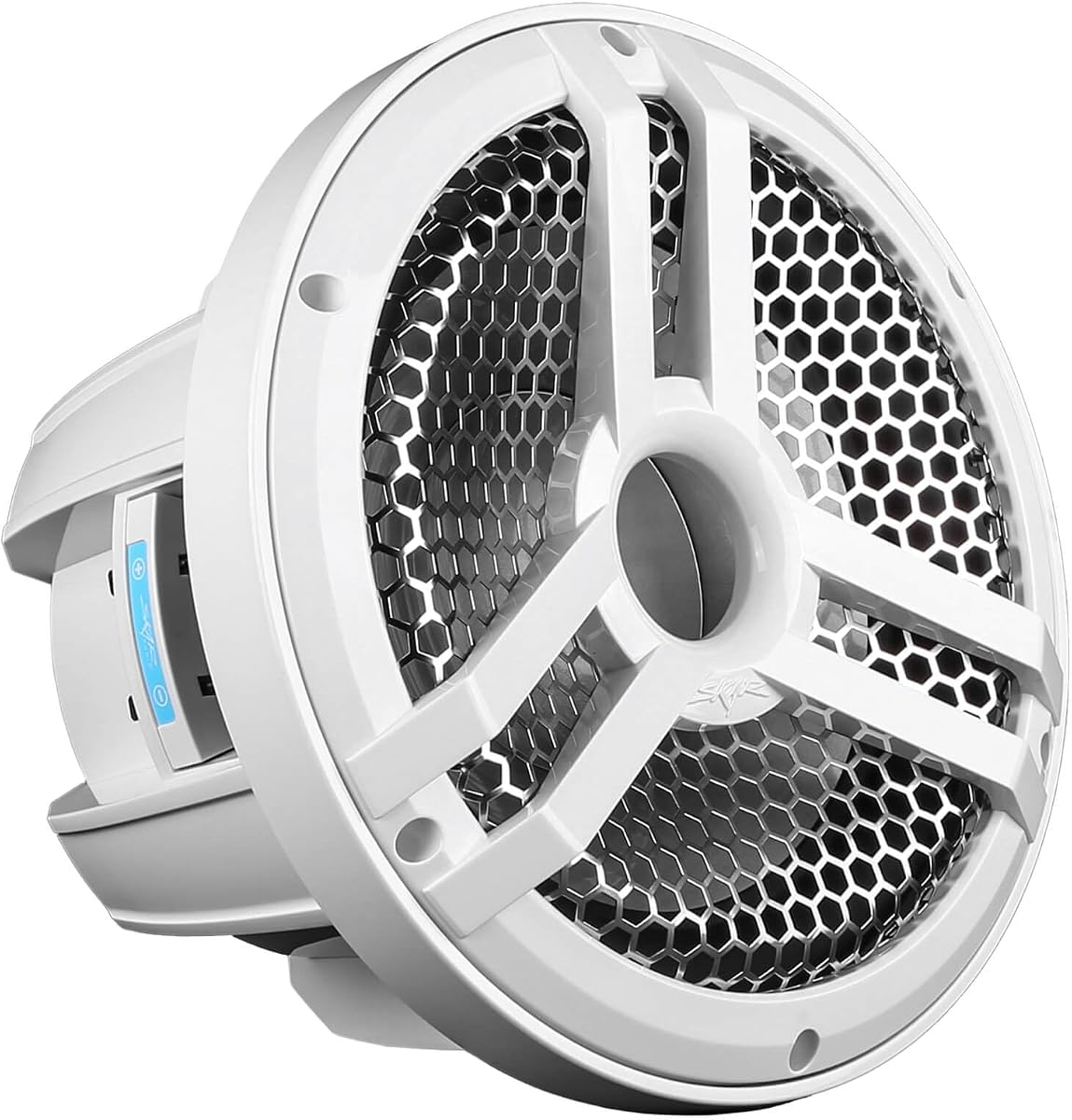


The Skar Audio SKM10WD2 is a 10-inch, dual 2-ohm marine subwoofer built for installers who want substantial output and flexible configuration. It carries a 4.8 customer rating and combines 500 watts of RMS handling with a 1,000-watt peak-power specification. Its white finish also makes it easier to coordinate with many boat interiors.
We may earn a commission when you buy through this link, at no additional cost to you.
The dual voice-coil design provides useful electrical options. Depending on the amplifier and desired stability, the two 2-ohm coils can be configured for different total loads, making this model useful for both a single-sub installation and a matched pair. A 34 Hz to 700 Hz frequency-response range gives it room to reproduce both fundamental bass and higher low-frequency detail.
A high-temperature copper voice coil, high-flux ferrite motor, and high-roll rubber surround form the core of the driver’s design. These features support controlled movement and durability, although buyers still need to construct or purchase a correctly sized enclosure. The listed sensitivity of 85.1 dB also means amplifier selection should be handled thoughtfully rather than based on peak power alone.
This is a strong choice for a boat owner seeking a conventional 10-inch marine driver with substantial power handling and a clean white appearance. It is less convenient than a preloaded enclosure, but the added enclosure-building flexibility can make it more adaptable. For buyers comfortable matching a subwoofer to an enclosure and amplifier, it combines solid specifications with favorable customer feedback.
Two independently terminated 2-ohm voice coils allow several wiring arrangements, helping installers balance electrical load and amplifier stability. The appropriate configuration should be selected using the amplifier’s manual and the subwoofer’s wiring diagram.
The 500-watt RMS rating gives this driver meaningful headroom when paired correctly. Its 85.1 dB sensitivity and low-frequency extension make it a flexible foundation for either a sealed or carefully engineered custom enclosure.
We may earn a commission when you buy through this link, at no additional cost to you.
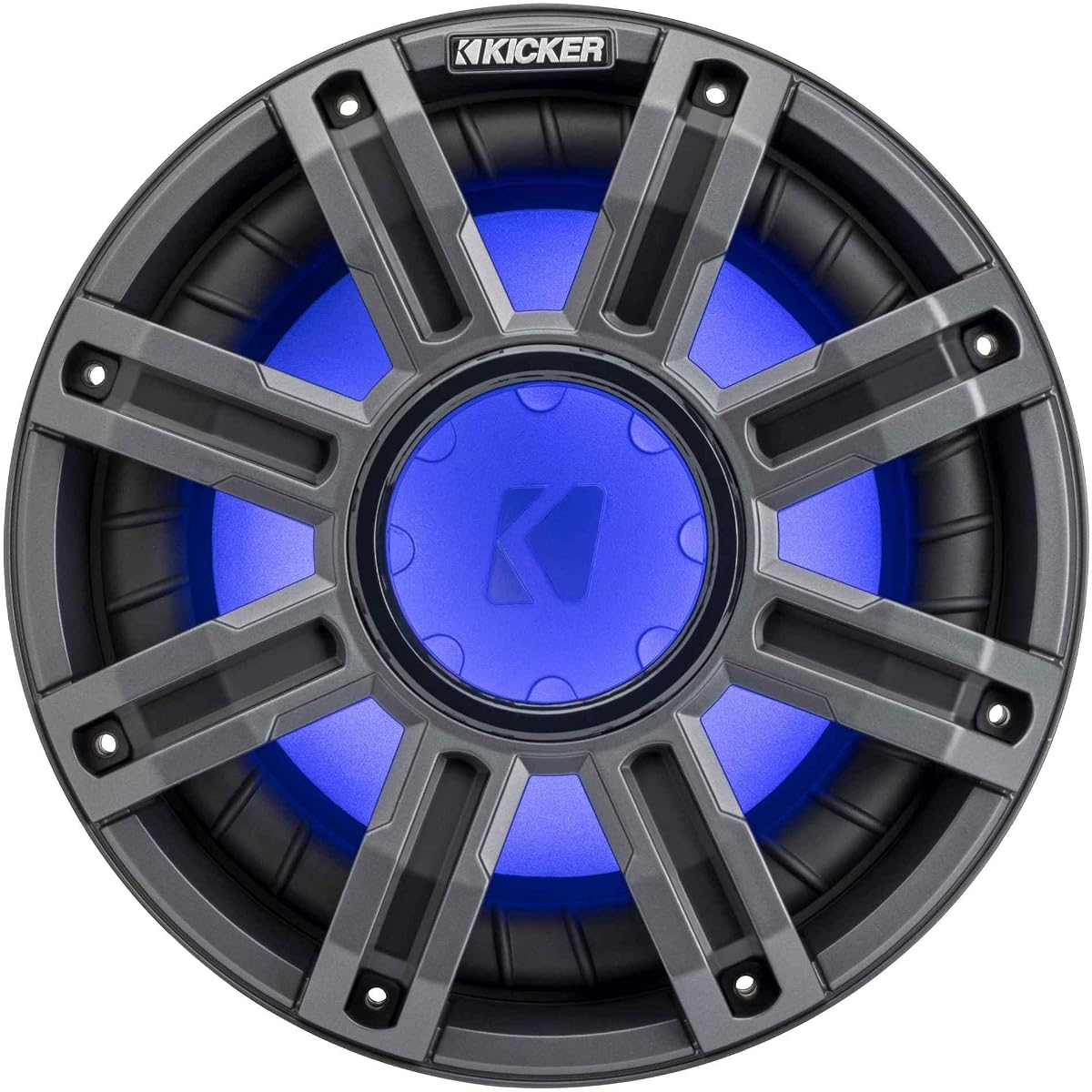
The KICKER 51MWF104 is the most complete premium marine driver in this group, combining a 5.0 customer rating with extensive environmental protection and integrated illumination. Designed with free-air applications in mind, it also features a polypropylene cone co-molded to a TPE surround, a construction aimed at accurate response and strong resonance control.
We may earn a commission when you buy through this link, at no additional cost to you.
Marine compliance is a central strength. The driver uses marine-compliant terminals and splash-and-spray resistance, with the description stating that it meets or exceeds applicable ASTM standards for ultraviolet and salt/fog exposure. Ribbed silicone gasketing, a polycarbonate bridge, and a sealed structure improve resistance to moisture, vibration, and the changing conditions encountered around a boat.
The integrated RGBW LED system is its most distinctive feature. It lets an installer add a tailored lighting effect without fitting a separate lamp over the cone. A compatible Kicker controller is required for color-changing operation, and the optional white grille is also separate, so buyers should include those accessories if their installation plan depends on them.
This subwoofer suits owners who want a polished, feature-rich marine audio system rather than a basic driver. The included charcoal grille supports a finished appearance immediately, while the option for a white grille improves coordination with a wider range of interiors. With marine-focused construction, accurate low-frequency behavior, attractive lighting, and excellent customer feedback, it earns the Editor’s Choice designation.
Marine-compliant terminals, silicone gasketing, splash-and-spray resistance, and a polycarbonate bridge address several common failure points. These details are particularly valuable for exposed installations where salt, moisture, and vibration are constant concerns.
Integrated RGBW illumination can make a subwoofer enclosure part of the boat’s visual design. A compatible controller enables broader color customization, while the included charcoal grille provides a finished appearance.
We may earn a commission when you buy through this link, at no additional cost to you.
The KICKER 46CWTB84 is an 8-inch loaded enclosure for buyers who want substantial marine-style bass without building a custom box. It has a 4.5 rating, a 4-ohm load, and a stated 300-watt power-handling figure. Its passive-radiator arrangement sets it apart from a conventional compact sealed enclosure.
We may earn a commission when you buy through this link, at no additional cost to you.
Thick ABS construction creates a rigid weatherproof shell, while the included bracket system supports horizontal or vertical placement. That flexibility makes the enclosure easier to integrate into a boat, Jeep, UTV, or dune buggy, particularly where the available mounting surface is not a conventional flat panel.
The active side uses a CompR woofer with a ceramic magnet, advanced suspension, and a heat-management system. On the opposite side, a passive radiator uses matching surround and cone materials to increase low-frequency extension and create a more expansive output than the 8-inch driver alone would normally deliver.
This enclosure is most appealing to installers seeking a complete, rugged solution with less assembly than a bare-driver system. It may not provide the same low-frequency reach or output as a larger 10-inch or 12-inch model, and the passive section increases the enclosure’s footprint. Even so, it provides a practical balance of compact size, weather protection, mounting flexibility, and deeper bass for mobile outdoor use.
The passive radiator works with the active 8-inch subwoofer to move more air and generate deeper output. Because it shares the active driver’s surround and cone materials, the system is designed to preserve a consistent visual and acoustic character.
The supplied bracket system can support horizontal or vertical installation. This makes the TB8 easier to fit beneath seating, inside a storage compartment, or against a selected surface in a boat or off-road vehicle.
We may earn a commission when you buy through this link, at no additional cost to you.
The KICKER KMF124 is a 12-inch, 4-ohm marine subwoofer built for larger systems and owners who favor the air-moving capability of a big cone. It has a 4.6 rating, 175 watts of RMS handling, and a frequency response extending from 30 to 500 Hz. A white grille and silicone-coated lighting give it a boat-ready visual presentation.
We may earn a commission when you buy through this link, at no additional cost to you.
Environmental protection is comprehensive. The waterproof grille is intended to provide long-term defense for the speaker, while the sealed motor structure and locking, sealed terminal cover reduce splash exposure. The product is described as tested for salt/fog and ultraviolet exposure against applicable ASTM standards, making it a credible choice for coastal and open-water use.
A tough Santoprene surround and marine-grade cone support controlled movement in wet conditions. The integrated lighting adds visual impact without requiring a separate grille-mounted lamp, and the listed low-frequency limit of 30 Hz indicates strong potential for deep bass when installed in a properly sized enclosure.
This model is best for a boat with room for a 12-inch driver and a solid enclosure design. The larger physical size requires more mounting area, and the relatively modest RMS figure means it should not be confused with a high-power competition subwoofer. Within the marine category, however, its size, low-frequency reach, protected terminals, lighting, and white grille create a compelling combination for style-conscious installers.
The listed 30 Hz lower limit gives the KMF124 a strong foundation for bass reproduction. Real-world depth still depends on enclosure volume, port design, amplifier control, and the boat’s acoustic characteristics.
Silicone-coated LEDs add a finished appearance while the sealed terminal cover helps protect connection points. Buyers should keep the grille and terminal seals properly seated during installation and routine cleaning.
We may earn a commission when you buy through this link, at no additional cost to you.
The KICKER 46CWTB104 delivers a balanced combination of size, output, and installation convenience. This 10-inch loaded weatherproof enclosure has a 4.7 rating, a 4-ohm impedance, and a listed 400-watt power-handling figure. It includes an active CompR subwoofer and a passive radiator to provide more effective low-frequency output than a basic single-driver box.
We may earn a commission when you buy through this link, at no additional cost to you.
The enclosure uses thick ABS construction for a durable, all-weather package. A bracket system allows horizontal or vertical mounting, giving installers options when working around seats, storage areas, decks, or vehicle panels. The product is explicitly intended for boats, UTVs, Jeeps, trails, water, and dunes, making it one of the more broadly versatile enclosures in the list.
The CompR driver uses a ceramic magnet, advanced suspension, and an improved heat-management system. On the opposite side, the passive radiator uses the same surround and cone materials as the active subwoofer. That coordinated construction supports a larger, more even low-frequency presentation while eliminating the need for a separate port or external enclosure calculation.
For a boat owner or off-road enthusiast who wants a robust ready-made system, the 46CWTB104 is easier to install than a bare driver. The 4-ohm load is also widely practical, although the amplifier must still be selected to handle the enclosure safely. Its main compromise is physical bulk: the passive radiator makes the package larger than a single 10-inch sealed enclosure, so installation clearance should be measured before purchase.
Matching the passive radiator’s cone and surround materials to the active driver creates a visually unified and acoustically coordinated enclosure. The extra radiating area helps produce deeper, fuller bass in a complete package.
The weatherproof enclosure and flexible mounting brackets suit boats, UTVs, and Jeeps. The installation location should still be protected from standing water, excessive heat, and direct impact where possible.
We may earn a commission when you buy through this link, at no additional cost to you.
The Bazooka MBT1014 is a complete 10-inch ported marine bass tube with a 4-ohm load and a 4.5 customer rating. Its straightforward, rugged design is aimed at outdoor installations where a conventional rectangular enclosure would be inconvenient. The supplied description lists both a 100-watt RMS figure and a separate 150-watt handling reference, so users should confirm the exact manufacturer specification before finalizing amplifier pairing.
We may earn a commission when you buy through this link, at no additional cost to you.
The tube enclosure includes a 10-inch waterproof subwoofer, ported construction, weather-resistant mounting straps reinforced with Velcro, and stainless steel hardware. These details make it straightforward to secure the unit in a boat or other mobile installation without building a custom box.
Salt-fog and ultraviolet certification are notable for an exposed marine product. The listed frequency response runs from 39 to 1,000 Hz, with sensitivity stated at 104 dB. The high sensitivity figure suggests efficient operation, although the enclosure design, amplifier requirements, and consistent handling specification still need to be considered together.
The MBT1014 is a practical choice for someone prioritizing a complete enclosure, simple attachment, and environmental resistance over a refined appearance. Its cylindrical format is visually distinctive and may not suit every boat interior, while the differing power figures require careful verification. It is best recommended for installers who want functional marine bass with minimal box construction and flexible placement.
Velcro-reinforced weather-resistant straps make the tube easy to position and remove. Stainless steel hardware adds corrosion resistance at attachment points that could otherwise deteriorate in a damp environment.
The ported tube provides a complete, efficient bass package without requiring enclosure construction. Its cylindrical shape also offers a distinct visual alternative to standard rectangular marine boxes.
We may earn a commission when you buy through this link, at no additional cost to you.
The KICKER 46CWTB102 is the 2-ohm version of the TB10 loaded weatherproof enclosure. It has a 4.6 rating, 400 watts of stated power handling, and the same combination of a 10-inch active CompR subwoofer and a passive radiator. Its distinguishing feature is the lower impedance, which can simplify some amplifier arrangements.
We may earn a commission when you buy through this link, at no additional cost to you.
A 2-ohm enclosure is useful when the amplifier is designed to drive low-impedance loads. This can make the system easier to configure for higher power delivery than a 4-ohm model, provided the amplifier’s specifications permit the load. It is particularly relevant when the subwoofer will operate as the primary low-frequency channel.
Construction remains focused on outdoor use. Thick ABS forms the enclosure, the bracket system supports horizontal or vertical mounting, and the ceramic-magnet CompR driver uses advanced suspension and heat management. Matching cone and surround materials on the passive radiator help create a consistent low-frequency output.
This is a good option for an installer who understands low-impedance amplification and wants a complete 10-inch marine bass system. The lower load can be beneficial, but it also demands careful amplifier selection. Buyers should verify the amplifier’s minimum stable impedance and avoid using impedances below its approved specifications. Subject to that condition, the enclosure offers a strong combination of convenience, output, and rugged construction.
The two-ohm load may suit amplifiers designed for stable low-impedance operation. Confirming the amplifier’s supported loads prevents instability and ensures the subwoofer receives appropriate electrical control.
The active 10-inch driver supplies strong cone area while the passive radiator increases total air movement. Together they create a full-featured package that avoids the complexity of a custom enclosure.
We may earn a commission when you buy through this link, at no additional cost to you.
The JBL 10-inch Marine Audio Multi-Element subwoofer pairs a 5.0 customer rating with a design specifically developed for harsh outdoor conditions. It handles 200 watts RMS and 600 watts peak power, offers 88 dB sensitivity, and covers a 30–250 Hz frequency range. Its gray finish and marine styling fit both boats and outdoor vehicles.
We may earn a commission when you buy through this link, at no additional cost to you.
The construction addresses the realities of life on the water. A one-piece polymer basket reduces potential moisture-entry points, marine-ready componentry handles environmental exposure, and stainless steel mounting hardware resists corrosion. The sealed, ultraviolet-resistant grille is designed to withstand spray and sunlight over extended periods.
Its IPX5 rating is a useful indicator that the speaker is designed for a harsh outdoor environment. That rating does not mean the driver can be deliberately submerged, and it does not remove the need for sensible placement, proper sealing, and routine maintenance. Even so, the combination of sealed construction and marine-rated materials gives it a strong foundation for exposed installations.
The JBL is best for a buyer who values recognizable engineering, straightforward protection, and the confidence of a one-year manufacturer warranty. It is a bare subwoofer, so an enclosure and suitable amplifier remain necessary. Its focused low-frequency range and 200-watt RMS handling make it particularly appropriate for a well-designed marine system where accurate bass matters more than extreme maximum output.
The one-piece polymer basket, marine-ready componentry, and stainless steel hardware target the corrosion and moisture challenges associated with outdoor use. These materials complement the sealed grille and IPX5 protection rating.
The 30–250 Hz range concentrates on the frequencies most important for bass. A properly designed enclosure will allow the driver to take full advantage of its low-end reach without trying to reproduce frequencies outside its intended range.
We may earn a commission when you buy through this link, at no additional cost to you.
The DS18 PSW10.4D is a 10-inch shallow-mount subwoofer aimed at installations where depth is the primary constraint. It carries a 4.8 customer rating, 500 watts of RMS handling, 1,000 watts of maximum power, and dual 4-ohm voice coils. Its reduced mounting depth makes it interesting for compact marine platforms, under-seat truck boxes, and other confined locations.
We may earn a commission when you buy through this link, at no additional cost to you.
The shallow profile is its defining advantage. The product description specifically highlights suitability for under-seat boxes and compact enclosures, where a conventional 10-inch driver may not fit. The PPI-molded cone is described as water resistant, and the steel basket is intended to add strength against shock and vibration.
Dual voice coils offer meaningful wiring flexibility. Depending on whether the coils are combined in series or parallel, the subwoofer can present different total loads. That makes it easier to match the speaker to an amplifier and to integrate it into a multi-subwoofer arrangement without changing the driver itself.
The PSW10.4D is a strong option for a boat, off-road vehicle, or truck with severe space limitations and moderate exposure to moisture. It is water resistant rather than explicitly marine-certified, so it deserves a protected location and careful sealing. For a boat owner who can provide a suitable sealed enclosure, it offers a rare combination of 10-inch cone area, dual-coil flexibility, and shallow depth.
The shallow design is useful under seats, inside shallow storage areas, and behind constrained panels. A correctly sized sealed enclosure can preserve low-frequency performance while preserving valuable installation space.
The two 4-ohm voice coils can be combined in series or parallel to suit different amplifier arrangements. Planning the final load before cutting the enclosure or mounting the speaker simplifies installation.
We may earn a commission when you buy through this link, at no additional cost to you.
The Polk Audio MM842 DVC is an 8-inch, dual voice-coil marine-certified subwoofer that emphasizes practical installation and environmental protection. It has a 4.4 rating, a 900-watt peak-power figure, and two 4-ohm coils. Its compact format makes it a useful option for smaller boats and installations with limited enclosure volume.
We may earn a commission when you buy through this link, at no additional cost to you.
Advanced Ultra-Marine IP56 certification is the standout feature. The product description identifies waterproof surrounds, a composite cone, stainless steel hardware, and an ABS basket as materials that resist corrosion. A titanium-plated composite woofer cone and butyl rubber surround are designed to maintain performance through challenging conditions.
Polk’s Dynamic Balance technology is used to select the relationship between speaker materials and support distortion-free response with broad dispersion. The terminal design accepts single banana plugs, pin connectors, or bare wire up to 10 gauge, providing practical connection choices for different marine audio systems.
This subwoofer is best for compact installations where a full-size 10-inch or 12-inch driver will not fit. Its dual coils can be wired in parallel for a 2-ohm load or in series for an 8-ohm load, offering useful flexibility. Although peak power is high, the smaller cone and unspecified RMS figure mean amplifier selection should focus on clean power and the manufacturer’s guidance. For space-conscious builders, it remains a well-protected and adaptable option.
The IP56 Advanced Ultra-Marine designation indicates deliberate attention to moisture, corrosion, and outdoor exposure. Stainless steel hardware, an ABS basket, and protected cone materials add confidence in demanding installations.
Two 4-ohm coils can produce either a 2-ohm parallel load or an 8-ohm series load. This flexibility allows the speaker to fit a wider range of amplifiers, although the chosen configuration must match the amplifier’s specifications.
We may earn a commission when you buy through this link, at no additional cost to you.
Choosing a marine subwoofer involves balancing environmental protection, enclosure requirements, electrical loading, output, and available space. The right product is the one that can be installed safely, powered correctly, and placed where it will remain protected from avoidable impact and standing water.
Salt, ultraviolet radiation, humidity, spray, and temperature changes can damage audio equipment faster than ordinary indoor wear. Look for sealed motor structures, protected terminals, UV-resistant grilles, corrosion-resistant hardware, and marine-grade surrounds. A product described as marine-certified or assigned an IP rating provides clearer evidence than a generic weather-resistant claim. IPX5, for example, indicates protection against water spray, while IP56 also addresses dust protection and powerful water jets under the relevant testing standard.
A certification reduces risk but does not make installation care irrelevant. Keep connections accessible, avoid standing water inside the enclosure, and position the speaker where direct impact is unlikely. Choose the most marine-specific model available for exposed boat locations.
Bare drivers offer the most freedom over enclosure volume, shape, mounting position, and finish, but they require accurate construction or a compatible ready-made box. Loaded enclosures are easier for beginners and often come with integrated grilles, brackets, passive radiators, and weatherproof shells. Ported enclosures can deliver strong extension and output, while sealed enclosures generally provide controlled, musical bass and occupy more internal space. Bass tubes are especially convenient for portable or flexible mounting.
Match the enclosure type to the installation. A custom builder may gain more from a high-output driver, while a boater seeking a straightforward upgrade may benefit more from a preloaded system. Never place a bare driver in a standard indoor box when its enclosure is part of the intended design.
Cone diameter affects how much air a subwoofer can move, how much physical space it requires, and how low it can reproduce bass. A 12-inch model generally provides greater displacement and low-frequency capability, but demands a larger enclosure. A 10-inch model offers a strong middle ground, while an 8-inch driver is easier to accommodate in compact boats and can work well when paired with passive radiators or a carefully designed sealed enclosure.
Choose size based on the available volume and the role of the subwoofer. More cone area is not automatically better; enclosure quality, amplifier control, and system integration determine the final result. A large driver in a poorly sized box may disappoint more often than a smaller driver in a sound design.
Impedance describes the electrical load presented to the amplifier and must be supported by that amplifier’s specifications. The featured options include 2-ohm, 4-ohm, 8-ohm equivalent, and dual-coil arrangements. A lower impedance does not automatically produce better sound, but it can allow compatible amplifiers to deliver more power. The final wiring diagram must match both the subwoofer and the amp’s supported configurations.
Use RMS power as the primary basis for matching and treat peak power as a secondary figure. An oversized amplifier can create distortion, while an undersized amplifier may struggle to control the woofer cleanly. Check manufacturer guidance for recommended amplifier power, impedance, and any required dual-coil wiring.
Power handling indicates how much amplifier output a subwoofer can accept under defined conditions. Continuous RMS ratings are more useful for system planning than headline peak values, which describe short-term limits. Sensitivity measures how efficiently the driver converts amplifier power into output and can influence amplifier choice. A high-sensitivity driver may need less power to achieve a given level, while a lower-sensitivity model may require a more capable amplifier.
Compare ratings from equivalent sources and distinguish continuous ratings from peak claims. A useful installation pairs the subwoofer with an amp that can deliver controlled power within the driver’s limits. Heavy thermal management, high-temperature voice coils, and efficient motors are especially relevant when low frequencies are played loudly for extended periods.
Measure the intended compartment before buying, including the driver diameter, mounting depth, grille clearance, terminal access, and space required for air movement around a ported enclosure. Shallow-mount drivers such as the DS18 PSW10.4D solve depth problems, while large 12-inch models and passive-radiator systems need more room. Account for removable seats, access panels, structural supports, and the depth of wiring.
Compact does not automatically mean easy. A tight enclosure can suffer from port turbulence, cabinet flex, or blocked airflow. Shallow designs are best paired with a correctly sized sealed box, and the specified mounting template should be used rather than estimating from the grille diameter alone.
Integrated lighting can make a subwoofer installation feel more like a designed part of the boat. The KICKER 51MWF104 includes RGBW illumination, and the KMF124 uses silicone-coated LEDs. Lighting adds visual appeal but should not be the only reason to choose a driver, and compatible controllers may be required. Grille color is also important because a white speaker can disappear into a white compartment while a dark grille creates a deliberate contrast.
Plan lighting wiring separately from speaker wiring, use marine-safe connections, and confirm controller compatibility before installation. If aesthetics matter, compare the included grille, optional accessories, and how the enclosure will look with seats and panels installed.
A passive radiator moves air without its own motor and voice coil, allowing a compact enclosure to generate deeper or fuller bass than its active driver alone. The KICKER TB series uses this approach effectively, but it requires extra enclosure volume and careful mounting. A dual-subwoofer setup can also increase output and reduce the strain on each amplifier channel, provided both enclosures share the same impedance and are wired correctly.
Avoid mismatching different models in the same amplification plan. Load, sensitivity, and enclosure behavior can differ, making the pair behave inconsistently. For balanced results, use matched speakers, follow the wiring diagram, and test the finished system at moderate levels before operating it at maximum output.
Begin by confirming that the subwoofer’s impedance and wiring arrangement match the amplifier. For dual voice-coil models, use the manufacturer’s diagram to determine the correct series or parallel connection. Check enclosure volume, leave the specified clearance around drivers and ports, and use corrosion-resistant fasteners where appropriate. Connect power and speakers with the system powered off, then verify polarity before testing.
Give the subwoofer a gradual test. Start at low volume with familiar music, listen for rattles or port noise, and increase the level gradually. Avoid clipping, prolonged full-output operation, and sharp impacts. If a port produces a chuffing or compression sound, pause playback and evaluate the enclosure and amplifier settings rather than masking the problem with more bass.
Marine equipment should be inspected after heavy rain, saltwater exposure, washing, or a day on the water. Rinse only with fresh water when manufacturer guidance permits, remove salt deposits, and let every part dry fully. Keep terminal covers and gaskets seated, check mounting hardware, and examine grille seals for cracks or movement. Access panels should remain secured so spray cannot reach internal connections.
A fully marine-rated model is the safest choice for exposed boat installations, especially on open decks or in compartments that receive spray and rain. The featured products vary from explicit IP or ASTM marine ratings to water-resistant construction. If a subwoofer is protected inside a dry compartment, a water-resistant model may work, but the enclosure and terminals still need suitable protection.
The number describes the electrical load the subwoofer presents to the amplifier. A 2-ohm model can suit more powerful low-impedance amplifier configurations, while a 4-ohm model is often easier to pair with conventional marine head units and amplifiers. The amplifier must support the selected impedance, and the subwoofer’s wiring instructions should always be followed.
Yes. A marine-rated subwoofer can work well in a car because its moisture-resistant materials are also suited to road dust, temperature changes, and occasional water exposure. Its electrical performance and power rating remain important, so the amplifier and enclosure should be matched just as carefully as they would be in a boat.
They require attention to the wiring diagram but provide more configuration options than a simple single-coil driver. The coils can often be wired in series or parallel to create different total loads. Before installation, choose the intended load, confirm amplifier stability, and make sure the final connection matches the subwoofer’s terminals.
A passive radiator can provide controlled low-frequency extension without a directional port, which can be useful in tight or visually sensitive installations. It also adds moving surface area to a compact enclosure. However, it requires proper integration and sufficient space, and it should not be assumed to outperform a well-engineered ported enclosure in every installation.
The correct power depends on the driver’s continuous RMS rating, impedance, sensitivity, enclosure design, and desired listening level. Continuous RMS ratings are more useful than peak-power claims when selecting an amplifier. Pair the amp within the manufacturer’s recommended range and use its stability controls appropriately, especially with a 2-ohm enclosure.
The subwoofer should be wired according to its impedance and the amplifier manufacturer’s guidance, with positive connected to positive and negative to negative. Marine installations benefit from corrosion-resistant terminals, protected connections, and strain relief. Sealed terminal covers and removable plugs should be properly seated after wiring is completed.
A dry, protected compartment can make a subwoofer easier to install safely, but ventilation, heat, water intrusion, and access still matter. Avoid areas where bilge water, ice, loose gear, or direct sun can reach the enclosure. The compartment should not block the driver, passive radiator, or port, and it should preserve access to the amplifier and electrical connections.
The KICKER 51MWF104 stands out as the most feature-rich overall choice, combining a 5.0 rating with marine-grade construction and integrated RGBW lighting. The DS18 PSW10.4D is the practical answer when shallow mounting depth is essential, while the JBL 10-inch model provides a 5.0-rated, purpose-built option with strong environmental protection and a sealed UV-resistant grille.
For a complete, ready-made installation, the KICKER TB series offers different sizes and impedance options, while the Bazooka MBT1014 prioritizes simple mounting and rugged portability. Whichever direction you choose, prioritize verified marine protection, correct impedance, continuous power handling, and an enclosure designed for the driver over headline specifications alone.
Before purchasing, measure the installation space, check amplifier compatibility, and confirm whether lighting controllers, grilles, or other accessories are required. Current product details and marketplace offers can change, so review the manufacturer’s latest specifications and the seller’s current listing before finalizing your system.