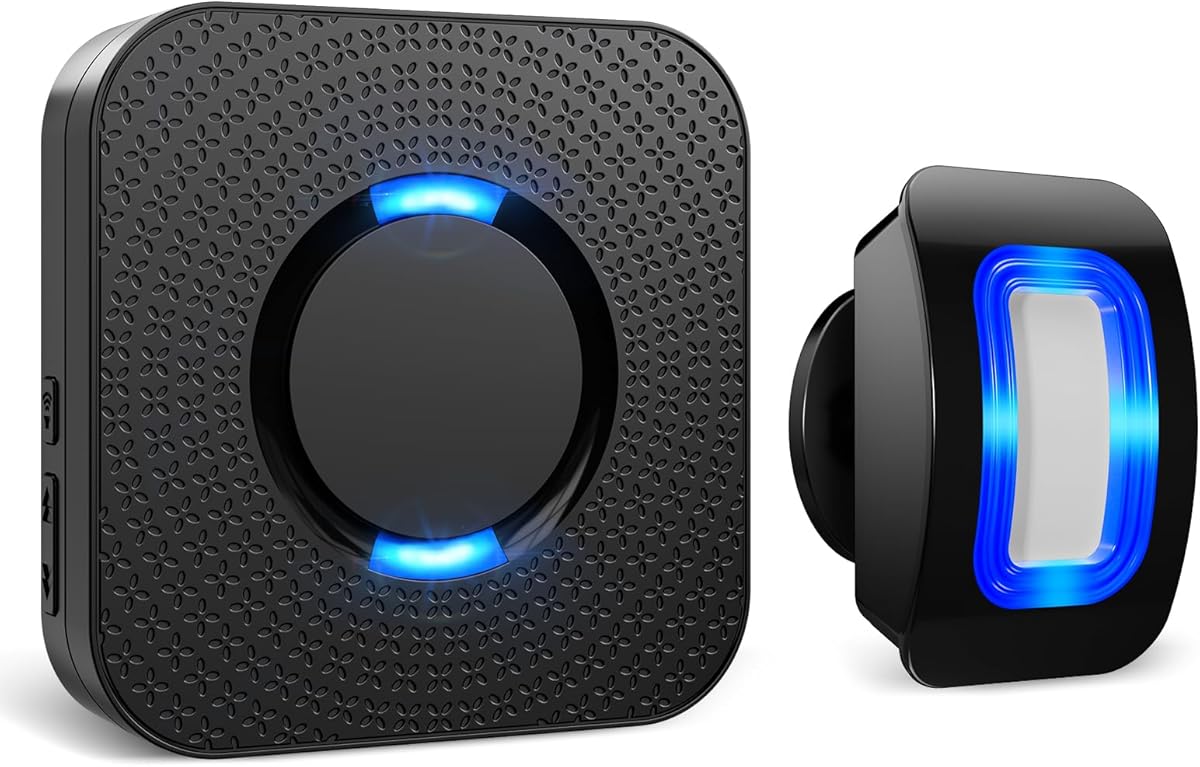
Wireless Motion Sensor LED Light – Motion Detector Alarm Chimes Door Sensor
4.3Editor score
Up to 500-foot signal range
Fifty-eight selectable ringtones
LED flashing visual alert
Battery-powered easy installation
Our guide compares the best motion sensor alarm for front porch options, covering weather resistance, detection range, alerts, installation, and expandability.
A front porch motion sensor alarm can warn you when visitors approach, reveal activity near an entryway, and add welcome lighting without requiring complex wiring. The most useful system balances dependable detection, clear alerts, outdoor suitability, simple installation, and enough flexibility to monitor several entrances.
We compared the products using their stated detection technology, wireless range, alert options, power requirements, environmental limitations, installation needs, and expansion capabilities. The list includes outdoor-rated driveway systems, indoor-only alarms suitable for covered porches, dual-power units, and solar-powered options for larger properties.
Each review identifies the strongest use case, practical limitations, and ideal installation location for the product. Rankings reflect the supplied product information rather than hands-on testing, while listing details and availability can change. Buyers should verify current specifications and porch conditions before ordering.
4.3Editor score

4.4Editor score

4.3Editor score
This side-by-side comparison highlights each alarm's detection method, range, outdoor suitability, alert controls, and expansion potential so porch owners can find a system that matches their property and installation environment.


This wireless motion sensor alarm combines a compact detection unit, a plug-in receiver, and 58 selectable ringtones for straightforward front porch awareness. Its 4.3 rating reflects a generally useful balance of features and convenience. The standout qualities are the stated 500-foot receiver range, five adjustable volume levels, flashing LED indicator, and ability to pair as many as 20 sensors with one receiver.
We may earn a commission when you buy through this link, at no additional cost to you.
The detection unit uses two included AAA batteries, while the receiver connects to a standard electrical outlet. Infrared sensing extends approximately 13 to 16.5 feet, and the stated coverage angle reaches up to 110 degrees. That makes the system more appropriate for a porch, doorway, path, mailbox, or nearby entry than for surveillance across a large yard. Its 110dB alarm can provide a noticeable alert inside the home when someone enters the monitored area.
The main trade-off is that the supplied information does not identify the detection unit as waterproof. A buyer should therefore treat it as suitable for a dry porch or another fully protected location unless the current manufacturer documentation says otherwise. The relatively short detection distance may also mean that someone approaching from the side could cross the field without producing the strongest response. These limitations matter more for exposed porches than for sheltered entries.
This is a sensible choice for homeowners seeking a simple entry chime, multiple tone options, and a receiver that can be placed deeper inside the house. It also works well for anyone who wants the flexibility to add sensors later. Choose it for a covered porch and moderate-property monitoring; for direct rain exposure or long driveways, a product with a stated weather rating and longer range is a better fit.
The ability to connect up to 20 motion sensors to one receiver makes this system useful for a front door, side entrance, mailbox, and other nearby zones. Different ringtones can help the household recognize which transmitter generated an alert without checking a separate display.
Five volume levels, 58 ringtones, and a flashing receiver LED provide several ways to notice activity. The visual indicator is particularly helpful when the alarm is muted, the room is noisy, or a household member has difficulty hearing the selected tone.
We may earn a commission when you buy through this link, at no additional cost to you.
This driveway-oriented alarm is a strong choice for a front porch because its outdoor sensor is explicitly described as IP44 weatherproof, with anti-freeze materials and a 360-degree swivel mount. The system holds a 4.4 rating, and its practical advantages include a stated 19-to-65-foot detection range, four volume levels, 60 ringtones, and a plug-in receiver. It is designed to detect people, vehicles, and animals entering monitored outdoor areas.
We may earn a commission when you buy through this link, at no additional cost to you.
The sensor's adjustable range makes it more versatile than a short-distance doorway chime. Installers can narrow the monitored area for a porch approach or extend it across a wider path. The rotating mount helps direct the sensor away from irrelevant background movement. Its 360-degree positioning is especially useful when the porch has an angled approach, a nearby wall, or landscaping that creates a predictable pedestrian route.
The product description notes that effective range can change with temperature, humidity, and obstructions, while the upgraded infrared technology is intended to reduce false alerts from fog, rain, snow, haze, wind, and sunlight. Those claims make it a better fit for exposed outdoor use than systems without a stated rating, but the product is still a basic notification system rather than a camera or professional security platform.
Choose this alarm when a porch receives direct weather exposure or when you also want to monitor a driveway. It offers a stronger outdoor case than many entry chimes, flexible sensor aiming, and useful sound customization. However, buyers needing more than eight sensors on one receiver should look at the solar eMACROS system. For most homes and small properties, this model provides a particularly balanced porch solution.
An IP44-rated housing is the most important feature for a porch that receives rain, moisture, or wind-driven spray. It makes this system easier to justify than an indoor alarm or a non-waterproof chime placed near an open front door.
The 360-degree swivel installation lets the sensor focus on the porch approach, walkway, or driveway. Adjusting the range and aim can reduce alerts caused by traffic, animals, vegetation, and movement beyond the area you actually want to monitor.
We may earn a commission when you buy through this link, at no additional cost to you.
The eMACROS 1/2 Mile Solar Wireless Driveway Alarm is built for properties where a short-range porch chime would be inadequate. Its 4.3 rating is supported by a generous feature set, including a stated wireless range of 2,600 feet, one receiver and one solar-powered sensor in the package, and support for as many as 64 sensors and unlimited receivers. The system can monitor driveways, front doors, garages, barns, sheds, and other entrances.
We may earn a commission when you buy through this link, at no additional cost to you.
Its most important advantage is the ability to place the sensor far from the receiver while still delivering a prompt notification. That capability suits a long driveway, detached garage, large yard, or rural property. Detection sensitivity is adjustable between a high setting of up to 30 feet and a low setting of 20 feet, allowing the homeowner to tune coverage according to the monitored route.
Solar power is another major advantage for a difficult-to-wire outdoor location. The built-in panel charges the internal battery, reducing the need for routine battery changes. The trade-off is placement: the sensor needs an appropriate amount of sunlight, and the system offers little reason to carry its half-mile range into a typical compact porch installation. Owners wanting the simplest close-range entry alert may find this setup more elaborate than necessary.
This is the pick for a buyer whose monitoring needs extend well beyond the front steps. It combines long range, low-maintenance solar charging, and unusually broad expansion capacity. For a small urban porch, its extra capability may go unused, but for a home with a long approach, multiple outbuildings, or several entry points, the system offers room to grow without running wiring to every sensor.
The stated 2,600-foot receiver range creates an early-warning advantage on long properties. A sensor can be positioned near a gate or far end of a driveway, allowing occupants to hear about an arrival before someone reaches the house.
A built-in solar panel continually charges the internal battery, which is valuable where wiring would be inconvenient. Mounting location should provide the solar panel with dependable sunlight and allow the detection field to cover the intended approach.
We may earn a commission when you buy through this link, at no additional cost to you.
This model offers a similar core experience to the first product but has the capacity to pair as many as 20 motion sensors with one receiver. The 4.3 rating reflects a well-equipped, approachable alert system with 58 ringtones, five adjustable volume levels, a flashing LED, and a stated 500-foot operating distance between the receiver and transmitter.
We may earn a commission when you buy through this link, at no additional cost to you.
The detector's infrared range of approximately 13 to 16.5 feet makes it most effective near a front door or porch approach. A 110-degree detection angle widens the monitored area, although buyers should not confuse that with the much longer radio signal between the sensor and receiver. The receiver can be placed farther inside the home, where its audible and visual alert is easier to notice.
The sensor runs on two AAA batteries, which are described as included, and the receiver plugs directly into a standard wall outlet. Installation therefore avoids complicated wiring, though the product information does not state that the detector is waterproof. It is best treated as a covered-entry device unless updated manufacturer instructions establish otherwise.
This alarm is a good fit for homeowners who want one receiver to serve numerous doors, paths, or rooms. Compared with the weatherproof driveway unit, it favors compact, flexible indoor or sheltered monitoring. Compared with the solar model, it offers a simpler installation at a much more contained detection distance. Choose it for a dry, covered porch where multi-entry customization matters most.
Supporting up to 20 sensors makes centralized household notification practical. The receiver can alert the home while separate detectors watch a porch, hallway, side door, or other nearby entrance, with different tones helping identify each zone.
The receiver's flashing LED adds a useful visual signal whenever the detector transmits. This can make the system easier to use in a busy household or in a location where an audible chime alone might go unnoticed.
We may earn a commission when you buy through this link, at no additional cost to you.
The TECKNET 125dB Loud Indoor Motion Sensor Alarm is a compact security alarm aimed at covered indoor spaces such as hallways, garages, shops, entryways, and storage rooms. It carries a 4.3 rating and stands out for a 125dB siren, flashing strobe, two operating modes, three volume settings, and a remote that can operate from up to 328 feet in open areas.
We may earn a commission when you buy through this link, at no additional cost to you.
PIR sensing covers approximately 16 to 26 feet within a 120-degree field of view. The alarm body rotates 360 degrees, making it easier to direct the sensor along a porch approach, corridor, or entry path. In Alarm Mode, it sounds continuously for two minutes after activation before returning to standby. Doorbell Chime Mode offers a gentler notification for ordinary visitors.
Power flexibility is another strength. The unit can run on AAA batteries for portable use or receive continuous power through USB-C, although the product details clarify that USB-C does not recharge the batteries. The included remote allows arming, disarming, mode changes, and an SOS trigger without approaching the sensor. These controls make the system particularly convenient for temporary or movable use.
This alarm suits a porch that is enclosed or protected from precipitation. It is less appropriate for a fully exposed entrance because the product is designed primarily for indoor use. The loud output and remote control give it more security-focused character than a standard entry chime, while the lack of Wi-Fi, an app, or a hub keeps operation straightforward.
The included 328-foot remote lets users manage the alarm without walking to the sensor. That is useful at night, when entering a darker area, or when placing the unit in a garage or storage space that is inconvenient to approach.
Alarm Mode delivers a sustained security response, while Doorbell Chime Mode supports lighter visitor notifications. The choice allows one device to serve as both an everyday arrival alert and a stronger warning system when extra protection is desired.
We may earn a commission when you buy through this link, at no additional cost to you.
This wireless driveway alarm is a noteworthy option for a porch in an area with substantial rain, snow, heat, or cold. Its 4.2 rating is supported by an IP55 weatherproof rating, a stated operating range of minus 4°F to 140°F, 58 chimes, five volume settings, and up to three years of advertised battery life.
We may earn a commission when you buy through this link, at no additional cost to you.
Instead of relying on the shorter PIR-style sensing described in several competing products, it uses a sensitive microwave motion sensor. The stated detection width is 20 feet, while the receiver can receive wireless signals from as far as 600 feet away. Microwave detection can cover a broad zone effectively, though the wider sensing method may require more care when aimed near roads, gardens, or neighboring activity.
The receiver offers five volume levels from muted 0dB through 110dB. Muting the sound does not disable the visual notification, so a resident can rely on the flashing light in a noisy room or during quiet hours. The product also retains settings after a power interruption, reducing the need to restore the preferred chime and volume after an outage.
This model is best for buyers who prioritize weather resistance and a broad monitored zone over the compact placement of a conventional entry chime. It can watch a porch approach, driveway, garage, barn, or yard. Installers should aim the sensor carefully and test it under different conditions, since a broad microwave field may pick up movement that falls outside the intended path.
The stated IP55 rating and operating range from minus 4°F to 140°F make this system more convincingly outdoor-oriented than many entry alarms. It is a logical choice where the porch is exposed to snow, summer heat, or frequent rain.
Setting the receiver to 0dB disables audible output but leaves the flashing light active. This gives households a way to receive quiet visual notifications at night without losing awareness of approaching vehicles, people, or large animals.
We may earn a commission when you buy through this link, at no additional cost to you.
This motion sensor door chime combines 58 melodies with a five-second interval between detections, a feature intended to reduce the repeated ringing that occurs when one person remains in the detection field. It has a 4.2 rating, a 500-foot receiver range, and a compact installation format that suits a front entry, retail doorway, or small business.
We may earn a commission when you buy through this link, at no additional cost to you.
Infrared sensing provides a maximum detection distance of 9.8 to 16 feet, with a stated angle of 45 degrees vertically and 15 degrees horizontally. That directional pattern can help focus on a narrow approach rather than an entire open area. The receiver uses colorful LED indicators for visual confirmation, and its volume can be adjusted from silent 0dB to 110dB.
The critical limitation is that the sensor is explicitly described as non-waterproof. It must be installed indoors or in a fully covered, dry area. The recommended mounting height is 1.9 to 2.5 meters, and the manufacturer advises avoiding direct alignment with glass doors, windows, or heat sources to reduce false triggers. Those placement rules are especially important on a porch with reflective surfaces.
This is a good pick for a sheltered entrance where the priority is a pleasant welcome tone rather than a full security siren. The repeat-delay feature, precise focus, visual alert, and dual-power options make it versatile for homes and businesses. It is less suitable for an uncovered porch or a long driveway, where a weatherproof wide-range system would be a better match.
The five-second detection interval helps limit repeated notifications when someone remains within the sensor's field. This is particularly useful for a porch or doorway where lingering visitors could otherwise cause a nearly continuous stream of chimes.
The narrow horizontal and vertical detection angles let the sensor watch a defined path instead of a broad area. Avoiding glass and heat sources is equally important because reflective surfaces and temperature changes can otherwise produce unwanted signals.
We may earn a commission when you buy through this link, at no additional cost to you.
The TECKNET Wireless Motion Sensor Door Chime has the highest listed rating in this group at 4.5. Its combination of 1,000-foot wireless transmission, 61 selectable sounds, five volume levels, 20-foot PIR detection, and a 110-degree coverage angle makes it highly flexible for homes, offices, shops, and elder-care settings.
We may earn a commission when you buy through this link, at no additional cost to you.
The system uses heat-signature recognition to improve motion discrimination, while the RGB light provides a visual notification in bright or dark environments. The receiver can reach 120dB, and a silent mode remains available for sensitive periods. The sensor's wireless transmission distance is much greater than its physical motion-detection range, allowing the receiver to sit comfortably away from the monitored doorway.
One important operating detail is that an alert repeats every ten seconds after the initial trigger. That may be useful as a persistent security warning, but it can become tiring in a household expecting occasional visitor chimes. The product also refers to weather-resistant components and a broad temperature range, yet the installation language and lack of a formal waterproof rating make covered placement the prudent choice for a porch.
This product is a strong all-around choice for a sheltered entry, especially when visual alerts or customized tones matter. It is also relevant to caregivers monitoring vulnerable people and to businesses that want a customer-arrival notice. Buyers primarily seeking a silent, one-time welcome tone should choose a model whose repeat behavior better fits that need.
A 1,000-foot transmission range separates the sensor's local 20-foot detection zone from the receiver's much longer communication distance. This lets a porch detector transmit to a receiver in another room, garage, office, or distant part of a property.
The RGB indicator and up to 120dB audible output create two distinct ways to notice activity. Muted operation preserves the visual signal, while the emergency tone and higher volume levels can provide a more assertive response in busier settings.
We may earn a commission when you buy through this link, at no additional cost to you.
The CPVAN CP2 Pro is a portable indoor motion alarm for homes, garages, sheds, shops, boats, vans, stairways, kitchens, and storage spaces. It has a 4.1 rating and offers a 125dB siren, PIR sensing up to 40 feet, a remote with a stated 328-foot range, and two operating modes. It is especially relevant when a monitored area is temporary or lacks convenient mounting infrastructure.
We may earn a commission when you buy through this link, at no additional cost to you.
The stated maximum detection distance is 40 feet, although the product details indicate that performance is typically best within 10 to 26 feet. This distinction matters because a unit can be technically capable of detecting movement farther away without delivering equally reliable results. As with PIR technology generally, motion is not detected through walls, windows, or glass doors.
Alarm Mode provides the loud security response, while Chime Mode offers a gentler notification. Users can arm, disarm, or change modes with the included remote. The unit can be attached with the included adhesive or screws, placed on a shelf or table, or carried into a vehicle. Because it operates on batteries, it does not require a nearby outlet for temporary use.
The principal limitation is that the alarm is not waterproof. It should be used only in dry indoor areas or vehicles protected from moisture. Its expansive range and portable design are useful for a covered porch, garage, or indoor entry, but buyers should not expect the same broad sensing reliability throughout the entire stated distance.
The compact, battery-operated format can move between a porch, garage, rental, or vehicle without permanent wiring. Adhesive mounting, screws, and freestanding placement make it useful when the monitored location changes.
The 125dB siren is designed to produce a forceful response when movement is detected. It can be particularly useful in closed garages, storage rooms, and other areas where a conventional soft chime may not provide enough warning.
We may earn a commission when you buy through this link, at no additional cost to you.
This two-receiver PIR entry system is designed for households that want one outdoor detection point to notify people in different parts of the home. It has a 4.4 rating, a stated 918-foot transmission range, approximately 6.6 to 26 feet of infrared detection, and five operating modes covering welcome, alarm, doorbell, colored-light, and night-light functions.
We may earn a commission when you buy through this link, at no additional cost to you.
The supplied receivers use 36 ringtones plus five welcome sounds, with four volume levels from 25dB to 113dB. Colored indicators can distinguish multiple entrances, and the night-light mode adds a practical porch function. Because two receivers are included, the same detector can alert a kitchen and a bedroom, or a home office and a garage, without requiring additional receivers.
The detector is explicitly described as unsuitable for outdoor use because it lacks a waterproof function. It should therefore be installed in a dry, fully covered porch or another indoor location. It accepts batteries or a micro USB power supply, although batteries are not included. Self-adhesive installation for the receivers and a wall-mounted detector keep setup relatively simple.
This is the pick for buyers who prioritize two-receiver convenience, multiple lighting modes, and distinct sounds for different household notifications. It is less suitable for a rain-exposed entrance. For that application, the weatherproof driveway alarm or the IP55 wireless alarm provides a more appropriate foundation.
Two included receivers allow the same porch sensor to notify separate areas of a home. This is useful when one household member is in the kitchen, another is upstairs, and both should know that someone has arrived.
Welcome, alarm, doorbell, colored-light, and night-light modes make the system useful for more than intrusion alerts. The light functions can provide a welcome cue or porch illumination, while the sound settings support different notification styles.
We may earn a commission when you buy through this link, at no additional cost to you.
The right porch alarm depends on exposure, approach distance, alert preferences, and the number of areas you want to monitor. Weather ratings, sensing methods, and power options should be matched to the installation rather than chosen by headline loudness alone.
Start by deciding whether the sensor will be exposed to rain, snow, wind-driven moisture, sunlight, or changing temperatures. Products with an explicit IP44 or IP55 rating are better supported for outdoor use, while systems described as indoor-only or non-waterproof should be restricted to a dry, fully covered porch. A porch ceiling may not be enough if wind-driven rain can reach the sensor, so examine the location from several angles and consider the direction from which bad weather arrives.
PIR sensors generally look for changes in infrared energy associated with movement, while microwave sensors detect motion through reflected radio signals. PIR is often suitable for defined entries and paths, but reflective glass, heat sources, and changing temperatures can influence results. Microwave systems may cover a wider zone but need careful aiming. Compare the stated physical detection distance separately from the wireless transmission range, since the number describing how far the receiver can communicate is not the same as the area the sensor watches.
Wireless range determines how far the sensor can be mounted from the receiver. A compact home may need only a modest distance, while long driveways, detached garages, and outbuildings benefit from hundreds of feet. Walls, floors, and outdoor obstructions can affect real-world performance, so use the stated figure as a guide rather than a promise. Choose a system with more capacity than you currently need if you plan to add entrances, garages, mailboxes, or other monitored zones.
Consider how the alarm should notify you. A porch chime works well for ordinary visitors, while a high-output siren is better suited to security areas. Adjustable volume, mute mode, multiple ringtones, and colored LED indicators let you tailor the experience. Check whether alerts repeat while someone remains in the field, because a persistent warning can be useful for security but tiring for routine greetings.
Battery power makes installation simple, but it introduces a maintenance routine. Look for included batteries, long advertised battery life, low-battery behavior, and the availability of common battery types. USB or USB-C power can support continuous operation, although one product explicitly notes that its USB connection does not recharge the batteries. Solar power is attractive for remote outdoor sensors, provided the mounting location receives adequate sunlight and the internal battery can maintain operation through poor weather.
The best specifications are useful only if the sensor can be placed where it can see the intended approach. Look for adjustable swivel mounts, angle control, sensitivity settings, and a clear field of view. Avoid pointing PIR sensors directly at glass, windows, or heat sources. Adhesive mounting is convenient for temporary installations, while screw mounting is generally more secure for exposed exterior locations. Always follow the stated height and orientation guidance and test the coverage after installation.
A single porch alarm may eventually become a broader home monitoring network. Compare the number of sensors each receiver supports, whether one sensor can trigger multiple receivers, and how different areas can be assigned different sounds. Systems supporting several sensors are helpful for front doors, side entries, mailboxes, and garages. If you also need visitor, caregiver, or customer-arrival notifications, verify that the alarm supports those lighter-duty uses without requiring a separate subscription or complex setup.
Begin by mapping the area that should trigger the alarm. Walk or drive along the normal approach to the front door, note nearby glass, vehicles, trees, and heat sources, and position the sensor where it can observe that route without watching unrelated activity. Confirm that the receiver is close enough to hear the selected chime, then mount the sensor at the height recommended in its instructions. For a battery model, install the specified batteries after deciding on the final angle so the unit can be tested in place.
Pair the detector and receiver before relying on the system, then perform a full test. Walk through the monitored zone from several directions and compare each response with the expected coverage. Adjust the sensor angle, detection sensitivity, and range where applicable. If the alarm repeats too often, first remove the cause of repeated detection rather than simply lowering the volume. A muted receiver can retain visual notifications when sound is undesirable, but the unit should still be configured so genuine approaches remain noticeable.
Routine care is mostly about preserving power and alignment. Replace batteries on a schedule based on actual use, especially in cold weather, and clean the sensor lens gently so dust, insects, and debris do not interfere with detection. Check the mounting fasteners after storms or strong wind. For solar systems, keep the charging panel free of shade, leaves, and snow. Periodically test the remote, ringtones, visual indicators, and sensor-to-receiver link so that a battery or alignment problem is discovered before a real visitor arrives.
It depends on the model's stated construction. A unit with an IP44 or IP55 rating is designed to tolerate outdoor conditions, while products explicitly described as indoor-only or non-waterproof should be kept in a fully covered, dry location. A covered porch is not automatically weatherproof, so check the specifications and consider wind-driven rain. Never expose a non-waterproof sensor to rain or condensation.
Detection range is the area the sensor can observe for movement. Wireless range is the maximum stated distance over which the sensor can transmit a signal to the receiver. A porch detector might detect movement within 20 feet but transmit that alert 500 or 1,000 feet to a receiver elsewhere. Both figures matter, but they serve different purposes and should be considered separately.
The products use different sensing technologies, so performance varies. The supplied information specifically states that PIR sensors do not detect motion through walls, windows, or glass doors. Reflective surfaces can also create false alerts or interfere with detection. Position the sensor so it faces open approach paths rather than aiming it directly at glass, especially when selecting a narrow detection angle.
Many systems can be expanded, but the limits differ by model. Some receivers support up to 20 sensors, while another supports eight; the eMACROS system supports up to 64 sensors and unlimited receivers. One sensor can also work with multiple receivers in some configurations. Check both the receiver capacity and the system's pairing method before planning a multi-entrance installation.
No. A 125dB siren is useful for a garage, shop, or security-focused entry, but it may be unnecessarily disruptive for routine visitor notifications. A porch system with quieter chime levels, mute mode, and a visual LED can work better in a household or nearby apartment. The best choice depends on the purpose, nearby occupants, and how much warning you need.
Most of the listed products are designed for straightforward DIY installation. They use plug-in receivers, battery-powered sensors, adhesive mounting, or screw mounting rather than concealed wiring. The outdoor sensor still needs careful placement and testing, and solar models need a suitable sunlight location. Review the included instructions and local requirements before installation.
Start by aiming the sensor toward the intended approach rather than the entire neighborhood. Avoid glass doors, windows, direct heat sources, roads, and areas with frequent animal movement. Adjust the range or sensitivity if the model supports it, and use a narrow detection pattern for a defined path. Test during different times of day and in varied weather before trusting the setup.
The weatherproof driveway alarm is the strongest general choice for an exposed porch because it combines an IP44 housing, adjustable 19-to-65-foot detection, directional mounting, and 60 ringtones. The first wireless motion sensor LED light stands out as a budget-friendly covered-entry option with a 500-foot receiver range, while the eMACROS solar alarm is the premium choice for long driveways, distant receivers, and large properties needing extensive expansion.
Prioritize the installation environment before any other feature. A non-waterproof chime can work well in a fully sheltered entry, but it should not be treated as an outdoor security system. Next, separate physical detection distance from wireless transmission range, select an alert pattern that suits everyday visitors versus security events, and confirm the power method will fit the location and maintenance plan.
Finally, verify the current listing details before ordering, as included accessories, supported configurations, environmental claims, and availability can change. A sound porch alarm should be installed where it can see the real approach, tested from several directions, and adjusted to provide useful notifications without becoming a source of constant false alerts.


