
Lian Li V100-ATX Mid-Tower PC Case
4.8Editor score
Four pre-installed ARGB fans
Supports 420mm graphics cards
Tool-less side panel access
Our expert guide compares the best PC Case with Front USB C options, evaluating airflow, I/O, expansion, cooling support, and overall build quality today.
A PC case with front USB C is more than a convenient place to connect a modern phone, controller, or drive. The right enclosure also organizes cables, supports contemporary hardware, provides effective airflow, and leaves enough room for components that may be difficult to install in a cramped design.
This guide compares ten mid-tower and full-tower enclosures using their listed specifications, physical compatibility, cooling options, included fans, front I/O, storage support, and overall design approach. It covers cases with explicitly documented USB Type-C connectivity as well as models whose supplied listings require closer verification.
Each review explains who the enclosure is likely to suit, from value-focused builders to creators and performance enthusiasts. Ratings reflect the supplied customer feedback, while product details and compatibility figures are based on the listing information. Availability and pricing can change, so confirm the current configuration before buying.
4.8Editor score

4.8Editor score

4.7Editor score
The table below compares all ten enclosures by format, USB Type-C details, cooling capability, hardware clearance, and standout features, making it easier to identify the case that matches your components and preferred build style.




The DARKROCK EC2 is an ATX mid-tower built around a straightforward idea: provide enough flexibility for air-cooled or liquid-cooled configurations without turning the enclosure into an oversized full tower. Its customer rating is 4.4, and the supplied specifications highlight a meshed front panel, tempered glass side panel, separate magnetic dust filters, and Type-C readiness. For builders who want a conventional gaming layout with modern connectivity potential, it is a credible starting point.
We may earn a commission when you buy through this link, at no additional cost to you.
The cooling layout is the EC2's most useful feature. It supports up to eight 120mm fans and a 360mm radiator at the front, giving builders room to configure intake and exhaust positions around their motherboard and CPU cooler. The mesh front promotes airflow, while the top and bottom magnetic filters are mounted separately for maintenance. Component support includes ATX, Micro-ATX, and Mini-ITX motherboards, graphics cards up to 340mm, and power supplies up to 200mm.
There is an important qualification for anyone searching specifically for a front USB-C connection. The listing describes the case as Type-C ready, but it does not explicitly identify the port as a front-mounted USB Type-C socket. Buyers should check the current product images, manual, or manufacturer specifications to confirm the exact connector arrangement. The same verification matters for its other I/O ports, since the supplied information focuses on case features rather than a complete port inventory.
The EC2 is best for a gamer assembling a mid-tower around a standard ATX motherboard, a long but under 340mm graphics card, and either air cooling or a front-mounted 360mm liquid cooler. Its tempered glass panel, removable filters, and broad fan support make it straightforward to maintain. It is not the first choice for a buyer who absolutely requires explicitly documented front USB Type-C, but for a Type-C-ready chassis with serious cooling options, it remains a flexible recommendation.
Supporting eight 120mm fans and a front 360mm radiator gives the EC2 more cooling possibilities than many similarly sized cases. The meshed front also makes logical sense for systems that prioritize unrestricted intake over a completely closed exterior.
Separately mounted magnetic filters on the top and bottom can be removed for routine cleaning. The tempered glass side panel adds visual appeal and allows the builder to check cable routing and internal component positions during assembly.
We may earn a commission when you buy through this link, at no additional cost to you.
The Lian Li Vector V100 is a spacious ATX mid-tower with a 4.7 customer rating and a strong focus on displaying sophisticated hardware. Its open chassis layout, 4mm tempered glass panels, dedicated display platform, and 270-degree showcase make it particularly appealing for a workstation-style build or a carefully coordinated gaming system. It also accepts both conventional and qualifying back-connect motherboards, offering cleaner cable routing when the board is designed for it.
We may earn a commission when you buy through this link, at no additional cost to you.
Internal capacity is a major strength. The Vector supports GPUs up to 420mm, CPU coolers up to 178mm, and a 360mm top radiator, while its open layout provides up to nine fan positions. Back-connect ATX and Micro-ATX motherboards are supported, including some under 246mm in size, but builders should verify the exact board dimensions and connector arrangement before purchasing.
The USB-C detail requires careful attention. The supplied listing places USB-C on the side I/O, not explicitly at the front of the upper bezel. That placement can still be convenient when the case sits on a desk, particularly if the connector is within easy reach, but it does not satisfy a buyer whose primary requirement is a traditional front-facing USB Type-C port. A front USB-C alternative may be more appropriate for that specific need.
The Vector V100 is ideal for a builder with a long, powerful graphics card, a tall air cooler, or a demanding liquid-cooling arrangement. Its 420mm GPU allowance reduces the risk of having to remove a card while fitting it, and the included GPU support bracket adds stability. Choose it for its space, presentation, and flexible motherboard support, but confirm the side I/O position suits your preferred access point.
The 420mm GPU limit accommodates many of the largest desktop graphics cards. Combined with 178mm CPU-cooler clearance and a 360mm top radiator, the Vector gives builders a useful amount of thermal and physical flexibility.
Four-millimeter tempered glass, an open chassis, and a dedicated display platform turn the interior into a visual feature. This makes the enclosure especially suitable for systems with coordinated lighting, visible custom cooling, or carefully selected components.
We may earn a commission when you buy through this link, at no additional cost to you.
The Okinos Cypress 7 combines a distinctive genuine walnut exterior with a clearly documented USB Type-C 3.2 Gen 2 connection. Its 4.8 rating is the highest among the supplied products, and the enclosure is aimed at builders who want modern connectivity and attractive wood styling without assembling a visually generic all-black tower. It supports standard ATX builds and arrives with four 120mm PWM fans already installed.
We may earn a commission when you buy through this link, at no additional cost to you.
The listed airflow figure reaches 200 CFM across the pre-installed fans, while the chassis supports a 360mm radiator on top and a 280mm side-mounted AIO. I/O includes the USB-C 3.2 Gen 2 port, two USB 3.0 ports, audio jacks, a power switch, and a reset button. That explicit connector breakdown is particularly useful for buyers who want current Type-C functionality rather than a vague indication of readiness.
Storage and graphics-card placement require more planning. Up to five SSDs are supported, including two mounted along the side, but using those side positions limits additional fan installation. GPUs may reach 415mm with the front fan configuration, while a rear-installed GPU is limited to 390mm. The Cypress 7 supports horizontal GPU installation only, and a right-side 240mm water cooler can conflict with graphics cards wider than 280mm.
This is our editor's choice for a buyer who places appearance, explicit front USB-C, and useful preinstalled cooling on a similar level. The Cypress 7 suits creative workspaces and display-oriented builds where genuine walnut is preferable to the usual metal-and-glass treatment. Check graphics-card thickness and side cooler placement first, and avoid the case if vertical mounting is essential.
The USB Type-C 3.2 Gen 2 port is explicitly identified in the supplied I/O list. Two USB 3.0 ports, audio connections, and separate power and reset controls create a practical panel for everyday use.
Genuine walnut gives the Cypress 7 a warmer and more distinctive appearance than a typical gaming chassis. It also supports as many as five SSDs, which is useful for creators who want multiple fast drives in one organized enclosure.
We may earn a commission when you buy through this link, at no additional cost to you.
The CORSAIR 4000D RS ARGB is a customizable mid-tower with a 4.7 customer rating, three preinstalled addressable RGB PWM fans, and a modular FRAME design system. Rather than treating the enclosure as a fixed set of panels, CORSAIR describes the possibility of changing elements such as the motherboard tray or front I/O section. That approach can extend the useful life of the case as a build evolves.
We may earn a commission when you buy through this link, at no additional cost to you.
Cooling is the defining strength. The included RS ARGB PWM fans support daisy-chained four-pin PWM connections, Zero RPM operation at low loads, and control through a motherboard's 5V ARGB header. The InfiniRail steel mounting system permits considerable adjustment, including fans up to 200mm at the front and 140mm in the roof. The perforated 3D Y-pattern front panel is engineered to provide a low-obstruction path for incoming air.
The inner side panel near the motherboard tray can remain in place as a cable cover or be removed to support additional side fans. This dual-purpose design lets builders balance neat cable management against extra cooling capacity. It is especially relevant for visually oriented systems because the cables and their routes remain visible through the side panel.
The principal limitation is that the supplied listing does not explicitly identify a front USB Type-C port. Its modular I/O panel and established customization concept make it an attractive enclosure, but a buyer searching specifically for front USB-C should confirm the current panel and included insert. For a builder who prioritizes flexible cooling, integrated ARGB, and future modification, the 4000D RS remains one of the more adaptable mid-towers in this group.
The InfiniRail system slides along multiple mounting points, allowing the installer to reposition cooling as the hardware layout becomes clear. This is valuable for builds combining a large graphics card, a tower cooler, and a multi-fan intake configuration.
The FRAME concept is about more than interchangeable decorative parts. It presents the motherboard tray and I/O panel as elements that may be upgraded, giving the enclosure a modular character that can suit changing component and cable-management needs.
We may earn a commission when you buy through this link, at no additional cost to you.
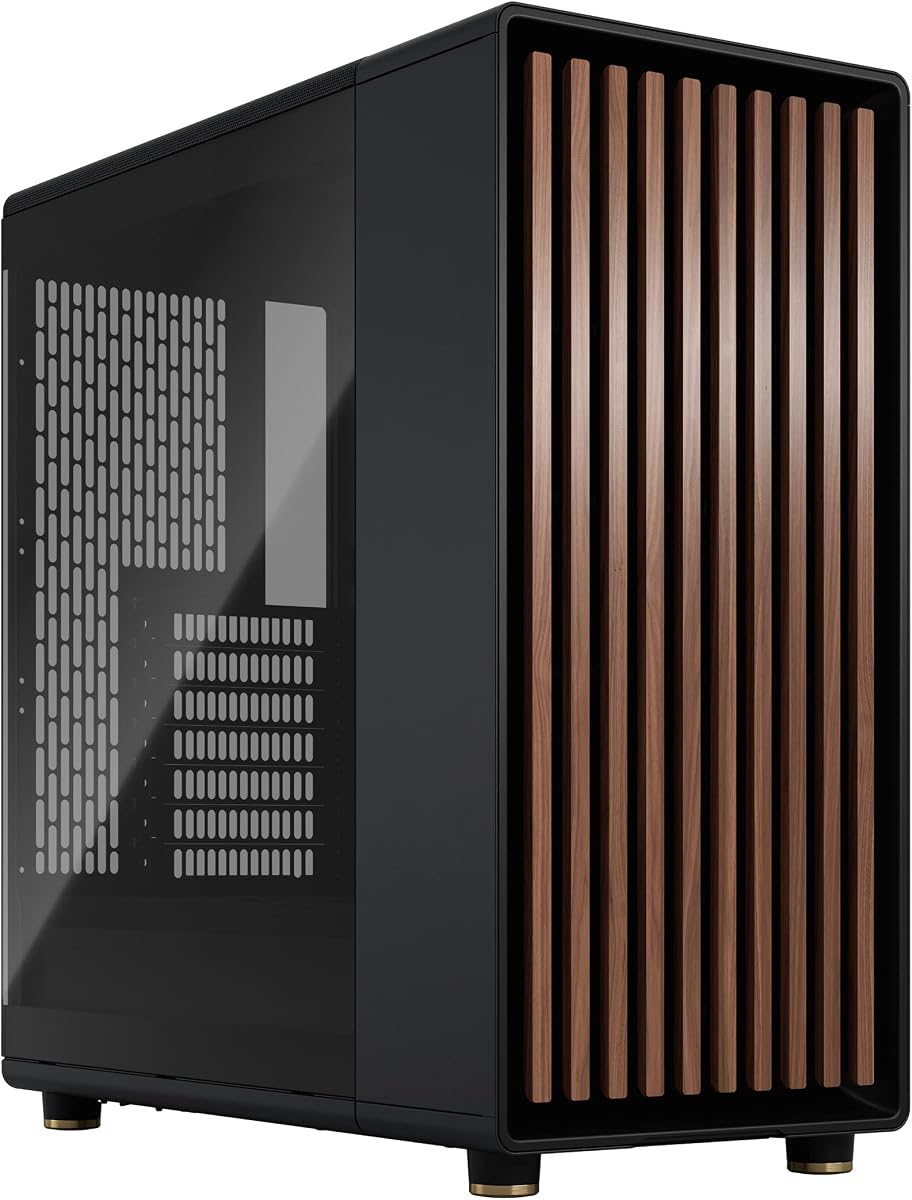
The Fractal Design North brings a distinctive natural-material design to an ATX airflow mid-tower, with a walnut front, alloy detailing, and a clear tempered glass side panel. It carries a 4.7 rating and includes two 140mm Aspect PWM fans. The open front and integrated mesh provide ventilation, while the front Type-C USB connection gives the case a practical answer for modern peripheral charging.
We may earn a commission when you buy through this link, at no additional cost to you.
The case supports ATX, Micro-ATX, and Mini-ITX motherboards, along with graphics cards up to 355mm. If a 360mm radiator is placed at the front, the stated GPU allowance falls to 300mm, so builders using a long card should account for that tradeoff. Seven bridgeless expansion slots provide room for multiple add-in cards, and the removable side panels, top panel, and front assembly improve access during assembly and maintenance.
Storage provisions are sensible for a mid-tower. The North comes with two combined 3.5-inch and 2.5-inch drive mounts and two dedicated 2.5-inch mounts. This allows a mix of conventional hard drives and compact solid-state drives without immediately requiring a larger chassis. The natural front bars are described as sustainably sourced oak or walnut, giving the enclosure an appearance that stands apart from the category's usual industrial styling.
The North is best for a builder who wants front USB-C, a distinctive display piece, and an open design that does not sacrifice ventilation. It is particularly suitable for a calm office, studio, or living-room gaming setup. Verify the front Type-C port and current accessory bundle in the listing, and compare the radiator-dependent GPU limit with the length of your graphics card before ordering.
Real wood and restrained alloy details create a warmer appearance than a conventional metal gaming case. The clear tempered glass preserves visibility of the components while allowing the front to remain a strong visual feature.
The open front and integrated mesh encourage airflow without requiring a fully sealed exterior. A 355mm GPU allowance is useful by default, although installing a 360mm front radiator changes that figure to 300mm.
We may earn a commission when you buy through this link, at no additional cost to you.
The MOROVOL 621-N4 is a straightforward ATX gaming enclosure built around four preinstalled 120mm RGB fans, a diamond-shaped mesh front, and a removable tempered glass side panel. Its 4.2 customer rating is the lowest in this selection, but the supplied specification demonstrates a capable cooling and storage layout for a conventional mid-tower build.
We may earn a commission when you buy through this link, at no additional cost to you.
The included fans use fixed RGB lighting rather than addressable control. That distinction matters for buyers who want synchronized colors that react to games, music, or motherboard software. The mesh front is shaped as a stereo contour intended to support strong airflow, and the tempered glass panel offers a clear view of the installed components while improving access during the build.
Compatibility covers ATX, Micro-ATX, and Mini-ITX motherboards. The case supports graphics cards up to 300mm, power supplies up to 160mm, and CPU coolers up to 155mm. Storage consists of two 2.5-inch SSD positions and two 3.5-inch hard-drive positions. These are useful figures, although they are more modest than the long-GPU and multi-drive capacities available in several competing models.
Most importantly for this guide, the supplied I/O list includes one USB 3.0 port, two USB 2.0 ports, HD audio and microphone connections, a reset button, and a power button, but no USB Type-C. The 621-N4 should therefore not be chosen on the assumption that it offers front USB-C. It remains a sensible enclosure for builders who prioritize four included fans, a ventilated exterior, and a conventional component layout without needing the newest connector standard.
Preinstalling four 120mm case fans reduces the number of extra parts a builder must purchase at the outset. The fan arrangement can create intake and exhaust paths around a standard ATX motherboard and a mid-range graphics card.
The listed panel centers on USB-A, audio, power, and reset connections. It is straightforward to use, but buyers who require a front Type-C socket should choose an enclosure that explicitly documents that port.
We may earn a commission when you buy through this link, at no additional cost to you.
The Lian Li V100-ATX is a clean, white mid-tower with a 4.8 customer rating and a strong set of convenience features. Four PWM-controlled 120mm ARGB fans come preinstalled, and an integrated 26-LED ARGB strip adds synchronized lighting. The case also supports ATX, Micro-ATX, Mini-ITX, and qualifying back-connect ATX or Micro-ATX motherboards.
We may earn a commission when you buy through this link, at no additional cost to you.
Practical access is a major strength. Both side panels use a tool-less mounting mechanism, making it easier to reach the interior during assembly or later upgrades. That matters in a system with several preinstalled fans and a modular cable layout, because the builder can inspect connections without searching for a screwdriver or disturbing components unnecessarily.
The hardware allowances are generous. The V100 supports graphics cards up to 420mm, CPU coolers up to 178mm, and a top radiator up to 360mm. Its fans run at up to 1800 RPM, with listed airflow ranging from 60.4 to 61.47 CFM, pressure from 2.17 to 2.54 mm-H2O, and noise from 26.5 to 30.8 dBA. Hydraulic bearings and daisy-chain connectivity help simplify the wiring process.
The supplied information does not explicitly list a front USB Type-C port, so this case is not automatically a confirmed answer to that narrower requirement. It is an excellent choice for a builder who values easy access, coordinated lighting, and component clearance, especially in a white-themed system. Confirm the latest I/O layout and included accessories before purchase if front USB-C is non-negotiable.
Tool-less side panels are useful during the initial assembly and any later component changes. Removing a panel without a tool reduces friction when checking a connection or repositioning a cable.
Four included ARGB fans eliminate much of the initial fan installation work, while the integrated LED strip creates a coordinated illuminated appearance. Daisy-chain connectivity also reduces the number of separate fan cables that need to be routed.
We may earn a commission when you buy through this link, at no additional cost to you.
The ASUS ProArt PA602 is a premium E-ATX full-tower aimed at workstations, creator systems, and builders who want more space than a conventional mid-tower can offer. Its 4.7 rating reflects a favorable customer response, while the supplied specifications highlight a 20Gbps USB Type-C port, large cooling capacity, and flexible mounting for a robust graphics card.
We may earn a commission when you buy through this link, at no additional cost to you.
The PA602's airflow design goes beyond adding a perforated front. A 15.5mm front grille with 45% porosity, two extra-thick 200 by 38mm front fans, and a 140mm rear exhaust fan form a high-flow path. Two internal deflectors direct incoming air toward the motherboard and other components, while a built-in fan hub centralizes management. The front dust indicator adds a practical reminder to clean the filter before efficiency declines.
Its full-tower format creates room for a 420mm radiator in either an AIO or a custom liquid-cooling loop. The case also accommodates robust graphics cards and supports horizontal or vertical mounting. A Power Lock Latch and two-section PWM control are designed to make the enclosure easier to manage during installation and operation, particularly when several fans or a complex cooling system are involved.
This is the best premium choice for a creator or enthusiast who needs E-ATX support, abundant internal space, and a high-bandwidth Type-C connection. The full-tower proportions are less attractive for a compact workstation, and the deeper case may require more desk area than a mid-tower. If the application can take advantage of its scale, the PA602 combines connectivity, cooling, and professional flexibility exceptionally well.
The listed USB Type-C 20Gbps interface is suited to modern phones, portable storage, and other compatible peripherals that benefit from faster transfer speeds. It is a meaningful upgrade over basic USB-A-only panels.
E-ATX support, a 420mm radiator, and flexible graphics-card positioning make the PA602 appropriate for substantial professional components. The internal air deflectors help maintain a directed path through the larger enclosure.
We may earn a commission when you buy through this link, at no additional cost to you.
The NZXT H5 Flow is a compact ATX mid-tower built around clean presentation, effective airflow, and a practical size. It holds a 4.7 customer rating and includes two 120mm Quiet Airflow fans, one at the front and one at the rear. Those fans provide an immediate airflow foundation while leaving room for the builder to expand the configuration.
We may earn a commission when you buy through this link, at no additional cost to you.
Cooling support is more generous than the case's compact appearance may initially suggest. It accepts a 360mm radiator at the front and a 240mm radiator at the top, allowing either an aggressive liquid-cooling layout or a combination of large and smaller cooling positions. Ultra-fine mesh on the top, front, and side panels supports airflow and helps filter dust while preserving a clean exterior.
The power-supply shroud is perforated on both the side and bottom. This allows two optional 120mm fans to draw air toward the PSU, though those fans are not included. Wide routing channels, hooks, and straps provide dedicated cable-management support, reducing the chance that data or power cables obstruct the visible interior.
The supplied listing does not explicitly state whether the H5 Flow includes a front USB Type-C port, so that detail should be confirmed for the current model. Even so, the case is a strong option for anyone who values a compact footprint, modern radiator support, and a tidy visual result. It is particularly suitable for a gaming system that does not require the enormous component allowance of a full-tower.
Support for a front 360mm and top 240mm radiator gives the H5 Flow serious liquid-cooling potential. This makes it possible to create an effective cooling layout without moving to a much larger chassis.
Wide channels, hooks, and straps use otherwise unused space around the motherboard tray. The result is easier routing in a compact enclosure, which can improve both appearance and the practical process of closing the side panels.
We may earn a commission when you buy through this link, at no additional cost to you.
The Cooler Master QUBE 540 is a flexible ATX mid-tower with a 4.4 customer rating and a clearly listed front USB Type-C connection. The I/O panel includes two USB 3.2 Gen1 ports and a USB 3.2 Gen2 Type-C port, giving buyers a modern port arrangement they can identify before purchasing.
We may earn a commission when you buy through this link, at no additional cost to you.
Its defining feature is orientation flexibility. The enclosure can operate in horizontal or vertical positions, with a reversible I/O panel and movable handles that support different layouts. The front uses a full mesh panel for ventilation and comes with one preinstalled SickleFlow 120mm fan. This design may suit builders who want to change the visual direction of a setup or place the system differently on a desk.
The QUBE 540 supports ITX, ATX, and large E-ATX motherboards up to 11 inches wide, despite retaining an ATX mid-tower format. Graphics-card clearance reaches 415mm without the front fan, allowing full-size cards such as the RTX 5090 and RX 9070 XT. That does mean the included front fan may need to be repositioned or removed for the longest cards, depending on the final cooling arrangement.
The QUBE 540 is best for a builder who values the rare combination of a documented Type-C interface, flexible motherboard support, and a case that can be arranged in more than one way. Its full mesh front and large GPU allowance are also compelling. Confirm that the reversible orientation and fan positions suit your desk and cooling plan, since those same flexible features require a little more thought during assembly.
The USB 3.2 Gen2 Type-C port offers a current connection in a convenient front location. Two additional USB 3.2 Gen1 ports provide compatibility with the accessories and peripherals commonly used by desktop builders.
A reversible I/O panel and movable handles allow the enclosure to work in horizontal or vertical positions. This makes the QUBE 540 adaptable to different workspaces, although builders should plan the final fan and cable arrangement before installation.
We may earn a commission when you buy through this link, at no additional cost to you.
Choose a PC case with front USB C by balancing connector placement, motherboard support, graphics-card clearance, cooling capacity, drive storage, and the size of your workspace. The most important step is to confirm that the enclosure actually places USB Type-C where you expect it.
A product may describe itself as Type-C ready, include Type-C on a side panel, or place the connector in a removable I/O module rather than at the front. Check the port location, USB generation, and whether the cable or controller is included. A front-facing socket is ideal for quick phone charging and device connections without reaching around the case, while a side-mounted port may be equally accessible on a desk.
Confirm that the case accepts your motherboard's exact form factor. Most mid-towers support ATX, Micro-ATX, and Mini-ITX boards, but full-size E-ATX support is less universal. Back-connect motherboards can simplify cable routing, although they may require a compatible case and exact board dimensions. Always compare the board outline, rear I/O arrangement, and mounting requirements before ordering.
Graphics cards vary greatly in length, thickness, and power-cable requirements. Some cases support 420mm cards, while others reach only 300mm and reduce that figure when a large front radiator is installed. CPU coolers also need vertical clearance, and modular power supplies require enough room behind the tray. Include room for cable bends rather than comparing only the bare component dimensions.
Look at both radiator support and included fans. Cases with 360mm radiator provision can accept large liquid-cooling radiators, while 240mm and 280mm options may be more realistic for compact builds. Confirm the number and position of fan mounts, whether a front fan reduces GPU clearance, and whether the manufacturer includes the fans needed for a balanced airflow path.
An open mesh front, perforated panels, and directed internal deflectors can improve how air reaches the motherboard and graphics card. Removable or magnetic dust filters make routine cleaning easier, especially in a system with several intake fans. A front dust indicator is a helpful extra, but it does not replace the need to inspect and clean filters regularly.
Determine how many 2.5-inch and 3.5-inch drives you need, not just how many the listing claims. Some cases offer dedicated SSD mounts, while others use combined trays that reduce flexibility. A design that stores drives behind the motherboard tray may sacrifice fan mounting, so check whether the drive layout and cooling plan can coexist in the same chassis.
A full-tower offers more room for long graphics cards, extensive cooling, and multiple drives, but it demands more desk space. A compact mid-tower can be easier to position beside a monitor and may suit a smaller workspace. Consider side-panel access, cable-routing space, front I/O reach, and whether the case's orientation fits the location where it will remain.
Tool-less side panels, reinforced edges, dedicated cable channels, and support brackets can make assembly and maintenance easier. A tempered glass panel is useful for visual builds, but a more service-oriented system may benefit more from removable panels, ample space behind the motherboard tray, and an easy way to reach the front fans and radiator.
Before installing components, compare every part with the case's compatibility chart. Install the motherboard and power supply first, connect the rear-panel cables, and then attach the front USB Type-C header to the correct motherboard connector. Confirm that the header and case-side port use matching USB standards, and never force a connector that does not fit.
After the build is complete, connect compatible devices to the front Type-C port and verify data transfer as well as charging. If the port is not detected, check the internal USB-C header, motherboard BIOS or operating-system settings, and any adapter used by the peripheral. Keep the front connector unobstructed and avoid sharply bending the internal cable where it passes behind the motherboard tray.
Maintain the case by cleaning removable dust filters and checking airflow every few months. Use soft brushes or compressed air held at a safe distance from fans, and power the system down before working inside it. Route cables through the dedicated channels, avoid blocking intake or exhaust openings, and check that a newly installed front fan or radiator does not reduce graphics-card clearance.
A Type-C-ready case may only provide a mounting point, cable, or internal header for Type-C connectivity. A case with a front USB Type-C port exposes a working socket on its exterior and connects to a compatible header on the motherboard. Buyers who require plug-and-play front access should verify the actual port in the current product images, manual, or manufacturer specification.
No. Front Type-C connections may support different USB generations and maximum data rates from one another. The Okinos Cypress 7 lists USB-C 3.2 Gen 2, while the ASUS ProArt PA602 lists USB Type-C 20Gbps, and the Cooler Master QUBE 540 lists USB 3.2 Gen2. Check the port rating and the motherboard header requirements together.
No, although several models support a 360mm radiator in a specific location. The DARKROCK EC2 supports one at the front, the Fractal Design North supports it at the front with a reduced GPU length allowance, and the ASUS ProArt PA602 supports one 420mm radiator. The Lian Li Vector V100 and Lian Li V100-ATX support a 360mm top radiator, while the NZXT H5 Flow supports a 360mm front unit.
Choose at least as much clearance as the manufacturer's stated GPU length, plus enough room for the power connector and cable bend. Cases in this group support figures ranging from 300mm to 420mm. Be aware that some front radiators or fan arrangements reduce the available GPU clearance even when the case advertises a larger base figure.
That depends on the components and cooling strategy. Cases with three or four preinstalled fans provide a strong starting point, while a case with one included fan may require additional intake and exhaust units. A front radiator also needs compatible fans, and a balanced setup should move cool air toward the CPU and graphics card while allowing warm air to exit.
An ATX mid-tower is usually easier to fit on a desk and works with the majority of standard gaming components. A full-tower is preferable for very long graphics cards, E-ATX motherboards, extensive storage, or large custom cooling loops. The ASUS ProArt PA602 provides the largest format in this selection, while the DARKROCK EC2 and Fractal Design North illustrate more compact ATX options.
Confirm that every power, data, fan, and front I/O connector is fully seated, and verify that no cable passes through a fan or interferes with a radiator. Check GPU seating, motherboard standoffs, and the position of the power-supply cables behind the tray. Leave enough slack for the side panel to close without pressing on a connector or sharply flexing a wire.
Yes, occasional cleaning can prevent dust and lint from affecting a connector. Power the computer off, unplug it, and use a soft dry brush or a lightly pressurized air source without forcing debris deeper into the case. Avoid metal tools and do not insert objects that could damage the connector's internal contacts.
The strongest all-around recommendation is the Okinos Cypress 7 because it combines a clearly documented USB-C 3.2 Gen 2 connection, genuine walnut styling, four included PWM fans, and generous storage support. The Lian Li V100-ATX is a compelling budget-oriented option for builders who prioritize tool-less access, ARGB lighting, and room for long graphics cards, while the ASUS ProArt PA602 stands apart as the premium choice for E-ATX systems and extensive cooling hardware.
Prioritize port placement, component clearance, and airflow over appearance alone. Verify whether USB-C is truly front-facing, measure your graphics card and CPU cooler, and check how radiator placement changes usable space. Cases such as the Fractal Design North and Cooler Master QUBE 540 offer clearly documented Type-C in more conventional mid-tower formats, while the DARKROCK EC2 remains appealing for cooling flexibility but needs closer port verification.
Finally, confirm the current product configuration and included accessories before purchasing because case revisions and bundles can change. Customer ratings provide useful context, but the compatibility sheet and port layout should make the final decision. Checking the live listing will help ensure that the enclosure supports your motherboard, cooling plan, and required front connection.