
Mini USB Aquarium Air Pump
4.6Editor score
Only 3.4 ounces
One-watt USB power
Includes air stone and tube
Discover the best portable air pump for aquarium setups by comparing airflow, runtime, noise, power options, portability, and tank capacity.
A portable air pump for aquarium can provide essential oxygenation during power failures, fishing trips, tank maintenance, and fish transportation. The right model should balance usable airflow, quiet operation, dependable power options, and a body that is easy to carry. Battery-powered and rechargeable designs are especially useful when a standard outlet is unavailable.
The products in this guide were compared using the specifications and feature details provided for each model. The comparison covers maximum airflow, pressure, supported tank capacity, battery or outlet power, runtime, noise level, flow controls, water resistance, outlet count, and included accessories. This makes it easier to identify the best portable air pump for aquarium use at home or outdoors.
Each review highlights the strongest use case, practical limitations, and the reasons a product may or may not fit a particular setup. The shortlist includes compact fishing aerators, quiet rechargeable models, and higher-output pumps for larger aquariums. Product specifications and availability can change, and prices should be checked on the linked retailer page before buying.
4.6Editor score

5.0Editor score

4.6Editor score
The table below compares airflow, power architecture, operating range, and key portability features across all ten pumps, helping readers distinguish compact fishing aerators from capable home and emergency systems.


The fishkeeper battery-powered aquarium air pump offers an ambitious combination of portability and output, earning a 4.5 rating. Its maximum airflow of 80 GPH, 0.02 MPa pressure, and stated compatibility with tanks from 5 to 125 gallons make it a flexible choice for freshwater or saltwater systems. It also functions as a fishing and emergency oxygen pump.
We may earn a commission when you buy through this link, at no additional cost to you.
The most valuable feature is automatic AC/DC switching. When connected to AC power, it behaves like a conventional aquarium pump; if the supply fails, it switches to its built-in 2600mAh lithium battery. Four flow levels allow the output to be tailored to the setup, while continuous and intermittent modes provide different runtime priorities. The stated runtime is 16–30 hours in continuous mode and 31–58 hours in intermittent mode.
Noise reduction is addressed through magnetic levitation technology, a high-precision copper motor, an ABS shell, and anti-slip damping feet. IP64 waterproofing adds reassurance around a damp tank, although the device should still be positioned carefully and protected from submersion. Some ambiguity remains about how tank-capacity figures relate to actual stocking, flow, and pressure, so the pump should be matched to the aquarium’s real oxygen requirements.
This is a strong choice for fishkeepers who want meaningful battery backup without carrying a separate emergency pump. It works particularly well for medium and large tanks, travel, and power outages. Buyers who need two independently controlled outlets or a very compact body may prefer another model, but this fishkeeper pump delivers the broadest balance of output, adjustability, and protection.
Four selectable levels make it possible to reduce airflow when the aquarium does not need maximum circulation. Intermittent operation can also extend battery life while maintaining a recurring bubble pattern.
Automatic transition from AC to battery operation reduces the need to intervene when household power fails. The rechargeable battery makes the unit useful both as a regular pump and as a standby oxygen source.
We may earn a commission when you buy through this link, at no additional cost to you.
The fishkeeper rechargeable aquarium air pump is a smaller-capacity companion to the 80 GPH model, carrying a 4.5 rating. It provides up to 30 GPH of airflow at 0.02 MPa and is listed for aquariums from 0 to 60 gallons. That makes it most appropriate for smaller tanks, bait containers, and portable applications where low power draw and simplicity matter.
We may earn a commission when you buy through this link, at no additional cost to you.
Its 2 W power consumption and 2200mAh lithium battery support stated runtimes of 40–45 hours in continuous mode and 70–80 hours in intermittent mode. Four flow levels, a control button, automatic AC/DC switching, and an included USB charging cable provide a versatile control package. Magnetic levitation, a copper motor, sound-insulating ABS housing, and damping feet are all intended to limit vibration and noise.
The main limitation is output. At 30 GPH, it does not offer the headroom of higher-capacity models, particularly for heavily stocked tanks or demanding marine systems. The tank-capacity range is also broad, and actual aeration depends on water volume, livestock, temperature, and the selected air stone. Users who need to know remaining battery charge at a glance may find the button-based controls less informative than a digital percentage display.
Despite those limits, this is a practical rechargeable option for small aquariums and emergency kits. It is especially attractive for someone who values compactness, long stated intermittent runtime, and automatic backup behavior over maximum airflow. It also fits fishing and transportation uses where a modest oxygen supply is sufficient.
The two-watt power rating and relatively small battery make this model less demanding than higher-output alternatives. It is a sensible fit for compact tanks and places where long, intermittent operation is more important than maximum aeration.
The control button provides four airflow choices without requiring a separate controller. This keeps operation approachable while allowing the user to match bubbling more closely to changing aquarium conditions.
We may earn a commission when you buy through this link, at no additional cost to you.
The Pawfly Aquarium Air Pump is a straightforward portable aerator with a 4.5 rating. It delivers up to 40 GPH at pressure of at least 0.012 MPa and is intended for tanks and buckets ranging from 5 to 30 gallons. The battery format, compact dimensions of 5.6 by 3.1 by 1.6 inches, and included clip make it convenient for mobile use.
We may earn a commission when you buy through this link, at no additional cost to you.
Two D batteries power the pump, avoiding the need to wait for a recharge or remain near an outlet. A small air stone and two-foot airline tube are stored inside the pump body, which is a thoughtful way to keep a basic aeration kit together. Its noise is listed below 45 dB, which is quieter than many portable devices but not as quiet as the sub-30 dB rechargeable models in this guide.
The absence of a rechargeable battery means replacement batteries are required when the installed cells are depleted. There is also no digital battery gauge, adjustable airflow, or automatic AC/DC transition. Although the stated maximum output is suitable for a range of small tanks, the product provides less flexibility for owners who want to fine-tune oxygenation or monitor battery condition.
Pawfly is best for anglers, live-bait keepers, and fishkeepers who want simple battery-powered aeration in a small package. It is particularly helpful for transport, buckets, and tanks up to the stated 30-gallon range. A rechargeable model may be more convenient for frequent indoor use, but this pump is simple, portable, and ready to operate with widely available batteries.
Keeping the air stone and airline tube inside the housing reduces the chance of leaving essential components behind. That makes the pump easier to pack for fishing or transport.
The metal clip can secure the pump to a bucket, tank edge, or other convenient surface. This hands-free attachment is useful when space and stability are both important.
We may earn a commission when you buy through this link, at no additional cost to you.
The hygger battery-powered aquarium air pump with digital display earned a 4.8 rating and stands out for its combination of information, quietness, and portability. It produces up to 30 GPH at 20 KPa and is intended for freshwater and saltwater tanks up to 60 gallons. The digital battery screen is a meaningful upgrade because it shows an exact percentage instead of relying on vague indicator lights.
We may earn a commission when you buy through this link, at no additional cost to you.
Four airflow levels and continuous or intermittent modes allow the output to suit different oxygen needs. A 2200mAh rechargeable battery provides stated runtimes of up to 53 hours continuously and 96 hours intermittently. AC/DC auto-switching preserves aeration when household power fails. The built-in cable slot stores the USB cord neatly, while the pump’s IPX4 water resistance helps protect against splashes.
Its listed noise level below 30 dB is especially suitable for bedrooms and living spaces, and the vibration-reducing design supports that claim. The 30 GPH maximum airflow remains the chief limitation, so heavily stocked or large aquariums may need a stronger unit. Light rain and splashes should also be distinguished from full waterproofing; the pump should be kept from direct exposure and never submerged.
This is a particularly well-balanced choice for a small or medium aquarium that needs quiet operation and a visible charge level. It is also useful for bait buckets, fishing, and emergency preparation. Buyers prioritizing the absolute smallest body may prefer the mini USB model, while those needing high output can choose the larger hygger models.
The digital percentage display makes it easier to judge whether the pump needs charging before a trip or emergency. This visibility is particularly useful for users who do not want to wait for a vague low-battery warning.
A stated operating level below 30 dB makes this model more appropriate for bedrooms and quiet living areas. Its compact, vibration-reducing design supports consistent everyday aeration.
We may earn a commission when you buy through this link, at no additional cost to you.
The hygger battery-powered air pump for tanks up to 150 gallons carries a 4.9 rating and centers on a large rechargeable battery. Its 4800mAh capacity supports stated runtimes of 30 hours in continuous mode and 78 hours in intermittent mode. A digital display shows the battery percentage, while automatic AC/DC switching helps maintain aeration during an outage.
We may earn a commission when you buy through this link, at no additional cost to you.
The pump offers continuous and intermittent operation and remains under 30 dB according to the supplied information. A vibration-reducing construction supports quiet daily use. IPX4 water resistance and a compact body make it practical for indoor aquariums, bait buckets, and outdoor scenarios where occasional splashes may occur.
Although the product is listed for aquariums up to 150 gallons, the supplied description does not state a maximum GPH airflow or pressure value. That makes direct output comparison with several competing models less precise. The large tank-capacity claim should therefore be considered alongside livestock density, water conditions, and the oxygenation needs of the system rather than treated as a guarantee of performance.
This model is best for users who want long battery endurance, quiet operation, and a clearly visible charge level in a relatively portable package. It is particularly compelling for emergency planning, where extended intermittent runtime may be more valuable than maximum continuous output. Buyers who need a known airflow figure or dual outlets should verify those details before choosing.
The 4800mAh battery is the defining advantage of this model. Its stated 78-hour intermittent runtime gives it substantial endurance for extended outages, fishing days, or transport where regular charging is difficult.
The percentage display eliminates uncertainty when checking remaining power. That makes it easier to decide when to recharge and reduces the chance of discovering a depleted battery only after an emergency.
We may earn a commission when you buy through this link, at no additional cost to you.
The hygger battery-powered aquarium air pump for 10- to 120-gallon tanks delivers up to 64 GPH at 22 KPa with a four-watt motor. Its 4.1 rating is the lowest in this group, but the specifications reveal a capable general-purpose pump with six airflow levels, continuous and intermittent modes, and a large 4800mAh battery.
We may earn a commission when you buy through this link, at no additional cost to you.
The stated runtime is 12–37 hours in continuous mode and 25–79 hours in intermittent mode. AC/DC automatic switching allows the pump to serve as a regular outlet-powered unit and then take over during a power failure. Its stated operating noise is below 35 dB, supported by a copper motor, four anti-vibration feet, and a thickened soundproof casing.
The complete kit is a meaningful advantage. It includes two air stones, two check valves, two five-foot tubes, a Y connector, a charger, and a USB-C cable. IPX4 water resistance is suitable for splashes and light rain but not heavy rain. The metal clip helps position the pump on most bait buckets. A battery gauge is not mentioned, so monitoring remaining power may be less precise than with digital-display models.
This pump is a good fit for fishkeepers who want more control than a four-level model and a full set of aeration accessories. It is suitable for larger home tanks, buckets, fishing, and emergency use. Its lower aggregate rating should prompt buyers to consider recent customer feedback, but the published feature set is broad and practical.
Two stones, check valves, tubes, a Y connector, and charging cables provide the basic components needed for a multi-point setup. This reduces the need to purchase accessories separately.
Six levels provide more granular adjustment than most competing portable pumps. Users can tune output for oxygenation, circulation, bait keeping, and changing livestock conditions.
We may earn a commission when you buy through this link, at no additional cost to you.
The Mini USB Aquarium Air Pump is built for portability, earning a 4.6 rating despite its very compact construction. It measures 2.56 inches long and weighs 3.4 ounces, making it easy to place in a pocket or backpack. Its one-watt motor produces a maximum airflow of 210 liters per hour, and the included air stone and silicone tube create a ready-to-use aeration arrangement.
We may earn a commission when you buy through this link, at no additional cost to you.
Because it draws power through USB, it can run from a compatible power bank or other USB supply. The product description states that a 10000mAh power bank can support approximately 50 hours of continuous use. This makes it highly flexible for travel, fishing, fish transportation, sales, small aquariums, and small ponds where a built-in battery would add unnecessary bulk.
Its output is modest compared with the larger portable aquarium pumps, and there is no built-in battery, AC/DC switching, or digital power gauge. The stated durability and low-noise benefits come from a ceramic motor and palladium component, while a soft silicone outer shell improves grip and resists slipping. It is not described as waterproof, so it must remain dry.
This is the strongest option for users who value size above everything else. It is ideal for carrying in a tackle bag, aerating live bait during transport, or providing modest circulation in a small aquarium. A larger aquarium or emergency application calls for a self-contained pump with more airflow and a rechargeable battery.
At 3.4 ounces and 2.56 inches long, the pump avoids the bulk of conventional battery aerators. Its aluminum clip also allows attachment to a backpack, belt, or tank edge.
Using a separate USB source lets the user choose the capacity and weight of the power bank. This is efficient for travel because one power bank can serve multiple devices and the pump itself does not need to carry an integrated cell.
We may earn a commission when you buy through this link, at no additional cost to you.
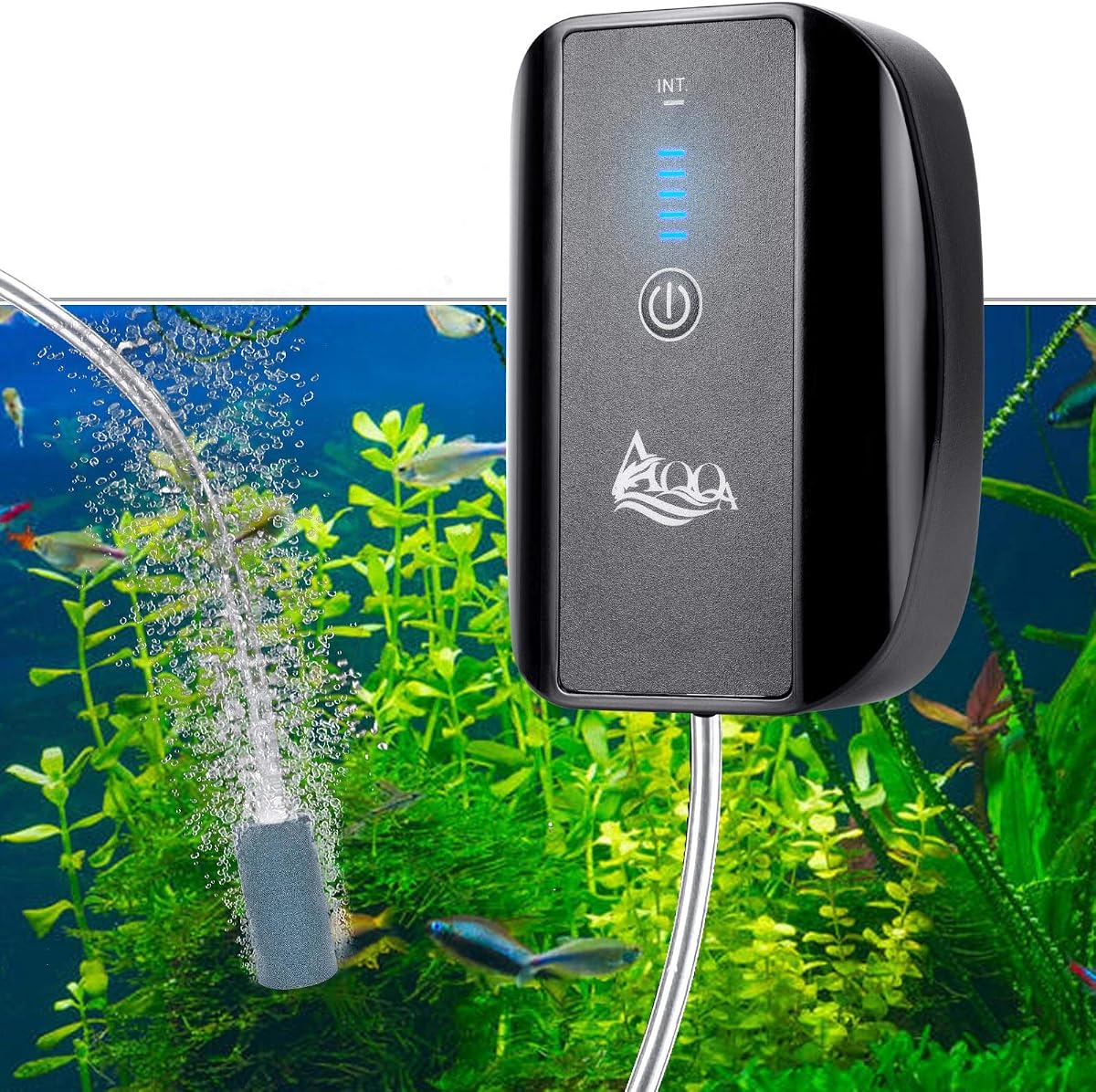
The AQQA aquarium air pump is a compact rechargeable option with a 4.4 rating. Its 2600mAh lithium battery provides approximately 14–18 hours of continuous operation or 25–28 hours in intermittent mode. The pump can run from an external power source during normal use and automatically activates its battery during an outage.
We may earn a commission when you buy through this link, at no additional cost to you.
A blue LED display communicates the active operating mode and a five-level battery indicator. Normal mode provides continuous bubbles, while intermittent mode runs for 10 seconds and pauses for 10 seconds. The pump supports one or dual outlets, and the included air stone and airline tubing can promote bubble formation, water movement, and oxygen exchange.
Noise is listed at up to 30 dB, with a magnetic drive system and vibration-reducing rubber pads supporting quiet operation. The main distinction from digital-display models is the five-level indicator rather than an exact percentage. Exact power monitoring is more informative, but the AQQA display still makes it easier to identify low battery and active mode without opening an app or relying on color changes alone.
This is a versatile indoor and travel pump with useful emergency behavior and dual-outlet support. It suits fish transportation, fishing, freshwater tanks, and marine aquariums that do not require maximum output. Those wanting the smallest possible size, the highest airflow, or a precise battery percentage should consider the mini or higher-output hygger alternatives.
The dual-outlet arrangement allows air to be directed toward more than one area of an aquarium or container. It is useful when a single stone cannot provide adequate circulation throughout the setup.
The blue LED system clearly identifies whether the pump is operating normally or intermittently. A separate five-level indicator gives a quick sense of remaining battery charge before recharging is necessary.
We may earn a commission when you buy through this link, at no additional cost to you.
The hygger battery backup aquarium air pump delivers the highest stated maximum airflow in this guide, reaching up to 254 GPH with a 10-watt motor. It has a 4.6 rating and is designed for freshwater or marine tanks up to 120 gallons. Its dual outlets can aerate multiple locations, which is a major advantage for larger systems.
We may earn a commission when you buy through this link, at no additional cost to you.
Two 5000mAh rechargeable lithium batteries provide 20 hours of continuous oxygen at maximum airflow. The pump automatically changes from AC to battery power when household electricity fails. Its smart digital display reports real-time airflow, and touch-sensitive buttons allow users to adjust output. Continuous, intermittent, and feeding modes cover regular aeration, periodic operation, and temporary pauses while fish are being fed.
Noise reduction is achieved with shock-absorbing rubber pads and a thick ABS shell, while the maximum operating frequency is listed as 35 dB. It is not waterproof, so outdoor use requires protection from rain. Its size and power requirements also make it less convenient for backpack-based fishing than the compact models, even though it can still serve as a portable bait aerator.
This is the premium choice for owners of larger aquariums who need substantial airflow and multiple outlets. It is particularly appropriate for fishkeepers who want battery backup with practical control features, including a feeding mode that can pause circulation. Users seeking a lightweight travel pump should choose a smaller model instead.
Separate outlets can send air to different sections of a large aquarium or to two containers. The included air stones and tubes support immediate multi-point aeration.
Feeding mode temporarily pauses bubbles and then returns to the original setting after a user-defined interval. This adds convenience for routine aquarium care without requiring constant manual control.
We may earn a commission when you buy through this link, at no additional cost to you.
The hygger battery-powered air pump for tanks up to 100 gallons combines a 5.0 rating with a balanced set of specifications. It produces up to 64 GPH at 22 KPa using a five-watt motor, offers four airflow levels, and supports both continuous and intermittent modes. Its 3500mAh rechargeable battery provides stated runtimes of 21 hours continuous and 46 hours intermittent.
We may earn a commission when you buy through this link, at no additional cost to you.
A digital screen displays the exact battery percentage, giving users better information than a simple light-based indicator. AC/DC auto-switching keeps aeration going when power fails, and the built-in cable slot helps keep the USB cord organized or positioned for hanging. The pump is compact and has an IPX4 rating for water resistance, although it should not be exposed to heavy rain or submerged.
The listed noise level below 30 dB makes it appropriate for quiet rooms, and the vibration-reducing design supports smooth daily operation. The primary tradeoff is that only one pump outlet is identified, so users needing multiple independently aerated points should consider the dual-outlet hygger model. The 100-gallon capacity figure is a broad guideline and does not guarantee adequate output for every stocking level or marine environment.
This is the most balanced choice in the roundup for readers who want more power than a small-aquarium pump but do not need the highest output of a premium dual-outlet system. It works well as a regular aquarium aerator, travel companion, bait-bucket pump, and emergency backup. Its quiet operation, clear battery display, and automatic power switching cover the most important daily needs.
The combination of 64 GPH airflow, a 3500mAh battery, and two operating modes provides flexibility without moving into the size and power demands of the dual-outlet premium model.
The exact battery percentage makes maintenance more predictable than an approximate indicator. Users can recharge before leaving for travel or after returning from an outage without guessing the remaining capacity.
We may earn a commission when you buy through this link, at no additional cost to you.
The best portable air pump for aquarium balances airflow, safe positioning, usable runtime, quiet operation, and the type of power available at the intended location. Tank size alone should not determine the purchase because stocking levels, water temperature, and the need for backup power can be just as important.
Begin with the pump’s maximum airflow in gallons per hour or liters per hour, then consider the aquarium’s volume and livestock density. A larger number does not automatically guarantee a better pump, but it gives more room to select a lower flow level and still provide enough oxygen. Published tank-capacity ranges should be treated as general guidance because heavily stocked tanks, warm water, and marine systems may need more aeration than a lightly stocked freshwater aquarium.
Choose airflow that can meet the aquarium’s needs without forcing the pump to run continuously at maximum. For compact systems, the 30 to 40 GPH class may be sufficient. Medium and large tanks generally benefit from models rated around 64 GPH or higher, especially if two diffusion points are needed. The 254 GPH dual-outlet premium model is aimed at substantially larger setups and multi-point circulation.
Decide where the pump will be used before comparing battery formats. USB models are lightweight but require a power bank or other source. Models using replaceable D batteries are simple to deploy outdoors, while built-in rechargeable batteries eliminate recurring cell replacement. For household aquariums, automatic AC/DC switching is valuable because it allows the same pump to operate from an outlet and take over during an outage.
The most useful setup has a pump that functions as the normal aerator while connected to AC power, with its internal battery reserved for emergencies. For fishing and transportation, the priority may instead be low weight, simple operation, or the ability to choose a power-bank capacity. Check the charging connector and confirm whether a charging cable is included before purchase.
Runtime claims should be interpreted with the operating mode in mind. Continuous mode normally offers stronger and more consistent aeration but uses the battery faster. Intermittent mode cycles the pump on and off, extending runtime while still providing recurring oxygenation. A feeding mode can pause bubbles for a set period, which is useful in aquariums where fish may rise to the surface during feeding.
Stated runtimes can vary substantially with flow level, battery condition, and operating environment. For outages lasting several hours, a model with a large battery and long intermittent runtime may be sufficient. For daily backup operation, automatic switching and the ability to keep operating on AC power matter more than the headline runtime alone.
A pump that runs continuously in a bedroom or living area should have low noise and minimal vibration. Models operating below 30 dB are the quietest options identified here, while the Pawfly pump is listed below 45 dB and the premium dual-outlet model at a maximum of 35 dB. Specifications are not perfectly standardized, so the stated figures are best used as relative guidance.
Beyond the motor, vibration can travel through the tank cabinet and be transmitted through the airline tube. Look for magnetic drive, vibration-reducing pads, damping feet, and sound-isolating housings. Place the pump on a level surface and avoid positioning the air stone directly against glass or acrylic, since both poor mounting and hard surfaces can create additional clicking or humming.
Portable does not necessarily mean waterproof. IPX4-rated models are designed to resist splashes and light rain but should not be submerged or left in heavy rain. Other products in this roundup make no waterproof claim, so outdoor users need a dry location or protective enclosure. A metal clip can help secure a pump to a bucket or tank edge without leaving it in standing water.
Weight and dimensions matter for travel. The mini USB model weighs only 3.4 ounces and is 2.56 inches long, while higher-capacity models with larger batteries naturally take up more room. For fishing, prioritize a body that fits the available bag or bucket space. For an emergency kit kept near an aquarium, prioritize recharge state and battery capacity instead.
Adjustable airflow helps prevent unnecessary bubbling, excessive splashing, and needless power consumption. Four-level and six-level controls give different degrees of refinement, while a digital battery display provides more precise information than a basic indicator light. Touch controls and a clear screen can make routine monitoring easier, especially when the pump is used as a backup rather than attended continuously.
For a simple bait container, a fixed setting may be perfectly adequate. For a mixed aquarium, adjustable output is valuable because oxygen demand changes with temperature, stocking, circulation, and time of day. Consider whether you also value a display that shows battery percentage, operating mode, or airflow, because not every controller combines all three functions.
A single outlet can still provide effective aeration if the airline tube is arranged carefully, but dual outlets allow air to reach separate areas. Multi-point setups can improve circulation around rocks, planted areas, or compartments that would otherwise receive little moving water. Two stones, check valves, tubing, and a Y connector may also reduce the need for separate accessories.
Check whether the product includes an air stone, airline tube, check valves, charging cable, power adapter, clip, or connector. Batteries are sometimes excluded, as with the Pawfly model, while the fishkeeper rechargeable pumps include a USB charging cable. A complete kit is convenient, but it should not compensate for inadequate airflow for the intended tank.
Confirm that the pump is described as suitable for the relevant water type. Many models in this guide support both freshwater and saltwater aquariums, while their use with bait buckets, fish transport containers, and small ponds may depend on local water conditions and manufacturer instructions. Material compatibility also matters around air stones and airline tubing that sit continuously in water.
Aeration is only one part of a healthy aquarium. Circulation, filtration, water quality, temperature, and livestock behavior all affect oxygen availability. A portable pump should support the established filtration system rather than compensate indefinitely for poor water quality, overcrowding, or a lack of appropriate circulation.
Before using a portable aquarium air pump, read the supplied instructions and identify the correct power source. Install the required batteries, or fully charge the internal battery before relying on it for backup. For USB-powered models, use a dependable power bank and confirm that its output is compatible with the pump. Connect the airline tube to the outlet and secure the air stone away from the filter intake, where it could be drawn into the circulation system.
Position the pump on a stable, dry surface and use the clip or damping feet as intended. Select a flow level appropriate for the tank rather than automatically using maximum output. Continuous mode is suitable when steady aeration is required, while intermittent mode can conserve battery capacity. A feeding mode can pause bubbling temporarily, but the pump should be observed to ensure it resumes operation as intended.
For upkeep, disconnect power before changing the air stone or airline tube, and keep the intake opening clear of scale, debris, and moisture. Wipe the housing with a dry cloth rather than immersing it. Allow splash-exposed parts to dry before charging, inspect cables for damage, and recharge the battery regularly. During an outage, switch to the lowest suitable flow setting and conserve battery life until power returns.
Yes, if the model includes a rechargeable battery or other independent power source. Pumps with automatic AC/DC switching can run from household power under normal conditions and switch to their battery when the supply fails. Runtime varies by airflow, mode, battery condition, and model, so the pump should be charged before an expected outage.
The correct airflow depends on tank volume, water temperature, stocking density, circulation, and the amount of dissolved oxygen in the water. Published gallon ratings are useful only as general guidance. A heavily stocked or warm aquarium generally benefits from more circulation, while a lightly stocked tank may need only a modest flow and intermittent operation.
Several models in this guide are explicitly described as suitable for both freshwater and saltwater aquariums. Confirm the compatibility statement for the exact model before installation and use only the supplied or recommended tubing and air stone. Regular inspection is important because salt deposits and mineral buildup can affect performance over time.
A USB pump is usually lighter and can be paired with a power bank whose capacity the user chooses. A rechargeable aquarium pump is more self-contained and may automatically switch to battery power during an outage. The better choice depends on whether minimizing carried weight or having independent standby power matters more.
Yes. Several products are specifically listed for bait buckets, fishing trips, live bait, and fish transportation. A clip helps position the pump on a bucket, while a compact body is easier to carry. Keep non-water-resistant models protected from rain and submersion, and use an appropriate flow for the container and species.
Charge it fully before planned travel, an expected outage, or any period when it will serve as the only oxygen source. Periodic top-ups are also useful if the pump is stored near an aquarium as emergency equipment. Following the manufacturer’s charging and storage guidance helps preserve battery performance.
Common causes include a vibrating housing, a loose airline connection, a hard air stone touching the aquarium wall, and buildup around the air intake or internal mechanism. Check placement and tubing first, then clean the unit as directed. If abnormal noise continues, stop using it and consult the manufacturer’s support instructions.
Not always. Continuous mode provides steady bubbles, but intermittent mode can be appropriate for many aquariums and uses less battery. The correct schedule depends on the livestock, volume, temperature, and circulation. Owners should observe the aquarium and increase aeration if fish show signs of stress or low oxygen.
The hygger digital pump for tanks up to 100 gallons offers the strongest overall balance, combining 64 GPH airflow, four flow levels, an exact battery display, automatic AC/DC switching, and operation below 30 dB. The mini USB pump is the leading lightweight and budget-oriented option, while the hygger dual-outlet model is the premium choice for large aquariums that need powerful output and multiple aeration points.
Prioritize the features that match the actual use environment. Small-tank owners can focus on compactness, quiet operation, and simple controls; larger-tank owners should pay closer attention to maximum airflow, pressure, outlet count, and battery capacity. Anyone relying on an outage backup should choose automatic switching and verify the stated continuous and intermittent runtimes before the need arises.
Finally, check current specifications, included accessories, and prices on the linked retailer pages because product details and availability can change. Ensure the selected pump is compatible with the aquarium size, water type, and available power source, and keep it charged, dry, and ready before an outage or fishing trip.