
Mdbebbron 120 Inch Projector Screen
4.5Editor score
120-inch 16:9 viewing area
Double-sided projection support
Foldable washable polyester fabric
Our Projector Screen guide compares ten 120, 150, 80, and 100-inch models for home theaters, backyard movies, camping, presentations, travel, and easier setup.
A projector can deliver an impressive image, but the right projection surface determines how much of that quality you actually see. A good projector screen balances image size, viewing angle, surface tension, portability, stability, and the space available for setup, whether that means a living room, backyard, campsite, classroom, or meeting room.
We compared ten projector screens using the specifications and features supplied for each product. The list covers hanging fabric, pull-down models, and freestanding screens in 80-inch, 100-inch, 120-inch, and 150-inch sizes, with attention to aspect ratio, material, included hardware, folding or rolling design, front and rear projection support, and outdoor practicality.
Each review explains where the screen is strongest, where compromises may appear, and who is most likely to benefit. The top selections represent a budget hanging option, an expansive screen-and-stand package, and a reinforced portable model. Product availability and pricing can change, so check the current listing before making a final decision.
4.5Editor score

4.3Editor score

4.3Editor score
The comparison below places every screen by size, format, construction, portability, and projection features, making it easier to distinguish a simple hanging sheet from a retractable indoor screen or a complete outdoor stand system.


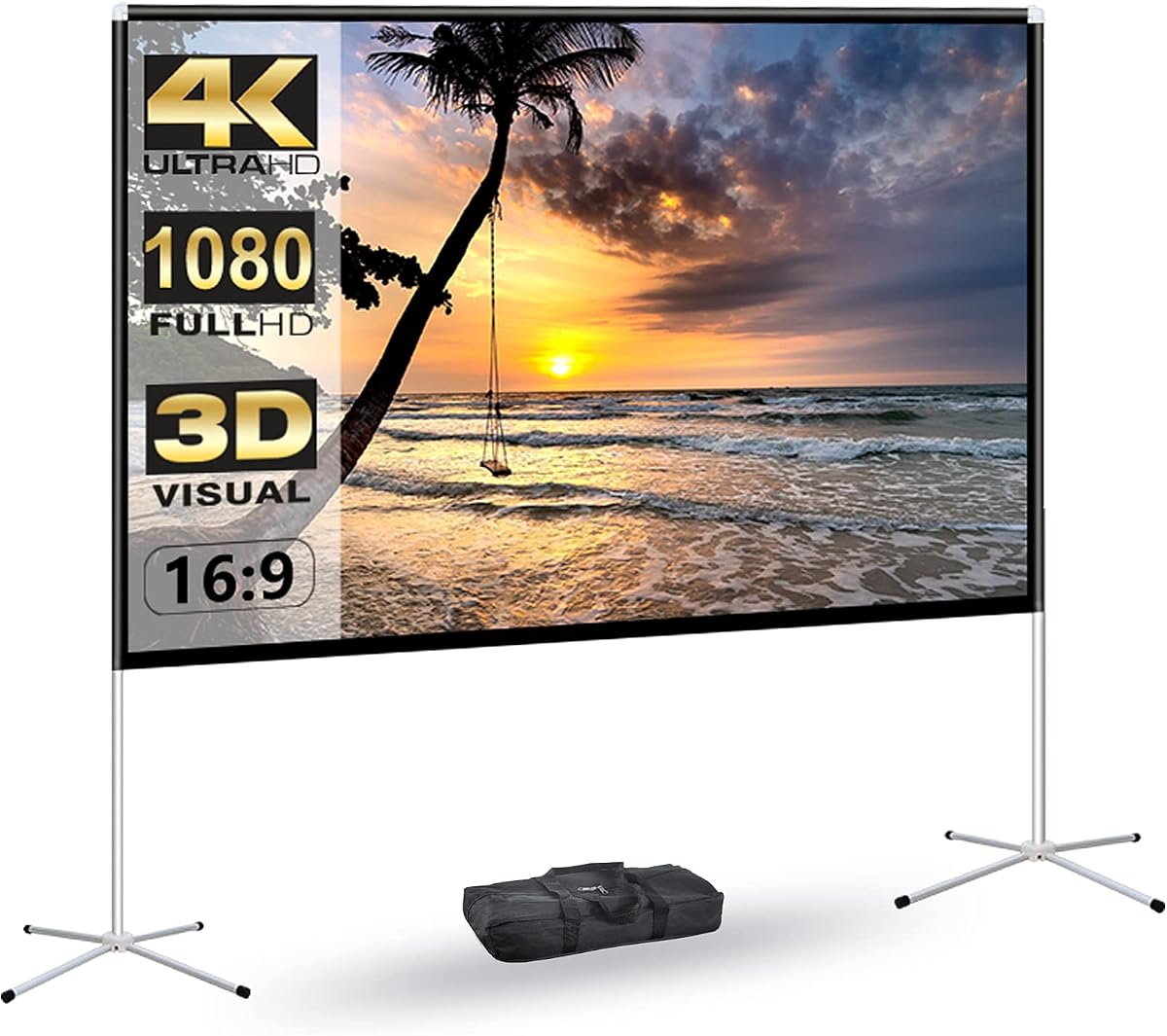


The Mdbebbron 120 inch Projector Screen is a flexible, hangable alternative to a bulky screen-and-stand system, combining a 120-inch diagonal with a 16:9 format and a 104-by-58-inch viewing area. Its 4.5 rating is the highest among the selected products, reflecting a generally favorable balance of useful size, straightforward installation, and portability.
We may earn a commission when you buy through this link, at no additional cost to you.
Its main strength is how many ways it can be used. The thickened polyester fabric supports front and rear projection, offers a stated 160-degree viewing angle, and is described as producing sharp, bright images. Installation does not require a proprietary frame: hooks, ropes, brackets, nails, or double-sided tape can secure the screen to a wall or another suitable mount. That flexibility makes it useful in a home theater, classroom, conference room, or outdoor gathering area.
The one-piece design folds into a compact package that can fit in a backpack or suitcase, while the material can be hand washed, machine washed, or spot cleaned. The main compromise is that the product supplies none of the structural benefits of a freestanding outdoor kit. You must provide suitable mounting points or build your own support, and the surface may be less convenient for repeated formal setup than a self-locking pull-down model.
This is a strong choice for renters, travelers, and casual viewers who want a generous screen without carrying a heavy frame. It is particularly appealing when a wall, fence, or other flat support is available and when the same screen needs to move between indoor and outdoor events. For a simple, flexible, large-format projector surface, it delivers the most versatile balance in this guide.
Because the screen does not depend on one specific frame, it can follow the projector rather than the room. Mount it temporarily for a film, presentation, lesson, or public display, then fold and carry it to the next event.
Front and rear projection support adds practical flexibility, especially when the projector cannot be placed directly in front of the viewing area. The stated 160-degree viewing angle also helps people spread out across a larger seating area.
We may earn a commission when you buy through this link, at no additional cost to you.
The TOWOND Projector Screen and Stand is built around a 150-inch diagonal and a self-supporting outdoor format, making it the most expansive option in this comparison. It carries a 4.3 rating and is designed for people who want a genuine large-screen event rather than a modest portable display. The screen supports both 1:1 and 16:9 viewing formats and can serve front or rear projection.
We may earn a commission when you buy through this link, at no additional cost to you.
The included folding stand is a major advantage because it eliminates the need to find separate mounting hardware for every event. The manufacturer states that users can unfold the stand and let the internal elastic cord connect the structure without tools, completing installation in about five minutes. The package also includes five crossbars, six ground nails, six ropes, two brackets, and a storage bag, providing a more complete outdoor setup than the basic hanging models.
Portability is another strength: the screen and stand are listed at 11.5 pounds and can be carried by hand or over the shoulder using the bag. The supplied list also states that the folded package can fit in a sedan trunk. The main limitation is space, and the manufacturer specifically advises indoor users to have a room wider than 140 inches. Even with a 16:9 image, the full 150-inch fabric can be difficult to position in a typical living room.
Choose this model for backyard cinema, community movie nights, camping, or temporary event spaces where a large display matters more than compact storage. It may also suit a dedicated media room with enough width to accommodate the screen and allow the audience to spread out. For those who can provide the space, it is a convenient and unusually complete large-format package.
The folding support and elastic-assisted connection make this screen more convenient than a fabric sheet that must be tied or taped in place. Its bundled accessories also reduce the need to assemble a complete support system separately for a backyard or temporary event.
The carry bag and manageable listed weight make the system practical for family trips and outdoor gatherings. It is still a large object, so the main limitation is storage space rather than the presence of a dedicated stand.
We may earn a commission when you buy through this link, at no additional cost to you.
This 120-inch Projector Screen with Stand distinguishes itself through a reinforced base and a comprehensive set of outdoor accessories. The screen offers a 16:9 format, a stated 160-degree viewing angle, and front and rear projection support. With a 4.3 rating, it is well matched to viewers who want a stable freestanding surface without moving to the much larger 150-inch format.
We may earn a commission when you buy through this link, at no additional cost to you.
The product includes four ground stakes, two ropes, and two sandbags, allowing users to reinforce the frame in several ways. Its extended base, strong support frame, and steel accessories are intended to limit the wobbling associated with lightweight stands. The washable milk silk fabric is described as producing vibrant 4K HD visuals, while its fitted installation helps reduce edge wrinkles and keeps the displayed image visually consistent.
Assembly is designed to require no tools, and the included instructions and straightforward parts make the process approachable. The screen folds flat for storage and comes with a dedicated bag for transport. A potential trade-off is that the two sandbags add bulk, and a reinforced outdoor base still cannot compensate for highly uneven ground. Very strong wind remains an environmental concern even with the included securing accessories.
This is a compelling choice for backyard movie nights, campsites, tailgating, and indoor living rooms that need a portable stand. It is also a practical option for people who want a complete kit without buying separate anchors, ropes, and weights. The combination of a manageable 120-inch image, washable fabric, front-and-back viewing, and stability hardware makes it the most thoughtfully equipped premium portable pick here.
The extended base and steel support pieces target a common weakness of portable screens: movement during projection. Ground stakes, ropes, and sandbags provide several ways to stabilize the structure according to the setting.
A 120-inch 16:9 screen remains large enough for a cinematic gathering but is more manageable than a 150-inch model. The folding frame and included carry bag make it suitable for events that move between locations.
We may earn a commission when you buy through this link, at no additional cost to you.
The 150 inch Projector Screen with Stand offers a large, cinematic surface in a portable package. Its 4.3 rating and 16:9 format make it appealing to viewers who want to recreate a stadium-scale or home-theater experience in a backyard, temporary event area, or spacious indoor room. The image area is supported by a foldable iron frame and anti-crease polyester material.
We may earn a commission when you buy through this link, at no additional cost to you.
This model includes ground nails and rigging ropes to improve stability in light winds, while the tool-free frame can be assembled in minutes. The complete kit fits into an included heavy-duty carrying bag, which helps with transport to parties, weddings, presentations, church events, and public displays. Its stated 4K HD capability and thick, opaque fabric are intended to provide a crisp image with fewer visible distractions than a thin hanging sheet.
The obvious limitation is scale. A 150-inch diagonal screen needs a large viewing distance, a broad projection area, and considerable storage space. The included anchors are suitable for basic stabilization, but the product description does not claim the more extensive wind system offered by some competing kits. The frame and fabric also need enough time and care to be fully arranged without folds.
The screen is best for hosts with a generous yard, an event venue, or a dedicated presentation area. It is less suitable for a compact apartment, a small campsite, or anyone who must carry the screen alone between locations. When large image size and a self-supporting frame are the leading priorities, this is a direct and uncomplicated choice.
The 150-inch diagonal gives an event a genuinely theatrical scale, especially for movies, sports, gaming, and group presentations. The 16:9 format aligns naturally with widescreen video content and modern projector output.
The iron frame, ground nails, and ropes provide a more independent setup than a wall-mounted fabric sheet. The folding structure and carrying bag support repeated use at parties, weddings, and community events.
We may earn a commission when you buy through this link, at no additional cost to you.
The STWUI Outdoor Projector Screen with Stand is a 120-inch, 16:9 portable screen designed for home movies, camping, courtyards, schools, offices, weddings, and churches. Its 4.3 rating reflects a useful combination of a lightweight package, washable milk silk fabric, and a chassis that the manufacturer has revised to improve stability.
We may earn a commission when you buy through this link, at no additional cost to you.
The support design uses lengthened and weighted components rather than the inferior plastic pieces associated with some entry-level stands. It also includes holes for customized ground nails. Assembly is tool-free, with a removable beam and a stated setup time of nine minutes, while the included storage bag measures 7.8 by 17.7 inches for the folded package. That compact figure makes transport easier than it may initially appear.
The screen supports front and rear projection, offers a stated 160-degree viewing angle, and is made from foldable, washable material that is intended to remain smooth. The main uncertainty is outdoor stability. While the chassis has been improved, the product data does not list the same detailed collection of ropes, stakes, and sandbags found in the more aggressively equipped kits, so buyers may need to plan anchoring around the site.
This model is a solid option for families and event organizers who need a 120-inch display that can be assembled without complicated hardware. It is particularly useful for small courtyards, family camps, offices, and community rooms where the screen must be stored compactly. The trade-off is that outdoor stability depends more on the setup location and less on a fully specified securing kit.
The removable beam and all-iron bracket are designed to simplify setup without small tools or complicated fittings. That makes the screen approachable for recurring family movie nights and portable event use.
The compact storage bag counterbalances the screen's 120-inch dimensions once it is folded. Users can keep the package in a vehicle or carry it to different venues without treating it as a permanently installed display.
We may earn a commission when you buy through this link, at no additional cost to you.
The Portable Projector Screen with Stand is the most compact option in the guide, offering an 80-inch diagonal, a 16:9 format, and a listed weight of 5.62 pounds. Its 4.4 rating is among the highest in the collection, and the focus is clearly portability rather than maximum image size. It is well suited to small gatherings, picnics, compact campsites, and backyard movie nights.
We may earn a commission when you buy through this link, at no additional cost to you.
The stand uses lightweight aluminum, while the polyester screen surface is washable and described as wrinkle-free. A soft padded carrying bag makes the package easier to transport, and the entire structure can be assembled or disassembled without tools. The listed 160-degree viewing angle allows viewers to sit across a wider area rather than directly in front of the projection.
A smaller screen naturally produces a less expansive image than the 120-inch and 150-inch alternatives, but that is a benefit when space, transport, and setup effort are limited. The included rope, hanging hook, and water bag provide basic stabilization, yet the product data does not describe the extensive stake-and-sandbag system offered by the more heavily equipped outdoor models. Very windy conditions may therefore require additional anchoring.
Buy this screen for a small family viewing area, a travel-oriented outdoor setup, or a user who wants a freestanding display without wrestling with a bulky package. It can also function indoors for gaming, presentations, or casual movie viewing. Its defining strength is manageable size, making it the most practical pick when portability matters more than a cinema-scale image.
At 5.62 pounds, this is the lightest stand package listed, and the padded bag makes it easier to carry by hand. The reduced weight is valuable for camping, picnics, and moving between indoor and outdoor locations.
The 80-inch diagonal is substantial enough for a family movie night but easier to position in a modest room or campsite. It offers a 16:9 image without requiring the wall width demanded by larger models.
We may earn a commission when you buy through this link, at no additional cost to you.
The VIVOHOME 120 Inch 1:1 Pull Down Projector Screen is designed for a permanent indoor display rather than a temporary event. Its 4.4 rating, matte white surface, and self-locking retractable mechanism make it appealing to home-theater builders, offices, classrooms, gaming rooms, and karaoke spaces. The viewing area measures 84 by 84 inches.
We may earn a commission when you buy through this link, at no additional cost to you.
The manual pull-down design allows the surface to stop at a suitable height, and the metal casing helps protect the screen from deformation during handling. Its three-layer waterproof PVC fabric is described as resistant to creases and changes in temperature or humidity. The product supports 3D, 1080P, 4K, 8K, and Full HD image formats, while the stated 160-degree viewing angle and matte finish aim to provide uniform brightness and reduce glare.
Installation requires a wall or ceiling and a suitable mounting arrangement; screws and an L-bracket are not included. Users must also account for the 90-by-92-inch overall size even though the diagonal viewing area is 120 inches. The 1:1 ratio is the defining drawback for widescreen movie viewing, because modern 16:9 content will not fill the full square surface. A slight initial odor may also be present and should fade after airing out.
This model is best for a dedicated room where a clean, retractable screen adds more value than portability. It gives regular users a simple way to reveal and store a large display without assembling a stand. Choose it when the primary content is square or adaptable, and when permanent mounting is acceptable. For standard films, the 100-inch 16:9 VIVOHOME model is the more natural fit.
A retractable housing keeps the surface protected and out of sight when it is not needed. For permanent installations, that tidy appearance can be more valuable than the simple portability offered by folding fabric screens.
The self-locking mechanism lets users choose how much of the screen is lowered. This makes the screen adaptable to different media, presentations, and room activities without changing the mounting position.
We may earn a commission when you buy through this link, at no additional cost to you.
The 150inch Outdoor Projector Screen Anti Crease Portable Movie Screen is a large, lightweight fabric alternative to a freestanding outdoor system. It carries a 4.4 rating and provides a 16:9 viewing area of 132 by 73 inches, along with a stated 160-degree viewing angle. It is intended for home theaters, outdoor movies, classrooms, offices, and travel.
We may earn a commission when you buy through this link, at no additional cost to you.
The thickened, smooth, nontransparent material is described as delivering brighter colors while remaining soft to the touch. It can be mounted with hooks, brackets, nails, double-sided tape, or wall ties from left to right, allowing the screen to fit a wide range of temporary locations. Its foldable, lightweight design makes it small enough for a backpack or suitcase after use.
Unlike the complete stand systems, this product does not include a dedicated frame, so image quality depends heavily on how evenly the fabric is stretched. Any folds, sagging, or surface tension issues can affect the picture. The screen is also washable by hand or machine, which is useful after outdoor use, but the user must allow it to dry properly before storage.
This screen suits people who already have a reliable wall, fence, or mounting structure and need more image area than a dedicated indoor model can offer. It is also a convenient choice for travel because it avoids the weight and bulk of a stand. If a complete outdoor package is a priority, however, one of the stand-equipped options will provide a more independent setup.
A flexible hanging screen can deliver a 150-inch diagonal while remaining much lighter than a large frame package. That makes it useful where wall space is available but storage and transport are limited.
Both hand washing and machine washing are supported, helping remove dust and outdoor residue from the surface. Cleaning and careful drying help preserve smoothness before the screen is folded for storage.
We may earn a commission when you buy through this link, at no additional cost to you.
The Outdoor Projector Screen with Stand featuring a Stake-Down Base focuses on a more specialized form of stability. Its 120-inch 16:9 screen supports front and rear projection, while the stated 160-degree viewing angle helps accommodate a wider audience. The 4.3 rating makes it a competitive option for viewers who regularly set up outdoors.
We may earn a commission when you buy through this link, at no additional cost to you.
The base plate is widened and thickened to increase the bearing area, and its added holes allow ground stakes to be inserted between the plate and soil. The all-iron bracket uses quality steel described as rust-resistant and resistant to bending. Four ground stakes and two windproof ropes are included, giving the screen a more deliberate anchoring system than simple fabric models with adhesive or hook mounting.
Assembly is stated to take about eight minutes. Modular splicing tubes and sturdy hook-and-loop straps help users connect the frame and pull the screen flat. The fabric is high-density woven milk silk with a thick, elastic, wrinkle-resistant construction intended to provide consistent color from both front and rear. Its portability comes from a compact carry bag and a disassemblable frame.
The stake-down design is especially appealing for yards, campsites, and soft ground where stakes can be driven securely. It is less essential for indoor use, where the additional base complexity has less benefit, and it cannot guarantee stability on surfaces that do not accept ground stakes. This is a good choice when secure outdoor anchoring is more important than a lightweight indoor package.
The enlarged weighted plate and dedicated stake holes create a firmer relationship between the stand and the ground. This is a meaningful advantage at outdoor events where a light freestanding frame could shift or tip.
The modular bracket supports quick setup, while hook-and-loop straps help tension the screen across the frame. A flatter surface is especially useful for preserving the clean geometry of widescreen images.
We may earn a commission when you buy through this link, at no additional cost to you.
The VIVOHOME 100 Inch 16:9 Pull Down Projector Screen combines a familiar widescreen format with a relatively compact installation. Its 100-inch diagonal produces an 87-by-49-inch viewing area, and the recommended viewing distance is 9.2 feet. With a 4.4 rating, it is a strong option for home theaters, meeting rooms, classrooms, gaming rooms, and karaoke areas.
We may earn a commission when you buy through this link, at no additional cost to you.
The manual retractable mechanism uses a self-locking system, allowing the screen to remain at the selected height. A matte white surface, stated 160-degree viewing angle, and support for 3D, 1080P, 4K, 8K, and Full HD images make it suitable for a broad range of media. The metal housing protects the screen during handling, while the three-layer waterproof PVC fabric is designed to resist creasing and changes in temperature or humidity.
The overall casing measures 92 by 57.5 inches, so the wall or ceiling needs enough clearance for installation and operation. Screws and an L-bracket are not included, which may mean buying appropriate mounting hardware separately. Unlike folding screens, this unit cannot easily be moved from one venue to another. A new screen may also have a temporary odor that is expected to fade after airing.
This is the most natural retractable option for standard 16:9 movies, streaming content, presentations, and games. It suits people who want a permanent, neat display and do not need to carry the screen between locations. Compared with the 120-inch square VIVOHOME model, it provides a more contemporary widescreen shape in a smaller overall package.
The 16:9 format closely matches the shape of most movies, streaming shows, presentations, and games. That makes the 100-inch model less likely to leave unused space above and below the projected image.
The roll-up housing protects the screen and disappears neatly when the display is not needed. At 100 inches, it offers a more manageable installation than larger retractable sets while retaining a substantial viewing area.
We may earn a commission when you buy through this link, at no additional cost to you.
The right projector screen depends on your room, projector placement, viewing content, and tolerance for setup. Compare size and aspect ratio first, then decide whether a permanent, wall-mounted, or portable design fits your space and events.
Screen size should be matched to the viewing distance, the room's width, and the resolution of the projector. The 80-inch model is the most compact and easiest to move, while 100-inch and 120-inch options provide a larger image with modest increases in space requirements. The two 150-inch options create the most expansive display but need a broad open area and sufficient projector throw distance. Aspect ratio also affects the shape of the visible image: 16:9 suits widescreen films, games, and presentations, whereas the 1:1 VIVOHOME screen can leave space around modern 16:9 content.
Choose the smallest screen that still feels cinematic from your normal viewing position, and the widest format that matches your media.
A large diagonal does not automatically create a better image. The projector must have enough throw distance to fill the screen, and the audience must be far enough away to view it comfortably. The TOWOND 150-inch model specifically advises that indoor room width should exceed 140 inches. Pull-down screens also need clearance for their housings, while freestanding models need space in front of and behind the frame. Measure the wall, ceiling drop, seating distance, and projector position before selecting a size.
Confirm both the screen dimensions and the room dimensions; the viewing area alone does not describe the full installation footprint.
Portable fabric screens can be folded into a backpack or suitcase and attached to an existing surface, making them ideal for travel and occasional use. Stand systems add independence but require assembly, transport, and more storage. The 80-inch model is the lightest listed at 5.62 pounds, while the 150-inch TOWOND set is 11.5 pounds. Tool-free frames simplify setup, but a larger screen is generally harder to handle one-handed. Include carrying bags, component count, and setup time in the decision rather than focusing only on size.
For frequent travel, favor weight and packed dimensions; for permanent event use, favor stand completeness and anchoring.
Outdoor screens face wind, uneven ground, and accidental movement, so stability deserves careful attention. The reinforced 120-inch model includes stakes, ropes, and sandbags, while the STWUI stake-down model uses a widened base plate and holes designed for ground nails. The TOWOND and 150-inch portable sets include their own ground hardware. Lightweight fabric sheets need an existing wall, fence, or strong external support. Even a well-anchored screen should be moved to sheltered locations when strong wind threatens the frame or projection equipment.
Match the support system to the ground and weather, and secure the screen before tensioning the fabric and starting playback.
A useful screen should remain smooth, opaque, and capable of presenting a uniform image. Products in this guide use polyester or milk silk, while the retractable VIVOHOME models use three-layer waterproof PVC with a matte white surface. A matte surface can reduce glare and distribute light more evenly, while a thick or tightly woven fabric helps prevent distracting background light from showing through. Washable materials are especially valuable for outdoor use because they can be cleaned before being folded and stored.
Prioritize a taut, wrinkle-resistant surface and cleanability, but do not assume resolution language alone guarantees a better image than the projector and lighting.
Front projection places the projector in front of the audience, while rear projection puts the projector behind the screen. Rear projection can reduce shadows and projector glare, but it needs a dedicated space behind the screen. Double-sided models are more adaptable to different venues, and the 160-degree viewing-angle claims found throughout the list can help spread viewers across a wider area. Not every projector supports rear projection, so verify lens placement and throw-distance requirements before choosing the arrangement.
Choose double-sided or rear-capable fabric when your setup changes, and reserve the choice of rear projection for spaces that can accommodate the projector behind the screen.
A pull-down model is visually tidy and convenient in a dedicated room, but it requires wall or ceiling mounting and appropriate hardware. The VIVOHOME units are therefore best for fixed installations. Hanging cloth screens are flexible and travel well, but they depend on smooth tension and suitable attachment points. Freestanding sets are self-contained and better for yards and events, though they occupy storage space. Choose the style that matches how often the screen moves and whether a permanent installation is acceptable.
Permanent rooms favor retractable convenience, while irregular event locations favor portable fabric or complete stand kits.
Projection quality depends on controlling ambient light. A matte white surface and wide viewing angle help distribute brightness, but curtains, blinds, and controlled room lighting still matter. The listed 160-degree angles on most fabric and milk silk models allow viewers to sit off center, which is useful for social gatherings. The square 1:1 VIVOHOME screen offers a similar stated angle but requires more thought about how 16:9 content is presented. Use the room's brightest viewing position to judge the image rather than relying only on diagonal size.
Reduce ambient light first, then choose a wide-angle surface and a viewing position that reflects how your audience will actually sit.
Before unfolding or unrolling a screen, choose a flat, clean location with enough clearance for the full surface. Inspect the fabric and hardware, confirm the projector is positioned for the correct aspect ratio and throw distance, and ensure the screen will not block doors, walkways, lighting, or electrical connections. For a hanging cloth model, attach the screen to a secure wall or frame and pull the corners evenly so the image area remains flat.
For stand-equipped screens, assemble the frame according to the included instructions, level the base, and add the appropriate stakes, ropes, weights, or sandbags before attaching the fabric. Stretch the material evenly from all sides, but avoid pulling it so tightly that the frame twists. Position the projector, focus the image, and adjust the screen or projector alignment until the picture fits the intended 16:9, square, or other format with clean edges.
After the final showing, switch off and cool the projector before handling the screen. For retractable models, lower the surface slowly and confirm it is fully secured in its housing. For folding fabric, remove the screen, clean away marks according to the care instructions, allow damp areas to air dry, and fold loosely rather than forcing sharp creases into the material. Store stand components in the supplied bag, dry the fabric before packing, and inspect anchors or fasteners before the next outdoor setup.
The best size depends on viewing distance, room width, and projector throw capability rather than one universal number. A 100-inch 16:9 screen can suit a dedicated room, an 80-inch option works well in smaller spaces, and 120-inch or 150-inch screens are more appropriate for open areas and large audiences. Confirm that the projector can fill the selected screen before installation.
A 16:9 screen is usually better for widescreen movies, streaming shows, gaming, and most presentations because it matches the shape of modern content. A 1:1 screen offers a square display that can be useful for older formats, images, or adjustable installations. If most of your viewing is cinematic, prioritize a 16:9 model such as the 100-inch VIVOHOME screen.
They can be, provided the setup accounts for wind, ground conditions, and surface tension. Stand models with ground stakes, ropes, weights, or sandbags are generally more practical outdoors than a fabric sheet that depends on an existing wall. Even a stable screen should be moved to a sheltered location during strong wind, and the projector itself needs appropriate protection.
A dedicated screen usually improves consistency by providing a controlled white surface, a defined viewing area, and better uniformity than textured or painted walls. It also helps hide the wall's color and prevents wall anchors or decorations from appearing in the image. A hanging fabric screen can be inexpensive and temporary, while a retractable model offers a neater permanent result.
Stretch the fabric evenly from all sides and secure it before starting the projector. Avoid pulling opposite corners with uneven force, which can create diagonal folds, and do not bunch the material while folding it for storage. Clean and fully dry the screen after outdoor use, then store it loosely in its bag or case.
Several models in this guide are explicitly designed for both front and rear projection. Front projection requires the projector in front of the audience, while rear projection places it behind the screen and can reduce visible shadows. Rear projection still requires sufficient space behind the display and a projector with compatible throw distance, so the arrangement must be planned carefully.
Requirements depend on the model, but common additions include ground stakes, ropes, sandbags, straps, and a stable base. The reinforced 120-inch and STWUI stake-down options include relevant outdoor hardware, while other kits may include a smaller selection. Check the included components carefully and add anchors appropriate to the soil and expected weather.
A pull-down screen is better for a permanent room because it rolls neatly into its housing, locks at different heights, and protects the surface between uses. A portable fabric screen is better when the display must move to different locations or when no permanent mounting is possible. Your use frequency, room layout, and installation preferences should determine the choice.
The Mdbebbron 120-Inch Folding Screen is the most flexible budget-oriented option, offering a large 16:9 surface, double-sided projection, and multiple ways to mount it. The TOWOND 150-Inch Stand Set delivers the largest image and a complete portable system, while the reinforced 120-inch stand model offers one of the most complete outdoor kits with stakes, ropes, sandbags, and a washable surface.
Prioritize fit before features. Measure the room, confirm the projector throw distance, match the aspect ratio to your content, and consider how much setup effort you genuinely want. A smaller 80-inch model may produce a more practical experience than an oversized screen, and a fixed 100-inch 16:9 retractable model may suit a dedicated theater better than any portable option.
Finally, check the current product listing, included accessories, availability, and price before purchasing. Listings and configurations can change, and details such as mounting hardware, carry bags, anchors, and fabric care instructions should be confirmed on the current product page. That final check helps ensure the chosen projector screen fits both your space and the way you plan to use it.