
XLR Male to RCA Female Adapter Cable
4.8Editor score
Durable nickel-plated metal shell
Rivet-fixed secure connection
Two adapters included
Discover the best RCA to XLR adapter options for audio gear, comparing connector genders, cable designs, shielding, channel support, build quality, and use
An RCA to XLR adapter bridges the connection between consumer-style RCA audio equipment and professional XLR-equipped devices. The right adapter depends on connector genders, signal format, channel needs, cable length, and the amount of shielding your setup requires.
We compared ten adapters and cables using their stated connector configurations, construction, shielding, conductor design, channel support, compatibility, and customer ratings. The guide includes compact couplers, longer shielded cables, stereo splitters, and color-coded pairs for different audio applications.
Each review explains the practical strengths and limitations of its product, while the top picks highlight the strongest options for budget-conscious, balanced, and premium builds. Product prices and availability can change, so confirm the current listing and connector layout before ordering.
4.8Editor score

4.7Editor score

4.8Editor score
This side-by-side comparison covers ten RCA and XLR connection options with different connector genders, formats, lengths, shielding choices, and intended applications, making it easy to identify the most appropriate product for your audio system.
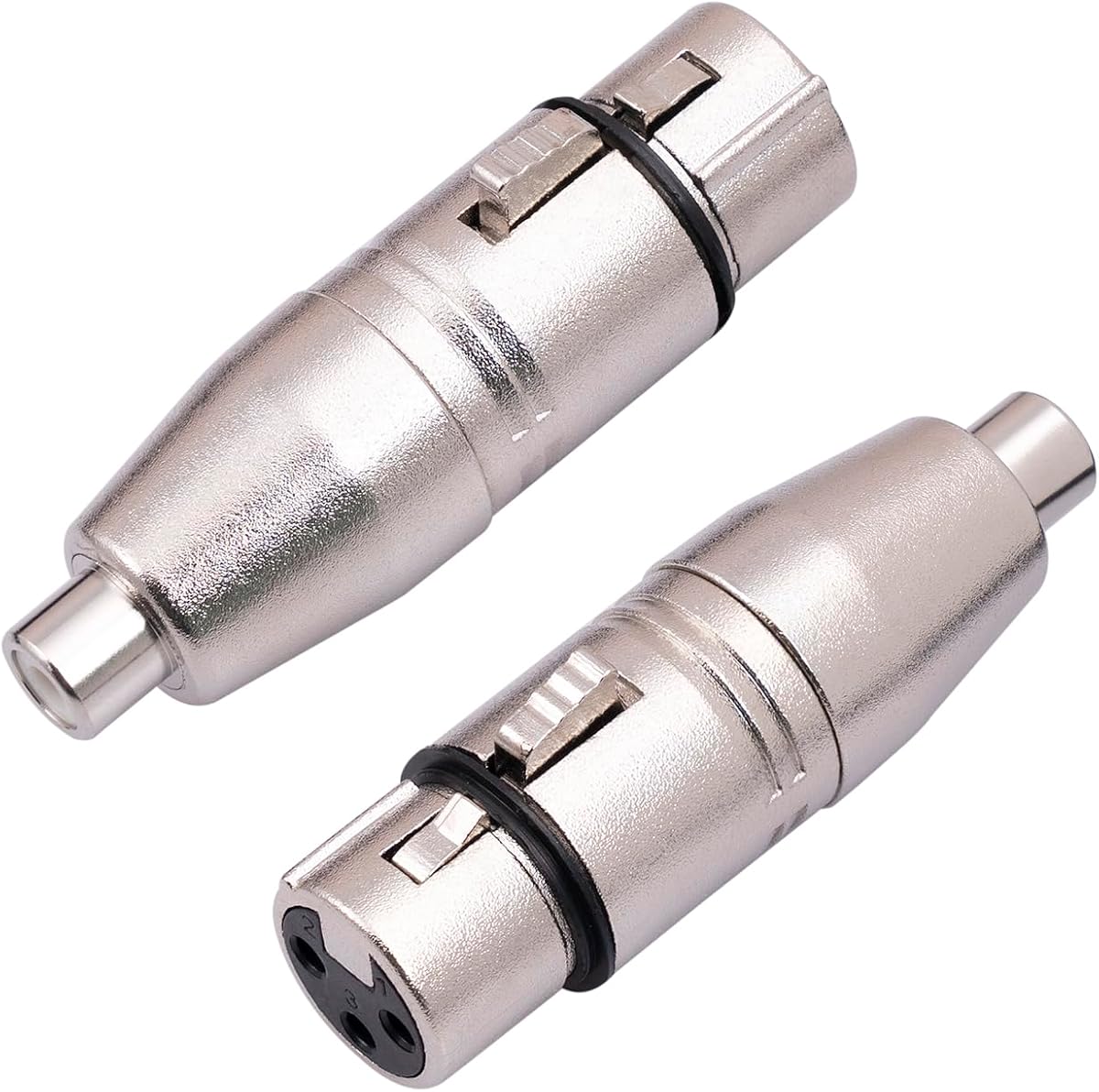


This two-pack provides a direct way to connect an XLR male output to an RCA female input, and its 4.8 rating places it among the strongest customer-rated products in this guide. Its standout feature is the durable nickel-plated metal shell, which is designed for repeated plugging and routine use in home studios, live setups, mixers, and other audio systems.
We may earn a commission when you buy through this link, at no additional cost to you.
Rather than relying on loose screws, the manufacturer uses a riveted connection between the XLR and RCA sections. That approach creates a firm mechanical joint and gives the adapter a more substantial feel than a lightweight plastic coupler. Two units are included, making it convenient to complete left and right connections or keep a spare available for another signal path.
The trade-off is that this is a gender-changing adapter rather than a cable. It requires compatible RCA and XLR leads to provide any reach between devices. Its interface conversion is also designed for audio interconnection, not digital signals, and users requiring long runs should consider a shielded cable with appropriate gauge and length.
This is our best overall pick for readers who want a direct, durable, and widely useful RCA to XLR solution without moving to a specialized cable. It suits microphones, mixers, amplifiers, and audio players with matching inputs, particularly when a pair of standard RCA connections is already present.
The nickel-plated metal shell is especially valuable in racks, rehearsal rooms, and mobile setups where connectors are handled often. A rigid shell also helps maintain alignment and reduce stress on the actual plug connections.
Two adapters make it easier to establish paired signal paths or retain a spare. The shared construction also provides a consistent connection method across more than one part of an audio setup.
We may earn a commission when you buy through this link, at no additional cost to you.
This adapter changes two female ends into a usable connection, with an XLR female on one side and an RCA female on the other. Its 4.6 rating reflects favorable customer feedback, while the full metal shell, electroplated finish, and copper-nickel contacts target reliable everyday audio connections.
We may earn a commission when you buy through this link, at no additional cost to you.
The rivet-fixed design keeps the two connector sections together without relying on screws that could loosen. The electroplated surface is intended to resist fading and corrosion, which can be helpful in mobile, studio, or high-humidity environments. Two adapters are included so users can create a matched pair for stereo equipment.
This design is most useful when both source and destination already use female-terminated cables. Because it has no integrated cable, it may be less convenient for permanent installations where a short, direct cable would reduce connector clutter. It also does not change a balanced XLR circuit into a balanced RCA circuit; the destination remains unbalanced.
Choose this model when connector gender is the deciding requirement and you already have compatible cables. It is a sensible gender changer for mixers, recorders, amplifiers, and microphone equipment where the available ports are female rather than male.
The full metal shell gives the adapter a durable structure and protects the internal contacts from everyday handling. It is a practical alternative to unshielded plastic couplers in frequently used equipment racks.
The two-pack supports left and right channel arrangements or provides a ready spare. This makes the adapter more useful for stereo or dual-output systems than a single loose coupler.
We may earn a commission when you buy through this link, at no additional cost to you.
This eight-inch cable connects an XLR male device directly to an RCA male input, offering a practical middle ground between bulky couplers and longer signal cables. Its 4.6 rating reflects positive customer feedback, and the stated conductor and shielding design make it a strong candidate for compact home-studio or stage-side connections.
We may earn a commission when you buy through this link, at no additional cost to you.
The cable uses 4N oxygen-free copper, 20AWG shielded twisted-pair conductors, and a braid combined with aluminum-foil shielding. Those features are intended to limit electromagnetic and radio-frequency interference as well as unwanted noise, static, and popping. Gold-plated connectors and rubber strain relief support dependable contact and improved durability.
Its principal limitation is length. Eight inches is well suited to devices positioned near each other, but it may not reach between a rack and a mixer or between a console and an amp across a room. The RCA side is also unbalanced, so the cable should not be treated as a way to preserve a fully balanced XLR signal path.
This cable is a strong pick for compact installations where both devices use male-ended leads and a short connection is sufficient. It is especially useful for a nearby mixer, amplifier, or playback device that needs a direct XLR-to-RCA run.
Dense braid and aluminum-foil layers help protect the signal from nearby electrical sources. That makes the short cable a practical choice for setups located near computers, power supplies, or other interference sources.
The compact length keeps connections tidy when equipment is arranged on the same shelf, desk, or rack. It is less suited to installations that require several feet of separation.
We may earn a commission when you buy through this link, at no additional cost to you.
This direct adapter combines an XLR male connection with an RCA female connection and arrives as a color-coded red and white pair. Its 4.7 rating indicates strong customer reception. The 24K gold-plated contacts and zinc alloy body make it an appealing option for systems where fast, organized channel identification matters.
We may earn a commission when you buy through this link, at no additional cost to you.
The product description emphasizes low resistance, stable signal transfer, and preservation of audio detail. Oxygen-free copper conductors and a nickel-locked mechanism are included to promote consistent contact, while the solid body is designed to reduce external electromagnetic interference and help avoid signal dropouts.
Color coding is more useful than it may initially appear. In stereo or dual-channel systems, the red and white housings reduce confusion when routing left and right signals among a mixer, amplifier, home theater system, or DJ controller. The adapters still require their own RCA and XLR leads, so connector count can become visually busy in a complex rack.
This is a good option for users who value quick channel identification, compact direct connections, and a refined connector finish. It fits home studios, DJ setups, and live audio systems where the included color distinction can simplify repeated patch changes.
Distinct red and white finishes help identify left and right channels at a glance. This is particularly helpful when moving cables between similar-looking pieces of equipment.
The zinc alloy construction is intended to provide a secure fit and help shield the connection from electromagnetic interference. It also gives the adapter a durable feel for frequently changing setups.
We may earn a commission when you buy through this link, at no additional cost to you.
This four-pack offers a generous collection of XLR male-to-RCA female adapters for home theaters, Hi-Fi systems, live audio rigs, and multi-device studios. Its 4.3 rating is lower than several alternatives in the guide, but the underlying design includes 5-micron 24K gold-plated contacts, a zinc alloy shell, and red and white channel identification.
We may earn a commission when you buy through this link, at no additional cost to you.
The gold plating is intended to reduce resistance and support fast, stable signal transfer. The solid body is designed to resist physical wear and shield against external electromagnetic interference, while the four color-coded units make it easier to keep several channel paths organized at once.
The main question is whether four adapters are necessary. A home stereo with only one auxiliary connection may leave some units unused, while a live rig or recording studio with multiple input paths may find the quantity highly convenient. The product does not include cables, and it remains an unbalanced interface conversion.
Choose this pack when your system needs multiple gender-changing connections or you want spare units for future expansion. It is less compelling for a single, simple home connection, but the larger assortment can be advantageous in a busy patch setup.
The four-unit count suits studios, stages, and entertainment systems that route several signals. Having spares also reduces the need to leave one connection unfinished when a coupler fails or is misplaced.
Red and white coding makes it easier to keep channel assignments consistent. The color scheme is particularly helpful where multiple XLR and RCA connections converge near a mixer or amplifier.
We may earn a commission when you buy through this link, at no additional cost to you.
This two-pack provides a direct XLR male-to-RCA female connection for integrating mixers, receivers, amplifiers, DJ equipment, and home audio components. Its 4.3 rating places it in the middle of the guide’s customer ratings, while the 5-micron 24K gold-plated contacts and zinc alloy housing provide a solid basis for home and stage use.
We may earn a commission when you buy through this link, at no additional cost to you.
The design emphasizes low resistance and stable contact, while the solid body is intended to resist wear and help protect the signal path from external electromagnetic interference. Red and white finishes provide immediate left and right channel identification, making the pair easy to integrate into a stereo setup.
Because the adapters do not include leads, a user must match them with suitable cables and account for the extra connector junctions in the chain. As with other XLR-to-RCA conversions in this category, the RCA destination is unbalanced, and the product is intended for analog audio rather than digital data.
This option makes the most sense for users who want exactly two matching direct adapters with clear channel coding. It is a versatile choice for a mixer-to-amplifier arrangement, a DJ controller feeding consumer audio equipment, or any home studio requiring a pair of gender-changing connections.
The listed five-micron plating is intended to lower contact resistance and resist corrosion. That supports consistent signal transfer in systems that are connected and disconnected regularly.
A matched pair is enough for left and right channels in many home and live configurations. The result is easier to organize than a larger collection of single adapters.
We may earn a commission when you buy through this link, at no additional cost to you.
This Cardas Audio pair is the premium-focused selection in the guide, combining a female RCA end with a male XLR end. Its 4.8 rating is among the highest listed, and the design prioritizes contact quality, secure locking, and rejection of radio-frequency and clock-signal interference.
We may earn a commission when you buy through this link, at no additional cost to you.
The contact surfaces use rhodium plated over silver, while the non-magnetic eutectic brass body is intended to support a stable, low-interference connection. The adapter also uses tight connections and a secure lock, which can be especially helpful in a live audio environment where movement or vibration could otherwise affect a less secure joint.
The tradeoff is that this is a direct coupler rather than a cable, so users need appropriate RCA leads to reach their source or destination equipment. It also changes connector types without transforming the fundamental signal architecture: an RCA input remains unbalanced. Its premium materials are best appreciated in systems where signal integrity and long-term robustness justify a specialized connector.
For discerning users connecting quality audio equipment, this is the pick to prioritize. It is especially suitable for a high-end home stereo, serious studio, or fixed installation where secure contact and refined construction matter more than the simplest possible connection.
Rhodium-over-silver contact surfaces are designed to enhance conductivity and resist degradation. The secure lock adds mechanical stability, helping the connection remain firm during use.
Non-magnetic eutectic brass and effective shielding help reject radio-frequency and clock-signal interference. Those attributes make the adapter suitable for carefully assembled audio systems.
We may earn a commission when you buy through this link, at no additional cost to you.
This cable differs from the standard adapters by dividing one three-pin XLR connection into two phono-style RCA plugs. Its 4.7 rating reflects solid customer reception, and the 1.5-meter length provides considerably more reach than the shortest couplers and cables considered in this guide.
We may earn a commission when you buy through this link, at no additional cost to you.
The manufacturer identifies the intended uses as connecting mixers, microphones, tape recorders, and amplifier line outputs. It can also link DJ controllers to amplifiers, adapt an XLR connection into an RCA run, or integrate home theater and professional audio equipment. High-density and aluminum-foil shielding are intended to reduce EMI and RFI interference.
The key caveat is that this is a Y-style signal arrangement rather than a straightforward one-to-one cable. Depending on the source and intended application, the dual RCA ends may represent separate channel outputs or a split of a connector, so it should not be selected merely because a user wants a gender change. The connection is also unbalanced at the RCA side.
Choose this splitter for a specific device or source that is designed to feed two RCA outputs through an XLR connection. It is less appropriate for ordinary one-channel routing, but it offers an effective solution for compatible console, controller, or line-output equipment.
A 1.5-meter lead can span the gap between nearby devices more easily than a short adapter. This makes the cable useful for arranging console, amplifier, and home theater equipment around a room.
High-density and aluminum-foil shielding help protect the signal when professional and consumer electronics are linked. The flexible jacket and rubber strain relief support regular handling.
We may earn a commission when you buy through this link, at no additional cost to you.
This two-pack of 4.92-foot cables is our editor's choice for readers who want a complete wired solution rather than a separate coupler. The 4.7 rating indicates positive customer feedback, while the combination of oxygen-free copper, multi-layer shielding, gold-plated contacts, and a braided jacket makes this one of the most thoroughly specified products in the comparison.
We may earn a commission when you buy through this link, at no additional cost to you.
The conductor design is said to support a balanced tonal response across bass, midrange, and high frequencies. Internally, the cable combines a high-density tinned copper braid, double-layer PVC shielding, and ferrite cores intended to filter interference and reduce signal loss or distortion. The connectors use five-micron 24K gold plating over pure copper to resist corrosion and support repeated insertion.
Its heavier construction may be unnecessary for a simple desktop connection, and RCA remains an unbalanced interface. The marketing information also describes the cable as useful for subwoofer applications, but connector compatibility and the input’s electrical design should determine whether that is appropriate. Users seeking a single ultra-compact adapter may prefer a direct coupler.
This pair is a strong all-around recommendation for home theaters, amplifiers, CD/DVD players, DACs, power amplifiers, and Hi-Fi systems. It works especially well for users who value reach, shielding, a rugged jacket, and two ready-made cables in one package.
Tinned copper braid, double-layer PVC shielding, and ferrite cores form a multi-stage approach to controlling EMI and RFI. That makes the cable well suited to systems containing multiple electronic components.
The nylon braided exterior resists pulling, fraying, and repeated bending. Its stated tangle-free design also makes the pair easier to store between uses than more exposed cable constructions.
We may earn a commission when you buy through this link, at no additional cost to you.
This six-inch, two-pack connects an RCA male plug to an XLR female socket, a useful orientation when the source has an RCA output and the destination accepts an XLR connection. Its 4.5 rating reflects moderate customer satisfaction, while the clearly stated pin arrangement gives buyers more technical information than many competing listings.
We may earn a commission when you buy through this link, at no additional cost to you.
The adapter is explicitly designed for unbalanced audio and connects XLR pin 2 to the RCA positive pole, with pins 1 and 3 joined to the RCA negative pole. The manufacturer says it is intended to split XLR signals into dual RCA mono signals, making the product especially relevant to AV receivers, DVD/VCD equipment, equalizers, compressors, interleavers, and digital decoders.
The six-inch length is suited to equipment placed close together, but it may be restrictive in a larger installation. Because the design is unbalanced only, users should not expect it to preserve a balanced XLR signal merely by changing connector types. The claimed handmade construction and factory testing are useful production details, although they do not replace checking the exact input arrangement of your equipment.
This adapter is a targeted solution for users who have identified the correct pin-out and need a short, flexible lead. It is worth considering when your source and destination match the stated RCA male and XLR female arrangement and the signal path is designed for unbalanced operation.
Stating that XLR pin 2 connects to RCA positive while pins 1 and 3 connect to negative is useful when diagnosing channel or polarity issues. It also helps confirm that the adapter fits the intended circuit.
At six inches, the cable keeps desktop, rack-adjacent, and media-center connections compact. It is less convenient for equipment mounted at opposite sides of a room.
We may earn a commission when you buy through this link, at no additional cost to you.
The right RCA to XLR adapter depends primarily on connector gender, signal routing, channel count, cable reach, and construction. Use the following factors to narrow the field before checking the final product listing.
Connector gender determines whether the adapter can physically connect your equipment. Common combinations include male XLR to female RCA, female XLR to female RCA, male XLR to male RCA cable, and male RCA to female XLR. A gender changer often has female sockets on both ends and therefore requires male-ended leads, while a cable with male ends on both sides can plug directly into female ports. The product title and connector photographs should be checked before ordering, because words such as male, female, and gender changer are sometimes used loosely in marketplace listings.
RCA connections are generally associated with unbalanced analog audio, while XLR can support balanced or unbalanced audio depending on the equipment and wiring. An adapter changes the physical connector but does not automatically create a balanced circuit. If the destination accepts only RCA, expect an unbalanced signal path unless its manufacturer specifically supports an alternative input arrangement. Some products also define exact pin assignments, which matters when connecting a powered speaker, amplifier, or device with unusual grounding.
Mono microphone and instrument signals normally need one connection, while stereo equipment commonly needs separate left and right paths. A two-pack of color-coded adapters is often convenient for stereo, although red and white are not universal labels for every device. A dual-RCA Y splitter is a different solution designed to take one XLR source to two RCA plugs; it should only be selected when the source and circuit layout genuinely call for that arrangement. Avoid buying multiple adapters merely for cable length if a purpose-built cable will be simpler.
Direct couplers add no cable length, which keeps desktop setups compact but requires existing leads on both sides. Short cables of a few inches suit equipment arranged side by side, while four- to five-foot leads work better when components are on separate shelves or across a room. Longer Y-style patch cables can solve reach and splitting needs together, but they are less flexible than adapters. Before buying, measure the space and consider cable bending, strain relief, and whether the connectors need enough space to be removed.
Shielding helps prevent electromagnetic and radio-frequency interference from entering the audio path, especially near computers, dimmers, power transformers, and poorly isolated power cables. Designs may use braided shielding, aluminum foil, or both, sometimes with added ferrite cores. Conductor material and gauge also matter: oxygen-free copper is common, while larger gauges are generally better suited to longer runs. A short adapter with a solid metal shell may be sufficient in a clean location, while a longer cable deserves close attention to shielding and conductor construction.
A durable connector should fit securely, maintain a clean electrical contact, and withstand repeated insertion. Nickel-plated, gold-plated, and rhodium-over-silver finishes are all presented as contact-enhancing options, while metal shells and riveted joints can improve mechanical strength. For permanent installations, locking mechanisms are particularly valuable. For portable systems, flexible strain relief and a protected cable jacket may matter more. Connector finish alone should not be treated as a guarantee of superior sound; fit, shielding, and correct wiring remain central.
Different environments place different demands on an adapter. A home listener may need only a compact left-right pair for connecting a mixer to an amplifier. A live operator may prefer color-coded connectors, locking couplers, and shielded cable runs. Studio users may focus on grounding, pin assignments, and predictable left-right routing. DJ controllers and home theater equipment are explicitly mentioned by several products in this guide, while microphones, recorders, amplifiers, receivers, equalizers, compressors, and mixers cover other supported applications.
Some products include two adapters, while one is a four-piece set and another is a pair of complete cables. Clarify whether RCA and XLR leads are included; most direct couplers require them, while the XLR male-to-RCA male and RCA male-to-XLR male products provide their own cable body. Color coding can be useful, but it is not a substitute for checking channel labels. A clearly stated package quantity and connector layout can make future troubleshooting and expansion easier.
Begin by identifying the output on the source and the input on the destination. Power off the equipment when practical, connect the correct XLR and RCA ends, and avoid forcing a connector into an unfamiliar port. For color-coded pairs, follow the left and right labels for both the source and receiving device rather than assuming the same color is used everywhere. If a product specifies a pin arrangement, compare it with the manual for the device before making the final connection.
Route the cable or adapter with as much slack as needed to prevent strain at the plug. Do not hang a heavy component from an adapter, sharply bend the cable immediately after the connector, or pull on the plug to disconnect it. Hold the connector housing when unplugging. Keep the connection away from water, excessive heat, and moving equipment, and do not route audio cables parallel to power cables for long distances when they can be separated.
Inspect the connectors periodically for dirt, oxidation, loose fit, damaged insulation, or a bent contact. Power down and disconnect the equipment before cleaning, and use a dry, soft cloth or an appropriate electronic-contact cleaner according to its instructions. Store long cables loosely rather than in tight coils, and keep adapter pairs together or labeled so their channel assignments and connector types remain clear.
No. An adapter changes the physical connector, not the underlying electrical format. An RCA destination is normally an unbalanced input, so connecting a balanced XLR source through the adapter produces an unbalanced connection unless the receiving equipment supports that arrangement. Check both devices for compatible input specifications.
The difference is which ends can accept or provide a connection. A male XLR to female RCA adapter plugs into a female XLR port and accepts an RCA male plug. An XLR female to RCA female adapter requires male-ended cables on both sides. A cable with two male ends generally connects directly to female ports on both devices.
It depends on the microphone and receiving device. A standard dynamic microphone with an XLR male plug can often connect to an XLR female-to-RCA female adapter, followed by an RCA cable and a suitable mic-level input. An RCA input on a consumer amplifier may not provide microphone-level gain, phantom power, or proper impedance.
Length alone does not determine sound quality. Cable construction, shielding, conductor gauge, connector quality, and the electrical characteristics of the connected equipment all matter. A well-shielded cable can perform well over several feet, while a poorly shielded cable may pick up noise even at a short distance.
One is normally enough for a mono signal, such as a single microphone or instrument output. Two are appropriate for separate left and right stereo channels. A dual-RCA Y-style cable is a specialized solution for a source designed to feed two RCA outputs and should not be confused with a basic stereo adapter pair.
Interference, an incomplete connection, or an incorrect pin arrangement may be responsible. Check that every plug is fully seated, confirm the left and right routing, and inspect the adapter for damage. Moving audio cables away from power sources and using a shielded cable can also help, but incompatible input levels or ground loops may require a different interface.
They can physically bridge many XLR and RCA audio devices, including receivers, amplifiers, and related components, but compatibility depends on the signal level and input design. Confirm that the receiving device accepts analog stereo or mono RCA audio. Some equipment uses RCA primarily for digital or composite video connections, which an audio adapter will not convert.
Not necessarily. Gold plating can provide corrosion resistance and maintain low contact resistance, but the overall connection also depends on fit, shielding, conductor quality, and correct wiring. Compare those factors rather than choosing solely from the finish of the connectors.
The best overall option is the two-pack of nickel-plated XLR male-to-RCA female adapters because it combines a useful gender-changing configuration, rigid housings, riveted construction, and broad equipment compatibility. The Audiophile HiFi cable pair stands out for complete 4.92-foot leads, multi-stage shielding, and a tough braided exterior, while Cardas Audio takes the premium position with rhodium-over-silver contacts and secure locking construction.
Prioritize connector gender and signal format before considering any other feature. Choose a compact adapter when existing cables are already in place, a purpose-built cable when distance and shielding matter, and a matched or color-coded pair for stereo routing. A Y-shaped cable should be reserved for a source that specifically requires one XLR connection to feed two RCA plugs.
Before ordering, confirm the ports on both devices, check whether additional RCA or XLR leads are needed, and review the package contents. Prices and product availability may change, so compare the current listing and recent customer feedback at the time of purchase.