
256GB microSD Express Card
4.4Editor score
Up to 880MB/s reads
Up to 600MB/s writes
ROG Ally optimized
UHS-I backward compatibility
Discover the best SD Card ASUS ROG Ally picks, comparing capacity, speed, durability, compatibility, and everyday handheld gaming performance for gamers.
An SD card for the ASUS ROG Ally must offer more than ample storage. It needs a compatible physical format, an appropriate speed class, enough capacity for demanding games, and a dependable controller that can handle frequent transfers and extended gaming sessions. The right card can also reduce loading delays while expanding the handheld’s storage options.
This guide compares ten relevant products for ROG Ally owners, including UHS-I microSD cards, a microSD Express card designed for compatible handhelds, and an ROG Ally-specific protective case with built-in card storage. We considered the supplied speed ratings, capacities, interfaces, durability claims, device compatibility, and practical features without claiming firsthand testing.
Each selection highlights a different use case: fast everyday storage, high-capacity game libraries, resilient performance, or organized transport for multiple cards. Ratings reflect the supplied customer feedback, while specifications reveal where each option differs. Market conditions and prices change frequently, so confirm the current listing and device requirements before purchasing.
4.4Editor score

4.7Editor score

4.7Editor score
The table compares the ten supplied products by capacity, stated performance, key ratings, and intended ROG Ally use. It includes conventional microSD options, a high-speed Express card, and a protective case designed to organize four microSD cards.

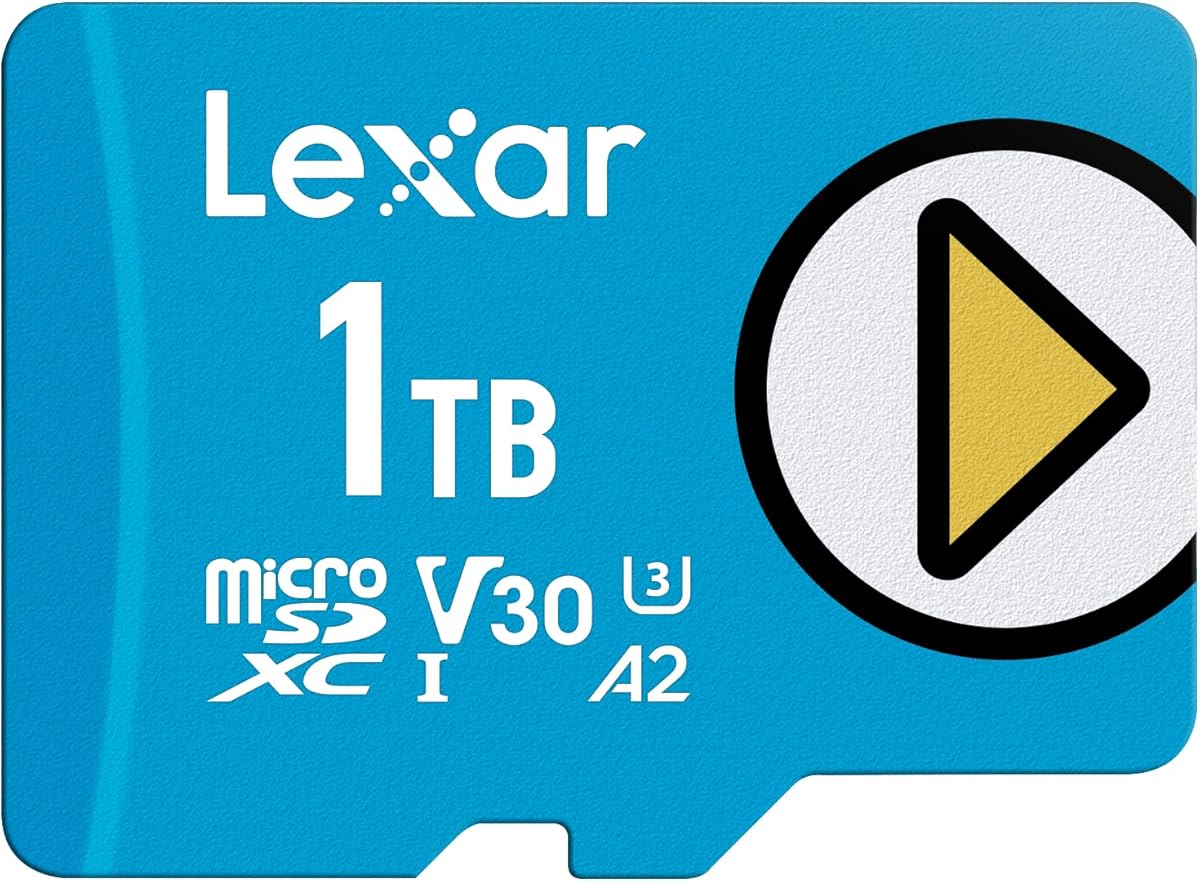

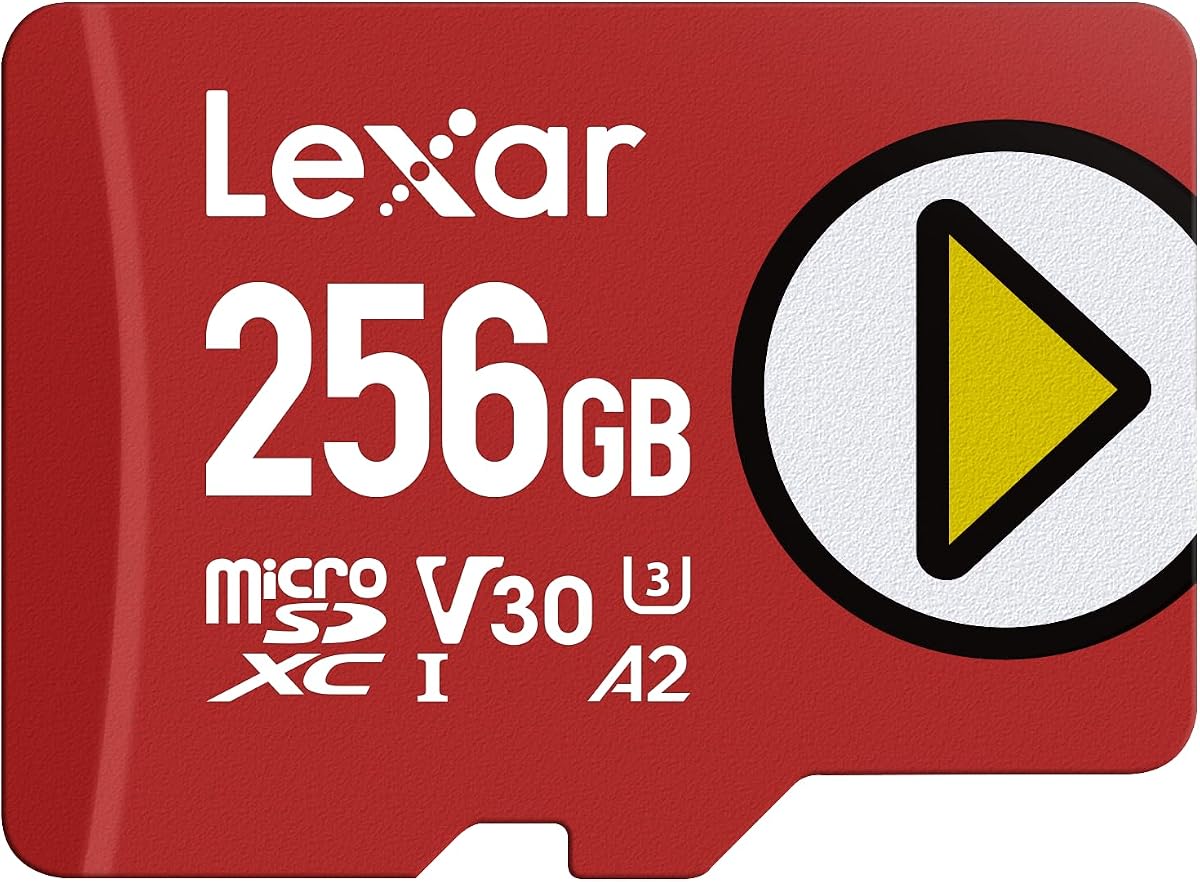
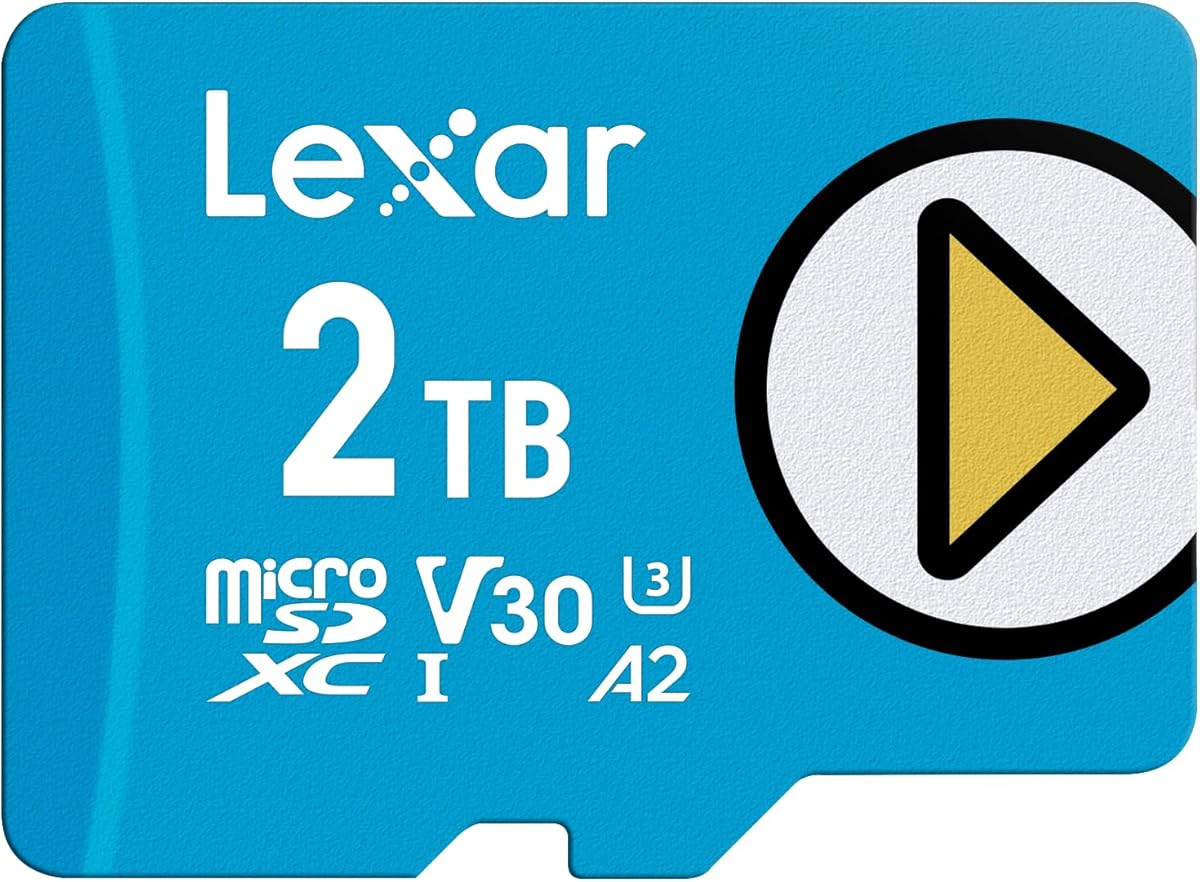


The Lexar 1TB Play Micro SD combines substantial capacity with one of the stronger conventional performance specifications in this guide. Its listed read speed reaches up to 205MB/s, while its write speed reaches up to 140MB/s. The card carries a 4.3 customer rating and is positioned as a practical all-rounder for expanding an ASUS ROG Ally game library.
We may earn a commission when you buy through this link, at no additional cost to you.
One terabyte is particularly useful when the internal storage of the handheld cannot accommodate several large titles. It can also hold backups, videos, photos, and files intended for transfer to a computer. The A2 rating is aimed at improving application access, while V30 support makes the card suitable for sustained 4K video recording workflows when used with compatible equipment.
The main limitation is that this is a UHS-I microSD card rather than a microSD Express product. Its strong headline speed does not equal the much higher transfer rates associated with an Express-capable slot. Buyers should therefore choose it for capacity and reliable everyday expansion rather than expecting the absolute fastest possible loading performance.
This is a strong recommendation for ROG Ally owners who want meaningful storage headroom without moving to the most specialized premium format. It suits users who install and remove games regularly, keep several portable titles on hand, or need one card for both console storage and personal media. Verify the current capacity and listing details before ordering.
A 1TB card provides much more room for large modern games than a small-capacity card. That makes it easier to maintain a portable library without repeatedly transferring and deleting files between the handheld and a computer.
The combination of up to 205MB/s reads, up to 140MB/s writes, and an A2 rating provides useful speed for game installs, file transfers, and application access within the limits of the UHS-I interface.
We may earn a commission when you buy through this link, at no additional cost to you.
The Lexar 1TB Play Blue is a high-capacity microSD option with a 4.5 rating, placing it among the better-reviewed products in this roundup. It advertises read speeds up to 160MB/s, 4K video support, a V30 rating, and A2 performance. Together, those features make it a sensible general-purpose card for an ASUS ROG Ally.
We may earn a commission when you buy through this link, at no additional cost to you.
The one-terabyte capacity creates a useful balance between portability and storage. Users can keep multiple game installations or a mixture of games and media without filling the card immediately. Its A2 classification also indicates an emphasis on application responsiveness, which is relevant when the card is used for portable games and Android-style apps.
Compared with the faster Lexar Play Micro SD, this card has a lower stated read speed, and the supplied information does not provide a specific maximum write speed. Those differences matter when moving large game folders or recording high-bitrate video. For normal handheld gaming and storage expansion, however, the lower figure may remain sufficient for many users.
Choose the Play Blue when capacity, the 4.5 rating, and broad device compatibility matter more than achieving the fastest conventional transfer rate. It is a good fit for ROG Ally owners building a moderate-to-large portable library or keeping one dependable card for games, media, and transferable files.
A2 performance is useful when a microSD card stores more than one-time media. It is designed to support faster app access and can be a meaningful advantage in portable gaming environments where load responsiveness matters.
The listed temperature resistance, waterproofing, and X-ray protection make the card better suited to travel and daily handling than an unprotected card, provided it is used within the manufacturer’s conditions.
We may earn a commission when you buy through this link, at no additional cost to you.
The Lexar 512GB Play Blue offers a middle ground between smaller cards and very high-capacity drives. Its listed read speed reaches up to 160MB/s, and it supports 4K video, V30, UHS-I, and A2 standards. The 4.5 rating indicates a favorable reception among customers.
We may earn a commission when you buy through this link, at no additional cost to you.
A 512GB card can provide room for several portable titles while remaining easier to organize than a two-terabyte option. It also works for storing media that can be transferred to a phone, tablet, or computer. Lifetime access to Lexar Recovery Tool adds a recovery-oriented tool for accidentally deleted files or formatted cards and drives.
The absence of a specific maximum write figure in the supplied details limits precise comparison with cards that state both read and write speeds. Users who regularly move very large files may prefer a model with clearer transfer specifications. For standard game installation, media storage, and mixed portable content, the stated performance is more than adequate on paper.
This card is best for an ROG Ally owner who wants dependable capacity without carrying an oversized two-terabyte option. It is particularly attractive when the Recovery Tool and five-year limited warranty matter alongside the 4.5 rating. Check that the card is properly formatted for the handheld before moving files.
Lifetime access to the Lexar Recovery Tool can help users attempt recovery after accidental deletion or formatting. Recovery utilities are not substitutes for backups, but they provide an additional layer of support when a card is used as active portable storage.
Half a terabyte is a practical midpoint for users who want several large games available but do not need to carry the largest available microSD capacity. It also simplifies card management compared with a very large library.
We may earn a commission when you buy through this link, at no additional cost to you.
The Lexar 256GB Play Micro SD brings up to 205MB/s read speed and up to 140MB/s write speed to a more compact capacity. It carries a 4.3 rating and explicitly supports portable gaming devices, making it a straightforward option for expanding an ASUS ROG Ally without carrying an oversized card.
We may earn a commission when you buy through this link, at no additional cost to you.
Its specification set includes V30, UHS-I, and A2 ratings, along with support for 4K video. Those features cover the core needs of a handheld game card: sufficient sequential performance for installing and loading games, plus application and video classifications for mixed-use storage. The five-year limited warranty adds a reassuring ownership detail.
Capacity is the central trade-off. A 256GB card may fill quickly with a handful of modern titles, particularly if the user also stores videos, backups, or media. It is also not a microSD Express card, so the advertised speed should not be compared directly with Express transfer figures from another product in the guide.
This is a good recommendation for a player who travels lightly and wants strong conventional performance in a modest-capacity card. It can work well as a curated game card containing one or two titles, or as a general media card. Choose a larger Lexar option if maintaining many installed games is the priority.
Up to 205MB/s reads and up to 140MB/s writes preserve strong transfer potential even at the smaller 256GB capacity. The result is a more compact option for users who regularly cycle through a small set of games.
V30 and 4K support make the card more versatile than a basic storage option, while A2 performance is useful for portable applications and files that may be accessed repeatedly.
We may earn a commission when you buy through this link, at no additional cost to you.
The Lexar 2TB Play Blue is the largest-capacity microSD card in the comparison, making it a natural option for a dedicated portable game library. It has a 4.5 rating, up to 160MB/s read speed, and support for 4K video, V30, UHS-I, and A2 performance.
We may earn a commission when you buy through this link, at no additional cost to you.
Two terabytes allows the ASUS ROG Ally owner to keep many large games, videos, and personal files on one removable card. That convenience can reduce the need for frequent transfers and deletions. The card also includes lifetime access to Lexar Recovery Tool and a five-year limited warranty.
Extra capacity does not increase the stated transfer speed. Users who frequently copy entire game libraries should not expect the performance of the microSD Express option in this guide. Very large cards can also be more demanding to manage, and it becomes more important to maintain organized folders and reliable backups.
This is the top choice for capacity-first buyers who want the ROG Ally to function almost like a larger, cartridge-based system. Choose it when portability of an extensive library matters more than obtaining the fastest possible file movement. Maintain a backup of irreplaceable files even with recovery software available.
Two terabytes dramatically reduces the need to remove games just to make room for new ones. That convenience is the defining advantage for users who regularly switch between portable and docked play.
As the card holds many gigabytes of content, access to the Lexar Recovery Tool can be valuable. Regular backups remain essential because no recovery utility can guarantee recovery in every failure scenario.
We may earn a commission when you buy through this link, at no additional cost to you.
The SANDISK 256B Extreme combines a 4.7 rating with the fastest stated conventional read speed in the guide: up to 245MB/s. It also offers up to 170MB/s writes for supported capacity models, along with U3 and V30 video ratings. For an ROG Ally owner seeking fast standard microSD performance, it stands out.
We may earn a commission when you buy through this link, at no additional cost to you.
The included adapter makes the card easier to use with full-size SD readers and compatible devices, which helps when moving files to a PC. Its U3 classification supports demanding recording use, and the listed 256GB capacity is enough for a focused collection of games or a mixture of handheld content and media.
Durability is a major strength according to the supplied information. The card is described as temperature, humidity, waterproof, shock, drop, magnet, X-ray, and wear-out proof. These protections make it suitable for mobile use, although proper handling and manufacturer conditions still apply. Capacity remains the main limitation for large libraries.
Choose the Extreme if you want fast transfers within standard microSD limitations and value the highest customer rating among the UHS-I choices. It is an excellent match for users who frequently install games or move large files. For a much larger library, consider a higher-capacity Lexar card; for an Express-capable device, investigate the specialized Express option.
The stated read speed of up to 245MB/s and write speed of up to 170MB/s lead the standard microSD products here. These figures are particularly relevant when copying complete game folders or large media collections.
The broad set of listed protections suits a handheld used in transit. Users should still keep the card in its protective slot, avoid exposing it to moisture outside its rated conditions, and replace it if the housing or contacts become damaged.
We may earn a commission when you buy through this link, at no additional cost to you.
The TEAMGROUP A2 Pro Plus pairs a one-terabyte capacity with up to 160MB/s read and up to 110MB/s write speeds. Its UHS-I, U3, A2, and V30 classifications cover several important storage standards, while the 4.3 rating indicates generally positive customer feedback.
We may earn a commission when you buy through this link, at no additional cost to you.
The product is listed for Nintendo Switch, Steam Deck, gaming devices, tablets, smartphones, and 4K shooting. That broad compatibility makes it a natural choice for a multi-device storage setup. The included adapter also helps with file transfers to compatible full-size SD equipment.
Its read figure is lower than that of the SANDISK Extreme, and its stated write figure is lower than the fastest Lexar Play Micro SD specification. The differences may not be noticeable in everyday handheld use, especially because the host device and installed games influence the result. Users should not equate the card’s advertised maximum with guaranteed application performance.
This is a strong pick when one card needs to serve both a large portable library and other devices. It suits buyers who value clear specifications, broad compatibility, and a large capacity without moving to the specialized Express format. The included adapter and A2 rating add convenience for a mixed gaming ecosystem.
The listed support for handhelds, tablets, phones, and 4K recording makes this card adaptable beyond the ROG Ally. That flexibility helps users avoid maintaining several incompatible storage formats.
U3, A2, and V30 ratings communicate suitability for demanding applications and sustained video workflows. These classifications complement the stated sequential speeds and give buyers a more complete view of the card’s intended use.
We may earn a commission when you buy through this link, at no additional cost to you.
The 256GB microSD Express Card is the premium performance selection in this guide. It advertises up to 880MB/s reads and up to 600MB/s writes, explicitly mentions ASUS ROG Ally compatibility, and has a 4.4 customer rating. It targets users who want the fastest compatible transfer performance available in the supplied lineup.
We may earn a commission when you buy through this link, at no additional cost to you.
Express technology is the major attraction. The stated figures can dramatically reduce transfer times in devices with compatible Express hardware, making the card attractive for repeated large game installations, high-bitrate 4K or 8K recording, and demanding camera workflows. The product also claims backward compatibility with ordinary UHS-I slots, although speed will then be limited by the host.
Buyers should verify that the specific ROG Ally model and any intermediary hardware support the format before purchasing. A card cannot deliver its full Express speed in a standard UHS-I microSD slot. Advanced thermal management is intended to help preserve performance during intense use, but actual results also depend on the host device, card position, and cooling conditions.
This is the premium recommendation for an ROG Ally owner who explicitly prioritizes transfer speed and has confirmed Express support. The 256GB capacity may be too small for a major library, so treat speed and capacity as competing priorities. For standard UHS-I use or extensive storage, a higher-capacity conventional card is more sensible.
Up to 880MB/s reads and 600MB/s writes can sharply reduce transfer time in compatible Express devices. That makes this card relevant for users who repeatedly install large titles rather than merely storing a few compact games.
Although the card is described as backward compatible with UHS-I slots, ordinary slots will not provide Express-level performance. Check the exact handheld, reader, adapter, and accessory specifications before making a purchase.
We may earn a commission when you buy through this link, at no additional cost to you.
The SANDISK 128GB Ultra is a compact entry-level card with a strong 4.7 rating and up to 195MB/s read speed. Its V10, U1, C10, and A5 classifications make it suitable for Full HD video and standard UHS-I workloads, including lighter portable gaming and media storage.
We may earn a commission when you buy through this link, at no additional cost to you.
The main appeal is straightforward value-oriented utility. The 128GB capacity can hold a selected group of games or a mix of smaller applications, music, photos, and offline media. Its read performance remains high enough for quick transfers, while the supplied information notes that it is optimized for faster app launch and overall app performance.
The small capacity is the decisive limitation. Large modern games can occupy a significant portion of a 128GB card, so this option works best for users who manage storage carefully. Its V10 and C10 ratings also place it below V30 and U3 cards for sustained, high-bitrate video recording.
Choose the Ultra as a lightweight secondary card or a curated game card for a ROG Ally. It is also a reasonable general-purpose option for phones, tablets, and cameras when a quick file transfer is the main need. Users building a large library should move up to a 256GB or greater model.
A 128GB card is easy to carry and can serve as a compact library of smaller or older titles. It is best treated as a curated collection rather than a full replacement for internal storage.
Up to 195MB/s reads make the card suitable for standard transfers, while V10 and C10 provide clear expectations for Full HD recording and general media use.
We may earn a commission when you buy through this link, at no additional cost to you.
The JSAUX PC0109 ModCase is not an SD card, but it is an important companion for ROG Ally owners who carry multiple cards. It has a 4.6 rating and is designed exclusively for the ASUS ROG Ally released in 2023. Its detachable front cover includes built-in storage for up to four microSD cards.
We may earn a commission when you buy through this link, at no additional cost to you.
The case combines those four card slots with a protective back shell and front cover. It is intended to shield the console, screen, and thumbsticks from scratches, dust, and everyday bumps while also providing a textured anti-slip surface for a more comfortable grip. Precision cutouts preserve access to buttons, ports, and vents.
The device fit is narrow and exact. It is explicitly not compatible with the ASUS ROG Ally X from 2024, the ROG Xbox Ally from 2025, or the ROG Xbox Ally X from 2025. Buyers must identify their handheld model carefully, particularly if they are considering an older unit or a similarly named release.
This is the right choice for a 2023 ROG Ally owner who wants a protective shell and a practical way to organize four removable cards. It does not improve card speed or add internal capacity, so it complements rather than replaces a storage card. The included straps can attach compatible accessories such as a power bank.
Built-in storage for four microSD cards reduces the chance of leaving a card behind at home, in a travel bag, or at another gaming location. It is especially helpful for users who swap between different capacity cards.
The protective shell and detachable front cover guard vulnerable surfaces, while textured material and precise cutouts seek to preserve grip and access to controls. The design is tailored specifically to the 2023 ROG Ally.
We may earn a commission when you buy through this link, at no additional cost to you.
Choosing a card for the ASUS ROG Ally involves balancing interface compatibility, storage capacity, performance, and durability. The most important first step is confirming how the handheld or accessory reads microSD cards, because advertised speed figures only represent the card’s maximum capabilities.
Begin by verifying the physical format and interface expected by the exact ROG Ally model. Standard microSD cards use UHS-I and are broadly suitable for normal handheld use, while microSD Express requires compatible hardware and a matching slot. A premium Express card cannot deliver its full speed in a conventional microSD reader, even if it remains usable there.
The supplied Express product specifically lists ROG Ally as an optimized platform, but buyers should still check the exact model and any adapter or accessory involved. Do not infer compatibility from the word microSD alone, because the underlying protocol and maximum supported speed can differ substantially.
Modern games can consume considerable space, so capacity is often more valuable than small differences in read speed. A 128GB card is appropriate for a few selected games or mixed media, while 256GB offers more breathing room. One-terabyte and two-terabyte options suit users who want a large portable library without frequent transfers.
Larger cards also make organization important. Use clear folders, avoid leaving incomplete transfers, and maintain a separate backup of important saves and personal files. Consider the balance between the amount of content you carry and the ease of managing a single card.
Read speed affects how quickly games and files can be loaded, while write speed matters when installing games, copying media, or recording video. The cards in this guide range from up to 160MB/s reads on conventional UHS-I models to up to 880MB/s on the Express option. These are maximum advertised figures, not guaranteed handheld results.
Host hardware, card position, file size, and the type of workload all influence real-world performance. A faster card still cannot exceed the limits of the slot into which it is inserted. Compare cards on both read and write figures when moving large game folders regularly.
The V10, V30, U1, U3, C10, A1, and A2 labels communicate minimum sustained performance for different use cases. V30 and U3 are relevant to sustained high-bitrate recording, while A1 and A2 focus on application and random-access behavior. These classifications can be more meaningful than headline sequential speed for certain workflows.
For an ASUS ROG Ally used primarily for games, UHS-I, A2, and an appropriate video class form a solid foundation. If the card also handles 4K or 8K recording for a camera or drone, prioritize the stated video speed class and write performance rather than gaming-oriented specifications alone.
A handheld travels, so resistance to shock, moisture, temperature, dust, and magnetic or X-ray exposure can be valuable. The SANDISK Extreme lists extensive protections, while Lexar cards offer durability features and, in some models, access to recovery software. No card is indestructible, and every protection claim depends on correct handling.
The JSAUX case adds another layer by protecting the handheld and organizing up to four cards. Recovery tools can help in some accidental deletion or formatting situations, but routine backups remain the best defense. The Recovery Tool should be treated as an additional safeguard rather than a replacement for preserving files elsewhere.
Different cards in the guide target different priorities. Standard Lexar and SANDISK UHS-I options suit portable games, transfers, and general media. The microSD Express card is intended for unusually fast transfers in compatible devices and also targets professional 4K or 8K recording workflows.
A gaming-focused buyer may get better practical value from a larger UHS-I card than from a smaller premium card. A creator moving large files between compatible devices may prioritize the Express option. Select for the heaviest workload rather than assuming the highest headline speed is necessary for every task.
An SD adapter can make it easier to transfer files between a microSD card and a compatible computer or camera. The SANDISK Extreme and TEAMGROUP A2 Pro Plus include adapters according to the supplied listings. Other products may be used directly in the handheld without one, so the accessory list should be checked before assuming an adapter is available.
Also look for related management tools. Some Lexar cards include recovery software, while the SANDISK listings reference Memory Zone for organizing and transferring content. Useful software can improve maintenance, but it should complement—not replace—regular backups.
The JSAUX accessory in this guide is exclusive to the 2023 ROG Ally and excludes the ROG Ally X from 2024, ROG Xbox Ally from 2025, and ROG Xbox Ally X from 2025. This illustrates why model verification matters when shopping for accessories and storage-related hardware.
For the handheld itself, confirm the available card format and whether any upgrade path depends on a specific reader or accessory. Search using the complete model designation, review the relevant manual, and compare the intended card against the supported specifications before checkout.
Before inserting a new microSD card, back up any existing data and confirm that the card is formatted in a file system supported by the ASUS ROG Ally. Use the handheld’s storage interface when possible, or use a compatible computer and reader that presents the card with a standard filesystem. Format the card before copying files so the system can assign them correctly.
Insert and remove the card only when the handheld is powered down or fully awake and not actively reading or writing files. Never pull it out during an installation, update, save, transfer, or application launch. After use, return it to a protective case or the JSAUX ModCase’s built-in slots, and keep the contacts clean and dry.
Avoid filling the card to its absolute limit because leaving a small amount of free space can help the system manage updates and temporary files. Periodically copy saves and personal media to another device, and use the card’s management or recovery software where applicable. If the card shows errors, unusual slowness, missing files, or physical damage, stop using it and inspect or replace it.
The products in this guide use the microSD form factor, but compatibility can extend beyond physical size to the interface and speed protocol. Standard UHS-I cards are designed for broad microSD use, while the listed microSD Express card requires compatible hardware to achieve its highest speeds. Verify the exact handheld model and its current specifications before purchasing.
It can be worth it if the exact device or accessory supports Express and you regularly transfer large game files. The listed Express card advertises up to 880MB/s reads and up to 600MB/s writes, far above conventional UHS-I figures. In a standard slot, however, performance will be constrained by the host, so the card’s premium characteristics may not benefit the buyer.
Choose 128GB for a small, curated set of games or lighter media use. A 256GB card offers more flexibility, while 512GB, 1TB, and 2TB options suit increasingly large libraries. The right balance depends on the size of your games, how often you can transfer files to a computer, and whether you prefer to carry a single high-capacity card.
Potentially, but only when the handheld, reader, and access method support the card’s speed. Advertised maximums cannot be achieved if the host device or interface is slower. Game files also vary in size, and storage architecture can influence perceived load times, so a faster card is most valuable for repeated large transfers.
You can copy compatible files between cards using a computer, but it is usually simpler and less error-prone to manage installed games directly through the handheld’s storage interface. Preserve existing save data, verify that the destination card has enough free space, and avoid interrupting transfers. The new card should also use a supported filesystem.
A2 is an application-performance class intended to indicate better random and random-sequential performance than A1 cards. It can help with app and game-file access, especially on compatible devices, although it does not guarantee a visible improvement in every title. Headline sequential speed, capacity, and device support still matter when selecting a card.
No. The supplied information says this case is made exclusively for the ASUS ROG Ally from 2023. It is not compatible with the 2024 ROG Ally X, the 2025 ROG Xbox Ally, or the 2025 ROG Xbox Ally X. Confirm the exact model before ordering the case or its four built-in microSD card slots.
Keep the card in a labeled protective holder, avoid touching the contacts, and do not remove it while the system is reading or writing. Use the protective ROG Ally case to organize up to four cards during travel. Maintain separate backups of important files, because durability features and recovery tools do not guarantee that every damaged card can be recovered.
The SANDISK 256B Extreme stands out as the strongest all-around conventional choice, combining a 4.7 rating with up to 245MB/s reads and up to 170MB/s writes. The 256GB microSD Express Card is the premium option for users who have confirmed Express support and need maximum transfer performance, while the SANDISK 128GB Ultra provides an efficient entry point with a 4.7 rating.
For larger portable libraries, prioritize capacity and choose among the Lexar Play, Play Blue, and TEAMGROUP options. A one-terabyte card often represents the most practical balance, while two terabytes maximizes space but does not increase transfer speed. Also consider the JSAUX ModCase if you own the 2023 ROG Ally and want to protect the device while organizing four cards.
Before ordering, verify the exact handheld model, confirm the supported card interface, and check whether your workload justifies a specialized format. Customer ratings and advertised specifications are useful but not substitutes for checking current device requirements and product availability. Prices and offers change frequently, so review the live listing before making a final purchase.