
ARCCTV 4MP Two-Pack
4.1Editor score
Two wireless 4MP cameras
Detachable solar panels
Dual-band Wi-Fi support
Our Solar Wireless IP Cameras guide compares 10 solar-powered security cameras for resolution, coverage, storage, alerts, night vision, and installation for
Solar wireless IP cameras combine a network-connected security camera with a rechargeable battery and solar panel, reducing the need for power cables and frequent battery changes. The best models add useful night vision, flexible viewing controls, intelligent detection, local recording, and dependable Wi-Fi connectivity.
We compared the ten products in this guide by examining resolution, solar charging, storage options, motion detection, two-way audio, outdoor durability, network support, installation requirements, and system capacity. The list includes individual cameras, two-packs, and larger kits for users covering everything from one entry point to an entire property.
Each review identifies the camera set's strongest qualities and practical limitations, helping you distinguish a compact single-camera solution from a multi-camera security system. Product details and availability can change, so confirm the current specifications, included accessories, app requirements, and storage terms before purchasing.
4.1Editor score
4.3Editor score

4.9Editor score
The comparison below highlights camera quantity, video resolution, storage choices, connectivity, and major detection features across all ten systems, making it easier to identify the option that matches your coverage needs and recording preferences.



This is the most complete all-in-one system in the group, combining a solar outdoor camera, a 500GB hard drive, local recording, dual-band Wi-Fi, two-way audio, and support for as many as ten cameras. Its 4.9 rating reflects an unusually strong reception, while 4MP recording and color night vision make it especially appealing for monitoring driveways, entrances, yards, and other areas where useful detail matters.
We may earn a commission when you buy through this link, at no additional cost to you.
The supplied 500GB drive allows recordings to remain on the included NVR without a recurring subscription, and a TF card slot provides an additional local option. The camera's 355-degree horizontal rotation and 90-degree vertical tilt provide broad coverage, while the 4MP sensor and stated night visibility of up to 65 feet support detailed monitoring after dark. Smart PIR detection can focus on human activity, and the app includes configurable sensitivity, notifications, two-way talk, and a sound-and-light alarm zone.
Solar operation is handled by a four-watt panel and an 8000mAh battery, with two hours of sunshine described as supporting a day of recording. That is a useful level of reserve for variable weather, although actual runtime depends on sunlight, placement, activity, and recording behavior. Some advanced AI categories are described as premium app features, so buyers prioritizing basic local recording should check exactly which detection tools remain available without payment.
This system is the strongest choice for someone who wants a coherent, expandable home setup rather than a single standalone camera. It suits users who value local storage, broad camera capacity, higher resolution, and no routine subscription for core recording. The NVR, drive, and full-system approach add complexity, but for a property-wide installation it delivers the broadest mix of capabilities in this list.
The included 500GB hard drive keeps core recordings local, while the optional TF card adds flexibility for backup or isolated use. This makes the system attractive for households that prefer to control their own footage without depending on a recurring cloud plan.
The 4MP sensor records more detail than the 2K cameras in the group, and the stated full-color night range reaches up to 65 feet. The spotlight and adjustable PTZ controls can help reveal faces, vehicles, and license-plate details after dark.
We may earn a commission when you buy through this link, at no additional cost to you.
The ARCCTV two-pack is a practical way to cover two separate outdoor locations without building a larger multi-camera hub system. It records in 4MP, supports both 2.4GHz and 5GHz Wi-Fi, and includes a detachable solar panel for each camera. Its 4.1 rating places it among the more affordable options, but the important distinction is that it provides real 4MP detail rather than settling for basic 1080p imagery.
We may earn a commission when you buy through this link, at no additional cost to you.
One of the most useful design choices is the detachable panel. It can be placed in the sunniest available position while the camera itself remains where the viewing angle is best. The cameras offer 355-degree horizontal and 90-degree vertical movement, controlled manually through the ARCCTV app. Local microSD recording up to 128GB provides a no-fee option, while cloud storage is available as a paid alternative for remote backup and AI event tagging.
The lack of automatic tracking deserves attention if you expect a camera to follow a person across a yard. A moving subject may leave the manually fixed frame unless another camera covers that direction or you reposition the view. The product description also advises starting near the router during configuration and keeping each camera within reliable Wi-Fi coverage, so strong signal placement is important despite dual-band support.
This pair is ideal for renters, first-time camera owners, and households that need two entry points without committing to a full NVR-based system. It provides 4MP recording, flexible solar positioning, and local storage in a straightforward package. Users who prioritize convenience and higher resolution over automatic tracking will find it especially well matched to their needs.
Because each panel is detachable, it can face direct sunlight even when the camera needs to sit under an eave or face a shaded approach. That flexibility can improve charging consistency without forcing the camera into an awkward position.
The 2560-by-1440 recording resolution offers a useful detail advantage over standard 1080p cameras. Dual-band Wi-Fi can use 2.4GHz for reach or 5GHz for speed, although placement and initial setup remain important.
We may earn a commission when you buy through this link, at no additional cost to you.
This standalone AlkiVision camera packs many premium-style functions into a relatively compact solar unit and earned a 4.6 rating. It combines 2K panoramic recording, full-color night vision, a spotlight, a siren, two-way talk, AI-assisted detection, and 2.4GHz Wi-Fi in one outdoor camera. It is a strong candidate for monitoring a single driveway, side entrance, patio, or parking area.
We may earn a commission when you buy through this link, at no additional cost to you.
The built-in 5000mAh battery and separate solar module create a generous energy reserve, with the product information stating that two hours of direct sunlight per day can support all-day operation. The camera offers a 120-degree adjustable housing for a 360-degree viewing pattern, and its AI PIR sensor can trigger real-time phone alerts. Motion events can produce clips of up to 20 seconds, followed by the siren and spotlight as a proactive deterrent.
Local microSD storage up to 128GB avoids the need for cloud recording, but advanced recognition for people, vehicles, pets, and packages depends on an AI cloud subscription. That distinction is important: the underlying motion and AI PIR functions remain useful, while the richest event classification is tied to the service. The camera also supports only 2.4GHz Wi-Fi, which is widely compatible but cannot take advantage of a 5GHz-only network.
This camera is best for a user who wants many visible security features without assembling a multi-camera hub. Its 4.6 rating, strong night tools, two-way communication, and flexible power design make it a persuasive all-around solo option. Buyers who rely entirely on free cloud-based AI classification should choose more cautiously, while those comfortable with local recording will find the core package versatile.
The combination of a siren, bright spotlight, phone notifications, and automatic event recording gives the camera several ways to respond to an approach. That is more active than a basic camera that only saves a clip after movement.
The adjustable body provides a broad 360-degree view while the 2K sensor preserves more detail than standard-definition alternatives. A single unit can therefore serve as a general-purpose camera for a medium-sized outdoor area.
We may earn a commission when you buy through this link, at no additional cost to you.
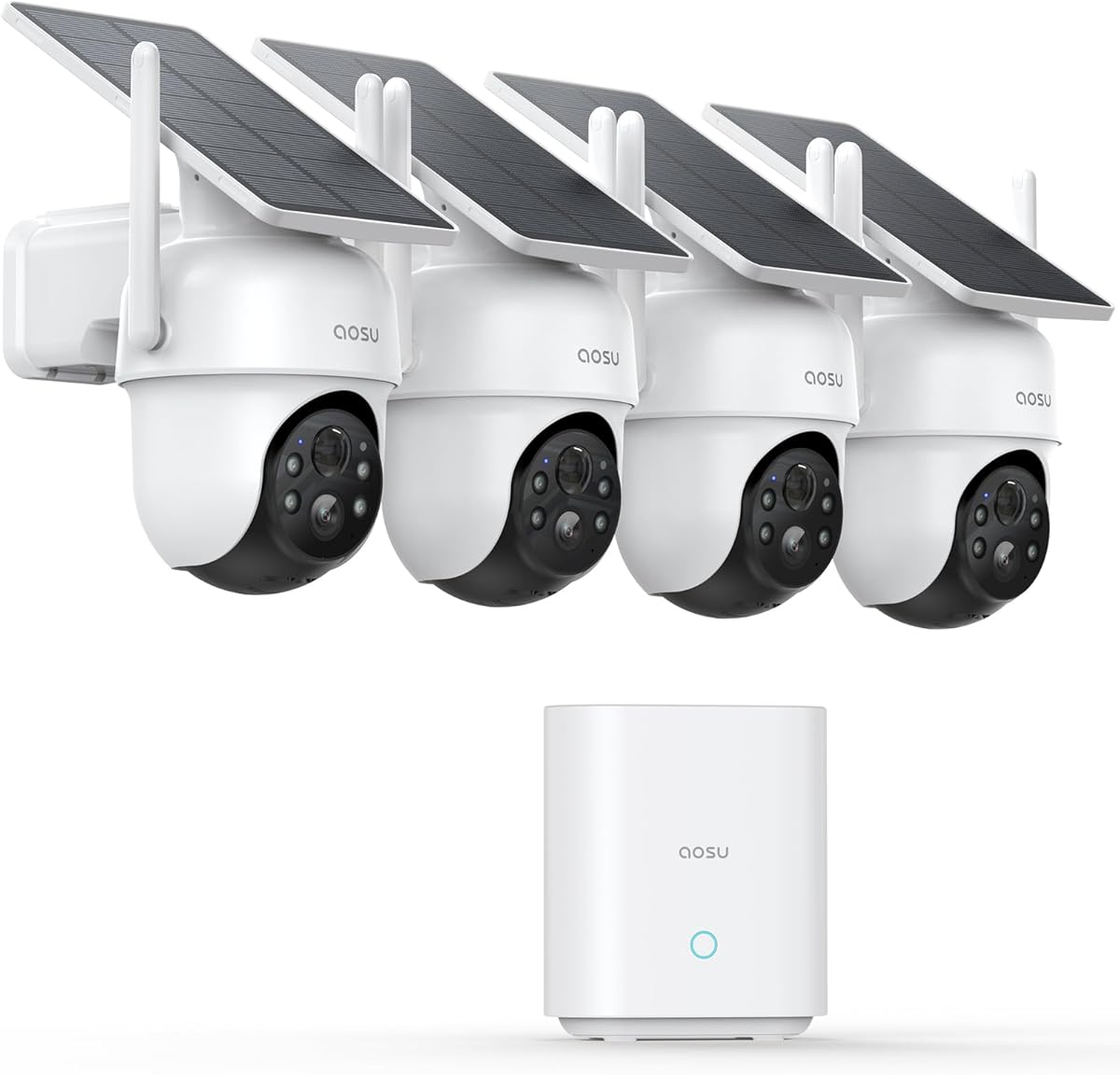
The aosu D1 Classic is built for users who want four cameras and automated subject tracking rather than manual repositioning. It holds a 4.3 rating and combines 3MP recording, a 32GB local aosuBase installation, 360-degree pan-and-tilt movement, and automatic tracking of activity within a target area. Four cameras provide broader coverage than the smaller packs in this guide while retaining subscription-free core recording.
We may earn a commission when you buy through this link, at no additional cost to you.
A particularly useful feature is its ability to relate recordings from the same event across cameras, which can save time when reviewing movement through several zones. The app can also display four live areas simultaneously and let one user control the status of multiple outdoor cameras from a single interface. Local encryption, notifications, and stable streaming are all included, and the stated 32GB capacity can support as much as four months of loop recording.
Solar panels are integrated into the cameras, with three hours of daily sunlight described as keeping the batteries operating through cloudy conditions. The automated tracking is more sophisticated than the ARCCTV pair's manual controls, but the 3MP resolution is lower than the 4MP available from the top-ranked NVR system and the Hiseeu four-pack. Users who insist on the sharpest possible file or plate capture may prefer those alternatives, while most property-monitoring tasks can benefit more from four viewpoints and coordinated tracking.
This kit is a strong fit for a medium or large home where front, back, side, and garage entrances need continuous monitoring. It is particularly useful for families that want live viewing from multiple cameras and event review without routine storage fees. Anyone comfortable managing a shared base and configuring each camera's detection zone should get an unusually capable system from this package.
The camera follows activity within its target area, and cross-camera event relationships help connect the same occurrence across different views. This can be valuable when monitoring a property with several connected outdoor zones.
The 32GB aosuBase allocation is designed for loop recording without a mandatory subscription. Multiple live streams, event notifications, and encrypted local storage are managed through one ecosystem.
We may earn a commission when you buy through this link, at no additional cost to you.
The GALAYOU R6 is a compact single-camera solution that emphasizes proactive deterrence and straightforward placement. It combines 2K recording, automatic pan-and-tilt tracking, human detection, a built-in siren, two-way audio, and flexible solar power in one package. Its 4.1 rating reflects a capable budget-oriented camera, especially for users who want active response rather than passive recording alone.
We may earn a commission when you buy through this link, at no additional cost to you.
Once PIR motion is detected and the system identifies human activity, the camera can move through 344 degrees horizontally and 85 degrees vertically. Users can also trigger the siren remotely, creating an immediate warning for a visitor or unexpected presence. A noise-canceling microphone and speaker improve two-way conversations, while multi-user sharing allows household members to access the feed from the app.
The solar panel can operate as the primary source or be positioned flexibly, and a Type-C connection acts as a backup during extended cloudy weather. The IP65 rating supports year-round outdoor use. Recording choices include a TF card up to 128GB and optional cloud backup, but out-of-the-box access is limited to two days of ten-second alert clips and five days of snapshots, so a card is advisable for users wanting a longer visual history.
This camera suits a single vulnerable point such as a gate, side yard, garage entrance, delivery area, or remote building. It is particularly attractive if you want a camera that can actively follow a person and sound an alert. It is less suitable for homes that require 5GHz Wi-Fi, very long event history without added storage, or a multi-camera centralized dashboard.
Automatic tracking, human-oriented alerts, a remote siren trigger, and two-way communication make the R6 feel like an active guardian. These tools can deter a visitor without requiring the user to rush to the live feed.
The detachable or integrated solar arrangement gives placement freedom, and the Type-C port provides a useful backup when sunlight is limited. That makes the camera suitable for remote yards, barns, and secondary buildings.
We may earn a commission when you buy through this link, at no additional cost to you.
The SEHMUA camera is a straightforward 2K PTZ model for a single outdoor zone. It provides 355-degree horizontal rotation, 100-degree vertical movement, solar power, PIR detection, two-way talk, and color night vision, earning a 4.2 rating. Its wide tilt range helps it cover both ground-level approaches and higher portions of a wall, porch, or yard.
We may earn a commission when you buy through this link, at no additional cost to you.
The camera is built for outdoor conditions with an IP65 rating and an operating range of minus 4 to 121 degrees Fahrenheit. Its solar battery is intended to recharge continuously, eliminating a power cable at the installation point. The 2K sensor delivers sharper imagery than 1080p cameras, while the built-in spotlight can illuminate the scene and produce color video after dark.
One important limitation is that the spotlight must be manually activated to use color night vision. The product does not state that color night mode turns on automatically with detection, so users who want immediate color illumination should account for that in their setup. It also operates on 2.4GHz Wi-Fi only, which generally provides good range but cannot be used on a 5GHz-only network. Event storage is available through two routes, although the supplied details do not specify every capacity and retention detail.
This camera is a good fit for buyers who want a wire-free camera with wide manual coverage, reliable outdoor construction, and useful night illumination. It suits a driveway, backyard, garage, or porch without the complexity of a multi-camera system. People who want automatic night lighting, 5GHz support, or more elaborate tracking should look toward the AlkiVision or GALAYOU models.
The 100-degree vertical movement is especially useful for properties with both low approaches and elevated activity. Horizontal rotation then lets the camera cover a wide yard or driveway from one mounting point.
The IP65 enclosure and stated temperature range make the camera practical for year-round exterior use. Solar charging keeps the installation wire-free while preserving flexible placement.
We may earn a commission when you buy through this link, at no additional cost to you.
This unnamed four-camera system delivers a balanced mix of 2K video, dual-band Wi-Fi, solar power, human detection, and two-way communication. Its 4.3 rating and four-camera format make it a useful option for covering several outdoor areas without moving to a larger hub-based kit. It also supports optional cloud storage, live viewing, and playback through Alexa voice commands.
We may earn a commission when you buy through this link, at no additional cost to you.
Each camera includes a detachable solar panel and backup battery, and the product information states that two hours of daily sunlight can maintain continuous operation. The built-in spotlight provides color night vision when motion is detected. Remote pan, tilt, and zoom controls provide a broad view, while IP65 construction is intended to handle rain, snow, dust, and temperature changes through the year.
The camera uses PIR together with AI human detection to reduce notifications from moving objects or animals. That focus can make alerts more useful in busy yards, although real-world accuracy still depends on placement, distance, lighting, and sensitivity. Local recording requires a microSD card, which is not included, and cloud service is optional rather than mandatory. This gives users a clear path to either local or remote storage without making either format the sole option.
This four-pack is well suited to homeowners who want broad coverage, flexible panel positioning, and modern connectivity without moving to a six-camera system. It also fits users interested in voice-assisted monitoring. Those who need higher 4MP detail, centralized multi-camera tracking, or a large included storage drive should compare the top-ranked system and the aosu kits.
Detachable panels can be mounted where sunlight is strongest while the cameras remain at useful viewing heights. This is particularly helpful around trees, eaves, fences, and other partially shaded locations.
Combining PIR with AI human detection helps the system distinguish people from other movement. The result is fewer distracting alerts and more relevant notifications when used with sensible sensitivity settings.
We may earn a commission when you buy through this link, at no additional cost to you.
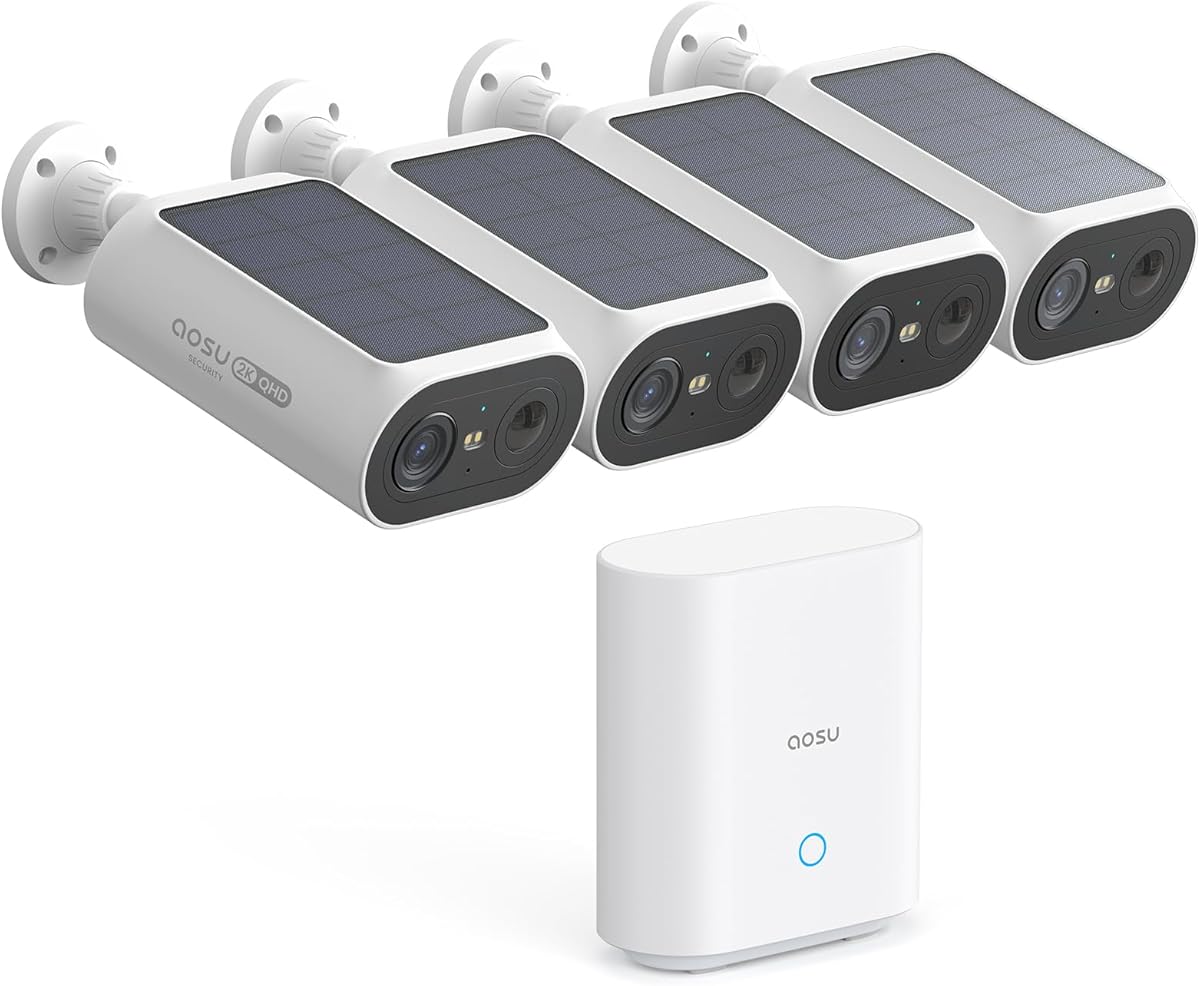
The aosu 2K QHD four-camera kit is an impressive system-level option, particularly for users who want a connected view of several parts of a property. It combines 2K color night vision, a 32GB encrypted aosuBase, dual-band Wi-Fi, cross-camera tracking, simultaneous viewing, and three alert modes. Its 4.3 rating reflects a well-rounded system with more coordination than a standard independent camera pack.
We may earn a commission when you buy through this link, at no additional cost to you.
The bullet cameras use a 130-degree fixed angle, which can provide focused coverage of driveways, gates, garages, fences, and other defined locations. At night, the cameras can capture detail up to 30 feet away, and four LED lights support color night vision. The aosuBase manages local playback, secure downloads, notifications, and live feeds while retaining recordings for up to 60 days according to the supplied information.
Cam-to-Cam tracking is the defining feature. It can sync a person's movement across different cameras and present a time-aligned path from entry to exit, reducing the need to watch unrelated feeds independently. The system also offers siren, spotlight, and app-notification alerts. Each camera has a 5500mAh battery, while the solar panel is designed to recharge from two hours of direct daily sunlight. The fixed lens and shared hub make deliberate placement important.
This kit is an excellent recommendation for a home that needs four clearly defined viewpoints and coordinated event review without a mandatory subscription. It offers a stronger overall system experience than simply buying four unrelated standalone cameras. Buyers should position each fixed-angle unit deliberately, while those wanting moving lenses or 4MP resolution should consider the ARCCTV pair or top-ranked NVR system.
Cam-to-Cam tracking connects a subject across separate views and reconstructs the route taken through the property. This can make event review faster and provide a clearer picture than isolated clips.
The aosuBase includes 32GB of encrypted local storage, supports free playback and downloads, and avoids a mandatory subscription. That approach is attractive for users who want direct access to their recordings.
We may earn a commission when you buy through this link, at no additional cost to you.
The aosu 2K six-camera kit is designed for broad property coverage and future expansion. It includes six solar cameras, a unified aosuBase, local storage without a mandatory subscription, PIR and AI human detection, full-color night vision, and cross-camera event grouping. Its 4.1 rating is still solid, though the four-camera QHD kit has a slight rating advantage and a more detailed description of its tracking workflow.
We may earn a commission when you buy through this link, at no additional cost to you.
A split solar-panel design separates the camera from the panel, allowing the panel to be placed in direct sunlight while the camera covers the required area. The app can display up to four camera feeds simultaneously, and Camera-to-Camera Tracking groups the same person across multiple views into a single timeline. This helps reduce repeated alerts and shortens the process of reviewing a property-wide event.
Local storage can be expanded through microSD up to 1TB, which is sold separately, and the system does not require a paid plan for its basic local-storage model. A warning is appropriate: solar performance changes with sunlight, season, mounting position, and camera settings, so the panel should be positioned deliberately. The camera-to-camera detection also depends on suitable lighting, distance, and field-of-view overlap.
This kit is a strong choice for a large home, farm, rental property, or multi-building site that needs more than four viewpoints from the beginning. It offers better initial coverage than the four-camera kits and still allows future expansion. Users wanting maximum night detail, 4MP files, or more simultaneous on-screen views may prefer other options, but the six-camera package delivers strong flexibility.
Six cameras can cover entrances, outbuildings, parking areas, and perimeter zones without immediately requiring additional units. The system also supports expansion as security needs develop.
The ability to expand local storage to 1TB gives users more control over retention and backup. It is particularly helpful for a multi-camera setup where event volume can accumulate quickly.
We may earn a commission when you buy through this link, at no additional cost to you.
The Hiseeu four-pack stands out because it combines four cameras with 4MP recording in a wire-free solar package. It earned a 4.2 rating and includes 2560-by-1440 sensors, full-color night vision, dual LED modes, a siren, two-way audio, and IP66 weather resistance. That resolution makes it a compelling four-camera option for users who want more detail than the 2K packs provide.
We may earn a commission when you buy through this link, at no additional cost to you.
Each camera has a 5200mAh battery, and the product information states that two hours of direct sunlight per day can support all-day operation. The battery is also described as handling as many as 5000 triggers or one to five months of use per charge, depending on activity. Installation is presented as a three-step process, while mobile-app control and multiple connection methods add flexibility for different outdoor locations.
The camera supports 2.4GHz home Wi-Fi, wireless, or hotspot connections, but it does not offer the 5GHz option found in the aosu and ARCCTV systems. Local storage, an SD card, and optional cloud storage are available, with extended cloud access requiring payment. Compatibility with other Hiseeu wireless systems can be useful for existing users, and Alexa support allows some voice-based control.
This four-pack is best for buyers who prioritize 4MP detail across several areas and want color night imagery without moving to a larger NVR system. It is a strong match for driveways, front entrances, garage areas, and yards. Users who need 5GHz connectivity, large centralized storage, or advanced cross-camera workflows should consider the stronger system-level options in the upper part of the list.
Four 4MP cameras offer a useful balance of coverage and detail. The higher resolution can make faces, labels, vehicles, and license plates easier to inspect in suitable lighting.
Siren support, red and white LED modes, instant notifications, and two-way communication provide several ways to respond after an event. The full-color night capability helps preserve useful visual evidence.
We may earn a commission when you buy through this link, at no additional cost to you.
The right solar wireless IP camera depends on how many areas you need to monitor, how much detail you expect, where sunlight is available, and whether local storage is a priority. These factors help separate a simple single-camera purchase from a coordinated multi-camera system.
Choose 4MP for close identification, 2K for balanced detail, and pay close attention to how color night vision is activated.
Prioritize direct sun, flexible panel placement, and a large battery reserve for dependable year-round operation.
Compare local capacity and paid-feature boundaries, not just whether cloud service is mentioned.
Match the camera's radio to your router, then improve outdoor signal with placement or a mesh network.
Count distinct outdoor zones first, then choose a pack that covers them without relying on motion to locate distant activity.
Prioritize human detection and useful recording behavior over the number of advertised AI categories.
Choose a suitable water rating, check temperature limits, and avoid placing the camera where runoff or snow can accumulate.
Treat two-way talk as a useful bonus, then verify app sharing and voice-control support against your household needs.
Begin by mapping every area that needs coverage and identifying the sunniest viable mounting point for each solar panel. Install the app, create the account, connect the camera near the router, and complete the initial pairing before moving it to its permanent location. Update all firmware, set the date and time, choose a strong password, and confirm that live viewing and recordings work before tightening the mount.
After installation, adjust the detection zones, activity sensitivity, notification preferences, and recording schedule. Walk the entire monitored area to test coverage. Verify the camera at different times of day and in darkness, and adjust the field of view so important paths remain visible. If tracking is available, check whether the camera returns to a useful home position after following a subject. Connect household members only after creating the appropriate user access and privacy settings.
Maintenance should include cleaning the lens and solar panel, checking the bracket, and inspecting the battery's charging behavior. Dirt on either surface can reduce image quality or charging efficiency, while a shifted mount can leave part of the property uncovered. Keep the app and camera firmware current, confirm the local storage remains healthy, and export important evidence before changing or formatting a card. After severe weather, inspect seals and reposition any panel that has accumulated snow or debris.
No. Solar power eliminates the need for a nearby electrical outlet, but the cameras still need a wireless network for live viewing, alerts, and many recording features. Some systems offer local recording or hotspot options, but network access remains important for remote access and coordinated multi-camera functions.
Most models in this guide are described as needing approximately two to three hours of direct sunlight for daily operation. Actual charging varies with panel orientation, season, weather, camera activity, and battery condition. A panel that receives unobstructed sun will generally perform more consistently than one placed under an eave or near dense foliage.
Yes, if the model supports local storage through an included drive, base unit, microSD card, or TF card. However, advanced cloud recording and some AI recognition tools may require payment even when basic operation does not. Check which exact features are free before deciding that a camera is subscription-free.
4MP generally preserves more fine detail and can make identification easier when the subject is reasonably close. The 2K models are still sharp enough for many entrances, yards, and general monitoring situations. Resolution is only one factor, so lighting, lens quality, motion settings, and camera placement also affect useful results.
Many models include weather-resistance ratings and stated operating-temperature ranges designed for outdoor use. Battery charging can still slow during poor weather, so a larger battery and well-positioned panel help maintain operation. Extreme conditions, blocked sunlight, and damaged seals can reduce reliability and should be considered before installation.
The 2.4GHz band usually provides better range and can pass through walls more effectively, making it useful for distant outdoor cameras. The 5GHz band generally delivers faster performance with less interference but has a shorter effective range. Dual-band cameras give you flexibility, while models limited to 2.4GHz require a compatible router band.
Choose a single camera for one clearly defined area or a small property. Multi-camera kits are more useful when you need to monitor several entrances, sides of a home, parking areas, or outbuildings. Coordinated tracking, shared live views, and centralized storage also become more valuable as camera count increases.
Local storage on an included hard drive or removable card generally gives the user direct control and avoids reliance on cloud retention. Encryption, strong account passwords, restricted app access, and timely firmware updates can further protect the footage. Users who need remote backup should understand exactly what data cloud services retain and how to manage or remove it.
The top-ranked No Monthly Fee Solar NVR System offers the broadest complete package, combining 4MP recording, an included 500GB drive, expandable capacity, dual-band Wi-Fi, and color night vision. The aosu 2K QHD four-camera kit stands out for coordinated tracking and encrypted local playback, while the ARCCTV 4MP two-pack provides flexible solar placement and a practical way to cover two areas.
Prioritize the features that directly affect your use case. Choose higher resolution for close identification, dual-band connectivity for crowded or obstructed networks, local storage for long-term control, and human-focused detection for fewer distractions. For larger properties, camera quantity and cross-camera review may matter more than having one especially elaborate standalone unit.
Before ordering, verify the current listing, included components, storage requirements, app compatibility, and any subscription-dependent features. Solar performance also depends on installation, so use the manufacturer's placement guidance and check the live view after positioning each panel and camera.