
EF ECOFLOW Delta 3
4.7Editor score
1,800W rated output
56-minute full recharge
Expandable to 5kWh
Runs 13 appliances
Our Tailgating Generator for TV guide compares 10 quiet, portable options for powering TVs, speakers, and game-day electronics reliably indoors or outdoors.
A tailgating generator for TV should deliver dependable electricity without overpowering the atmosphere around your viewing party. The right unit must run a television, streaming box, speakers, chargers, and other game-day electronics while remaining manageable, quiet enough for conversation, and safe in the intended setup area.
We compared ten portable gas and battery-powered options based on power output, energy capacity, outlet selection, charging flexibility, noise-related information, portability, and safety features. The list covers compact inverter generators, larger fuel-flexible machines, and portable power stations designed for electronics, outdoor entertainment, and backup use.
Each pick reveals a different balance of capability, and the rankings are not intended to imply identical performance for every application. A compact power station may suit an easy indoor setup, while a fuel-powered generator can offer longer runtime. Confirm current specifications, availability, pricing, and operating requirements before making a final purchase.
4.7Editor score

4.7Editor score

4.0Editor score
The table below compares all ten candidates by power type, core capacity or output, practical tailgating features, and their most notable limitation. Battery stations emphasize quiet, fume-free operation, while gas generators emphasize sustained runtime and higher or more flexible output.





The Jackery HomePower 3600 Plus combines a substantial 3,584Wh battery with 3,600W of continuous AC output, giving it the versatility to support a television and streaming equipment while leaving room for speakers, lights, and charging devices. Its 4.6 rating reflects a strong overall balance of capacity, output, charging options, and mobility for a portable power station.
We may earn a commission when you buy through this link, at no additional cost to you.
The most impressive feature is the combination of usable capacity and power. Jackery states that two units can operate in parallel to deliver 7,200W, while a single unit supports both 120V and 240V arrangements in parallel configurations. Four charging paths—hybrid AC and DC, standard AC, solar, or a gas generator—give owners more ways to restore power in different environments.
Its battery architecture also targets durability. Ceramic membrane cells are described as tested at 302°F, and the product is rated for 6,000 cycles with a stated 10-year lifespan. The trade-off is size and weight: although Jackery calls it the lightest 3.6kWh LFP power station and says it is smaller and lighter than competing models of similar size, a 3.6kWh system is still a substantial piece of equipment to transport.
This is a strong choice for a tailgate where the television, sound system, and other devices need substantial power without relying on engine noise or open-flame fuel handling. It may be excessive for a single small television, but it provides useful headroom for a multi-device event or a portable power station that will also support travel and emergency preparation.
The 3,600W continuous output provides ample room beyond a TV and streaming box. It can also support speakers, small appliances, lighting, and device charging, making it useful when the gathering extends beyond a single screen.
AC, solar, car charging through a compatible setup, and gas-generator input make the unit adaptable to homes, campsites, and road trips. The stated two-hour hybrid recharge is especially attractive when quick restoration matters.
We may earn a commission when you buy through this link, at no additional cost to you.
The Jackery 3600 Plus Solar Kit combines the same 3,584Wh HomePower 3600 Plus platform with two 200W solar panels. That makes it a particularly complete energy package for a tailgating setup that needs daytime replenishment, although the additional panels add storage and carrying demands.
We may earn a commission when you buy through this link, at no additional cost to you.
The battery supplies 3,600W of continuous output and can reach 7,200W when two compatible units are configured in parallel. For a television event, that capacity is likely more than a small screen requires, but it also creates room for a larger display, audio equipment, refrigeration, lighting, and repeated device charging without relying on venue power.
The kit is most compelling for campers or event organizers who want a renewable charging option. Jackery lists a four-hour solar charging time and also supports AC, hybrid AC and DC, and gas-generator charging. The trade-off is that two unfolded solar panels need meaningful space and sunlight, and they are not a substitute for carrying the unit already fully charged.
Choose this version when self-sufficient recharging and bundled equipment are priorities. Buyers who will have reliable access to AC power or only need a television and a few small devices may prefer the standalone HomePower 3600 Plus to avoid transporting two additional panels.
The paired 200W panels allow the power station to recharge in the sun, reducing dependence on venue outlets or vehicle charging during a prolonged outdoor event. Panels should be positioned where they receive direct sunlight and are protected from obstruction.
With 3,600W available, the kit can serve a complete entertainment area rather than only a television. That makes it useful for anyone planning to add speakers, lights, charging hubs, or a small cooler to the event.
We may earn a commission when you buy through this link, at no additional cost to you.
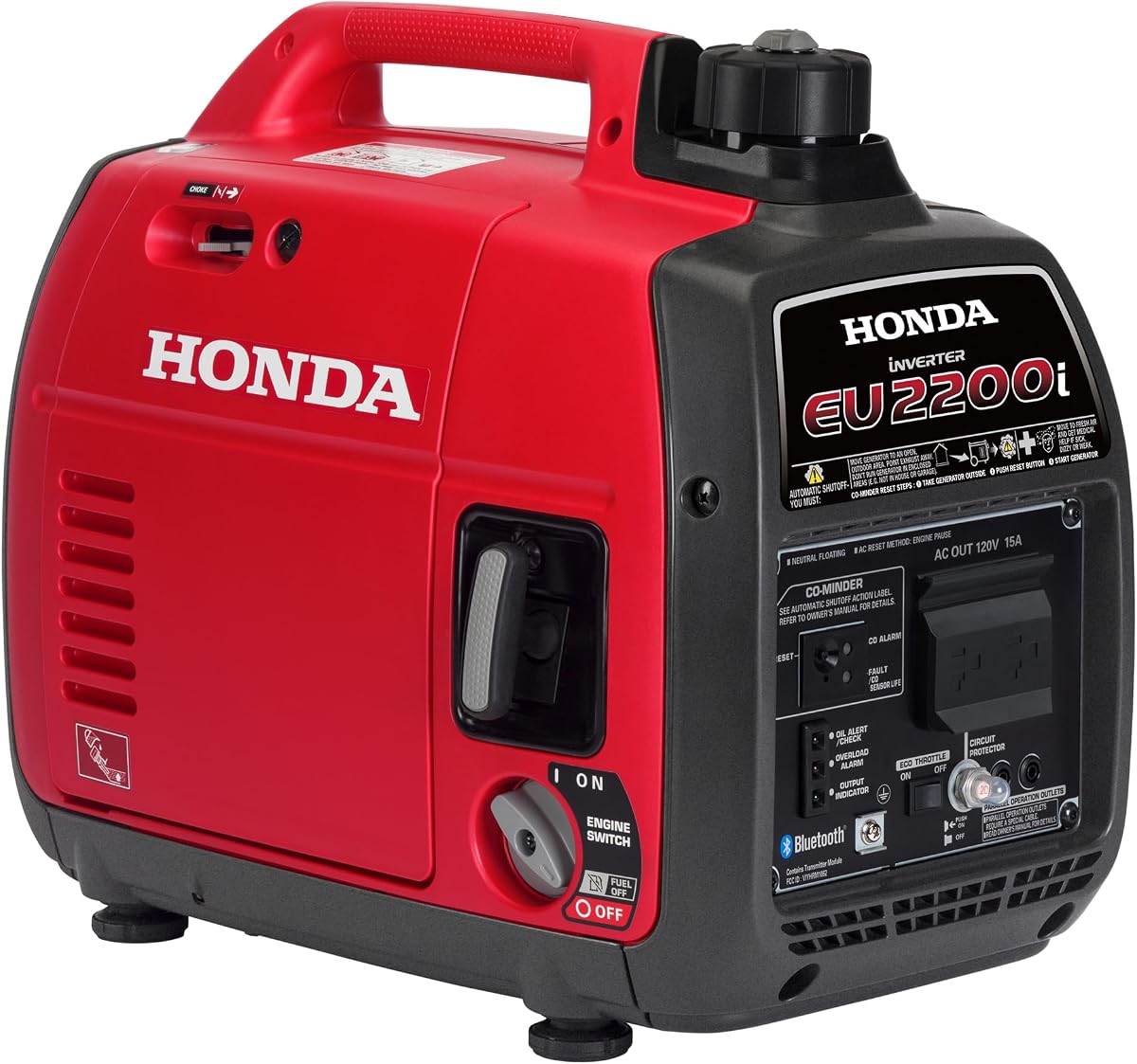
The Honda EU2200i is a compact gasoline inverter generator with 2,200 watts of output, a 4.7 rating, and a design centered on quiet operation. It is a natural fit for powering televisions, computers, streaming devices, and other sensitive electronics at a campsite, RV area, or outdoor gathering.
We may earn a commission when you buy through this link, at no additional cost to you.
Honda specifies an operating range of 48 to 57 dB(A), placing it among the quieter options in this guide. Its Eco Throttle adjusts engine output to match demand, and the listed 3.2-to-8.1-hour runtime range comes from the 0.95-gallon tank. The generator weighs just over 47 pounds and includes Bluetooth monitoring through Honda's My Generator app.
Safety and convenience are notable strengths. The CO-MINDER system monitors carbon monoxide and shuts the machine down when levels become dangerous, while wireless stop and service reminders add remote-control utility. The main compromises are inherent to gasoline operation: fuel must be available, the engine produces emissions, and the product is unavailable in California.
This generator is a strong recommendation for buyers who prioritize established inverter quality, low sound, and easy transport. It can comfortably run a television and associated electronics without the larger proportions of a high-output dual-fuel unit, provided the fuel and carbon monoxide guidance in the manual are followed.
The listed 48–57 dB(A) range is a major advantage when the television is not the only entertainment. A quieter generator reduces the chance that engine noise will dominate discussion, commentary, or music around the viewing area.
Honda's inverter technology is designed to provide stable power for computers, refrigerators, hair dryers, and small air conditioners. That makes it suitable for media equipment that benefits from a more consistent output waveform.
We may earn a commission when you buy through this link, at no additional cost to you.
The Anker SOLIX C2000 Gen 2 offers 2,048Wh of capacity, 2,400W of rated output, and 4,000W of peak power in a relatively compact 41.7-pound enclosure. It is an appealing middle ground for tailgating because it combines meaningful capacity with easier transport than larger 3.6kWh systems.
We may earn a commission when you buy through this link, at no additional cost to you.
Anker highlights a nine-watt standby draw, six recharging methods, and a 58-minute full charge using AC and solar. An 800-watt alternator charging option can fill the battery in three hours from a vehicle, while expansion batteries raise total storage to as much as 4kWh. The 4,000W peak figure also gives headroom for devices with temporary startup surges.
The main limitation is that 2,048Wh is not an enormous reservoir when several high-draw appliances are involved. A television and streaming equipment are modest loads, but audio systems, coolers, and additional household appliances can consume that reserve quickly. Adding an expansion battery increases runtime at the cost of more equipment to transport.
For a focused tailgating setup centered on a television, speakers, and charging devices, this is one of the most balanced picks in the guide. Its quiet operation, lack of engine fumes, fast replenishment, and manageable size make it particularly suitable for campsites, indoor-adjacent parties, and locations where a combustion generator would be inconvenient.
At 18.1 by 9.8 by 10.1 inches and 41.7 pounds, the unit is designed to move more easily than larger home-backup stations. That portability matters when the tailgate location is a short walk from a vehicle or parking area.
The stated 58-minute AC and solar recharge and three-hour vehicle charging make it practical to replenish the battery between outings. Users should still account for sunlight availability, cable requirements, and the time needed to move and position equipment.
We may earn a commission when you buy through this link, at no additional cost to you.
The EF ECOFLOW Delta 3 pairs a 1,024Wh battery with 1,800W of output and a 4.7 rating. Its standout feature is charging speed: EcoFlow states that a full charge can be achieved in 56 minutes with 500W solar input and up to 1,500W AC input, while 80% is reachable in 30 minutes.
We may earn a commission when you buy through this link, at no additional cost to you.
The interface selection is unusually broad for a portable station, with support for 13 appliances simultaneously. X-Boost assists with resistive appliances that draw more than 2,600W continuously under compatible conditions. The unit can also join EcoFlow's broader battery ecosystem and expand to 5kWh with compatible Delta 3, Delta Pro 3, and Delta 2 Max packs.
Its base capacity is the central limitation. A television, streaming box, and a few phones or speakers are a reasonable load, but a larger display and high-powered audio or cooking equipment would consume the 1,024Wh reserve quickly. LFP cells rated for 4,000 cycles to 80% capacity and an IP65-rated expansion pack support long-term ownership, but they do not change the amount of energy available at the start.
This model is a strong choice for buyers who value fast turnaround, flexible expansion, and a compact starting footprint. It may be the easiest recommendation for a television-focused event when the primary need is quick charging and many low-to-moderate electronics rather than hours of high-power entertainment.
The 56-minute full recharge is a major advantage when the power station is needed for an afternoon event and then again later. AC charging is particularly convenient, while solar adds flexibility where direct sunlight is available.
Expansion up to 5kWh means the purchase can begin with a manageable unit and grow as the owner's entertainment equipment changes. It is a practical approach for buyers who want a television setup now but may later add refrigeration, tools, or more displays.
We may earn a commission when you buy through this link, at no additional cost to you.
The Generac GP2500i is a portable gasoline inverter generator producing 2,200 running watts and 2,500 starting watts. Its 4.0 rating is the lowest among the ten products, but it remains a practical lower-cost option for a television, streaming equipment, and other sensitive devices when fuel is readily available.
We may earn a commission when you buy through this link, at no additional cost to you.
TruePower Technology is designed to produce a stable sine wave with less than 3% total harmonic distortion, making the generator suitable for laptops, tablets, CPAP machines, and entertainment electronics. Two 120V 20A household outlets and a USB-A port provide convenient connections, while a sold-separately parallel kit can double output to 4,400 running watts with a second unit.
Noise and safety are handled thoughtfully. The listed 53 dB(A) at 25% load is comparable to normal conversation, and Economy Mode adjusts engine speed to the demand. However, the stated runtime falls to 5.5 hours at 50% load from 8 hours at 25% load, so refueling plans matter. It also weighs 46.6 pounds and requires outdoor use with attention to carbon monoxide placement.
Among the gasoline models, this is a sensible entry point for a straightforward tailgate where quiet inverter output and simple household sockets are priorities. It is best suited to buyers who do not need the battery convenience or larger capacity available from portable power stations.
The sub-3% total harmonic distortion specification is particularly relevant to televisions, streaming boxes, computers, and other devices with sensitive power supplies. A properly sized inverter generator can serve these products more appropriately than an open-frame conventional generator.
Two standard household outlets and one USB-A port cover the common needs of a media setup. The ability to parallel two machines is valuable for buyers who expect their energy requirements to grow.
We may earn a commission when you buy through this link, at no additional cost to you.
The Jackery HomePower 3000 Solar Kit combines a 3,072Wh battery, 3,600W of continuous output, and two 200W solar panels. Its UPS function, which switches within 20 milliseconds, is the distinguishing feature for users who want critical electronics to continue operating during an outage or source change.
We may earn a commission when you buy through this link, at no additional cost to you.
The stated output is suitable for a television and a broad range of event equipment. Dual 100W USB-C PD ports can charge compatible phones, tablets, and drones, while AC, USB-A, DC, and a built-in TT-30 RV port add flexibility. Jackery says the station can run a household for up to 15 hours and keep a refrigerator operating for one to two days.
Recharging is flexible. Hybrid AC and DC charging completes the stated cycle in 1.7 hours, AC takes 2.2 hours, and the included solar panels can reach 80% in nine hours. The trade-offs are the time required for solar charging and the additional space needed to transport the station and panels. Its 4,000-cycle LFP rating is also lower than the 6,000-cycle claim for the larger HomePower 3600 Plus.
This kit is well suited to a tailgate that doubles as a portable media and backup hub. It is especially appealing for owners who value UPS continuity, fast charging, and solar replenishment more than the smaller footprint of a compact station.
The UL-certified 20ms UPS can keep supported devices operating when power changes, making it useful for network equipment, security cameras, and media accessories. Users should verify compatibility and test the desired configuration before relying on it for critical loads.
The two 100W USB-C PD ports reduce the need for separate charging bricks. Combined with conventional AC and USB-A connections, they make the station useful as a centralized charging station for a group.
We may earn a commission when you buy through this link, at no additional cost to you.
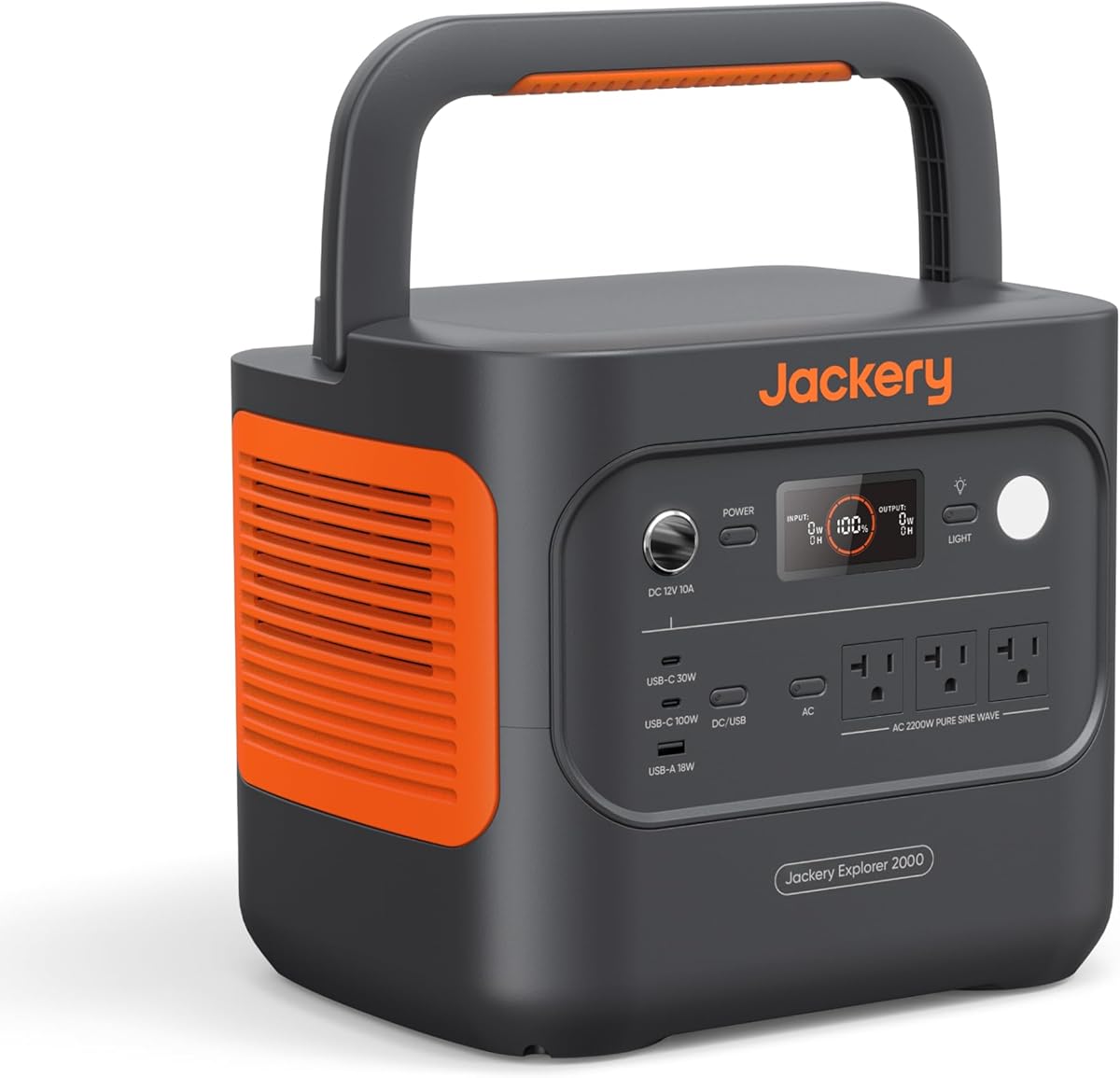
The Jackery Explorer 2000 v2 is a 2,042Wh portable power station rated for 2,200W of AC output. At 39.5 pounds, it is one of the lighter larger-capacity options in the guide, making it easier for a single person to load, unload, and position near a tailgate.
We may earn a commission when you buy through this link, at no additional cost to you.
Three AC outlets, a 100W USB-C PD port, and the stated 2,200W total output make it appropriate for a television, streaming devices, speakers, and charging. Jackery highlights an AC fast charge from zero to 80% in 66 minutes, a 102-minute app-enabled emergency super charging mode, and solar charging in as little as six hours with compatible 400W panels.
Silent Charging mode operates at less than 30dB, which is beneficial when devices need to recharge overnight or in a quiet resting area. The 20ms seamless switching and UL1778 test certification support UPS use, while LFP chemistry is stated to last up to ten years. The primary limitation is that 2,042Wh leaves less reserve for high-draw appliances than the 3,000Wh-class systems.
For a focused television tailgate, the Explorer 2000 v2 is a well-balanced battery option. It suits buyers who want more capacity than a small station, quieter operation than a gasoline generator, and a lighter load than the largest home-backup models.
The 39.5-pound weight and compact Cell-to-Body construction make this unit more manageable than many 2kWh competitors. That portability can be the deciding factor when a vehicle, stairs, or a long walking distance separates the power source from the viewing area.
A stated noise level below 30dB in Silent Charging mode allows the battery to be prepared without the engine noise of a gas generator. The reduced fan speed also suits quiet campsites and indoor-adjacent spaces where continuous sound would be disruptive.
We may earn a commission when you buy through this link, at no additional cost to you.
The Greenmagic Dual-Fuel Generator has the highest maximum output in the guide, reaching 6,500W on gasoline and 5,900W on propane. Its 4.8 rating is also the highest listed rating, making it a capable choice for large tailgating installations or users who want one machine to serve several different power demands.
We may earn a commission when you buy through this link, at no additional cost to you.
Rated output is 5,300W on either fuel, and inverter technology is designed to provide a clean, stable 120V/240V 60Hz sine wave for smartphones, laptops, projectors, and other sensitive devices. Outlet selection includes a 5-20R duplex receptacle, L5-30R and L14-30R connections, USB, and Type-C charging.
Its disadvantages are physical. The generator weighs approximately 93 pounds and measures 26.38 by 18.11 by 24.02 inches, making it much more difficult to move than a 2,200W inverter or a battery station. The 12-liter tank and large motor also represent far more equipment than a simple television setup requires.
This model makes sense for serious RV events, outdoor productions, or a tailgate with several displays and substantial audio equipment. For a single TV, portable game screen, and speakers, it may offer more capacity than necessary, but it delivers the greatest output flexibility in this comparison.
The 120V and 240V selection makes the unit suitable for more than conventional household outlets. High maximum output can accommodate several large displays, powerful speakers, or other equipment that would overwhelm compact inverter generators.
Running on gasoline or propane gives owners flexibility based on fuel availability. The switchable system also reduces the need to maintain only one fuel type for a backup or travel application.
We may earn a commission when you buy through this link, at no additional cost to you.
The EF ECOFLOW Delta Pro is a 3,600Wh portable power station with 3,600W of AC output, a 4.6 rating, and extensive connectivity. It is designed for home backup, camping, and work, but those same characteristics give it more than enough power for a high-end outdoor media setup.
We may earn a commission when you buy through this link, at no additional cost to you.
Fifteen output methods cover two USB-A ports, two fast-charge USB-A ports, two 100W USB-C ports, five AC outlets, two DC outlets, a car power socket, and an Anderson port. This is one of the most versatile interface arrangements in the guide and can support televisions, streaming hardware, speakers, cameras, laptops, and network equipment simultaneously.
Charging is equally flexible. EcoFlow states a 1.8-hour recharge through a 240V 3,000W outlet, 2.7 hours through a 1,800W wall outlet, and 2.8 hours using four compatible 400W solar panels. Capacity can expand from 3.6kWh to 25kWh with compatible batteries and Smart Generators, while two Delta Pro units can be paired for 7,200W.
The trade-off is size, weight, and potential overpurchase. This system is more substantial than a basic tailgate requires, and carrying extra batteries compounds the logistics. It is best for buyers who want a single energy platform for viewing events, travel, work, and household backup rather than a narrowly focused game-day appliance.
The broad mix of AC, USB-C, USB-A, DC, and vehicle-style connections simplifies event planning. Different devices can use suitable connections without relying on a collection of personal adapters and extension cords.
The ability to scale to 25kWh makes the Delta Pro relevant to buyers who see portable power as a long-term home or work investment. Extra capacity is unnecessary for a small tailgate, but valuable when the same equipment is expected to support more demanding uses.
We may earn a commission when you buy through this link, at no additional cost to you.
The most useful tailgating generator for TV is the one that matches the planned equipment, location, and operating duration. Capacity, output quality, noise, safety, charging speed, and portability should be considered together rather than judged by wattage alone.
Start with the power requirements of the television, streaming device, receiver, speakers, game console, lights, and chargers. Add their combined running watts, then allow reasonable headroom for startup surges and devices that briefly draw more power than their normal operating level. A station rated above the expected load also provides flexibility if the entertainment setup grows.
Battery power stations operate quietly and without engine fumes, making them convenient for campsites, tents, and areas where a combustion engine is restricted. Gasoline or propane generators generally provide longer continuous operation and are useful when the event has no reliable charging source. The right decision depends on location, available fuel, runtime expectations, and how much equipment must be transported.
Capacity, measured in watt-hours, determines how much energy the unit can store. A television and streaming box are generally manageable within a moderate battery system, while large displays, amplifiers, refrigeration, and cooking equipment consume reserves rapidly. Expansion support can make a smaller base system more versatile if the owner expects to add equipment later.
Modern televisions and streaming devices can be sensitive to unstable or heavily distorted power. Inverter generators are designed to produce a smoother sine-wave output, while portable power stations use battery inversion and battery management. Look for clear inverter specifications, especially when computers, audio equipment, projectors, or other sensitive electronics are part of the setup.
Noise depends on both the model and its load. Some generators publish a range, while others specify output at a particular load percentage. A tailgate television can be hard to hear over a continuously running engine, so lower-decibel models and adjustable engine or economy modes deserve attention. Placement also matters because every gas generator must be operated outdoors in an appropriate location away from people and enclosed spaces.
For gas generators, carbon monoxide monitoring and automatic shutdown systems are important safeguards. Battery systems avoid engine exhaust but still require attention to heat, moisture, damaged cables, and manufacturer instructions. Never extend an exhaust into an enclosed area, and never use a gasoline generator inside a tent, vehicle, or partially enclosed structure. Review local rules and the product manual before use.
Fast charging is valuable when the unit must be restored between outings. Compare wall-charging time, solar input, vehicle charging, and the availability of expansion or generator input. Solar panels improve self-sufficiency but require direct sunlight and occupy additional transport space. Runtime claims should also be distinguished from recharge time: one describes how long the stored energy lasts, while the other describes how quickly it can be restored.
Tailgating equipment must be carried from a vehicle to the viewing area. Weight, dimensions, handles, wheels, and the number of separate components all affect setup convenience. Large systems with high capacity or multiple solar panels offer impressive capability but become less attractive when one person must manage the load. Smaller units are easier to position but may require more frequent recharging or have less expansion headroom.
Begin by inventorying the devices that will be connected and checking their voltage and power requirements. Charge a battery station fully before departure, or prepare a gasoline generator with the correct fuel mixture and an adequate supply of fuel. Arrange the television, speakers, and extension connections so cables do not create a trip hazard, and keep all power equipment protected from moisture and accidental contact with drinks.
For a portable power station, use compatible cables and avoid exceeding the rated output or combining loads beyond the system's surge or parallel limits. Position a gas generator outdoors, following the manual's carbon monoxide and clearance guidance, and never operate it in an enclosed area. Give a battery unit the ventilation recommended by its manufacturer, especially while it is rapidly charging or running high-output loads.
After the event, disconnect devices before switching off the unit, remove any fuel or propane connection as directed, and allow hot components to cool. Clean gas generators according to the manual, inspect the air filter and spark-related areas on the recommended schedule, and store fuel and the machine in an appropriate location. Battery stations should be stored according to the manufacturer's instructions, inspected for cable or casing damage, and recharged periodically if the guidance calls for it.
A modest television, streaming device, and router usually require far less output than the largest generators in this guide. The important step is to list every powered device, including soundbars, speakers, game consoles, lights, and chargers, then add their running requirements together. Select a unit with comfortable headroom for startup surges and future equipment additions.
A portable power station is usually quieter, produces no engine exhaust, and is easier to place near a viewing area. A gas generator generally offers longer runtime and may be more practical when no charging source is available. The best choice depends on whether quiet operation, flexible placement, or extended continuous power matters more for the event.
Yes, provided the television's voltage and wattage are within the power station's supported output. Connect the television through an appropriate AC outlet or compatible DC connection, and account for the streaming device, sound system, and any other devices running at the same time. Check surge requirements before adding higher-draw equipment.
Runtime depends on the generator's fuel capacity, operating load, efficiency settings, and the energy used by the connected devices. Published fuel-based runtime figures usually describe a particular load rather than every real-world setup. Battery runtime likewise depends on watt-hour capacity, conversion losses, battery age, temperature, and how much of the capacity remains available for use.
An inverter generator is generally the better choice for televisions, computers, projectors, audio equipment, and other sensitive electronics because it is designed to produce a more stable sine wave. Quality portable power stations can also supply suitable clean power through their battery inverters. Verify the product specifications and avoid using equipment outside its rated limits.
Operate the generator outdoors in an open area with adequate clearance, following the manual's carbon monoxide, exhaust, and weather instructions. Never use it inside a tent, vehicle, building, or partially enclosed space, and avoid positioning it where exhaust could reach people, doors, windows, or air intakes. A battery station offers more placement flexibility because it does not produce engine exhaust.
Solar charging is best viewed as a supplemental method rather than a guaranteed quick reset. Charge the station before departure, then use solar panels to add energy during daylight when panel size and sunlight allow. Fast wall charging is usually the most predictable way to prepare a full battery for a specific event time.
Some headroom is advisable because startup surges and additional accessories can increase demand. However, an oversized generator adds weight, noise, fuel consumption, and cost without improving the basic television experience. A modestly oversized inverter or a compact battery station with adequate capacity is generally more practical for a straightforward event.
The Jackery HomePower 3600 Plus stands out for high output, substantial capacity, flexible expansion, and multiple recharging paths. The Anker SOLIX C2000 Gen 2 is a more compact alternative with fast charging and useful peak output, while the EF ECOFLOW Delta 3 is particularly attractive for buyers who value quick restoration and an expandable EcoFlow ecosystem.
For gasoline-powered setups, the Honda EU2200i offers quiet inverter performance and app monitoring, the Generac GP2500i provides a more straightforward budget-oriented approach, and the Greenmagic dual-fuel unit supplies the most output and fuel flexibility. Prioritize the total connected load, required runtime, operating environment, clean output, and realistic transport requirements before selecting a model.
Ratings, availability, pricing, promotions, and product configurations can change over time. Check the current listing, manufacturer instructions, included accessories, compatibility details, and safety requirements before purchasing. The right choice is ultimately the system that can power the planned equipment safely and conveniently for the intended event.