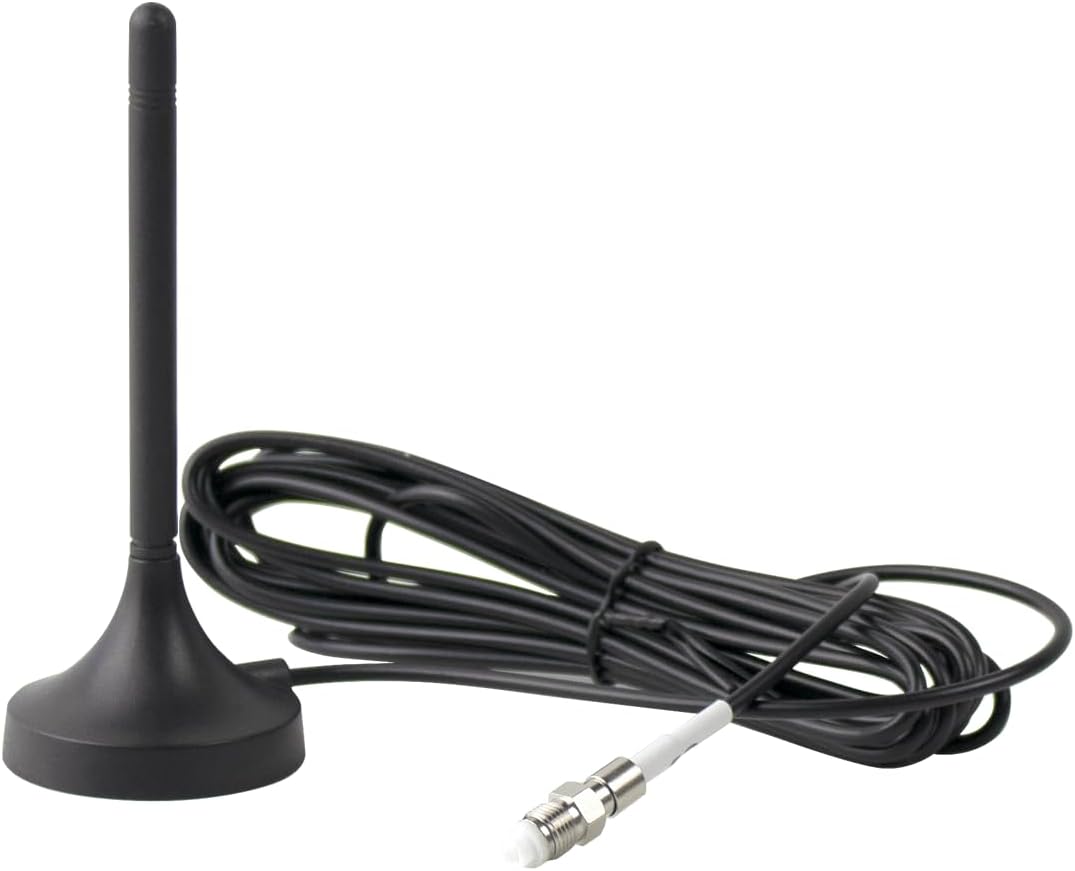
Bolton Mighty Mag 5G Magnetic Antenna
5.0Editor score
Wideband 617–4000 MHz
Omnidirectional 3.1 dBi gain
Strong magnetic base
FME-female connector
Our expert guide compares 10 magnetic mount LTE antennas for vehicles, covering cellular bands, gain, connectors, MIMO support, mounting, and GPS options.
A magnetic mount LTE antenna can improve cellular reception by placing an external antenna above the vehicle’s metal body, where a phone or router may otherwise experience a weaker signal. The right model depends on supported frequency bands, connector type, MIMO requirements, cable length, environmental protection, and whether navigation reception is also needed.
This guide compares ten magnetic-mount antennas using the specifications and product information supplied for each model. It covers dedicated cellular antennas, combined GPS and LTE units, multi-antenna sets, adjustable magnetic bases, and options made for routers, trackers, cameras, hotspots, and signal boosters.
Each review explains the antenna’s strongest use case, relevant specifications, and practical trade-offs. The shortlist begins with the most balanced all-around option, followed by a feature-rich MIMO model and a versatile dual-band choice, while every product remains eligible for readers with more specialized equipment needs.
5.0Editor score

5.0Editor score

4.3Editor score
The table below compares all ten antennas by their core radio coverage, mounting approach, connector arrangement, and intended vehicle applications, making it easier to identify a compatible model before making a purchase.


The Superbat Car GPS and 4G LTE Combination Antenna is a two-function unit that brings cellular and navigation reception into one magnetic-mount package. It carries a 4.3 rating and stands out from many single-purpose options because it combines a GPS antenna with an LTE antenna in a single housing. That makes it especially useful for vehicle navigation systems, telematics modules, connected stereos, tracking equipment, and installations that require both cellular data and satellite positioning.
We may earn a commission when you buy through this link, at no additional cost to you.
The cellular section covers 698–960 MHz and 1710–2700 MHz, supporting major 4G LTE frequency ranges used by cellular networks. It has a stated gain of 2.0 dBi, linear polarization, 50-ohm impedance, and a VSWR below 3.0. The GPS section operates at L1 around 1575.42 MHz and includes an active low-noise amplifier with a listed gain of 28 ±2 dB. A three-meter RG174 cable terminates in an SMA male connector, while the product supports both magnetic and adhesive mounting.
The principal advantage is versatility. Vehicle owners can avoid managing separate roof antennas when the equipment already exposes a single SMA connection for a combined antenna, and the magnet makes relocation between cars straightforward. The included cellular range is broad for a 4G LTE antenna, although the two-dBi cellular gain is not intended to rival a dedicated high-gain setup. Likewise, the single connector arrangement is less suitable for equipment that requires two physically separate antenna inputs for MIMO.
This is a strong recommendation for a driver who needs one antenna to serve both navigation and cellular communication. It is less suitable for modern routers that demand a dedicated MIMO antenna pair or for users seeking a connector type other than SMA male. Before buying, confirm that the connected equipment accepts a combined GPS and cellular antenna and that its connector and pin arrangement match the supplied specification.
Combining GPS and LTE reception simplifies vehicle installations that need positioning and cellular data at the same time. It also reduces the number of roof-mounted components without reducing the available radio functions.
Magnetic placement permits quick repositioning between vehicles, while adhesive mounting offers a more permanent option. The three-meter lead gives installers enough reach to route the cable from a roof or trunk location toward an interior electronics compartment.
We may earn a commission when you buy through this link, at no additional cost to you.
The Wilson Electronics 311125 is a dual-band magnetic-mount antenna created for cellular signal boosters and compatible Wilson equipment. Its 4.2 rating reflects a practical, established design, while the long RG174 lead and strong magnetic base make it well suited to temporary or permanent vehicle installations where the antenna must sit outside the cabin.
We may earn a commission when you buy through this link, at no additional cost to you.
The antenna operates across 800 and 1900 MHz with an omnidirectional pattern and is described as improving voice quality and 3G data reception. Wilson states that it can provide up to 6.1 dB of gain. It includes 12.5 feet of RG174 coaxial cable and an SMA male connector, allowing connection to compatible boosters, routers, and cellular devices. Because the radiation pattern is omnidirectional, the vehicle does not need to maintain a fixed orientation toward a cell tower.
Its primary limitation is that the 800/1900 MHz specification is narrower than the wideband alternatives in this guide. It does not cover the 617–4000 MHz range offered by the Bolton Mighty Mag, nor does it provide the 698–2700 MHz coverage listed for the 4G LTE models. It also supplies one antenna rather than a physically separated pair for MIMO equipment. Buyers using a modern 5G-capable system may therefore find broader frequency support more appropriate.
The 311125 is a compelling option for a vehicle booster installation centered on Wilson-compatible systems, especially when a long, flexible cable and easy magnetic placement are priorities. Confirm that the booster’s external antenna port uses SMA male and that both 800 and 1900 MHz are appropriate for the cellular services and equipment involved.
This antenna is specifically associated with Wilson and weBoost cellular booster configurations. That focused purpose makes it a logical external antenna when the goal is to move the booster’s cellular connection away from a weak location inside the vehicle.
An omnidirectional pattern receives signals from all directions, which is valuable when the vehicle is moving or parked in changing locations. The generous cable length helps installers find a metal mounting surface that improves reception.
We may earn a commission when you buy through this link, at no additional cost to you.
The GPS Navigation Antenna with SMA Male Connector is a high-rated active GPS aerial for vehicle electronics. Its 4.5 rating is among the strongest customer feedback scores in this group, and its stated uses include automotive head units, telematics, mobile DVR systems, fleet tracking, marine navigation, security systems, and amateur radio installations.
We may earn a commission when you buy through this link, at no additional cost to you.
The antenna operates at the GPS L1 frequency of 1575.42 MHz ±3 MHz and includes a listed 28 dB low-noise amplifier gain. It uses a three-meter cable with an SMA male plug and accepts a 3-to-5-volt DC supply with maximum current of 10 mA. Magnetic and adhesive mounting are both supported, giving installers flexibility when permanent drilling is undesirable or when the antenna must move between vehicles.
Despite appearing in a roundup focused on LTE antennas, this model is most useful when a vehicle already has cellular connectivity and needs a stronger dedicated navigation signal. It is not a 4G LTE antenna and should not be expected to carry cellular data. Its active electronics also mean that the receiving device must be able to supply the stated voltage and current, something that should be verified before installation.
Choose this antenna when a navigation head unit, tracker, or telemetry receiver has a compatible SMA GPS input and needs a removable exterior aerial. It is especially appealing for trucks, RVs, buses, vans, boats, and mobile DVR installations where a roof or body-mounted GPS position can improve satellite visibility.
A dedicated GPS antenna can be a better match for navigation equipment than a generic cellular aerial. The active amplifier and L1-band design focus the product on satellite-positioning reception rather than trying to handle mobile-network traffic.
The listed applications span passenger vehicles, commercial fleets, marine installations, and mobile recording systems. Its combination of a magnetic base, adhesive option, and three-meter lead supports both quick installations and more permanent routing.
We may earn a commission when you buy through this link, at no additional cost to you.
The Bolton Mighty Mag 5G is a compact wideband magnetic antenna with a 5.0 rating. Its most important feature is the 617–4000 MHz operating range, which is broader than the LTE ranges stated for most competing antennas. The result is a versatile option for modern cellular boosters and compatible mobile communication equipment that can use low-band cellular signals, conventional LTE bands, and higher frequencies within the antenna’s specification.
We may earn a commission when you buy through this link, at no additional cost to you.
Gain is stated at 3.1 dBi, and the antenna uses an omnidirectional pattern to receive from all directions. A strong magnetic base allows it to attach to a metal roof, hood, trunk, or other suitable surface without drilling. The supplied connection is FME female, so buyers should confirm the cable or adapter arrangement used by their booster or mobile equipment. The listing does not provide a three-meter lead as a standard included feature, which may require an additional compatible cable depending on the setup.
Compared with the dual-SMA cellular options, the Bolton has a simpler connection style and no built-in pair for MIMO. That simplicity is beneficial for a single-antenna booster or communication arrangement, but it can limit compatibility with routers that require two antenna leads. Its wide frequency coverage also makes it a future-oriented alternative to the older 800/1900 MHz Wilson models, particularly for users seeking one antenna that covers a broader set of cellular frequencies.
This is a strong budget-conscious recommendation for mobile equipment requiring broad cellular coverage. It is less convenient for a plug-and-play router installation when the device expects SMA male, and it is not the right choice for a MIMO network that needs two antennas. Confirm the required connector, cable length, and supported radio bands before ordering.
The 617–4000 MHz range covers substantially more of the cellular landscape than the narrow dual-band designs in the guide. That breadth can make one antenna useful across several generations of mobile networks and compatible booster systems.
The magnetic base avoids permanent modification to the vehicle and allows rapid removal. This is useful for temporary fleet use, removable electronics, or drivers who want the option to move the antenna between vehicles.
We may earn a commission when you buy through this link, at no additional cost to you.
The Bingfu 8 dBi MIMO set is a two-antenna package intended for cellular routers, hotspots, CPE equipment, trackers, cameras, and compatible signal-boosting systems. It has a 4.2 rating, and its two matching antennas are the main attraction for equipment that supports MIMO by using separate connections for different radio paths.
We may earn a commission when you buy through this link, at no additional cost to you.
Each antenna covers 698–960 MHz, 1710–2170 MHz, and 2300–2700 MHz, with stated gain of 8 dBi and an omnidirectional pattern. Both have magnetic bases and three-meter cables with SMA male connectors. The supplied information lists compatibility with major carriers and a wide range of vehicle and industrial equipment, including mobile routers, cellular gateways, DVRs, trail cameras, remote monitoring systems, and digital signage.
The pair offers more installation flexibility than a single wideband antenna. In a proper MIMO arrangement, the two units can be separated to improve spatial diversity, which is generally more valuable than placing both identical antennas directly beside one another. Users should follow the router manufacturer’s antenna-placement guidance. The stated eight-dBi figure is a nominal antenna specification and should not be interpreted as guaranteed additional signal at every location.
This is a good match for a vehicle router or tracking system with two cellular antenna ports and SMA male interfaces. It is less suitable when the equipment accepts only one antenna or uses RP-SMA connectors. It also requires enough metal surface for both magnetic bases and thoughtful cable routing, so the complete installation should be planned before final placement.
Two separate antennas can support diversity reception in compatible MIMO equipment. Separating them may reduce interference between the units and can be more meaningful to overall performance than simply adding gain in a single lead.
The listed applications cover mobile internet, vehicle recording, fleet tracking, surveillance, industrial gateways, and remote monitoring. This makes the set useful beyond passenger cars, particularly for commercial vans, trucks, buses, RVs, and mobile equipment.
We may earn a commission when you buy through this link, at no additional cost to you.
The Proxicast Large 3 Inch SMA Magnetic Antenna Base is different from most entries in this guide because it is a mounting platform rather than a complete cellular antenna. It provides a large magnetic base, a 6.5-foot coax lead, and an SMA female connection that accepts a separately selected SMA male antenna. Its 4.4 rating indicates strong customer satisfaction for a practical, adaptable mounting solution.
We may earn a commission when you buy through this link, at no additional cost to you.
The three-inch magnetic base is designed to hold cellular, HAM, ADS-B, GPS, 900 MHz, and other compatible SMA antennas securely. A rubber cap helps protect the vehicle surface, while the flexible coax can connect to routers, modems, radios, and GPS receivers with suitable SMA female ports. The manufacturer specifically notes that the base is not for Wi-Fi antennas, whose connector and radio requirements differ from the included SMA system.
This product is valuable when a driver wants to choose the radio antenna separately while retaining a stable, removable mount. The generous base may hold the antenna more securely than a very small magnetic puck, and the six-and-a-half-foot lead provides more routing freedom. The main trade-off is cost and complexity: buyers need an additional SMA male antenna, and they must confirm that the chosen antenna’s frequency, gain, connector, and weather resistance suit the installation.
Choose the Proxicast base when flexibility matters more than an all-in-one package. It is especially useful for experimenters, installers supporting multiple device types, and owners who already own a compatible antenna. It is not the simplest recommendation for a first-time buyer who wants a ready-to-install LTE setup.
Separating the base from the radiating element lets the installer match the antenna to the exact cellular bands, gain, connector, and environmental needs of the equipment. The base then serves any compatible SMA male antenna.
The large magnetic footprint provides a stable platform for an external antenna, while the rubber cap reduces direct contact with the vehicle finish. The long coax lead also makes it easier to move the antenna around while searching for a better signal location.
We may earn a commission when you buy through this link, at no additional cost to you.
The Wilson Electronics 12-inch Dual Band Magnet-Mount Antenna is a compact traditional cellular antenna with a 4.3 rating. It supports 800 MHz and 1900 MHz analog and digital modes and is described as compatible with cellular, PCS, and iDEN providers. Its relatively short body and removable magnetic design make it convenient for owners who want a simple antenna without a long exterior installation.
We may earn a commission when you buy through this link, at no additional cost to you.
The antenna connects through an SMA male interface and is designed to be easy to install and move between vehicles. Wilson claims that it can provide substantially stronger reception than a cell phone used inside a vehicle without an external antenna. That comparison reflects the basic purpose of an exterior magnetic aerial: it can avoid some of the shielding created by the vehicle’s roof, doors, and body panels.
The important limitation is generational. Its stated 800/1900 MHz coverage is much narrower than the 698–2700 MHz offered by the dedicated LTE sets and the 617–4000 MHz span of the Bolton. It also provides one antenna and no GPS reception, so it may not meet the needs of a 5G router, a two-port MIMO modem, or a navigation system. It remains relevant for older or legacy cellular equipment designed around those two bands.
This antenna is a practical option for compatible legacy cellular devices, especially when portability and compact size are priorities. Verify the supported cellular bands of the radio and its connector type before purchase. Newer multi-band equipment may benefit more from one of the wider LTE or 5G options in this guide.
At twelve inches, the antenna is easy to handle, store, and carry between vehicles. The removable mount also makes it convenient for temporary use with compatible legacy cellular equipment.
The magnetic base positions the antenna outside the vehicle while the SMA lead connects to a compatible device. This straightforward architecture suits basic cellular installations that do not require multiple radio chains.
We may earn a commission when you buy through this link, at no additional cost to you.
The Bingfu Vehicle Waterproof Active GPS Navigation antenna has a 4.6 rating, making it one of the most highly rated products in the guide. It is a dedicated navigation antenna with a waterproof housing, a magnetic base, adhesive mounting support, and a three-meter SMA male cable. It is designed for vehicle telematics, trackers, mobile DVRs, buses, trucks, RVs, vans, security systems, and vehicle-mounted radios.
We may earn a commission when you buy through this link, at no additional cost to you.
Operating at 1575.42 MHz, the antenna provides a listed 28 dB LNA gain and requires a 3-to-5-volt DC supply with maximum current of 10 mA. The package includes one antenna and a double-sided adhesive piece. Its water-resistant construction makes it more appropriate for exposed exterior placement than a basic indoor puck, while the magnetic and adhesive options allow installers to choose between repositionable and semi-permanent mounting.
The key limitation is scope. This is not a 4G LTE cellular antenna, so it cannot replace a cellular roof aerial or provide mobile data reception. It is most valuable in a vehicle that already has cellular connectivity but needs a separate antenna for position data. Users must also ensure that the tracker or navigation unit can power an active antenna and that its connector matches the supplied SMA male interface.
For a driver building a vehicle tracking, DVR, or navigation installation, this is a well-rated and weather-conscious choice. It is less relevant to someone shopping strictly for improved mobile data. Its high rating, active amplification, and range of listed applications make it a strong specialist addition to a complete vehicle communications setup.
The waterproof shell is designed for vehicle environments where condensation, rain, dust, and routine outdoor exposure are concerns. It can be mounted on an exterior metal surface while keeping the active GPS element away from the cabin.
The listed 28 dB LNA gain is intended to help preserve GPS signals over the cable run to the receiver. This can be especially relevant when the antenna is separated from navigation or tracking electronics by a longer installation.
We may earn a commission when you buy through this link, at no additional cost to you.
The Superbat 4G LTE MIMO Magnetic Mount Omni-Directional SMA Antenna combines a 5.0 rating with a feature set well suited to mobile routers and other multi-antenna equipment. It covers 698–960 MHz, 1710–2170 MHz, and 2300–2700 MHz, provides 3 dBi of stated gain, and uses an omnidirectional pattern. Two SMA male connectors provide connections for a compatible MIMO device.
We may earn a commission when you buy through this link, at no additional cost to you.
The antenna has an IP67 ingress-protection rating, a sturdy ABS shell, and a low-profile magnetic mounting design. Its three-meter, ten-foot lead is long enough to route from an exterior mounting point toward a router, USB modem, MMDVM hotspot board, CPE unit, industrial gateway, or camera. The listed applications include mobile hotspots, cellular routers, signal boosters, security cameras, trail cameras, LoRa gateways, telemetry systems, and utility-connected equipment.
The fixed dual-connector design is the main installation consideration. A router that supports MIMO will usually benefit from antennas with some physical separation, and the supplied information does not state that the two elements are independently positionable. A single low-profile assembly is nevertheless convenient in crowded vehicle roofs, and the IP67 housing adds confidence for exposed mounting. The stated three-dBi gain is modest, but radio performance depends heavily on the network, device, location, and installation.
This is the strongest recommendation for a vehicle system that explicitly requires a dual-SMA MIMO antenna and values weather resistance, low profile, and simple magnetic placement. It is less appropriate for a single-antenna device or for installations needing independently separated antenna elements. Verify that the router supports the listed frequency bands and that both connector positions are labeled for the correct MIMO channels.
IP67 protection gives the assembly a meaningful advantage for roof and exterior vehicle placement. The shell is designed to withstand exposure while preserving a low, streamlined profile.
Dual SMA male connectors allow the antenna to serve compatible MIMO routers, modems, hotspot boards, and CPE equipment. The paired-lead design reduces the need to identify and match separate loose antennas during installation.
We may earn a commission when you buy through this link, at no additional cost to you.
The Bingfu 7 dBi MIMO set is a flexible two-antenna package for cellular routers, trackers, cameras, and related vehicle electronics. Its 3.9 rating is the lowest among the ten products, but that figure should be interpreted alongside the set’s broad compatibility, stated seven-dBi gain, and practical benefit of allowing two magnetic bases to be placed independently.
We may earn a commission when you buy through this link, at no additional cost to you.
Each antenna supports 698–960 MHz, 1710–2170 MHz, and 2300–2700 MHz. Both are omnidirectional, use strong magnetic bases, include three-meter cables, and terminate in SMA male connectors. The package includes two antennas. The listing calls out major carriers and applications including vehicle trackers, mobile DVRs, trail cameras, outdoor security cameras, cell phones, hotspots, routers, repeaters, industrial IoT gateways, digital signage, RV cameras, cellular radios, and backup cameras.
Independent placement is a notable advantage over a single dual-connector assembly. Installers can separate the two units if the device supports MIMO and the manufacturer recommends spatial diversity, which can reduce interference between radio paths. On the other hand, gain specifications do not guarantee a specific improvement in throughput. Vehicle construction, terrain, network congestion, cable losses, router behavior, and antenna position can all influence the final result.
The set is a sensible option for a two-port LTE installation that needs flexible placement across a roof, hood, or trunk. Its lower customer rating calls for more attention to installation quality and connector compatibility, but the product specifications remain useful. Confirm that the equipment uses SMA rather than RP-SMA connectors and that both antenna channels are supported before installing the set.
Two loose magnetic antennas give installers freedom to find two suitable metal surfaces and create separation where needed. That flexibility can be valuable on large vehicles with complex roofs or equipment distributed in different compartments.
The frequency coverage spans low, mid, and high cellular bands used across major networks. A seven-dBi nominal rating and omnidirectional design provide a versatile platform for mobile data, voice, tracking, and camera applications.
We may earn a commission when you buy through this link, at no additional cost to you.
Choosing a vehicle LTE antenna starts with the radio system, connector, and installation environment. Frequency coverage determines compatibility, while MIMO, cable length, mounting security, and weather protection determine whether the antenna can work effectively after installation.
The most important technical check is whether the antenna covers every band used by the vehicle’s cellular carrier and hardware. The products in this guide span 800/1900 MHz, 698–2700 MHz, and the especially broad 617–4000 MHz range used by the Bolton Mighty Mag. Older dual-band antennas may work well with legacy cellular equipment, but a modern LTE router can employ additional frequencies that a narrow antenna does not cover. A 5G-capable system also requires careful attention to the full band plan of the carrier rather than assuming that every modern network uses the same frequencies as 4G LTE.
Prioritize an antenna with coverage extending below 1000 MHz and across the 1710–2700 MHz range, unless the connected equipment is documented as legacy-only. This gives the installation more flexibility across carriers, regions, and network upgrades. Always compare the antenna specification with the cellular modem, booster, or router manual before installation.
MIMO equipment uses multiple radio paths and commonly requires two physical antenna connections. Some antennas in this guide are sold as two separate units, while the Superbat MIMO model integrates dual SMA male outputs in one low-profile housing. Choosing the wrong arrangement can prevent a router from operating at full specified functionality or leave one connection unused. Single-antenna models are sufficient for some basic cellular devices, but they are not interchangeable with a true two-antenna MIMO arrangement.
Look for two compatible connectors and confirm which device ports they should populate. Independent antennas can be separated to improve diversity, whereas a single dual-element housing is easier to install and may be better suited to a clean, compact roof installation. Follow the equipment manufacturer’s placement guidance rather than assuming the most visible location is always ideal.
Most cellular antennas in the guide terminate in SMA male, while the Bolton uses an FME female connection and the Proxicast base presents an SMA female port. SMA and RP-SMA look similar but are not interchangeable. A male connector also needs a corresponding female port on the device, and some equipment includes proprietary adapters or cables that limit the user’s options.
Check the connector label and required cable arrangement before ordering. Do not force a mismatched connector, strip a cable unnecessarily, or assume an adapter preserves the antenna’s full electrical performance. If the equipment accepts an FME connection, verify that the required FME-to-SMA cable is included or plan to obtain a suitable one.
The listed gain values range from 2.0 dBi on the combined Superbat cellular section to 8 dBi for the two-antenna Bingfu set. Higher nominal gain does not automatically produce faster downloads or stronger service in every location. It describes the antenna’s concentration of energy, while real mobile performance also depends on network availability, terrain, vehicle obstruction, cable losses, and the receiving device. The omnidirectional pattern used across this category is particularly appropriate for vehicles because it avoids requiring constant alignment with a tower.
Treat gain as one factor rather than the sole buying criterion. Match the antenna to the application, verify the frequency range, and prioritize a clear line of sight to the sky. For signal boosters, follow the booster manufacturer’s guidance because a single antenna may also be used to create a coverage pattern different from a vehicle-to-tower configuration.
Cable length determines how far the antenna can be placed from the device. The Wilson 311125 provides 12.5 feet of RG174, several products include three-meter leads, and the Proxicast base has 6.5 feet of coax. Longer leads improve placement flexibility but can introduce more signal loss, particularly with thinner coax or higher frequencies. The cable should be routed away from sharp edges, hot surfaces, moving parts, and sources of electrical interference.
Plan the cable path before choosing a permanent mounting position. A three-meter lead may work for a roof-mounted router in a compact car, while a truck or bus may need more reach to connect with an interior equipment cabinet. Leave a little service loop at both ends and use appropriate strain relief so the connector is not carrying the cable’s weight.
Magnetic mounting is attractive because it avoids drilling and allows an antenna to transfer between vehicles. However, magnet strength, surface curvature, road vibration, and nearby metal can affect stability. The Proxicast base emphasizes a three-inch magnetic footprint, while the Bingfu sets and Superbat models use strong magnetic bases intended for vehicle use. The included rubber cap on the Proxicast base helps protect the mounting surface, and adhesive options provide a more stable alternative.
Choose a broad, relatively flat metal surface and confirm the antenna cannot slide into a windshield wiper, hatch mechanism, roof seam, or other moving component. If using adhesive, clean the surface and test the magnetic position first. For a permanent installation, also consider a cable tie or mechanical retention point in addition to the magnet.
A roof-mounted antenna is exposed to rain, sunlight, road grime, dust, snow, and temperature changes. The Superbat MIMO antenna has an IP67 rating, the dedicated Bingfu GPS model is described as waterproof, and the Superbat GPS/LTE combination is marketed for automotive use with a protective housing. An IP rating is more specific than a general claim of weather resistance because it describes tested levels of solid-particle and water ingress protection.
Choose a model with sealed construction for exposed locations. Also inspect the connector after installation, because even a well-sealed antenna can be compromised by an unsealed cable joint. For components installed behind a head unit or inside a console, weather resistance may matter less, although it can still protect against condensation and accidental splashes.
A cellular antenna cannot necessarily improve satellite navigation, and a GPS antenna cannot carry LTE data. Some vehicle installations need both functions, making the Superbat combined antenna attractive. Dedicated GPS options provide a specified L1-band frequency, active LNA amplification, and an SMA male lead for navigation receivers, trackers, and mobile DVRs. Their value is concentrated in receiving a cleaner positioning signal from a more favorable exterior location.
Decide whether positioning is genuinely required before choosing a combined or dedicated GPS design. Verify that the receiver can power an active antenna and that the cable and connector arrangement match. Combining functions can simplify a vehicle installation, but a dedicated unit may be easier to optimize when GPS and cellular equipment use different connectors or mounting positions.
Begin by identifying the antenna’s required connector, supported frequency bands, and whether the connected equipment expects one antenna or a MIMO pair. Test the existing connection before changing anything so you have a baseline for signal strength, data stability, and device behavior. Mount the antenna only after confirming that the vehicle system recognizes the new connection and that the radio is configured for an external antenna where required.
Choose a broad, clean metal surface with an unobstructed view of the sky. Clean the area, remove debris, and consider the adhesive pad included with models that offer it. Position the antenna securely away from hinges, door tracks, wipers, roof rails, and sharp body seams. Route the cable gently, avoid kinks and pinches, and leave enough slack for minor movement without allowing the lead to flap against the body.
For care, inspect the mount and cable during routine vehicle maintenance, especially after rough roads, car washes, or seasonal weather changes. Wipe the housing with a damp cloth, remove salt and mud, and dry the connector area before reconnecting anything. If reception changes unexpectedly, check the mount first, then inspect cable damage and connector seating, and finally review the device’s band and antenna configuration.
No. Results depend on the antenna placement, vehicle construction, cellular network coverage, cable quality, and the receiving device. A roof-mounted antenna can often perform better than a phone inside the cabin because the vehicle body may otherwise obstruct or attenuate radio signals. It cannot create coverage where the local network has no usable signal, and a more expensive antenna does not guarantee better performance in every location.
Many modern hotspots and routers support MIMO and need two antenna connections, while some simpler devices accept only one. The dual-SMA Superbat model and the two-packs from Bingfu are designed for paired use, but the exact arrangement must match the equipment. Check the router manual and identify its cellular antenna ports before selecting a product or installation pattern.
No. SMA and RP-SMA have different connector standards even though they can look similar at a quick glance. The Bingfu 7 dBi set specifically notes SMA rather than RP-SMA compatibility. Confirm the connector printed beside the device port and match the gender and electrical standard before purchasing, or use a properly specified adapter.
No. A GPS antenna is designed for satellite-positioning signals and cannot provide cellular voice or data. A dedicated GPS model can improve navigation or tracking reception, while an LTE antenna improves communication with cellular networks. If both functions are needed, choose a compatible combined antenna or install two appropriately connected antennas.
The best location usually has the clearest view of the sky and is away from obstructions, moving parts, and sharp body edges. A high roof location is often effective, but the ideal position can vary by vehicle and antenna. Test several metal surfaces, keep the antenna securely mounted, and route the cable without pinching it before tightening or adhering the base.
A properly positioned magnet usually causes no immediate damage, but grit trapped beneath it can scratch the finish when the antenna moves. Clean both surfaces before mounting, retain any protective cap or adhesive layer, and avoid placing the base directly over a crease. Inspect the area periodically and do not use the magnet as a temporary storage point for loose objects.
No. Gain describes how an antenna concentrates radio energy, but final performance also depends on the network, terrain, vehicle obstruction, cable losses, device sensitivity, and congestion. A well-positioned moderate-gain antenna may outperform a higher-gain model mounted poorly. Frequency compatibility and a suitable MIMO installation are generally more important than chasing the largest number.
Yes, provided the connector and radio bands are compatible with the second vehicle’s equipment. Remove the antenna before washing or servicing the vehicle, clean the mounting surface, and inspect the base for accumulated debris. For equipment that uses paired MIMO connections, both antennas should be moved and positioned consistently rather than mixing them with unrelated models.
The Superbat 4G LTE MIMO model is the most complete choice for compatible dual-antenna equipment because it combines dual SMA connections, broad LTE coverage, IP67 protection, and a low-profile magnetic base. The Bolton Mighty Mag 5G stands out for its exceptionally broad 617–4000 MHz range and straightforward booster-oriented design, while the Superbat GPS and LTE combination is the preferred all-in-one option for vehicles that need navigation and cellular communication in one antenna.
Most buyers should prioritize frequency compatibility, connector type, MIMO requirements, and mounting position before gain. A GPS-only antenna is appropriate for navigation or tracking electronics, a two-pack offers maximum placement flexibility for MIMO systems, and a single wideband unit is convenient for compatible boosters. Cable routing, weather protection, and the manufacturer’s antenna-placement instructions can matter as much as the headline specification once the product is installed.
Before purchasing, verify the equipment manual, compare every connector and supported band, and consider the vehicle’s available metal surfaces. Current product details and market terms can change, so check the latest listing information and compatibility documentation before ordering. With the correct match, a magnetic mount can be a clean, removable, and effective way to improve vehicle communication.