
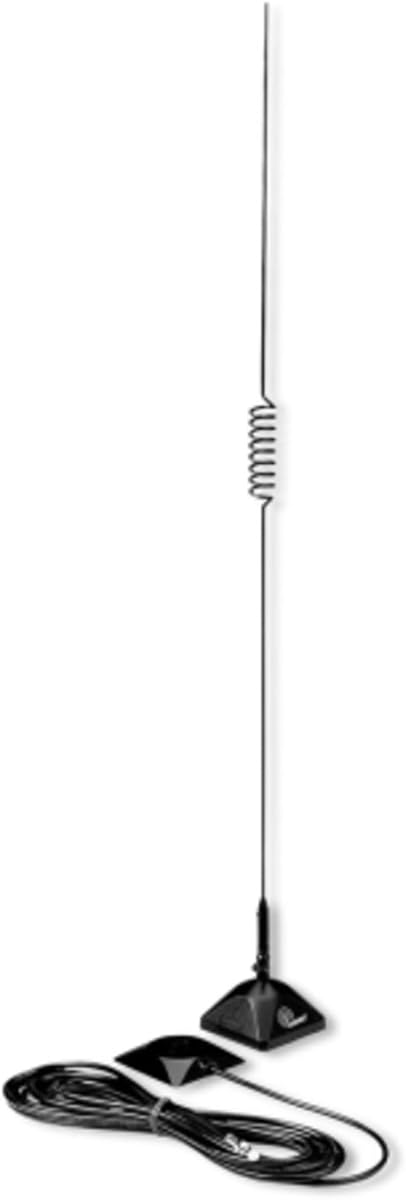
ProComm Disguise Glass Mount Scanner Antenna
4.4Editor score
Discreet disguise-style housing
Full 30–1,200 MHz coverage
Transmission coupler box included
Our Glass Mount Scanner Antenna guide compares glass-mount models for frequency coverage, connector type, mounting hardware, cable length, and reception.
A glass mount scanner antenna can provide a noticeable reception upgrade over a handheld scanner’s stock antenna without requiring permanent changes to a vehicle. The right model balances broad frequency coverage, appropriate connector compatibility, durable glass-mounting hardware, usable cable length, and a design that suits mobile or fixed listening positions.
The products in this guide were compared using the supplied specifications, including supported frequency ranges, antenna construction, connector standards, mounting methods, cable details, and listed user ratings. The list includes dedicated scanner antennas, general wideband receive antennas, and two dual-band glass mounts intended for selected amateur-radio use.
Each review explains the strongest reason to consider a particular antenna, along with its mounting approach, connection requirements, and practical trade-offs. Ratings and specifications can change over time, and current prices also vary, so shoppers should confirm the latest listing details and radio compatibility before purchasing.
4.4Editor score

4.4Editor score

4.3Editor score
The table below compares all ten antennas by their most important practical attributes, including frequency coverage, connector standard, antenna height or construction, mounting method, and included cable. The selections range from discreet wideband models to larger dual-band glass mounts designed for transmit-capable amateur-radio use.


The Tram 25 MHz to 1,300 MHz Scanner Glass-Mount Antenna stands out as the most complete general-purpose option in this guide. It has a listed rating of 4.4 and is designed for scanners and CB users who need access to a wide range of frequencies. Its 28-inch center-loaded whip, glass-mount hardware, 17-foot RG58/U cable, and BNC connection provide a balanced package for mobile listening.
We may earn a commission when you buy through this link, at no additional cost to you.
Broad coverage is the central benefit. A 25 MHz to 1,300 MHz range can cover many scanner, CB, public-service, aviation, and amateur-radio frequencies that lie within the antenna’s operating span. The extra-long whip and center-loaded configuration are intended to support gain and bandwidth, while the supplied low-loss cable gives the radio more freedom from the mounting location.
The main trade-off is size and connector compatibility. A 28-inch whip is substantial on some cars, and the BNC interface will not connect directly to every scanner. The glass-mount hardware also requires a clean, suitable mounting area, so users should verify that the adhesive or base can bond properly to the selected window.
This is the strongest all-around recommendation for listeners who want flexible frequency coverage, a useful amount of cable, and a conventional BNC connection. It is particularly appropriate for CB and scanner reception, provided the radio has a BNC input or the buyer can obtain a suitable adapter.
The 25–1,300 MHz specification gives this model broad reach across the scanner market. It is a better fit for listeners interested in several services than for someone who needs one narrow amateur band.
The included 17-foot RG58/U cable allows the radio to sit farther from the mounted whip, while the BNC connector provides a common scanner interface. Check your radio’s connector before installation to avoid needing an additional adapter.
We may earn a commission when you buy through this link, at no additional cost to you.
The ProComm Disguise Glass, Window Mount Scanner Antenna is designed for users who want broad reception without the visual prominence of a large traditional whip. It carries a 4.4 listed rating and includes a 22-inch 17-7 stainless steel whip, a 15-foot Belden RG58 coaxial cable, and a transmission coupler box within a 30–1,200 MHz receiving range.
We may earn a commission when you buy through this link, at no additional cost to you.
The defining benefit is its disguise-style presentation. Rather than resembling a conventional long scanner antenna, it is intended to blend into a vehicle or window setting more discreetly. That makes it useful for listeners who monitor frequently but do not want a large, highly visible antenna drawing attention.
Its wideband coverage and stainless steel whip provide a more specialized package than the simplest adhesive antennas. The included transmission coupler also adds installation complexity, because the user must account for cable routing and understand how the coupler is positioned and secured. Buyers should plan the cable path before applying the mount.
The ProComm is best for users who prioritize appearance and a complete kit alongside broad scanner coverage. It is less attractive for someone wanting the smallest possible mount or a simple direct cable, but its 4.4 rating, full-range design, and included hardware make it a refined choice.
The disguise housing and 22-inch whip reduce the overt appearance associated with conventional roof-mounted scanner antennas. This makes the kit well suited to vehicles where visibility and an integrated appearance matter.
The antenna, Belden RG58 cable, and transmission coupler box provide the major components needed for a mounted scanner setup. Its stated 30–1,200 MHz range is broad enough for varied listening interests.
We may earn a commission when you buy through this link, at no additional cost to you.
The Taurus 25–1300 MHz Glass Mount Scanner Antenna is a compelling value-oriented choice. Its listed rating is 4.3, and the specification sheet combines a wide frequency range with a 28-inch black Kote stainless steel whip, removable center-loaded design, 17-foot RG58 cable, and stress-relief BNC connector.
We may earn a commission when you buy through this link, at no additional cost to you.
The removable whip is especially useful for owners who wash their vehicles often or do not want the antenna projecting while parked. Transferring signal through the window avoids drilling, while the generous RG58 run gives the scanner flexibility in placement and helps keep the radio away from the base and vehicle electronics.
As with any adhesive glass mount, surface preparation and placement matter. The base should be installed on clean, smooth glass with enough space for the full whip, and the adhesive should be given proper time to set. The BNC connector also means the scanner must support BNC or require a correctly selected adapter.
This antenna is best for budget-conscious scanner listeners who want wideband coverage, a removable whip, and a long cable. It offers the most attractive balance of useful features for shoppers who do not need the ProComm’s disguise housing or a more specialized transmission setup.
The threaded whip can be removed for washing or safe storage while leaving the glass-mounted base and cable in place. This is a practical advantage for frequent car washers and anyone who values a low-profile setup.
The 25–1,300 MHz range covers many scanner interests, while signal transfer through the window avoids a permanent hole. The included 17-foot cable also makes it easier to position the radio inside the cabin.
We may earn a commission when you buy through this link, at no additional cost to you.
The BNC Scanner Radio Receiver Glass Mount Wire Antenna offers a different approach to temporary glass mounting. It has a 4.1 listed rating, covers 25–1,300 MHz, and includes two suction cups for attaching an approximately eight-foot wire antenna to a window. It can be used with digital or analog radio scanners.
We may earn a commission when you buy through this link, at no additional cost to you.
Its greatest advantage is flexibility. The suction-cup arrangement can be moved between windows as reception conditions or listening locations change. It is suitable for a vehicle or an indoor window position, offering a quick way to place the antenna away from the radio without installing a fixed adhesive base.
The trade-off is retention and antenna construction. Suction cups are convenient, but they may not maintain the same hold as a bonded mount, particularly through temperature changes, road vibration, or extended use. The long flexible wire differs from a rigid stainless steel whip and may receive differently in demanding locations.
Choose this model when portability and quick repositioning matter most. It is a sensible choice for listeners who want to try an external window antenna or move the mount between vehicles, though the Taurus or Tram offers a more substantial fixed installation.
Two included suction cups allow the antenna to be attached to a suitable window without adhesive installation. This makes it easy to experiment with placement or take the setup down when it is no longer needed.
The stated 25–1,300 MHz range and BNC interface suit many analog and digital scanners. Buyers should still confirm the radio’s antenna input and ensure the wire can be positioned without sharp bends.
We may earn a commission when you buy through this link, at no additional cost to you.
The Window Glass Mount Wide-Band Receive Scanner Antenna is a simple mounted option for a wide selection of Uniden, RadioShack, and Whistler scanners. Its listed rating is 3.8, and it covers 50–1,200 MHz with a stated receive gain of 3 dB. The package includes the antenna, double-sided tape, and a BNC-to-SMA adapter.
We may earn a commission when you buy through this link, at no additional cost to you.
The included adapter is a meaningful convenience because many handheld and mobile scanners use an SMA connection while the antenna base uses BNC. The broad receiving range and long list of compatible scanner models in the product title make it approachable for users who know their radio brand but may not be certain which connector it requires.
The primary limitation is the 50 MHz lower boundary, which is narrower than the 25 or 30 MHz starts offered by several competing products. Double-sided tape is also less reversible than suction cups, and the 3.8 rating suggests more mixed user experiences than the category leaders.
This antenna is most appropriate for a listener working mainly above 50 MHz who wants a straightforward adhesive mount and a supplied adapter. It remains a valid option, but the Taurus offers wider low-end coverage and a higher listed rating.
The supplied BNC-to-SMA adapter can connect the antenna to scanners that use SMA rather than BNC. This reduces the chance that connector compatibility will complicate an otherwise simple installation.
Double-sided tape handles the mounting, while the 50–1,200 MHz range targets many common scanner services. Choose clean glass and allow the tape to establish a secure bond before using the antenna.
We may earn a commission when you buy through this link, at no additional cost to you.
The Tram 50-Watt Pretuned Dual-Band Glass Mount is a specialized alternative for amateur-radio users rather than a general scanner antenna. It has a 4.4 listed rating, a 50-watt maximum power rating, and separate pretuned 150–154 MHz and 450–470 MHz bands. The kit includes a 29.25-inch overall glass-mount assembly and 17-foot RG58/U cable.
We may earn a commission when you buy through this link, at no additional cost to you.
Its dual-band tuning makes it useful when a user needs reliable VHF and UHF amateur operation in two selected ranges. The black-kote base, stainless steel whip, and gold-plated plunger-type contact pin are designed for a permanent mounted installation, while the PL-259 connector suits many amateur-radio transceivers.
This is not the right general scanner choice. Most scanner listeners need a wide, continuous receiving range rather than two narrow pretuned bands, and the PL-259 connector will not directly match BNC- or SMA-equipped scanners. Its advertised power handling also makes it a more demanding accessory than a basic receive-only antenna.
The Tram is recommended for amateur-radio operators working in the specified 2-meter and 70-centimeter segments who want a glass-mounted transmit antenna. Scanner users should favor one of the wideband models instead.
Separate 150–154 MHz and 450–470 MHz pretuning gives the antenna a focused role in selected amateur-radio bands. This focus differs from the continuous 30–1,300 MHz reception of the general scanner models.
A 29.25-inch overall height, stainless steel whip, and 17-foot RG58/U cable create a robust installation. Users should verify that their transceiver supports the required PL-259 connection and power level.
We may earn a commission when you buy through this link, at no additional cost to you.
The SMA Wideband Scanner Glass Mount is a compact, uncomplicated antenna for radios with an SMA connection. It has a listed rating of 4.3, a stated 3 dB receive gain, and a 30–1,200 MHz receiving range. Installation uses a stick-on or tape glass mount, and the included cable measures three meters.
We may earn a commission when you buy through this link, at no additional cost to you.
The direct SMA male plug removes the need for an adapter on compatible radios, making setup especially simple. Its broad frequency coverage suits users who monitor several services rather than one narrow band, while the adhesive mount avoids permanent modifications to the vehicle.
Compared with the Taurus or Tram, this model has a shorter feed cable and does not list a removable whip. That may matter if the radio needs to sit far from the window, if the antenna will be moved often, or if the user wants to remove the projecting element before washing the vehicle.
This antenna is a good fit for an SMA-equipped scanner used in a straightforward fixed mobile position. It combines wideband range with a low-complexity installation, though buyers should consider the longer cables and removable elements offered by higher-ranked choices.
The SMA male connector can make installation more streamlined for compatible scanners. It removes the adapter step that is necessary with some BNC-mounted alternatives.
The three-meter lead and adhesive glass mount create a relatively simple setup. Position the radio where the cable is not pinched, sharply bent, or routed through a moving window seal.
We may earn a commission when you buy through this link, at no additional cost to you.
The Compact BNC Scanner Glass Mount has a listed rating of 5.0, making it one of the most favorably rated products in the group. It is a 30–1,200 MHz glass-mount scanner antenna with a stated 3 dB gain, BNC male connection, ABS body, and brass connector component.
We may earn a commission when you buy through this link, at no additional cost to you.
Its compact form is attractive for drivers who want a mounted antenna without the visual bulk of a long whip. The standardized design is described as easy to install, while the ABS construction is intended to resist breakage. The brass connector detail may also appeal to users who want a solid connection at the radio end.
The perfect rating should be interpreted carefully because the product listing does not provide a comparable depth of user feedback or detailed cable specifications. The supplied information also focuses more on construction and ease of use than on the precise mounting arrangement or included hardware. Buyers should review the current package details before ordering.
This model is worth considering for a BNC-equipped scanner and a driver who prioritizes a compact appearance. Its stated 5.0 rating and 30–1,200 MHz range are attractive, but the established wideband models offer more clearly documented cable and mounting features.
The ABS body offers a smaller alternative to long-whip glass mounts. It may be easier to accommodate on vehicles with limited glass area or for users who prefer a less visible installation.
A BNC male interface and brass connector component support a straightforward scanner connection. The connector should be seated firmly without applying unnecessary twisting force.
We may earn a commission when you buy through this link, at no additional cost to you.
The Bidirectional Wideband Scanner Antenna is a lightweight, compact glass mount intended for portable and mobile radio use. It covers 30–1,200 MHz, has a stated 3 dB gain, and includes a low-loss three-meter coaxial cable with an SMA male connector. No customer rating is currently listed in the supplied data.
We may earn a commission when you buy through this link, at no additional cost to you.
Its strongest feature is portability. At only 50 grams and with an 11.5 by 2.2 centimeter mounting pad, it can be used across vehicles, field operations, or emergency-response contexts without bulky hardware. The adhesive and hook-and-loop backing are intended to remain stable despite vibration, temperature shifts, and repositioning.
Because the product has no listed rating, there is no user-rating history to support a confidence comparison with established models. The descriptive text is detailed, but buyers should examine the package contents, connector fit, and actual dimensions in the current listing. Glass must also be cleaned thoroughly for reliable adhesion.
This antenna is best for users who prioritize low weight, broad range, and fast deployment. It may be particularly useful in a multi-vehicle setup, while the Taurus offers a higher listed rating and a removable rigid whip for more traditional mounted use.
The 50-gram ABS construction is easy to carry between cars or deploy in the field. A compact mounting pad can also be useful where a full-size whip would be inconvenient.
After cleaning the glass, the mount is designed to attach by pressing the pad firmly into place. The process avoids drilling and can be completed quickly, though surface condition remains critical to adhesion.
We may earn a commission when you buy through this link, at no additional cost to you.
The Larsen Dual Band Glass Mount Antenna, model KG2/70CXPL, is a specialized 2-meter and 70-centimeter antenna with a 4.8 listed rating. It uses a patented low-impedance glass-mount design, heavy-duty air-wound base coils, and tough 17-7 stainless steel whips. The supplied connector description is FME with PL-259.
We may earn a commission when you buy through this link, at no additional cost to you.
This model is built for users who value antenna engineering and robust construction over broad scanner coverage. The air-wound coils are intended to reduce RF loss, while the low-impedance design and stainless steel whips support radiation efficiency. An optional internal shock spring uses flexible insulated wiring to reduce distortion.
Its narrow dual-band purpose is the main limitation for scanner listeners. It is not presented as a continuous 30–1,300 MHz receive antenna, and the connection arrangement may require appropriate coaxial fittings. Users focused on general scanning should not mistake its excellent listed rating for wideband versatility.
The Larsen is an excellent choice for amateur-radio operators seeking a refined 2-meter and 70-centimeter glass mount. For ordinary scanner use, the Tram, ProComm, or Taurus wideband models are more directly aligned with the category’s needs.
The heavy-duty air-wound base coils are intended to minimize RF loss. That construction makes the model appealing to experienced amateur-radio users who understand the relationship between antenna efficiency and transmission performance.
Tough 17-7 stainless steel whips are designed for maximum radiation efficiency and resistance to everyday outdoor exposure. The optional internal shock spring adds further protection against vibration and flexing.
We may earn a commission when you buy through this link, at no additional cost to you.
The best glass mount scanner antenna is the one that matches your radio, vehicle, listening priorities, and tolerance for different mounting methods. Compare frequency coverage and connector type first, then consider whip size, cable length, mount security, and whether the antenna is intended only for reception or also for amateur-radio transmission.
Start by comparing the full frequency range with the services you actually monitor. Wideband scanner antennas in this guide generally span 25 or 30 MHz through 1,200 or 1,300 MHz, which is more appropriate for listeners interested in CB, aviation, public safety, weather, amateur radio, and other varied services. The 50–1,200 MHz model has a narrower lower limit and may be less useful if low-frequency scanner activity matters. The two specialized amateur-radio antennas cover defined VHF and UHF bands rather than a continuous scanner range, so they should be considered only for matching transmit or receive requirements.
The connector at the radio end must match the scanner’s antenna input. BNC is common on many mobile and communications radios, while SMA is frequently used on handheld scanners and some compact mobile models. Some kits include a BNC-to-SMA adapter, which can make one antenna useful with multiple radios, but adapters add another connection point that must be secured. The specialized amateur models use PL-259 or an FME-to-PL-259 arrangement, requiring different coaxial hardware. Check the radio manual or inspect the existing antenna connection before choosing, and avoid buying an adapter based only on the shape of the connector.
A larger whip may support broader bandwidth and gain, but it also changes the visual profile of the vehicle and may be less convenient during car washing. Rigid stainless steel whips tend to be more substantial than compact or flexible designs, while the approximately eight-foot wire antenna relies on flexible positioning. The Taurus offers a removable threaded whip, which balances a full-size element with easy storage. The compact ABS options reduce visual bulk, and the Larsen uses stainless steel whips for a more specialized permanent setup. Choose based on available glass area, vehicle appearance, and how often the antenna will be removed.
Glass mounts avoid permanent drilling, but their security depends on the mounting method and surface preparation. Adhesive and double-sided tape models are simple but generally more permanent than suction cups. The BNC wire antenna includes two suction cups for easy repositioning, while the lightweight bidirectional model uses industrial-grade adhesive and hook-and-loop backing. Always clean the glass, remove contaminants, and follow the mounting instructions. Avoid placing the base near a window edge where the seal may move, and allow adhesive time to bond before connecting the radio or driving aggressively.
Cable length determines how far the scanner can be positioned from the glass-mounted base. Seventeen-foot RG58/U leads provide flexibility in larger vehicles and allow the radio to sit away from the antenna, while the three-meter cables on several compact models are sufficient for many installations. A transmission coupler box, as included with the ProComm, adds another component to plan and secure. Keep the coax away from sharp bends, pinched window seals, hot surfaces, and moving hinges. Longer cable also adds bulk, so select a length that meets the installation needs without creating unnecessary excess inside the cabin.
Most scanner antennas are designed for reception and should not be treated as general-purpose transmit antennas. The Tram dual-band kit and Larsen model include power-handling or amateur-radio features, but their tuning and connectors target specific radio bands. A wideband receive antenna may be physically sturdy, yet that does not establish that it can safely handle transmitter power. Before transmitting, confirm that the antenna, connector, cable, radio, and tuned frequency are all rated for the intended output. If the requirement is only monitoring scanner traffic, a purpose-built receive antenna offers a simpler and potentially more appropriate choice.
The best-performing antenna is the one that maintains a reliable signal in the locations where the vehicle is used. A long whip positioned high on clean glass may have more room than a compact dashboard mount, while very low placement near a metal roof or dense vehicle frame can change the signal environment. Urban obstruction, rural distance, terrain, and nearby structures all affect results. Consider where the radio is normally used and whether the mount can be repositioned. A removable whip or suction-cup design allows quick adjustments, while a fixed adhesive mount is more consistent once its position has been established.
Ratings can provide a useful snapshot of customer experience, especially when a product has a long and substantial review history. The Larsen carries a 4.8 listed rating, while several wideband options sit between 4.1 and 4.4. A 5.0 rating for the compact BNC model is promising, but it should be considered alongside the limited rating history. Construction details such as stainless steel whips, brass connector parts, removable elements, and included mounting hardware provide another layer of confidence. Review the current listing for updated ratings, package contents, dimensions, and compatibility because product details can evolve.
Begin by identifying your scanner’s connector and the intended radio frequencies. Test the scanner with its original antenna in the locations where you plan to listen, then compare that baseline with the glass mount after installation. Position the mount on clean, smooth glass with enough clearance for the whip and keep the radio lead away from sharp edges, window tracks, doors, and dashboard components.
For adhesive mounts, thoroughly clean both the glass and base with an appropriate glass cleaner, allow the surface to dry, and follow the manufacturer’s recommended bonding time. For suction cups, moisten the cup lightly if required, press it firmly onto the glass, and check it after a short drive. Route the coax without tight bends and connect the antenna only after the mount is secure.
During car washes, remove a removable whip before using an automatic wash cycle and avoid directing high-pressure water at the base or connector. Inspect the adhesive edge for lifting, clean the glass periodically, and check the coax and connector for damage. If reception changes, move the mount to another window, reposition the radio away from interference, and confirm that the connector remains fully seated.
A properly positioned glass mount can improve reception by moving the antenna away from the radio and reducing some interference caused by the vehicle’s electronics and metal structure. Results depend on the mounting area, vehicle, terrain, frequency, and comparison with the stock antenna. Testing the same station before and after installation is the most reliable way to judge the improvement.
Modern vehicle glass does not block radio signals in a way that makes a glass-mounted scanner antenna impractical. These antennas are specifically designed to transfer signals through the window. The material, tint, antenna position, and surrounding vehicle structure can still affect performance, so comparing locations may help.
Only when the antenna’s connector matches the radio or a correctly configured adapter is available. A BNC-to-SMA adapter is included with the 50–1,200 MHz window antenna, but other products may require one to be purchased separately. Confirm both connector gender and the scanner’s supported antenna interface before ordering.
Do not transmit through a scanner antenna unless its documentation explicitly specifies suitable transmit power and frequency ranges. Most products in this guide are receive-oriented. The Tram dual-band and Larsen antennas are designed around amateur-radio use, but their connectors, tuned bands, power ratings, and mounting requirements should still be checked against the radio.
Choose a clean, smooth section of side or rear glass that does not interfere with wipers, defrosters, sensors, or opening windows. Leave room for the complete whip, and route the cable away from moving hinges and sharp body edges. Test more than one position because local vehicle structure can make a substantial difference.
Suction cups can be secure when installed on clean, smooth glass and checked regularly, but they are more likely to shift or release than a bonded adhesive mount. They are useful when the antenna must be repositioned or removed frequently. Inspect the cups after long drives, temperature changes, and high-speed travel.
The correct amount depends on the distance between the mounting point and the radio. Seventeen-foot leads suit larger cabins and flexible placement, while three-meter cables are adequate for many compact installations. Avoid excess cable when possible, and never route it where it can be pinched, sharply bent, or exposed to moving components.
A wideband scanner antenna covers a broad continuous frequency range, making it suitable for monitoring many services. A dual-band antenna is tuned for selected VHF and UHF frequencies, often for amateur-radio transmission and reception. The wideband choices are more practical for general scanning, while dual-band models suit a narrower operating requirement.
The Tram wideband model is the strongest all-around selection because it combines 25–1,300 MHz coverage, a substantial whip, a long RG58/U cable, and a BNC connection. The ProComm stands out for discreet styling and a complete wideband installation kit, while the Taurus delivers the most compelling budget-oriented feature set and a removable whip.
Prioritize connector compatibility, usable frequency range, and the amount of cable needed for your vehicle. Adhesion quality, whip size, and the ability to reposition or remove the antenna also affect daily convenience. The two dual-band products and the 50 MHz model may suit specialized needs, but they should not replace a continuous wideband antenna for general scanner monitoring.
Before buying, confirm the radio’s antenna connector, review the package contents, and compare the current listing and rating. Prices and product details can change over time, so checking the latest availability and specifications helps ensure that the selected glass mount scanner antenna remains compatible with your setup.