Canon EOS R50 Mirrorless Camera
4.5Editor score
24.2-megapixel APS-C sensor
Fully articulated touchscreen display
Advanced subject-detection autofocus
Discover the best camera for dental photography by comparing intraoral systems, DSLRs, mirrorless cameras, creator cameras, and practical lighting aids.
Choosing a camera for dental photography means balancing image quality, clinical workflow, compatibility, and ease of use. The right system may be a dedicated intraoral camera, a conventional camera, or a light-equipped phone accessory, depending on how images will be captured, stored, and presented.
We compared the ten products using their stated specifications, intended applications, supported software, imaging features, and included accessories. The list covers clinical intraoral systems, versatile interchangeable-lens cameras, compact creator cameras, and lighting tools designed to improve oral photography.
Each review explains the product’s strongest features, practical limitations, and ideal user. Rankings reflect fit for the dental photography category rather than a universal professional standard, while product availability and listing details can change over time.
4.5Editor score
4.4Editor score

4.6Editor score
The comparison covers dedicated intraoral cameras, interchangeable-lens bodies, a compact creator camera, a feature-heavy digital camera, and a lighting accessory. Each option serves a distinct workflow, from direct clinical documentation to flexible production of educational images.


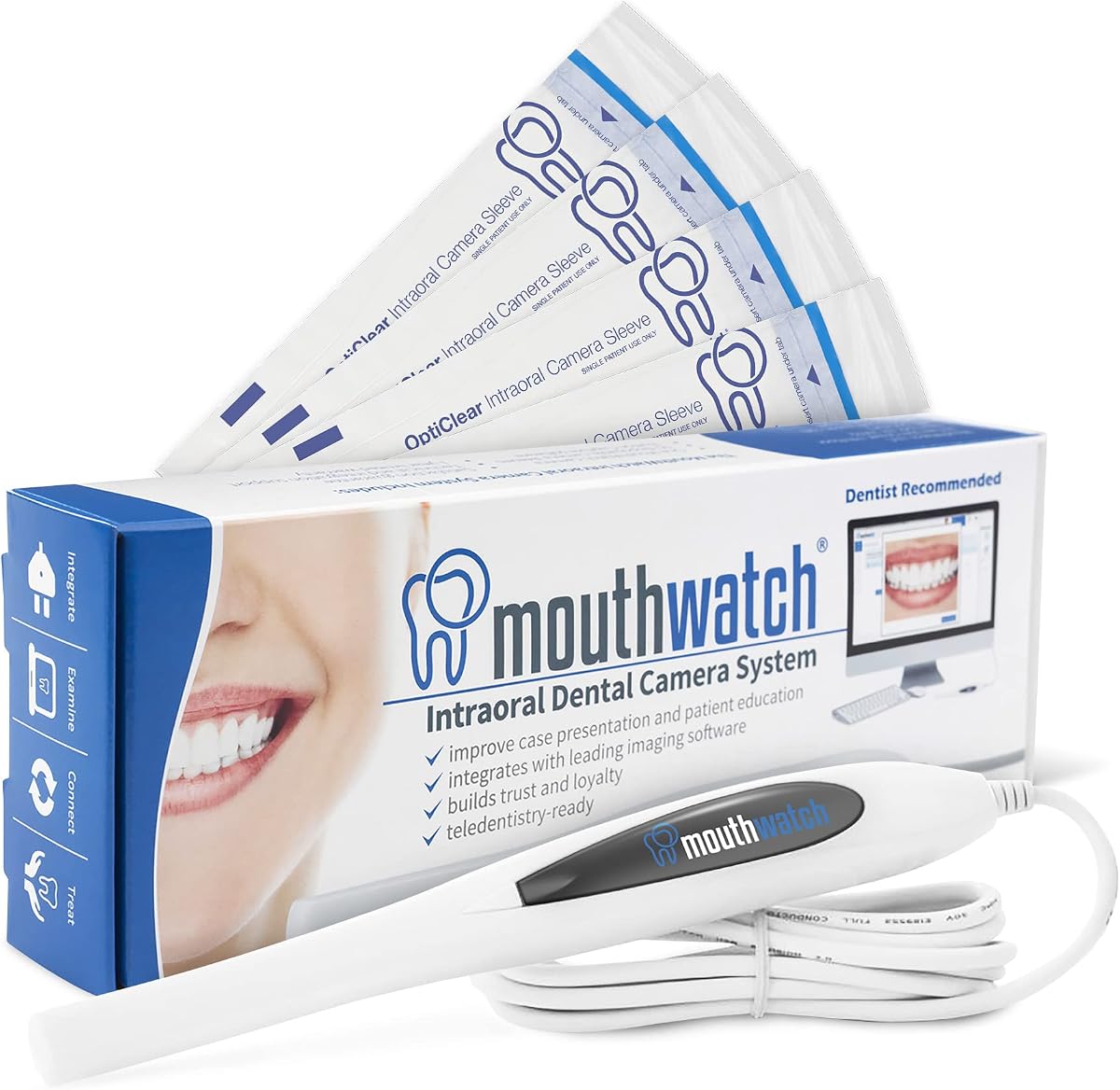
The MouthWatch Intraoral Camera earns the top position because it is designed specifically for the central task in this category: capturing usable dental images during patient care. It holds a 4.4 rating and combines a 31-gram housing with one-button operation, fixed focusing, and support for more than 50 dental imaging integrations. Rather than asking clinicians to master a general camera menu, it places the essential capture function directly on the handset.
We may earn a commission when you buy through this link, at no additional cost to you.
Its most meaningful advantage is workflow integration. The camera is described as saving intraoral pictures immediately to a patient chart with one button press, without requiring a mouse or keyboard. Compatibility includes major platforms such as Eaglesoft, Dexis, Schick, and Apteryx, along with numerous other imaging suites. The fixed 4mm-45mm focal distance also helps avoid autofocus hunting, which can waste time and produce inconsistent frames in close-up clinical work.
There are practical limits to consider. This is an intraoral camera rather than a conventional DSLR or mirrorless model, so it is not intended to photograph staff, practice interiors, smiles from a distance, or detailed treatment footage in the same way a larger camera could. Its usefulness also depends on confirming that the exact dental software used by the practice appears among the supported integrations. Lifetime customer support and reportedly quick integration setup help reduce the learning burden.
For a clinic that primarily needs reliable, chart-ready images of teeth, restorations, and oral conditions, this is the strongest overall choice. It removes unnecessary steps from a frequent clinical task and provides a compelling balance of speed, compatibility, and low handling weight. It is less suitable for buyers seeking one camera to cover every marketing and clinical application.
One-button capture directly supports a smooth patient conversation. The image can move into the chart without the separate mouse and keyboard steps associated with many conventional workflows, helping the operator keep attention on the mouth and the patient.
The fixed 4mm-45mm focal distance removes manual focusing and reduces the chance of repeated autofocus adjustments. This is particularly useful when reflections, moisture, and limited working space make consistent focus more difficult.
We may earn a commission when you buy through this link, at no additional cost to you.
The Canon EOS Rebel T7 combines a 4.6 rating with an accessible entry into interchangeable-lens photography. Its 24.1-megapixel APS-C sensor, included 18-55mm lens, and familiar DSLR controls make it useful for dental practices that want a single camera for portraits, team photographs, before-and-after galleries, and selected close-up work. It is not an intraoral device, but it provides considerably more framing flexibility than a phone.
We may earn a commission when you buy through this link, at no additional cost to you.
Built-in Wi-Fi and NFC make transferred images relatively easy to move to compatible phones, tablets, or computers. The 9-point autofocus system, AI Servo AF, and optical viewfinder with approximately 95% coverage support dependable shooting, while the camera can also serve as a webcam through compatible Canon software. The included lens provides a useful general-purpose starting point and allows the user to add specialized Canon EF or EF-S optics later.
The trade-off is that a standard zoom lens is not designed for the extremely close working distances or illumination demands of intraoral photography. A dental photographer would need an appropriate close-up lens and controlled lighting to achieve consistent results. The Rebel T7’s conventional controls also require more setup time than a one-button intraoral camera, and image transfer may not integrate directly with every practice-management platform.
Despite those limitations, the Rebel T7 is a sensible budget-oriented choice for a practice that wants a capable conventional camera without moving into a more advanced mirrorless system. It is especially attractive for staff portraits, exterior images, office documentation, and wider smile photographs. Users whose primary requirement is routine tooth close-ups should instead prioritize a dedicated intraoral system.
The interchangeable-lens design expands beyond intraoral close-ups. The Rebel T7 can document the practice, photograph the team, or produce wider patient portraits while retaining the ability to expand into more specialized Canon lenses.
Wi-Fi and NFC allow compatible devices to receive images without relying on a card reader for every transfer. This can streamline a daily workflow, although practice-management compatibility should be confirmed before purchasing.
We may earn a commission when you buy through this link, at no additional cost to you.
This Rebel T7 bundle is built around the same core platform as the standard Rebel T7 kit but adds several accessories intended to make the package more complete at the outset. The bundle includes the camera, 18-55mm lens, battery, charger, eyecup, body cap, neck strap, shoulder bag, and 64GB memory card. Its 4.6 rating makes it one of the strongest customer-rated options in the list.
We may earn a commission when you buy through this link, at no additional cost to you.
The 24.1-megapixel APS-C sensor and DIGIC 4+ processor deliver the foundation for sharp photographs with vibrant color, while automatic settings keep the camera approachable for newer users. A bright optical viewfinder, 3.0-inch LCD, simplified menus, and comfortable grip support a variety of shooting conditions. The included storage is useful for someone starting without a compatible card, and the shoulder bag supports transport between rooms or locations.
Like the standard Rebel T7, this is primarily a general photography system rather than a clinical intraoral camera. The supplied zoom lens is appropriate for portraits and broad scenes but not a ready-made solution for extreme intraoral close-ups. The bundle also does not include a dental light, diffuser, macro lens, or direct dental-software integration, so buyers should not mistake the larger accessory list for specialized clinical readiness.
The bundle makes most sense for a new practice or creator who wants a ready collection of core equipment and plans to create dental content beyond clinical documentation. It offers a strong sensor, an easy-to-use body, and the flexibility to add compatible lenses later. For routine chart images, the dedicated MouthWatch and DY-50 options are more purpose-built and potentially less complicated to operate.
Including a memory card, charger, strap, and carrying case reduces the number of separate items a new owner must assemble. It is a convenient way to begin creating portraits, educational posts, and general dental imagery.
The Rebel T7 balances automated operation with familiar manual controls. As the photographer becomes more comfortable, compatible wide-angle, telephoto, macro, and specialty lenses can broaden the creative possibilities.
We may earn a commission when you buy through this link, at no additional cost to you.
The Canon EOS R50 is the most advanced interchangeable-lens camera in this group, combining a 24.2-megapixel APS-C sensor, DIGIC X processor, sophisticated autofocus, and a compact mirrorless design. Its 4.5 rating reflects a strong balance of capability and usability. The included RF-S 18-45mm STM lens makes the kit versatile for portraits, office content, demonstrations, and broad dental imagery.
We may earn a commission when you buy through this link, at no additional cost to you.
Dual Pixel CMOS AF II covers up to 100% by 100% of the frame with 651 autofocus zones. Deep-learning subject detection can identify and track people, animals, and vehicles, while the vari-angle touchscreen and high-resolution electronic viewfinder make composition easier in constrained environments. For video, the camera supports 6K oversampled uncropped 4K recording at up to 30 frames per second and a Close-up Demo Mode that shifts focus toward the nearest subject.
The included zoom is still not a dedicated dental macro lens, and the camera does not directly integrate with every charting program. Users will need controlled lighting, a suitable close-focus lens, and a dependable file-transfer method for clinical use. A conventional mirrorless body also has more controls and potential setup complexity than a dedicated intraoral camera, especially during a busy appointment.
The R50 is best suited to a practice or dental professional who wants one sophisticated system for clinical education, before-and-after content, staff imagery, presentations, and video. Its autofocus, articulating screen, and strong 4K capabilities provide room to grow. It is the premium choice here, but a buyer focused only on quick tooth documentation may find a dedicated intraoral camera more efficient.
The wide autofocus coverage and subject detection reduce the need for constant manual repositioning. These features are valuable during demonstrations where the subject may shift unexpectedly or the camera angle needs to change.
The vari-angle touchscreen can rotate into positions that are difficult to use with a fixed rear screen. This makes the camera more adaptable when working around a reclining patient, a treatment setup, or a low tabletop display.
We may earn a commission when you buy through this link, at no additional cost to you.
The Sony ZV-1 Bundle is optimized for compact content creation rather than clinical charting, yet those characteristics can make it useful for dental education and social video. It has a 4.3 rating, a 20.1-megapixel one-inch stacked Exmor RS sensor, and a fast 24-70mm ZEISS Vario-Sonnar T* lens. The wider zoom range offers useful framing choices around a treatment chair.
We may earn a commission when you buy through this link, at no additional cost to you.
The bundle includes a 64GB card, reader, soft case, flexible tripod, and cleaning kit. A vari-angle LCD flips forward for straightforward self-framing, while dedicated controls provide background defocus and product showcase effects. The three-capsule directional microphone system prioritizes clear voice capture, and the multi-interface shoe accepts compatible accessories. Built-in Wi-Fi, Bluetooth, and USB-C support file transfer and direct live streaming.
For dental photography, the ZV-1’s lens and sensor are not substitutes for a clinical close-up setup. Small details may be difficult to isolate without suitable positioning and lighting, and the creator-oriented controls do not replace a practice-management camera workflow. It also lacks a direct dental-software integration claim. Users focused on precise diagnostic imagery should evaluate the dedicated intraoral models instead.
This camera is a good fit for a dentist who wants polished educational videos, short demonstrations, staff introductions, and social content. Its compact body, flexible screen, capable lens, and included support accessories reduce the need for separate creator equipment. The recommendation depends on making video and presentation content a major part of the camera’s role rather than treating it as a chart-image device.
The included card, reader, case, tripod, and cleaning kit cover several common setup needs. It is a convenient package for a creator who wants to begin recording and organizing dental content without assembling each accessory separately.
The directional microphone system helps prioritize a speaker’s voice, while the flip-forward display simplifies self-recording. Together, these features suit procedure explainers, introductions, and short educational clips.
We may earn a commission when you buy through this link, at no additional cost to you.
The 8K 88MP Digital Camera emphasizes feature density, offering still photography, 8K video, autofocus, a touch display, Wi-Fi, multiple shooting modes, and two batteries. It carries a 4.0 rating, placing it behind several more established products in customer feedback, but the extensive package may appeal to a creator who wants a single versatile device for travel, demonstrations, and content.
We may earn a commission when you buy through this link, at no additional cost to you.
Its front and rear dual lenses support self-recording and alternate shooting perspectives, while the 3.2-inch IPS touchscreen provides direct control of framing and focus. The mode dial includes portrait, landscape, slow motion, timelapse, filters, and program-style options. A 16x digital zoom, built-in flash, 6-axis stabilization, and 32GB card round out the feature set, and Wi-Fi transfer through the iSmart DV2 app simplifies moving files to a phone.
High-resolution labels alone do not guarantee clinical-level detail, and the 16x digital zoom is likely to be less useful than optical magnification for examining small oral structures. The information provided does not mention a dedicated dental mount, ring light, software integration, or a close-focus lens. The product may also be less representative of a focused photography system because several functions are designed around accessible content creation.
This camera is best for buyers who value a touchscreen, flexible video modes, and an extensive accessory-style package more than clinical integration. It could support office educational videos, social content, and general close-up demonstrations when paired with appropriate illumination. A dental clinic that needs dependable chart documentation should favor a dedicated intraoral system with clearly stated software compatibility.
The combination of high-resolution stills, 8K video, and numerous scene modes allows the same body to serve different content plans. It is particularly convenient for practices producing frequent short-form educational material.
A large touchscreen reduces the need to navigate a small physical interface, while the app-based Wi-Fi workflow simplifies file movement. The included batteries and charging stand also help reduce interruptions.
We may earn a commission when you buy through this link, at no additional cost to you.
The DY-50 Intraoral Camera offers a direct, USB-based route for routine clinical images. It has a 4.5 rating, a lightweight 34-gram handset, a 1600×1200 still-image resolution, and a listed compatibility range that includes Eaglesoft, Dexis, Apteryx, Schick, Dentrix Ascend, and many other systems. A capture-button driver is included so supported software can respond directly to the handpiece control.
We may earn a commission when you buy through this link, at no additional cost to you.
The camera connects to a computer by USB and is described as requiring no other hardware or software for operation. Its autofocus, anti-fog lens, non-spherical lens design, and automatic power-off function support dependable daily handling. The package includes the camera, holder, USB cable, 50 sheaths, and the required capture-button driver, giving a new user the main accessories needed to begin documenting patients.
Compatibility is the central issue, and the manufacturer is unusually direct about it: buyers should not purchase the camera if their software is absent from the list unless they are willing to use the camera’s own software. The stated operating systems include Windows 10, 8, 7, and XP, which may not reflect every modern practice environment. The 640×480 video format is also less detailed than the still-image capability, and the product is not a broad creative camera.
The DY-50 is a practical choice for a Windows-based clinic using one of the explicitly listed imaging platforms. Its direct connection, included driver, and broad compatibility can simplify a clinical setup more than a general camera with a separate transfer workflow. Confirm the exact practice software first, and consider the system requirements carefully before making this purchase.
Unlike general cameras, an intraoral model must be able to place images where the practice expects them. The detailed compatibility list is a strength, but the explicit warning about unlisted software makes verification essential before purchase.
Connecting the handset directly to a computer reduces the number of separate components. The included driver, cable, and capture control also improve the convenience of routine chairside documentation.
We may earn a commission when you buy through this link, at no additional cost to you.
The DARYOU DY-60 differentiates itself with a 720p HD output and 4x zoomable capability, both useful when a dentist needs to frame a small area or adjust the apparent view of an intraoral scene. Its 4.3 rating and broad software list position it as a practical clinical tool for supported practices using programs such as Dexis, Apteryx, Schick, Dentrix Ascend, Carestream, and others.
We may earn a commission when you buy through this link, at no additional cost to you.
A capture-button driver is included so the handpiece control can operate within compatible imaging software. The system does not require a foot pedal, helping simplify setup and reduce the number of accessories around the chair. Its USB-oriented design and dedicated clinical focus make it more efficient for image documentation than a generic camera whose files must be moved and renamed manually.
Its 720p video resolution is lower than many modern expectations, and there is no stated high-resolution still-image specification. The product also carries the same important compatibility caveat: the manufacturer advises against purchasing when the practice software is not on the list unless the user accepts the camera’s own software. The available information is less complete than for the DY-50, so buyers should request confirmation of the exact connection process and current software support.
The DY-60 makes sense for a supported clinic that values zoom and a direct capture button more than maximum video resolution. It is useful for examinations, treatment discussions, and routine documentation where 720p output is sufficient. Buyers seeking more detailed modern imaging should compare the stated capabilities of higher-resolution dedicated cameras or a sophisticated mirrorless setup.
The 4x zoom allows the operator to adjust framing without moving the camera tip closer to sensitive areas. That can make it easier to isolate a particular tooth or surface in a crowded intraoral view.
The included driver makes the capture button functional in supported software without a separate pedal. This reduces setup complexity and keeps the operator’s attention on the patient.
We may earn a commission when you buy through this link, at no additional cost to you.
The UNK Kime-X8S Elite is the most integrated system in the group, combining a 17-inch all-in-one touchscreen with an HD intraoral camera, Wi-Fi QR transfer, and a slim 5mm imaging option. Rather than requiring a separate monitor and computer, it presents a consolidated setup for clinical imaging and case review. No customer rating is supplied, so its performance should be assessed primarily from the stated features.
We may earn a commission when you buy through this link, at no additional cost to you.
The full-screen and quad-split layouts allow multiple angles or before-and-after images to be viewed together. That is useful for comparisons during consultations, case presentation, and documentation. The imported image chip is described as delivering high-definition visuals, while the 5mm camera can improve access in confined oral spaces. Wi-Fi QR functionality allows patient photos to move to another device by scanning a code.
The integrated 17-inch display is a significant commitment of space and is likely to offer less portability than a small intraoral camera or conventional interchangeable-lens body. The provided information does not list particular practice-management platforms, still-image dimensions, or detailed technical compatibility, so buyers should confirm whether the system meets the requirements of their existing software. A built-in screen also cannot automatically guarantee that images will reach the correct patient record.
The Kime-X8S Elite is a compelling option for a clinic that wants a large review display, wireless transfer, and a complete imaging station. It may be especially convenient for private practices that control their own equipment and want before-and-after comparison in a single interface. Prospective buyers should ask about software integration, warranty coverage, and installation details before committing.
The 17-inch touchscreen provides a dedicated surface for reviewing images with patients. Its larger scale can make close inspection of multiple views more comfortable than working from a small computer window.
QR-based transfer removes the need for cables or complicated software when moving patient photos to a compatible device. The approach can make consultation and documentation workflows feel more immediate.
We may earn a commission when you buy through this link, at no additional cost to you.
The Oral Phone Camera Light Kit is not a camera, but it is a useful accessory for anyone using a phone to document dental conditions. It carries a 4.6 rating and addresses a common weakness of phone photography in the mouth: inconsistent illumination, harsh shadows, and difficulty seeing surfaces inside the oral cavity. Its bidirectional LED design and adjustable brightness can make images clearer for consultations and educational use.
We may earn a commission when you buy through this link, at no additional cost to you.
The support bar permits omnidirectional shooting, while the removable handpiece bracket allows the user to adjust the light’s angle. Each unit has a brightness knob that controls output from zero to full, making it possible to reduce glare rather than always using maximum brightness. The kit works with most compatible cell phones as well as suitable dental photography equipment, and a non-slip handle supports a secure grip.
The quality of the final image still depends on the phone’s camera, software, lens condition, and available controls. This kit cannot provide the same workflow integration as a clinical intraoral camera or the sensor and lens flexibility of the Canon and Sony models. It also does not resolve the challenge of pulling a phone back far enough to focus on every intraoral surface, so the device must support a suitable close-up approach.
This is the most accessible option for a dental professional who already prefers a phone and wants to improve oral lighting without adopting a conventional camera body. It is also useful for laboratory communication, treatment-result presentations, and general medical or product photography. It should be viewed as a lighting upgrade rather than a complete replacement for a dedicated dental imaging system.
The dual-light arrangement can illuminate the oral environment from opposing directions, reducing the uneven shadows that make phone images difficult to interpret. Adjustable output gives the photographer more control over glare and surface detail.
The removable bracket and support bar adapt the kit to most compatible phones. This makes it a relatively simple addition for a practice that already handles images on mobile devices.
We may earn a commission when you buy through this link, at no additional cost to you.
The right camera depends on whether images must enter patient charts, document treatments, support education, or create polished marketing content. Compatibility, working distance, lighting, and transfer speed deserve more attention than headline resolution alone.
For routine patient documentation, the camera must be able to place images in the exact program used by the practice. The MouthWatch, DY-50, and DY-60 list substantial compatibility with systems such as Eaglesoft, Dexis, Schick, Apteryx, and Dentrix Ascend, while the Kime-X8S Elite emphasizes wireless transfer rather than named practice platforms. Check the current supported list, operating-system requirements, and capture-button behavior before buying, and confirm whether the software version in the clinic is included.
Resolution matters when a practitioner needs to inspect surfaces, document small findings, or compare treatment details. The DY-50 states a 1600×1200 still-image resolution, the DY-60 lists 720p HD video with 4x zoom, and the interchangeable-lens cameras use 24.1- or 24.2-megapixel sensors. Higher nominal resolution does not automatically create a better clinical image; focus, illumination, lens quality, stabilization, and file workflow also influence the final result.
Intraoral cameras operate very close to the subject, so focus behavior can be decisive. The MouthWatch uses a fixed 4mm-45mm focal distance to avoid autofocus hunting, while the DY-50 includes autofocus. Conventional cameras can offer more framing control but usually require a suitable close-up lens and careful positioning. Consider the size of the treatment area, the camera tip’s physical length, and the operator’s ability to maintain a consistent working distance.
The mouth is a reflective environment, and inconsistent light can hide detail or create distracting glare. Dedicated intraoral cameras are designed to illuminate the field, while general cameras need added continuous light and careful diffusion. The phone light kit offers adjustable bidirectional LEDs for that purpose. When comparing cameras, consider whether the lighting is integrated, whether it can be positioned, and whether exposure can be controlled without washing out pale surfaces.
A camera that takes excellent images is less valuable if files become difficult to label, save, and retrieve. One-button clinical capture and direct chart integration suit high-volume use, while Wi-Fi, NFC, and Bluetooth suit general content creation. The Kime-X8S Elite adds QR transfer, and the Rebel T7 supports wireless transfer to compatible devices. Consider who handles the files, which devices are in use, and how patient images will move from capture to storage and presentation.
A dedicated intraoral camera is optimized for tooth documentation, while a conventional camera can cover smiles, portraits, the office, equipment, and educational video. The Rebel T7 and R50 support interchangeable lenses; the Sony ZV-1 offers a creator-oriented screen and controls. Choose a dedicated system when chart documentation dominates, or a general camera when the same device must create a broader content library.
Clinical work requires mobility between operatories, while patient consultations may benefit from a large display. The MouthWatch and DY-50 provide lightweight handsets, the Rebel T7 and R50 are portable camera bodies, and the Kime-X8S Elite includes a 17-inch screen. The R50’s vari-angle touchscreen and ZV-1’s creator display also support flexible positioning, which can help when shooting over a patient or around a treatment setup.
Dentists producing procedure explainers or social content need more than still capture. The R50 supports uncropped 4K and a Close-up Demo Mode, while the Sony ZV-1 includes a directional microphone system and creator controls. The 8K digital camera also provides extensive video modes. Match resolution, frame-rate needs, audio, autofocus, and focusing behavior to the content rather than selecting a camera solely for still-image specifications.
Begin by confirming compatibility, installing any required driver or companion software, and testing the camera with a nonclinical image before a patient appointment. For an intraoral system, inspect the lens, sheath, cable, and capture control, then confirm that images appear in the intended chart or presentation view. For a conventional camera, fit the appropriate close-up lens if needed, set a consistent exposure, and establish a repeatable position around the chair.
Create a simple lighting routine before each session. Clean the lens according to the manufacturer’s instructions, use fresh sheaths or an approved barrier where required, and avoid touching optical surfaces with dry fingers. Control reflections by changing the light or camera angle slightly instead of increasing intensity unnecessarily. For phone-based photography, keep the light centered and adjust its brightness in small steps while checking the live image on a larger screen when possible.
For ongoing care, store the device in a clean, dry environment and keep cables free from sharp bends. Follow the stated supported operating systems, update software when instructed, and avoid unlisted compatibility workarounds. Use the included protective case or a suitable container for transport, and periodically review image sharpness, focus, illumination, and transfer procedures so that workflow problems are corrected before they affect patient documentation.
An intraoral camera is usually better for routine tooth documentation because it is designed for close-up capture, integrated illumination, and clinical-software workflows. A regular DSLR or mirrorless camera is more useful for portraits, wider smiles, practice imagery, and video. Many practices use both types for different jobs rather than expecting one device to handle every image.
Software compatibility, focus behavior, illumination, and transfer workflow matter more than headline specifications. Confirm that the camera works with the exact imaging program and operating system used by the practice. Then evaluate how the images will be stored, labeled, shared, and presented so the device fits a real clinical routine.
A suitable close-focus or macro lens is important when using a conventional camera for detailed oral images. The standard 18-55mm lenses included with the Rebel T7 and Canon EOS R50 are useful for general photography but are not dedicated dental optics. A dedicated intraoral camera is a simpler alternative when routine chart documentation is the main requirement.
Yes, especially for consultations, treatment-result images, and educational content when lighting and focus are controlled. The Oral Phone Camera Light Kit can improve illumination, but the phone’s camera quality and close-focus ability still determine the result. Phones also require a deliberate naming and transfer process if images need to reach a patient chart.
A new practice may begin with a dedicated intraoral camera and a separate conventional camera or controlled phone setup. The intraoral model supports tooth documentation, while the other equipment covers portraits, office content, and video. Starting with two clearly defined roles is usually more manageable than buying a large kit of unspecified accessories.
They can be valuable when a practitioner wants to move images quickly to a phone, tablet, presentation, or consultation device. However, convenience does not guarantee clinical organization. Confirm that the destination system accepts the files, that transfer does not create duplicates, and that patient information is handled according to the practice’s privacy procedures.
A fixed-focus camera uses a set working range, which can be fast and predictable when the distance suits that range. An autofocus camera adjusts to the captured distance, which may add flexibility but can also take time to settle. The best choice depends on typical treatment depth, operator technique, and the consistency of the available working space.
No. Resolution contributes to detail, but focus, lighting, color, stability, and file integration determine whether images are clinically useful. Compare actual output modes, lens behavior, software support, and the workflow around each product. A modest-resolution camera that saves reliably to the chart may serve a practice better than a higher-resolution device that creates complicated file handling.
The MouthWatch Intraoral Camera is the leading choice for practices that want fast, chart-ready dental images with one-button operation, a lightweight handset, and broad software support. The Canon EOS Rebel T7 offers an approachable conventional-camera route with a strong rating and wireless transfer, while the Canon EOS R50 stands out as the premium choice for advanced autofocus, flexible positioning, and 4K educational video.
Prioritize the workflow you need most. Choose a dedicated intraoral model for frequent tooth documentation, a general camera for portraits and broader visual content, and supplemental lighting when working with a phone. The DY-50 and DY-60 reward careful software verification, while the Kime-X8S Elite suits clinics attracted to a large integrated display and QR-based transfer.
Before ordering, confirm compatibility, included accessories, intended image destinations, and the physical room available for the equipment. Product listings, included components, and technical details can change, so review the current manufacturer and retailer information before making a final decision.