
TEEHO TE001 Keyless Entry Deadbolt with Keypad for Front Door, Bronze
4.5Editor score
Twenty access codes supported
Automatic locking from ten seconds
Single-use guest PIN codes
Our best Coded Lock for Doors guide compares 10 top keypads on security, access features, installation, battery life, and smart-home connectivity today.
A coded lock for doors replaces the need to carry or hide keys by letting trusted people enter with a numeric PIN. The best models combine sturdy construction, intuitive keypads, flexible locking controls, reliable battery alerts, and easy installation, while connected options add remote access and visitor management.
We compared all 10 products by examining their security features, code capacity, temporary-access options, auto-lock behavior, power requirements, weather resistance, installation requirements, and smart-home capabilities. The list covers standalone keypads, lever and knob sets, deadbolts, and Wi-Fi-enabled models for different homes and access situations.
Each review identifies the product's strongest qualities, useful limitations, and ideal buyer so you can choose confidently. Product details and availability can change, so confirm the current listing, included components, dimensions, and installation requirements before ordering.
4.5Editor score

4.5Editor score
4.3Editor score
The comparison below highlights the major differences in lock format, access methods, connectivity, power source, and intended use, making it easier to narrow the field before reading the full reviews.


This Schlage electronic keypad lock earns a 4.5 rating and stands out as the most balanced option for a typical residential or light-commercial door. It combines a familiar lever design with Grade 2/AAA security, an illuminated keypad, flexible locking behavior, and straightforward installation.
We may earn a commission when you buy through this link, at no additional cost to you.
Its automatic relocking engages five seconds after a code is entered, reducing the chance that an unlocked door will be forgotten. The lock supports easy exit by turning the interior handle, while a dedicated low-battery indicator helps prevent an unexpected lockout. Silicone-coated numbers remain easy to locate and press in low light.
The main compromise is that this is a standalone electronic lock rather than a connected smart-home device. It does not offer remote control, access history, voice commands, or app-generated temporary codes. It also depends on a 9V battery, so the indicator should be monitored even though typical use can produce up to two years of operation.
It is a strong recommendation for someone who values established mechanical construction and straightforward keyless entry without account setup or network configuration. Homeowners replacing an existing lever or knob can install it with a screwdriver and no hardwiring.
Grade 2/AAA construction gives this model a stronger security-oriented foundation than many inexpensive keypad knobs. The five-second re-lock interval adds a practical second layer without requiring the user to remember a separate lock command.
The backlit, silicone-coated keypad is designed for regular use in the dark, and the lock can be programmed for multiple household members. Its lever format also makes it more natural to operate than a thumbturn deadbolt.
We may earn a commission when you buy through this link, at no additional cost to you.
The Yamiry Keypad Smart Door Knob Lock has a 4.4 rating and appeals to buyers who want keypad entry in a compact lever-and-knob format. It supports 20 programmed codes, a one-time guest code, and physical key entry for flexibility when the battery or electronics are unavailable.
We may earn a commission when you buy through this link, at no additional cost to you.
One of its most useful features is the adjustable automatic locking period, which can be set from five to 99 seconds. That range lets users choose a brief delay for quick household traffic or a longer delay for carrying groceries, moving furniture, or unloading a vehicle. The lock can also be set to remain unlocked when needed.
Its aluminum alloy body, IP54 weather resistance, anti-prying code protection, and low-battery indicator make it practical for exterior residential use. Installation is advertised as taking less than 15 minutes with a screwdriver, though buyers should still verify their door's dimensions and bore requirements.
Choose this model if a knob-style lock better matches your door than a deadbolt or lever set. It is also a sensible option for families that want one-time guest access but do not need remote app control.
The unusually broad five-to-99-second range accommodates everything from quick family entry to extended periods of frequent movement. Disabling the feature is also possible, although it is better reserved for controlled situations such as temporary passage.
A dedicated one-time code lets a visitor gain entry without receiving a permanent user credential. Physical key support adds another backup method for times when the batteries need replacement.
We may earn a commission when you buy through this link, at no additional cost to you.
The TEEHO TE001 combines a 4.5 rating with a broad set of entry features, making it our best budget selection. It supports 20 access codes, including a temporary code that deletes itself after one use, and provides both timed automatic locking and one-touch locking.
We may earn a commission when you buy through this link, at no additional cost to you.
Its anti-peeping user-code protection adds a layer of privacy around the keypad. A red indicator warns when battery power falls below 15 percent, while four AA batteries are advertised to last up to 365 days under typical use. Buyers must supply those batteries themselves.
Installation is generally straightforward with a screwdriver, but compatibility requires attention. The deadbolt is designed for a 2-1/8-inch, or 54-millimeter, door hole and does not fit a 38-millimeter opening. It must also be reset before first use so it can detect the door's swing direction.
This is an attractive choice for a standard front door where a traditional deadbolt profile is preferred. It provides more entry flexibility than a basic mechanical keypad without introducing the setup demands of a connected lock.
Holding a keypad button for two seconds locks the door immediately, while the programmable timer covers slower exits. Both methods make it easier to secure the door when the household is in a hurry.
The stated battery life of up to 365 days reduces routine maintenance, and the early low-battery warning provides time to replace the cells. A physical lock cylinder remains part of the overall security design.
We may earn a commission when you buy through this link, at no additional cost to you.
The iulock Keypad & Key Smart Door Lock earns a 4.3 rating and stands out with support for up to 50 customizable codes. Its high code capacity is particularly relevant to shared properties, offices, rentals, workshops, or other locations where several different people may need controlled access.
We may earn a commission when you buy through this link, at no additional cost to you.
This model also offers passage mode for periods when the door should remain unlocked and silent mode for reducing keypad noise. The numbers have a soft backlight for nighttime operation, while the lock uses four AAA batteries and provides a low-battery alarm. A USB-C backup connection can power the lock if the batteries are depleted.
The physical lock cylinder accepts two keys compatible with most mechanical keys, giving users a familiar backup method. Its IP65 rating and listed operating range from -22 to 176 degrees Fahrenheit indicate a strong focus on exterior and changing environmental conditions.
It fits doors between 1-3/8 and 2-1/2 inches thick and supports adjustable latch options for 2-3/8- or 2-3/4-inch backsets. It is a strong fit for users seeking more code capacity and flexible operating modes without a connected ecosystem.
Up to 50 customizable codes provide room for family members, tenants, employees, and occasional visitors. Codes from one to 15 digits can be tailored to different access groups or routines.
IP65 weather resistance and the broad stated temperature range suit exterior doors in varied climates. The silicone grip and illuminated keypad also support comfortable everyday operation.
We may earn a commission when you buy through this link, at no additional cost to you.
The TEEHO TE004 has a 4.2 rating and emphasizes layered keypad security. It supports up to 20 user PIN codes, one-time temporary codes, and two physical backup keys, giving households several practical ways to manage entry.
We may earn a commission when you buy through this link, at no additional cost to you.
Its anti-peeping function allows random digits to be entered before or after the actual code, which can obscure the real sequence from someone watching. After 10 consecutive incorrect PIN attempts, the lock shuts down for three minutes. The zinc alloy body and reinforced lock cylinder add physical strength, while the ANSI Grade 3 certification provides an objective construction standard.
The model includes auto-lock timing from 10 to 99 seconds, one-touch locking, a privacy thumb turn, passage mode, and optional mute operation. Four AA batteries provide a stated life of up to one year, and the keypad flashes red below 15 percent power. Batteries are not included.
This is a well-rounded lever lock for someone who values code privacy and intrusion resistance but does not need remote access. Its installation is advertised as taking about 10 minutes with a screwdriver, with compatibility across common door thicknesses, backsets, bore sizes, and handing.
Anti-peeping digit randomization helps conceal the true PIN, while the timed shutdown discourages repeated guesses. These controls are especially useful in busy households or properties where visitors may stand near the entrance.
A manual interior thumb turn allows immediate privacy or egress, while passage mode supports frequent movement through a shared space. Auto-lock remains enabled by default and can be adjusted for different routines.
We may earn a commission when you buy through this link, at no additional cost to you.
The second Schlage option in this guide carries a 4.5 rating and offers up to 19 programmable codes for friends and family. Two pre-programmed codes help simplify initial setup, while its familiar lever and Camelot trim make it suitable for many residential entrances.
We may earn a commission when you buy through this link, at no additional cost to you.
The interior flex-locking switch lets users move between an unlocked mode and automatic re-locking operation. That makes the lock adaptable to situations where frequent passage is needed without giving up the convenience of automatic security. Exit remains possible by turning the interior handle.
As with the other Schlage model, Grade 2/AAA construction, metal construction, a low-battery indicator, and an illuminated silicone-coated keypad form the core feature set. The included 9V battery is advertised to last up to two years with typical use.
Its most significant advantage over the first Schlage pick is the explicit flex-locking control and broader stated electronics warranty. However, it lacks app-based management, remote access, and one-time digital visitor codes, making it most appropriate for households that want dependable local control.
The interior switch provides a quick way to change between automatic relocking and a continuously unlocked state. It is useful for homes with repeated daytime traffic or shared interior access.
Nineteen codes cover regular household access without requiring internet service. The illuminated keypad and simple turn-to-exit operation make the lock approachable for adults and children with assigned PINs.
We may earn a commission when you buy through this link, at no additional cost to you.
This Keypad Door Lock with Handle earns a 4.4 rating and delivers a polished local-entry experience without requiring an app, Wi-Fi, or Bluetooth. It can issue up to 20 personalized four-to-eight-digit codes, including temporary one-time codes for visitors.
We may earn a commission when you buy through this link, at no additional cost to you.
The backlit keypad supports nighttime entry, and auto-lock can be configured anywhere from five to 99 seconds. Passage mode keeps the door unlocked during periods of frequent movement, such as moving days, gatherings, or business hours. Two backup keys provide a nonelectronic access option.
Its reversible handle fits both left- and right-handed doors, while the stated compatibility covers 99 percent of standard wooden doors in the United States and Canada. Installation is advertised at about 15 minutes using a screwdriver. IP54 weather resistance makes it suitable for both indoor and outdoor doors.
This model is ideal for users who want multiple PINs and temporary access without the account setup and network dependence of a Wi-Fi lock. Its four AA batteries are not included, and the stated eight-to-twelve-month runtime varies with use.
The keypad handles code assignment, temporary access, passage mode, and auto-lock locally. This reduces setup complexity and continues to function without a router, hub, phone, or cloud account.
The reversible handle and adjustable installation components make the model a practical upgrade for many standard wooden doors. Measure the door and confirm bore and backset dimensions before beginning.
We may earn a commission when you buy through this link, at no additional cost to you.
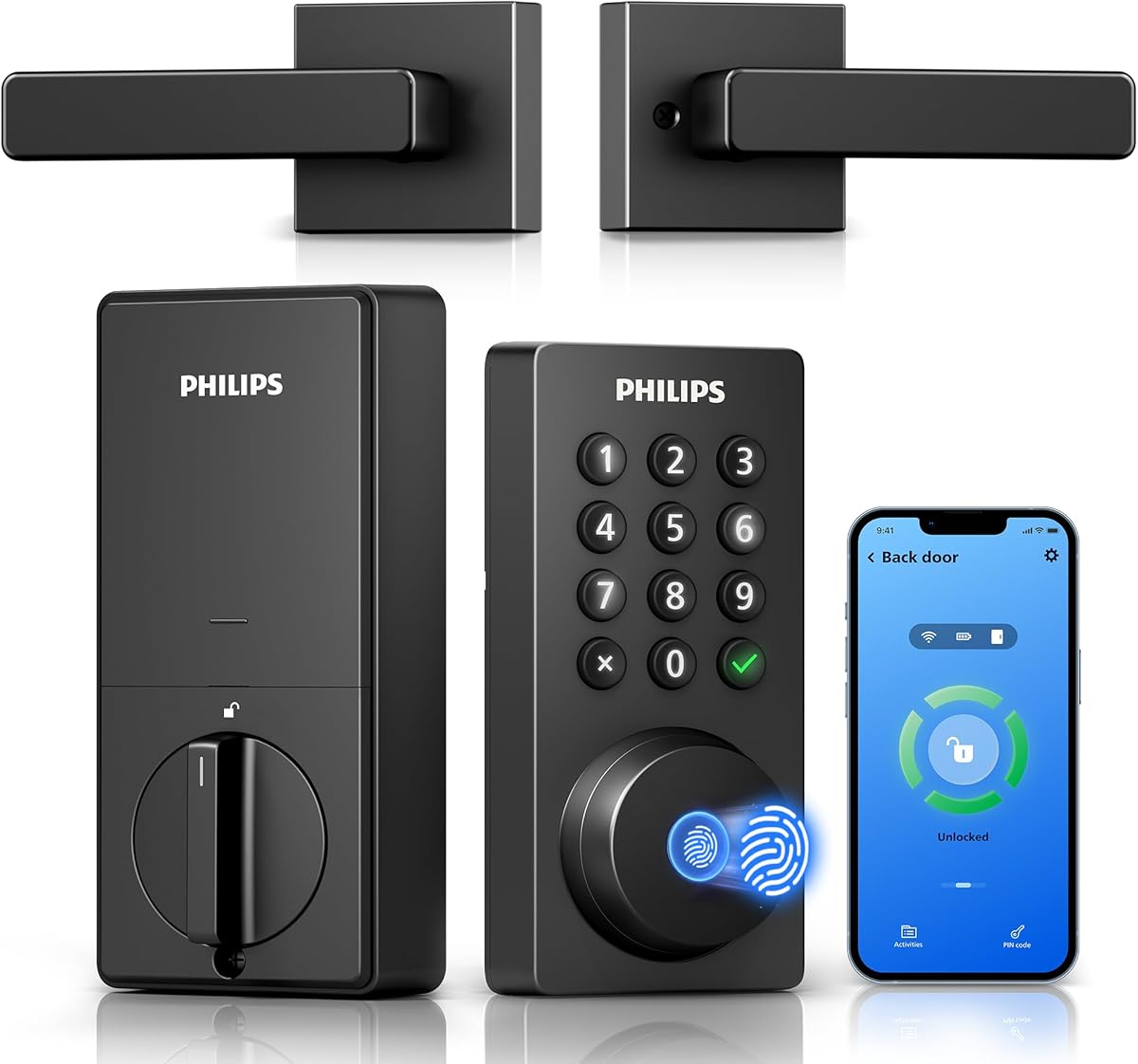
The Philips WiFi Keypad Deadbolt with Handle has a 4.3 rating and is the most complete connected entry set in the list. It combines built-in Wi-Fi, an illuminated keypad, fingerprint access, app management, and a matching handle in one package.
We may earn a commission when you buy through this link, at no additional cost to you.
The Philips Home Access app allows users to lock or unlock the door, manage codes and fingerprints, check lock status, and review access history. It also supports permanent, one-time, periodic, and recurring PINs, making it useful for family members, cleaners, visitors, and rental properties.
Fingerprint access is advertised to unlock in 0.3 seconds, while voice commands through Alexa or Google Assistant provide another option. The lock connects directly to a 2.4GHz network without a separate hub and should remain within 33 feet of the router for the strongest connection.
Its stated battery life is up to six months, with an intelligent low-battery alert. The complete set is a strong choice for someone who wants remote control and a coordinated deadbolt-and-handle installation. Buyers should account for network placement, door handing, and the need to use standard 1.5-volt alkaline batteries.
App-based status checks and real-time access history make it easier to know whether the door is secure and who entered. Remote locking is particularly valuable for users who are away from home frequently.
PINs, a fingerprint reader, app control, and voice commands offer several ways to enter. This flexibility helps family members choose the method that best fits their routine.
We may earn a commission when you buy through this link, at no additional cost to you.
The Philips Wi-Fi Smart Deadbolt has a 4.2 rating and places substantial remote-management features in a connected deadbolt. It supports app control, passcodes, fingerprints, a physical key, and voice commands through Alexa or Google Assistant.
We may earn a commission when you buy through this link, at no additional cost to you.
A major strength is its capacity for up to 100 custom passcodes, along with unlimited one-time or scheduled codes that can be shared for guests, cleaners, and deliveries. Real-time alerts and access history provide visibility into when the door opens, while remote locking and unlocking are available from the phone.
Away mode offers a focused security response by disabling all unlock methods except the master code. Automatic locking can be adjusted from 10 to 180 seconds. Voice control requires a signed-in Google or Alexa account and a stable 2.4GHz network, with the router ideally kept within 65 feet.
This is a capable connected deadbolt for users who actively want digital access management. It does not include a door-position sensor, so its status reporting should not be confused with real-time confirmation of whether the door itself is open.
Up to 100 custom codes provide room for large households and busy rental properties. Sharing one-time or scheduled credentials removes the need to collect a physical key after a visit.
Away mode limits access to the master code while the household is traveling. It offers a straightforward way to reduce credential exposure during an extended absence.
We may earn a commission when you buy through this link, at no additional cost to you.
The Veise KS01B has the highest listed rating in the comparison at 4.6 and is a particularly complete lever-lock set. It includes two ergonomic handles, a keypad, up to 20 permanent codes, one-time passwords, and two physical backup keys.
We may earn a commission when you buy through this link, at no additional cost to you.
Security features include anti-peeping protection, a three-minute shutdown after 10 failed attempts, an ANSI Grade 3 certification, IP54 water and dust resistance, and a zinc alloy lock cylinder. The stated cycle testing and construction details support its positioning as a durable residential or light-commercial option.
The lock offers auto-lock timing from 10 to 99 seconds, one-touch locking, silent mode, and vacation mode. Vacation mode disables every code except the master code, while the interior thumb turn can trigger an alarm if the door is unlocked from inside. Four AA alkaline batteries are needed and are not included.
The dual-handle arrangement gives both sides of the door a coordinated appearance and natural grip. It is well suited to buyers who want the highest-rated option in this guide and a complete handle set, while preferring local controls over app-based management.
The failed-attempt lockout, anti-peeping code, reinforced cylinder, and Grade 3 certification create several complementary protections. These features are especially useful on a main entrance where unauthorized code attempts are a concern.
Vacation mode reduces the number of active credentials during travel, while silent mode suppresses routine keypad sounds without muting important security alerts. The interior alarm provides an additional signal when the door is manually unlocked from within.
We may earn a commission when you buy through this link, at no additional cost to you.
Choosing a coded lock starts with the door, the people who need access, and the level of control you want. Security, installation, credentials, power, connectivity, and weather resistance should be considered together rather than in isolation.
A deadbolt, lever, and knob are not interchangeable in every installation. Check the door thickness, bore diameter, backset, lever or knob projection, handing, and whether the existing strike and latch can be reused. Products such as the Veise KS01B and TEEHO TE004 state compatibility with common left- and right-handed doors, while the TE001 has a narrower, specifically stated 2-1/8-inch bore requirement.
Measure before buying and compare the product's installation diagram with your door. Also account for trim clearance around the frame, the path of the handle, and any existing deadbolt hardware.
Look beyond the keypad and examine the lock cylinder, metal construction, latch or bolt, certification, and resistance to weather. Schlage's models carry Grade 2/AAA ratings, while the TEEHO TE004, Veise KS01B, and several other products use ANSI Grade 3 certification. These standards provide useful context, but correct installation and a sound door frame remain equally important.
Choose a lock with a solid cylinder, secure fasteners, and a proven certification for the intended exposure. Also consider anti-peeping code features and failed-attempt lockouts for entrances where someone might stand near the keypad.
Code capacity should reflect regular users, occasional visitors, cleaners, contractors, and family members rather than only current residents. Capacity ranges from 20 codes on several models to 50 on the iulock and 100 on the Philips Wi-Fi Smart Deadbolt. More capacity is useful for shared properties, but one-time and scheduled codes may be more valuable than a large permanent list.
Match the credential system to your routine. A household of two needs very different access management from a rental property or small office.
Automatic locking is central to many coded locks, but the available timing differs. Some begin in five seconds, others start at 10 or 15, and connected models can reach as high as 180 seconds. Passage mode can temporarily disable automatic locking, which is convenient during moving days or in frequently used shared spaces.
Test the timing in daily use so it is long enough to carry items and short enough to protect the door. Remember that some products disable auto-lock by default or require the function to be activated through an app.
Standalone keypads are simpler because they do not require an account, router, hub, or phone. Connected models add remote locking, access history, alerts, scheduled codes, voice control, and sometimes fingerprint management. Those conveniences also bring network placement, app permissions, setup, and ongoing support considerations.
Choose local control when reliability and simplicity matter most. Choose Wi-Fi control when you regularly need remote visibility or expect to issue temporary digital credentials from a distance.
Battery life varies with frequency of use, auto-lock settings, and the number of electronic operations. Products use different cells: the Schlage models use an included 9V battery, while many others use four AA or AAA batteries. Some listed runtimes approach a year, whereas the connected Philips deadbolt is stated at up to six months.
Look for a clear low-battery indicator and consider an emergency-power method. The iulock includes USB-C backup power, and most products provide a physical key or mechanical override. Know where the override is before the main batteries fail.
A front door lock must tolerate rain, sunlight, cold, and temperature changes better than an interior model. IP54 appears across several products, while the iulock keypad knob carries IP65 protection and a broad stated temperature range. These ratings indicate stronger environmental suitability but do not eliminate the need to keep water away from keyholes and exposed lock interiors.
For exterior use, verify the listed rating, operating temperature, and installation instructions. Avoid exposing batteries or electronic components to moisture, and follow the manufacturer's guidance on direct sunlight.
Most products advertise screwdriver-only installation in roughly 10 to 15 minutes, but the wording does not guarantee every installation is simple. Existing trim may need removal, wiring may have to be repositioned on connected models, and unfamiliar doors can reveal dimension or handing problems. Read the manual and installation video before drilling or disconnecting existing hardware.
Confirm whether batteries, keys, strike plates, screws, and mounting hardware are included. Warranty terms and support channels also vary, so retain the purchase record and register the product where applicable.
Before programming the lock, install it with the door open, confirm that the latch or bolt moves smoothly, and test the handle in both locked and unlocked positions. Follow the manufacturer's reset instructions for models that must learn the door's swing direction. Do not overtighten screws, as excessive tension can interfere with turning the handle or retracting the bolt.
Create a clear naming plan for each PIN, and avoid easy-to-guess sequences. Use temporary or one-time codes for guests, cleaners, contractors, and delivery personnel rather than sharing the master credential. Set auto-lock timing to match your routine, enable passage mode only when needed, and test every programmed credential before handing the lock over for regular use.
Check the battery indicator periodically and replace batteries as a group when prompted. Keep the keypad clean and dry, inspect weather seals, and use the physical backup key if the keypad fails. For connected locks, update the app when instructed, preserve network access, and review stored codes or fingerprints when household members move, renters leave, or access permissions change.
Keypad locks can reduce key loss and make it easier to revoke or limit access without changing the cylinder. Their actual security depends on the lock's construction, code practices, failed-attempt protections, and the strength of the door and frame. A coded lock with a solid cylinder and sound installation can complement physical security rather than replace it.
Most models provide a low-battery warning before power is completely lost. Many also include a physical key or another mechanical override, while the iulock keypad knob adds USB-C emergency power. Check the override method during installation so you know where the backup key is and how to use it before the batteries run down.
Most households need only a few permanent codes plus one or two temporary credentials. Families, offices, and rental properties may benefit from the larger capacities offered by the iulock and Philips models. Use separate temporary codes rather than one shared PIN when you need to know when a visitor's access period should end.
No. Standalone models such as the Schlage, TEEHO, Yamiry, iulock, and Veise locks handle codes locally without internet service. Wi-Fi models add remote control, access history, alerts, scheduled credentials, and sometimes voice commands, but they also require a suitable 2.4GHz network and app-based setup.
Most listed models are designed as DIY replacements for an existing lever, knob, or deadbolt and use a screwdriver for installation. Compatibility depends on door thickness, bore size, backset, handing, and included hardware. Connected models may also involve wires, so read the installation guide and watch the supplied video before beginning.
Auto-lock is one of the most useful security features because it reduces the chance of leaving the door open. Choose a delay that accommodates carrying groceries or other items without leaving the entry unsecured for long. Use passage mode only for controlled periods of frequent passage, and re-enable auto-lock afterward.
Yes, provided the lock supports one-time, scheduled, or recurring codes. Local models can handle one-time guest PINs, while connected Philips models allow credentials to be managed through an app. You should still confirm how quickly a one-time code expires and maintain a dependable secondary access method for emergencies.
Choose a model with a suitable weather-resistance rating and operating-temperature specification. Many options are rated IP54, while the iulock knob is rated IP65. Install the weather seals correctly, keep liquids away from the keyhole and interior electronics, and follow the manufacturer's guidance on sunlight and moisture.
The Schlage keypad lever is the most balanced all-around selection, combining Grade 2/AAA security, flexible locking, a useful illuminated keypad, and straightforward installation. The TEEHO TE001 is a compelling budget-oriented deadbolt, while the Philips WiFi Deadbolt with Handle is the strongest choice for remote control and a complete connected entry set.
Your priorities should guide the final choice. Choose a deadbolt for a strong, traditional front-door profile, a lever or knob for convenient everyday operation, a local keypad for simplicity, or a Wi-Fi model for remote oversight and digital credential management. Verify dimensions, handing, battery type, and weather rating before purchasing.
Finally, review the current product listing and included components at the time of purchase, since configurations and support details can change. Keeping a backup key accessible, updating temporary codes promptly, and checking the battery indicator will help the chosen lock remain convenient and secure over time.