
Outdoor Projector Screen with Stand
4.3Editor score
Tool-free modular assembly
Stakable reinforced base
Large 120-inch viewing area
Our Easy Setup Projector Screen guide compares ten portable stands, tripods, and folding screens for fast assembly, stable viewing, indoor use, and outdoor
An easy setup projector screen should do more than unfold quickly. It also needs a stable support, a smooth viewing surface, and enough portability for moving between a living room, classroom, backyard, or campsite. The right model can turn an ordinary projector into a practical, large-screen entertainment system without requiring complicated installation.
We compared ten projector screens using the details supplied for each product, emphasizing assembly, folded size, carry options, aspect ratio, viewing angle, screen material, gain, and outdoor support. The list covers freestanding tripod models, stake-down systems, and a lightweight hanging screen so shoppers can compare practical formats rather than filtering by one narrow use case.
Each review explains the product's strongest benefits, its limitations, and the situations in which it makes the most sense. Ratings and specifications reflect the available product information, while availability and pricing can change. Always confirm screen dimensions, projector compatibility, and included accessories before making a final purchase.
4.3Editor score

4.4Editor score
4.6Editor score
This side-by-side comparison highlights each screen's size, aspect ratio, setup system, portability, and outdoor support, making it easier to identify the option that matches your room, projector, and viewing plans.

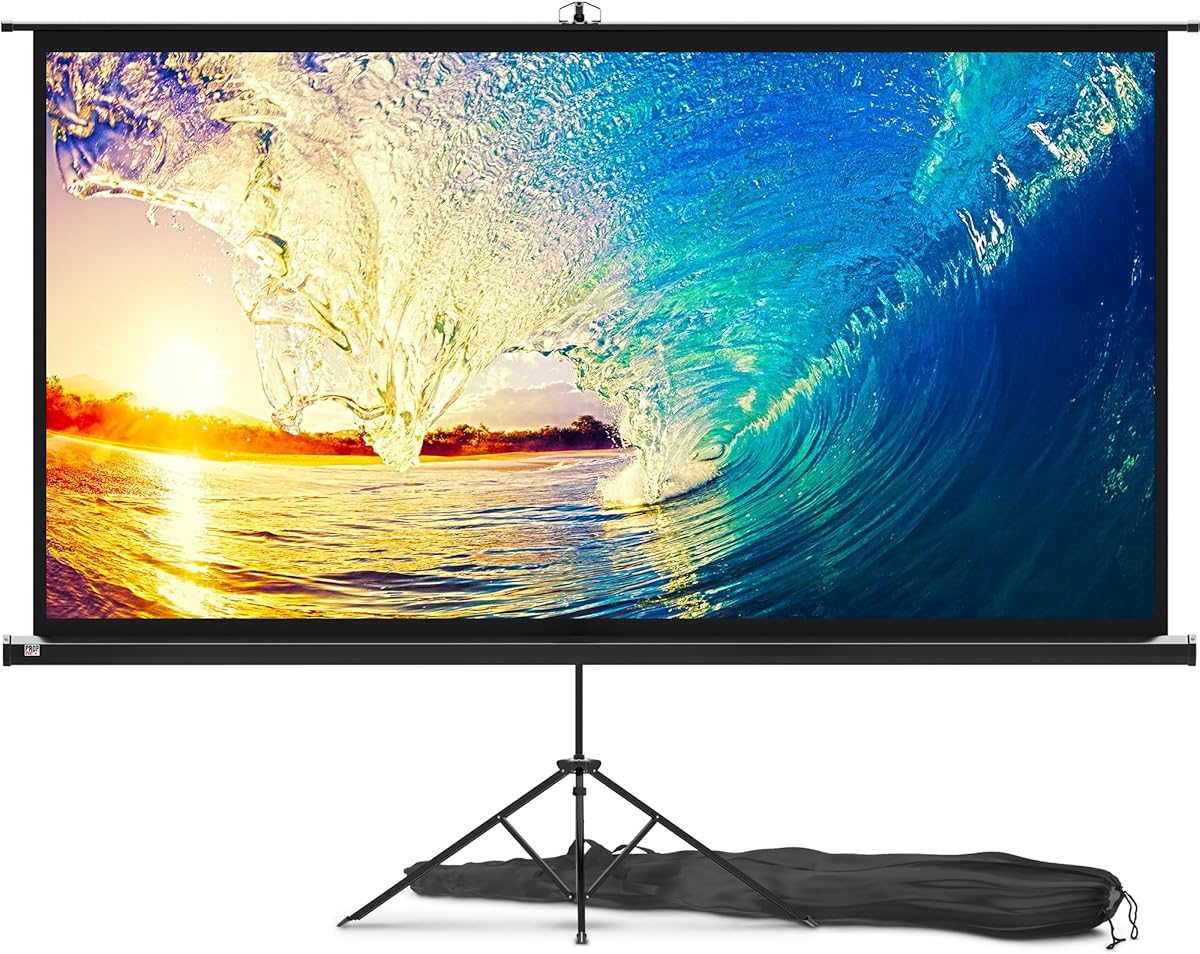


This 120-inch freestanding screen combines a large theater-style image with an unusually complete outdoor support system. Its 4.4 rating reflects a well-rounded package that emphasizes clear instructions, quick component assembly, a 160-degree viewing angle, and a carry bag. It is especially convincing for backyard movie nights, camping, and large gatherings where a compact tabletop screen would be inadequate.
We may earn a commission when you buy through this link, at no additional cost to you.
The screen uses washable milk silk attached to a reinforced premium-steel frame. Four ground stakes, ropes, and sandbags help prevent swaying or collapse, while the widened support and integrated installation are designed to keep the surface flat and reduce edge wrinkles. Front and rear projection support gives buyers more placement options, and the broad viewing angle allows guests to watch without crowding directly in front of the screen.
The main trade-off is scale. A 120-inch screen is less convenient to transport and position than the smaller tripod models, and outdoor stability still depends on using the included accessories correctly. The product is also presented with a front-and-rear 4K HD claim, although actual image sharpness depends on the projector, ambient light, source quality, and correct alignment. None of those factors diminish the value of the complete support package.
This is the strongest all-around recommendation for buyers who want a genuinely large screen and plan to use it outside as well as inside. Its combination of a foldable design, carry bag, broad viewing angle, and complete stabilization kit makes it more versatile than a basic hanging screen. People with limited storage or frequent one-person carrying needs may prefer a more compact option.
The combination of a reinforced steel frame, sandbags, ropes, and ground stakes gives the screen a more convincing outdoor foundation. Those accessories add weight to the setup, so use them whenever conditions could make the screen sway.
A 120-inch 16:9 canvas and 160-degree viewing angle suit larger audiences. Supporting both front and rear projection also makes it easier to adapt the screen to the projector placement and seating arrangement.
We may earn a commission when you buy through this link, at no additional cost to you.
This 80-inch portable projector screen is a refined middle ground between compact presentation screens and very large backyard displays. It carries a 4.5 rating, and the supplied information highlights quick assembly, a lightweight frame, 1.2-gain glass-fiber fabric, and a 160-degree viewing angle. It works well for home cinema, family gatherings, garden viewing, classrooms, and relatively mobile outdoor use.
We may earn a commission when you buy through this link, at no additional cost to you.
Its support system combines a sturdy adjustable tripod with four aluminum tubes held under spring tension. That tension helps maintain a flatter surface, while the adjustable stand allows the user to vary the screen height. At 8.5 pounds, the package is light enough to move between rooms or carry to another venue, and the included bag keeps the components together during transport.
The main limitation is outdoor stabilization. Although the stand is described as stable, the product information does not list dedicated ground stakes, ropes, or sandbags. It may therefore need a calm location or separate anchoring solution for exposed outdoor use. The 80-inch diagonal also offers less impact than a 100- or 120-inch screen for large groups, even though 16:9 matches modern projectors and streaming content.
This is an excellent recommendation for a buyer who values fast setup and manageable portability without giving up a proper tripod and wide viewing surface. It is easier to recommend as an all-purpose home screen than the larger outdoor model because it moves more conveniently and takes less space when folded. For permanent large-format displays or unattended windy events, consider a more specialized support system.
The four spring-loaded aluminum tubes and folding tripod create a structure designed to go from packed to ready in about two minutes. That speed is valuable for spontaneous movie nights, presentations, and changing venues.
The 16:9 image area aligns with widescreen video, while the compact 8.5-pound design makes this screen easier to reposition. It offers enough scale for family viewing without requiring the footprint of a 100- or 120-inch model.
We may earn a commission when you buy through this link, at no additional cost to you.
This 100-inch projector screen is aimed at people who need one surface to handle movies, presentations, events, and everyday entertainment. Its 4.4 rating is supported by a design that prioritizes a familiar 16:9 format, adjustable height, a wide-angle viewing area, and an easy three-step assembly process. It is a practical middle ground between an 80-inch portable model and a 120-inch outdoor screen.
We may earn a commission when you buy through this link, at no additional cost to you.
The wide-legged tripod provides the main support, and tight straps secure the screen to the assembly. Its retractable and adjustable design is especially useful when the required image height changes. A fitted projector-screen bag makes the complete unit easier to move to a backyard, auditorium, classroom, church, office, wedding, or party venue.
The product information provides fewer details about the screen's exact fabric and gain than some competing listings, so buyers who prioritize fine material specifications should investigate those details before buying. Outdoor stability is also less clearly addressed because the listing does not identify stakes, ropes, or sandbags as included components. In bright daylight, image quality will depend more heavily on projector brightness and the ambient environment.
The screen is a strong recommendation for schools, offices, event organizers, and families seeking a large 16:9 display that can serve both entertainment and professional presentation needs. It is less specialized than a dedicated backyard system but potentially more versatile because the same screen can move between practical indoor venues. Confirm its packed and assembled dimensions if storage or transportation is limited.
Movies, video games, conferences, classroom material, and sporting events can all benefit from the 100-inch 16:9 format. The adjustable support helps the screen fit different spaces and viewing arrangements.
A perfectly fitted bag and a retractable, adjustable design make relocation straightforward. That portability is especially valuable for presenters who move between rooms or venues regularly.
We may earn a commission when you buy through this link, at no additional cost to you.
The Pyle 50-inch screen focuses on convenient, retractable setup for travel, presentations, and smaller viewing areas. Its 4.3 rating reflects a straightforward design with a white matte surface, tripod support, and a pull-open structure. It is a practical fit for offices, classrooms, home use, and outdoor events where screen size matters less than quick deployment and simple handling.
We may earn a commission when you buy through this link, at no additional cost to you.
The screen's height is adjustable from a minimum of 25 inches to a maximum of 48 inches. A black masking border helps define the image and improve projector alignment, while the matte fabric provides a conventional viewing surface with reduced reflective glare. The stand can also be used on a flat floor or table, adding flexibility when a full-height setup is unnecessary.
Its 4:3 aspect ratio is the primary compromise. Modern widescreen movies often leave more black space around the image, and 50 inches is less immersive than the 80-, 100-, and 120-inch choices in this guide. The supplied details do not specify included ground stakes or other outdoor anchoring hardware, so exposed outdoor use should be approached with appropriate stabilization.
Choose this model for presenters, travelers, and users with limited storage who value a familiar retractable design. It is also more manageable for one person than a large screen and can be useful for casual viewing where a 50-inch image is sufficient. Home-theater enthusiasts seeking a true widescreen canvas should favor a 16:9 model instead.
The pull-up style removes the need to attach fabric to a separate frame. Its height adjustment makes it easy to adapt the screen to a projector, table, audience, or available floor space.
White matte fabric offers a familiar surface for projected content, while the black masking border helps keep the image visually contained. These features are particularly useful in rooms with ambient light.
We may earn a commission when you buy through this link, at no additional cost to you.
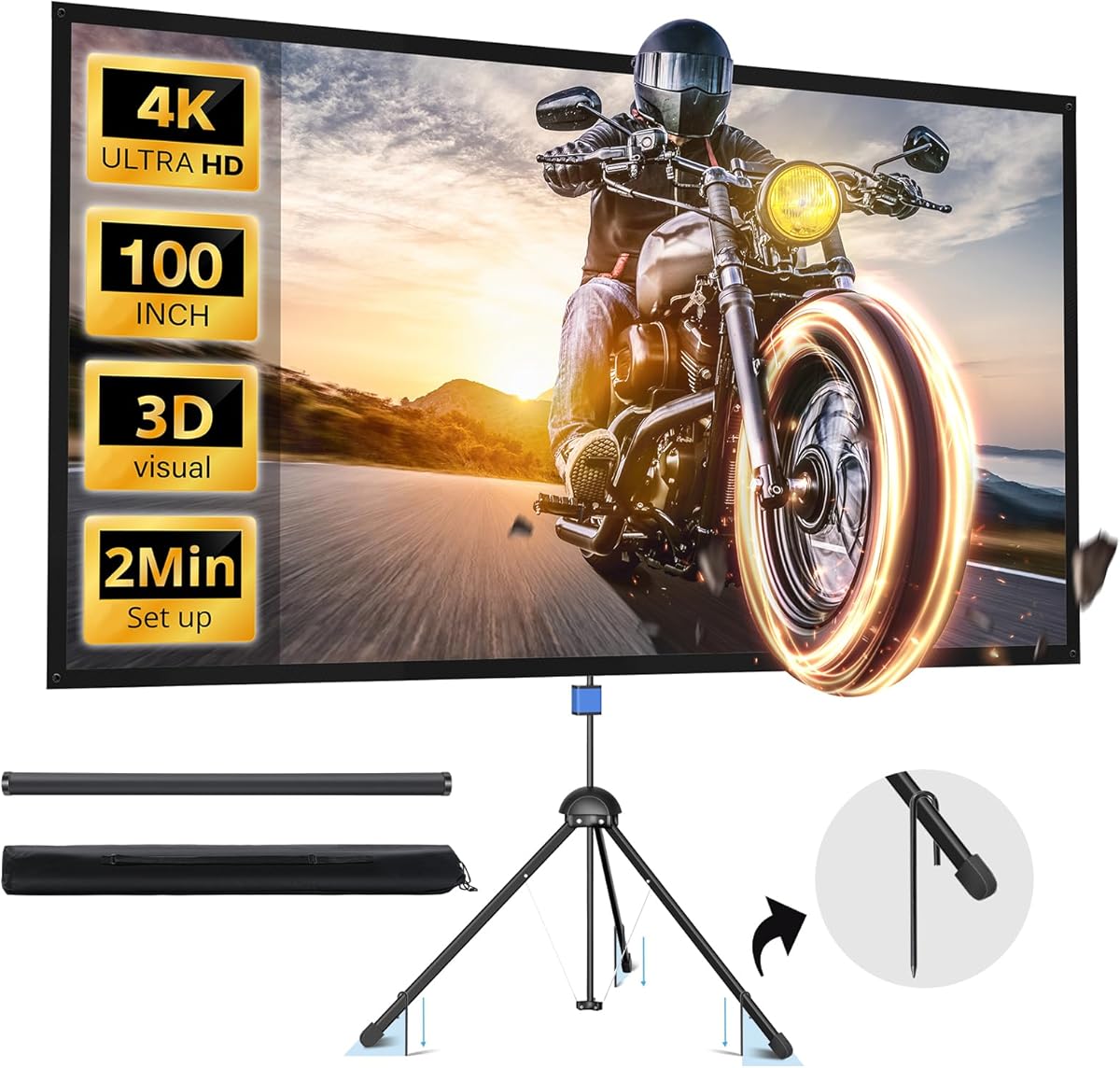
The TOWOND 100-inch screen stands out for unusually specific setup advice. Its 4.3 rating is supported by a large 16:9 surface, dual-tripod support, 160-degree viewing angle, and a package that includes sandbags, ground nails, and windproof ropes. The detailed instructions are valuable for anyone who wants repeatable assembly rather than improvising a support arrangement.
We may earn a commission when you buy through this link, at no additional cost to you.
Its polyester milk silk is described as thicker than ordinary screen fabric, foldable, washable, and soft enough to pack. A detachable crossbar attaches without tools, while the tripods open quickly. The stand weighs 7.4 pounds in the supplied information, which is manageable for a 100-inch screen and helps distinguish it from heavier, bulkier systems.
The instructions reveal one important drawback: even indoor use benefits from placing the included sandbags on both sides of the stand. Outdoor use calls for the ropes and ground stakes as well. Buyers who expect a freestanding screen that remains stable without added ballast may find the system less convenient, and folding a large fabric screen can produce temporary creases despite the wrinkle-resistant design.
This is a strong recommendation for backyard theaters, camping trips, and event hosts who want clear instructions and all the necessary outdoor hardware. The 100-inch size offers more impact than an 80-inch model while remaining lighter than some larger competitors. It is best for buyers who understand that stable outdoor performance comes from using the complete accessory system.
The illustrated sequence explains how to extend the legs, align the tripods, distribute fabric tension, and add ballast. Following those steps consistently produces a flatter and more stable screen.
Ground nails, ropes, and a sandbag cover the essential methods for securing the stand outdoors. Indoors, the sandbags can also keep the tripod from shifting on smooth flooring.
We may earn a commission when you buy through this link, at no additional cost to you.
This 80-inch fiberglass screen is one of the most clearly specified portable options in the guide. Its 4.5 rating accompanies a 1.2-gain surface, 160-degree viewing angle, black-coated backing, and a stated assembly time of less than three minutes. The exact dimensions and adjustment range make it easier to determine whether it fits a room, vehicle, or viewing area before purchase.
We may earn a commission when you buy through this link, at no additional cost to you.
The support frame uses a thick main pole, four diagonal poles, and four aluminum tubes with spring tension. This construction is intended to provide a solid structure while remaining flexible enough for transport. The screen rolls into a storage tube, and the supplied 10-pound net weight is manageable for a permanent-position screen but heavier than the 50-inch and 80-inch fiberglass alternatives in this comparison.
The product information does not identify dedicated stakes, ropes, or sandbags. While the screen is marketed for outdoor use, buyers relying on it in windy conditions should consider a separate stabilization method. Its 80-inch diagonal produces a 70-by-39-inch viewing area, and the tripod adjusts from 59 to 89 inches from the floor to the bottom of the screen. Those measurements are particularly useful for avoiding setup surprises.
This model suits buyers who value transparent specifications, quick assembly, and a properly defined 80-inch canvas. It is appropriate for home theater, travel, camping, and outdoor movie nights when the location is relatively protected. Those seeking the lightest option will find the smaller 50-inch screen easier to carry, while outdoor event hosts may want a model whose anchoring hardware is explicitly included.
The listing gives the viewing area, approximate metric dimensions, and full tripod adjustment range. Checking those figures against the projector throw distance and available floor space prevents an inconvenient mismatch.
Four spring-tension tubes and a reinforced metal support help maintain the screen's shape. The structure is foldable, yet the listed 10-pound weight prioritizes stability over ultralight portability.
We may earn a commission when you buy through this link, at no additional cost to you.
This compact 50-inch screen is the lightest freestanding model listed here, making it particularly attractive for travelers and presenters. It has a 4.6 rating, the highest in the group, and its supplied information emphasizes rapid opening, retractable construction, 1.2-gain fiberglass, a 160-degree viewing angle, and a 5.51-pound operating weight.
We may earn a commission when you buy through this link, at no additional cost to you.
The procedure is refreshingly direct: pull the legs to 90 degrees, engage the lock, and the frame opens. An automatic locking mechanism helps keep the support open, while the folded unit measures 34.25 by 3.46 by 3.15 inches. A lifting handle and compact tension frame make it easier to move from a living room to a garden, classroom, or meeting space.
There is an important specification inconsistency in the supplied data. The product title identifies a 4:3 screen, but the later description states that the product adopts a 16:9 projection ratio. The listed unfolded area of 40.16 by 29.92 inches is closer to 4:3 than 16:9, so a shopper should confirm the actual surface ratio with the seller. This is especially important for widescreen projectors and home cinema content.
Despite that ambiguity, the screen's portability, quick-opening design, and high rating make it an excellent choice for mobile use. It is less immersive than the larger 16:9 options and offers fewer pixels of surface area, but it solves the common problem of transporting a full entertainment screen. Buyers should verify dimensions and aspect ratio before ordering, while people who prioritize image size should choose a clearly specified 16:9 model.
The legs and locking mechanism allow the support to open quickly without a complicated assembly process. That makes spontaneous presentations and small outdoor screenings much easier to organize.
At 5.51 pounds with a built-in handle and narrow folded profile, the screen is easier to carry than most full-size options. It is well suited to users who regularly move between indoor locations.
We may earn a commission when you buy through this link, at no additional cost to you.
This 120-inch stake-down screen delivers a large outdoor image with a support strategy centered on ground anchors rather than heavy sandbags. Its 4.3 rating is backed by an emphasized widened base, reinforced steel bracket, ground-stake holes, four ground stakes, and two windproof ropes. It is a compelling choice for homeowners planning frequent backyard movie nights on grass or soil.
We may earn a commission when you buy through this link, at no additional cost to you.
The widened and thickened base plate increases the force-bearing area and includes holes for fluorescent ground stakes. Inserting those stakes directly into the ground helps fix the base more firmly than relying solely on added ballast. The all-iron bracket uses rust-resistant steel, while the woven milk silk is described as elastic, thick, wrinkle-free, and suitable for front or rear projection.
Its biggest practical limitation is that the anchor-centered design depends on ground access. It is not the most convenient choice for polished indoor floors, and the large screen and base create a substantial footprint. The listing claims an eight-minute tool-free installation, which is quick but not as immediate as the pull-open 50-inch model. The stated 4K HD capability remains dependent on the projector and source.
This is the best value recommendation for buyers who want a very large outdoor screen and have a suitable anchoring area. The stake-down base makes the package more practical for grass than many sandbag-dependent competitors, while the modular tubes and Velcro straps simplify assembly. Users seeking an indoor-first screen should choose a freestanding tripod or hanging model instead.
Ground-stake holes provide a direct way to secure the base in soil. This approach reduces the need to carry heavy ballast, although ropes are still included for wind resistance.
The bracket uses splicing tubes and Velcro straps, allowing the fabric to be pulled flat without tools. The result is a process that is longer than a simple pull-open frame but still approachable for first-time users.
We may earn a commission when you buy through this link, at no additional cost to you.
The Mdbebbron is fundamentally different from the tripod options because it is a lightweight hanging screen rather than a self-supporting unit. Its 4.5 rating highlights a foldable 120-inch design, 16:9 format, broad viewing angle, and simple attachment with hooks, ropes, brackets, nails, or double-sided tape. It is useful when a wall or other mounting surface is already available.
We may earn a commission when you buy through this link, at no additional cost to you.
The thick polyester fabric is designed to resist creasing and maintain a smooth projected image. Supporting both front and rear projection gives users flexibility in projector placement, while the 160-degree viewing angle allows a larger audience to see the picture. The one-piece design folds into a small package that can fit in a suitcase or backpack, making it exceptionally easy to transport.
The central trade-off is that the buyer must provide a suitable mounting location and make sure the attachment can support the screen's size. A wall-mounted indoor installation is straightforward, but outdoor attachment to a temporary surface may be vulnerable to wind. It also does not include a stand, so it offers no independent height adjustment or freestanding placement convenience.
This is a strong recommendation for minimalists, renters who can use removable tape, and travelers who already know how they will hang the screen. It is also a good option for anyone who values a large 16:9 image more than a complete all-in-one package. For fully self-contained outdoor movie nights, one of the screens with a tripod and anchoring kit will be easier to operate.
Hooks, ropes, brackets, nails, and double-sided tape give the screen flexibility across different surfaces. The method should match the wall, frame, or temporary structure to maintain tension and safety.
The foldable one-piece construction offers a 120-inch image without a bulky support frame. It is especially convenient for travel, temporary home theater setups, and presentations in borrowed spaces.
We may earn a commission when you buy through this link, at no additional cost to you.
The Paris RHÔNE 100-inch model is the premium material pick in this guide. It carries a 4.6 rating and distinguishes itself with a 1.5-gain PVC surface, multilayer coating, 160-degree viewing angle, and a foldable construction that avoids the bulk often associated with rigid PVC screens. It is designed for home theater, backyard events, presentations, and flexible indoor use.
We may earn a commission when you buy through this link, at no additional cost to you.
The reinforced aluminum X-shaped tripod adjusts from 64 to 85 inches, allowing the screen to suit different projector and seating arrangements. A detachable, lightweight design and included carry bag make the package easier to move. The product can also be used in a wall-mounted position, which gives buyers a practical fallback when floor space is limited.
A 1.5-gain surface can produce a bright, concentrated image, but it is not automatically best for every room. Higher gain can concentrate brightness and contrast toward the central viewing area, so very wide seating arrangements may benefit from a screen with a broader gain distribution. The listing also includes three ground nails but not the full range of ballast and rope equipment seen with some outdoor-focused competitors.
This is the most refined recommendation for a buyer who prioritizes a premium surface, quick setup, and flexible placement. Its two-minute, three-step process is notably efficient, and the combination of a carry bag, adjustable tripod, and wall-mount option increases its usefulness. For spacious rooms and outdoor use, carefully plan the projector distance and test the lighting conditions before the event.
The multilayer 1.5-gain PVC material is designed for clear, bright, color-accurate projection. A foldable construction retains many benefits of a rigid screen while remaining easier to store and transport.
The detachable tripod and lightweight frame allow one person to assemble the screen in about two minutes. The included carry bag makes it convenient to move between rooms or venues.
We may earn a commission when you buy through this link, at no additional cost to you.
The easiest projector screen is not always the one with the shortest assembly time. A useful choice balances image size, aspect ratio, surface quality, stand design, portability, and the conditions where it will be used.
Start with the content you watch and the space available for the image. A 16:9 screen matches widescreen movies, streaming services, presentations, and games, while a 4:3 surface can suit older content and certain office projections. The diagonal measurement alone does not reveal how much room the screen occupies, so compare the stated width and height as well. Also account for the distance required to project a readable image without making the screen extend beyond the room or audience area.
Screen gain describes how the surface handles projected light. A 1.1-gain material offers a relatively balanced approach, 1.2-gain screens are common for home and outdoor viewing, and a 1.5-gain surface can create a bright, punchy image with stronger central emphasis. Higher gain is not automatically superior in every environment, particularly if viewers sit far to the sides or the room already has controlled lighting. Pair the surface with the projector's brightness and consider ambient light before choosing.
Retractable frames are usually the quickest to deploy, tripod models provide more height adjustment, and modular stake-down systems prioritize outdoor stability. Read the package list carefully because ground stakes, ropes, sandbags, rods, and carrying bags are not universal. A screen advertised for outdoor use may still need added ballast for grass or a smooth patio. The clearest instructions are valuable too, particularly when several fabric corners or tensioning points must be attached correctly.
Portability involves more than whether a bag is included. Check the listed operating weight, folded length, handle design, and number of separate pieces. Small retractable screens are easiest to carry by one person, while a 100- or 120-inch fabric screen may be light but still awkward because of its width. If you regularly move between rooms or venues, remove the projector, cables, and accessories from the equation and focus on the screen and stand you must carry yourself.
Outdoor stability depends on the support geometry, surface condition, wind exposure, and ballast. Wide tripod legs help on level floors, while stakes are especially effective in soil. Sandbags add downward and lateral stability on patios, but they must be filled securely and positioned as directed. Ropes help brace the frame, and a robust steel or aluminum structure resists bending. Even a well-built screen should not be used in severe weather when it could become a sail.
A wide viewing angle allows people to sit to either side without seeing a severe brightness or color shift. Models advertised around 160 degrees are appropriate for group viewing, although room geometry and projector placement still affect the result. The screen should be positioned so the central image is not blocked, and the projector should be aligned to avoid distortion. Wider images also benefit from seating that spreads beyond a narrow line directly in front of the display.
Polyester, fiberglass, woven milk silk, and PVC offer different handling characteristics. Thin polyester screens are easy to fold but may retain more creases, while tensioned fiberglass and coated surfaces can preserve a flatter image. Washable or hand-cleanable materials make outdoor dust and fingerprints easier to handle. Always allow a screen to dry fully before folding it, avoid abrasive cleaners, and store the fabric loosely rather than crushing it for long periods.
Confirm that the screen's aspect ratio matches the projector output, and check the projector's throw distance and lens shift before setting up. Some screens are optimized for front projection, while others support both front and rear projection. Rear projection can solve a projector-blocking problem, but it requires sufficient depth behind the screen and precise image orientation. White walls and textured surfaces are not interchangeable with a dedicated projection screen, particularly in rooms with ambient light.
Start in a clear, level area and place the projector where it can maintain the correct throw distance. Unpack the screen, separate its support pieces, and read the included instructions before connecting any fabric. Extend every tripod leg fully, engage all locks, and position the legs for stability. Check the viewing area and make sure the projector will not cast light into the eyes of people seated directly in front of the screen.
Attach the screen evenly from one side to the other. Pull the fabric gently toward the corners without overstretching it, and check that the edges hang straight without twisted corners. For outdoor setups, add the specified sandbags, stakes, and ropes before raising the screen or starting the projector. Turn on the projector, use its keystone and focus controls, then make smaller image adjustments rather than stretching the physical screen to compensate for an incorrect throw angle.
After use, switch off and unplug the projector, then let the screen and any damp cleaning areas dry fully. Wipe or clean the surface according to the material instructions, remove dust from the fabric, and fold or retract it without forcing sharp creases into the corners. Store the stand in its bag or designated case in a dry area, inspect locks and connection points periodically, and replace missing stakes or damaged ropes before the next outdoor event.
The 50-inch retractable model is the quickest to deploy because its legs open and lock without attaching separate fabric panels. The 80-inch fiberglass model is also designed for assembly in less than three minutes. The easiest choice still depends on whether the screen must be wall-mounted, carried frequently, or anchored outdoors.
No. A larger image is more immersive, but it also requires more room, a longer throw distance, and a more stable setup. A 50- or 80-inch screen may be much more practical for a small room, classroom, or travel situation. Choose the largest 16:9 screen that comfortably fits the intended area and remains stable.
Yes, because 16:9 is the standard widescreen format used by most modern 4K projectors. Compatibility does not mean the screen determines the final resolution. Image sharpness still depends on the projector, source quality, focus, throw distance, and whether the projected image exactly fills the viewing area.
It depends on the design and location. Some models use ground stakes, ropes, or a weighted base instead of sandbags, while others recommend sandbags for added stability on patios or indoor floors. Follow the included instructions and use every appropriate anchoring method, especially on smooth or uneven surfaces.
Almost all the included models are intended for indoor use as well as outdoor viewing. Indoor placement makes setup easier because the screen does not need to withstand wind, but ambient light can still wash out projected images. A dedicated screen generally produces a clearer and more focused picture than a standard wall.
A hanging screen is lightweight and flexible, but it requires a wall, frame, or other mounting surface. A screen with a stand is more self-contained and easier to position, although it is bulkier and may require additional outdoor stabilization. Hanging models are convenient for travel, while freestanding models suit locations where mounting is unavailable.
Attach the screen evenly, keep the supporting tubes fully extended, and avoid pulling one corner harder than the others. Do not leave a folded screen compressed for long periods, and clean it before storage so stains do not set. If creases appear, follow the manufacturer's care guidance rather than applying excessive heat or pressure.
A 16:9 screen is generally the most practical choice for widescreen films, streaming video, television, and games. A 4:3 screen may suit older content or specialized presentations, but it can leave more unused space beside modern widescreen images. Check the projector output and your viewing content before deciding.
The 120inch Projector Screen with Stand is the most complete outdoor-oriented recommendation, combining a large 16:9 surface, broad viewing angle, folding design, carry bag, and robust stabilization accessories. The 80-inch portable fiberglass model provides a more balanced home option, while the Paris RHÔNE 100-inch screen stands out for its premium 1.5-gain PVC material and three-step setup.
Prioritize the support method and dimensions that match your space rather than focusing on nominal size alone. A screen is easy to use only when it can be assembled correctly, carried when needed, and stabilized in the location where you will actually use it. If outdoor stability matters, prioritize included stakes, ropes, sandbags, or a well-anchored base; if portability matters, compare folded size and operating weight.
Ratings, product availability, and prices can change, so check the current listing before ordering. Verify the screen dimensions, aspect ratio, projection direction, included accessories, and projector throw distance using the latest seller information. Those checks will help ensure that the selected easy setup projector screen works as smoothly in practice as it does in the feature list.