
EZRED SP101 Battery Hydrometer
4.6Editor score
Universal battery-acid hydrometer
Specific gravity range 1.100–1.300
No temperature tables required
Compare 10 Lead Acid Battery Tester, with key specifications, product ratings, pros and cons to help you choose.
A lead acid battery tester helps reveal the condition of a vehicle battery before it leaves you stranded. The right device may estimate state of health, state of charge, cranking performance, charging-system output, internal resistance, or remaining amp-hour capacity, depending on its design and supported battery types.
We compared the ten products in this guide by examining their testing capabilities, lead-acid compatibility, voltage ranges, display features, safety protections, and intended applications. The list includes a simple hydrometer, compact digital analyzers, workshop-oriented testers, and models with built-in reports or printing.
Each review explains the strongest use case, important limitations, and ideal buyer. Ratings reflect the supplied customer feedback, while specifications and compatibility are based on the listed product information. Availability and prices may change, so confirm current details before buying.
4.6Editor score
4.6Editor score

4.5Editor score
The table below compares all ten options by battery type, supported voltage, diagnostic scope, and standout features. It shows how a basic hydrometer differs from digital testers with cranking, charging-system, capacity-analysis, and record-keeping functions.


The EZRED SP101 is a straightforward battery hydrometer with a 4.6 rating. Rather than connecting to terminals or navigating menus, it checks the electrolyte in accessible lead-acid cells. Its principal advantage is simplicity: a technician, mechanic, or attentive vehicle owner can obtain a basic indication of battery-acid condition without learning a complex diagnostic interface.
We may earn a commission when you buy through this link, at no additional cost to you.
The hydrometer is built for service-station and garage use, with a universal fit and an electrolyte-specific-gravity range of 1.100–1.300. The manufacturer emphasizes an easy-to-read float, avoiding difficult interpretation and temperature-table adjustments. That makes it especially useful when the objective is a quick check of battery-acid condition rather than a complete assessment of the starting or charging system.
Its limitations are inherent to the design. It does not report cranking voltage, alternator output, state of health, internal resistance, or remaining capacity in the way an electronic analyzer can. It also requires access to a cell opening, so it may not suit sealed, inaccessible, or nonstandard battery installations. It should be treated as a basic maintenance instrument rather than a complete vehicle diagnostic tool.
Choose the SP101 when you need an inexpensive, dependable way to inspect accessible lead-acid cells and do not require digital reports or charging-system analysis. It is a particularly good match for a home garage, service counter, or battery-focused toolkit where simplicity and rugged handling matter more than automated interpretation.
The SP101 focuses on electrolyte specific gravity, giving users a direct visual estimate of battery-acid condition. That narrow scope makes it quick to deploy and easy to understand without relying on a display, internal battery, or vehicle power.
The universal design works best where battery cells can be opened safely and inspected directly. It is less useful for sealed batteries or batteries mounted where cell access is difficult.
We may earn a commission when you buy through this link, at no additional cost to you.
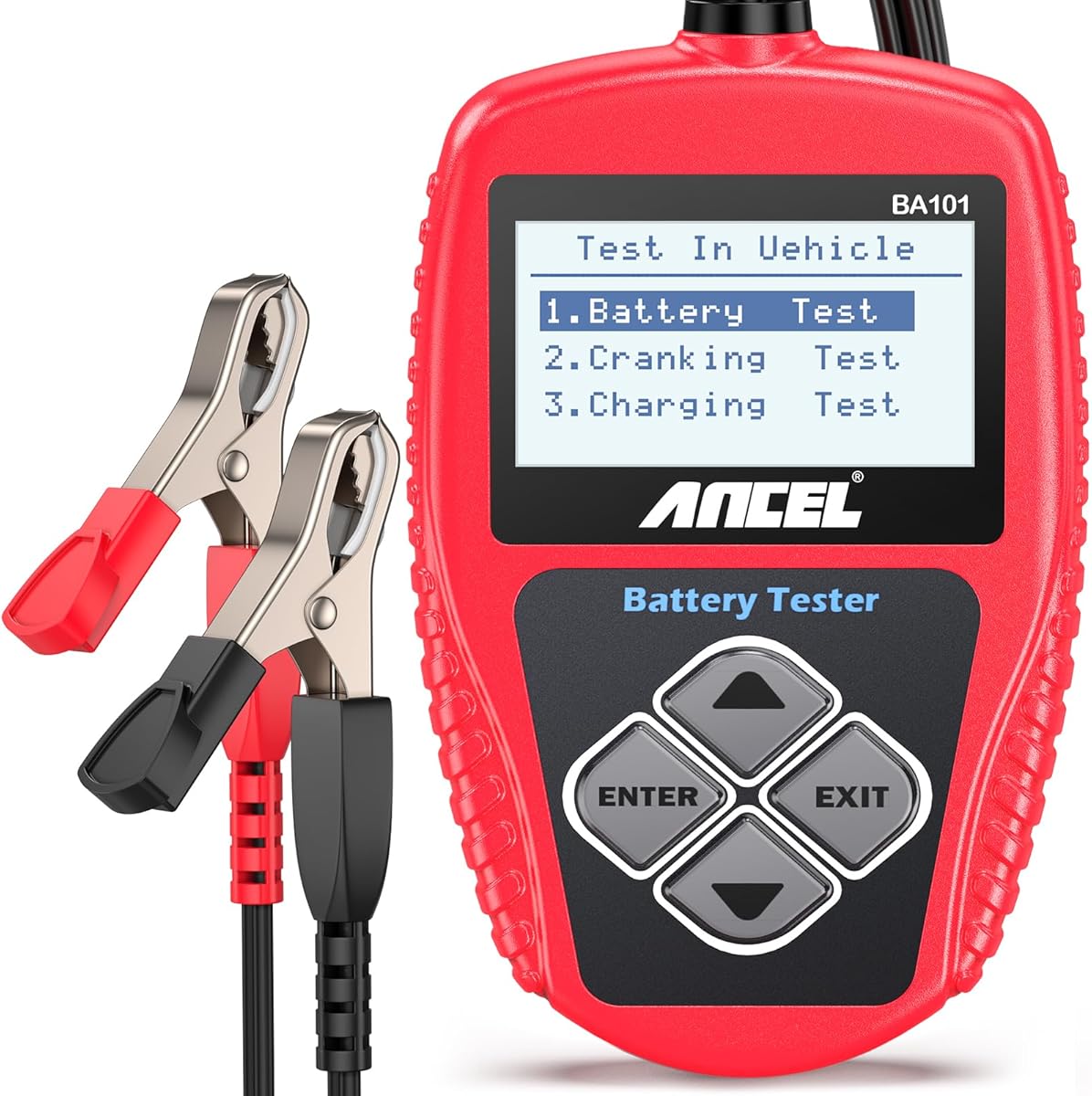
The ANCEL BA101 is a 12V digital analyzer rated 4.5 by customers. It expands on a basic battery check by reporting state of health, state of charge, voltage, current, cold-cranking amperage, and results for cranking and charging-system tests. That combination makes it useful when the goal is to distinguish a weak battery from another starting or charging problem.
We may earn a commission when you buy through this link, at no additional cost to you.
The tester supports 100–2000 CCA batteries and multiple standards, including JIS, EN, DIN, SAE, BCI, GB, CA, MCA, and IEC. It accommodates flooded, AGM, GEL, and EFB lead-acid batteries found across cars, trucks, boats, recreational vehicles, and other equipment. Copper crocodile clips, a precision smart chip, and a reinforced ABS housing support reliable use and durability.
Its black-and-white screen is less visually rich than a color display, but adjustable contrast and a white backlight improve readability. One-handed operation and power drawn directly from the vehicle battery make routine testing straightforward. The tradeoff is that it is limited to 12V systems and does not support lithium batteries, 6V batteries, or 24V systems.
The BA101 is best for owners and technicians who test a broad mix of standard 12V lead-acid batteries and want starter and alternator information in one device. Buyers should enter the correct battery type, rating, and temperature to obtain the most meaningful results, and should choose a different model if they need 6V, 24V, or lithium compatibility.
By combining state-of-charge, state-of-health, CCA, cranking, and charging information, the BA101 gives users a broader diagnostic picture. This can help separate a battery problem from a starting-system or charging-system issue.
Support for flooded, AGM, GEL, and EFB batteries, combined with numerous international rating standards, makes this a versatile option for mixed vehicle fleets.
We may earn a commission when you buy through this link, at no additional cost to you.
This 6V and 12V lead-acid analyzer carries a 5.0 rating and focuses on estimated remaining amp-hour capacity. Its defining feature is a simulated 20-hour C20 discharge test that produces voltage and actual Ah results in seconds, without consuming the battery being tested or requiring a lengthy discharge procedure.
We may earn a commission when you buy through this link, at no additional cost to you.
Compatibility is broad within its intended voltage range. The unit handles 6V batteries from 1.2Ah to 10Ah and 12V batteries from 1.2Ah to 100Ah, including SLA or AGM, GEL, flooded, and automotive starting batteries. Potential applications include cars, trucks, boats, mobility scooters, golf carts, security systems, and UPS equipment.
Operation is direct: connect the clamps, select the appropriate battery type and capacity range, press the test button, and interpret the LCD display. Reverse-polarity indication, 30VDC over-voltage protection, a durable ABS housing, and a protective cover improve safety. A carry case, test leads, and instructions are also included.
The main constraint is its scope. It is centered on lead-acid capacity analysis rather than a full cranking and charging-system workflow, and it does not support 24V systems. It is best for users who prioritize fast remaining-capacity information across deep-cycle, stationary, mobility, and smaller 6V applications.
The simulated C20 process offers a practical way to estimate Ah capacity in seconds. This can make routine battery inventory checks and deep-cycle battery assessments considerably more convenient.
The supported capacity ranges and chemistry list make the analyzer relevant beyond automotive starting batteries, including UPS, scooter, golf-cart, and security-system applications.
We may earn a commission when you buy through this link, at no additional cost to you.
The ACT 612 is an intelligent lead-acid battery tester with a 4.4 rating. Its supplied description identifies support for SLA, GEL, and flooded batteries, placing it among the more specialized analyzers in this roundup rather than a general-purpose automotive scan tool. It is best understood as a dedicated battery-analysis option.
We may earn a commission when you buy through this link, at no additional cost to you.
The most important strength is its explicit compatibility with three common lead-acid categories. SLA, GEL, and flooded batteries are found in automotive, industrial, backup-power, and mobility applications, so a tester that addresses those formats is useful for mixed battery collections. The “intelligent” positioning suggests a more analytical approach than a basic terminal voltage meter.
The supplied product information is limited, however, and does not state the supported voltage, CCA range, display type, battery capacity range, cranking capability, charging-system analysis, or included accessories. That makes it prudent to check the current product listing and manual before purchase. Its 4.4 rating is solid, but less favorable than the leading products in the list.
Choose the ACT 612 when you specifically want an intelligent analyzer for SLA, GEL, or flooded lead-acid batteries and its published capabilities align with your setup. It is less compelling for buyers who require clearly documented 12V/24V support, detailed cranking analysis, or extensive report-keeping features.
Explicit SLA, GEL, and flooded support gives the tester a clear battery-focused identity. That is useful for users who test stationary, industrial, or mixed lead-acid batteries rather than only vehicle starting batteries.
The available description is concise, so buyers should confirm voltage range, capacity limits, diagnostic outputs, and accessories on the current listing. Those details matter for matching a tester precisely to a battery fleet.
We may earn a commission when you buy through this link, at no additional cost to you.
The ANCEL BT410 is the most feature-rich premium option in this guide and carries a 4.5 rating. It supports 12V and 24V systems across lead-acid AGM, GEL, regular flooded, and EFB batteries, with a stated 100–2000 CCA range. It also supports lithium batteries, making it broader than tools limited strictly to traditional lead-acid chemistry.
We may earn a commission when you buy through this link, at no additional cost to you.
Diagnostics extend beyond the battery itself. The BT410 evaluates state of charge, state of health, voltage, internal resistance, cranking voltage, charging-system performance, and ripple voltage. A 2.4-inch color TFT display with adjustable contrast and day/night mode keeps results readable in garages, daylight, and service environments. Shareable QR reports preserve test data for customer records or professional advice.
Safety and physical design are also carefully addressed. Reverse-polarity and short-circuit protection help manage common connection mistakes, reinforced ABS clamps support dependable contact, and 800mm cables provide reach into crowded engine compartments. The device draws power from the battery under test, and the stated operating range extends from -4°F to 158°F.
The main compromise is complexity. Users must configure the tester correctly and interpret several results rather than relying on a single simple verdict. Lithium compatibility should also be understood in the context of the listed supported battery types. Even so, the BT410 is an excellent choice for users who want one sophisticated tool for battery, starter, and alternator diagnostics.
The ability to combine battery health, cranking analysis, charging output, and ripple-voltage assessment makes the BT410 more valuable than a terminal-only checker. It helps users investigate the electrical system rather than simply judge battery voltage.
The color TFT screen, adjustable contrast, day/night mode, and QR reporting support both quick field checks and more organized service workflows. These features are particularly helpful for professionals testing several vehicles in one day.
We may earn a commission when you buy through this link, at no additional cost to you.
The BT60 PRO supports 6V, 12V, and 24V batteries and has a 4.5 rating. It is particularly interesting for mixed fleets because the same device can cover 6V motorcycle batteries, 12V automotive batteries, and 24V truck batteries. A stated 2–120Ah range and 100–3000 CCA span provide broad operating flexibility.
We may earn a commission when you buy through this link, at no additional cost to you.
For supported lead-acid batteries, conductance-based testing provides state of health, state of charge, voltage, internal resistance, CCA, cranking, and charging-system information. Flooded, AGM, EFB, and GEL formats are covered. Lithium and LiFePO4 batteries can be checked for voltage and health, although the product description warns that precise CCA results are not guaranteed for LiFePO4.
The 3.2-inch HD screen, 12-language support, dedicated motorcycle menu, memory function, and QR-enabled cloud printing make it useful for professional record keeping. Results can be viewed in a smartphone browser, shared, saved, or printed without requiring a dedicated app. A built-in LED, wide-mouth clamps, long cable, and ergonomic ABS housing improve field usability.
Important boundaries remain. The device is not compatible with 48V systems, is not an OBD2 scanner, and cannot read or clear diagnostic trouble codes. It is also not a carbon-pile load tester. For technicians seeking voltage breadth, reporting, and solid digital diagnostics without a full vehicle-code scanner, it is a strong fit.
Covering 6V, 12V, and 24V batteries reduces the need for separate tools. Dedicated 6V motorcycle handling and 24V truck testing make this practical for repair shops, fleet yards, and multi-vehicle households.
QR-based cloud printing lets users view, save, share, or print results through a smartphone browser. This supports customer documentation and repeated battery checks without adding a complicated software workflow.
We may earn a commission when you buy through this link, at no additional cost to you.
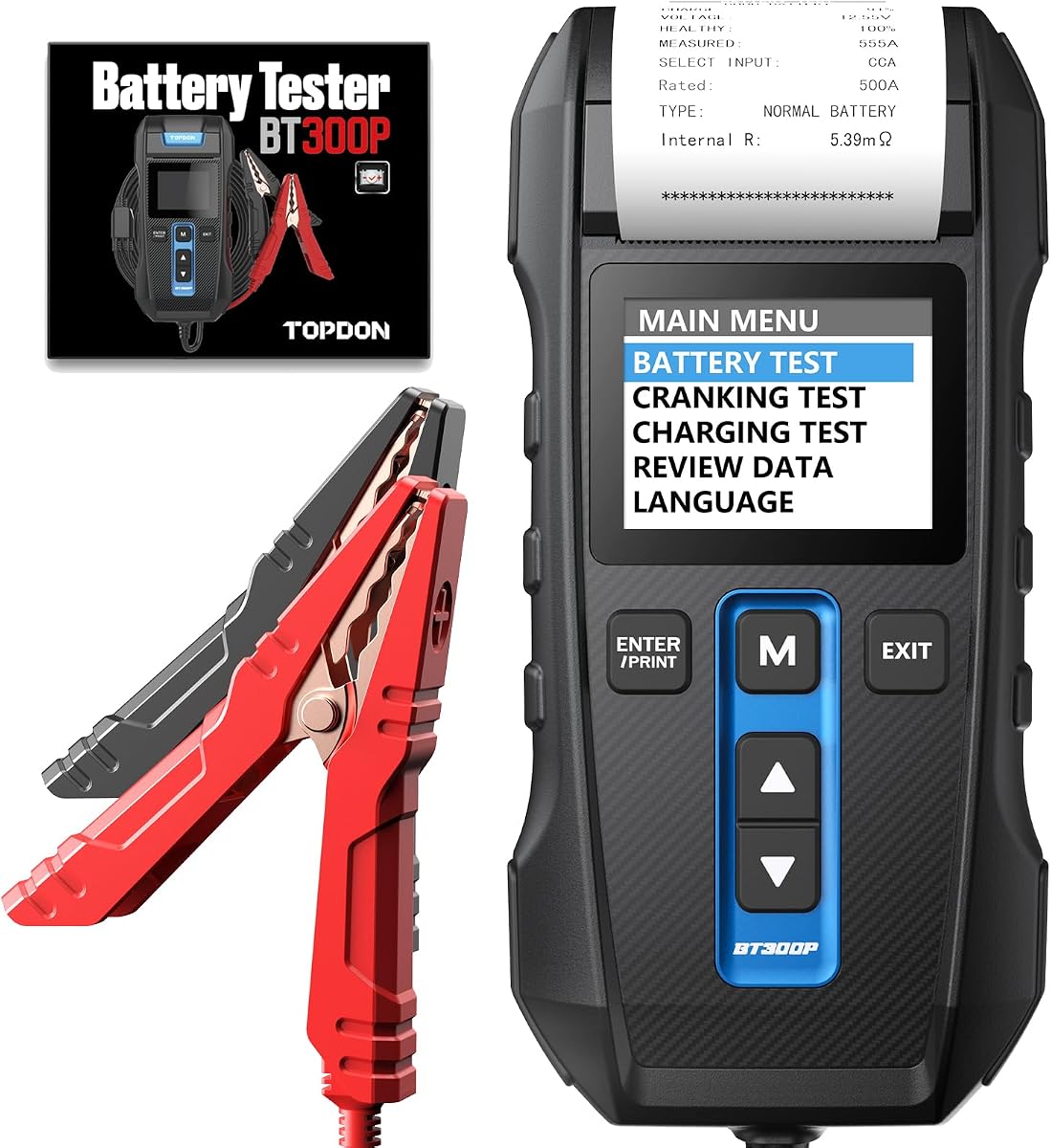
The TOPDON BT300P earns a 4.6 rating and stands out as a workshop-friendly diagnostic tool. It evaluates 12V battery health along with 12V and 24V starter-motor cranking status and charging-system condition. Its 100–2000 CCA range covers regular flooded, flat-plate AGM, spiral AGM, GEL, and EFB batteries.
We may earn a commission when you buy through this link, at no additional cost to you.
Its standout feature is the integrated thermal printer. Test results can be delivered as diagnostic receipts without ink ribbons or cartridges; only standard thermal paper must be replenished. For a repair shop, battery retailer, fleet operator, or mobile service professional, that can make customer handoffs and maintenance records more efficient.
The color screen, intuitive buttons, conductive testing technology, and stated three-second result time support a quick workflow. The product information also cites 99.5% accuracy and provides protective measures such as spark-free copper clamps, insulated PVC-coated wiring, reverse-polarity protection, and an ABS shell. A 31.5-inch cable improves access in larger vehicles.
The thermal printer adds bulk and creates a consumable requirement that a simpler display-only tester would avoid. It is also centered on lead-acid automotive batteries rather than broad capacity analysis. Even with those trade-offs, the BT300P is a compelling professional choice when fast testing, 24V coverage, and printable documentation are priorities.
The integrated printer creates a ready-to-hand diagnostic receipt at the vehicle. Technicians can provide customers with a tangible summary while avoiding separate printers, ink systems, and most consumable-management tasks.
A stated three-second result time, clear color display, and broad chemistry support suit repeat inspections. The design favors technicians who need to move quickly from test to documentation.
We may earn a commission when you buy through this link, at no additional cost to you.
The MOTOPOWER MP0515A is a compact 12V analyzer with a 4.6 rating. It reports state of health, state of charge, internal resistance, and voltage, then supports cranking-voltage and alternator-output analysis. Its quick mode provides a fast check, while standard mode allows battery type and model selection for more specific results.
We may earn a commission when you buy through this link, at no additional cost to you.
It supports 100–2000 CCA lead-acid batteries, including regular flooded, flat-plate AGM, spiral AGM, GEL, and EFB types. Multiple rating standards are recognized, including CCA, BCI, CA, MCA, JIS, DIN, and SAE. The stated vehicle applications span cars, motorcycles, trucks, RVs, ATVs, SUVs, boats, yachts, mowers, and golf carts.
A 3-inch full-color LCD, lightweight enclosure, and plug-and-play approach make the MP0515A easy to carry and operate. It supports nine languages and stores testing results for later review. Results can also be printed by connecting the device to a computer with the supplied print driver, although this is less convenient than the BT300P's built-in thermal printer.
The primary limitation is voltage coverage. It is designed around 12V systems, so it will not serve 24V truck batteries in the same way as the BT300P, BT410, BT60 PRO, FOXWELL BT705, or ANCEL BA101PRO. For owners of standard 12V vehicles who want battery, starter, and alternator checks in a portable package, it remains a balanced choice.
Quick Test offers a direct path for routine checks, while Standard Test asks the user to match battery type and model. This balance serves both fast screening and more informed interpretation.
The color display, stored results, cranking analysis, and charging-system review provide more capability than a basic handheld meter while keeping the unit light and straightforward to carry.
We may earn a commission when you buy through this link, at no additional cost to you.
The FOXWELL BT705 is a guided 12V and 24V battery and alternator tester with a 4.5 rating. It checks CCA, voltage, internal resistance, state of health, cranking performance, and charging output. Clear GOOD, RECHARGE, and REPLACE summaries help users who may not know how to interpret every raw value independently.
We may earn a commission when you buy through this link, at no additional cost to you.
Its 100–2000 CCA range covers flooded, AGM, GEL, and EFB lead-acid batteries used in cars, pickups, trucks, RVs, boats, and commercial vehicles, including start-stop applications. The 2.8-inch screen presents step-by-step prompts, while a 5.9-foot cable lets the tester remain near the battery while reaching the driver's seat during an engine start.
The physical package is well suited to repeated use. A protective housing, durable clamps, and an included hard carrying case help organize and protect the device in a home garage, repair shop, multi-vehicle household, or fleet-maintenance setting. The result-oriented labels also make the tool approachable for first-time users.
The BT705 is limited to 12V and 24V lead-acid testing and does not cover 6V systems or lithium batteries. It also does not offer the BT300P's built-in receipt printer or the BT410's QR-report sharing. Its strongest appeal is the combination of guided operation, a long solo-use cable, solid protective hardware, and broad vehicle coverage.
Step-by-step prompts and plain-language GOOD, RECHARGE, or REPLACE conclusions reduce the learning curve. Users can move from connection to an understandable result without independently interpreting every diagnostic value.
The 5.9-foot cable reaches from the battery toward the driver’s seat, allowing one person to operate the vehicle while monitoring the display. This is more convenient than a short-cabled tester during starting tests.
We may earn a commission when you buy through this link, at no additional cost to you.
The ANCEL BA101PRO is a 12V and 24V lead-acid tester designed for cars, trucks, SUVs, RVs, boats, commercial vehicles, and heavy-duty applications. It has a 4.5 rating and provides a 100–2000 CCA range for regular flooded, flat-plate AGM, spiral AGM, GEL, and EFB batteries.
We may earn a commission when you buy through this link, at no additional cost to you.
Beyond state of health, state of charge, voltage, and internal resistance, it evaluates cranking voltage, charging-system status, load or unload voltage, and ripple voltage. Its 2.8-inch color TFT screen can display real-time voltage curves, and the tester can replay up to 120 seconds of data. That makes it useful when the user needs to examine a voltage drop rather than rely only on a final verdict.
Operational efficiency is another strength. The Fn one-touch shortcut starts a quick battery test, while storage for up to 1,400 records supports comparisons over time and across multiple vehicles. Reverse-polarity, short-circuit, overcurrent, and overvoltage protection reduce the consequences of common setup errors, and insulated clips support stable contact.
The BA101PRO does not support 6V or lithium batteries, narrowing it compared with multi-chemistry models. Its menus and data-review features may also exceed the needs of a casual owner. Nevertheless, for fleet maintenance, battery-service providers, repair shops, and advanced users who regularly work with 12V and 24V lead-acid systems, the combination of rapid tests, stored history, and detailed curves is highly relevant.
One-touch quick testing and storage for 1,400 records support fast inspection routines. Technicians can review prior results, compare battery condition over time, and manage tests across a large vehicle fleet.
Real-time curves, 120-second replay, cranking voltage, load or unload voltage, and ripple-voltage data provide more diagnostic context than a basic pass-or-fail battery result.
We may earn a commission when you buy through this link, at no additional cost to you.
The right lead acid battery tester depends on battery chemistry, voltage, capacity, and the depth of diagnosis you need. Consider whether you want a quick state-of-charge check or a full battery, starter, and charging-system evaluation.
Start by identifying the nominal voltage of the batteries you intend to test. A 12V-only analyzer is sufficient for many cars and light vehicles, but 24V commercial vehicles and trucks may require a tester with explicit 24V support. Some tools also cover 6V batteries, which can be useful for motorcycles, mobility devices, and legacy equipment. Confirming voltage compatibility prevents the frustrating situation of owning a sophisticated tester that cannot analyze the battery in front of you.
Lead-acid is a broad family rather than a single battery format. Conventional flooded, AGM, GEL, and EFB batteries may require different testing profiles, while deep-cycle SLA batteries have different capacity expectations from vehicle starting batteries. The best choice is a model that names the relevant formats explicitly. If your work includes stationary UPS batteries, marine batteries, mobility batteries, or mixed fleets, look for a tester that covers both chemistry and intended application instead of assuming every lead-acid reading is interchangeable.
A hydrometer provides a basic electrolyte-specific-gravity reading, while a digital analyzer can estimate state of health, state of charge, internal resistance, and CCA. For deeper battery work, an Ah capacity tester can estimate remaining amp-hour capacity, sometimes using a simulated 20-hour discharge test. If you also need to diagnose a no-start complaint, prioritize cranking voltage and charging-system output. The more measurements a tool provides, the more setup and interpretation may be required, so match the feature set to your actual diagnostic workflow.
Cold-cranking amperage is important when comparing a tester with a battery label, but a broad CCA range alone is not enough. Some devices also support standards such as BCI, CA, MCA, JIS, DIN, SAE, and others. For the most meaningful test, enter the correct rating value, battery type, and temperature where the manufacturer requests them. Devices with dedicated motorcycle modes, 6V support, or wider CCA limits may fit mixed inventories better, while lithium compatibility is a separate consideration because CCA accuracy is not guaranteed for every lithium chemistry.
A readable display becomes important when comparing multiple readings. A monochrome backlit screen is adequate for many users, while a color TFT display can make waveforms, status labels, and menu navigation easier to interpret. For professional workflows, consider stored results, QR sharing, computer printing, or an integrated thermal printer. Built-in printers are convenient but add bulk and require paper. QR or cloud reports can be more flexible for service businesses, although they depend on suitable connectivity and a compatible device for viewing or printing.
Battery location affects usability. Long cables make it easier to reach batteries in large trucks, RVs, boats, and crowded engine compartments, and they allow one person to monitor cranking voltage from the driver's seat. Short leads can be easier to store but may force awkward positioning. Also consider clamp size, cable flexibility, grip, and the width of the battery terminals. For repeated professional use, secure contacts and durable insulated cables can matter more than a marginally larger screen.
A tester draws substantial current during some diagnostic procedures, so connection mistakes can create real problems. Reverse-polarity protection is the first safeguard to look for, while short-circuit, overcurrent, and overvoltage protection provide additional defense. Copper clamps, insulated wiring, spark-free claims, and a durable housing can improve safety around battery gases and confined spaces. A visible warning is also useful when polarity is reversed, especially on a model without comprehensive protection.
Home users may prioritize simple menus, readable results, and compact storage. Professional technicians may value fast testing, one-touch shortcuts, saved histories, long cables, and printable or shareable records. Fleet operations benefit from durable clamps, broad chemistry support, and capacity to store many tests. A hard case is worthwhile when the tool travels between vehicles, while an LED light or high-contrast display helps in dim garages and poorly lit engine bays.
Begin by identifying the battery type, nominal voltage, rated CCA or Ah value, and any temperature compensation information printed on the label. Inspect the tester and cables for damaged insulation, corrosion, or loose clamps. Connect the clamps with the ignition off according to the device instructions, taking care to observe polarity before energizing the tester.
Select the correct battery chemistry, rating standard, and test mode. For a digital tester, enter the label values as accurately as the manual requires. Run the battery test first, then follow the prompts for cranking or charging-system analysis when those procedures are appropriate. Do not interpret a healthy charging result as proof that the battery itself is healthy, or a weak battery result as proof that the alternator is faulty.
After testing, disconnect the device according to its instructions, clean any surface corrosion from the terminals with suitable tools, and return the clamps to a protected storage area. Keep the tester away from moisture, excessive heat, corrosive fumes, and dropped impacts. Inspect cables periodically and avoid pulling on the leads when removing a clamp, since that can damage the internal connection.
A battery tester generally estimates condition using voltage, CCA, conductance, electrolyte specific gravity, or capacity-related algorithms. A battery load tester applies controlled electrical load or performs a simulated load analysis to reveal how a battery behaves under demand. Some products marketed as load testers use conductance-based methods rather than a traditional carbon-pile resistance load, so the manufacturer's testing method should be checked.
Not necessarily. Each chemistry should be selected within the tester's supported list because the expected voltage, internal resistance, and performance characteristics can differ. Using the wrong profile may produce misleading results. The EZRED hydrometer focuses on electrolyte, while the digital analyzers in this guide explicitly support various combinations of flooded, AGM, GEL, EFB, and SLA batteries.
A rated CCA or Ah value gives the tester a reference against which it can compare the battery's measured performance. Incorrect values can make a healthy battery appear weak or cause an unhealthy battery to be judged too generously. Use the value printed on the label and select the matching chemistry, standard, and test mode whenever the manual calls for those inputs.
A tester with a charging-system function can evaluate charging output while the engine runs, and some models also assess ripple voltage. That can reveal signs of charging problems, but it is not a complete alternator diagnostic. A professional may still need regulated-load, waveform, and electrical-system tests to isolate the cause accurately.
They are worthwhile if your equipment actually includes those battery systems. A 6V-capable unit can serve certain motorcycles, mobility devices, and legacy applications, while a 24V-capable unit is important for commercial vehicles and trucks. If all batteries are standard 12V systems, a focused 12V model may be simpler and less expensive to carry.
A hydrometer checks electrolyte specific gravity through a float and provides a manual reading from an accessible battery cell. It does not normally report CCA, internal resistance, cranking performance, or alternator output. A digital analyzer connects to the battery terminals and automates a broader set of measurements, making it more suitable for routine vehicle diagnostics.
No. The BT410 and BT60 PRO list lithium support, but the BT60 PRO specifically states that LiFePO4 CCA results are not guaranteed and that lithium operation is limited to voltage and health checks. Users should follow the manual and avoid treating a lithium CCA estimate as equivalent to a lead-acid CCA measurement.
Disconnect the clamps before storage, wind the cables without creating sharp bends, and keep the unit in a dry area away from heat and corrosive fumes. A protective case is helpful for models that travel between vehicles. Periodically inspect the insulation and clamps for cracking, corrosion, or heat damage, and follow the manufacturer's instructions if a component appears compromised.
The EZRED SP101 is the simplest and most economical choice for basic electrolyte checks, while the ANCEL BT410 stands out for detailed 12V and 24V diagnostics, color readability, and QR reports. The TOPDON BT300P is especially compelling for professional settings because it combines quick testing with a built-in thermal printer and broad lead-acid coverage.
Your priority should be battery voltage, chemistry, and diagnostic depth. A basic owner may need only a straightforward digital analyzer, a fleet operator may value stored records and fast one-touch testing, and a service shop may prefer printed documentation. Specialized users evaluating remaining Ah capacity should consider the 6V/12V capacity analyzer rather than assuming a CCA-focused automotive tool serves the same purpose.
Before purchasing, verify the current listing, manual, battery-label requirements, included accessories, and warranty terms. Product prices and availability can change, so compare current options carefully. Use protective procedures during every test and interpret the tester as one source of evidence alongside the vehicle's symptoms and a qualified technician's assessment when necessary.