
SOOMFON aptX-LL Bluetooth 5.3 Transmitter Receiver
4.4Editor score
Low latency as low as 40ms
Dual headphone pairing
Informative LCD display
Up to 23-hour TX battery
This guide compares the best low latency Bluetooth transmitter for TV options, covering latency, codecs, connection flexibility, range, battery life, and setup.
A low latency Bluetooth transmitter for TV can turn an older television into a convenient private-listening system, but the strongest option is not simply the one with the newest Bluetooth version. Codec support, wired inputs, dual-device pairing, range, power options, and ease of setup all influence whether dialogue stays synchronized with on-screen action.
This guide compares ten transmitters using the specifications and feature details supplied for each product. It covers models designed only for television audio, versatile transmitter-receiver adapters, portable units for travel and airplane entertainment, and premium options with advanced codecs or simultaneous wired and wireless listening.
Each review identifies the product's strongest use case, notable limitations, and ideal buyer. The top selections reflect the most compelling balance of synchronization, connectivity, and convenience, while prices and availability can change, so readers should confirm current details before purchasing.
4.4Editor score

5.0Editor score

4.1Editor score
The comparison below highlights latency technology, audio inputs, pairing flexibility, power options, and other practical distinctions across all ten transmitters.


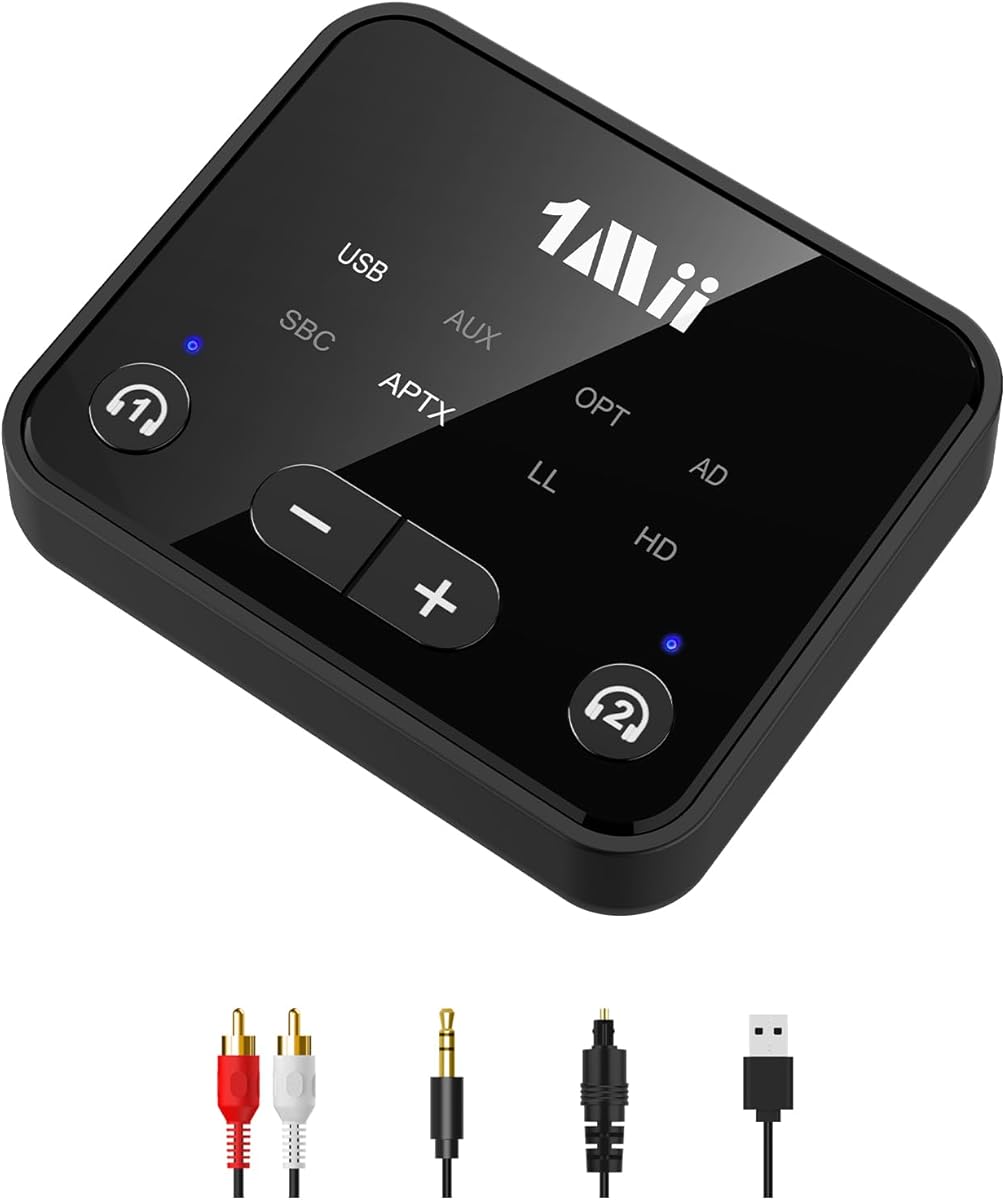


The 1Mii B06TX is a dedicated Bluetooth 5.3 transmitter designed to move television audio to up to two wireless headphones or speakers. Its 4.1 rating reflects a practical feature set rather than an elaborate receiver ecosystem. The standout combination is aptX Low Latency support, broad wired-input compatibility, and uncomplicated pairing controls.
We may earn a commission when you buy through this link, at no additional cost to you.
Its analog and digital inputs accommodate optical, coaxial, RCA, and 3.5mm outputs, making it suitable for newer televisions as well as older sets and related source components. Two dedicated pairing buttons allow two listeners to connect simultaneously. A dual-antenna design is intended to strengthen the signal, while aptX Low Latency helps reduce the familiar lip-sync problem when the receiving headphones also support that codec.
There is an important distinction between the transmitter's claimed low-latency feature and the experience of every pair of headphones. If the connected receiver does not support aptX Low Latency, some delay may remain. The unit is also a transmitter only, so buyers who want to add Bluetooth reception to a wired stereo will need a two-way model instead.
This is a strong choice for households that want two people to watch television privately without replacing a perfectly functional TV. It is especially appealing when low latency, broad input support, and straightforward dual pairing matter more than receiver functions or a built-in battery. For compatible aptX Low Latency headphones, it delivers a well-balanced package.
aptX Low Latency can keep speech closely aligned with visible dialogue, provided the headphones or speakers support the same codec. Check receiver compatibility before purchasing if synchronization is your main concern.
Optical, coaxial, RCA, and 3.5mm inputs mean the adapter can work with many television arrangements. Users of digital outputs may need to change the TV's audio-output setting as directed by the product instructions.
We may earn a commission when you buy through this link, at no additional cost to you.
The 1Mii Bluetooth 5.3 Transmitter Receiver is a compact two-way adapter for televisions, computers, airplane entertainment, and traditional audio systems. With a 4.0 rating, it offers a straightforward way to add wireless audio without limiting the purchase to one direction of transmission. aptX Low Latency support makes video and gaming a more compelling use case.
We may earn a commission when you buy through this link, at no additional cost to you.
In transmitter mode, the device can send 3.5mm AUX or RCA audio to Bluetooth headphones. Switching it into receiver mode turns wired speakers, a car stereo, or a home system into a Bluetooth target. The listed battery endurance is 18 hours in both operating modes, and the adapter's Bluetooth 5.3 implementation is backward compatible with older Bluetooth versions.
Its biggest limitation is the absence of optical or coaxial television connections. A television limited to digital audio may require another solution, and users should confirm that it has the necessary AUX, headphone, or RCA output. The 80% latency reduction is also codec-dependent; compatible receiving devices are required for the best synchronization.
Buyers who want one adapter for home and travel will find this model particularly versatile. It suits a user who occasionally watches TV privately but also wants to send phone music to an older stereo. For those with an accessible analog TV output, it offers useful flexibility in a small package.
The switchable design adds value beyond a single-purpose TV transmitter. It can serve as an airplane entertainment adapter during travel and become a Bluetooth receiver for an older wired sound system at home.
An 18-hour operating time in both transmitter and receiver modes is useful for long journeys. The compact two-way format is more relevant to frequent travelers than a permanently powered home-only adapter.
We may earn a commission when you buy through this link, at no additional cost to you.
The SOOMFON aptX-LL is a 4.4-rated Bluetooth 5.3 transmitter-receiver that combines a stated 40ms latency with a useful LCD display. That combination makes it one of the most approachable options for TV viewers who want visible connection feedback and two-headphone support without committing to a more specialized home audio adapter.
We may earn a commission when you buy through this link, at no additional cost to you.
Its strongest technical feature is aptX Low Latency, which can keep sound aligned with on-screen action when paired with compatible headphones or speakers. The display shows operating mode, pairing status, connected devices, and dual-paired equipment. In transmitter mode, two receivers can share the television signal; in receiver mode, two phones can be paired for convenient switching.
Several boundaries are worth noting. There is no microphone, so it is not suitable for phone calls. Individual volume adjustment is unavailable in dual-connection mode, only one connected source plays in receiver mode, PIN-protected devices are unsupported, and Dolby audio is excluded. It is also not recommended for musical instruments or professional audio work.
This is an excellent value-oriented pick for a traveler, apartment viewer, or family that wants two wireless headphones connected to a TV. The display reduces setup guesswork, while the compact USB-C rechargeable body suits airplane entertainment and other portable systems that expose a 3.5mm connection.
The LCD removes uncertainty by showing mode and connection status at a glance. That is particularly helpful when moving between television, airplane, and home-stereo applications with two-way operation.
A stated 23-hour transmitter battery supports long portable sessions, while dual pairing makes it possible for two people to watch a program on separate headphones.
We may earn a commission when you buy through this link, at no additional cost to you.
The 1Mii B03 is a 4.1-rated Bluetooth 5.3 adapter built for both television viewing and home-stereo upgrades. Its main appeal is codec breadth: aptX HD, aptX Adaptive, and aptX Low Latency are all supported, giving compatible receivers options for high-resolution sound or tighter audio-video synchronization.
We may earn a commission when you buy through this link, at no additional cost to you.
The B03 can operate as a transmitter or receiver, although not both simultaneously. It also offers a family-friendly bypass mode that sends audio to Bluetooth headphones and a wired TV soundbar at the same time. This lets one person raise the volume privately without forcing everyone else to listen at the same level.
Optical, RCA, and 3.5mm connections make it relevant to many TV and stereo arrangements. Its stated range reaches 164 feet outdoors and 82 feet indoors under suitable line-of-sight conditions, although walls, metal, Wi-Fi, and receiving hardware can change results. Connecting two aptX Low Latency headphones switches the codec to standard aptX for stability.
The B03 suits mixed households that need both shared TV sound and private headphone listening. It is less appropriate for someone who requires simultaneous transmitter and receiver operation, but for conventional use its codec selection, bypass function, and connection flexibility are difficult to overlook.
Supporting aptX HD, Adaptive, and Low Latency provides flexibility across different compatible headphones. The best result depends on the receiver's supported codec and the activity being viewed or played.
Bypass mode preserves the TV's wired output for the room while delivering a separate wireless feed to headphones. This is useful for viewers with different hearing or volume requirements.
We may earn a commission when you buy through this link, at no additional cost to you.
The 1Mii B03Pro+ is the premium-oriented selection in this guide, offering a rare combination of LDAC, aptX Low Latency, a readable display, and versatile transmitter-receiver operation. Its 4.1 rating does not reflect a lack of advanced features; it reflects a sophisticated device whose benefits depend heavily on the receiving equipment used with it.
We may earn a commission when you buy through this link, at no additional cost to you.
LDAC can transmit high-resolution wireless audio up to 24-bit/96kHz when paired with a compatible device. In transmitter mode, however, LDAC is supported with only one Bluetooth headphone or speaker. The unit also supports aptX Low Latency for synchronized video, bypass mode for simultaneous wireless headphones and a wired soundbar, and a display that makes device selection easier.
Low latency is never guaranteed by the transmitter alone. If the receiver lacks aptX Low Latency and uses SBC or standard aptX instead, the product information notes that audio delay may range from 70ms to 200ms. The optical connection may also require the TV's audio format to be set to PCM for proper operation.
This model is best for an enthusiast who already owns LDAC-capable headphones or speakers and wants one sophisticated adapter for television, music, and home-stereo use. It is less appealing when a basic transmitter is sufficient, but for compatible high-resolution equipment it offers a more ambitious listening experience.
LDAC support can preserve considerably more audio detail than basic Bluetooth transmission when the paired device also supports the codec. Single-device pairing is necessary to use LDAC in transmitter mode.
The display, volume controls, and bypass mode make the adapter easier to manage than a basic plug-in box. These conveniences are especially helpful when different household members use wireless and wired listening simultaneously.
We may earn a commission when you buy through this link, at no additional cost to you.
The 1Mii Bluetooth 5.3 Transmitter for TV to 2 Wireless Headphones/Speakers is a 4.2-rated dedicated adapter with an emphasis on clear controls and codec visibility. It supports aptX Adaptive, aptX Low Latency, and aptX HD, while a readable display helps users understand the active connection and codec status.
We may earn a commission when you buy through this link, at no additional cost to you.
Optical and AUX inputs cover many television configurations, and the product information cites compatibility with 99 percent of TVs when an appropriate output is available. Two pairing buttons support simultaneous headphones or speakers, while dedicated volume controls make output adjustment convenient when the television remote cannot control the connected source.
The stated open-area range is 100 feet, making it practical for movement around a home, though real results depend on the environment. When two aptX Low Latency or aptX HD receivers are connected, the codec changes to standard aptX. Mixed receiver codecs can lead to noticeable delay, so matching compatible devices is advisable.
Unlike many portable adapters, this unit has no built-in battery and needs a user-supplied 5V/1A USB power adapter. In exchange, it is designed for continuous home use. It is a good match for users who want easy visual feedback, broad codec support, and straightforward dual-headphone viewing.
The readable codec display reduces uncertainty about which mode is active. This is valuable when testing several headphone models or adjusting settings for movies and games.
Because the adapter operates from USB power, it can remain connected beside a television without battery-management concerns. A compatible 5V/1A power adapter must be supplied separately.
We may earn a commission when you buy through this link, at no additional cost to you.
The Bluetooth 6.0 Transmitter Receiver is the most modern specification in this comparison and earns the Editor's Choice for its combination of low-latency positioning, dual-device support, fast reconnection, and portable power. Its 5.0 rating is the highest listed, although real-world performance still depends on the connected headphones and television output.
We may earn a commission when you buy through this link, at no additional cost to you.
The Qualcomm Bluetooth 6.0 platform is presented as offering near-zero latency and stronger signal stability with two headphones connected. In TX mode, it supports AUX and RCA sources, including TVs, game consoles, portable players, and airplane entertainment. RX mode adds Bluetooth reception to wired car stereos and home speakers.
Dual-device mode is stated to support two headphones over a 40-foot range with 24-bit/96kHz audio and synchronized playback. The unit includes a dual-prong airplane headphone adapter, offers more than 24 hours of playback, and can recharge in about 1.5 hours through USB-C. Its protection features include voltage, overcurrent, short-circuit, and overheat safeguards.
This is an appealing choice for a traveler who wants one device for airplane screens and home television, particularly if modern Bluetooth hardware and quick reconnection matter more than optical input. Its shorter stated range and analog connections make it less ideal for large homes or TVs that expose only digital audio.
Automatic reconnection to the last paired device within five seconds reduces setup friction. That convenience is particularly valuable for airline entertainment or switching between a television and a portable audio source.
Dual-channel operation is designed to keep two headphones synchronized. It is a compact solution for travelers or couples who want shared listening without carrying two separate transmitters.
We may earn a commission when you buy through this link, at no additional cost to you.
The MEE audio Connect is a dedicated transmitter rated 4.2, built around Qualcomm aptX Low Latency and independent control of two wireless receivers. Its separate A and B pairing buttons simplify a shared-listening setup, while the included cables cover 3.5mm, RCA, and optical TOSLINK connections.
We may earn a commission when you buy through this link, at no additional cost to you.
The adapter can send high-definition stereo television sound to compatible Bluetooth headphones while reducing lip-sync delay when the receiving devices support aptX Low Latency. Each connected listener can adjust volume independently, making it practical for roommates, children using different sound levels, or two adults sharing a program.
The optical input does not convert Dolby Digital signals, so the television must be configured appropriately when using that connection. Its rechargeable battery allows cordless use, while the option to remain plugged in avoids repeated charging during extended home sessions. It also supports computers, set-top boxes, cable boxes, and other compatible sources.
This is a strong recommendation for a household that prioritizes independent dual-headphone control rather than receiver functionality. Its broad input selection, aptX Low Latency support, and ability to run continuously make it a focused and versatile solution for private television viewing.
Discrete A and B controls reduce the confusion associated with multi-device pairing. Each listener can also set a comfortable volume without changing the other listener's experience.
Support for analog, RCA, and optical inputs allows one adapter to serve many types of television and source equipment. The correct TV output setting remains essential for clean digital audio.
We may earn a commission when you buy through this link, at no additional cost to you.
The 1Mii B03Pro is a 4.2-rated transmitter-receiver that combines a SABRE digital-to-analog converter, three aptX codec options, and strong range claims. Its headline is audio refinement, with a stated 121dB signal-to-noise ratio and support for decoding lossless-quality files when the source and receiving device allow it.
We may earn a commission when you buy through this link, at no additional cost to you.
The adapter can stream from a television, DVD player, or other source to Bluetooth headphones or speakers. In receiver mode, it can receive music from a phone, tablet, or laptop for a wired stereo. Its bypass mode sends television audio to both Bluetooth headphones and a wired soundbar, while dual-link connectivity allows two wireless endpoints to connect simultaneously.
Class 1 Bluetooth technology and dual antennas support a claimed range of 265 feet outdoors and 80 to 110 feet indoors. Results vary with walls, metal, Wi-Fi conditions, and the receiving device. Connecting two aptX Low Latency headphones causes the codec to switch to standard aptX, and the unit cannot operate as transmitter and receiver at the same time.
This model is a strong fit for larger homes, dedicated home-audio setups, and listeners who care about signal conversion in addition to low-latency television audio. It is more elaborate than a basic TV-only adapter, so buyers should confirm that its range, codec selection, and bypass features solve a real need.
The SABRE DAC is intended to improve signal-to-noise performance and preserve detail in transmitted content. Its practical benefit is most relevant when connected to a good pair of headphones or a capable home stereo.
Dual antennas and Class 1 Bluetooth provide more theoretical reach than smaller adapters. Walls and interference remain important variables, so the stated outdoor and indoor figures should be treated as maximum-use scenarios.
We may earn a commission when you buy through this link, at no additional cost to you.
The Avantree Audikast Plus is a 4.2-rated Bluetooth 5.3 transmitter created for uncomplicated private television listening. It supports optical and 3.5mm AUX outputs, aptX Adaptive for compatible receivers, and simultaneous connection to two Bluetooth headphones for shared viewing.
We may earn a commission when you buy through this link, at no additional cost to you.
Built-in volume buttons are a particularly useful detail for televisions with fixed audio output or when the normal remote cannot adjust the source level. Dual Link allows two people to watch the same program on separate headphones, while the stated 100-foot range gives listeners room to move around an open home environment.
Its most important limitation is that it does not work with HDMI-only televisions because it relies on optical or AUX connections. RCA is not listed among its supported inputs either. The TV must also be changed to PCM when using optical output, and the headphones must first enter pairing mode for successful connection.
This is a sensible choice for a user with an optical- or AUX-equipped television who wants two-person listening without complicated receiver features. It is less versatile than the optical, RCA, and AUX models in this list, but its focused design, dual-link capability, and direct volume controls meet a clear need.
On-adapter volume buttons solve a common problem with fixed-output televisions. They also reduce the need to navigate television menus when changing listening levels.
Dual Link removes the need for two independent transmitters when watching together. Both receivers still need compatible Bluetooth support and an appropriate television connection.
We may earn a commission when you buy through this link, at no additional cost to you.
The right transmitter depends on your television outputs, headphone capabilities, viewing habits, and tolerance for different connection or battery compromises. These factors help separate a low-latency claim from the complete experience you will have at home or while traveling.
A transmitter can advertise aptX Low Latency, aptX Adaptive, aptX HD, LDAC, or another codec, but the connected headphones or speakers must support the same technology to obtain the intended result. This is the most important consideration for anyone whose priority is synchronized dialogue. A basic receiver may fall back to SBC or standard aptX and introduce a delay even when the transmitter itself supports a low-latency mode.
Match the codec first, then consider secondary features. Some devices prioritize aptX Low Latency for video, while others offer LDAC for higher-resolution music but may not deliver the same latency benefit. Check the headphone specifications before deciding which transmitter to buy.
Transmitters connect to televisions through analog or digital audio outputs, not through the HDMI connector itself. Common options include 3.5mm AUX, RCA left-right pairs, optical TOSLINK, and coaxial digital audio. A product that supports only one connection type may be unsuitable if your television offers only another type, so inspect the labels and ports before ordering.
For optical or coaxial connections, digital audio may need to be changed to PCM. Some products cannot convert Dolby Digital audio, and unsupported formats can result in silence. The most versatile adapters combine analog and digital inputs.
A transmitter-only adapter has one job: sending television or source audio to Bluetooth headphones. A transmitter-receiver can also receive phone or tablet music and send it to a wired stereo, car audio system, or home speakers. Two-way functionality is useful for travel and mixed entertainment setups, while dedicated transmitters generally provide a simpler experience for permanent TV installation.
Check whether the device can operate in both modes simultaneously. None of the listed products supports concurrent TX and RX operation. If your setup requires both directions at once, you will need two separate adapters.
Two-output adapters are useful for couples, families, or roommates watching television together. The number of pairing buttons is not the only consideration, however. Some products let each listener control volume independently, while others reduce codec performance when two advanced receivers are connected or do not provide per-device volume control.
For consistent performance, matching receiver models and compatible codecs are generally preferable. Check whether the product changes from aptX Low Latency to standard aptX in dual mode and whether shared volume or independent volume fits your household.
Advertised range is usually measured under favorable line-of-sight conditions. Walls, furniture, metal, Wi-Fi interference, and the receiving device's own antennas can reduce the practical distance. A stated range of 80 to 100 feet is ample for many apartments, while a longer 164- to 265-foot claim may matter in larger homes or outdoor listening.
Range should not be the only priority. A stable connection close to the television is more valuable than an exaggerated maximum distance that fails through walls. Consider where the receiver will normally be used and whether nearby obstructions are likely.
Rechargeable battery-powered transmitters are ideal for airplanes, gaming equipment, and other portable entertainment because they do not need a nearby outlet. Battery life varies, with listed endurance ranging from 18 to more than 24 hours. USB-C charging adds convenience where supported.
Home-only adapters that use external USB power can remain connected continuously and avoid battery degradation. This model often suits a transmitter that lives beside the television. Make sure you have an appropriate power adapter if the product does not include one or specify one.
Bypass mode allows the television audio to reach both Bluetooth headphones and a wired soundbar at the same time. One person can listen privately at a higher volume while others continue using the room speakers, making it particularly helpful for households with different hearing needs.
Bypass mode is not identical to ordinary dual Bluetooth pairing. It combines one wireless path with a wired path, allowing the television's normal speakers or soundbar to remain active. Verify the specific wired outputs supported by the adapter and confirm that your television setting does not mute the analog or optical feed.
Simple pairing buttons and automatic reconnection make a transmitter easier for children, older adults, or anyone who does not want to manage an app. A display can add valuable feedback by revealing the active mode, connected devices, codec, and battery state. Physical volume controls are particularly helpful when a television has fixed output or an inaccessible menu.
Do not pay for complexity you will not use. A basic adapter with dedicated pairing controls may be ideal for one pair of headphones, while an LCD or screen is more valuable for frequent mode changes, travel, and mixed-source use.
Begin by identifying the correct output on the television. Connect the transmitter using 3.5mm AUX, RCA, optical, or coaxial connections as appropriate. When using a digital output, check the television's sound menu and select PCM when required by the product instructions, then adjust the television volume to a suitable baseline.
Power the adapter and put the desired Bluetooth headphones or speakers into pairing mode. Use the dedicated pairing button or controls to connect each receiver, and confirm the active mode and codec on any display. Test a short video first to verify synchronization, then adjust listening volume on the headphones or the adapter's controls.
For long-term care, keep the adapter away from moisture, excessive heat, and obstructed ventilation. Rechargeable models should be recharged before extended travel, while plug-in models require a stable compatible power source. Periodically reconnect or re-pair headphones if firmware, television settings, or device connections have changed.
No. A transmitter that supports aptX Low Latency can substantially reduce delay, but the connected headphones must support the appropriate codec. If the receiver falls back to SBC or standard aptX, some delay may remain. Dual-device connections can also change the selected codec, so matching receivers is the best way to maintain consistent synchronization.
Usually not directly. Most transmitters use analog or digital audio outputs such as 3.5mm, RCA, optical TOSLINK, or coaxial, while HDMI carries video as well as audio. The Avantree Audikast Plus is explicitly limited in this way. Check the television's ports and specifications before purchasing, or investigate a separate HDMI audio extractor if no compatible output is available.
The television may be sending a format that the adapter cannot decode, such as Dolby Digital. Many models require the audio-output setting to be changed to PCM before using an optical or coaxial connection. Also confirm that the correct cable is inserted fully and that the transmitter is selected as the audio output device.
Yes, all ten products in this guide describe support for connecting two wireless headphones or speakers. However, dual operation may reduce the selected codec, and only some models allow independent volume adjustment. The SOOMFON, for example, does not support individual volume adjustment in dual-connection mode.
It depends on the intended use. A transmitter-receiver is more versatile because it can also receive phone or tablet music and pass it to a wired stereo or car system. A dedicated transmitter is usually simpler for someone who only wants private television audio and has no need to modernize a wired sound system.
For a typical living room or bedroom, a stable connection within a few rooms is usually sufficient. Maximum range claims assume open or line-of-sight conditions, and walls, metal furniture, Wi-Fi interference, and receiver antennas can reduce practical distance. Choose based on where the headphones will normally be used rather than selecting solely by the largest stated range.
A rechargeable model is more convenient for travel, airplane entertainment, and temporary use. A USB-powered home adapter can remain connected beside the television without regular charging. The 1Mii Bluetooth 5.3 transmitter without a battery requires a separate 5V/1A USB power adapter, while the listed portable models provide built-in batteries.
Yes, if the transmitter supports bypass mode or if the television continues to drive its wired speakers independently. Several 1Mii models support simultaneous wireless headphones and a wired soundbar. This setup lets one listener use a higher personal volume while others continue listening through the room's normal audio system.
The SOOMFON aptX-LL stands out as the best budget-oriented choice because it combines a stated 40ms latency, an LCD, dual pairing, and portable battery life. The Bluetooth 6.0 Transmitter Receiver is the Editor's Choice for modern wireless hardware, quick reconnection, and travel flexibility, while the 1Mii B03Pro+ takes the premium position with LDAC, aptX Low Latency, and bypass mode.
The most important buying priority is compatibility. Confirm that your television has a supported audio output, that the transmitter and headphones share an appropriate codec, and that the intended connection method matches your setup. Dual-headphone behavior, bypass mode, power requirements, and display controls should be secondary considerations once those essentials are in place.
Finally, check current prices, availability, included accessories, and manufacturer instructions before ordering, since these details can change over time. The right low latency Bluetooth transmitter for TV is the one that reaches your audio source cleanly, connects to your chosen headphones, and maintains synchronization under the conditions you will actually use.